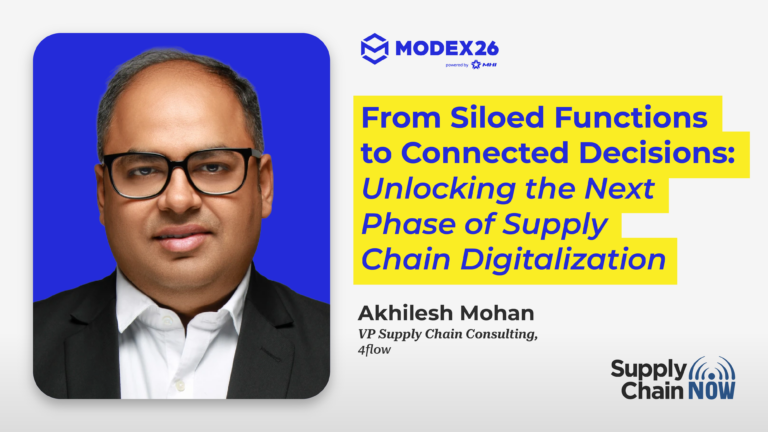
From Siloed Functions to Connected Decisions: Unlocking the Next Phase of Supply Chain Digitalization
In a recent conversation, 4flow’s Akhilesh Mohan joined Scott Luton with Supply Chain Now to explore a critical shift underway in global supply chains: the move from siloed functional optimization to truly connected decision-making. The discussion highlights a growing realization across the industry. As organizations continue to invest heavily in digital platforms, Mohan makes it clear: the next wave of value won’t come from adding more tools, but from aligning how decisions are made across the enterprise ensuring those decisions are connected end-to-end.
Beyond Systems: The Rise of Decision Integration
For years, companies have digitalized supply chains function by function: ERP systems, planning tools, warehouse management, transportation platforms. While necessary, these investments often created islands of capability rather than a cohesive whole.
Despite this investment of technology, Mohan says “in many organizations those capabilities still operate in silos ,” limiting the value companies hoped to achieve.
The result? Planning, logistics, manufacturing, and customer service frequently operate with different priorities and incomplete visibility. Mohan emphasizes that the real transformation lies in connecting these decisions: “It is less about having more systems and more about making those systems, processes, and teams work together.”
This is the shift from system integration to decision integration. And for many organizations, it requires rethinking how work actually gets done.
Why Now: The Pressure to Perform
So why is this shift happening now? According to Mohan, many organizations are asking a tough question after years of investment: why aren’t we seeing the expected outcomes? Mohan says a key culprit is decision-making.
“The technology exists, but the decisions are still fragmented,” he notes.
At the same time, the environment has changed. Disruptions move faster, customer expectations are higher, and cost pressures are relentless. Companies can no longer afford delays caused by disconnected decisions or prolonged handoffs between functions.
“This is why I see connected decision-making as the next phase,” Mohan states “It is about making digitalization operationally meaningful.”
Spotting the Symptoms of Siloed Operations
The signs of a disconnected supply chain are often hiding in plain sight. Mohan highlights several common indicators:
- Planning outputs that execution teams don’t trust
- Manual workarounds in warehouses and transportation
- Simultaneous inventory excess and shortages
- Repeated customer service issues
Perhaps most telling, Mohan shares: “Every function believes it is optimizing performance, but the enterprise is still struggling.”
That’s the hallmark of local optimization at the expense of end-to-end performance, and a signal that decisions are not aligned.
The Real Barriers: Process and Organization
Interestingly, Mohan doesn’t point to technology as the primary challenge. Instead, he highlights process design and organizational alignment as the real constraints to progress.
“Technology implementation alone does not eliminate functional silos,” he explains.
Programs are often scoped around systems rather than outcomes. Processes are designed within functions instead of across them. Decision rights remain unchanged, even as technology evolves. Add inconsistent data and weak change management, and even the best systems fall short.
“The challenge is rarely just system capability,” Mohan notes. “It is usually whether the organization has aligned process design, roles, governance, master data, and performance management.”
What Connected Decision-Making Looks Like
So what does “connected” actually mean in practice?
“It means the supply chain is operating from a shared view of priorities, constraints, and business objectives,” Mohan says.
In this model:
- Planning decisions reflect real-world constraints like capacity and logistics
- Execution feedback loops quickly inform upstream decisions
- Trade-offs between cost, service, and inventory are governed and transparent
- Decision rights and escalation paths are clearly defined
This is not just a technology shift. It’s an operating model transformation that changes how teams interact daily.
Logistics: Where Reality Meets the Plan
One of the most compelling insights from the discussion is the critical role of logistics.
“In fact, logistics is often where disconnected decisions become most visible,” Mohan explains.
A plan might look perfect on paper, but constraints in transportation or warehousing quickly expose gaps. That’s why logistics must move from being a downstream executor to an active participant in decision-making.
“Transportation, warehousing, deployment, and fulfillment… have to be part of the decision ecosystem.”
The Power of the Operating Model
Throughout the conversation, Mohan returns to one concept: the operating model as the backbone of connected decisions.
“Connected decisions require connected accountability,” he states.
A strong operating model defines who owns the decisions and how trade-offs are made. It will also determine how exceptions are handled and help to determine how teams collaborate across functions. Without it, even the best digital investments fall back into siloed behavior.
What Success Looks Like
When organizations get this right, the results are powerfully tangible and measurable.
“Success is when decisions become faster, better, and more synchronized,” Mohan says.
That translates into:
- More realistic plans
- Fewer manual interventions
- Better responsiveness to disruption
- Improved service and lower costs
Most importantly, Mohan says, “the organization starts to operate as one supply chain rather than as a collection of functions.”
Final Takeaway: The Next Frontier of Value
Mohan leaves listeners with a clear message:
“The next phase of supply chain digitalization is not about adding more tools. It is about enabling better decisions across the enterprise.”
For organizations that have already invested in digital platforms, the opportunity now is to connect the dots across planning, logistics, execution, data, and people. That’s where the next level of supply chain value will be created.
Where to Learn More
Connect with Akhilesh Mohan on LinkedIn. Learn more about how 4flow empowers end-to-end supply chain optimization with consulting, software and 4PL services by visiting their website: https://www.4flow.com/.
More Blogs
Why Your Supply Chain Team Spends More Time in Outlook Than Your ERP