[00:00:00] Noha Samara: AI is actually the highest funded supply chain initiative for 2024 and 2025, but organizations would never realize the ROI behind AI if they don’t have an enterprise wide strategy for deploying ai. You cannot pick AI use cases in silos, right? It has to be done with a, with a cross-functional view. You have to understand how is this going to.
[00:00:28] Noha Samara: Impact the different teams.
[00:00:31] Voiceover: Welcome to Supply Chain Now the number one voice of supply chain. Join us as we share critical news, key insights, and real supply chain leadership from across the globe, one conversation at a time.
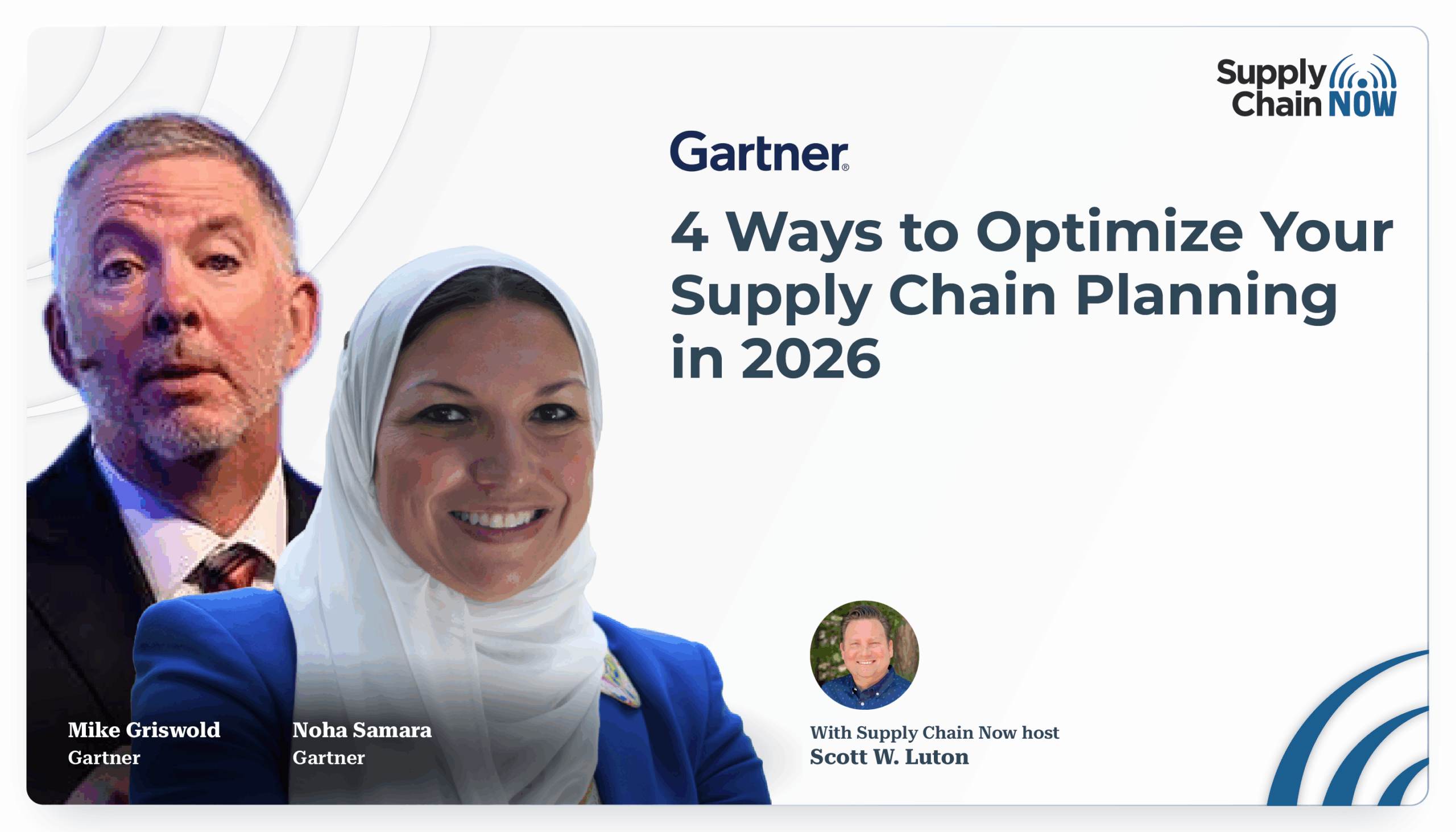
[00:00:44] Scott W. Luton: Hey, good morning, good afternoon, good evening, wherever you may be. Scott Luton and always special guest hosts, Mike Griswold here with you on supply Chain.
[00:00:52] Scott W. Luton: Now welcome to today’s show. Hey Mike. How you doing today? I’m doing very well, Scott, how are you? Great to be with you again, as always. Outstanding. Wait. We love these monthly conversations and it’s great to see you and we’re doing well here. I think it’s, it may be a smidge warmer here in Atlanta than it is where you are, Mike.
[00:01:11] Mike Griswold: Yes. Boise today will be low to mid forties. Oh man. So jealous. I dunno what that is in Celsius. It’s below 20 Celsius, I can tell you that. So thank.
[00:01:25] Scott W. Luton: Cool. It’s cool. It’s cool. Well, great to have you and hey, we’ve got a hot conversation though. Very hot conversation today. We continue on the longest running of this popular series, as y’all know, supply chain today and tomorrow with Mike Griswold with Garner.
[00:01:40] Scott W. Luton: Mike, of course, serves as vice President Analyst with Gartner, but we have a little twist on today’s series as we bring back one of our favorite guests of the year. Folks, you’re in for a treat. We’re gonna be walking through an intriguing discussion for best practices for optimizing your supply chain planning in 2026, I should say, our supply chain planning.
[00:02:01] Scott W. Luton: It’s very collaborative, folks, and Mike, we’ve been looking forward to this show. It should be a good one, huh?
[00:02:05] Mike Griswold: Oh yeah, I agree. Planning is a hot topic for us at Gartner. Noha is, um, you know, does a lot with our, our planning summit and to get her perspective on what is a relatively new event for us, uh, will be great.
[00:02:21] Mike Griswold: And, you know, lots of insights on the planning function, which is probably one of the more evolving functions within the supply chain.
[00:02:29] Scott W. Luton: Well said. That’s right. Evolving fast too. Almost as fast as the pace of global business, which is getting faster by the hour. But folks, stay tuned as we walk through. A very actionable and outstanding discussion here today.
[00:02:43] Scott W. Luton: So as Mike mentioned, Noha is back with us. I wanna introduce our guest here today. So Noha Samara is senior director in Gartner’s supply chain research and advisory group. Her current research area is focus on. Supply chain planning. She helps organizations with their supply chain planning, transformations, organization design and talent and supply chain planning process, maturity advancement.
[00:03:07] Scott W. Luton: Now, Noha is known, and you’ll see it here today for her thought provoking and inspirational keynotes and presentations. In fact, she dazzled. Yes, dazzled our Supply Chain Now audience earlier this year as she shared the immense value of decision shaping with Jake Barr and I. Noha also acts as a global conference chair of the popular Gartner Supply Chain Planning Summits, which Mike was just referencing.
[00:03:31] Scott W. Luton: Noha joined Gartner in 2020 after leading several supply chain teams at Procter and Gamble, Microsoft and HMD Global. So welcome in Noha, Samara Noha. How you doing?
[00:03:42] Noha Samara: I’m good. Thank you, Scott, for hosting me today. I’m really, really glad to, to share with you this episode.
[00:03:49] Scott W. Luton: We are too. We’re delighted. And, and Mike, it took us a little planning to bridge this very global conversation here today.
[00:03:56] Scott W. Luton: Huh, Mike?
[00:03:57] Mike Griswold: Certainly a lot of logistics involved multiple times, zones, and, uh, yeah. Getting everyone on the same page, but I think the audience will, uh, appreciate the fact that we’ve pulled this together. To talk about the planning
[00:04:11] Scott W. Luton: summit. That’s right. It’s all worth it. Uh, we even had to go through No, no.
[00:04:15] Scott W. Luton: Ha’s rock and roll agent because she’s on a world tour, folks. Uh, but hey, uh, I wanna start with a fun and warmup question, Noha and Mike. So today we’re recording this episode on November 20th, right? It’s hard to believe we’re at that point in the year, but it’s today. It’s Revolution Day in Mexico. It’s World Philosophy Day, it’s social enterprise day, and here’s where I wanna settle up on it’s Future Teachers of America Day.
[00:04:43] Scott W. Luton: So with that one in mind. I’d like to celebrate the teachers of our past because they’ve all had a tremendous impact on our journey. So, Noha, when you think about teachers and your education journey, what teacher or two made a big significant contribution to where you are today?
[00:05:02] Noha Samara: I still remember my math teacher back in grade eight because I, I think, you know, the, the way she was teaching, the way she was explaining the concepts.
[00:05:14] Noha Samara: Made me fall in love with math and I joined like engineer, like I studied engineering afterwards because I fell in love in with math and, and it’s somehow because of her, because of her approach, because of her teaching style. So, yeah.
[00:05:31] Scott W. Luton: That is outstanding. Uh, Noha, I needed your teacher for math. Uh, no, I’m just kidding.
[00:05:37] Scott W. Luton: That’s a great, only kidding. Uh, Mike, how about you? What teachers come to mind?
[00:05:42] Mike Griswold: Yeah, I, math was never one of my favorite subjects. So the fact that No, how she, she, uh, hooked you on math is, is fantastic. I’m gonna go, actually, my dad, he was a high school history teacher. I grew up in a small town, small school.
[00:05:58] Mike Griswold: He had myself and all my brothers. He taught, uh, for the longest time European history and as a sophomore in high school. The last thing you really wanna hear about are, you know, the kings and queens of, of Europe. But he managed to make it interesting. He managed to make it something that you at least didn’t dread going to class.
[00:06:21] Mike Griswold: And now as an adult, that’s probably where, if I were reflect, that’s probably where I got my interest in history, particularly European history was, was from that. And I’ve been fortunate enough to make a couple of trips to Europe and. I wish I had paid closer attention in class so that I could, uh, you know, recall some of the, uh, the things that I learned about Europe, you know, back when I was a sophomore in high school.
[00:06:46] Mike Griswold: But I think Scott and Noha, how is a, is a, her story is a great example of that. The power that teachers have with the young people in terms of potentially shaping, you know, not, maybe, not necessarily the rest of their lives, but certainly shaping. The interest that they have and how that affects them moving forward.
[00:07:07] Mike Griswold: Right. The, the story of, you know, the math teacher Noha and how she got you excited about math and, and pointed you in a direction is one of the things I think teachers are able to do for their students.
[00:07:21] Scott W. Luton: So true. Well said, Mike and I, and I was stitching that together, connecting the dots with your father’s love for not only understanding history, but teaching history.
[00:07:32] Scott W. Luton: Now I know he comes full circle. Why you’re such a history buff and a military history buff as well. Mike, that is terrific and I’ve just gotta share Noha and Mike. I had so many, I was blessed with so many great teachers in all grades in college and everything. But Ms. Gloria Marks was my third grade English teacher, and she was a throwback, right?
[00:07:53] Scott W. Luton: She kept a lot of discipline in the, in the classroom, right? But it was worth it because she was the best storyteller and she had these piercing blue eyes that I’ll never forget as she told stories of her upbringing of Greek and Roman mythology of all kinds of stories, and it certainly shaped. My journey too.
[00:08:12] Scott W. Luton: So again, Noha, I gotta circle back and, and maybe get some math tips from you.
[00:08:20] Scott W. Luton: We’ll save that down down the road. But, um, but Noha all that aside, great to have you back on the show. Now I referenced, um. Jake and I got a lot of feedback around your earlier appearance this year that really focused on decision shaping. We’re gonna talk about something a little bit different here today, but I wanna start with this.
[00:08:36] Scott W. Luton: Let’s level set a bit. Could you share a few aspects of your professional journey so folks kind of better understand your point of view?
[00:08:45] Noha Samara: I actually started in manufacturing, right? So I didn’t start directly in supply chain. I started as a process engineer with P&G. So I worked for three years on in operations, on the lines, and then I was obviously complaining a lot about like how those planning people or planning for our lines.
[00:09:05] Noha Samara: So my next assignment was directly to manage the planning department for the site I was in. And it’s funny because like when you take a different role, you broaden up your point of view, you start seeing things from a different angle, and this is how my career journey started with supply chain. I fell in love with supply chain.
[00:09:25] Noha Samara: I took afterwards several roles with logistics initiatives, planning initiatives is the new product, introductions, and then move more into regional and global roles. I worked with different categories at P&G and again, like it’s, it’s interesting when you see like supply chain of like, you know, different types of, or different parts of the business.
[00:09:48] Noha Samara: Again, supply chain, in its core, there are common fundamentals that apply to the different. Products you’re producing or different categories, but again, you have to adapt sometimes to the specifics. And then afterwards I shifted Gears Shifted Industry, and I joined Microsoft Devices. It’s a totally different dynamics if you think of it, but again, like you know, working in different companies and working with different industries makes your point of view.
[00:10:19] Noha Samara: Very much broadened you. You start thinking of things from a different perspective. And when I joined Gord in 2020, so I was very much focused on planning. That’s my passion. But I’m, I’m, I’m helping clients cross industries. So I get again to see like, you know, the dynamics of the different industries and, and how like the planning fundamentals are definitely the same, but there are.
[00:10:43] Noha Samara: Specifics, I would say that has to be accommodated.
[00:10:48] Scott W. Luton: Noha, uh, you made so many great points there. In particular, uh, as you are introduced to new sectors, new organizations, uh, that is so valuable perspective. And in my experience, you start to see the common threads. You know, every sector will say, Hey, but, but we’re different, but we’re different.
[00:11:05] Scott W. Luton: There are some nuances for sure. Right? No doubt. But there’s some very strong common threads, especially in how supply chain is done around the world and across industries, in my perspective. Mike, what’d you hear there from Noha’s, uh, journey.
[00:11:18] Mike Griswold: Yeah. I think it’s, it’s, it’s one of those things, Scott, you and I have talked about this before, and, and I’ll certainly, you know, date myself.
[00:11:24] Mike Griswold: The, the days of people kind of staying one place for 30 years, right. And getting the gold watch. Those days are over. I think that there were. Probably benefits at the time, right? Of people’s having that longevity in a single place. But I think in today’s environment, both just the way the newer generations are wired to, they’re wired to get different experiences.
[00:11:50] Mike Griswold: And I think you’re exactly right. There is a, a common theme, right? When you think about the role that Noha has, right? At the end of the day, we’re just trying to match demand and supply, right? And whether you’re trying to do that. In a heavy industrial organization, or whether you’re trying to do that in a high tech company, or whether you’re trying to do that in a life sciences company, those different experiences that you gather, I think allow you to bring different insights into things that are relatively common across industries like matching demand and supply, like the S&OP process, right?
[00:12:26] Mike Griswold: So I think we’re in an environment now where people are going to have lots of different experiences like Noha described. And I think the leading organizations have figured out how do we bring in people into our organizations with those different perspectives that are gonna create value for us, right?
[00:12:46] Mike Griswold: And not see those people with different experiences as necessarily a liability because they’ve hopped around, right? They’ve got these unique experiences and different perspectives that they can bring to our organization.
[00:13:01] Scott W. Luton: Hmm. Well said, Mike. Well said. I’ll tell you what, Noha and Mike, who knows, at some point down down the road at the core of what Mike just shared, matching demand and supply, there may be just a button, A button we can press that says Match demand and supply.
[00:13:18] Scott W. Luton: Who knows? Of course. I’m kidding. Alright, so Noha, one other thing I wanna ask you about as we kind of level set. You’ve served as global conference chair for the Supply Chain Planning Summit for almost a year now, and I know this is one of your passions. And you’re so great at it. We were able to connect at a different Gartner event earlier this year, and Noha, the passion was exuding from your eyes.
[00:13:39] Scott W. Luton: I mean, you were in your element, but 2025, I tell you. I’m looking forward to attending the planning summit in Denver coming up soon. ’cause 2025 has been an interesting year. We’ve had a lot more of the same that, that you find in every year. Right. But we’ve had some differences and, and some nuances when it comes to challenges for supply chain planners everywhere.
[00:14:00] Scott W. Luton: Your thoughts, Noha?
[00:14:02] Noha Samara: I fully agree. I mean, if you think of it would’ve been in continuous waves of destructions for quite few years, however. 2025 specifically started with somehow a higher level of volatility and a higher level of risk with a ton of situation with a heightened geopolitical tensions. In fact, according to our latest research, these geopolitical risks for this year are actually negatively impacting supply.
[00:14:30] Noha Samara: On its cost to serve. 64% of supply chain leaders are seeing these negative impacts of the geopolitical risks. Yet at the same time, guess what, like, you know, the, the growth ambitions of the CEOs are still there, right? So they are, despite all of these disruptions, growth remains to be the number one priority for, for CEOs, and they are expecting supply chain to help them deliver across different fronts.
[00:14:56] Noha Samara: Like, you know, driving the cost, the cash, the service, and the inventory, uh, targets. Also, another thing, you know, that I have seen this year, there is a bigger and a higher appetite to really pilot and implement AI and to invest more in ai, which again, right, puts a big mandate on supply chain leaders to realize the ROI behind these big investments.
[00:15:22] Noha Samara: So. What I’m trying to say here, it has been obviously a busy year, a year full of different levels of volatility, complexity, and different pressures on supply chain leaders.
[00:15:36] Scott W. Luton: Hmm. Noha, a lot to dissect in that response there, Mike, what, uh, what stood out the most to you?
[00:15:43] Mike Griswold: Definitely, uh, the, I’ll echo Noha’s perspective on disruption.
[00:15:47] Mike Griswold: Yeah. I think when you look at some of our research, what it tells us is. The supply chain has, has gotten really good, if you go back, even to COVID, right, to, to figuring out how to work in disruptions. But disruptions and, and even COVID was a single disruption that lasted a while. What we’re seeing now is not only disruptions that last a while, but we’re seeing more frequent disruptions.
[00:16:14] Mike Griswold: So during COVID you had, you know, maybe one which was COVID. Now Noha just mentioned a couple already, right? Tariffs. Geopolitical stuff. You know, the US administration things, there’s just multiple disruptions that the supply chain is now being asked to deal with. And oh, by the way, we need you to keep the lights on and we need you to support growth.
[00:16:35] Mike Griswold: So the list of things to do in a highly disruptive and a highly fluctuating environment is the challenge that supply chains are facing now. And if that wasn’t enough, what Noha mentioned around ai, right. You know, the, the AI is, is across broader Gartner, the hottest topic. It’s an incredibly hot topic with us in the supply chain.
[00:17:01] Mike Griswold: And it’s one of those things where, you know, people don’t know what they don’t know, but what they think they know is we need ai. And you know, they, to your earlier comment before we came online. Around different parts of the organization and we’ll circle back to that, but there’s just, you know, it’s a gross oversimplification, but there’s a lot going on in the supply chain all at the same time.
[00:17:24] Mike Griswold: Right. And, and we’re being asked to manage that. Yes. And I would say for the most part, companies are, are managing that, right? Mm-hmm. But it’s, it has not been easy. And I think, you know, knowhow would probably agree. It doesn’t look like it’s gonna get any easier in the foreseeable future.
[00:17:42] Scott W. Luton: Which is all more, the more, the more reason why we gotta get outside of our four proverbial walls and compare notes with fellow supply chain practitioners at the planning summits or at other events out there is absolutely critical.
[00:17:56] Scott W. Luton: We’re gonna touch on all that in a second too. Noha and Mike, I wanna get into the center plate. Of our discussion here today, the four best practices for optimizing your supply chain planning in 2026, our supply chain planning in 2026. Noha, we’ve got some good stuff here. I wanna start with the first one.
[00:18:14] Scott W. Luton: Where would you start in terms of how we’re advising folks out there? Tremendous opportunities for improvement.
[00:18:21] Noha Samara: I’d always start with strategy, right? So driving stronger alignment between the supply chain planning strategy and the corporate objectives is key. Because if you think of supply chain planning, supply chain planning is the core of decision making within the organization.
[00:18:37] Noha Samara: In whatever strategy that you’re setting for your supply chain organization, it has to have full alignment with those bigger objectives that you want to. Try to drive, right? Otherwise, there would be like, we would be talking about functional silos here. If supply chain planning is just looking at, you know, the day-to-day activities and forgetting about those bigger corporate objectives that are expected to be delivered.
[00:19:04] Scott W. Luton: So, Mike, when it comes to, you know, aligning those strategy and what, what’d you hear there from Noha, Mike?
[00:19:09] Mike Griswold: Yeah, it’s, it’s one of the biggest things I think that we talk to companies about it, and I’m going to give us a very quick. Kind of a, a US American sports analogy, right? We think about, you know, pretty much any sport you need to adopt a strategy that aligns with the personnel that you have, right?
[00:19:30] Mike Griswold: So if I’m a, an American football team and I wanna run the football, then I need to invest in an offensive line, right? Right. If I wanna be a more of a passing team, I need to invest in the skill positions. And it’s the same with the supply chain, right? You need to decide what type of supply chain you wanna have and that needs to align with, with the corporate goals.
[00:19:53] Mike Griswold: And I think one of the biggest challenges that we talk to companies about, and I know knowhow does, is around that alignment, right? Asking that question, you know, what is the mission of your business, right? Why are you in business? And then what type of supply chain do you need to have in order to do that?
[00:20:14] Mike Griswold: And then it fundamentally comes back to what’s near and dear to Noha is, is how does the planning organization fit within that? Yeah, right. From a people process and technology perspective, how do you get all of those aligned? And where we see companies struggle the most is when that is misaligned. When you have.
[00:20:36] Mike Griswold: A vision around, this is the type of organization I wanna be, and these are the goods and services I wanna provide. Yet you have, let’s say, a very narrow definition of your supply chain, just as one example, right? Those types of disconnects. I mean, frankly, selfishly, in some ways it’s good for us because people wanna talk to us about it.
[00:20:58] Mike Griswold: But in general, right? It can be fairly frustrating as an organization when you can see those disconnects.
[00:21:05] Scott W. Luton: That’s right. And, and as we all know, supply chain pros work best when we know what we’re trying to do. Right. Right. We know what success looks like. Right. And that’s a big part of that alignment. Noha, I wanna ask you about something.
[00:21:17] Scott W. Luton: When I think of alignment, I think of one of my favorite topics that, that Mike and I and many others have talked about, silo busting. Right. And I think we’ve made a, a lot of progress in some, in some ways of, of breaking down silos. But in a weird counterintuitive sense, we’ve also. I’ve gotten good at building new silos, oftentimes unintentional here in the golden age of supply chain tech, and along those lines Noha.
[00:21:43] Scott W. Luton: One theme in my conversations and visits and observations that I’ve kind of noticed is you got teams, some teams within larger organizations or in smaller organizations even embracing ai, adopting AI, and moving fast. Right, and effectively with AI driven tools, platforms, and approaches, and then you got other pockets, other teams that are really late to embrace the AI movement and maybe they’re relying more on tribal knowledge and manual analysis and spreadsheets.
[00:22:12] Scott W. Luton: It sounds like my Saturday morning. That’s a big gap there that we’ve got the bridge. Especially I would argue with the larger organizations. Do you see the same thing, Noha?
[00:22:23] Noha Samara: I do and there is a big hype around ai, right? We, we see that all the time. I mean, it’s worth mentioning AI is actually the highest funded supply chain initiative for 2024 and 2025 to think of it, right?
[00:22:37] Noha Samara: But organizations would never realize the ROI behind ai, if they don’t have an enterprise wide strategy for deploying ai. You cannot pick. AI use cases in silos, right? It, it has to fit the bigger purpose and of the organization. It has to be done with a cross-functional view. You, you have to understand how is this going to impact the different teams?
[00:23:06] Noha Samara: One of the common, interestingly enough that you mentioned themes in reflections that we have seen from the top 25 supply chain organizations is how they deploy big AI initiatives. Within them, right? So in a way they involve the, like, you know, a cross-functional team when they are picking the AI use cases across the organization because you cannot be working on AI initiatives in silos.
[00:23:35] Noha Samara: And that obviously applies to like, you know, enterprise wide initiatives, not just AI initiatives. I mean breaking, breaking silos within the organization. It should be a key focus. Right? And specifically, again, for planning, right? Because the planning function is a function that deals with different cross-functional and stakeholders.
[00:23:56] Noha Samara: The yes and op process, for example, is a business planning process. It involves all the different teams. So if your initiatives including AI initiatives are not considering, you know, uh, or not having that bigger view of. Uh, the, the organization, they would never work,
[00:24:16] Scott W. Luton: right? Uh, and if they don’t work, that poses all sorts of risks to organizations, including lots of burnout.
[00:24:24] Scott W. Luton: When folks don’t understand what we’re trying to do, and they’re folks are throwing tools over the, uh, over the fence, they do something with it, man, that if that does not work. Well, Mike, we’re gonna circle back on ai, I think in this, these four best practices for optimizing and supply chain planning. But your quick comment, Mike, what we heard there from Noha.
[00:24:42] Mike Griswold: Yeah, it definitely should be viewed as a cross-functional exercise, and I think it, it, it speaks to organizations that I think are managing this well, have created a relationship between the CSCO and the CIO. So the chief chief Supply chain Officer and the chief information officer, right, the, the, the guy that or gal that is, is deciding on the technology strategy.
[00:25:06] Mike Griswold: Those two need to be much more closely aligned than maybe we’ve seen in the past, because what we’re seeing is, is the cross-functional impact of ai, right? It may have started as an IT thing, but I think as, as Noha alluded to, when you start looking at the use cases. The use cases span the organization and, and the CSEO needs to find a way to be connected with that CIO so they can be in, in partnership, understanding the ramifications of this across the organization.
[00:25:40] Scott W. Luton: Well said, Mike. Again, we’re gonna circle back to AI because as, as we’re all know, and all the folks out there watching or listening to us. It’s required to be in every single supply chain conversation these days for good reason. Okay, so Noha, let’s talk about the second best practice for optimizing supply chain planning in 2026.
[00:25:59] Scott W. Luton: It’s all, it’s all about ecosystems. Tell us more.
[00:26:03] Noha Samara: So, I mean, the concept generally the concept of collaborative planning, forecasting, and replenishment with key trading partners, like suppliers and customers is actually not new, right? But the ecosystem is obviously broader than that. So we’re talking broader than your direct customers, your direct suppliers.
[00:26:23] Noha Samara: We’re talking about tier two and tier three suppliers. It’s the collaboration across the ecosystem. And if you think of it. It creates that end-to-end visibility. It helps you have the right data sets. It enables you to have the right level of decisions. When we talk about building the ecosystem partnerships, it goes obviously, again beyond visibility, so it’s, it’s really also about looking at initiatives or projects that could help you across the ecosystem, directly collaborating with your.
[00:26:57] Noha Samara: Key suppliers and key customers is not a new concept, and CPFR has been there probably for 40 years, and it’s very much known specifically for CPG organizations. But what we see now more evident is that the concept is obviously broader than directly your direct customers and suppliers. And it’s also not just for CPG organizations, it could be applied to different industries.
[00:27:22] Noha Samara: If you think of the benefits of collaborating across the ecosystem.
[00:27:26] Scott W. Luton: Yes, and you know, however you do it. Building trust across these ecosystems is a proven way of optimizing resilience. And gosh, if 2025 has taught us anything, we’re not quite as resilient as we’d like to be. Mike, what’d you hear there?
[00:27:42] Scott W. Luton: From Noha?
[00:27:43] Mike Griswold: Yeah, I think the, the ecosystem one is, is a really interesting one, and it has gotten a lot of traction within our clients and our research at Gartner. I think. For me personally, this discussion really started to emerge during COVID when people really started to look at their supplier base and found out that I have some tier two and and tier three suppliers that make like this really, really important widget that if they do not survive c.
[00:28:11] Mike Griswold: And I can’t get this little widget, then the bigger portfolio products is gonna really struggle. And it was, knowhow used a great word, which is visibility. I think during COVI. It provided us visibility into tier two, into tier three, and it highlighted the importance of them within the ecosystem. Right?
[00:28:32] Mike Griswold: And I think for many organizations it changed that dynamic. It became for some tier two and tier three. It became much less of a transactional relationship and much more of a, you know, two-sided value equation that maybe we would not have seen had we not had to do that deep dive into our, our other suppliers.
[00:28:56] Mike Griswold: And the other point I think, which is a really good one is, is yes, we, we, as we associated CPFR, with CPG companies, and if I wasn’t one of those. There was really no value in me trying to understand how to better collaborate. Right. And I think what our research has shown and what Noha pointed out is the value of the ecosystem, almost regardless of industry, that there is value in understanding the scope of your partnerships.
[00:29:25] Mike Griswold: You mentioned trust, right? Is really that that is one of the fundamental components. Of a well-functioning e ecosystem is this, this reliance on each other and establishing that trust within the ecosystem.
[00:29:42] Noha Samara: In essence, it’s joint value creation as well, right? Because it’s, it wouldn’t work without having a win-win proposition there.
[00:29:51] Noha Samara: Um, and yeah, so fully agree with Mike.
[00:29:55] Scott W. Luton: Yeah. Yeah, great point, Noha. Because you’re not gonna create much trust if it’s a one-sided relationship. Right. It’s not gonna work. But by the way, both of y’all alluded to an acronym that I wanna make sure our audience out there is with us, uh, ’cause we love our acronyms in the global supply chain, CPFR, collaborative Planning, forecasting, and Replenishment.
[00:30:15] Scott W. Luton: I had to look that up just to make sure I got it right. I’ve used that a couple times. It too. CPFR. So folks, check it out. It’s a great framework or strategy. Closed loop. That you can make some big gains. And as Noha and Mike both have alluded to, it’s not just for CPG. Right. And I love how we’re applying old and new tools and getting outside of, of some of the core sectors that, that they may be well known for.
[00:30:37] Scott W. Luton: Okay. Let’s move to number three. We’re gonna revisit AI and, and Noha, you’re really gonna talk about amongst other things, how important it is to really define a deliberate role for ai. Is that right?
[00:30:50] Noha Samara: Yeah, it’s, that’s absolutely right. And specifically, you know, again, like latest research shows that for planning supply chain professionals believe that the ROI that could like that, that, uh, that AI can bring in planning is really high.
[00:31:05] Noha Samara: Like planning is the biggest area where we can see ROI behind the AI investments. That’s by the way, what supply chain professionals believe in. However, in reality, when we talk to organizations, they might not be seeing the ROI really materializing as such as the expectations. And big part of it is not having a very clear strategy on, on your ai.
[00:31:32] Noha Samara: I mean, it’s a big myth when you want to have AI everywhere. You shouldn’t, right? It’s a matter of picking. The right use cases. It’s a matter of being data ready. It’s a matter of being skills ready. Like your team, they, they also have to be skills ready. It’s also a, a matter of having the right culture for ai, right?
[00:31:54] Noha Samara: I mean, we always talk about the technology aspect and the investment that we’re putting behind ai, but we sometimes overlook. The readiness from a change perspective and from a culture perspective for ai, AI wouldn’t work if you are not also adjusting your workflows and your processes. So there is a lot of reasons why ROI behind AI is, is not as we expect or as we are positively thinking about it, but AI is.
[00:32:27] Noha Samara: Like it’s a, it’s a great tool and we have like, and with all the investment, as I said, like, you know, it is the biggest supply chain funded initiative for 2024 and 2025. So it is a mandate that supply chain leaders and supply chain planning leaders get the right level of ROI. Behind it, there is a lot of things to think about aside from just.
[00:32:50] Noha Samara: Like, you know, getting that signed or commitment on investing on ai, there is a lot of other elements that you have to think when you’re trying to be ready for ai.
[00:33:01] Scott W. Luton: Yes. You know, Noha, there’s a tremendous opportunity, right? But that word you chose to use there, deliberate. It is so important to know what we’re trying to do, to really put don’t mail in the use case.
[00:33:16] Scott W. Luton: Right? It’s really important that we carefully construct that and it’s tied to reality and we communicate the what’s in it for me or, or even the why we’re doing this. To the organization and that’s just there. There’s a lot more you shared there, but those were some things that stuck out to me. Mike, what’d you hear from Noha?
[00:33:35] Mike Griswold: Yeah, I think AI is, is similar to some other things we’ve seen over the course of supply chain technology history, but it’s the one that probably has the greatest opportunity. To kind of do good and kind of the greatest opportunity to do bad, right? What Noha has described in what we, we try to get clients not to do is to have AI running around your organization trying to find a problem to solve, whether it’s AI or whether it’s any other technology, right?
[00:34:09] Mike Griswold: If you have not determined what problem am I trying to solve, right? And does AI solve that problem, you know, in this discussion. Right. If you have not gone through that exercise, then you’re going to struggle, right? There’s the old analogy, right? If you have a hammer, every problem looks like a nail, right?
[00:34:29] Mike Griswold: And when you have ai, right? There is this temptation to try to solve every problem with ai. And when Noha articulated very well, and what our research tells us is it is about the use cases. Right, and it’s understanding that not all use cases are created equally, right? Depending on where you are from the supply chain maturity perspective, right?
[00:34:55] Mike Griswold: If you are a relatively immature, or have a relatively immature planning organization, then AI and planning might produce for you a significant ROI if you’re already pretty good at planning. Then the ROI in planning may not be as great as say that’s something you might be able to do in procurement or sourcing.
[00:35:19] Mike Griswold: So it really comes down, I think, to a couple things. One, identifying the use cases, which I do think we’re getting better at as a supply chain, understanding specifically what problems lend itself to ai. But I think organizations also have to have. A bit of self-reflection and really understand where does their maturity lie in different key supply chain functions.
[00:35:46] Mike Griswold: Think about plan, source, make, deliver, customer service. Very simple areas, right? What’s my maturity level in each of those areas, and does AI lend itself to, to raising my maturity and where can I get the most value? I think Nohow would agree. Wh where we see this go wrong and in many instances horribly wrong, is we just bring AI in and then we kind of generically peanut butter spread it across the organization and then we cross our fingers and yeah, I think I’ve heard a lot of people reference hope is not a strategy, so we,
[00:36:22] Scott W. Luton: we need to plan, we need to plan.
[00:36:24] Scott W. Luton: That’s exactly where my brain went. And also, as you shared earlier, Mike, uh, you kind of put it, um, you know, AI is terrific. It can be good, it can be powerful, but also can be really bad. One more thing, uh, before we move on to the fourth one. I think I mentioned use case instead of business case. Earlier as I was trying to summarize what I heard from Noha and I meant business case, constructing the business case and what we’re trying to do and what does success look like, what the specific AI strategy and the, the specific AI tools that we’re using.
[00:36:54] Scott W. Luton: Okay, so Noha and folks, by the way, if y’all love this discussion, you gotta be at the. Uh, supply Chain Planning summit. We’re gonna touch on that in just a minute. Um, we’re up to number four. So Noha the grand finale when it comes to best practices for optimizing supply chain planning in 2026. And this might be my favorite one.
[00:37:14] Scott W. Luton: I loved all three, but this might be my favorite one. Tell us more.
[00:37:17] Noha Samara: It’s obviously about our people, right? So we can’t be thinking of all those different strategies without thinking of our people and how we’re evolving. The roles of our people, how are we evolving their skills? And again, because of all those different factors that we talked about, about ai, about frequent disruptions, about like, you know, the challenging environment that we are planning in.
[00:37:41] Noha Samara: I mean, that requires that we rethink the skills of our teams. We rethink the roles. Again, like part of the AI strategy should be thinking of. Okay with ai, if I’m going to pick that use case, what does that mean for my people? What does that mean for the day-to-day activities? Which decisions am I going to automate and which decisions I still would need the judgment of the planners to move forward with them?
[00:38:11] Noha Samara: So you cannot think of improvements in supply chain and in supply chain planning without thinking of how you should evolve your team. Earlier, if you remember in the, in the episode we did earlier this year, we talked about the evolution of the role of planning into decision shakers, right? And this is a, a critical evolution that has to happen because if you think of, again, planning, planning sits in the middle of the.
[00:38:41] Noha Samara: Cross-functionality. They try to influence and drive decisions within all the different forums that they orchestrate and manage. And if, if we always think of our planning teams as those people who are just executing and developing supply and demand plans. We’re just honestly missing the point on, on the real role of, of planning and the real role where planning should play.
[00:39:07] Noha Samara: So again, as we are investing in technology, as we’re investing in our, in improving our processes and rethinking about all the three previous strategies we talked about, we have to bring people with us along that journey, right? You can be doing all this without thinking. Okay, how am I going to develop the people?
[00:39:28] Noha Samara: What are the new skills that I need for my people to help them, you know, face all this new environment to help them maybe leverage these new technologies that I’m implementing and so on. So the people element is the heart of the transformation of any transformation.
[00:39:46] Scott W. Luton: Well said Noha. I completely agree.
[00:39:48] Scott W. Luton: And you know what? If you don’t do it with your people instead of to your people, there’s lots of risks there, but one of them on the short list. Is it really impact adoption? And gosh, if you put all the work into building the direction or bringing on technology or whatever, and no one uses it, man, that’s gotta be one of the ultimate wastes.
[00:40:09] Scott W. Luton: But, uh, Mike, what’d you hear there from Noha?
[00:40:11] Mike Griswold: Yeah, it’s, it’s definitely the people play the key role in, in the success of, of all the things that that Noha described. You know, we have across bar, uh, broader Gartner, and they, they’ve been talking about this through their IT symposium, these ideas of predicts, right?
[00:40:30] Mike Griswold: What, what do we think is gonna happen? And, and one of the predicts that is directly aligned to AI and directly aligned to people is there is a real risk that there are certain. Let’s call them softer skills, critical thinking. Those types of skills that we’ve potentially run the risk of losing if we don’t focus on those skills.
[00:40:53] Mike Griswold: In addition to the skills we need to have, uh, around ai, one of the people on my team has written a note on, on upskilling within AI that has been incredibly popular with our clients in terms of understanding. In this new environment, what are the skills that I need to ensure my associates, my, my teams have, and it is a mix of technical skills and let’s call them people skills, right?
[00:41:22] Mike Griswold: The ability to collaborate, the ability to continue to have critical thinking. It is so easy and so tempting to type stuff into your Gen AI tool of choice. And basically absolve yourself of any critical thinking, right? And just take whatever the tool spits back to you as the solution to what are, whatever you’ve asked it to do.
[00:41:45] Mike Griswold: And, and Noha correctly pointed out, leading organizations are figuring out, you know, what does that intersection of, of people in AI look like? And it, it’s, I would say, a, a huge opportunity area for many organizations. Is to figure that out. But if you, if you don’t involve the people in this, it will be very difficult for organizations to succeed.
[00:42:10] Mike Griswold: And that that’s what our research is telling us is we, we need to get the people involved. We need to understand the magnitude of change. We need to help organizations navigate that change. And it will be critical to the success of these AI initiatives that Noha. Correctly pointed out is a significant investment area over the next several years.
[00:42:34] Scott W. Luton: Outstanding. Noha. I knew the bar was high for your appearance here today after our webinar in February, but you have somersaulted over that high bar again, Noha. I really wish we had a a a second hour here, but I know both of y’all have a swamp schedule. I wanna do this though. So we’re recording this on November 20th.
[00:42:54] Scott W. Luton: It is airing. During the supply chain planning summit in Denver, which is going on here in early December, uh, I’ll be, I’m there right now, or we’re in the future. I’m there right now enjoying conversations with Noha and many others. Let’s do this though, Noha and, and Mike, but Noha, when you. Think about all the feedback you’ve received from attendees, both at the London Summits and the Denver Summits for several years now.
[00:43:19] Scott W. Luton: What do you find to be from the customer, so to speak, the most valuable aspects of their experience at these events?
[00:43:26] Noha Samara: I love it when I hear the feedback that they have heard thought provoking insights during the Gartner sessions, right? I mean, because the whole intent of really going to these conferences is to trigger.
[00:43:39] Noha Samara: Like an idea to trigger a thought, to trigger a change in the attendee’s minds. And they go and they take it to their organizations and they initiate something different, right? So obviously the summit is a great opportunity to get these latest insights and thought provoking ideas from the Gartner experts.
[00:43:58] Noha Samara: It’s also a great opportunity to meet peers. Exchange ideas, talk about common challenges and exchange different knowledge ideas around how they are facing the common challenges. And then last but not least, also to get foresight on what is the latest emerging technologies there. Because like, you know, and since we are there in the future right now.
[00:44:23] Noha Samara: You would see by, but now like you would see, like, you know, we, we have around 40 plus exhibitors. They are like different technology vendors. So I think these can hear about these latest technologies get demos on this and this is all happening under the same roof. So it’s a great opportunity for attendees to, to get all of this.
[00:44:46] Noha Samara: In those two days. And I can tell you these are two very busy days. So for everyone, like, you know, I mean, I always get the feedback that, oh, I mean there were lots of things that were like lots of sessions that we wanted to attend, but everything is happening in parallel. Yes. Like you have to be very, like you have to plan ahead to your agenda to make the best of your time.
[00:45:10] Scott W. Luton: So true. So true. Imagine that all comes back to planning. And of course, one other quick thing, Mike, before I get you to weigh in, and we talked about this in the past, I think folks have really appreciated the really singular focus on planning. ’cause there’s so much too. I mean, we could be talking about supply chain planning, old and new stuff for months on end.
[00:45:30] Scott W. Luton: And so I know I really appreciate, and a lot of the market really appreciates that singular focus. Mike, what’d you hear there? And what, what have you heard from attendees of the planning summits?
[00:45:40] Mike Griswold: I, I think there’s a lot of appreciation that we have provided a very focused event for the planning role.
[00:45:49] Mike Griswold: Yes, we touch on that in our bigger symposium, but to have an event that is geared and targeted and the work that Noha does such a great job on a really isolating sessions and vendors and topics. That we know will resonate with, with a planner. Whether it’s someone that is actually doing the planning or whether it’s someone that, that runs planning organizations, you know, Noha does a great job of, of building an agenda.
[00:46:22] Mike Griswold: She pointed out very well a, a action packed two day agenda where, you know, just like in real life, people have to make hard decisions. Right, right. Which, which session do I wanna go to? These are both great, but I can only pick one. I think, Scott, one of the things that, that I’m gonna give you a lot of credit for, and, and I know you or you’re a humble person, you may or may not take credit for it, but I think, I think the summits and the people that we put on stage, like Noha.
[00:46:51] Mike Griswold: Are in fact teachers, right? We started this session about recognizing teachers and I know there will be people that have gone to London and I know there will people that will be at Denver that will will hear Noha and will hear our other experts and get excited and get reinvigorated about the planning profession.
[00:47:13] Mike Griswold: And that to me, I is another role that I think we can play. I in these events is, is to continue to get people excited about planning, right? Because we’re gonna have people that are, that are very early in their planning career, very early in Noha’s math career, right? And we have an opportunity to shape the future planners of the world, and we take that responsibility very seriously with the work that Noha does in pulling this event together.
[00:47:45] Mike Griswold: So,
[00:47:45] Scott W. Luton: yeah,
[00:47:46] Mike Griswold: that’s why I think they’ve been so successful.
[00:47:48] Scott W. Luton: Uh, I completely agree with what you shared, and I hadn’t even been to one yet. I’m, I’m one, I’m, I’m in Denver, but South. I do know Noha and I know Mike well. And I also have been at plenty of Gartner events and my favorite, uh, EL and, and for that matter, events in general.
[00:48:04] Scott W. Luton: And my favorite sessions, to your point, Mike, our folks that are. That are sharing and teaching in a very actionable way and advising us on how we can get better at what we do, especially in global supply chain. There’s tremendous opportunities that come with tremendous risks if we do it the wrong way.
[00:48:22] Scott W. Luton: And that’s kind of a one of the big themes of today’s discussion. So do what Noha says and your supply chain will. Right, exactly. Exactly. Listen to Noha. New t-shirt, new t-shirt isn’t there? Um, all right. So no, how, uh, I wanna give you a chance if there’s anything else you wanna touch on related to the planning summits, um, washup folks, uh, come out even if, you know, it’s too late this year, uh, while they should plan for it in 2026.
[00:48:50] Scott W. Luton: Anything else you want to add before we, I get Mike’s patent, a key takeaway here today?
[00:48:55] Noha Samara: Okay, sure. I think it’s, it’s worth mentioning that every year we pick a theme. For our, for our summit events and this year we intentionally picked the team of innovate to elevate performance, defining the future because we do believe that we are at a very critical moment where we need to pick the path or like shape that future that we’re heading into.
[00:49:20] Noha Samara: And there is. A big responsibility for supply chain planning leaders to define that now for their organizations. There’s different things that we’ve done this year, like compared to previous years where for the very first time this year, we brought the Garner Future Lab content, which is actually part of Gartner, which looks at the fourth future.
[00:49:42] Noha Samara: So it’s not talking about like the next year or two, but it’s really about how is it going to be looking like in 30 years from now and what are the things that you need to consider? And we had, we have several searches that would be run by the Gartner Future Lab. We are also catering to different levels of maturity within our attendees.
[00:50:02] Noha Samara: We know that, right? So we know that people are at different levels of maturity, different, like each and every person is. Running their own race, they have their own challenges depending on where they are in, in terms of maturity. So when we’ve built the agenda, we made sure that we’re having a good balance between foundation and advanced sessions, right?
[00:50:25] Noha Samara: Because at the end of the day, all attendees should come and they should be provoked to do something different after the summit. That’s how we can really drive a real impact.
[00:50:36] Scott W. Luton: And how we can measure success when folks start doing different things as a result from experiences like attending the planning summit, man.
[00:50:45] Scott W. Luton: That’s, uh, that’s like, uh, the best stuff, right? Noha, Samara, it’s been terrific to reconnect with you and have you here, uh, today. But before we go, before we thank everybody and challenge folks to do what we’re just saying, do something with this great conversation. I gotta get Mike Griswold’s. You’re gonna have the toughest question today, I think, ’cause Doha has backed up the truck and shared a lot of good stuff with us.
[00:51:08] Scott W. Luton: What’s your favorite takeaway from our time with Doha here today? Mike?
[00:51:12] Mike Griswold: Yeah, I think, I think the way that we structured those four key takeaways are really important, right? We started with alignment around strategy and we ended with people. And I think the middle two things are certainly important, but if you don’t do the first one, if you’re not aligned and you don’t have an investment in people, it is next to impossible to do the middle two.
[00:51:38] Mike Griswold: So, you know, think about. In your own organizations, you know, is my supply chain aligned? Can I as a supply chain person articulate my supply chain strategy and how it aligned with the business strategy? And are we investing in people? Without those two things, it becomes really hard to do things like AI and, and manage an ecosystem, right?
[00:52:03] Mike Griswold: If you don’t have alignment and if you aren’t investing in people. That’s right. You know, all that. Plus a
[00:52:09] Scott W. Luton: lot of math. Uh, a lot of math, yes. For folks out, a lot of math. Uh, Mike, well said. Very well said. And folks, again. We, my favorite, again, number four from Noha was my favorite one. And it was like a crescendo that was built up to what I think was the most important point at the end, which is all about the people.
[00:52:30] Scott W. Luton: You know, Noha even said it, digital transformation. People drive digital transformation, right? People make AI happen and make it happen effectively with results and outcomes. And we’ve got to, as leaders, I think it’s a leadership, it’s a burden on us. To make sure we’re applying focused technology to give our people, our colleagues, right, our team members, easier days to find more innovative success.
[00:52:56] Scott W. Luton: And as Noha put it, innovate to elevate, right? We all have this opportunity to truly define a much more successful future every. Okay, Noha really have enjoyed you and Mike, you and Mike are quite the one two punch. Uh, we’re gonna have to, uh, create a Noha Mike traveling tour here, but Noha great to have you here.
[00:53:16] Scott W. Luton: Let’s make sure folks know how to connect with you. Noha, Samara.
[00:53:21] Noha Samara: So if they are in Denver, so I’m, I’m there. Please stop by and say, hi, I’m available on LinkedIn, so please, like, if there is any questions, reach out. I always like to have these conversations that drives change. As I said, I, I’m truly passionate about driving change in organizations and, and it all starts with small ideas.
[00:53:41] Scott W. Luton: Well said Noha. It’s like one of my favorite phrases. Uh, you move, mountains are moved. Through millions of small nudges. Right? And you know, if you can get a small nudge in every single day, right? Make that it’s a pretty low bar, man. Over time, you’re gonna do big things. So, Mike, let’s make sure folks know how to connect with you as well.
[00:54:02] Scott W. Luton: Mike Griswold. How can folks do that?
[00:54:04] Mike Griswold: Uh, LinkedIn, uh, email probably the most efficient. Uh, mike.griswold@gartner.com. I’m sure I’m not nearly as, as fluent and active on LinkedIn as Noha is so email is still a tried and true way to get ahold of me
[00:54:20] Scott W. Luton: outstanding. I’d love to know the pitches you get as you share your emails with us on these shows here from Alto warranties to you named it right When folks, what a terrific conversation.
[00:54:31] Scott W. Luton: Big thanks again to Noha Samara and Mike Griswold from Gartner Noha. I look forward to seeing you in Denver soon.
[00:54:40] Noha Samara: Me too. Looking forward to like, you know, to having you there for two days. So that’s, that’s super exciting.
[00:54:47] Scott W. Luton: I’m gonna come, I’m gonna have to empty everything outta my brain so it’s, it’s empty and ready to go.
[00:54:52] Scott W. Luton: Ready to absorb a lot and bad. Yeah. Yes, I’m starting today. Alright. I’m already late. And Mike Griswold always a pleasure. I love our monthly conversations. I look forward to next month already. Thanks for being here, Mike. My pleasure. Always a good time. Thanks, Noha.
[00:55:07] Noha Samara: Thank you, Mike. Thank you, Scott.
[00:55:09] Scott W. Luton: You bet.
[00:55:09] Scott W. Luton: Folks, though, first off, hope you enjoyed the conversation with Noha and Mike as much as I have today. It’s been a terrific one, but you’ve got a challenge. You’ve got homework, whatever you wanna call it. You gotta take one thing from Noha or Mike. They shared a lot of actual perspective here today. Take one thing, share it with your team, do something with it, please.
[00:55:27] Scott W. Luton: Y’all know that we’re gonna keep transforming global supply chain. Via deeds, not words, right? And so with all that said, Scott Luten here on behalf of the whole supply Chain out team, challenging you to do good, give forward, be the change that’s needed. We’ll see you next time, right back here. On Supply Chain Now.
[00:55:43] Scott W. Luton: Thanks everybody.
[00:55:45] Voiceover: Join the Supply Chain Now community. For more supply chain perspectives, news and innovation, check out supplychainnow.com. Subscribe to Supply Chain Now on YouTube and follow and listen to Supply Chain Now wherever you get your podcasts.