

More
supply chain
June 26, 2025
What a Buyer Wants, What a Buyer Needs
Special Guest Blog Post written by Bernadine Henderson Ms. Henderson, senior director of procurement at Protolabs, lifts the lid on buying in manufacturing and why relationships are central to it. Simply put, the job of a buyer is really about buying the right thing at the right time for the right price. It sounds simple, but it really is very complicated because everything that’s going on in the world impacts the timing, the availability, and the price of the product. This means that buying has recently got a lot more complicated. World events have very real consequences on global supply chains. Just one example is the way in which buyers have responded to tariffs in the U.S. by re-routing sourcing locations. It takes a certain amount of agility to be a buyer in 2025, and this quick responsiveness is helped along by one key ingredient, and that is strong relationships with suppliers. Relationships Built on Trust A widely held misconception is that buyers are only interested in getting to the lowest price possible. In fact, the most important thing to a buyer is for suppliers to bring solutions that deliver overall value. In my experience, a really strong supplier…
supply chain decision making
February 16, 2026
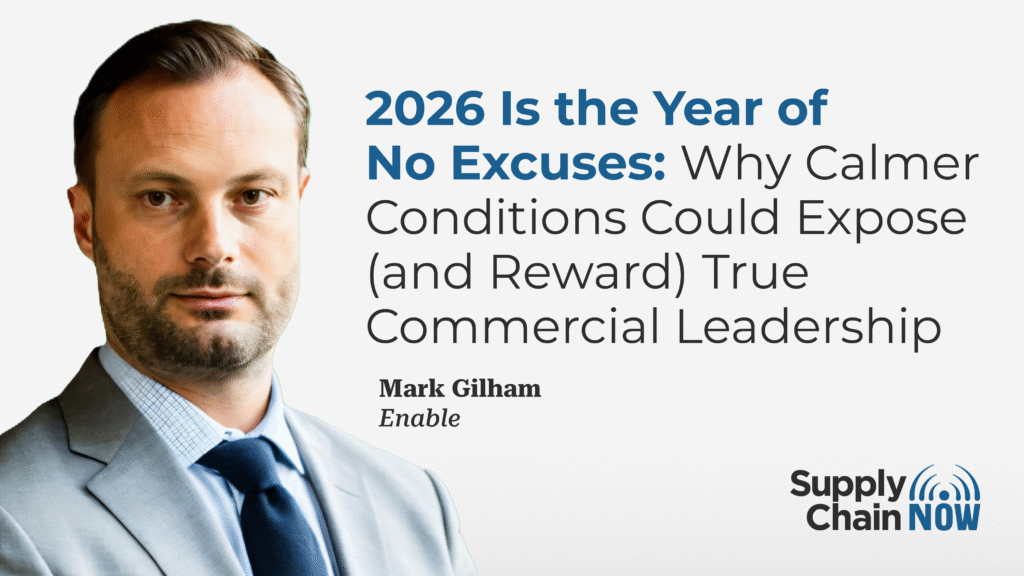
2026 Is the Year of No Excuses: Why Calmer Conditions Could Expose (and Reward) True Commercial Leadership
A Shift in the Narrative for 2026 In a recent conversation, Scott Luton spoke with Mark Gilham, Vice President & Head of Global Advisory at Enable, about what supply chain and commercial leaders should expect from the year ahead. While many annual outlooks attempt to forecast the next major disruption, Gilham offered a different lens: 2026 may become the “year of no excuses.” After years defined by a global pandemic, inflationary shocks, geopolitical instability, supply shortages, and the rapid rise of AI, organizations have already endured extraordinary volatility. Businesses not only survived, but in many cases adapted and grew. According to Gilham, that reality weakens the argument that disruption alone explains underperformance. Disruption is not disappearing, he cautioned, but leaders can only lean on it for so long. Why a Calmer Year Raises the Bar Gilham argued that if external conditions stabilize even slightly, the pressure on leadership actually increases. A less chaotic environment removes convenient explanations and shines a brighter light on internal shortcomings. Process gaps, misaligned incentives, and execution failures become harder to ignore when the world is not on fire. Rather than waiting for certainty, Gilham believes leaders should act decisively. This does not mean radical…