[00:00:00] Garuth Acharya: Data is the new oil, right? Like if you don’t have good data, your models don’t matter, right? Fundamentally, that’s what matters is how do we generate data that is clean, correct and actionable.
[00:00:14] Voiceover: Welcome to Supply Chain Now the number one voice of supply chain. Join us as we share critical news, key insights, and real supply chain leadership from across the globe, one conversation at a time.
[00:00:27] Scott W. Luton: Hey, good morning, good afternoon, good evening, wherever you may be. Scott Luton and special guest host Wiley Jones with you here on Supply Chain Now. Welcome. Hey Wiley, how you doing today?
[00:00:39] Wiley Jones: I am doing awesome.
[00:00:40] Scott W. Luton: It’s nine o’clock here and I’m ready to rock. You are ready to rock. I think you stay ready around the clock and we got a great one here today, folks.
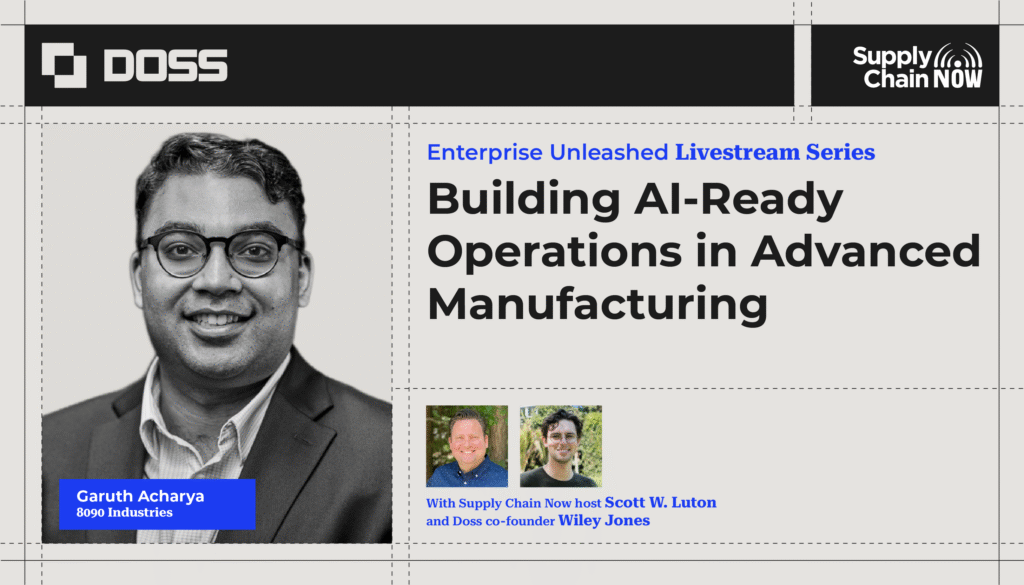
[00:00:47] Scott W. Luton: We’re kicking off an exciting new series for 2026, Enterprise Unleashed Power by Wiley and all of our friends at DOSS, who’s been organizational on the move for years now. Now throughout the year of 2026, this series is gonna be focusing on. Real leadership conversations with individuals, dynamos that are truly unleashing the power of the enterprise and beyond liberating their people, their operations, and their performance from old fashioned technologies and approaches that we all, let’s face it, we all clinging to, right?
[00:01:18] Scott W. Luton: You’re gonna hear stories and perspective from innovative individuals that have led transformative change, not just talk about it all to help you drive real targeted outcomes driven change in your own organizations. And today.
[00:01:32] Scott W. Luton: We’re gonna be focusing on building truly AI ready, operations, and advanced manufacturing, one of our favorite, favorite sectors.
[00:01:39] Scott W. Luton: So Wiley, we’ve really come to appreciate your point of view and expertise and all the great work you and the DOSS team have been doing out in the marketplace. Delighted to partner with you on this series here. What else would you add to what we’re after in this series? Here in 2026?
[00:01:54] Wiley Jones: We’re experiencing a really unique time where.
[00:01:58] Wiley Jones: Uh, human intelligence is something that machines are able to really operate on now. All the advancements in AI are allowing us to completely re, you know, reframe and challenge a lot of assumptions we’ve had over the last decades. And so it’s a cool time to get, you know, all these vignettes collected from people out in the field that are operating on the cutting edge because we just have a lot to learn.
[00:02:20] Wiley Jones: There’s so much new stuff that we can actually go in and work on today that wasn’t possible for, so that’s good. Really excited to bring all this to light.
[00:02:27] Scott W. Luton: Actionable, innovative vignettes to still one of Wiley’s. Many, many terms there. And folks get ready. We’re working on an incredible calendar of interviews and we start today with an outstanding business leader.
[00:02:39] Scott W. Luton: You’re gonna learn more about. So Wiley, you ready to get to work? Let’s do it.
[00:02:44] Scott W. Luton: Alright, I’m gonna introduce our esteemed guest here today. Garuth Acharya is a member of 8090 Industries investment team focused on the organization’s deep tech thesis across space. Defense and decarbonization Garuth has lived and worked across the world.
[00:03:00] Scott W. Luton: Get this. Wrestling rattlesnakes in Texas. Dune bashing in the Middle East and building rockets destined for Mars and Silicon Beach. Growing up, the son of a computer science professor, he’s been surrounded by quantum computing, AI and machine learning since he was a kid. Garuths believes in deep tech because he’s seen it change lives from startling, providing internet to victims in war zones.
[00:03:26] Scott W. Luton: To leveraging innovative grid systems to electrify Sub-Saharan Africa.
[00:03:31] Scott W. Luton: Now keep in mind, Ruth holds a bachelor’s in nuclear engineering and mechanical engineering from Penn State, a master’s in systems engineering from Cornell and an MBA from Wharton. With a background at innovative companies such as SpaceX and Blue Origin.
[00:03:46] Scott W. Luton: Currently he’s an investor and part of the founding team of 8090 Industries where they’re building space defense and advanced manufacturing technology to a robust portfolio of innovative companies. So join me and Wiley and the rest of the gang and welcoming Garuth Acharya, an investor with 8090 industries.
[00:04:04] Scott W. Luton: Hey. Hey, Garuth. Good. Uh, good morning, good afternoon, good evening. Welcome to Enterprise Unleashed. How you doing?
[00:04:11] Garuth Acharya: Howdy, brother. I’m doing well. Once again, please don’t hold a suit against me and don’t hold the NBA against me either. I’m a Penn State guide through and through.
[00:04:18] Scott W. Luton: Well, I love that. And Wiley, I love what Garuth Sheridan, the pre show, but he is also a certified forklift operator and he is very proud of that credential.
[00:04:26] Scott W. Luton: Is that right Wiley? Yes
[00:04:28] Wiley Jones: it is. That’s amazing.
[00:04:29] Scott W. Luton: So let’s do this. I wanna start with a fun moment.
[00:04:31] Scott W. Luton: Question before we get into a slew of things that I, I can’t wait to learn from you both really, but I gotta learn more about your rattlesnake wrestling in Texas in the earlier part of your career groove. Did you really wrestle with some rattlesnakes?
[00:04:46] Garuth Acharya: Look, you know, you gotta rumble in the jungle with some rattlesnakes and you know, you got a tango with some tarantulas. You know, it’s, it’s what you do when you’re out in, uh, west Texas. So, look, I’m from Central, well, I was born in Buffalo. My dad was a professor at SUNY Buffalo, and then he became a professor at Penn State.
[00:05:00] Garuth Acharya: I grew up in Happy Valley. I’m a central PA guy and I graduated undergrad.
[00:05:05] Scott W. Luton: Yeah,
[00:05:05] Garuth Acharya: and I was supposed to go travel the world with General Electric, doing cool stuff in power, electrification, energy, the whole nine yards. And then in 2014, the price of oil cratered. Uh, if you guys remember Marcellus Shale and kinda like some of that geopolitical stuff going on in the Middle East.
[00:05:21] Garuth Acharya: And I got a call after I finished my last final, and the person in charge of my program, the OMLP, operations Management Leadership Program, called me and they said, Hey, you’re ready to, you’re ready for your first job. I’m like, hell yeah, brother. Where are you setting me? I’m thinking offshore oil rigs in, you know, off the coast of Angola.
[00:05:37] Garuth Acharya: I’m thinking I’m about to live expat life in UAE or do some cool stuff in Southeast Asia, like brother. We’re saying you to East Texas and West Texas. So I, you know, I’m from central PA and I went down from, from, you know, my, my fraternity at Penn State all the way down to, you know, eating cactus chimichangas out in the Permian Basin, uh, when we weren’t, you know, putting pumps down hole.
[00:06:00] Garuth Acharya: I was an artificial lift guy, man. And so I remember 5:00 AM being on the site. I’ve seen a, I’ve seen a bed of tarantulas and, uh, quite a bit of snakes. Just, you know,
[00:06:07] Scott W. Luton: rummaging around. Groove. What an outstanding opening Wiley. That’s gotta be one of the more unique openings we’ve had in recent memory. What, uh, you’re not scared of snakes, are you Wiley?
[00:06:18] Wiley Jones: I am. I’m a big fan of snakes. I am a. Absolute wuss when it comes to spiders. Okay? It’s not, they just aren’t we all, we all just really, we who, you know, who, who is, I’m not gonna lie. I’m not gonna lie. I don’t, I, I don’t like them. I don’t like ’em. Hey,
[00:06:33] Scott W. Luton: at least we got lots of problems in global supply chain, but snakes and tarantulas, maybe that’s not one.
[00:06:38] Scott W. Luton: So, and I’m very thankful both of those things. Alright, Ruth, I love how you kind of baked in some of your personal history and journey. With my rattlesnake question, I wanna dive in a little bit deeper to kind of set the table for a deep conversation we’re having.
[00:06:52] Scott W. Luton: Tell us more about your background, including your time in operations and technical program management at the incredible organizations known as SpaceX and Blue Origin.
[00:07:02] Garuth Acharya: Listen, look, I had a great time. I would say the fundamentals of manufacturing and supply chain. I learned at my time at ge, uh, in the OMLP program. I started my first job off as a supplier quality engineer. Then I went in Lean Six Sigma, like how do you five as a shop. That’s where I actually got forklift certified.
[00:07:17] Garuth Acharya: And then my third is I actually ran a shop out in West Texas, which was fantastic. Uh, artificial lift. It was an incredible opportunity and I think there was a big cohort of GE guys. In fact, a lot of my friends who are the heads of ops or COOs of all these neo primes that are coming. A lot of ’em started off at GE and then we all went to SpaceX together, which was incredible.
[00:07:37] Garuth Acharya: So I was a supply chain ops guide at SpaceX. My job was to manage the inner stage. It has the four grid fins that help stabilize the landing. And on top of that, it’s the large composite structure, uh, that connects the first and the second stage together. And then I owned the two nose guns that go on top of the side, was just fucking heavy.
[00:07:55] Garuth Acharya: And that was incredible. ’cause we were going from two x reusability to, to 10 x plus reusability. And that meant working directly with research and development teams on, you know, the material science teams, your propulsion teams that, you know, we call it, you know, the plumbing guys. Right. And it was. The definition of design, build and qualify in parallel, which was antithetical, right?
[00:08:21] Garuth Acharya: The exact polar, or opposite to the prime mentality, which is you design, then you qualify, and then you build, right? Which is fundamentally why it takes 15 plus years for the primes to build something. And SpaceX, I wouldn’t say does it overnight, but the lead times are are much shorter.
[00:08:38] Scott W. Luton: I’m big old space nerd Garuth, so I’m fascinated with what you’re steering here.
[00:08:41] Garuth Acharya: Yeah. I mean, listen, like these guys, like these SpaceX materials guys would come up with like new novel ways to leverage composites technology. Right? And we had to be super nimble ’cause this was pre boosters every week, right? We were still building quite a bit of new boosters and the goal was, is in order to go at scale, you need to be able to do reusability.
[00:09:00] Garuth Acharya: So we didn’t have the spend that a Lockheed or an Northrop did. Right? Because like when you go out, it’s all about your spend, your demand forecasting stable supply. Right? In Procurement 1 0 1, I don’t know if you can tell, the reason why I’m almost bald is because like we were trying to spool up suppliers and you know, we were like, Hey, we will have more spend.
[00:09:18] Garuth Acharya: Right? Or on top of that, where, where is my part? You know, does it have good quality? Right. You know, can I get it faster? Those are the three big questions. Every person supply chain’s asking ’cause of the delay to the production line. Is what’s hairy. That’s the most hairy part, but it was incredible. And then being operating in unison, right?
[00:09:35] Garuth Acharya: The, I would say one of the people who leads the show is the material planner. The material planner there is the face of the part or the face of the structure. So what they’ll do is they’ll say, you know, Hey, engineering. Where’s your engineering bill of materials and manufacturing, engineering quality guys, where’s my manufacturing bill of materials?
[00:09:53] Garuth Acharya: Are we reconciling the two together? Are we doing DFM designed for manufacturability? Are we demand forecasting? Demand planning? Are we saying that, hey, this is gonna be a super lead time, long lead part. Are we spooling up the supplier with a unreleased drawing so that they know what to expect ahead of time?
[00:10:09] Garuth Acharya: Right? This is something that I would say most organizations don’t have the sophistication to do because everybody’s in their own office or nobody’s really communicating supply chain fundamentally. Ops guys are, you have, I don’t wanna say you have to be an extrovert, but I think you do a little bit better as an extrovert, but more importantly, it’s a culture thing.
[00:10:26] Garuth Acharya: It’s a people problem.
[00:10:27] Scott W. Luton: So, uh, Garuth, before I turn over to Wiley and dive a little deeper on more of a technical side, I wanna ask you one thing, because those organizations, you’re describing some of the processes, some of the uniqueness of those of space sectors, space manufacturing sectors, and failure can’t be tolerated.
[00:10:43] Scott W. Luton: Oftentimes, you know, human lives are on the line. So what’s it like, two part question. What’s it like operating that environment and how has that shaped your mindset moving forward about, especially about execution in, in other companies?
[00:10:56] Garuth Acharya: Look, these are zero fail missions. If you’re launching astronauts in a space like these entities are human rated, so everything has to be perfect.
[00:11:03] Garuth Acharya: I would say the secondary element is that you’re launching oftentimes national security assets into space. Whether it’s for space force, whether it’s for the intelligence community, it could also be for nasa, right? Or it’s just like commercial assets that you’re launching as well. Fundamentally, these are mission critical to the United States, to our allies, and also for broader humanitarian applications.
[00:11:22] Garuth Acharya: So to fail means that you are setting the United States back, and then on top of that, like lives can be lost. These are very serious programs that we’re working on, and so everybody’s gotta be on. Everybody’s gotta be on the same page. Everybody’s gotta live and breathe This, which is what you get, like at a SpaceX and Blue.
[00:11:40] Garuth Acharya: The people live for this. The Rocket Lab, the same culture exists, like people live for this stuff. Everybody on the shop floor all the way up to the boardroom lives and breathes, you know, human space exploration. You live and breathes frontier technology. And so being in that environment, you’re just, your, your sophistication goes up, your level goes up, you’re attuned to different things.
[00:11:59] Garuth Acharya: You work 10 x harder because you’re bought into the mission. I mean, and listen, like the quality for these parts are very intense. Like the cleaning that it goes through, the specifications that you go through if you’re looking with suppliers, right? Like the barrier to entry to be a supplier to these entities are super intense.
[00:12:14] Garuth Acharya: Like eight 100 ISO 9,001, sometimes NAD cap certifications. These are not that easy to get yet and maintained.
[00:12:21] Scott W. Luton: Alright, so Wiley, I think you wanna explore about some of these demanding operational environments. Huh?
[00:12:27] Wiley Jones: I am always open-minded about where these conversations go, and I love just the reframing of part of this, which is that when you look at some of the world’s most high competency organizations, the thing that you’re describing when people talk about SpaceX, SpaceX is fundamentally an r and d and cutting edge technology company, and it’s also a manufacturing business, and it’s one of the best ones in the world.
[00:12:48] Scott W. Luton: Hmm.
[00:12:48] Wiley Jones: And when we look at how these organizations operate, I think a lot about tempo, you know, an incredible operating tempo and cadence. And creating, creating incredible leverage and then just being right a lot. And it sounds like the thing that you’re describing Garuth is that at the core is actually a deep philosophical mission alignment that everyone has bought into this shared vision, and that then the decisions and approach flows outwards from that.
[00:13:15] Wiley Jones: What are the concentric circles that you would draw around that mission that you think determine a lot of what you saw was successful inside of these companies?
[00:13:25] Garuth Acharya: Yeah, listen, I think like the, the hiring, the hiring practice for these guys are like super intense. I would say there’s probably one of the more, more important things in the application process is like, look, the case I is cool, right?
[00:13:38] Garuth Acharya: Like, of course, can you triage these problems? How do you approach these problems? Like that is standard. I think one of the more important things is there’s a section, and I don’t know if they still do it, I’m sure I’m positive, that they do, is that you have to write a paragraph or like a short essay as to why you’re passionate about space tech and human space exploration.
[00:13:55] Garuth Acharya: Right. So just like the application process itself just weeds you out. ’cause like everybody there wants to be part of this mission. It’s part of this kinda like grandiose plan to take. Humankind from just, you know, one planet into an interplanetary species. Um, I would say tric circles is that everybody works hard and everybody works smart, right?
[00:14:16] Garuth Acharya: And I think being able to work together, teamwork makes the dream work is like a very serious thing. And it’s also do to small things, right? ’cause they add up, you know, there’s a phrase, slow, smooth, smooth is fast. I think a lot of folks in the military community use it. It’s very apropos in, in production and manufacturing.
[00:14:32] Garuth Acharya: Because if you can’t get the fundamental pools right then, like, bro, you can’t, you can’t design and launch a rocket. Yep.
[00:14:38] Scott W. Luton: That would be the US maybe Seals, I believe Garuth and Wiley, if I’m not mistaken.
[00:14:43] Wiley Jones: Yeah, we use that a lot internally as well. The question that I think is then the, you know where, where a lot of my mindset is right now is that we had these operating cadences, the leverage, this correctness mindset inside of operations.
[00:14:59] Wiley Jones: And the pre AI version of it looked one way, and the post generative AI version of it now is gonna look another way. It does feel like there is a material shift happening in the way that people are gonna be adopting these technologies in the next decade. What is one of the big areas that you’re excited about?
[00:15:14] Wiley Jones: How are you seeing things fundamentally change already? Where are you seeing real value unlocks in your day-to-day already? Like walk me through your framework on the before and after shift here.
[00:15:23] Garuth Acharya: Yeah, listen, I think there’s a couple great, you know, there’s a couple great examples of this, but just, just look.
[00:15:28] Garuth Acharya: Most recently, I think Andrew or and Roc Phil, shout out to him, he’s building an incredible tech stack where you can have automated work instructions. One of my, one of like the beings of my existence was. Yeah. All right. Now I have my engineering bill of materials that’s been released, but like, you need to make it all your consumables, the work orders, steps one through 20 screwing, you know, fastener A into this thing, right?
[00:15:50] Garuth Acharya: How do you actually do this? Right? That’s the, that’s the work order, right? That’s the work instructions. Those take forever to make, especially if it’s a complicated part, right? And so areas that you can use to make humans more productive. I think people have this preconceived notion that AI is gonna. It is gonna displace a lot of folks, I think in manufacturing will just make people a lot more productive.
[00:16:10] Garuth Acharya: I mean, there’s never a shortage of work in supply chain and production. Let’s get that clear. Right. There is no shortage of work there can, oh, I could work 24 hour days if I wanted to. Right. The whole point here is that you can do so much more with ai. The example would be, if I need to build more products, I need the work instructions to do that.
[00:16:27] Garuth Acharya: How do you leverage physics-based AI models to go and do that? Dur rock is solving that, right? If I wanna have, for example, understand what are my shortage reports that are going on, what work orders or what material planning do I have, let’s say two or three months from now that I’m not looking at that I might have raw material issues for right?
[00:16:44] Garuth Acharya: Where am I seeing, for example, anomalies in procurement? What are my, because quality defects, right? There’s so much data, right? The question is a, is the data good? Right? So the master data is probably one of the most important functions that if you are going from analog to digital. You gotta do it the right way.
[00:16:59] Garuth Acharya: That’s the most important part. You know, once again, it’s a culture issue, right? Master data is, it comes down to culture. Are people inputting the right things into the system? And I think the second thing is, what’s the takeaway? What’s the TLDR? What’s the BLUF of what’s going on? An example would be, hey, we’re seeing major issues across parts, across this material with these complex geometries, right?
[00:17:20] Garuth Acharya: Like, here’s what we are seeing right? Here are the quality defects that we are seeing. Like these are the types of. You know, analytics that enable, let’s say, a design engineer to go back up the flag pole and say, Hey, maybe we should take a look at DFM designed for manufacturability, maybe as a quality manager, right?
[00:17:36] Garuth Acharya: If I need to load share, where, where am I gonna be allocating resources, what can we do? Computer vision, right? Computer vision is not being used for defect detect versus, you know, just 100% in person inline inspection, right? Like assn 100 certs will require a lot of quality control methods. But when we’re talking about high rate production, a lot of this stuff, how can we ensure that things don’t get missed?
[00:17:58] Garuth Acharya: Uh, a double ot, right? Like. Identify really the 80 20 rule. What should a human be doing versus what can infrastructure and systems or IT systems do for us? So I think there is, we are beginning, I would say there are very few factories that you know are super sophisticated and how they do this. Like even Tesla try to build a fully automated entity and like they had a ripple a lot of stuff out and say, first principles, what should we automate?
[00:18:22] Garuth Acharya: What should we have a human do? So I think in this case it’s AI is a tool, but really identifying what are the big bottlenecks. What are the big things that we’re seeing, right? You have Atomic Industries, right? Aaron is doing incredible work both through Reindustrialization, right, and broader, some of those major, major, um, organizations that he’s starting, but more importantly, right, for injection molds.
[00:18:42] Garuth Acharya: If you want a plastic part. You have to go to China to get this stuff half the time because the lead times take forever to build a mold, to clean a mold, to define a mold, right? How do we bring in AI to design molds, right? That help a Procter and Gamble or help a Lockheed if they need certain plastic components that go in or their tier two, tier three suppliers.
[00:18:59] Garuth Acharya: So what I have seen as an investor is what are the big problems and culturally, what are you doing to solve this? And I think AI is a tool. AI is not the solution. The solution will always be a problem. Uh,
[00:19:13] Wiley Jones: yeah, that, that all that resonates and it, it, it does tie up tail back into the thing you were talking about, which is it probably actually a really good segue into Scott’s question.
[00:19:22] Wiley Jones: I know he’s gonna ask, but it’s, that culture is actually at the center of all of this. Yes. It’s the kernel that everything grows out from
[00:19:28] Scott W. Luton: it. It’s so true. I, I’ve heard culture, I bet Garuth has mentioned it probably 13 times thus far, and it, there’s so much truth in that. But I wanna move forward to your point, while you’re reading my brain here, because I think.
[00:19:40] Scott W. Luton: Uh, amongst the value we’re gonna get from talking, uh, with Garuth here and, and share with our SE and Global fam is talking about what it really means to build AI ready operations. ’cause Garuth has been there and done that. So, I wanna ask you, Garuth, from your operator lens, right, from your, um, all that that means, including operating those forklifts, which I love.
[00:20:01] Scott W. Luton: I love driving back in my day. Why does AI on top. Usually fail in physical world environments. Your thoughts, Eric, Gar, Ruth,
[00:20:10] Garuth Acharya: listen, look it. Garbage in, garbage out, right? That’s, that’s like the number one thing. Ai, like you can have incredible models, but data is the new oil, right? Like if you don’t have good data, your models don’t matter, right?
[00:20:24] Garuth Acharya: Fundamentally, that’s what matters is how do we generate data that is clean, correct, and actionable. So whether we’re plugging in a PLC SCADA to output all this machinery, all this data that’s coming outta your lay there, your CNC machine, right? Like, that’s great, but then I take out and say, all right, what’s going on with my raw material?
[00:20:46] Garuth Acharya: Are there certain issues that I’m seeing with raw material suppliers? It could be quality defects, it could be lead time issues, it could be a, you know, a myriad of different things. How do you then say, what are the big problems that I’m looking to solve? Fundamentally, the customer cares about three things.
[00:21:01] Garuth Acharya: A. Where’s my part for transparency, right? Because you want to prevent baldness, right? Receding hair lines, and you do that by figuring out where’s my part B? Am I getting it on time? Can I get it the right way? Is it actually accurate? And fundamentally, can I get it faster, right? Yeah. Like on time delivery, good quality, can I get it faster?
[00:21:20] Garuth Acharya: These are the big three things, and you can leverage AI by saying, Hey, like there’s potential raw material shortages that are coming in, right? Like all of these things that are there. If AI fails, if you don’t have the culture to A, implement the infrastructure pipelines, and then B, ask the right questions.
[00:21:39] Garuth Acharya: What does the customer care about? Whether, you know, there’s plenty of people who are creating orchestration layers for a Domino’s pizza tracker, but is there anything to API into, and even if you API into it, is the data correct? That’s a culture issue, right? Yeah, so, so fundamentally. How do you take a factory from analogs?
[00:21:57] Garuth Acharya: Digital, right? That’s a major endeavor. Like General Electric spends billions of dollars on MRP/ERP integrations and they’re very hairy. Onboarding pounds here, is that the right thing for a small business to do? It might be pretty expensive. Right? Can they use it? Do they wanna use it? What are they gonna use it for?
[00:22:14] Garuth Acharya: Right? Like crafting these strategies I think is very interesting because we’re at a time where people know that you have to innovate, you. But at the same time, the Vikings were building ships. Right. You know, the Chinese were building ships back in the day before there was ai or before there was an AutoCAD right before SolidWorks existed.
[00:22:30] Garuth Acharya: Yes. So shipbuilding is in the hu is is in the DNA manufacturing is in the DNA of humankind. It’s what we do. Yeah, but the question is we can always do it better. I mean, the Japanese taught us TPS, the Toyota Production System, that’s where the Lean Six Sigma stuff came from. At least that’s what I was trained on.
[00:22:47] Garuth Acharya: So culture is number one.
[00:22:48] Scott W. Luton: Yes. Yes. Yeah. Back tape Esna number 16. I’m counting. E each time you mention, uh uh, the culture word there, Garuth. I love it. Big culture guy. Wiley, really quick, I’m about to ask, Garuth, you already touched on a few things that have to be true operationally before AI can really drive outcomes.
[00:23:05] Scott W. Luton: Your quick comment, Wiley, what we just heard there from Garuth.
[00:23:08] Wiley Jones: Yeah. Just to react to one part of it, the part that I see so much in our day to day is that. People a lot of times will speak to us as a company about capabilities and there’s, you know, speaking in terms of revenue and profitability and risk, risk being a lot of stuff that, you know, Garuth is talking about related to, do I get my part, do I get it on time?
[00:23:28] Wiley Jones: Can I get it faster? Is it actually correct? And their ability to then go in and deliver on the revenue downstream of that. When we trace through those capabilities of like, can we deliver on all those things, the thing that actually ends up being the most common problem on all, you know, all of it at the very bottom is.
[00:23:42] Wiley Jones: We don’t actually have clean master data and we don’t have a culture inside of our organization or operating system and operating principles that enforces, that people have reconciled clean, accurate master data and that we don’t have this, you know, let’s call it messy machine that continues to generate and spit out, basically make an oil spill all over the business every time we go and do anything transactionally.
[00:24:04] Wiley Jones: And that just what Drew’s describing is something that we see in practice. And you pull that thread all the way through. Somehow you always end up back at Master Data.
[00:24:13] Scott W. Luton: Don’t go out and get the latest and greatest Corvette and then put a V six in it. Right? Uh, yeah, I love with y’all’s points there around data.
[00:24:20] Scott W. Luton: Um, alright, so two part question. Garuth, you touched on a few things already that have to be true operationally before leadership can turn to a AI to drive real outcomes. So I wanna see if there’s anything else you’d suggest there and. Second part here, workflows, data discipline, and decision making. How does all of that have to evolve for companies that really are.
[00:24:41] Scott W. Luton: Prompt and are delivering big, big results with ai. Your thoughts, Ruth?
[00:24:46] Garuth Acharya: Listen, w Wiley, you, you, you hit the, you hit the nail on the head, right? It’s master data. Master data is a team effort, right? Like no one manufacturing in ops probably are the most humble folks because you have to work with everybody.
[00:24:59] Garuth Acharya: Like if you have a high ego in supply chain, you’re not gonna make it brother, right? Like, you’re just not gonna make it, right? I mean, the amount of times I go up to someone’s desk and like, Hey, can we like do A, B, C? And they’re like, well, like. Can I get a deviation to odine instead of anodize? That will reduce my lead time, right?
[00:25:15] Garuth Acharya: Like you have to go convince folks to go do things.
[00:25:17] Garuth Acharya: But let me take a couple steps back. I think we all have some war wounds, uh, uh, about this. But you know, listen it master data or just clean hygiene is a team effort, plain and simple. I’ll give you this example. It starts off with your engineering PLM system, right?
[00:25:34] Garuth Acharya: Like your part data, right in I am an engineering part. What are the commodities around that part, right? Tier one, tier two, tier three, commodities. A, it’s a machine, part B, it’s small, medium, large. C, it’s, you know, some other taxonomy, right? The more data that you can parse and once again, you don’t boil the ocean and do stuff unnecessary for the sake of just doing it.
[00:25:53] Garuth Acharya: It’s gotta have value to the organization or it’s gotta, you know, there’s gotta be a business case for everything. It starts off with something as simple as that. What are the commodities of the part? How do you break down that part? And then how do I correlate those things to make decisions off of? That is not easy to do and in an organization or acquire a supply chain to work with quality, to work with engineering, to work with manufacturing, engineering, and then all and all that.
[00:26:14] Garuth Acharya: Then the BI guys in the background, right? And then all these SQL or Python wizards can go ahead and start building all the, these dashboards.
[00:26:22] Garuth Acharya: I mean, I’ll give you this example. We were looking at what are the number of red lines that are going on a work order and a red line for those who don’t know, it’s a deviation, right?
[00:26:30] Garuth Acharya: And so. I, I don’t know many people who have ever built something without a deviation. If you have, good for you. I love that and I applaud you, but we were always saying, okay, right, we’re on the shop floor. Even if it’s rev five, right? Right. If it’s Rev d, rev E on the drawing or on the work order, we’re saying, oh, we can do this better.
[00:26:48] Garuth Acharya: Oh, let’s substitute this for this. Like those are what you call engineering approved red lines that says we can deviate to go do something. Well, then maybe after you do this, like 20 times across 20 different things. You can now start saying, well, I’m looking at all this taxonomy and all this data that I have.
[00:27:04] Garuth Acharya: Maybe if we made these three, five changes upstream, we wouldn’t have to red line and have to delay the production floor and get engineering approval or quality approval to go do things. Right? So at the end of the day, what matters most is how do I execute clean and fast my production guys on the shop floor, all of that.
[00:27:19] Garuth Acharya: Comes down to master data at the end of the day. Right? But it’s a ultra thing and everybody has to be bought in
[00:27:25] Scott W. Luton: 1818 groove.
[00:27:26] Scott W. Luton: Alright, so, so we’re gonna get groove’s, investor hat put on, we’ve been talking really from an operational lens for the first half of the conversations. We’re gonna get some of his perspective from an investor here in just a second.
[00:27:37] Scott W. Luton: But Wiley, clearly our kindred spirits and the, and the immense value of master data and probably amongst other many, uh, other things. Your quick call out of anything that Ruth just shared there. Uh, a mix
[00:27:49] Wiley Jones: of a call out and maybe a, you know, a tee up. The next, the next section on this is, I think what you described is that process of refinement and the building a dimensional understanding of what’s happening in a work order where you say, Hey, we did these five red lines and four red lines and three year red lines over the last 20 of these builds.
[00:28:12] Wiley Jones: They end up being the same or roughly the same every single time. If the business has a framework to pass that back upstream in the organization, then you can make changes inside of the company. If you don’t have that, and it’s to your point is, you know, the, the salesmanship inside of manufacturing organizations is that you have to go around and socialize and coalesce ideas around the company.
[00:28:32] Wiley Jones: Uh, you just say, Hey guys, like we don’t want to keep getting handed these work orders with a a million different deviations. How do we as a business come up with a plan for. The ability for people that are receiving problems downstream to go in and, you know, make it so that organization members upstream of that, that they’re not affected by any of this.
[00:28:48] Wiley Jones: That they can actually be delivered a very clear, you know, rule of rules of engagement for how we drive change in their work streams, even if they have no reason to actually improve. Something that comes back up to the, you know, the leadership point of view that we were talking about and how the, you know, culturally leadership has to be able to establish that, but.
[00:29:05] Wiley Jones: Those are the things that we also see and I, I think the way you call that out and the kind of the pipeline building of that process is something that is immensely valuable for organizations to understand. How does their version of this operate?
[00:29:15] Scott W. Luton: Yes, well said. And clarity. Gosh, clarity is always underrated.
[00:29:20] Scott W. Luton: Operational and clarity. Oh my gosh. Uh, operating through the supply chain ecosystem to where, to your point, Garuth, why deal with problems that we could completely eliminate. And when I, when I think we bring lots of clarity to these, uh, product development, design development conversations, we can really get on a magic wand.
[00:29:39] Scott W. Luton: And make certain problems disappear. And imagine all the hours we get back to drive, uh, more practical innovation or, um, um, a hundred
[00:29:46] Garuth Acharya: percent.
[00:29:47] Garuth Acharya: I mean, look, a clear example is, you know, I have a friend of mine, Sam Hoffman, guy’s a legend, X SpaceX, he’s that violet, and they’re, they’re the backbone, right? So like I have all these siloed individual systems.
[00:29:58] Garuth Acharya: I have a PLM system, I have a manufacturing execution system. I have a bunch of stuff. These guys are building the orchestration layer that’s a ping, and integrating and fusing this data together so that I can make these decisions, right? As you said, culture is great, but like infrastructure and tools are a functional culture.
[00:30:15] Garuth Acharya: Right. And that’s where energy like Violet, right, can go in and parse that information and fuse that data together. So shout out to Sam if anybody’s listening. Go give him a go, go, go. Give ’em a holler.
[00:30:25] Scott W. Luton: Garuth. Let me ask you, red flags, right? We were just talking a second ago and then we’ve been talking a good bit.
[00:30:30] Scott W. Luton: Last chunk about AI ready organizations. When you see certain operational red flags that say, Hey, we’re not ready. What are a couple that really concern you each and every time?
[00:30:43] Garuth Acharya: Listen, I, I think the first and foremost question is like, I never ask about ai, I never ask about tools. I, I just say like, talk to me about what you’re building.
[00:30:52] Garuth Acharya: How do you build it? Right? Talk to me like value stream map 1 0 1, right. I, I mentioned before, I think we all agree, right? One is we were building ships. Right before we had computers, right? Like, I mean, people didn’t have AutoCAD. They were old school on, you know, uh, on the desk, uh, with large sheets of paper.
[00:31:10] Garuth Acharya: So I think it goes back to fundamentals, manufacturing, science. A what is your mission? What is the culture, right? Like, are you going to fundamentally be a design build and qualifying series or a parallel culture? How do you do it today? Where do you wanna be? Right? What are your big challenges? Do they know the right questions to ask about themselves?
[00:31:31] Garuth Acharya: Right? Like, do they know what, what their issues are? And are they open? Right? It’s almost as if it’s a therapy session. I think when it speaks to a lot of organizations, right? Whether it’s small to medium sized businesses or MAGA corporate entities, right? Like all of these massive corporations have an AI strategy, but it’s not an AI strategy.
[00:31:46] Garuth Acharya: It’s a culture strategy. Like what exactly do you wanna do? And automating it is the easy part. You just gotta have all the backend infra setup so that you can do it right? Slow, smooth. Smooth is fast. So I think the red flags are a, have you done the work to know? What your own in, you know, roadblocks are, are people coming outta their offices?
[00:32:06] Garuth Acharya: Is accounts payable. Coming outta their office to talk to procurement. And is procurement going out to talk to the shipping and receiving guys? Right? Uh, the shipping and receiving guys going and talking to your shop floor guys to make sure that they’re not just going to the dock picking stuff out and then issuing it a work order.
[00:32:20] Garuth Acharya: Like maybe you don’t even have any work orders, like is everybody on the same page to know where they all flow and how they’re executing? And if you don’t have that, then AI is a, not even a bandaid, it’s probably gonna be a net negative ’cause you don’t have the clean data. So that’s kind of my thoughts.
[00:32:35] Garuth Acharya: Why? What do you think?
[00:32:36] Wiley Jones: I mean it, this is exactly the conversation. I think Scott and I, I have had this conversation multiple times on the show and I in in the past, which is just the willingness and desire and courage to change the business and the courage to have conviction about what you’re gonna go do, the courage to, to know yourself as a company.
[00:32:56] Wiley Jones: That’s the foundation that allows us to establish the culture that allows us to establish the process, which allows us to establish the tooling, like, and it’s all just this very deep, you know, Socratic thing that starts with. Do you want to do these things or not? And, and do you have the willpower to drive that through the company?
[00:33:12] Scott W. Luton: Yes. Wiley. Well said. And conviction is one of my favorite words of what it communicates. When you know you’re ready to hang everything you have on one thing happening or, or, or moving into one big new chapter or one big new initiative. Love that. And when you’ve got a conviction of a team, kinda going back to what you and Garuth both have spoken to and you can really move mountains.
[00:33:35] Scott W. Luton: So Wiley, I think up next we’re gonna be talking about prioritizing modernizing operations and where folks start, take it away, Wiley.
[00:33:42] Wiley Jones: So let’s say you’ve done all of this, you’ve done the, the internal work, you’ve done the value stream mapping as a business. You understand that there are, you know, especially people who are in your position as well, group, where you’ve seen a bunch of these patterns.
[00:33:57] Wiley Jones: There are so many things you can go in and fix. There are so many things that you can go in and decide to work on. The bottlenecks are innumerable often, and they only appeared, you know, depending on the sit stuff you push through the system. You find them in different, you know, shapes and sizes. How do you think about how to prioritize?
[00:34:15] Wiley Jones: Where do you go first? What do you focus on? Build versus spy partners in-house, all like what is your framework for this?
[00:34:22] Garuth Acharya: I mean, this is, this is the quintessential question on how you don’t boil the ocean, right? Like Right. Yeah. Yeah. Even if you have infinite resources, your build by partner strategy is probably the most important because that’s where you dedicate resources to.
[00:34:36] Garuth Acharya: And resources are precious, right? Like if I’m taking a manufacturing engineer or a supply chain guy off. The shop floor are off like demand planning, right? And triaging, supply chain shortages or some defect issues or whatever it is. Or you know, if they’re not on the phone calling your supplier saying, where are my parts or issuing pos, then you, they have to be returning incredible value back to the business, right?
[00:35:00] Garuth Acharya: That could be. You know, sitting up and saying, do I wanna build my own internal ERP/MES system? Right? Can I use a docs, can I use the First Resonance, right? Like, what do I wanna do? Do I wanna go and build up my own robotic infrastructure to automate my warehouse or to automate my packaging? Like, is that necessary?
[00:35:17] Garuth Acharya: Should I build that myself or can I go partner with a Reflex Robotics, right? Or a Tutor Intelligence, right? All of these guys are leveraging ai. They’re all incredible engineers. They’re building great products. Do I want to compete with them? Do I want to build that internally or can I just go partner, right?
[00:35:33] Garuth Acharya: Do I wanna go build my internal orchestration layer, or do I go leverage a violet, right? Do I want to build up my own PLM system from scratch or do I use a duro, right? All of these things are a, who do I wanna hire slash who do I have on my, on my company? You know, HR Sheet, like who’s in my business and what is most valuable for them to do, and more importantly, what’s the core competency of your company?
[00:35:57] Garuth Acharya: I think like this is the sole searching every executive needs to do that says, you know, is SpaceX or Blue Origin or Lockheed, these are fundamentally systems integrators, right? Like they’re doing incredible engineering design, incredibly system, you know, complex systems engineering. They do manufacture certain things like for example, outta their composite structures, like they lay up themselves, but.
[00:36:17] Garuth Acharya: They’re systems integrators, right? At the end of the day, does that mean that they should go and develop? You know, buy a hundred C NNC routines and do all of that in-house. Maybe, maybe not. That’s the core competency that they gotta figure out. Who do they wanna be and what do they wanna do? And that’s something that a company like Nik, right, which is backed by an incredible table, has an incredible lineup of x, SpaceX and Xander roll folks, right?
[00:36:38] Garuth Acharya: Software is an internal core competency. So they’re gonna hire a bunch of software engineers. Manufacturing is gonna be a core competency. What types of things are they gonna do? Right? Varda, which is an in-space manufacturing business built by partner. What are they gonna do? All of these hardware intensive businesses, but even for software as a whole is critical, right?
[00:36:55] Garuth Acharya: I invested in a company called Galvanic, right? Josh Steinman, former director of cyber at the NSC now is building an industrial cybersecurity company, right? OT cyber. Like should I be building that if I go start buying an operating factory, should I be building my own OT cybersecurity platform? Maybe, or do I partner with the right people?
[00:37:14] Garuth Acharya: So I think as a business executive is taking two steps back and saying, what does my business do? What does the core competency build That, and then partner slash buy with everybody else. That’s how I approach it when I’m talking with founders and we invest in their business. That’s exactly the types of conversations that we have.
[00:37:30] Garuth Acharya: Like, do you wanna be a software ERP business? If so, then build it internally. If not, then buy a DOSS, then buy a first residence.
[00:37:39] Wiley Jones: Yep. Yeah. And where do you see the leverage? Yeah, I mean a lot of it also is where do you see competitive advantages for the company, or durable advantages that can compound through further investment?
[00:37:52] Wiley Jones: Great example of this being, you know, all the work that I know that SpaceX as an organization has put into internal tooling and internal platforms that I think a lot of people, you know, externally look at with, on wonder. People internally see, uh, they see the pros and cons. And so I think that’s where there are, there are ways for organizations to have an intellectually honest discussion about build versus buy and what are the incentives as well.
[00:38:19] Wiley Jones: In that build versus buy relationship with the partners that you work with. I think that is another really massive thing to consider.
[00:38:25] Scott W. Luton: Yep. Well said there, Wiley. Before, um, I got a couple of questions that we’re gonna kinda use as a bookend to our, um, fast. I think I’ve got 27 pages of notes, Ruth, so I’m gonna try to act on all of that.
[00:38:40] Scott W. Luton: Um, but it’s been fascinating and equally as fascinating is your ecosystem, the companies. And the, and the really cutting edge technologies that you’re plugged into. You know, we’re gonna have to have you back soon. But, Wiley, anything else, especially when it comes to building, buying partners versus in-house execution, uh, even that, that modern, you know where to start when it comes to modernizing operations.
[00:39:02] Scott W. Luton: Anyone else you want? Anything else you wanna pose Toru here today?
[00:39:06] Wiley Jones: Yeah. I think on the other end of it, actually, now that I consider this, I think that the advice, a lot of what we’ve been talking about is quite specific to certain types of businesses and manufacturing businesses. What would you say, and just from what you’ve seen, especially the really large organizations like the big, you know, the big global, big global mega cap companies, anything distinct that you’ve seen around those, especially from what you saw at ge and you know, the your operations program time.
[00:39:30] Wiley Jones: Any di distinct advice, like where maybe they would be deviating from some of the advice that you’ve just been outlining?
[00:39:36] Garuth Acharya: I think it’s, if you can find something that you really need to help scale, then you just gotta do it yourself, right? I mean, I think like internally, SpaceX built Warp Drive because they’re like, Hey, like SAP is no bueno, right?
[00:39:49] Garuth Acharya: Uh, it’s not gonna work. But be very mindful of that. The data took some time for it to be really useful. When you look at, when you look at it like the material planner was in charge for master data and that’s why it’s clean. ’cause you had a single point of contact, you said like they’re the face of the part.
[00:40:03] Garuth Acharya: And when new part’s created and pushed from your PLM system into your supply chain systems, then they would have to go do the whole supply chain taxonomy and say like, Hey, if it’s a composite part, then like here is like the, the commodity codes, which then translate down to supplier quality codes that the purchase order has to go fall flow onto.
[00:40:21] Garuth Acharya: And would also like material inventory. Uh, management, right? If I, if it’s a, if it’s a refrigerated part, then like, and there’s all this like stuff that you have to do with it that flows down. So, moral of the story is if you can’t, if you can’t build or partner with something, then just do it yourself. But the question is, do you really wanna invest that many resources?
[00:40:37] Garuth Acharya: It could be alpha, right? And if it’s Alpha, then do it.
[00:40:41] Wiley Jones: Yeah. Yeah. And I think the, the, the substrate of what you’re describing as well is making sure that the organization is set up in terms of a human capital perspective and the way that the actual org chart functions, so that functional group owners can also be tied to a system group owners.
[00:40:59] Wiley Jones: It’s not like a pop fly where people are looking at each other and they’re like, the ball lands in the middle of the field, and they go, oh, that was supposed to be yours. And they’re like, no, that was supposed to be yours. But in the thing you’re describing in this case is. The material planner, like the buck stops at them, whether or not the part actually ends up being correct or not.
[00:41:13] Scott W. Luton: Yes. Ownership. Ownership. Ownership, ownership. And uh, hey, we gotta revise major league baseball’s infield popup rule. By the way, it reminds me while my Atlanta Braves been burned on that, uh, I know in past seasons. Um, okay, so Garuth, I wish we had a couple more hours with you here today, but I know you’ve got, uh, you spend, uh, your morning in our nation’s capital.
[00:41:34] Scott W. Luton: Me meeting with many other industry leaders, but you’ve got some more afternoon meetings as we start to kind of come down the home stretch. I want to ask you this.
[00:41:42] Scott W. Luton: What advice would you give the operators trying to build AI ready operations today, especially in manufacturing or industrial environments, beyond what you’ve already shared with us?
[00:41:52] Scott W. Luton: Garuth.
[00:41:54] Garuth Acharya: I think if you’re, if you are building in anything manufacturing or hardware related, you fundamentally have to spend time on the shop floor and you have to know who your end user is and you have to, you have to spend time in the trenches with them. My first job outta college right, was supplier quality and Lean Six Sigma.
[00:42:12] Garuth Acharya: At ge, my MLP manager, my plant manager, put me in the trenches and said like, Hey, for the first one month, you are just gonna spend time on the shop floor figuring out. What’s going on? What are the sins? You know, these guys probably already have the solutions. You can work with them to just figure it out.
[00:42:28] Garuth Acharya: And I think when you’re building ai, AI is a tool. It’s not the solution. I think that’s like very important. You have to really have firsthand experience of what it is. I think there’s a lot of people who think that the customers will come, but in reality there’s a lot of backend infra that requires you to plug into the API into.
[00:42:43] Garuth Acharya: And if that’s not there, then you’re gonna have to pivot, uh, your strategy. So be on the shop floor. Yeah,
[00:42:51] Scott W. Luton: that’s right. And, and Wiley one other thing, I wanna get your reaction to that, but one other thing I, I loved that we heard from Garuth earlier in today’s episode is ego, right? We’ve got to be open to better solutions, especially if we own the solution, you know, we’re using today, right?
[00:43:06] Scott W. Luton: And because we all probably feel immense pride and ownership with things we build and organizations use. But gosh, we got folks in that position. May, may need to be the most humble as folks. Sometimes we gotta break. What we’ve been using and build back bigger and stronger and, and newer And ego oftentimes, from what I’ve seen, prevents us from doing all of that, or at least makes it a lot tougher.
[00:43:31] Scott W. Luton: But while he react to that, react to what we heard there from Garuth in terms of his advice.
[00:43:36] Wiley Jones: Hey, it’s our, your preaching to the, uh, the Taichi Ono’s number one fan here to a production system. Go and see, you know, Genchi Zo, right? If you cannot go and physically be where the problems are, how can you understand them?
[00:43:52] Wiley Jones: How can you get to clarity? And then how can you drive a culture, the downstream of that, that deeply understands how to operate? Yeah. And so we, we espouse that inside of our own organization, work with our customers. You know, what we see in the market is that it all begins there deep, profound understanding of what is physically happening.
[00:44:11] Scott W. Luton: That’s right. Deep, profound. Understanding of what exactly is happening and there’s no fooling. We can’t fool each other. We can’t fool ourselves, and humans are really, including myself. We’re all good at doing that sometimes. Garuth spent as much time talking about the intangibles as he spent talking about high-end technologies today, and I really can appreciate that angle of attack.
[00:44:34] Scott W. Luton: Okay, so Garuth, we will have you back. On a future show, love what you’re up to hear some things. There’s some cool initiatives you’re up to that you can’t share publicly here today. We’ll have to get an update later, but how can folks follow your work or connect with you and the team over at 8090 Industries Garuth?
[00:44:52] Garuth Acharya: Absolutely. You can just shoot me a note on LinkedIn. We’re pretty responsive. And then, or you can just shoot me a DM on X and we can take it from there. I think always, if you’re an investor, you should be open to just chatting with folks ’cause that’s your job.
[00:45:05] Scott W. Luton: That’s right. That and do your job folks. Do your job.
[00:45:10] Scott W. Luton: Good stuff there, Garuth. Now Wiley, we’re gonna talk about Garuth as if he’s not here and you get probably the toughest question of the whole last hour. ’cause Garuth has really shared some good stuff with us. What’s your biggest takeaway here today? From our conversation,
[00:45:26] Wiley Jones: it’s. You know, I, and this is our first of these installments on, on this show that we’ve, we’ve started here.
[00:45:32] Wiley Jones: Scott, I think, I’m curious to see if this is the takeaway every time, but it’s that when every time we talk about technology, we talk about ways that we can unlock more value and get organizations moving better and faster. We always come back to how we can get people. To have more leverage how we work together as an organization, as people using tools and technology.
[00:45:53] Wiley Jones: And so the unsurprising surprising takeaway is that our, you know, when we talk about technology innovation, we end up talking a lot about how we can work together as better as people.
[00:46:03] Scott W. Luton: Yes, Wiley. I love it. I, I think it’s common sense, and to your point, it is a common theme in some of these conversations, and I bet by extension in a lot of operational round tables, uh, war rooms, I know I’ve been in, in my career, where, uh, it comes down to how we work together.
[00:46:20] Scott W. Luton: And I, and that kind of sounds Pollyannish, but it is such a, a big truth. Okay. Well, uh, Garuth I is, uh, it’s wonderful to have you here. We gotta have you back. We’re gonna wrap though, Garuth, get this. Uh, we’re gonna wrap with a couple things about Wiley and the DOSS team. And I wanna start Wiley with, you know, I’ll tell you on February 24th.
[00:46:43] Scott W. Luton: We’re having the second installment of Enterprise Unleash and Gu, thank you so much because you’ve set the bar way up here. Yes. So whoever’s coming on the second episode, oh my gosh, you’re gonna have their work cut out for ’em. Gu did you do that intentionally?
[00:46:57] Garuth Acharya: You’re too kind. You’re too kind. But shout out to DOSS.
[00:47:00] Garuth Acharya: My brother over at Mask Law, uh, uses them. So it’s a, it’s a small world and clearly it’s a testament to their product.
[00:47:07] Scott W. Luton: How about that Wiley Man, we get, we get a little bit of an endorsement there. Huh?
[00:47:11] Wiley Jones: It was very funny. His brother sent me a, a message on it in our, you know, you know, kind of customer support thing.
[00:47:17] Wiley Jones: He was like, Hey, didn’t know you’re interviewing my brother. I was like, wait, what? What are we talking about?
[00:47:22] Scott W. Luton: It is a small world. A small world, but hey, that’s blessed. Be the ties that bind. And folks, mark your calendars for the next installment of Enterprise Unleashed, February 24th at 12 Moon Eastern Time.
[00:47:36] Scott W. Luton: We also wanna encourage you. Folks go over to DOSS.com where you can, you just heard it from Garuth. You can check out all the cool things that Wiley and the team were up to. You can even get a demo, right? Learn more, doing some really cool things. And better yet, they’re hiring a ton of team members. I think this is Kathryn and Ranil here.
[00:47:58] Scott W. Luton: Wiley. I love this, uh, these Polaroid approach you use. Is that right?
[00:48:02] Wiley Jones: Yes. Yeah, we were, we were laughing about it, that we were like, we need to just, we need to zoom in a little more. Gotta see their beautiful faces along more. But no, it’s, it’s been amazing. The, you can actually see, uh, behind Kathryn in that photo.
[00:48:13] Wiley Jones: There’s a wall of Polaroids. Love it. As we’re adding more team members, so. Um, we hope to fill that wall out entirely soon.
[00:48:20] Scott W. Luton: Folks. Go to DOSS.com, check out all that stuff, including a new big time. Lots of career opportunities there. Okay, this has been terrific, Garuth. I really appreciate all of your time. I know you’re out on the road.
[00:48:33] Scott W. Luton: Uh, really appreciate you carving some time out with us here today. Garuth Acharya with 8090 Industries. Thank you, Garuth. Thank you so much for being here, my friend.
[00:48:43] Garuth Acharya: Thank you for having me. It was a pleasure, gentlemen.
[00:48:46] Scott W. Luton: No doubt. Thank you. Um, Wiley Jones, really appreciate you and, and Asan and the whole DOSS team.
[00:48:52] Scott W. Luton: Appreciate you, not only what you’re doing in the industry, but thank you for enabling conversations with the Wonder only Garuth here today. So thank you, Wiley. Of course, folks, uh, again as Joshua, big thanks to Joshua and Amanda behind the scenes. Go check out DOSS.com. Learn a whole bunch more, but folks.
[00:49:10] Scott W. Luton: You learned a lot from Garuth and Wiley that your homework is this. You gotta take one thing, one thing out of all the actionable advice we heard here today. Take one thing, put into practice because you know it’s all about deeds, not words. That’s how we’re gonna continue to unleash technologies, unleash teams, and unleash enterprises.
[00:49:29] Scott W. Luton: And the months ahead, exciting months ahead. So with all that said, Scott Luton here on behalf of the Supply Chain Now Team challenge you to do good, give forward, be the change that’s needed. We’ll see you next time. Right back here on Supply Chain Now. Thanks everybody.
[00:49:42] Voiceover: Join the Supply Chain Now community.
[00:49:43] Voiceover: For more supply chain perspectives, news and innovation, check out supplychainnow.com. Subscribe to Supply Chain Now on YouTube and follow and listen to Supply Chain Now wherever you get your podcasts.