Intro/Outro (00:02):
Welcome to Supply Chain. Now the number one voice of supply chain. Join us as we share critical news, key insights, and real supply chain leadership from across the globe. One conversation at a time.
Scott Luton (00:14):
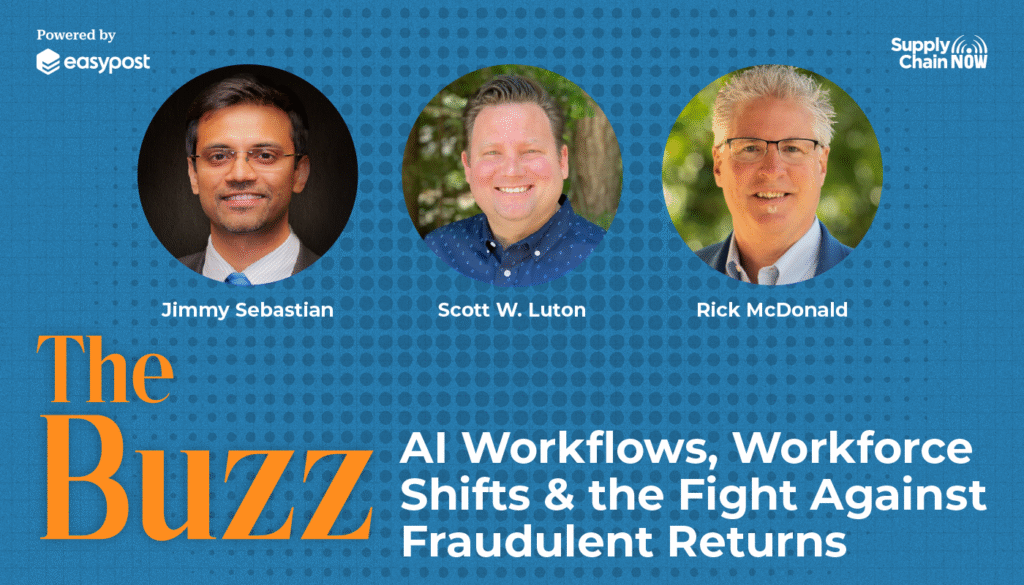
Hey, good morning, good afternoon, good evening, wherever you may be. Scott Luton and special guest, rock and roll co-host Rick McDonald here with you on Supply Chain. Now welcome to today’s live stream. Hey Rick, how you doing today?
Rick McDonald (00:26):
I’m doing great, Scott. I’m doing great and good to see you again and thank you very much. Nice to be back with you and the supply chain now crew.
Scott Luton (00:33):
You as well. And I’ll tell you what, it is great to see you. We’ve enjoyed all of our chats going back for years and we’re going to touch on some of the really cool things, big things you’re up to in industry here today. But folks, you know what it is. It’s the buzz here where every Monday at 12 noon eastern time, we discuss a variety, a wide variety of news and developments across global supply chain. Really global business news that matters is what we like to call it. And Buzz is powered by our friends at EasyPost through doing some big things in the world of global supply chain. They may help make shipping easy, flexible and scalable. You can learn how you can simplify your shipping operations and delight your customers. That’s fun to do@easypost.com. Rick, we got a big show teed up here today.
(01:17):
Let’s see what we’re getting into. We’re going to get into some big events coming up this week and later this year. Good news as it relates to the workforce showing interest in skilled trades. A startup is looking to make a difference in the fight, the massive fight versus returns fraud. And hey, did you pay more for your sweet chocolate for your sweet Valentine over the weekend? I know I did all that and a whole bunch more. And Rick even better, in about 12 minutes or so, we’re bringing in a special guest. Jimmy Sebastian with Four Kites is here with us. And folks, you’re going to enjoy his perspective. So Rick, did you take your multivitamins this morning like I did and ready to go on this big show on this President’s Day 2026. I
Rick McDonald (01:56):
Got a couple of cups of coffee and my multivitamin,
Scott Luton (01:59):
So I’m ready to go. Outstanding folks. The buckle up for a big edition of the Buzz Powered by our friends, easy post right here today. Hard to believe it’s mid-February 2026 already. So Rick, before we bring on Jimmy Sebastian, we’ve got four things that we’re going to knock out on the front end. Okay? Our work is cut out for us. So let’s start with the addition of, with that said, we dropped over the weekend and this edition folks, we led with some key takeaways from Manifest Las Vegas 2026. We got to start adding Las Vegas because they’ve announced there’s going to be a European component to manifest starting next year. How cool is that? But a couple of big things from Vegas. Global supply chain has moved well past, well, well past exploring AI into implementing ai, the importance of redesigning our systems, not just patching with an AI bandaid, the limitations that point systems offer.
(02:53):
It’ll be interesting to track point systems versus the massive orchestration platforms and current global disruption be keeping loads of cash on the sidelines. We wrapped with what I’d call a billion dollar question a twofer. Tools are advancing, signals are clearer, the gap between vision and execution is narrowing, but it begs the two part question, who’s going to act and accelerate and who’s going to be waiting? So folks, check out all of that and much more. And with that said, tools, resources, you name it. Now, Rick, I can’t wait to hear some of your thoughts on some of these themes or what else you caught up in. And with that said,
Rick McDonald (03:30):
It was a really good, with that said, it’s a very insightful session and the favorite part for me has to be this theme of the intersection of humans and technology. I spent a lot of time in the leadership development and executive education space and it’s always fascinating to me to think about how that intersection comes together for people and the gear they’re using. And I’ve been talking about this a lot on stage over the last 18 months as brand owners and shippers we’re all trying to operate at the speed of the consumer. And my point of view on this is we often talk about these as technology projects. It’s often the thing we start about. We either talk about the brand name of the technology or the technology itself, and I think that’s just mislabeled. These are not technology products per se. These are actually massive change management initiatives.
(04:21):
And I think in our minds, we all have to think about this because on every dimension we have to be thinking about change management, whether it’s in the people space, the leader’s mindset that’s got to change. The digital fluency has to increase the upskilling and reskilling of our talent processes. You can’t just map what you’re doing. You have to actually have new workflows that replicate the speed that you need to operate at in your new technology. And then visibility. So what are leaders going to do with all of this real time or very close to real time data at the same moment? The inertia of the organization is pulling you right back to where you were. And so this whole change management thing is a massive bit in order to be able to gain the ROI that the gear that you bought should be able to deliver. And I think it’s leaders and organizations that think about it that way and choose to act that will move faster, will be more competitive and leave their competition in the dust.
Scott Luton (05:17):
Rick, I love it, man, we got a bottle the last two minutes and share that with a lot of organizations and their leaderships because obviously it’s been there, done that perspective from you, Rick, and good stuff there. And folks, Rick is right. Two quick thoughts. Digital fluency, right? We all need to get better, not just our front line but all leaders so we know how to use it better and then plan for it and drive change. That was a big theme that Rick just shared. And secondly, Rick, after I brought you up in that ISO shot I figured out you got your colors on. That is a Georgia Tech yellow jacket gear you got on folks. If you used to call it Rick’s previous appearances, you’ll know that Rick, you played baseball at Georgia Tech, right? I
Rick McDonald (05:56):
Did, I did. And I figured I would wear Buzz for the buzz. So there’s a little, see
Scott Luton (06:00):
What I did there? Yeah, a lot, Rick. I like it. I like it folks. Check out what that said. Let us know what you think. Maybe you agree with me and Rick or maybe you disagree with some of the takeaways we got in there, but we’d love to get your thoughts and Trisha’s already dropped a link to that and make sure you subscribe. So you get all of those just about every week, almost weekly. Francisco, Francisco will try to work your question and I’m going to go ahead and throw it out there. We can get it in later in the buzz, but it’s great to have you part of this discussion. As supply chains become increasingly tied to clinical outcomes, what leadership capabilities do you believe will define the next generation of supply chain executives? Operational excellence, risk participation, or strategic influence. We’ll probably speak to this and I think Rick’s comments just did, but Francisco, stick with us.
(06:42):
Keep your perspective coming. Andrew is back with us once again from Schroer. Hope I said that right? Andrew, great to see you here today. Scott Curtis is with us. Hey all Schroer and Stafford Shire represented JRR Tolkien would be pleased. Great to see you, Scott. And of course Alan Jacque, AKA, the Rodney Dangerfield of Global Supply Chain. Great to see you, Alan. It’s been too long. So Rick, let’s see. I said four things. That means we’ve got three more to knock out before we bring on Jimmy Sebastian. Folks, I got to share this big event coming up, Rick. We’ve got a hit on our hands, our never normal series, which started with an episode last fall featuring three or four C SEOs has really drawn a ton of feedback. So hey, installment three has been scheduled and get this who’s who of a lineup. Rick Douglas, Guam, global VP of supply chain with the Hershey Company. They’ve been pretty busy lately. Corey Knox, who leads North America supply chain for Proctor and Gamble, personal healthcare supply chain operations. Shay Nessler, vice President, supply chain, CPG and Beauty with Danon and Eduardo oee, vice president, global supply chain with 3M all in the same show LED fearlessly by Corinne Bursa. Focus is coming up February 18th, that’s two days from now, 12 noon eastern time. We’re dropping link. So you can be part of that. We’d love to have you participate on that. But there’s more
(08:04):
Lineup
Rick McDonald (08:05):
Though, Scott, before you go. I mean that is, oh
Scott Luton (08:06):
Sure,
Rick McDonald (08:07):
That is a who’s who of Chief supply chain officers. What a great lineup,
Scott Luton (08:10):
Man. I’m with you Rick. I’m with you. I’m going to grab a Diet Coke and some popcorn. I got the day off thanks to Corinne for that one. I’m just going to sit with my notes and take probably, I don’t know, 372 pages of good notes from what a rock and roll panel that will be. But folks, wait, there’s more. We’ve got a national supply chain day coming up April 29th at 12 noon Eastern time. That’s about two and a half months from now. Join us as we celebrate many things across global supply chain, but especially the people that make supply chain happen each and every day. And Rick, really quick, I know from all of our past discussions, you’ve got a profound appreciation for the hardworking people, the talented, innovative people that make global supply chains happen. Quick thoughts there.
Rick McDonald (08:55):
I think the heroes in all of this are the folks in our factories and our logistics centers, their first line supervisors, that next level of management. I mean, everybody’s got a hard and complicated job, but they’re the ones that are showing up every day, all day 24 7, making it happen. And my hat’s off to all of them on
Scott Luton (09:12):
National Supply Chain Day. I’m with you Rick. Very well said. We’re here. We stand on their shoulders, right? Based on all the great work they do each and every day. So here’s the first correction of the buzz dated February 16th. I’ve gotten this wrong. Again, my apologies, Andrew and Scott Schrock Shearer Andrew’s told me a thousand times and I bet that Stafford Sheer, so Andrew and Scott and all of your neighbors, my apologies. I’ll get it right one day, I promise. And one more quick shout out. Hey Tom Valentine. Happy President’s Day and late Valentine’s Day. My favorite day to two of my favorite people, Scott and Rick tv. Great to see you. We’re overdue for breakfast and great to have you here today. Rick, I know you know Tom Valentine pretty good too, huh?
Rick McDonald (09:54):
Absolutely. Good friend.
Scott Luton (09:56):
Okay, so we knocked out some events. I’m down to one more thing before we bring on our outstanding guests here today. Our friends at US Bank recently released their Q4 2025 Freight payment index. Released it just two weeks ago and there were more than a few surprises. I think one of the biggest surprises might’ve been the across the board increases in quarterly spending, even in regions where quarterly shipments declined a clear signal. That capacity is exiting the industry. And as we do each quarter with US Bank, we conducted a live stream last week reviewing the key takeaways from the Q4 index with US Banks, Bobby Holland and Nick Pucci, senior Director of Supply Chain Logistics and Final Mile at Ferguson Enterprises. If you missed the livestream folks, the podcast replay is going to be dropping on March 2nd, so don’t miss that. If you’re subscribed to your supply chain now, it’ll automatically be delivered to your podcast player of choice.
(10:50):
But check that out. And if you missed our January live stream covering the all new US Bank Freight Payment index rates edition with Bobby Holland and Dr. Chris Capless from DAT Freight Analytics, you should definitely check that out. We’ll drop a link maybe to that in the chat and you can find links to all of our published podcasts with US Bank on their strategic alliance leader page that we host@supplychainnow.com slash US Bank. And of course, you can also download all this great data-driven insights@freight.us bank.com. Rick, we can’t get enough of real market data-driven insights as we make decisions big and small in global supply chain organizations each and every day.
Rick McDonald (11:34):
Absolutely. And this topic of visibility and orchestration is becoming more and more important. And I’m keen to see where it goes with respect to big platform solutions versus single point. I tend to gravitate towards the single point. I’m not sure platforms are long-term going to be there as more and more activities move to artificial and agent ai, we’ll see. But it’s going to be an interesting conversation as we move ahead and how those capabilities solve real problems that we all have in our supply chains.
Scott Luton (12:02):
Rick, good stuff. I can’t wait. I’m going to keep my finger on the pulse. My crystal ball has been broken a long time, but we’ll see how the evolution continues to move forward. And by the way, Andrew gives me a score nine out of 10 for ra, she nine out of 10, I’m working on that 10th point Ed. Hey, feel it, Robert, great to have you again from Cape Town South Africa, great to see you here today, Robert. Looking forward to hearing your perspective on what we talk about here today. Alright, so Rick, we’ve got a great guest M and you enjoyed speaking with Jimmy Sebastian in the green room here today pre-show. So folks, if you don’t know Jimmy Sebastian has spent over 25 years building high powered technology platforms and products that transform global business. He brings over 25 years of industry leadership experience to the table, including deep expertise creating AI that’s not just powerful, but explainable, secure and enterprise ready. Now, currently, he’s on a mission to build a digital workforce of AI agents that augment supply chain operations, turning thousands of manual tasks that none of us like to do into intelligent automated workflows at scale across global supply chains. Please join me in welcoming Jimmy Sebastian, vice president of AI products at Forkites. Hey. Hey Jimmy, how you doing?
Jimmy Sebastian (13:17):
Hey, I’m Scott and Rick. Great to be here.
Scott Luton (13:19):
Great to have you. Now Rick, Jimmy calls Los Angeles home and he was telling us when I asked him what the weather was like in LA earlier, I expected a perfect 70 and nice and cool, but it’s raining in LA today, which is a bit unusual. Jimmy, is
Jimmy Sebastian (13:33):
That right? Yeah, it is. But yeah, we do get a little bit of rain during the winter season.
Scott Luton (13:37):
Okay. Alright Rick. So we’ll have to avoid the winter season when we venture out to California. All right. Rick
Rick McDonald (13:42):
Makes it nice and green though. It’ll dry up about May, but right now it’s going to be really green and pretty.
Scott Luton (13:47):
Yeah, that is right. That is right. Well, here, I want to start with a fun warmup question. Jimmy and Rick, I want to share what a fun image just came to us via Donna Creche, one of our executive producers here, Mardi Gras, right? Looks like they’re having a great time in New Orleans. I think this was last year, Donna, I stole this from your social media, so don’t come after me too hard, but look forward to talking with you soon. And I want to use that for our fun warmup question because Jimmy and Rick, as I learned something earlier today, tomorrow, February 17th is Mardi Gras, AKA Fat Tuesday. That’s the final day of the carnival season. And of course, Mardi Gras celebrated in a variety of places, but chiefly big time in New Orleans. And I’ve been to New Orleans a few times, but never during Mardi Gras, which I’m missing out maybe next year. But Jimmy, I want to ask you, what is one of the coolest holidays in some city abroad that you have enjoyed being a part of?
Jimmy Sebastian (14:43):
Yeah, it’s funny. Mardi Gras was actually the name of the big cultural festival when I went to college and it was pretty wild and fun. So the name does bring back great memories, and I haven’t made it to New Orleans for the real thing yet, but one of the fun cities that I would say that I’ve been to is Tokyo, just wandering around eating the street food. I’ve seen the cherry blossoms stumbling into these ancient shrines and temples right in the middle of a ultra modern city. Honestly, you could spend a week there and still feel like you barely scratched the surface. So I got to get back,
Scott Luton (15:21):
Jimmy, my wife and my daughter went to Tokyo last year, early last year, and they absolutely rave the images, the food, the sight, the sounds of people, everything was like a plus. So Jimmy, I’m going to find a way to get to Tokyo soon. Now, Rick, I know you travel extensively as well. I bet you and Jimmy are regularly moving around the world. Rick, what’s been one of the coolest holidays you’ve been even enjoyed in a different part of the world?
Rick McDonald (15:47):
I’m going to stay here in the US because it’s a super memorable experience and one that I got to experience with my family. It was July 4th in Washington DC and we picked the Iwo Jima Memorial as the place to view the fireworks down on the capitol and the Washington Monument. It was just kind of surreal to be sitting up there and looking at all the amazing government buildings in Washington DC while the fireworks went off. And it really is a spectacular display. So that was one of them. I’ll never forget,
Scott Luton (16:16):
Rick kind of slept on DC for a long time and then we went and took all the kids a couple years back and just all the sites and sounds and museums and a lot of ’em are free to get into. And I’ll tell you, it is such a great learning opportunity, not just for our country, but just globally in our nation’s capital. So hadn’t been there on July 4th, but I can see how that’d be incredibly special. Well, Jimmy and Rick, beyond celebrating your adventures, we’re going to celebrate and learn from your perspectives here today. We’ve got a lot to get into and I want to welcome in. Hey, Nadine from Saudi Arabia, great to have you back with us here today. Looking forward to your perspective. First topic we’re going to talk about here today, we’re going to start with some good news, Jimmy. Rick, we don’t get enough good news in today’s society it seems, but I’m always convicted that if you want some good news, you go looking for it.
(17:03):
And you will certainly find some here, our friends from manufacturing dive sharing some good news related to the skilled trades. So according to a recent survey published by resume templates, six in 10 by my South Carolina math, that 60% of Gen Z’s plan to pursue jobs in the skilled trades and just so we’re all level set here, construction, electrical, hvac, plumbing and more. All those are some of the great professions considered skilled trades. So that 60% interest level is a bit different from the results that a Harris poll found in 2025 where they found that less than 40% of Gen Z has planned for a career in the skilled trades. According to the US Bureau of Labor Statistics over the next several years, we’re going to need 150,000 construction workers just in the States a year, just in the States each year and another 80,000 electricians. Oh my gosh. Some corporations are investing resources and the programs that help bridge these gaps, including our friends at Schneider Electric, home Depot and Carrier Global. So Jimmy, I’m really curious. I think this is good news. What are your thoughts here?
Jimmy Sebastian (18:09):
This is a really good one that caught my eye because I think as someone who builds AI products every day, I think this reaction from Gen Z is partially right, partially wrong. So AI will absolutely transform a lot of white collar knowledge work, but I don’t think it’s going to eliminate it is just going to reshape it. And the people who are going to thrive are the ones who learn to work with AI not to compete against it. But then here’s a supply chain angle that I think is really interesting. We desperately need this labor pipeline. There’s over 550,000 jobs unfilled construction roles right now. So if Gen Zs bring this energy and their digital fluency like Rick was mentioning into the trades, then I think that’s a massive win for logistics infrastructure, for warehouses, for distribution centers, for fleet maintenance. So it’s going to be a win for all of us.
Scott Luton (19:02):
Well said there. And Rick, he references one thing as part of a response. We have seen all the announcements and we’ve seen a lot of projects get started. I think there’s 3000, y’all check me on this just in the US there’s 3000 data centers under construction or planned. There’s going to be a lot of human talent that makes that happen. But Rick, your thoughts on this newfound potential interest in skilled trades.
Rick McDonald (19:24):
Yeah, I’m fully where Jimmy is and I’m going to connect a dot on either side of what he commented on. And the first one is for decades we instructed all of us that college was the only path or likely the only path to really having a successful career. And as we all know, there are many ways to have a successful career, but what it did was it created a void in the skilled trade area. It also created a lot of college graduates who are probably overkilled and underemployed in their current assignment. And so I absolutely get it. They’re looking at the ROI, they’re looking at the level of satisfaction, looking at what they want to do with the next 10, 15, 20 years in our life and they’re seeing this as a great path. The dot I’ll connect on the other end is we need those skill trades for all of our manufacturing activities. It’s been really hard to recruit for manufacturing talent here in the US over the last five to 10 years. And so the more people we have in skilled trees, the more likely they are to gravitate towards something that would be beneficial in one of the new manufacturing plants that’s going to come online here in the us.
Scott Luton (20:26):
Rick, great point. And of course manufacturing is one of my favorite parts of global business. I was very fortunate to spend some time in that industry as of course you were too, Amanda and Tricia behind the scenes. First off, thank you for what you do to Rick’s comments there. We just had a great webinar on really quantifying the skills gap in the manufacturing industry and offering some best practices for what leading companies were doing about it. So Amanda and Tricia, if we could drop a link to that session with Dr. Allen Ling and a few others, that would be terrific. But Rick and Jimmy, well said, appreciate y’all’s take on this topic. And again, I think this is a good trend. We’ll see where it goes from here. Now we are going to talk about, this is like the buzz full of Scott’s favorites because we’re talking about some of my favorite topics here today.
(21:09):
One of my next ones is reverse logistics and returns management. I find this to be a fascinating part of our world. So I was at a great event in Dallas last year hosted by Tony sch Sheroda Scott Caseon NRF team, and we toured returns processing center thanks to sender Shamus and the return protein folks, if you have not toured a returns processing center, it will help you wrap your head around this tidal wave of returns that we have to do something with each and every year. So as part of that tour, Rick and Jimmy, we got a demo of this really cool technology you see here from Clarity. Now as reported here by the Wall Street Journal, clarity is a new startup that offers technology to help retailers identify counterfeit merchandise and return goods. Their technology uses AI to scan return products for differences in organic materials or missing parts or counterfeit parts like fake batteries, fake chips, you name it all helping to flag potential counterfeits or incomplete returns.
(22:05):
It’s even helping to find fraud in returns that are in their original factory packaging. How about that? We need a whole bunch more tech like this to deal with this tidal wave of returns I was talking about earlier because get this, as the Wall Street Journal reports, US consumers returned an estimated 15.8% of purchases last year with 9% of those returns being fraudulent. Big time problem. That’s got to cost retailers not only millions of hard tangible dollars, but no telling what the cost is in terms of intangible waste related to time, resources and the like. And always, before I get to Jimmy and Rick here, folks, we’re dropping a link to all these stories. Trisha’s busy today dropping a link to all the stories right there in the chat so y’all can dive in full. But Jimmy, your thoughts on new technology in the returns space, specifically helping to fight return fraud?
Jimmy Sebastian (22:58):
Yeah, so it’s a great example I think of how AI is creating entirely new categories of capability in the supply chain. So think about it, right? So before this startup clarity came along, you had two choices when it comes to returns. You could manually inspect every item, which is slow and inconsistent and expensive, or you could just eat the loss, right? But now with clarity, you can actually x-ray a seal box and detect counter feeds and component swaps and missing accessories without ever opening it. And I think that’s not just an incremental step or an improvement, but I think it’s a big leap forward and a hundred billion dollars when you talk about the annual returns fraud, that’s not a rounding error by any means. It’s a huge, I would say, p and l crisis for the retailers. And at forkites we see the exact same pattern. The biggest ROI almost comes from automating those messy manual processes that everybody’s been ignoring.
Scott Luton (23:58):
Jimmy, I like it. So Rick, I’ll tell you returns. I’m not sure what you’ve seen in your career, but it is becoming a bigger and bigger problem despite some of the gains we’re making in that part of global supply chain. Your thoughts?
Rick McDonald (24:10):
Well, Scott, you mentioned 9% fraudulent returns. I’ve seen numbers that are almost double that in some return centers depending on the category, there’s a massive problem as you both noted, and I think it’s going to get worse. This whole gaming of the system seems to have its own little set of industry players and industry makers, and I love the use of AI for this purpose. What I’m curious about is how the point of sale systems and the refunds are going to be tied to these returns. Now if you’re returning to Amazon, they have the right to and do challenge the return and maybe deny payment or move in that sort of direction. But if it’s a cash return or a gift card, the timing of this is all going to matter greatly. And so I’m curious to see how that’s going to evolve to make sure that the effect monetarily is actually going to take place on a consumer that returns something fraudulently.
Scott Luton (24:59):
Yes, a lot of good stuff there Rick. And I may agree with you in terms of the return, the fraud percentages going higher and higher. When I was out at that event I was talking about earlier, Rick and Jimmy, I rubbed elbows with Chuck Johnston and Chuck has done some really big things in the return space and rolled out has created the initial reverse logistics ecosystem for really big retailers. So he is a bit of a legendary figure. And Jimmy and Rick, he was blowing my mind with some of the fraud approaches they’re seeing these days with power tools that you buy that are battery powered, that the batteries get swapped out to really cheap stuff and then get returned. And of course, the hardworking retail associates at the desk, especially for in-person returns. Until we get more and more technology like this with clarity, they have no way of really knowing, especially all the different products that may come back.
(25:46):
So that was fascinating. And then secondly, organized crime getting more and more into the fraud game. So Rick and Jimmy, we’re going to keep our eyeballs on this and see where it goes, but we all play a role as consumers, as practitioners. We all play a role and I appreciate y’all’s comments here today. Nadeem is dropping some supply chain poetry. Nadeem says AI is created by humans. It cannot be replaced. The creator cannot be replaced by creation. Okay, I like that, Jimmy. My hunch is I see you smiling. You might just have a comment or two on that, but we’ll save it. We’ll save it for one of the next segments. Okay, let’s talk Valentine’s Day. Let’s talk about one really important notion related to Valentine’s Day. It’s one of my favorite topics. Again, that’s chocolate. CNN business. This isn’t necessarily good news though. CNN business is reporting on chocolate prices that were spiking just in time for Valentine’s Day over the weekend.
(26:38):
In fact, here’s what did you know, the National Confectioners Association, 75% of all candy sold around Valentine’s Day is chocolate. How about that? Why the hate on nerds? Right? Nerds are great for Valentine’s Day gifts, but we’ve talked a lot about chocolate prices regularly over the years, and I’ll tell you, they always seem to spike around the holidays. I think there might be a little bit more to the story, but I’m going to put my 10 foil hat aside and talk about what CNN business reports on chocolate prices are up 14% year over year from last year to 2026. That’s almost double the price hike that took place from 2024 to 2025. One of the primary reasons as reported are the continued cocoa bean shortages. There’s been a lot of extreme weather in west Africa. West Africa produces 70% of the world’s cocoa. All that disruption has caused cocoa beans to increase from $2,500 per metric ton in 2022 to almost 13,000 per metric ton in 2024. But there is a little bit of good news because it’s dropped to back down to $4,000 for cocoa beans per metric ton recently. So maybe we see Easter and Halloween price breaks for candy and get this one last thing, Jimmy, get you a comment. One Hershey’s executive says, we can’t blame tariffs for this one saying quote, we can’t make cocoa in the us. So we were happy about that. Hey, silver linings. I love silver linings. Jimmy, your thoughts on chocolate prices coming up, coming down, their fluctuation, your thoughts?
Jimmy Sebastian (28:05):
Yeah. Oh man, I think this is a big one. I would say it’s a classic case study in supply chain dynamics and it’s really a story about time lag. As you noted, cocoa futures have come down crashing, but the chocolate sitting on shelves today was made with beans that were purchased a record highs, right? And it’s the classic bull web effect that’s playing out in real time. So it’s very interesting to see, but I think there’s a deeper lesson here that goes way beyond chocolate climate driven disruption to agricultural supply chains is unfortunately it’s a new normal now. So West Africa produces 70% of the world’s cocoa and a single bad harvest season as we had has sent shockwaves through the global markets for about two full years. And so that kind of geographic concentration risk is exactly why supply chain leaders need to be looking out for optimization and visibility solutions and diversified sourcing strategies.
Scott Luton (29:03):
Yes, good stuff there Jimmy. Rick, do you see how Jimmy always ties it back to good supply chain leadership practices? I love that, Rick, your thoughts on chocolate and us paying more a lot more for chocolate these days.
Rick McDonald (29:18):
My comment and the only comment is going to be around what my wife would say she loves chocolate and she’d say higher prices. What’s your point?
Scott Luton (29:27):
Keep it coming right? Keep it coming. That’s right. Well speaking of significant others, I certainly enjoyed some of these Russell Stover. Now they call ’em pecan delight. If you’ve been around caramel, chocolate and pecans like I have, these are turtles, right? And let’s see here. Jimmy and Rick, I think there was eight in here at one time and they are long gone, so we got to resupply the warehouse. They were so good. It’s a big shout out to Amanda. Alright, so Jimmy and Rick, by the way, Tricia, dropping again on links to all these, all the articles that we tackled here today. And by the way, I hope everyone’s Valentine’s Day was as happy as everyone’s here.
Jimmy Sebastian (30:05):
Just a quick thought there, Scott. I mean if prices are high, I think the wife says it’s great. That means if you buy that, it’s a luxury item now, right? That’s right. Ways to show you love. And so we should be looking at the price
Scott Luton (30:19):
It pays to show your love and you get what you pay for, right? Alright, so let’s see here. We’re going to dive in a little bit deeper with the cool things that Jimmy Sebastian and the Forkites team are up to. But first I got to share a little bit of news from our friends at Easy Post because we’ve got a great session coming up here today. Webinar session coming up Thursday, February 26th. Circle that calendar folks, that’s just 10 days away. Me and special co-host Laurie Boyer are hosting a talented panel exploring the notion that chat, GPT is just beginning for shipping. We’re going to be walking through how large language models are currently being used in shipping and how that continues to evolve by the hour. We’re going to keep it very real. EasyPost always does examples, limitations and been there doing that perspective with Tyler and Tom.
(31:07):
Come join us as we separate the week from the chaff register using the link we’re dropping right there in the chat and Ohia on February 26th. So Jimmy, y’all got some big news, you and the four kites as you continue to innovate global supply chain with technology. I want to level set on something, something me and Rick have talked about over delicious Atlanta area meals going back a few years. Hey, the struggle is real for many companies out there, many leaders out there to move from pilot AI projects to measurable business outcomes. Now, from your experience building AI products at Forkites, two part question here. What are the most common barriers to scaling AI and supply chain operations and how can leaders overcome them? Jimmy?
Jimmy Sebastian (31:49):
Yeah, it’s a great question, Scott. So yeah, the pilot purgatory problem is very real. We see it all the time. A company runs a successful proof of concept, everybody gets excited and then it just stalls. And in my experience, there are three main barriers and honestly, none of them are technology. And the first one is starting with the technology instead of looking at the business problem. So too many teams, they say, Hey, let’s use AI instead of asking what specific operational pain is costing us real money. So at forkites, whatever agent we have built, whether it’s Tracy for Track and Trace or Sam for document processing, we start with a specific measurable business problem. And so for example, if you have an agent and using that, if response times go from hours to minutes and if an assigned load percentages go down, that’s the kind of outcome that funds the initiatives.
(32:50):
So I would say that’s the first barrier. And the second barrier is the data that provides network intelligence. And everybody says this, but let me be specific about what it actually means. It’s not about having a data lake or a data warehouse, it’s about having internal operational data combined with external network signals that support critical decisions. So we process 3 million shipments per day across thousands of companies. And that network data is what makes ai, I think actually intelligent so that they’re not just guessing, but they’re learning from real operational patterns. So data and having that network intelligence I think is a second. The third barrier I think, and this is the silent killer, is the people and process gap. So you need people who trust AI enough to let it run, but also know when to step in and override it. You obviously don’t want it to be running amuck, right? So start with AI augmenting human decisions first and then prove the value and gradually increase the autonomy. So those are the three things I would say. And Scott, if I had to boil down to how to overcome all of three, I’d say this, right? So pick your most painful, most repetitive process and automate that one thing really well. Measure the ROI pretty obsessively and then use those results to fund and justify the next. So that’s how I would say you compound your way out of pilots into production.
Scott Luton (34:20):
Jimmy, love that. I feel like I’ve gotten a masterclass in the last couple minutes, and Rick, we’re about to get even better because I know you’ve done it, you’ve crafted a strategy and you’ve led the change, digital transformation change through your leadership career. What are your thoughts on Jimmy’s response or the initial question?
Rick McDonald (34:35):
Yeah, it is just right. And the thing that I learned was you’ve really got to have the inventory of the problems you need to solve. And then right after you get that inventory, you’ve got to look at the materiality of that problem, running it through a financial reputation, customer and regulatory filter that’ll help you force rank those problems. And then you got to decide, is this really something I need to solve with a digital asset or do I need better workflows? Do I need better trained people? Do I need different people? Once you decide on the digital asset, then it’s really using your digital fluency to figure out what type of asset will solve this problem. Not all of ’em do the same thing, of course, and that’s the real trick here. When I see digital transformations that fail, it’s either the problem wasn’t well understood and there wasn’t really a business case behind it. Number two was you didn’t understand the gear that you were buying or you got sold something that didn’t really solve your problem. Number three was you did a bad job of change management. It’s almost always one of those three things.
Scott Luton (35:33):
Been there, done that perspective between Jimmy and Rick here today. Really quick, Jimmy, I’m going to ask you about Loft in just a second, but Rick just laid out three things that he has seen time and time again from the lack of business case to maybe not understanding the solution or maybe even buying the wrong solution. And what was that thorough one, Rick? I was trying to write it down.
Rick McDonald (35:54):
Change.
Scott Luton (35:55):
Oh, how could I forget that one? Jimmy, comment on that really quick. Maybe one of those three or maybe do you see the same repeated problems and mistakes out there that leaders make?
Jimmy Sebastian (36:05):
Yeah, I think exactly right. I mean, I think we’re very aligned in our thinking and Costa Rica has all these decades of experience. And what I’ve also found as a critical factor is how much of executive support there is in getting all this done. Because unless, especially when there’s a lot of anxiety about AI and what it can do to the job market and the workforce and people are looking for direction and guidance, and I think that’s where the executive thinking and backing plays a big role in making sure that we have the right environment and then we’re able to pick the right business problem and then go all in and have a situation where humans are in control and it’s a managed rollout of ai. So I think that’s a critical factor.
Scott Luton (36:56):
Jimmy, well said. And I just wanted to mention one thing on something you shared there, workforce anxiety, if there’s anything that should keep us all up at night, is the notion of any member of your team, small team, big team, all points in between being anxious or uncertain or nervous or pained with what’s next, what’s next, they next in their role being replaced, you name it. And I think all of us, I think we have a great leadership opportunity to get a lot better in how we communicate, how we navigate, going back to change management that Rick mentioned, we’ve got to get better there because I tell you, it pains me to think of folks really nervous about their roles or about their value in organization or you name it. Okay, Jimmy Sebastian. And by the way, Jimmy, I shared an pre-show. You have got such a rock and roll name. We were talking about how you got to be a lead singer of the supply chain version of Guns N Roses or something like that. Jimmy, that’s where my head went when I was introducing you earlier. But let’s talk about some big news that y’all are doing over at Four Kites Loft. Tell us about Loft and what it poses to supply chain leaders everywhere.
Jimmy Sebastian (38:04):
So we just launched Loft at Manifest and it was a great event and really excited and I love telling the story. Where do you store a kite? You store it in a loft. So that’s the connection that really helped us. Four Kites is our name. So that’s the connection that helped us name the platform four. Forkites Loft is our AI native agent development platform and management platform. It’s where our digital workforce, Tracy Sam, some of these named agents that you may have heard of live and get created and get managed. And here’s the problem it solves. So today, if a supply chain leader wants to automate a workflow, say automatically rerouting shipments when a weather event hits or sending proactive delay notifications to customers, that takes months of custom development sometimes and requirements gathering, coding, testing, integration, all of that. So by the time you deploy the business has probably moved on to some new problems, right?
(39:02):
And so it’s a big cycle time that we’re talking about and lofts changes it completely. So you describe what you need in plain natural language. And our AI developer agents, Sophie converts that into what we call as agentic operating procedures. So standard operating procedures converted to agentic operating procedures, which are basically blueprints for an intelligent workflow. Sophie then builds it, tests it, and helps deploy it while being guided by human developers and architects. And the whole thing is supercharged with forkites network intelligence, which is real-time data from Millian shipments. So what does it mean for supply chain leaders? What does Loft represent? I’d say three things. The first is speed. So you go from concept to production in days, not months. The second is accessibility. So you don’t need to be a data scientist or a developer and supply chain operators who understand the business problem can now create a quick solution themselves. The third thing is intelligent intelligence. So every agent that you build on and within Loft inherits the insights from the Forkites network so it understands carrier behavior, transit patterns, facility performance across the industry from day one. And so I think the bigger picture is that Loft is the execution layer of our intelligent control tower solution. And the control tower gives you operational visibility, you can see what’s happening and Loft gives you the action. So it basically connects the visibility into action. So that’s a leap from visibility to action to autonomy.
Scott Luton (40:32):
Good stuff there. Jimmy and Rick, one thing he shared between the speed accessibility and intelligence that really resonates with me is that our time to develop and implement solutions out there. The great thing about, for example, the simulations that are running these days versus it taking a month back in the day, I’ll pick on 1987 or whatever between manual calculations and I was going to say T squares, but it’s not T Square, it’s whatever the engineering tool. You know what I’m saying? Rick slide rule. What’s that
Rick McDonald (41:02):
Slide rule?
Scott Luton (41:03):
Yeah, slide rules, right? It would take forever, right? These simulations and by the time we arrived at the answer, the problem’s way done, it’s just a bunch of wasted work. Now of course I’d be a little bit extreme in that example these days, but if we can take simulations from days or hours to seconds, oh my gosh, the smarter intelligence we can apply to guiding our organizations and making decisions. But Rick enough from me, I mean you have led organizations that need some of these things that Jimmy had mentioned, whether do you get it from four kites or elsewhere? Your thoughts, Rick?
Rick McDonald (41:35):
Well this is the beauty of the digital twin aspect of this going from weeks and months to literally seconds and really having the ongoing ability to replicate your supply chain and various assumptions about your supply chain in real time. And that is a fabulous construct and it’s all in service of being able to operate at the speed of the consumer. If we think about all of this stuff that we’re doing here, we’re doing it to squeeze out the losses to drive out the waste, that’s going to help the bottom line. But at the end of the day, we got to be present on the shelf with a consumer wants us, whether that’s a virtual shelf or a brick and mortar shelf. And capabilities like this at Forkites really help advance that agenda quite nicely to operate at the speed of the consumer.
Scott Luton (42:17):
Well said. And folks, you don’t have to keep me honest, I got to stick to my compass and my protractor and lead those slide rules and T squares alone. I’ll leave that to the smarter folks like Rick and Jimmy here. Alright, so I want to ask you about this, Jimmy, I really enjoyed being in Denver last year for the Gartner Supply Chain Planning Conference. It’s been a really popular part of their programming for a couple years now. And one of the big key themes I left with one of my favorite parts is how leading organizations were investing in a deliberate human machine strategy. Lots aren’t, but some of the leading organizations are. Jimmy, what would be your advice? I mean, you’ve been around AI since before ai, long before AI was cool and doing the cool things it’s doing now, big things it’s doing now. What would be your advice you’d like to offer to supply chain leaders that want to incorporate a similar formal part of their strategy in their organizations?
Jimmy Sebastian (43:08):
Yeah, great question to bring up Scott. So there was a phrase at Gartner that really struck with me. So someone said, don’t spread AI like peanut butter, right? And I think that’s exactly right. A human machine strategy is not about ing AI everywhere. It is not about just blanket use. It’s about really being deliberate about where you apply it and which decisions you automate, which ones to augment and which ones you want to keep fully human or mostly under human control. And I think we can think of a framework to manage this. Let’s call it the three A’s, right? The first one is automate. So these could be the high volume, repetitive low judgment decisions. I think that’s where you have AI playing a big role there. And the second part of the three A’s is augment. So these are your medium complexity decisions where AI provides the recommendation, but human makes the final call if think about some optimiz route optimization, appointment scheduling, and probably exception prioritization.
(44:11):
And so here, AI surface is the best option and the humans validate and proof. The third AI A would be advice of this framework, and these are your strategic high stakes decisions. So network design, supplier selection or supply contracting and strategic selection, et cetera, capacity planning. So here the AI will provide scenario analysis and predictive insights, but humans ultimately bring the judgment, the relationships, and the business context that AI simply cannot replicate. So I think that’s where just want to emphasize that there’s a place and a certain thing that AI does well and so you really have to be very strategic about where you want to use it. Finally, I’d say invest in the people side first. Make sure that people are fully digitally fluent, AI fluent and redefine the roles and make sure that they’re constantly upscaling because the best planner with AI tools can do a lot more than what many planners can do just a few months ago in fact. And so that’s not really a threat to their job, but think of it as a superpower. And I think you have to frame it like that from day one.
Scott Luton (45:21):
Jimmy, good stuff. And folks, I use spreadsheets all the time. I’m going to keep it real. However, we got to get more and more spreadsheets out of global supply chain. And I think to anyone out there that’s using spreadsheets for what they do day in and day out, the sooner you can learn other forms of technology to get all that time back, the better off the more value you’re going to bring to the organization. Rick, that formal human machine strategy, what would be your advice? I mean you’ve been there and done it led massive, some very successful organizations. Your thoughts? Well the first
Rick McDonald (45:49):
Thing, and I agree with everything that Jimmy said, I’ll see if I can compliment it just a little bit. The first thing is it’s a strategic mindset shift for the leaders in organizations where AI is just sort of a nascent capability. They’re often just asking the very rudimentary question of where can AI replace labor? It’s sort of an admin play and that’s actually not the right question. The right question is where can AI reduce that cognitive load of constant keyboarding, lots of data, lots of transactions, very repetitive work, where can it reduce that cognitive load so that time is freed up to think more strategically about bigger things and that is where the real value comes from. So I’d say that’s the number one thing is shifting our mindset from this is an admin play to this is a very strategic forward looking activity to figure out how we can actually increase the competi our organization through more strategic thought.
(46:45):
The second thing is around not the technology, as I said before, it’s really around the decisions you want to make using the technology and is this a problem you want to solve with this capability? And last but not least is this idea of you can’t sleep on change management. You just absolutely have to make sure that your change management is right on point. And part of it starts with the trust element of these tools. Most of us don’t like believe in off the bat black box solutions. We want a glass box. And so the more that you can show the end user how the solution was derived, how it got to that thinking, how it got to that answer and outcome, the better chance you have of making your change into this technology work and work well
Scott Luton (47:28):
Man, Rick, outstanding in this notion of a glass box. That might be something I’ve missed for years, but I love that I can just picture that and picture the value of that let’s folks in any organization, they want to know why we’re doing what we’re doing right and how it works and how it’s going to make my day easier to find success. So very well said there Rick and Jimmy. Man, I really wish we had a bonus addition to the buzz here today. I’ve really enjoyed both of your perspectives, Rick, of course I’ve always, I mean you’ve established a big track record, but Jimmy, your first time on the Buzz and you’re hitting it out of the park, so you’re going to have to join us again soon folks, as we start to wrap. Thank you, Tricia. If you want to learn more about Loft and the big news they rolled out at Manifest, we’ve got a great link there. Tricia is dropping and I’m sure Jimmy, I have a hunch that you’d love a following conversation to talk about the cool things you’re doing with Loft and otherwise. Is that right,
Jimmy Sebastian (48:21):
Jimmy? Yeah, definitely Scott would love to join you.
Scott Luton (48:24):
Excellent. And folks, we’ll make sure you know how to connect with Jimmy and Rick in just a minute. I want to close out with a couple of resources folks. If you enjoy live discussions just like this one very live on this 16th day of February, 2026, go check out our upcoming live programming calendar. You got all of our remote calendar, you’ll find our upcoming programming at modex and Gartner and many other places. So go check that out. And while you’re there, check out that resource hub. You see that little link right there. You’re going to find white papers, news, eBooks from a wide variety of leaders from Deborah Dole and Tony Sheroda and Rich Bulger there, InterSystems, Amazon Freight, you name it. And we’d welcome as always your feedback on any of those perspectives. Alright, really quick, Alan Jacques says The evolution of the self-driving car is a good proxy for how AI will evolve over time.
(49:18):
Alan, I agree and I look forward to the day that I’ll be jumping into a car and be perfectly okay with not trying to touch the steering wheel or the gas or the brake or you name it. We’re going to be there soon, folks. Alan, good stuff. And Tom Valentine says, MIT’s offering free AI courses as well as a great callout. Tom, I would argue we had a little pseudo MLT session here today with Jimmy and Rick given their perspective. And Tom, look forward to breakfast soon. Okay, so Jimmy, Sebastian, let’s make sure folks know how connect with you and the four kites team. What’s the easiest way to have a chat
Jimmy Sebastian (49:54):
With you? Yeah, absolutely. So people can find me on LinkedIn. I’d love to connect over there and sometimes to share thoughts on AI and supply chain. And if you’re curious about Loft and our digital workforce, then hello to four kites.com. We’d love to show you for our listeners, we’d love to show you how agent looks like in production and not just on a slide deck.
Scott Luton (50:15):
Outstanding. And folks, we’re dropping links so you can connect with Jimmy right there on LinkedIn. It’s been great to have you here, Jimmy. Now Rick, I think we touched on this on the front end, but our team has done some homework. You’re a tough person to kind of track down and see where you’ve been. But let’s see here, over 20 times, you’ve been on stage over the last year, 3,275,000, 426 miles. You have traveled, you’ll check me on that last number, but US, Canada, Europe, and you’ve really been delivering some home run content. I’ve seen you in action, some very popular sessions on supply chain, digital transformation, adaptive planning, even the future manufacturing, logistics and procurement and more. So if folks want to take you up on what you see, how can folks reach out to you, Rick McDonald?
Rick McDonald (51:05):
Yeah, for sure. I appreciate that Scott. So first of all, LinkedIn, love to connect with you there. You can also reach me at rickMcDonald@att.net. And lastly, I’ll be at modex here in Atlanta in April and would love to connect with, love to connect with you there.
Scott Luton (51:20):
Outstanding Rick. I look forward to seeing you there. We’re going to be on Podcast Row all four days or so, whatever it is with modex, A big shout out to Daniel. And again, do a great job, Rick and Jimmy Modex is bringing their planning on almost 40,000 people. It’ll be the biggest modex ever. So that is remarkable. Right here in Atlanta, supply chain city. Well, I got to thank you both. I tell you, I feel like I’ve gotten smarter over the last hour just by absorbing what y’all two both have been sharing. Jimmy Sebastian with four Kites. Jimmy, thanks very much for being here.
Jimmy Sebastian (51:52):
It’s been a great pleasure. Thank you, Scott.
Scott Luton (51:54):
Same, same and may sunny skies soon reestablished themselves there in Los Angeles. Jimmy, Rick McDonald, you’re rocketing up the charts here on supply chain. Now. It’s always a pleasure to have these conversations with you. Thanks for being here, Rick
Rick McDonald (52:10):
Scott, thank you very much for having me, Jimmy. Really nice meeting you. Enjoyed the conversation. Likewise, same,
Scott Luton (52:15):
Same also beyond Jimmy and Rick. Thanks to Tricia and Amanda behind the scenes for making it all happen. Big thanks to our friends at EasyPost who are powering the buzz all month long in February, and who are helping to make shipping easy, flexible, and scalable. Learn more. easypost.com. Big thanks. Most importantly, to our audience, I know we could hit everybody’s comments here today. Really appreciate you being here on the Buzz for February 16th, 2026. But he got homework. Jimmy and Rick brought it. They brought very innovative but actionable perspective. Your homework is to take one thing that you heard here from Jimmy or Rick, share it with your team. Do something with it. Deeds, not words. That’s how we’re going to keep transforming global supply chain, leaving no one behind. And with all of that said, on behalf of the entire team here, Scott Luton, challenger, you do good, give forward, be the change that’s needed, create some good news here today. And on that note, we’ll see you next time. Right back here on Supply Chain now. Thanks everybody.
Intro/Outro (53:06):
Join the supply chain now community. For more supply chain perspectives, news and innovation, check out supply chain now.com. Subscribe to supply chain now on YouTube and follow and listen to supply chain now wherever you get your podcasts.