[00:00:00] Mike Griswold: We’re seeing chief supply chain officers have more and more responsibility for IT. And as the AI and IT world starts to grow and we continue to see that convergence, there is probably going to be a requirement for some IT acumen within our CSCO community that we may or may not have today.
[00:00:22] Voice Over: Welcome to Supply Chain Now, the number one voice of supply chain. Join us as we share critical news, key insights, and real supply chain leadership from across the globe. One conversation at a time.
[00:00:35] Scott W. Luton: Hey, good morning, good afternoon, good evening, wherever you may be. Scott W. Luton and always special guest, Mike Griswold, here with you on Supply Chain Now. Welcome to today’s show. Mike, how you doing today?
[00:00:45] Mike Griswold: I’m doing great, Scott. As always, good to be spending time with you and our listeners and talking about supply chain stuff.
[00:00:53] Scott W. Luton: No doubt. And you’re on the road this week, maybe taking a walk down memory lane. Is that right?
[00:00:58] Mike Griswold: Yes. People will probably notice a different background. I’m back home visiting my dad and broadcasting from the house I grew up in and actually from the bedroom that I grew up in. So yeah, it’s been a while.
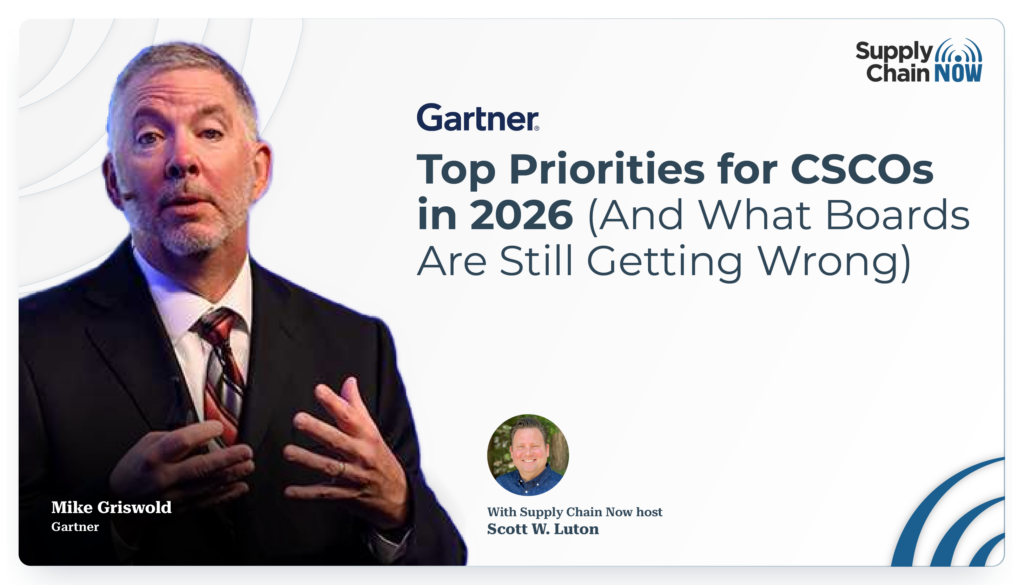
[00:01:12] Scott W. Luton: That is awesome. Well, we’re going to have to set up a whole different show and walk down memory lane in a more deliberate fashion. But folks, today we continue one of our longest running and most popular series, supply chain today and tomorrow with Mike Griswold with Gartner. Of course, many of y’all will know that he serves as Vice President Analyst with Gartner. And today we’re going to be touching on a variety of topics, including an updated take on winning in the turns. What Mike thinks many boards are still getting wrong about supply chain. Top priorities for CSCOs here in 2026 and one of Mike’s favorite recent use cases for AI, all that and much, much more. So stay tuned as we walk through a great discussion with lots of actionable takeaways with the one and only Mike Griswold. Mike, are you ready to go for a great conversation?
[00:02:04] Mike Griswold: Yes, as always. Ready
[00:02:06] Scott W. Luton: To go.
[00:02:07] Scott W. Luton: I’ve got a very unique … Usually I refer to these as a fun warmup question. This was going to be much more serious, but I think an intriguing warmup question at that. So we’re recording this podcast conversation on March 11th, 2026. So Mike, I went and did some digging because I think the last time we got together, I was referencing that we’ve been renewed for our sixth year in a row. We had a little fun with that. And then it led me thinking, okay, when did we start this? So the best I could tell, and I got the staff historian, the Library of Congress to help, you name it. So we started the series in December 2019. So that is six and a half years ago, almost six and a half years ago. But what’s even more interesting about that timeframe? If you take your mind back to then, just a few months after we started this series, again, in December 2019, on March 11th, 2020, the World Health Organization would officially declare COVID-19 as a pandemic.
[00:03:11] Scott W. Luton: So that’s six years ago today as we’re recording this. So I want to get your reaction to that. And namely, what’s one important lesson that you hope we’ll always continue to remember and apply from the global pandemic, of course, that we hope we’d never see again?
[00:03:28] Mike Griswold: Yeah, it’s interesting, Scott. When we think about what we learned through that pandemic, I want to kind of tie this into one of the topics everyone knows I’m pretty passionate about, and I think it resonates here is basketball, women’s basketball in particular. And I would encourage people to do some Googling, if I could turn that into a verb around the Duke Women’s Basketball Coach. Her name is Kara Lawson, and she played at Tennessee and has really resurrected the Duke program. A couple of years ago, she went viral with a short three-minute video that was taken of her talking during the summer to some of the incoming team. And if you go in and you Google Kara Lawson, handle hard better, the message to the team was very simple. It’s a coach’s job to make things hard, and it’s a player’s job to figure out how to handle hard things.
[00:04:29] Mike Griswold: And her message was really around … She used the word, “If you wait for the easy bus to come around, you’re going to be waiting a long time because anything worth doing requires handling hard better.” The fact that things don’t get easier, the fact is we handle hard better. And I think that really resonates with me when I think about the pandemic. It really was hard for us. And I think what we learned through that and what our supply chains learned is that we can handle hard better and we can get better at handling hard things like disruption and risk and understanding how to mitigate risk. So my big takeaway from the pandemic was how supply chain leaders learned how to handle hard better and learned how to help their supply chains get through those tough times. And if you think about it, we probably will not face things as hard as that, hopefully, right?
[00:05:31] Mike Griswold: Fingers crossed. We will definitely face and continue to face hard things in our supply chains, but I don’t know that they will necessarily rise to that level that we were able to get through during the pandemic. So that’s my big takeaway is how do organizations learn to handle hard better?
[00:05:50] Scott W. Luton: Okay. Coach Lawson, I’m going to be doing some Googling that new verb that Mike coined and I can’t wait to see the handle hard better in a three-minute coach talk. Yeah. One more thing I want to add, because I was on X earlier today, and I try to stick to the uplifting positive stuff on social in general. And I came across that classic interview that we’ve all seen of the dad on Sky News or one of the big news stations. And as he’s given a very professional interview on TV, his two or three year old comes in behind him and then his significant other comes in and trying to … They’re all trying to … And one of my favorite things about that is that really represented an era where we as humanity hadn’t embraced that Amazon may knock on the door when you’re interviewing or the dog may bark, and that was terrible, but it’s not like that anymore.
[00:06:44] Scott W. Luton: We’re always professional, but we’re largely, we’ve gained some perspective about what’s important and what isn’t. And Mike, that’s a great thing, huh?
[00:06:51] Mike Griswold: Yeah. We’ve learned, I think, in some ways, how to relax a little bit and not let those things that are relatively uncontrollable, control the controllables and be able to be okay with the things you can’t control and go with the flow. And I think more people during the pandemic kind of realized that, that there’s only so many things I can control and letting go of the things I can’t control really helps your state of mind.
[00:07:22] Scott W. Luton: That’s right. Well said. On a much, much lighter note before we get the work here. So Mike, oftentimes I will type into an LLM, Chat or Claude or whatever with somebody I’m talking with. And it’s always interesting to see what comes back because a lot of times I’ll find stuff in my blind spot. So you’re going to get a kick out of this, Mike, because for the first time after six years of talking with you, I did that recently and this was Chat’s response, quote, “Scott, if you’re interviewing Mike Griswold, you’ve got a rare opportunity.” He’s one of the clearest strategic thinkers in supply chain, especially on scenario planning, risk and long-term structural shifts. Mike, Chat is also a fan of Mike Griswold.
[00:08:09] Mike Griswold: Wow. Well, I appreciate you doing that, Scott. I was cringing a little bit because I was like, “Oh my gosh, what’s going to come out of ChatGPT?” And I would say it’s still fairly accurate. Those are things that I tend to talk to people about.
[00:08:24] Scott W. Luton: Nothing about basketball.
[00:08:26] Mike Griswold: Yeah, no, that’s all right. It’s one of those things where if it was me, I’d kind of type it and then I’d cross my fingers and say, “Okay, what are they going to come back and say about me?” So interesting, interesting.
[00:08:38] Scott W. Luton: It is. It always is. Okay. So Mike, we got to get to work and I want to start with, we’re already kind of doing a walk down memory lane, history lane, whatever. Sure. And I want to continue that theme because a few years back, three, four years back maybe, Gartner spoke a lot about winning in the turns, right? We did lots of shows about it, largely meaning seasons of business or economies, right? And let me know if I’ve got that wrong. I hope I got that right. But now it seems that the turns may well be much, much bigger and in some cases have become more systemic changes in global industry or supply chain, you name it. Your reaction to that?
[00:09:15] Mike Griswold: Yeah. I think if we go back in time, then the winning of the turns I think was really a reference from auto racing, high performance racing teams, where do they get their edge? It’s winning of the turns. And we took that several steps farther when we talked about really what are leading organizations doing when they’re faced with these types of scenario changes, right? Whether it’s macroeconomic, political, environmental, whatever it might be, supply chains are faced with these kind of inflection points, these turns. We did a lot of research and what we found is organizations that succeeded in these disruptions and in these turns did several things, right? The biggest is they continued to invest. If I were to sum it up, that seemed to be the biggest distinction between companies that survived and thrived in those types of changes. They invested in technology, they invested in people, they invested in growing the business, where many others, and you could argue the common response during those inflection points was really around contraction, right?
[00:10:33] Mike Griswold: We’re going to cut spending, we’re going to cut people, we’re going to not introduce new products, we’re going to trim our portfolios. And I think if we fast forward to even today’s environment, I think to your point, Scott, what we’ve noticed, I think if we kind of substitute or replace this idea of turns and make it to some degree synonymous with disruptions, what we’re finding, to your point, which is very accurate, is we’re seeing more disruptions more frequently and lasting longer. The philosophy though, I think still remains the same, is to be very smart and pragmatic about continuing to invest and invest can take a lot of different forms, doesn’t have to just be money. And I think that was the message then and is still the message now that disruptions are now, they’re now kind of normal, which I know is kind of counter to the idea of a disruption.
[00:11:38] Mike Griswold: Disruptions, I think almost by definition, happen every once in a while. That’s why they’re called a disruption. I think what our research tells us is they’re more frequent, as I said, they last longer and some of them are actually more pronounced than maybe they’ve been in the past and we still need to think about how to manage through those through expansion and not contraction. That I think, Scott, is the message that I think remains consistent from us, whether we’re talking about turns or whether we’re talking about
[00:12:10] Scott W. Luton: Disruptions. Yeah, good stuff. That took me back. That took me back quite a bit. I also want to share one more thing. Speaking of disruptions and speaking of investing proactively, I’ll call it, I just did a great show around quantum computing and it’s amazing. It is amazing where we’re headed. And I picked up a new acronym from that conversation, Mike, that at least wasn’t on my radar. HNDL, harvest now decrypt later. And I think I’ve got this right. Basically what that means is you’ve got a lot of bad actors that are just gathering, gathering all this big data. For one reason out of many, that once quantum computing really hits its tipping point and is widely available and all of its fruition, their decryption, the passwords and be able to use that information is going to be universes ahead of where we are today. We use that as one of the many reasons why organizations have got to be taking practical steps for, it’s not a certainty, but it’s close to this new quantum computing era.
[00:13:17] Scott W. Luton: Your thoughts really quick on that? I’ll tell you, I had to really eat my Wheaties and really think hard to keep up with these two dynamos in that conversation, Mike. That was a tough one for me.
[00:13:27] Mike Griswold: I’m sure I’d be at the back of the class in that discussion. I do think though, it is another example of the people and/or entities that want to use data in ways that maybe aren’t great or ways that it wasn’t designed are expending a lot, a lot of energy to do that. We have to be expending as much, if not more energy, to be able to either protect the data and or be able to harvest it in ways that are better for us. I’ve always said that people on the criminal side, they spend so much energy trying to figure out how to get around things. If they would spend half that energy in doing things the right way, we would all be better off. So the fact remains though that we’re going to have to spend as much, if not more, kind of intellectual energy around our data if we want to keep it safe, not have it used against us, those types of things, because you’re exactly right.
[00:14:29] Mike Griswold: The technology will no longer be a barrier. We talked a little bit about this in our last episode, right, around how AI provides us opportunities to look at much, much larger data sets than we ever could before. Quantum computing now allows us to do things so much faster, and some of that can be used for good and certainly some of it won’t be used for good.
[00:14:52] Scott W. Luton: That’s right. Faster at scale, in volume, it’s really amazing. All right. So this is an interesting segue because for as much as we all and especially leaders get wrong about evolving, innovative, coming attractions types of topics, a lot of boards are still getting blocking and tackling wrong when it comes to their perception of supply chain management. I want to ask you, Mike, what comes to mind? What do you see regularly where boards that maybe think they understand the value and the craft of supply chain management and they still haven’t quite gotten it?
[00:15:31] Mike Griswold: I think it is the multi-edged sword that is AI. There is one school of thought that says AI will basically automate everything and therefore I can make some fairly dramatic people decisions that in the short term might make sense and the long term probably will not make sense. There are uses of AI that are much more around productivity and insights that we’re probably not taking advantage of. So I think there is an opportunity for the boards and the C-suite to be much more collaborative around the deployment or the acquisition and deployment of AI. You talked about quantum computing. I think there’s also some elements of we want to have an aggressive AI strategy, but what does that really mean from a technical infrastructure perspective? Because we know the impact that data centers have as an example from a sustainability perspective, a water usage perspective. If we want to go all in on AI and have some of our own kind of proprietary stuff around that, what does that mean from an infrastructure perspective and are we willing and able to spend that?
[00:16:56] Mike Griswold: So I think there are longer term AI implications that people are not thinking of or not concerned with because they see or at least feel like they’re short-term AI benefits that they can get. They’re opening themselves up for some challenges if they’re only thinking around the short-term cause and effect for AI because there’s longer term effects that we really should be thinking about now when we’re crafting our broader AI strategy.
[00:17:27] Scott W. Luton: That’s right. Well said. And if they aren’t, their competitors are, their suppliers are, their customers are, and especially as we’ve touched on, those bad actors are. A lot of good stuff there. It’s really an amazing time. It’s a tough time to stay on top of the endless developments and not only disruptions, but innovations. Interesting time for sure to be in global supply chain.
[00:17:48] Mike Griswold: One of the things real quick, we can maybe think about this for a future show. One of the analysts on my team, a guy named Matt Moser, has been seeing, and we’ve been seeing it in our Top 25, some convergence between supply chain organizations and IT organizations. We’re seeing CSCOs, chief supply chain officers have more and more responsibility for IT. And as the AI and IT world starts to grow and we continue to see that convergence, there is probably going to be a requirement for some IT acumen within our CSCO community that we may or may not have today. So that convergence between supply chain and technology in general, supply chain and AI specifically, if I go back to the longer term decisions, we really need to be thinking about that in partnership with our IT partners, and we’re seeing some of that convergence happening already within the supply chain.
[00:18:51] Scott W. Luton: Yes, same. And of course, the CFO suite, which isn’t new, but continues the convergence that we’re seeing there. Okay. So Mike, this is perfect. This is a perfect segue. It’s like you’re reading my mind because I want to dive a little deeper into C-suite, but especially from a CSCO, chief supply chain officer perspective. There’s a great article that came out from Gartner, probably within the last couple weeks that talks about the top three strategic priorities for chief supply chain officers, a leadership vision for 2026. And I want to go ahead and share all three and I’m going to get your comment, your key takeaways. So the first was architect, the AI-driven supply chain, kind of what Mike was just sharing a minute ago. Number two, engineer profit amid shifting cost mandates. Hey, you got to have the CFO and their team involved. And number three, grow market share through frictionless supply chain performance.
[00:19:45] Scott W. Luton: And we were talking about friction in the green room pre-show. So us folks are reading our brains. Mike, great read. Folks need to check it out on their own, but your key takeaways from this focus of priorities.
[00:19:58] Mike Griswold: I think it would be very easy to look at that and try to prioritize those three. Be very easy to take a look at that list and say, “AI pertains to me, but I’m not going to worry about the other two.” Or I’m in, if we go back to the conversation around winning in the turns and disruptions, I’m heavily focused on cost cutting. I’m not going to worry about the other two. So just maybe two observations. One, the first is all three of them are important. And when we look at leading organizations, they are focused on all three. And it’s the reason that we’ve landed on those three is because we see those three things as the most important drivers to supply chain success, certainly in the next 12 to 18 months. My second observation is that it’s very easy, would be very easy if I look at those to say they are one dimensional.
[00:20:59] Mike Griswold: So architecting the AI supply chain, just as one example, it would be very easy for people to think that that is solely a technology problem. Or if I look at the cost mandate strategy, it’d be very easy to say it’s all about cutting costs and ramifications. My second observation is all three of those. There are at a very high level, and one of my gifts is gross oversimplification. But as a gross oversimplification, all three of those have people, process, and technology ramifications. Let’s just take the first one. The AI, architect and supply chain, certainly there is a technology component to that, but there’s also a people component. There’s the upskilling, there’s the, do I end up with too many people in certain processes because I’ve automated the process and then there’s the process discussion. When I look at the cost mandate, what role does technology play in helping me manage that?
[00:21:59] Mike Griswold: What processes can I eliminate? When I think about the frictionless supply chain, that’s really about how do we get the supply chain more connected with other parts of the organization. Technology plays a role, the people for sure, and process. So I don’t want people to lose sight of really two things. You really can’t pick one of these. You really need to focus on all three. As hard as that is, and as unrealistic as it may sound, that’s what you need to do. And don’t get caught thinking that each of those three strategies is one dimensional because again, at a very high level, all three of those have three very important dimensions.
[00:22:43] Scott W. Luton: And we got to handle hard better going back to Coach Lawson. So it may be really hard to make traction on all three of those, but we got to find a way. Okay. We’ve already talked about AI. Everybody’s talking about AI. It’s an amazing time from an artificial intelligence standpoint. But one of my favorite parts, and we’ve talked about this before, is finding really practical use cases because I think maybe going back to the gap you pointed out and then in the boardroom where folks aren’t really thinking about not the extremes, but all the different ways that AI is changing, work as we know it, businesses as we know it, and certainly global supply chain. So what’s been one of your favorite recent AI use cases, Mike?
[00:23:24] Mike Griswold: I probably don’t have a specific use case, Scott. I think what I would offer to the group is what we’re seeing is an evolution within AI to what we’re calling agentic AI, which really is the evolution of getting to self-governing activities where the tools are making a lot of the decisions for us, not unilaterally, but with human intervention farther down the decision cycle. One example, if I maybe call it a favorite use case, is around vendor selection, where it’s very easy for a particular product to feed in the specifications, “This is what I need made.” Have a list of vendors submit how they could make that, what are their raw materials, and have an AI tool sift through all of that, and come back to me and say, “Here are the three best vendors for this product.” Not that they necessarily make the decision, they being the tool, but they’ve provided me with what I would’ve done manually in terms of my decision criteria.
[00:24:44] Mike Griswold: They’ve now narrowed it down for me and probably done it much more quickly. So it’s that evolution of using AI from the standpoint of just to look at data sets and let’s just say produce an output to this agentic approach, which is when it’s actually making decisions. We’ve talked a lot about this idea of augmentation, right? Not replacement, but augmentation in terms of the AI approach. These decisions are now coming to me to augment. Maybe this vendor just showed up in the news for all the wrong reasons, right? And while the tool may have said, “This is the one you want to use, there’s no way I’m using them for lots of different reasons.” So that to me is kind of this next evolution of use cases is around the augmented decisions that are coming out of these tools.
[00:25:34] Scott W. Luton: Your response there reminds me of what I want to see in one of the use cases this year, because one of my least favorite things to do, other than getting cavities filled, is to buy a car. It’s painful with the psychology that’s deployed, and that’s just to get to agreeing on price and all. And then you get into finance office and it’s a whole different round of psychology. I’m looking for an AI platform that I can give it inputs, it could handle everything and have it show up in my driveway a week later. How’s that sound, Mike?
[00:26:10] Mike Griswold: It sounds like someone like Carvana is headed that direction, right? I mean, if we park the fact that Shaq is in all the commercials, I mean, to me, I’ve never bought a car that way, but I’m with you. I would rather go to the dentist without Novocaine than have to sit and buy a car. So these places like Carvana where you do all as much as you can online, and then it shows up at your house, that’s the way to go, Scott. I’m with you. And you would think it’d be pretty easy with the technology that we have, right? Because you can search for a car like that. And I think most people, you wouldn’t even have to give them truth serum would tell you that buying a car has got to be up there in the list of things I would rather not have to do.
[00:26:57] Scott W. Luton: Same. That’s no disdain on any profession. Not even industry, it’s just a human. It’s one of those human experiences. But I’ll add to that, Mike. I’ve used a platform like Carvana
[00:27:09] Scott W. Luton: And you’re right, they’ve made a lot of progress, but one of the gaps is really a full, thorough inspection of the vehicle, right? Which is one of the reasons why they give you that week or so of trial time, then you can return it. If we could cover that gap upfront, not through insurance, but upfront through, hey, the more you know, and then maybe you look at a different vehicle, we’d be cooking with grease. We may be there soon. We’ll see. So let’s paint a picture here. It’s the year 2050. Bots are crawling up under cars and they’re even doing shopping for you. And even … Actually, that might happen in 2040 or 2030, but let’s say it’s 2050. And when you look back into the 2020s, Mike, what is going to be one of the biggest turning points that you point to for global supply chain?
[00:27:58] Scott W. Luton: And for the sake of … A lot of folks I’m sure would point to the pandemic, but let’s set the pandemic aside. What would come to mind?
[00:28:06] Mike Griswold: The easy answer, and I don’t have a different one, quite frankly. I think the easy answer is going to be AI. And I think we’re going to look back and reflect on all the things we learned early around what AI can and can’t do. I think we’ll reflect on what we’re kind of going through right now, which is to your earlier question, what are the best use cases? What are the best ways to deploy this? And I think we’re also going to reflect on the impact that it had on our people, both from the perspective of an automation perspective and what did that mean to people. But I also think in a larger way, the opportunity it provided for people to learn new skills and get upskilled. And I think we’re going to reflect on this time as a transformation of supply chain skillsets that are very different than maybe the skillsets we’ll be having in 2050, which I’m hoping A, to still be around and B, as much as I love our time together on a golf course or chasing my great-grandkids around at that point.
[00:29:19] Scott W. Luton: That’s right.
[00:29:20] Mike Griswold: But I do think, Scott, it’s a very interesting question because I’d be curious if we ask this question, let’s say 30 years ago and ask people, what do you think 2026 is going to look like? If we asked them 30 years ago, what was the most transformational thing? We’d probably get a very different answer, but I do think there’s going to be an AI underpinning to that answer.
[00:29:45] Scott W. Luton: Yeah, two quick thoughts. Number one, it’ll be really interesting and not to be morbid, but with AI being leveraged in healthcare, I wonder lifespan wise, what we see over the next five, 10 years, especially as healthcare continues to be transformed. So that’s to be interesting. So who knows? We may still be playing basketball 50 years from now, Mike. We’ll see. And then secondly, kind of what you closed on, I think it’s Popular Science. It could be Popular Mechanics, but I think it’s Popular Science. They’ve got a great feature, at least when I used to get the magazine, that shows their magazine covers and some of their articles, highlights of their articles from 10 years ago, 50 years ago, and 100 years ago. And Mike, it is fascinating to see what humanity back then thought about what was going to be big and what was going to become next.
[00:30:38] Scott W. Luton: And invention-wise, it really is fascinating. Sometimes it’s dead on, other times it’s way too optimistic and other times it’s not advanced enough. Have you seen this feature?
[00:30:48] Mike Griswold: I have. And even the cover, I find the covers fascinating in terms of how the covers were even designed 20, 30 and 40 years ago and what they were focused on. My sense is if we’re doing this in 2050, I’ll probably be like a hologram, one of those science fiction type of 3D rendered objects that actually can speak. But yeah, the Popular Science and Popular Mechanics fascinating. Those retrospectives on what were we talking about 30 years ago and how close is it to what we’re talking about today?
[00:31:22] Scott W. Luton: I’ll tell you what, folks, check it out. Let us know if you have seen the same. And we also welcome your predictions. I always ask Mike a variety of questions. A lot of it’s future based. I would love to get your predictions for what you expect where we are going to be in a few years or in a lot of years. Well, Mike, one of the places that we’re going to be in just a couple months is Gartner Supply Chain Symposium, 2026 back in Orlando, May 4th and 5th and 6th. And we’re excited about it. We’re delighted to be media partners once again. We’re going to be interviewing some movers and shakers. It’s one of the best supply chain events around, especially where you can be able to meet and rub elbows with senior supply chain leaders. Also, Mike, as we talk about, I think every single time that we bring up symposium, it is the biggest supply chain happy hour, at least this side of the Mississippi.
[00:32:15] Scott W. Luton: But Mike, you always touch on the networking. Is that what you would again tout again today for folks why they should sign up and come join us in Orlando?
[00:32:24] Mike Griswold: I think for sure it’s the networking, Scott, but it’s also, I think one of the things I think we do well at that event, and while it’s targeted to CSCOs and their direct reports, we have probably 75 to 80% of our content there is designed to be at that strategic level. There is 20, 25% of that content that does get into the hands-on, how do you do stuff? There are a lot of smart supply chain people in the world. I think we have a higher concentration of them, quite frankly, at Gartner. So going to our event and hearing both the strategic and tactical types of solutions that we’re talking about, and then being able to talk to your peers about it during the networking. I know a lot of people, they have lots of interactions with their Gartner analysts isn’t a great way to actually meet some of the people that they talk to on the phone regularly in person.
[00:33:20] Mike Griswold: So that probably falls in the networking category, but I think the mix of tactical and strategic conversations that we bring to the table, I think is highly beneficial for the attendees.
[00:33:32] Scott W. Luton: And I might put that example you mentioned in the gathering critical market intel bucket, which is networking on steroids maybe. Whether you’re working with an analyst or you just attend, this is one of the best places to get that critical market intel of what’s working, what isn’t working, what’s on the horizon, what’s already here, what’s down the road, who’s doing what, and how we’re tackling some of the challenges. And Mike, I bet we interviewed 20 folks last year, I think, at symposium. And almost to a person, they talked about the value is exchanging, “Hey, how are y’all tackling X, Y, Z?” Oh, really? And that comparing, contrasting, and leaving with how other organizations are finding success, they all spoke to that regularly. It was like a broken record, Mike. But in a good way. Yes, in a good way. In a good way. That’s right.
[00:34:21] Scott W. Luton: I should add any good way. All right. So folks, come join us again. The dates are the 4th, 5th, and 6th of May. In Orlando, registration is open, but you got to act fast. And you want to save your spot to be lots of exhibitors too, lots of great sessions, networking, keynotes, you name it. All right. So Mike, how can folks connect with the one and only Mike Griswold?
[00:34:42] Mike Griswold: Email, mike.griswold@gartner.com and then certainly LinkedIn. If I could throw in one real quick shameless plug, we’ve got the Planning Summit as well. And I don’t know that we’ve talked about this, Scott. In September, we’re launching a procurement event. So we will have a procurement, I believe it will be a summit. So think of Planning Summit, copy and paste for procurement people. That will be in September, and I believe it’s in San Diego. So that’ll be new for us. That’d be the first year that we’ve done that. But procurement is such an important part of the supply chain. We have a lot of great insights to share on procurement, and we now have an opportunity to do that for people that really live and breathe procurement all the time.
[00:35:26] Scott W. Luton: Love that. I would look forward to that in September. Of course, you got the US version of the Planning Summit coming in November this year, a little bit earlier than last year. Will the procurement summit also take place overseas somewhere?
[00:35:37] Mike Griswold: I believe right now, Scott, it is just a US-based event. I’ll do some homework, and if we want to bring it up again next time we get together, I’ll be a little bit better prepared to talk about that.
[00:35:49] Scott W. Luton: Well, there’s so much going on across the Gartner ecosystem, and I really appreciate your perspectives and opinions and positions here today. And again, Mike, I bet they can also, you’re still upping your LinkedIn game, but I bet they can also find you there too, huh?
[00:36:03] Mike Griswold: Please. Yes. I need a forcing function that makes me spend more time on LinkedIn. That could certainly be it.
[00:36:10] Scott W. Luton: No, Mike, you don’t. Don’t do it. Don’t do it. Oh, gosh. Anyway, folks, what a great episode. Big thanks again to Mike Griswold, Vice President Analyst with Gartner. Come out and see us at symposium. Check out the Planning Summits. I’ve got a sneaking suspicion. We’ll be there again this year. We really enjoyed it last year. And I look forward to learning more about the procurement summit in September. Mike, really appreciate, as always, your time here today.
[00:36:34] Mike Griswold: Thanks. Great to be here with everybody.
[00:36:36] Scott W. Luton: No doubt. All right. So folks, Mike dropped a ton of actionable perspective here today. You know your homework, right? Take one thing. Just one thing Mike shared. Do something with it, share it with the team, act on it. Y’all know the power of deeds, not words. And with all that said, Scott Luton here challenging you on behalf of the Supply Chain Now team. Do good, give forward, be the change that’s needed. And we’ll see you next time right back here on Supply Chain Now. Thanks for bye.
[00:37:04] Voice Over: Join the Supply Chain Now community for more supply chain perspectives, news and innovation. Check out supplychainnow.com. Subscribe to Supply Chain Now on YouTube and follow and listen to Supply Chain Now wherever you get your podcasts.