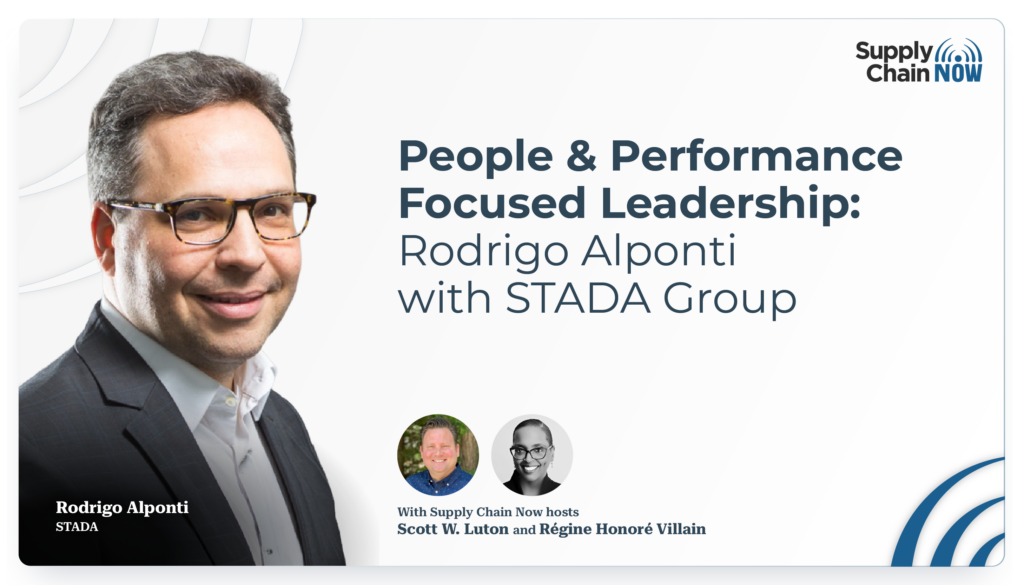
Rodrigo Alponti (00:00):
From time to time, we are going to have events that are going to affect us somehow. We need to acknowledge that and know that the changing environment is now the normal.
Show ID (00:13):
Welcome to Supply Chain Now, the number one voice of supply chain. Join us as we share critical news, key insights, and real supply chain leadership from across the globe. One conversation at a time.
Scott Luton (00:26):
Hey, good morning, good afternoon, good evening, wherever you may be. Scott Luton and Hall of Famer, Régine Villain with here on Supply Chain. Now, welcome to today’s show. Régine, how you doing today?
Régine Villain (00:37):
I’m doing great, Scott. How about you? I had my croissant and my coffee, and I’m ready to go.
Scott Luton (00:43):
Oh, you always are. And I am doing wonderful because I get to really spend time and learn from two of my favorite people. An old friend we’ve been collaborating for quite some time and a newer friend. And so this is going to be terrific. And so Régine, let me, now that I’ve kind of teased a little bit, I’m going to kind of shed more light on what we’re doing here. We’re bringing back an industry dynamo back by popular demand. We’ve been featuring incredible supply chain senior leaders via our never normal series for months now. And our supply chain now GlobalFam has given us a lot of feedback on this project, including how they want to dive deeper with some of the panelists. So to that end, we’re bringing back a supply chain leader that wowed us a few months ago, much like Régine has wowed us over the years.
(01:29):
And we’re going to be diving into topics such as successful supply chain leadership in the pharmaceutical industry, resilience now versus pre-pandemic times, practical AI deployment, getting those outcomes we’re all after, aligning teams in a constantly changing and disruptive environment, all that stuff and much, much more. And Régine, again, I’m thrilled that you can join me here today as an official co-host. Are you ready for this today?
Régine Villain (01:56):
I think I am. I’m feeling the nerve that I’m shaking it off and I’m ready for that. Are you ready for this?
Scott Luton (02:04):
I think so. Hey, I’ve had my Wheaties. I’ve had my cup of coffee. I hadn’t had a delicious Parisian croissant this morning, maybe tomorrow, but I am delighted really to have these two forces join us on an episode of Supply Chain now. I’m delighted. And of course, most of our audience has been with us for a while will know that Régine Villain has done some really big things in the industry, especially healthcare, even serving for quite some time as chief supply chain officer for one of the largest healthcare providers in the country. So I’m really looking forward to her take on the conversation here today. So folks stick around for a great discussion that’s going to offer up tons of actionable insights by the truckload. All right. So Régine, I am going to introduce our wonderful guest joining us today back by Paper Demand. Rodrigo Alponti serves as senior vice president global supply chain for STADA Group.
(02:54):
Now STADA is a leading manufacturer of consumer healthcare products, generics, and specialty pharma, which is based in Germany, but provides its products to markets in over a hundred countries. Now, Rodrigo brings almost 30 years of leadership experience to the table, especially in large national, multinational companies in the consumer goods and pharma segments. Prior to his current role, Rodrigo has held leadership positions with companies such as Sanofi, Europharma, and Avon. He has developed quite a track record for not only driving world-class results, but also empowering the workforce and keeping those customers. There’s patience and customers as a north star. So please join me in welcoming Rodrigo Alponti, Senior Vice President, Global Supply Chain for STADA Group. Rodrigo, how you doing today?
Rodrigo Alponti (03:42):
Oh, thank you very much for the great introductions, Scott. I’m doing great. How about you?
Scott Luton (03:48):
Doing fantastic. Not as good as the two of y’all, because folks, you may not know this, but Rodrigo and Régine both are in Paris right now, and that’s got to be just a beautiful time of year to be in Paris. Régine, you can verify that. Is that right?
Régine Villain (04:03):
Absolutely. I got to tell you, the weather here is absolutely to die for. It is a balmy, I think almost 60 something degrees here. Beautiful sun, just gorgeous, gorgeous, gorgeous spring weather. Love it. Well,
Scott Luton (04:19):
So that’s a perfect segue. See, I told you, Rajim is a natural co-host. It’s a great segue, Coach Rodrigo. One thing we learned when you joined us in January as we’d like to start with these fun warmup questions is you’re a big time movie buff, which we might revisit later in the show, but you love being with your family and your kids in the outdoors. And Rodrigo, is that a big part of your weekend plan coming up?
Rodrigo Alponti (04:43):
Oh yes, absolutely. Tomorrow morning, we are heading all of us to Juvenile to see some of the sceneries there and spend some time there. Great city there.
Scott Luton (04:55):
Outstanding. Well, we look forward to learning more, maybe get some pictures. And Rajin, on a somewhat related note, I was learning in the green room earlier today that you had a bucket list item that you were recently able to check off, and that is dining up in the restaurant atop the Eiffel Tower. Is that right?
Régine Villain (05:13):
That’s correct. We went to for … Actually, it was more of a brunch, but it was like a three and a half, almost four hour branch, just absolutely amazing to die for.
Scott Luton (05:25):
Okay. I’m jealous. We’ll have to compare notes after today’s show, but regardless, great to have both of you all here. And again, Rodrigo, I want to give a shout out to Mario and Mike who joined you on that incredible panel back in January. Y’all were fantastic and it’s great to follow up here today with you and Régine. So let’s do this. Let’s level set a bit, Rodrigo, because we might have some new audience members tuning in here today that missed that panel. So let’s level set on some of your professional background. Would you start by sharing a couple of key roles that really shaped your worldview prior to your current role?
Rodrigo Alponti (06:00):
Absolutely. Thank you very much, Scott, for the opportunity. So we divided my career in two parts. First part in FMCG companies, so as you well said, Avon, but also I worked 12 years in P&G. So I went through almost all the disciplines in supply chain, but the role that I wanted to call the attention is more on the integration of Gillette. I have been the leader of the integration of Gillette in Brazil, and this gave me the opportunity to see the whole company from a different perspective. This helped me to look at the different aspects of the company and how the decisions are made from the CEO standpoint. This I think is one important point. On Avon as well, then I led the supply chain of Brazil. We used to deliver to one million representatives each 19 days. And I had under my responsibility, 8,000 people in the supply chain community.
(06:55):
And in that moment, what I would call the attention more, and it was my big focus was to manage people. So how to manage people and how to ensure that people are working their peak. So this is the second role that I had, I think very, very important in my information. And the third one was when I arrived in Europe in Sanofi and how to deal with the different cultural aspects when I led the supply chain Europe. It was different because for the first time I had to work with different countries in a very, very integrated region. And this helped me to understand this whole diversity. And so if I put these three roles as a good representation of the way I am today, I learned how to look at the company from a more holistic way in first place. Second, looking at how to manage a big group of people.
(07:59):
And third one is to how to manage and integrate the different aspects of the different countries. These are the three main roles.
Scott Luton (08:09):
Rodrigo, that speaks volumes to me. Regime, when you think about kind of how he learned the systems view, the holistic view of the company in one of those earlier positions, and then optimizing the performance of the people and really learning how to really tweak his approach there. And then that last, that third item, supply chain is the most beautiful team sport, as I’ve heard it said here today, global team sport at that. And being able to really better understand as a leader of making sure we include all customs and countries and people and be able as supply chains go through so many different countries, how to optimize our approach there. But what’d you hear there, Régine?
Régine Villain (08:50):
Really stood out to me is what Rigo shared in the ability to read with a truly holistic lens, not just understanding the different functions of the business, but how those decisions came across like finance, operations, and ultimately impact outcomes. And then layered on top of that, the cultural complexity. I can’t even imagine leading across regions that operate very differently, different time zones, different cultural approaches, that requires to me a level of intentionality that goes beyond process. So it really becomes about how you align people and perspectives. And I really appreciated hearing what.
Scott Luton (09:36):
Regina, that was a marvelous response. And in particular, I like that call out of the degree of intentionality that leaders have to have to do these very complex feats. As you said, it’s not just that cross-functional bridges, it’s then further complicated by the cross-cultural bridges we’ve got to build. So very well said. Okay. So Rodrigo, I want to touch base or level us a little bit more on a couple other things here. Tell us, if you would, about your current role as an executive with STADA Group and what the company does.
Rodrigo Alponti (10:12):
We are, as you said, a pharma industry, and we produce medicines to the whole world. We are now very much focused, in fact, in Europe, Asia, Africa, and Australia. So we have a very small business with Americas, so we are more concentrated 99.9% of our business in the right side of the map, if I may say like this. Yeah. And we are focused on three major business segments, consumer healthcare, generics, and specialty. And why is this important? Because the needs of each part of the business is different. Our go- to market in the different markets is different depending on the business segment. So in specialties, for instance, we are more focused on tenders, more on hospitals and with the governments. Consumer healthcare is more concentrated on pharmacies and generics is a mix of pharmacies with hospitals and so on. And this brings us an important challenge to ensure that we build the supply chain in a way that we serve well the go- to-market of the different markets.
(11:25):
And knowing as well that there are differences among the different markets that we have. This is what we do today in STADA. And then talking about more specifically my role, I lead the global supply chain and we do have today four different disciplines, if I may say, like this. One is distribution, so global distribution to our customers, customer service as the second discipline, planning and demand and supply planning. The fourth one is the excellence. So we also see excellence as one of the work streams. I don’t see today we surviving without excellence helping us throughout the journey. So we have three more operational disciplines and another one, helping the other three to reach the best that they can reach. And then in all of this, we are talking about approximately a thousand employees in this supply chain community. Important to mention as well, sorry, it’s from an end-to-end standpoint.
(12:30):
We touched since our suppliers towards our customers. I’ll
Scott Luton (12:36):
Tell you what, that is so helpful to better understand the perspective you’re going to be sharing. And I’m going to get Regina to comment on that in just a second, especially that fourth pillar being excellent. I love that. But really quick, before we do that, Rodrigo, when you think about global supply chains, of course, few or as consequential as healthcare, right? So how does that reality shape the way you lead supply chain in particular as Startup?
Rodrigo Alponti (12:59):
Well, it’s a very good question as well, Scott. So how do we do is that we put our patients and customers at the center of all our decisions. So this is the first and most basic principle that we use in all our processes. So this means that it may have times that we may make decisions that are not going to be the ideal ones from the cost standpoint, but we need to make sure that our patients are well-served and our customers as well. Also reminding that part of our business is generics and even the consumer healthcare. So they are not standalone brands. This means that if we are not at the point of say, or we are not reaching the patient, someone else will summarizing, right? So first, and our purpose to serve our patients, but second one is if we are not there, our competition will be there.
Scott Luton (13:56):
All right. So Régine, whether it goes back to how he was describing the organization, I think that’s really interesting, especially again with the excellence being a pillar, but also on the healthcare industry, which of course you are a supply chain hall of famer. None of this is new to you. I’d love to get your thoughts on that. One
Régine Villain (14:14):
Of the things I want to call out, what really stood out to me is the level of complexity behind what might seem like a single supply chain. Again, when we say supply chain, we tend to think about it as a linear thing. Even the idea of chain, you think about the chain links, but you’re not just managing the flow, you’re really orchestrating multiple business models. And that’s why Rodrigo articulated very well, each with different customer expectations and regulatory environments and the requirements. And I think that’s where leadership becomes critical because it’s not just about the efficiency, it’s about making that intentional choice around how you are prioritizing and serving every need differently within one system and the next. And so that really stood out to me as I was listening to him.
Rodrigo Alponti (15:10):
You are absolutely right when you said that. And just to illustrate a little bit of this complexities, all the things that you said, the needs from customers, regulatory aspects and so on, with 26,000 SKUs, each one of them are very important because again, we are affecting or we are improving the health of our patients, right?
Scott Luton (15:30):
So Rodrigo and Regime, I think what I’m going to do, because this is really good stuff, especially the vibe between the two of y’all, I’m going to get my Diet Coke and get me a box of popcorn and I’m going to sit back and listen, really there’s a reason why we want a regime to be a special co-host for this session with Rodrigo because we knew that there was a lot of kindred spirits and expertise. So I think we’re seeing that already. Let’s shift gears over to the current landscape. And gosh, we’d be here, we could be here for hours. It’s a really challenging current landscape, but you know what? With that said, it also comes to the territory, right? Supply chain is not for the faint of heart. So Rodrigo, how would you describe the current state of global pharmaceutical supply chains and say maybe your top two or three observations there?
Rodrigo Alponti (16:19):
Okay. This question is very pertinent for how we are managing supply chain today. So let me first call the attention to the first aspect, which is the size of our supply chain, right? We do have, in many cases, a very complex supply chain, depending on the molecule, depending on the product. We bring, depending as well on the company, but we bring between 40, 50% of our APIs from China or from India because they have very good quality products and with an affordable price with a good price. So it starts with that, which has in important lead times. We bring the API, we produce the bulk. Then the bulk in some cases is packaged in a different country. Then it goes to another country to be released from the quality standpoint. So our supply chains, depending on the molecule, depending on the way we manage, they are very complex as well.
(17:18):
So remember, I said that we have 26,000 SKUs. In many of them, the supply chains are very complex in that way, and each molecule has their unique supply chain. So the first aspect of today’s environment is the size of our supply chains and the complexity of them. The second aspect that I wanted to call attention is exactly what we were discussing before, the regulations. Regulations are there and they are there for a good reason because we want the patients to be safe and secure that everything that we do is well done and they are going to have good quality and their products are going to get to them and give them the effect that they are expecting. So regulation is important and this is needed. Having said that, we need to apply and ensure that regulations from different countries are obeyed. So it’s not a simple task.
(18:15):
We need to ensure that this is also framing the operation in a way that we don’t break any part of the regulation. What I said is complex supply chain, long supply chain. Second, regulations. The third one, and I would say maybe the last one is the geopolitical situation. Let me say it this way, right? Because from time to time, we have different facts that happen and we need to deal with them. So as you well said, with the head pandemic, the beginning of the 20s, we had the conflict, the start of the conflict in Ukraine. Now we have this conflict in era. We had one year ago or so, the tariffs as well that started to affect as well some dynamics in the market. So I think this is a reality now. How do we see that is that from time to time, we are going to have events that are going to affect us somehow.
(19:14):
We need to acknowledge that and know that the changing environment is now the normal. I don’t like this word to be honest, which is transformation. And let me tell you why. Because transformation predicts that we go from a point A to point B. But guess what? When you arrive to point B, it’s time to go to the point C. So transformation now does not apply in my view anymore. It’s changing is a permanent state of supply chain. So these are the three aspects that I would call the attention now on how I see the current environment in these three aspects that I manage supply chain with the supply chain leadership team.
Scott Luton (19:55):
Rodrigo, we could have a whole podcast series, I think, on your response. Régine, I want to go back all the way to something you shared there because how many supply chains do we hear your leaders talking about? It depends on the molecule. I mean, that really speaks to the complexity, I think, in many ways, but size, regulation, complexity, geopolitical transformation, whether we like the word or not, or some of the big themes there. Regime, what’d you hear about the current state of global pharmaceutical supply chains? Wow.
Régine Villain (20:25):
You know what? I agree with you. So I’ll tell you what stood out to me and what he shared. The last piece is very powerful that we’re no longer operating in a world of transformation as a phase, but really it’s a state of continuous change. And then when you layer on the complexity of global supply chains as we so nicely articulated regulatory requirements, geopolitical dynamics, it becomes clear that adaptability is no longer a capability, right? It’s a core leadership discipline. I think it’s how we think, how we decide, and how we lead through constant movement.
Rodrigo Alponti (21:13):
Going a little bit further on that, right? So we are going to talk about resilience, but to me, the resilience is very well connected with adaptability. I prefer to use the word adaptability than the word of resilience, because if we are adaptable, we are going to be resilient, right? Adaptability comes before the resilience.
Scott Luton (21:34):
That state of continuous change that Regime mentioned earlier, maybe we start using that instead of the word transformation. We’ll see. All right, so let’s do this. Rodrigo, you’ve spoken to some of the regulatory components in terms of how that’s factored into your supply chain decision making, leadership approach, and probably how you think about risk. But when you think about patient safety decisions, how does that help impact how you and the team view risk?
Rodrigo Alponti (22:03):
Safety of the patient is the most basic thing that we manage, right Scott? And we need to be very responsible in all the decisions that we make. I don’t do anything that quality is not together with me and say that what we are doing is safe. So even if I’m going to change the transportation carrier, quality is with us to make sure that if we are going to change the carrier, the new carrier, it fulfills all the needs, all the requirements from the quality standpoint. Just to give a very simple example. So absolutely no decision is made if we are not one quality check. Second, we are in accordance with the regulations and the regulatory is also with us. The point here is that differently from some aspects of the FMCG companies where we have more freedom to make all the decisions from the supply chain standpoint in pharma, we need to make sure that all those aspects are taken into consideration.
(23:06):
No decision is made if quality is not with us and regulatory.
Scott Luton (23:12):
So Régine, I know from all of our conversations, patient safety, patient outcomes that has been the North Star in many ways. Your response to what we heard there from Rodrigo.
Régine Villain (23:22):
Well, patient safety, patients just generally, they’re at the middle of everything that we do. We cannot operate in the worlds that we operate, pharmaceutical healthcare per se, without putting the patient in the middle of everything that we do. Again, when I think about what he said, again, what stands out is the level of discipline behind the decision making. In healthcare, risk isn’t something that you manage after the fact, especially when you think about people’s lives being involved in that. It’s something that’s built into how the decisions are made on the very, very beginning. And that’s why anytime you see anything about healthcare, there’s always a framing or a diagram that shows the patient and safety at the core of everything that we do. Because what Rodrigo described is a model or quality, regulatory and operational consideration of fully integrated, ensuring that patient safety never, ever, ever, ever compromised.
Scott Luton (24:28):
Regina, I really appreciate your response, especially how you said you can’t manage risk after the fact when it comes to patient safety. It’s so very true. And that’s kind of one of the big unique elements when it comes to pharma and healthcare and the differences in how supply chain has to take that into account, operation, supply chain and more. Let me ask you this, Rodrigo, you touched on this earlier, and I don’t mean to be glib or … I take this very seriously, right? Whether we call it resilience or anti-fragility or whatever your favorite phrase is. When you think about pre-pandemic, and then you think about all that we learned painfully and otherwise during the pandemic and how we’ve responded and how some of that response has stuck with us, some of that response, unfortunately, we’ve forgotten about until then the next really big challenging thing.
(25:21):
How do you put it, Rodrigo? In terms of organizational resilience today versus a pre-pandemic, have we made progress?
Rodrigo Alponti (25:28):
I think we have made up a big progress since then, right? And to be honest, if I think about the timings, the pandemic started in 2020, and we are starting 2026 now in six years. The speed that we came through is, in my view, phenomenal. We are in the whole industry, the whole world, in fact. If I think about how in the pharma industry we evolved since then, I would call the attention to a couple of points. The first one is that we are much more integrated in the communication, right? In 24 hours, we are able to reach anybody in any part of the world. In one hour, we can do this, right? I can give you an example. When the conflict in Iran started, in one hour, we established the committee and we evaluated the shipments to the countries involved, and we already talked about the actions that we put in place.
(26:27):
So the integration is one, and it comes already together with the agility. So I just give you an example of connection and agility. So very quickly, we were able to understand the situation and design the possible solution. This was the first action plan because the situation continues to evolve. And this is the next important point, which is the racking and the follow up because we cannot just establish the first action plan and just say, “Okay, our job is done,” which is not true because the situation continues to evolve and we need to continue monitor and he build the plan over and over to make sure that things are going to the right direction. So right now in this example, we have only one port working well in the region, which is Jada in Saudi Arabia. All the other ports are closed. So we now need to understand pragmatic problem that I saw this morning, which is how to reach equate from Saudi Arabia, from Jeddah.
(27:27):
So this gives us as well this, I would say this challenge also help us to find different ways of doing things. And this is just an example. I can give you many other examples on that. So I said integration, agility, and follow up through process, right?
Scott Luton (27:48):
And I love that example. Less than 60 minutes, you’ve got the team gathered, got the SWAT team gathered to figure out a better path, mitigating the risk. Rajin, your thoughts on his response and the question, resilience prior to the pandemic to where we are today.
Régine Villain (28:05):
What resonated with me is that in pharma, the risk is not episodic. When I hear that, and it’s so true, I go back, and by the way, I get it’s almost like trauma when I hear the pandemic, when I hear all the things that we’ve had to go through, but that risk is inherent to every decision that we have to make in our world. And the discipline that we described, where quality, regulatory, fully integrated decision making, we enabled organizations to move with both feed and confidence, and the fact that you now have an ecosystem that is able to react a lot more quickly to some of the risks that we’re seeing in the world. And when you layer that with the integration and majority that was clear that resilience today is much more dynamic than it was pre-pandemic. I still think that we have work to do, but I think that it’s a lot more dynamic.
Rodrigo Alponti (29:16):
Absolutely correct. I couldn’t agree more with what you said. Regina, to me, resonates on the resilience is the consequence of all of this, right? So at the end, all of these will improve the resilience to ensure that we continue to serve the business without disruption, or with the minimum disruption possible, at least.
Scott Luton (29:35):
We’ve made progress, but we’ve got a lot more work to do. I think
Rodrigo Alponti (29:39):
It’s
Scott Luton (29:39):
One of the big common themes here.
Rodrigo Alponti (29:41):
Absolutely.
Scott Luton (29:42):
Rodrigo, when you think of AI and here in the golden age of supply chain tech, at least it seems that way, where are you seeing healthcare really make a big practical outcomes producing impact in healthcare supply chains or farmer, you name it?
Rodrigo Alponti (29:58):
Yeah. Good question as well, Scott. And I know that this is a little bit polemic, but many people have different ideas on where can we go and so on. I would say that I don’t like to go so beyond the vision that I heard and I read sometimes that to say, “Oh, we are going to be replaced by AI and AI will do everything.” I don’t think we are there. We are not even close to that vision yet. Maybe someday we are going to get there. But now I like to think about AI as a tool to solve some problems that we have. And so far, I like to think AI as a boarding tool. So let me explain. We have some projects in course. One is to improve our demand forecast. Another one is to improve our supply planning. And we have another one with training the people.
(30:58):
So people now in study and supply chain can just type the topic that they want to learn. Our chatbot powered by AI tells him everything that we have in terms of documentation, so on, and where to find and what to do based on our documentation. These are the three main topics that we are driving in supply chain specifically. STADA is doing much more things with AI, but specifically in supply chain, these are the three topics that we are betting our efforts now. But to give you one example and to be more concrete on what I’m saying, today we have between 350 and 400 SKUs per planner in supply planning. So what I want with AI is AI to help my planners with the correct information and to give them recommendations for them to be able to make the right decisions and be able to increase their productivity to between 500, 550 SKUs.
(31:56):
So the final decision, at least today, it still needs to stay with the planners, with the people. And that’s why in January, when we talk about this, my opinion continues to be the same, which is I need highly educated people to be able to make the right decisions. Even AI, this need is even higher because they need to make sure that we are making the right decisions and they are much more productive than they were before. Because imagine that with good information coming and good recommendation coming, their decisions are going to be better. We are going to generate more efficient … The operation’s going to be more efficient and we will be able to reduce inventory and provide a better service. So this is to give you the example of one of the applications that we are using. And this is the same way I see demand planning and even the training part.
(32:49):
This is my view for AI now. It doesn’t mean that it will be like this forever. I understand that we’re going to evolve and eventually we’re going to the point that AI is going to do everything. Maybe, maybe.
Scott Luton (33:03):
Régine, what I heard as Rodrigo was sharing his thoughts there, one thought came to my mind, especially as he spoke about one of the many aspects of where AI can bring a lot of benefit to organizations is helping more planners take on more of the SKUs, right? And really kind of brought a conundrum, I may not be using that word right, but it brought a thought to my mind that people are making AI more successful. However, AI is making people more valuable and more successful as well when implemented in a very targeted, meaningful, outcomes focused way. And that is a beautiful thing. And who knows? The billion dollar question is just how far will AI continue to disrupt the human element of global supply chain? There’s lots of different thoughts there. But Rajin, what’d you hear there in his thoughts on AI in healthcare and pharma?
Régine Villain (33:55):
Well, if I have to translate what Rodrigo said, where I really appreciate it is that he described that AI is basically scaling capability, but not replacing the accountability. Because when I heard the example of still having to go through the planners to make sure that they validate some of the informational output of AI, that’s the accountability that people tend to think is going to go away with the use of AI, but I think it’s about scaling that capability, but still we change that accountability. And in healthcare supply chains or pharma supply chain where decisions directly impact patients, that human judgment still remains essential until such time that, as you said, that somehow we’re not going to need that anymore, but we’re not yet at that point. So I think the real opportunity is how we elevate and encourage our people to make better, faster, more informed decisions with AI, not instead of …
Scott Luton (35:02):
Régine, love it. Love it. All right. So I hate to leave this topic. We’re also going to kind of come down the home stretch of this great interview and we’ll have to have you again back with us, Rodrigo. Let’s stick with the human factor, the beautiful human factor for a moment, right? We’ve all been talking about a variety of challenges, right? From geopolitical to those that are more unique to healthcare and pharma, to general supply chain challenges. It can be very disruptive. It also speaks to the state of continuous change, as Ragin said earlier, right? It can be really challenging for leaders to find an approach that works to keep or to instill and then protect that alignment that teams have and all these wonderful, talented humans can have. What have you found in your almost 30 years of supply chain leadership? What’s a couple of core elements to your approach to protecting that alignment during disruptive times?
Rodrigo Alponti (35:58):
Great point. And I think this is, I would say, maybe one of the core works in supply chain, right? Because it’s all about people, right? So people make the decisions, as we just said, if they are well educated, if they know what are the objectives, they will make the right decisions. So to be really pragmatic here, let me tell you a couple of processes that we have. So we built our north, our strategic roadmap two years and a half ago. Each year, we review that and we look at the action plan for the next one to two years, and we do some adjustments sometimes. Sometimes we don’t do any adjustment. This depends on the dynamic of the market, how things are going. Each six months, I’d say we do some kind of review and usually once a year, we do some adjustments. So the first important thing is to know where we are going and what is our strategic framework.
(37:00):
This is the first important point. The second important point is how to execute that, right? How to execute that and how to link the strategic framework with the day-to-day work. Because if we don’t relate one to another, nothing will happen. It’s very beautiful to have a fantastic and beautiful strategic framework there. But if you don’t bring this to reality and to the day-to-day, forget it. This will never be implemented. So in the execution phase, if I may say like this, we link this to the SNOP and to our monthly business reviews. So we always track the initiatives, actions, what we are putting in place, and we are linking this with the results of the company. Because if this is not linked, it will not happen. Last but not least, again, I’m going to repeat what I said before, which is, to me, absolutely fundamental, which is education of our people.
(37:56):
Strategic framework needs to get into all the levels of the company in supply chain. And I need to make sure that our people, they have all the tools, intellectual tools. So if I need to provide trainings, if I need to send them to another country, for them to be equipped with the right knowledge to do the things they need to do, I will do it.
(38:18):
So this is another important aspect. Now, coming back to the framework and the vision, it needs to be simple and straightforward. This needs to reach all the levels of supply chain. I cannot, and I saw this in my past, sometimes people doing fantastic, beautiful things with the most sophisticated wording and so on. And then when this gets to the lower levels of the organization, nobody understood that single word. So it needs to be understood by and understood and internalized by everybody. Everybody. They need to leave this. If they leave this, if they believe this, this will happen, right? They need to believe you.
Scott Luton (39:04):
And if they don’t, they’re not going to be bought in. If they’re not bought in, ain’t nothing
Rodrigo Alponti (39:07):
Happening. Nothing will happen. Nothing will happen.
Scott Luton (39:11):
That’s probably a little bit simplistic. But Rajin, I want to go back to a couple things he shared there. That linkages, as he called it, between the strategy and the day-to-day, that probably sounds very commonsensical to so many people watching or listening to us. However, that can be, in my experience, at least, so challenging to create. And then if you don’t create it, even if you had the brilliant trillion dollar strategy, but it’s not connected to what drives behaviors every day, what do you got? But that was one thing. And of course, secondly, amongst many of the things he shared, education. I believe those organizations that invest in their people, invest in new skills, tools, opportunities, and a lot more, all the places you’ll go. But Régine, what’d you hear there from Rodrigo in terms of protecting that and delivering that powerful alignment that helps execution and success?
Régine Villain (40:09):
This is something that truly, truly very nice. This is where it gets very real for me. We can talk about the strategic imperatives. We can talk about the metrics. We can talk about all of the execution, but then really wants to start talking about the people and the core fundamental principle of being human-centered leaders. That alignment is not static. It’s something that leaders have to continuously design and reinforce. Yeah, it starts with a clear strategic direction, but it only becomes real when it’s embedded in how people operate every day. I think you just said it. They have to be bought into it in order to be able to move towards those strategic directions. And ultimately, it’s the investment in the people, their understanding, their capability, their ownership, that’s going to sustain that alignment over time. You cannot have recovery.
Scott Luton (41:13):
Well said. And yes, I do know this is one of your passions given all of our conversations over the years. And this is a conversation and an aspect of discussion. It won’t stop. There’s so much more we can talk about. It’s so critical and there’s no magic wand. All right. So let’s do this. I’ve got a quote here as we start to wrap. Folks, I want to explore the empowerment of the human workforce. One of my last questions here. Then we’re going to make sure folks know how to connect with Rodrigo. We’re going to get Regime’s patented key takeaway, and then we’re going to also make sure folks don’t connect with Régine all before we leave here. But as I’d mentioned, Rodrigo joined us last January where I took 18 pages of notes, I think. And when it comes to that beautiful human element, YeSTADA, Rodrigo’s organization seems to be very well known for being an organization that has a culture that celebrates and empowers its workforce.
(42:09):
Big themes here today. Rodrigo has a personal track record for doing just that. So get this. I’m going to quote you here, Rodrigo. You shared this in January. “As companies scale and skew complexity explodes, the real competitive advantage in 2026 won’t just come from better systems or AI-driven planning. It will come from empowered highly skilled planners who can forecast risk, make faster decisions, and prevent the supply chain from becoming a bottleneck to growth. “So really, I hate to be redundant, but this is one of my favorite things to talk about. Empowering the talented human element remains a top priority, not just as a personal leader, but for those organizations that want to do big things, this is a top priority. Your thoughts, Rodrigo.
Rodrigo Alponti (42:58):
Scott, I think the culture in startup drives a lot of the culture has some elements that I already told you and which I love it. First, it’s simple to understand. Second, it goes to all the levels of the organization. So I can tell you easily what are the elements of our culture. So entrepreneurship, one start approach, which is collaboration, agility that we just said, right? Entrepreneurship, agility.
Scott Luton (43:26):
Excellence is not
Rodrigo Alponti (43:26):
Bad. Integrity and integrity.
Scott Luton (43:28):
Integrity.
Rodrigo Alponti (43:29):
Yeah. The four of them. So you see, all of them are in the minds of everybody. We talk about them every day and we leave them. This is the most important thing. All the decisions are made based on our values. And these together with a simple and clear vision, together with the elements that we will help them to make the right decisions. So from the educational standpoint, from the system standpoint, these all complete the set of tools for all the employees to make the right decisions. Because as we discussed over this past hour, the complexity that we have, if we don’t have each one ready to make the right decision and moving forward, we won’t be able to succeed.
Scott Luton (44:16):
I agree. Rodrigo. I agree. Régine, we’re going to come to you for your key takeaway in just a second, but just really quick, respond to what we heard there from Rodrigo.
Régine Villain (44:26):
When I hear what Rodrigo is talking about in terms of the people, right? I mean, supply chain, not transform, people do. And so as the complexity continues to grow, and whether it’s through scale or AI or global disruption, I just love how he has packaged this for information and provided it back in a way that is powerful. And by the way, that quote, I want to copy of that quote because that was a micro.
Scott Luton (44:59):
Régine, beyond getting those mic drop quotes from Rodrigo, which he’s clearly got a superpower to do, the passion from which you speak, just the second, maybe the third conversation I’ve had with you at Rodrigo, the passion. You talked about the importance of believability earlier in the conversation. I don’t know about you, Rajim, but I’m believing everything Rodrigo’s dropping here. I’ll take it to the bank. Would you do the same thing, Régine? Yes. Yeah. Yeah, no doubt. You love what you do. Both of y’all love what you do and you can tell so much in your responses. So let’s do this. Rodrigo, love this second conversation we’ve had with you here. Our second show we’ve had with you here. How can folks reach out if they want you to keynote that they want to compare notes on something you’ve done here today, something you’ve shared here today?
(45:46):
How can folks connect with you, Rodrigo?
Rodrigo Alponti (45:49):
The easiest way is to go through LinkedIn. I’m there, so it’s easy to find me there, or you can reach me through my mail as well. So rodrigo.alponti@stada.com and I’ll be ready to connect.
Scott Luton (46:05):
You will definitely be ready. You’re always ready. You and Régine both. You’re definitely going to be ready. So Régine, two final questions here before we thank everybody and wrap. First off, this might be the toughest question to whole day, Régine. What’s one of your favorite, what’s your Pat and Key takeaway from Rodrigo’s brilliance here today?
Régine Villain (46:26):
By the way, I was trying to keep up and trying to write some notes. And this is where shorthand would’ve all been very helpful. Some of those moments, those soundbites were coming in so quickly and so beautifully, but for sure, I know there are a couple of things that resonated with me. So if I have to capture it in one, if you’re forcing you to take one takeaway, I can say that we are no longer operating in a world of transformation. We’re operating in a world in a state of continuous change. And what Rodrigo articulated so well is that in that kind of environment, success is not just about systems or strategy, it’s about the people. People who are aligned, who are equipped, who are empowered to make decisions with both the confidence and the ability as well. So technology enables, but people are the competitive advantage.
Scott Luton (47:34):
Regime, beautiful. Love it. And as you suggest, there’s lots of takeaways here today. We all got to kind of settle on one of our favorite ones, but I would just … We’ve mentioned simplicity a couple of times or keeping things simple a couple of times. That does not mean if you can communicate in simple, straightforward terms does not mean it’s loads and loads of simplicity. It can be a very complex strategy, but you’ve got to find a way, as Rodrigo and Regina spoken to today, to be able to communicate clearly and in simple terms so that folks can understand what we’re doing, where we’re going, and why. And if you can’t do that, the most brilliant strategy, it may not be worth all that much. So what a great conversation here today. Regina, I’d be remiss. I know you’re in Paris for a few more weeks here.
(48:25):
Hopefully you’ll be back stateside. We got to break bread together, but how can folks track you down? I know you’re doing lots of cool things in the industry still. How can folks track you down, Régine?
Régine Villain (48:35):
I am very findable on LinkedIn. Hopefully you can share that information as well as you are sending information about the podcast. I believe my LinkedIn name would Eugene honor you Len. And certainly through Regeal, my new advisory and leadership platform that I’ve created, there’ll be lots of information. I’ll be on LinkedIn as well. And folks can reach me directly via email as well. Very simply, Régine, that’s R-E-G-I-N-E@rehveal.com. And REHVÉAL™ in this case is R-E-H-V-E-A-L.com. So regine@rehveal.com or on LinkedIn.
Scott Luton (49:17):
Outstanding. And folks, you also, beyond all of that, you’ll be able to find regime on regular Supply Channel programming in the months to come outstanding. All right. What a great conversation. I knew it. I knew we were getting two of the super friends together and the superpowers would manifest itself. But you know what? All that aside, I’m big fans of both of these folks, but there’s lots of authenticity in this conversation. I’m telling you, they speak from having done it and continuing to do it. And I think there’s lots and lots of actionable perspective here over the last hour. So hopefully you enjoyed it as much as I have. I want to thank you everybody first. Rodrigo Alponti, Senior Vice President, Global Supply Chain for STADA Group, Rodrigo. Well done, my friend. Look forward to having you back soon.
Rodrigo Alponti (50:03):
Thank you very much, and I will be more than glad to be back here, Scott. Whenever you invite me.
Scott Luton (50:08):
I will be in touch with your agent soon, Rodrigo, I promise. Big thanks to my esteemed co-host, Rajin Valle, always a pleasure to connect with you. I look forward to hearing more about your leadership and culinary adventures and more in the weeks ahead, Régine.
Régine Villain (50:26):
Thank you so much, Scott. And I would be amazing if I didn’t thank you for trusting me to co-host with you because you’re doing some beautiful and amazing things in the industry. You are a force to be reckoned with yourself and so that you trusted me to sit alongside me to do this is really, really important. Thank you. That
Scott Luton (50:51):
Makes my day. Makes my day, Régine. Look forward to what’s to come. To our supply chain now GlobalFam. Again, I hope you enjoyed this conversation, but you know you’ve got homework. But you know what? Rodrigo and Régine have really worked hard to make this easy for you because they’ve offered a ton of really good actionable stuff and perspective that hopefully makes it easy for you to take one thing and share it with your team, share it with your manager, share it with your colleagues, do something with it, right? Deeds not words beyond all the other good stuff you heard here today from Rodrigo and Régine. So with all that said, Scott Luton challenging all of our listeners, our viewers, or our global fan, do good, give forward, be the change that’s needed. And we’ll see you next time right back here on Supply Chain Now.
(51:36):
Thanks everybody.
Show ID (51:38):
Join the Supply Chain Now community for more supply chain perspectives, news and innovation. Check out supplychainnow.com. Subscribe to Supply Chain now on YouTube and follow and listen to Supply Chain Now wherever you get your podcasts.