[00:00:00] Gustav Khambatta: The number one way cyber criminals are getting into corporate systems is via email. Yeah. Once they get into your email, they can see what you’re doing. Understand the supply chain. Next thing you know, they have your bill of lading. They’ve got your form. They fill the form out, then they go, they’ve got a driver comes up, they know exactly what they’re supposed to be picking up, and when they come a little early, show the forms load up.
[00:00:27] Gustav Khambatta: Leave, they’ve just taken goods, and then the actual driver comes in two hours later. We already delivered.
[00:00:37] Voiceover: Welcome to Supply Chain Now the number one voice of supply chain. Join us as we share critical news, key insights, and real supply chain leadership from across the globe, one conversation at a time.
[00:00:50] Scott W. Luton: Hey, good morning, good afternoon, good evening, wherever you may be, Scott Luton and the one and only Karin Bursa with you here on Supply Chain Now welcome to today’s show, Karin. How you doing today?
[00:01:01] Karin Bursa: I’m doing great, Scott. Hey, happy New Year.
[00:01:03] Scott W. Luton: Happy New Year to you as well, and you usually have a, another mantra that you always fit in somewhere we wanna kick off with that or we wanna sprinkle it in later.
[00:01:13] Karin Bursa: I, I think we kick off with it because everybody who is with us today, you are the supply chain movers and shakers. You make commerce happen and I want you to know that it is a great time to be in supply chain, and 2026 is gonna hold new opportunities for all of us.
[00:01:30] Scott W. Luton: No doubt. Love that perspective. And now I can, I can put a, uh, I can mark out that bingo spot on my card.
[00:01:37] Scott W. Luton: ’cause every conversation that’s in your bones, Karin, and I love that. So folks, to echo Karin’s Point, hope your new year has gotten off to a great start. You know, one of my favorite sessions in 2024 was this end of year recap with a couple of savvy industry veterans. You already seen one right in the intro here.
[00:01:55] Scott W. Luton: In fact, we liked it so much. We’re conducting a sequel here today. That’s right. A sequel. So folks, we’ve got a great show teed up. We’re gonna be getting into a variety of topics from cybersecurity to cargo insecurity, maybe to ai, to the world of freight. Of course, we’re gonna reflect on 2025 and offer a few predictions to see how wrong we can we, we can be on 2026, all that, and much, much more.
[00:02:19] Scott W. Luton: So stick around for a great conversation that’s gonna offer up tons of actionable insights by the truckload. Karin, are you ready to go? Excuse me. Great show. Huh?
[00:02:29] Karin Bursa: Oh, I’m sure it’s gonna be packed with facts and insights. And hopefully you can get our guest to pull out his crystal ball and let us know what’s gonna unfold for us in the new year.
[00:02:41] Scott W. Luton: Hey, we’re holding them to it. We shall see. So let’s, uh, let’s dive on. Incorrect. Can tell you’re ready and I think I am too. I’m gonna find one more cup of coffee somewhere here. But hey, our guest today is backed by popular man. He brings more than 20 years of experience to the table in developing marketing, selling global.
[00:02:57] Scott W. Luton: Business to business software solutions, all in a wide array of sectors, especially across the global supply chain ecosystem. He also brings a background of private equity to the table, which allows him to inject strategic financial perspective to all that he does. Our guest also serves as if his leadership role isn’t enough.
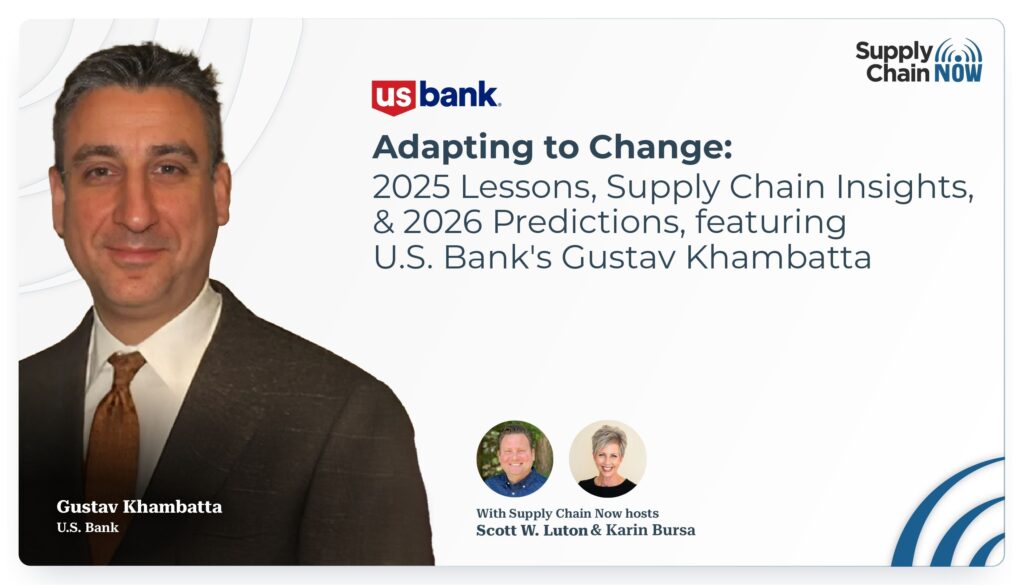
[00:03:16] Scott W. Luton: In some of his spare time, he serves as president of the New England CSC and P Roundtable, where he loves to support. Students, the network serves membership and he loves those plant tours. He may talk about some of those here today. So let’s welcome in. Gustav Khambatta, Senior Vice President, Head of Freight Payment Sales with US Bank.
[00:03:37] Scott W. Luton: Gustav, how you doing? I’m doing great. Happy New Year. How are you? Happy New Year to you as well. And Karin, we had a lot of fun with Gustav about a year or so ago, didn’t we?
[00:03:48] Karin Bursa: I think it was almost a year ago. Yeah, absolutely.
[00:03:51] Scott W. Luton: So we had to have him back for the sequel. Did you like that Gustav, the sequel that we’re calling this The sequel?
[00:03:55] Scott W. Luton: Yeah. Okay. Little little play from Hollywood there. So I wanna start with a fun warmup question. Sure. And it’s gonna be. I think US Bank is involved in a sports desk somewhere, some in some way, shape or form. And you’re a big sports lover. We were talking to pre-show about your beloved patriots. They’re having one heck of a year.
[00:04:14] Scott W. Luton: Huh?
[00:04:14] Gustav Khambatta: Who would’ve thought after the first two games that they’d be in the position they are in today? And, you know, there’s still people that don’t believe, but All right. I think we’re, we’re, we’re, we’re headed. We’re headed for the playoffs.
[00:04:25] Scott W. Luton: As a big Clemson fan, I saw Drake may up close and personal at UNC, and that’s who’s the quarterback for the Patriots now?
[00:04:32] Scott W. Luton: Tearing it up. Karin our Falcons and stick with the NFL theme. Our falcons are struggling this year again. Huh?
[00:04:38] Karin Bursa: Yeah, it’s not pretty. They’ve had plenty of opportunity. They’re just not getting it done.
[00:04:44] Scott W. Luton: Not at all. You are so true. Now, the other and beyond the NFL, ’cause we’re not gonna dwell on that performance here.
[00:04:50] Scott W. Luton: Lindsay Vaughn, you’re talking about Gustav in the pre-show. She had a big accomplishment recently. Huh?
[00:04:55] Gustav Khambatta: Yeah, I mean, here’s woman in her forties and boom, she has won a World Cup race. So it’s very exciting, really looking forward to watching the, uh, Olympics and a lot of skiing here in February, come that time.
[00:05:08] Gustav Khambatta: So, uh, it’s very exciting time in sports right now. It
[00:05:12] Scott W. Luton: is. And I’m gonna finish with one more. The F1, so I’m new to F1. I’m the oddball out there ’cause I know it’s, it’s very popular. I was at a event out in Vegas and I snuck out of town, uh, out of town right before F1 invaded and it was gonna be, I’ll tell you few things.
[00:05:29] Scott W. Luton: Take Vegas to the next level. Maybe the Super Bowl. Clearly F1. But Gustav, you’re a big time fan, huh?
[00:05:36] Gustav Khambatta: Oh, yeah. I love watching it and I, I don’t necessarily have a favorite team racer, but I, I really enjoyed watching Lando Norris pull it off this year. Come next year. I guess we’re all gonna have to subscribe to Apple TV in order to watch it.
[00:05:48] Gustav Khambatta: So
[00:05:50] Scott W. Luton: they’re gonna get us one way or another. Now Karin, we’ve got our own F1 here in Metro Atlanta. It’s called Driving through the City. Is that right? Cor,
[00:05:58] Karin Bursa: I don’t know that we actually get the speed that we just get the traffic. There’s plenty of bumping cars along the way.
[00:06:05] Scott W. Luton: Oh my gosh. And my, some of my relatives would disagree.
[00:06:07] Scott W. Luton: I, I’ve seen them obtain, uh, attain certain speeds, but regardless. From, from the world of sports athletic performance to the world of global supply chain and supply chain performance. Before we get into our whole interview here today and conversation, Gustav, I want to, again, especially for our new audience members mm-hmm.
[00:06:26] Scott W. Luton: I wanna share a little context about your professional journey, right? So they, they can, they know why they should trust, uh, a lot of your perspective here today. So tell us a little about your journey and about your current role at US Bank.
[00:06:38] Gustav Khambatta: Sure. Well, I, I guess you say I really started in the ERP software industry.
[00:06:42] Gustav Khambatta: Well played, had a number of hats, a lot of roles, and that parlayed into e-invoicing. And through that process, uh, I worked for a company that ended up getting, uh, acquired by a bank by JP Morgan, and then ended up over at US Bank, and I’ve been in this position, trade audit, and payment sales since 2013, so about 14 years there, right at the bank.
[00:07:04] Scott W. Luton: Yes. And you have seen in this 14 years, I bet you have seen a lot of things come and go. Some stick around, but you’re ready to write a book, huh? Only Afraid Industry. I’m Retirement. Maybe I’ll do that. And Karin, I know. You know, you’ve been doing big things in global supply chain for a long time, especially in the technology standpoint.
[00:07:23] Scott W. Luton: Gosh, the world of Freight, just in the last 14 years, it has been hanging onto your hat, huh?
[00:07:30] Karin Bursa: Absolutely. Um, you know, it’s a great indicator of overall economic position on where we are. If you. Uh, from my perspective, I look at it as a leading indicator because when we’re investing in inventory and moving inventory, that’s usually in anticipation of future demand.
[00:07:47] Karin Bursa: So I do like to look at the US Bank report that’s shared here on Supply Chain Now every quarter, and really look at it as an important indicator for all of us in supply chain.
[00:07:59] Scott W. Luton: Karin, you’re reading my mind ’cause that’s exactly what I’m gonna ask Gusav about next. The US Bank Freight Payment Index, which we have been really enjoyed covering for probably five or six years now, every quarter.
[00:08:09] Scott W. Luton: And we’ll touch on how y’all can check out those conversations in a minute. But Gustav in your gu. Perspective, especially being in your, your leadership role now for 14 years in the, you know, serving the freight space and the shippers and, and really global supply chain. What value do you constantly hear from your customers and industry in terms of the value that the freight payment index delivers?
[00:08:29] Gustav Khambatta: We process over $40 billion in spend on our annual basis, and we’re auditing that for accuracy and we’re conditioning that data. So we’ve got good, clean, usable data, which from that we have generated our index. And so we published that quarterly, and it’s also regional based, so you can really see what’s happening in different parts of the country, which has been quite apparent this year with a lot of the turmoil going on.
[00:08:54] Gustav Khambatta: And so that provides value across the board in both. Public report for industry to use. And then also it’s a basis too for us to be able to provide benchmarking services to our customers.
[00:09:07] Scott W. Luton: Hmm. Karin, one of my favorite parts of the US Bank of Freight Payment Index is I, I love the core shipping data.
[00:09:15] Scott W. Luton: Right. Volume mm-hmm. And pricing. And, and now the also. Rate updates, which is a new add-on in the last year, which I think has brought a lot more value. But perhaps my favorite part, Karin, is the holistic approach. We get economic insights, we get certain sector insights, and it’s a very holistic tool that I think not only benefits shippers, but really what anyone, to your point, Karin, that wants to kind of keep their finger on the pulse of what’s going on across the country and really across North America.
[00:09:45] Karin Bursa: Yeah, I love because it’s actual data. It’s not a survey that is reading feelings or emotions. And you know, I’m big on facts, not feelings. ’cause we can add color commentary to it as you layer in what’s happening in in the global economy. But the fact that this is based off, as Gustav said, real data that’s auditable.
[00:10:06] Karin Bursa: It’s a great indicator, it’s a great pulse of where the market is, and we can read into that lots of regional assessments that are taking place. It’s always interesting to see in the US how different regions are performing as an indicator of overall economic activity.
[00:10:24] Scott W. Luton: That’s right. And really quick before I, I’m gonna call out one of our, all of our shows are, are my favorites, right?
[00:10:29] Scott W. Luton: It’s like picking your favorite child. You can’t do it, but I’m gonna, I’m gonna get your take on one of them. But Gustav, I tell you, you’ve got. Truckloads of data, and as you said, good, clean, usable data. You’re making organization leaders everywhere. Very envious of having all that good, usable data. Huh?
[00:10:46] Scott W. Luton: Yes, we are.
[00:10:51] Scott W. Luton: It’s changing. It is changing. Maybe not ever so slowly, but it’s changing. It’s changing Karin and, and we see evidence of that here, there, and everywhere. But I gotta call out one particular show. So we had, of course, Bobby Holland joins us for a lot of our quarterly sessions. Mm-hmm. Where we have in deep into the US Bank Freight Payment Index.
[00:11:08] Scott W. Luton: And Karin, you joined me as a co-host for a session. I think it was in November, I think 2025. It featured Bob Costello, who is Chief Economist for the American Trucking Associations. What was one of your favorite moments, Karin, from that episode?
[00:11:24] Karin Bursa: Well, uh, you know, I think some people kinda hear the, the gist of this and they’re thinking we’re gonna be bogged down and just dry data.
[00:11:31] Karin Bursa: But the color commentary on that particular call was really interesting. The combination of Bobby Holland and Bob Costello I think was a good comprehensive view of the market and getting Bob’s. Color commentary on some of the members was really interesting as well.
[00:11:52] Scott W. Luton: I, I completely agree. And that, that’s a great, in a nutshell, encapsulation of some of the value that those shows have, right?
[00:11:59] Scott W. Luton: Mm-hmm. We look at the data, look at the report that we bring in that perspective from folks that are really entrenched in the marketplace, and here’s Gustav and Ryn. My favorite parts from that show Threefold. Really quick. Number one, we found out Bob Castello is a big tennis fan. There was some debate over Roger Federer versus Andre Agassi.
[00:12:16] Scott W. Luton: That’s kind of fun. Number two, he’s an economist that I could really listen to all day long, and you can’t say the same for all those economists we see. Not throwing stones, but some of ’em can be kind of dry. Bob, Bob, really? I could listen to him for hours and number three. Little data point. I may get these numbers slightly off, so Bob Costello, I apologize, but he made a comment on that show, Karin, Gustav, that in January, 2025, the effective tariff rate across the US for imports was like two point a half percent.
[00:12:46] Scott W. Luton: Right? It’s been that way for a long time. Well come late in the year. That effective. Tariff rate was over 18%, I think. Mm-hmm. Highest since the 1930s that we’re gonna get into key takeaways in 2025, in the second half of the show. But Karin, that was an eyeopener. That was a real eyeopener. Huh? Yeah,
[00:13:06] Karin Bursa: that is a real eyeopener.
[00:13:07] Karin Bursa: And, um, I think that those dynamic tariff situation, if you will, will they, won’t they, how far will they go? What the increase will be really drove some crazy inventory swings this year. So it was interesting to see that reflected in the freight payment information because if I’m doing forward buys, if I’m bringing it in ahead of the need for the market, because I’m trying to drive a lower cost, there were just lots of interesting dynamics that were driven by uncertainty and then actual price increases.
[00:13:43] Karin Bursa: And then. Combined with interest rates starting to come down a bit in the us.
[00:13:48] Scott W. Luton: Yep. Uh, and Gustav, one final note here on the freight payment index. ’cause I know Bob Costello is a big time contributor for all of them. You’ve seen lots of challenges in those 14 years. Trade policy is one of many, but again, I’m, I’m looking, I’ll be the first person to show up and buy that book when it comes out in a couple years.
[00:14:06] Scott W. Luton: Gustav, how’s that sound? Sounds good. Sounds like a plan. Okay, so folks, come join us all year long as we review the US Bank Freight Payment Index. Every quarter you can learn more and never miss a show by checking out the upcoming lab programming tab on the new supplychainnow.com website. Okay, so Gustav Technology’s played as we’ve established a big role in your background, a professional journey, and given that I wanna venture into a couple of technology topics that are playing a big time role.
[00:14:38] Scott W. Luton: Mm-hmm. And gain your perspective there. And I wanna start with the wide world of cybersecurity. So Gustav, when you think of what’s going on in cyber and how fast things are evolving, what comes to your mind?
[00:14:50] Gustav Khambatta: It’s something that every company and organization meets that top of mind. The challenge right now, I think with cybersecurity, when you think of companies that have breaches, no one wants to admit it, they don’t wanna go public with it.
[00:15:03] Gustav Khambatta: There’s a stigma associated with it, and that’s kind of a problem because. It’s happening all the time. You see it in personal life. A personal story. My mom, 91, she was at the bank person on the phone. She was trying to take out $40,000. I mean, this has happened. I mean, it didn’t happen. Nothing happened in the end, but this happens every day now.
[00:15:23] Gustav Khambatta: Yeah. And the same thing’s happening on with organizations. We actually had, one of our customers, they had a breach and they were missing data. Yeah, thankfully they have, we’re using US Bank Freight Payment. We have hardened systems. All that data was safe. They said, we still need to be able to pay our carriers.
[00:15:43] Gustav Khambatta: Can you help us? And we as a bank, we’re able to do that for them. Hmm. So until they got their systems up and running. So it’s really important that if you’re gonna work with partners, that they have the security measures in place to keep you safe.
[00:15:57] Scott W. Luton: So before I we’re gonna tie that. To the cargo insecurity.
[00:16:02] Scott W. Luton: Mm-hmm. Landscape in just second. But Karin weigh in on that. I mean, the attacks, the threats, the breaches, the bad actors, man, I don’t think they rest. They stay on the move. Huh?
[00:16:14] Karin Bursa: I know if only they use those skills for good instead of evil, it would be a better world, let’s put it that way. But Gustav, you’re right.
[00:16:21] Karin Bursa: Cybersecurity is a big issue. It’s an issue personally for us as individuals, but also in the, um, the commercial world or the corporate world. And you’re right, companies don’t wanna admit when they’ve had an issue. They don’t wanna admit when they have vulnerabilities or they’ve been penetrated in some way from a security perspective.
[00:16:43] Karin Bursa: But it’s very real. I’m, I’m personally aware of a good half dozen companies this year that have had some issues.
[00:16:50] Scott W. Luton: Yes, no doubt. I’ll tell you what, and let’s bring some Karin. I’m gonna try to make you, you and Gustav have, because y’all both are big disciples in the data, right? Facts, not feelings. Check this out.
[00:17:01] Scott W. Luton: A lot of folks are projecting cyber spending across industry is gonna exceed $520 billion in 2026. But that PEs in comparison to this number, 10.5 trillion, and that’s how much cyber crime was projected to cost industry this year. And I got creative point, the average cost of a data breach in 2025 was.
[00:17:25] Scott W. Luton: Was globally $4.44 million, except in the US where it was more than double that amount, over $10 million, the average cost of a data breach. So Gustav, think about other numbers. According to one estimate, cargo theft cost industry over $6.6 billion annually. And according to my bad, South Carolina math. I’m from there.
[00:17:49] Scott W. Luton: I can say that that’s just under $20 million a day. So Gustav, when you think of cyber and the connection, it it has to protecting freight and cargo everywhere. Your thoughts Gustav?
[00:18:02] Gustav Khambatta: Yeah. Well I think there’s a misconception that cargo theft is, oh, there’s the rail yard. Someone came over there and was able to break in and, and steal the goods that were inside that those box cars.
[00:18:13] Gustav Khambatta: This is actually more, very, much more sophisticated. It is really, uh, criminal networks. It starts with going in through cybercrime and penetration is really through email systems. That’s probably the still the number one way cyber criminals are getting into corporate systems is via email. Yeah. Once they get into your email, it’s not about necessarily going ahead and trying to ransomware, but now they can see what you’re doing.
[00:18:41] Gustav Khambatta: Understand the supply chain. Next thing you know, they have your bill of lading. They’ve got your form, they fill the form out. Then they go, they’ve got a driver comes up, they know exactly what they’re supposed to be picking up, and when they come a little early, show the forms, load up, leave, they’ve just taken goods, and then the actual driver comes in two hours later, we already delivered.
[00:19:06] Gustav Khambatta: Mm-hmm. Oh, this is exactly how these criminals are working and it’s getting tougher and tougher to prevent that from happening.
[00:19:13] Scott W. Luton: N uh, undoubtedly, I’ll tell you some of the stories you just mentioned. I swear I hear a new story every day. Every single day. Sometimes several Karin, if we can’t secure our cargo.
[00:19:24] Scott W. Luton: Goodness gracious. We’ve done a lot of work all for Naugh, huh?
[00:19:27] Karin Bursa: Oh, absolutely. And I think that that cargo theft, my, my number may be off just a little, but I think it’s up 50% year over year. I mean, it’s significant. Gustav, does that sound right to you? That that sounds about right. Yeah. Increased. I mean, it is, it’s
[00:19:41] Gustav Khambatta: increased considerably.
[00:19:43] Karin Bursa: And I think it’s under-reported because as Gusta said there, there’s a stigma associated with it. So I think some companies, some carriers don’t want to, um, to report all of the challenges that they’ve had or all the thefts that have occurred.
[00:19:56] Scott W. Luton: Yep, that’s right, Karin. Okay. So. We got folks, government mandates.
[00:20:02] Scott W. Luton: We’ve gotta talk about ai and I’m kind of tongue in cheek when I say that, but hey, for good reason. It’s amazing what artificial intelligence has been doing, especially with the companies and the leadership out there that really are using in a targeted, disciplined, not doing it to their people who are doing it with their people.
[00:20:20] Scott W. Luton: I mean, it’s amazing innovation that’s driving. So Gustav ai, your thoughts on the impact it’s
[00:20:25] Gustav Khambatta: having? Certainly it’s, it’s. It’s what’s driving the economy right now. But when we look at from US bank perspective, we wanna take a very responsible and deliberate approach to ai. There’s certainly plenty of use cases, but you really have gotta think about also the security involved, where you’re getting the data from, where you’re pulling that from, and when you’re actually asking AI to perform its analysis and work that you’re doing this in a closed environment.
[00:20:56] Gustav Khambatta: That you’re not giving proprietary information out there to the public. You put something in chat, GPT oh, it perhaps is, seems like it’s anonymous, but they know what URL that’s coming from. So that data can end up being understood of where it is, right? So we take a very deliberate approach. Making sure that what we’re gonna be doing is going to be accurate.
[00:21:21] Gustav Khambatta: There’s a lot of hallucination still out there. I mean, think about it. You’re gonna go ahead and you use chatbots right when you go customer support, that AI still isn’t working very well if it’s being used. So take a very careful approach to ai.
[00:21:35] Scott W. Luton: You make a great point, Gustav, because everything can’t be unicorns and care.
[00:21:40] Scott W. Luton: Bears and rainbows, right? We gotta be realistic about the good, the bad, and in some cases the ugly Karin. What’d you hear there From Gustav?
[00:21:49] Karin Bursa: Yeah. I think authentication is really what we, we need to look at. So different measures of authentication. I’m a believer in leveraging artificial intelligence. I just.
[00:21:59] Karin Bursa: Think that we’ve gotta get some guardrails in place. We need to be able to discern when something is created electronically or if it is an authentic document or transaction, uh, that has occurred. The problem is that some of this AI is really hard to detect AI generated infiltration. So even, you know, again, on a personal level, Gustav, you mentioned your mother.
[00:22:27] Karin Bursa: And a banking situation for her that occurs all the time in, um, in business as well.
[00:22:34] Gustav Khambatta: Yes. I’ll tell you though, we’ve got some good use cases though. You mentioned documentation and verification, so we’re certainly looking at, for example, A POD, right? Proof of delivery document. No one wants to have to necessarily open that document and look at it to approve every single invoice.
[00:22:51] Gustav Khambatta: That takes very manual process, very time consuming. So we’re using AI to be able to start looking at those documents. We know a document’s been looked uploaded. Now let’s verify what that document is without actually having to open up and look at it. And so these are very good use cases for using AI for verification and fraud prevention.
[00:23:11] Scott W. Luton: And if folks wanna check all those out, they can reach out to you and you’re happy. I, I bet you are a member of your team, are happy to sit down and, and share that value with them, huh? Yes, indeed. Outstanding. And maybe talk about a little NFL or get the Sports Desk update from Gustav Khambatta two. Huh.
[00:23:27] Gustav Khambatta: Um, it’s interesting.
[00:23:28] Gustav Khambatta: One, one other comment to make is in terms of linking even AI with cybersecurity, I think as I mentioned last year, you know, a lot of the RFPs we get. A bulk of DRF key questions end up being about security. Mm-hmm. Well, for the first time, just recently we had a whole section that asked about how we utilize AI and the security thereof.
[00:23:49] Gustav Khambatta: So this is propping up more and more and companies really need to be able to focus on being able to respond to those types of questions and actually having authentication and security in place when using these types of tools.
[00:24:02] Scott W. Luton: Yeah. Gustav and Karin is interesting. I was kidding when I, I mentioned those was government mandated to talk about ai.
[00:24:08] Scott W. Luton: Of course. But on a serious note, when it comes to the regulatory environment, it’ll be really interesting to see. I mean, we’ve all seen that the policies that have been put in place across Europe, it’ll be interesting to see the environment continue to evolve here in the States. In some cases you got the federal government don’t want states to take the lead, and those, um, debates are continue to play out.
[00:24:27] Scott W. Luton: But to one of one of y’all mentioned, we still need to have some. Good guideposts. I think that might have been Karin that said that. So we’re gonna, we’re gonna kind of see how the regulatory environment continues to unfold. But a couple other observations I have Gustav and Karin. Mm-hmm. Karin, you and I talked about it out at the supply chain planning summit.
[00:24:43] Scott W. Luton: Gartner holds out in Denver. Mm-hmm. Lots of leadership approaches and one of my favorite moments from my chats with you and Jake Barr was his comment around, some leaders are out there. They’re a bit of a deer in headlights when it comes to just how technology has evolved. Karin, that was a neat moment from our conversation out.
[00:25:02] Scott W. Luton: Huh?
[00:25:03] Karin Bursa: Yeah, I, I do think that there is a feeling of being overwhelmed that AI is evolving so quickly. It’s important to have a trusted partner or trusted partners in your ecosystem that can help you with that, and that are looking at some of this deeper authentication as a part of the process as well. I think as supply chain practitioners, we also just have to be open.
[00:25:27] Karin Bursa: To thinking that, hey, this is all gonna change and that’s gonna change rapidly. So Gustav, you mentioned being in the ERP, um, marketplace early in your career at, at that time, those systems were progressing much more slowly. Today they’re moving at rapid speed. And then when we look at these transaction based systems or payment processing, for example, I mean, we’re talking about millions and millions of transactions.
[00:25:55] Karin Bursa: That happen. And we need the added security, that good banking partnerships, transaction partnerships bring to the table because you’re paying a wide variety of large companies and small individual carriers in some situations.
[00:26:10] Scott W. Luton: Hmm. Good stuff. Any thoughts on that before I move on?
[00:26:14] Gustav Khambatta: Yeah, I mean, we certainly have, uh, taken an approach too.
[00:26:20] Gustav Khambatta: When you look at the. One of the things we’re developing further is our audit core agent Ace, as we like to call it. Call it. So we’re revamping, revamping the internal mechanisms within our database structure that allows us then to take more advantage of the AI tools if you have historical structure data that allows you to do better analysis.
[00:26:42] Gustav Khambatta: Hmm. So a lot of the internal developed things that our customers won’t even see, but are now labeling us to use. These tools and being able to, you know, things have to develop on a lot quicker pace. As you had mentioned, Karin,
[00:26:55] Scott W. Luton: I’ve gotta come outta the deep end ’cause you just about to the conversation above my payroll Gustav.
[00:27:01] Scott W. Luton: But the great thing there that I think is important for anyone out there is that much like the best organizations and industry leaders. You and the US bank team are not sitting on laurels. You’re constantly evolving and innovating to not only keep up with, but to stay ahead of not only what businesses need out there and supply chain leaders, but what the bad actors are doing.
[00:27:21] Scott W. Luton: Is that right? Gustav? That is correct. Outstanding. Alright, a couple final points. Y’all know I, I’m a big nerd for data points, but three things as we wrap on AI and then we’re getting into getting some of y’all’s key takeaways from 2025. So check this out as we wrap up. Ai, according to a BE research, three outta four supply chain professionals surveyed.
[00:27:40] Scott W. Luton: I know it’s a survey Karin, it’s not hardcore data, but a survey believed that autonomous AI agents will manage core planning tasks. By as early as 2026, we had some of those conversations out at Gartner. McKinsey data shows AI adoption continues to scale, where they say one of the fastest growing domains is supply chain, and they show that 88% of companies who.
[00:28:03] Scott W. Luton: Using AI in at least one business function. That sounds low to me. Maybe, I don’t know. And then more and more, you’re gonna find ai, not just taking care of the tedious tasks, which seem to be easier to automate, right? Blocking and tackling, but. In executive suites, you’re seeing AI being leveraged in more strategic capacities, executive decision support, scenario planning, and adaptive risk management.
[00:28:29] Scott W. Luton: Karin, your quick comment there before I move on to reflections on 2025.
[00:28:34] Karin Bursa: I agree with all of the above. All of those are are great examples. I spent a full day yesterday working with a leader in the industry, and our focus 80% of the day was around ai and the next things to be accelerated or automated or provide greater granularity of.
[00:28:53] Karin Bursa: So it’s coming. It’s coming fast and furious, and it will drive value, right? With faster decision making, better decision quality, the ability to augment strategic initiatives and answer questions as well as simply automate some of the tactical areas of the planning process.
[00:29:13] Scott W. Luton: Yes. Uh, I’ll tell you, Gustav.
[00:29:15] Scott W. Luton: When Karin Bursa agrees with everything you said, you know, you’ve done something, uh, you know you’ve done something. I was worried there for a second. We’ve been validated. Yes, I’ve been validated. Thank you, Gustav. That was a great word. I was
[00:29:28] Karin Bursa: impressed. Scott, you were on a roll there. I’m like, yes, yes, yes.
[00:29:32] Karin Bursa: That’s really good.
[00:29:33] Scott W. Luton: It really happens. All right. So 2025, right? We’re here in the new year. Thankfully, opportunities abound as Karin opened with, but looking back at the year, that was right. Gustav, when you think about global supply chain and a lot of things that transpired last year, you know, again, good and bad, what are some things that really stick with you, Gustav?
[00:29:55] Gustav Khambatta: Things didn’t, weren’t as bad as we thought they would be, you know, even tariff wise. But also, you know, it didn’t produce all the big boom that we were also hoping, I mean, manufacturing at the end of the year did seem like it had a dip, right? Labor market still bouncing around. So I think it was in the end, perhaps maybe the best we could have hoped for, somewhat stable.
[00:30:17] Gustav Khambatta: And I think that’s, that’s what people want here. Stability. And I think this is what’s gonna be very important is that. You know, shippers and carriers just continue to really partner and deepen their partnerships with each other that you can’t do it alone and they really have to come together and work together.
[00:30:35] Gustav Khambatta: Partners,
[00:30:36] Scott W. Luton: yes, Gustav, preach it louder to the folks in the back. I, I can’t agree with you more. ’cause you don’t do global supply chain alone. That lesson has been reemphasized. Plenty of times over the years, but last year was, uh, one that certainly stood out. Karin, uh, between what you’ve heard there from Gustav and your own key takeaways from last year, your thoughts.
[00:30:56] Karin Bursa: Yeah, I, I like Gustav’s point of view on this, that, that in hindsight, 2025 was not nearly as volatile as we expected. But I will tell you, there were moments that felt really, really volatile. And so I think technology plays a big part in that because I think businesses have to be able to model a wide variety of scenarios.
[00:31:19] Karin Bursa: And deliver really a range of outcomes. I mean, this is an area back to ai. This is an area where AI is helping, but I don’t think we saw some of the improvements we’ve expected yet. So as interest rates, for example, have come down in the us, I think that we expected to see a corresponding increase in housing related sector.
[00:31:42] Karin Bursa: So whether it’s new construction or. Furnishings, any of those sectors that often get influenced by people purchasing or moving their residences? We’re not seeing it yet, or certainly I haven’t seen. The impact of that yet. So I think there’s room here in early 2026 to see that impact. I think the US may see a couple more interest rate reductions, which, you know, kind of brings any kind of economic impact right to your dining room table as, as you, um, care for your loved ones in your own home.
[00:32:17] Karin Bursa: So we’ll see if that spurs the economy and freight movements for as an indicator of that.
[00:32:24] Scott W. Luton: Yep. Um, I wanna add two quick points to things you both mentioned there. It’s, it is amazing to, to use and be a part of the AI revolution and observe all the incredible things that we’re doing with that technology.
[00:32:37] Scott W. Luton: However, it comes at a cost. And one of my key takeaways, takeaways from 2025 was energy demand. It’s rising like a Wayne Gretzky golden hockey stick, right? Electricity growth in particular. I saw somewhere, I think for the next couple years. The world has to bring on. The electricity consumption that Japan uses in a single year.
[00:33:00] Scott W. Luton: That’s the new demand coming on our electrical grids around the world. Data centers powering AI innovation and more. Of course, big users. Check out this data point from the US Department of Energy, and this is a study 2024, so I bet, I bet it’s resident. Since then, data centers consumed 4.4% of total US electricity in 2023.
[00:33:21] Scott W. Luton: And are expected to consume approximately 6.7 to 12%. That’s a pretty big range. US Department of Energy of total US electricity by 2028. Yeah. Oh my gosh. So we’ve got, is it
[00:33:34] Karin Bursa: 6.7 to 12%? What was that range?
[00:33:38] Scott W. Luton: 6.7 to 12. So it might be almost two x or three x. Yeah. That’s big. So we’ve gotta find more juice. And I, for one, Gustav and Karin continue to be more optimistic about better efficiencies and more innovation in the green energy space we’ve just had on a, a great mm-hmm.
[00:33:56] Scott W. Luton: Solar power CSEO that was really driving more and more efficiencies out of solar panels and nuclear energy. I think we’re entering a really new chapter for nuclear energy, especially with the small modular reactors that I think will be leveraged in a number of different ways. So we shall see. So energy Gustav, we need more juice.
[00:34:15] Scott W. Luton: Quick comment, therefore I move to the second point.
[00:34:17] Gustav Khambatta: Absolutely. I mean the, the da, these data centers are taking up a lot and water’s the other piece too, when cooling these systems down. A lot of water usage. So it is something that we’ll have to keep an eye on, make sure we can continue to support right.
[00:34:34] Scott W. Luton: Gustav, great point. And Karin, did you know to, to his point there that data centers, that power AI particular in particular, use 10 x the amount of water because of the cooling? Yeah. So how about that Karin, Karin, you’re responding to energy bit. I add one more before we look at 2026.
[00:34:53] Karin Bursa: No, I, I think it’s an important thing that we should all be aware of, especially in regions that have.
[00:34:59] Karin Bursa: Significant climate swings or changes. You know, when you, you think about being in the West coast or the very hot markets, that temperatures are over a hundred degrees. There are times of day when you know you have brownouts or you don’t want people running their dishwasher or bringing their air conditioning units on.
[00:35:18] Karin Bursa: I think that that’s gonna be an issue as a part of. The infrastructure. You mentioned nuclear power, those are a long onboarding process. So I do think that we need to look at that as an option, but that’s not something, you know, that two years from now is gonna be available to us. Those new reactors take decades really to bring onboard and to activate to, um, to help drive.
[00:35:42] Karin Bursa: Available energy in different regions,
[00:35:45] Scott W. Luton: Karin, great point. I’m hoping Uber or Lyft or something like that could be offer fractional nuclear energy. We’ll see. That’s a great point We’re in. We’re in the early pages of the new chapter. Yeah, that’s a great point. Okay. Uh, I wanna go back to how, where Gustav started, his key takeaways for 2025.
[00:36:05] Scott W. Luton: ’cause there’s a lot of, a lot of good stuff there. There’s a reason we call it the ecosystem, right? I know some folks don’t like that term and they think it’s cliche, but I would argue ecosystem and, and words. Things become cliche because they’re often rooted in truth. And all the geopolitical and trade and other disruptions in 2025 gave quite a test of supply chain ecosystems everywhere.
[00:36:29] Scott W. Luton: And let’s keep it real. Some of them failed that test worse than my biology tests in, in college, right? And I, I’m hoping that we really, kidding aside, get those lessons learned and I really apply them here this year and moving forward because we’re only cor, I mean, I hate to be simplistic, um, be too simple about it, but we’re only as strong as our, as our weakest supplier, right?
[00:36:52] Scott W. Luton: Mm-hmm.
[00:36:54] Karin Bursa: That’s true. That’s true. I mean, that’s all part of your risk assessment in looking at your company’s ability to satisfy customer needs,
[00:37:01] Scott W. Luton: no doubt. Um, okay, so turning the page from 2025, ’cause now we’re here. Both feet planted in New Year and so Gustav, one of my favorite parts of your time with us last year, we can say actually two years ago, I guess we can say now, was you broke out your crystal ball.
[00:37:19] Scott W. Luton: And you shared some predictions. Again, a new sequel there. Any supply chain predictions you can share for what’s gonna transpire here in 2026.
[00:37:27] Gustav Khambatta: Well, Chauncey Gardner says there’ll be growth in the springtime, so I, I’d like to say that the stability will, I think we, we will stabilize. People have gotten used to what’s been going on, and I think we will see some growth interest rates, you know, if they continue to drop, as we’ve discussed, that the economy will start getting more uneven footing.
[00:37:48] Gustav Khambatta: So I’m cautiously optimistic and that we’ll continue to plow through this.
[00:37:53] Scott W. Luton: Yes. I like that. I like that take. And gosh, I certainly hope things still, still still grow and, and bloom and spring Karin, I think he’s on something there. There’s a lot of different factors that are fueling heightened activity in 2026.
[00:38:08] Scott W. Luton: And I’m no economists and there’s some, there’s mixed bag of things, but we’ve got a new legislation, we gotta find a new name for the big, beautiful bill. We gotta really, uh, I found, I felt kinda silly saying that each and every time I reference it, but all those things come into effect. You’re in January, right?
[00:38:23] Scott W. Luton: So we’re, I’m curious about that impact and to his other point, kind of in that devil that, you know, category.
[00:38:29] Karin Bursa: Mm-hmm.
[00:38:30] Scott W. Luton: We’ve kind of been through the shock and awe that surprised a lot of folks when it comes to new trade policy and tariffs. And that’s kind of settled in a little bit, which I hope will be to Gustav’s point.
[00:38:41] Scott W. Luton: Tailwinds always get tailwinds and headwinds confused, but tell, it’ll push us forward. Karin, your thoughts on what we might see this year?
[00:38:49] Karin Bursa: Yeah, I, I like goose’s prediction that we’re gonna stabilize. To me that means we’re gonna be less volatile. I’m sure there’ll still be a range of activity that happens, but as long as we can kind of break it up and not every sector get hammered at the same time, it makes a little lot more manageable.
[00:39:06] Karin Bursa: Where 2025, we had a lot of different sectors and geographies. Getting hit with uncertainty at the same time. So I like that stability within a range. I think that the interest rate moves both in Europe as well as in uh, north America, are gonna have the desired effect that they will stimulate the economy.
[00:39:29] Karin Bursa: That they’re localized to. So I think that will be good news as well. And I think that we are just scratching the surface on some of the productivity improvements we’re gonna see with ai. So I know we spoke about some of the cybersecurity risks, but I think on the other side of the equation, companies will start to realize some of those gains from their investments in artificial intelligence in a variety of areas.
[00:39:54] Scott W. Luton: That’s right. Karin, we, there’s some things there. We’re not even, they’re so deep in our blind spot because we’re still so early on in the modern age of ai. It’s gonna be amazing a year from now when we do the next sequel. Gustav and Karin. It’s gonna be amazing to see what we didn’t even think about wasn’t even our on our radar right now.
[00:40:15] Scott W. Luton: One more thing, Karin, based on a lot of what you shared and who knows, we got a new fed chair evidently coming in, in, in weeks ahead. That’d be interesting to see, um, how the policies will change. But I think approaches to inventory, you’ve mentioned inventory a couple times. Correct. Based on all the advances with the.
[00:40:32] Scott W. Luton: Technology and AI and others new visibility. Hopefully getting deeper and deeper into the ecosystem. We got a lot of work still do there. The stabilizing forces that you and Gustav both have mentioned, maybe the pendulum always swings right from JIT to just in case and back and forth. Hopefully it’ll swing a little bit more to the just in time side, we shall see.
[00:40:54] Scott W. Luton: Okay, so Gustav, I gotta ask you to be another question. How can folks track you down? You mentioned a lot of different ways, a lot of different values that you and your team bring far beyond the freight payment index, which is a big one. But if folks wanna reach out and have a cup of coffee and, and dive into anything you’ve shared here today, how can folks track you down?
[00:41:14] Gustav Khambatta: Well, certainly direct email gustav.khambatta@usbank.com or just ping me on LinkedIn.
[00:41:22] Scott W. Luton: We will do that. Outstanding. I can’t wait. You know what? I’m gonna ask you one more question. Sure. Since we’re talking 2026, who is going to win the big game? The NFL. Big game? The Super Bowl. I think I can say that since we’re talking about the game itself, who’s gonna win Gustav.
[00:41:40] Scott W. Luton: I should hope the, uh, new England Patriots. Okay. They’re gonna add one more trophy to their talk about a warehouse that they need for their trophies. Oh my gosh. We’ll, we’re gonna see this. So the Patriots are your favorite. Is that right? Favorite? Of course. There you go.
[00:41:54] Karin Bursa: Of course. Of course. And winning.
[00:41:56] Karin Bursa: Winning never gets old. Scott. Yes. Winning. We’ll build another, you know, the, the golden, they’ll, they’ll go more. Ill say, you
[00:42:03] Gustav Khambatta: know, if. If the pets, you know, can’t make it, you know, certainly I, I do have a, a soft spot for the bills. They’ve tried so many times. You know, you gotta give it to ’em once
[00:42:12] Scott W. Luton: I’m with you.
[00:42:13] Scott W. Luton: And by the way, if y’all have not seen, I think it’s called the Four Falls of Buffalo, it’s a terrific ESPN 30 for 30 documentary. ’cause those are some great teams, great players and they, and Buffalo does deserve, I really hope that they get a trophy NFL trophy soon. Karin, we can probably both. Have a pretty safe bet on who’s not gonna be even in the Super Bowl.
[00:42:35] Scott W. Luton: Uh, is that right, Karin?
[00:42:38] Karin Bursa: Well, I know my local team is not gonna be in the Super Bowl. I know the Falcons are not gonna make a showing for, uh, for 2026 Super Bowl. So, we’ll, we’ll, uh, we’ll pine away for yet another season. How’s that?
[00:42:51] Scott W. Luton: Hope springs eternal, as they say. So we’ll see what, uh, maybe next year brings 2020.
[00:42:56] Scott W. Luton: Seven. Gosh. Alright, so lemme do this, Karin. We’ve covered a lot of ground with Gustav here today and really have enjoyed the conversation. Once again. When you think of this, you might get a toughest question. What’s more of your patented key takeaways? The key takeaway from the conversation here today, Karin.
[00:43:14] Karin Bursa: Well, it’s gonna be facts not feeling. So Gustav shared with us that the US Bank Freight Payment reports that, that are shared here on Supply Chain Now every quarter they represent about. Gustav, I think you said 40 billion. 40 billion in spend in freight payments. Right. Um, and those are actual transactions and they are audited transactions.
[00:43:38] Karin Bursa: So it’s a really good indicator of what’s happening in the marketplace as interest rates move, as artificial intelligence is leveraged in the industry, as we gain precision in our inventory investments. All of those moves are inventory in motion. They’re moving from buyer to seller to consumer, depending upon the industries that are served or business to business Marketplaces.
[00:44:03] Karin Bursa: It’s important insight, I think facts. Start with the facts and then add your own color commentary about your business into what’s happening so that you can have that stability that Gustav talked about for your business, that you can work within a range of outcomes versus having the dynamic ups and downs that we experienced in 2025.
[00:44:28] Gustav Khambatta: Well, if I may just add, yeah. Um, please, as you know, from this past year in 2025, we. Started releasing, um, collaboration with DAT, you know, spot and contract rates. And we’ve just released our, uh, latest collaboration rates edition with DAT. Really focusing more on that spot and contract market. You’ll see, uh, I hope, continued collaboration with that great organization as well.
[00:44:54] Scott W. Luton: Outstanding. And folks can, if they reach out to you, they can get their hands on that, uh, that newest in, uh, value twist, the rates edition, is that right, Gustav? That’s correct. Outstanding. Okay, so I was gonna Karin on on your final key takeaway. I was just gonna add one, one quick thing. Own your, one of your mantras of facts, not feelings.
[00:45:14] Scott W. Luton: We gotta save the feelings for our football fandom, and we gotta run our supply chains with facts. Would you agree with that? Karin?
[00:45:23] Karin Bursa: I would, I would indeed. I think that you’ve got a big sports theme going today, Scott.
[00:45:29] Scott W. Luton: Hey, Gustav got us going.
[00:45:31] Karin Bursa: He did. He did. He is a sports fan.
[00:45:33] Scott W. Luton: Yes. Okay, well, so let’s do this.
[00:45:36] Scott W. Luton: Big thanks. Uh, I’ll tell you, Gustav Khambatta, Senior Vice President, Head of Freight Payment Sales with US Bank, Gustav, in this sequel you did not disappoint. Thanks so much for being here. Pleasure. And Karin Bursa have enjoyed all of your perspective and expertise here today. I look forward to another big year of covering the movers and shakers across global supply chain.
[00:45:58] Scott W. Luton: Thanks for being here today.
[00:45:59] Karin Bursa: Oh, I enjoyed it. Gustav, great to see you again.
[00:46:02] Scott W. Luton: Likewise. And to our audience members out there, you’re the most important part of any conversation we have. You’re our number one priority. Really appreciate all that y’all do, all the feedback. It’s a blessing. Keep it coming. But you know you got homework.
[00:46:14] Scott W. Luton: Yes. In the new year. We gotta get out of the, the holiday doldrums. Get this new year going. Great. Take something. One thing you heard here today from Gustav and Karin put it into practice, lots of actionable pieces of perspective and and resources just to. Take one thing right All. It’s all about deeds, not words.
[00:46:32] Scott W. Luton: That’s how we’re gonna continue transforming the global business world and realize more and more of the art of the possible. So with all that said, Scott Lud and the whole team wishing you all happy New Year. Have a great year and more importantly, challenging you to do good, give forward, be the change that’s needed.
[00:46:49] Scott W. Luton: We’ll see you next time, right back here on Supply Chain Now. Thanks everybody.
[00:46:53] Voiceover: Join the Supply Chain Now community. For more supply chain perspectives, news and innovation, check out supplychainnow.com. Subscribe to Supply Chain Now on YouTube and follow and listen to Supply Chain Now wherever you get your podcasts.