[00:00:00] Raymon Krishnan: You don’t compete on volume, you dominate on orchestration. Right. The trucks and planes will always be there, but a profit will belong to those who own that data direct and controls the supply chain. Mm-hmm. So that’s something that I’m seeing Singapore. Trying to do or needs to do, not doing it fast enough, in my opinion, and that’s a huge opportunity for us.
[00:00:26] Voiceover: Welcome to Supply Chain Now, the number one voice of supply chain. Join us as we share critical news, key insights, and real supply chain leadership from across the. One conversation at a time.
[00:00:38] Scott W. Luton: Hey, good morning, good afternoon, good evening, wherever you may be. Scott Luton with you here on Supply Chain Now welcome to today’s show, folks.
[00:00:44] Scott W. Luton: We’ve got a great show teed up here today as we’re gonna be talking with a few friends of the show and some big time industry leaders about global. Supply chain trends. We’re gonna be taking a closer look on the supply chain landscape across Asia, uh, including some of the cool things that Singapore is doing in Southeast Asia.
[00:01:01] Scott W. Luton: Plus, we’re gonna get our panels take on some of their favorite AI use cases, how the skills gap is going to continue to evolve over the next few years, and some of the. Fantastic supply chain programming and events. That’s just gotta be on your radar, all that, and much, much more. So stick around for a great conversation.
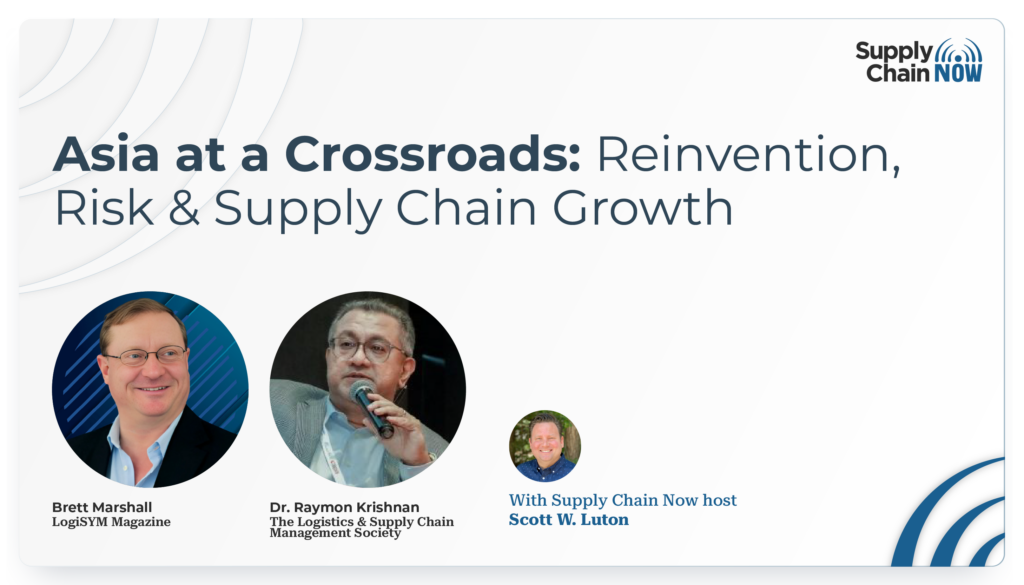
[00:01:19] Scott W. Luton: It’s gonna offer up tons of actual insights by the pallet load. Okay, so let’s welcome in. Our wonderful guest joining us today, starting with Dr. Raymon Krishnan, President of the Logistics and Supply Chain Management Society. He is a 30 year veteran of the Singapore logistics sector, where I bet he’s just about seen it all.
[00:01:40] Scott W. Luton: Raymon is also a certified logistics professional and a fellow of the Chartered Institute of Logistics and Transport. He specializes in supply chain resilience. And digital transformation to lead high performing businesses and supply chains. Now, Raymon currently leads the regional effort to re-skill and upgrade logistics professionals for the AI driven economy through the log sim and cargo now platforms.
[00:02:06] Scott W. Luton: Raymon, how you doing, sir?
[00:02:08] Raymon Krishnan: Great, Scott, great to be here and thank you for having us.
[00:02:11] Scott W. Luton: You bet. Well, you know what? Uh, we’d be good with you and me, but you bring great friends and it’s gonna get even better. So I wanna introduce Brett Marshall, editor in chief with LogiSYM Magazine. Now Brett is an accomplished transformation leader with 35 years in logistics, supply chain, and quality, including 30 years in the very complex.
[00:02:31] Scott W. Luton: Pharmaceutical industry. He’s passionate about quality, safety, and sustainability dedicated to making healthcare accessible while ensuring product integrity and patient safety. And he is a respected advocate in the fields of anti-counterfeiting and brand protection. How about that? Brett has worked in a variety of countries, including Australia, Indonesia, Thailand, Philippines, Bangladesh, and Singapore, and he holds a variety of certifications and serves on numerous boards and associations, including.
[00:02:59] Scott W. Luton: International Supply Chain Education Alliance, apac, ISPs, ips, women in Pharma and apac. I’m gonna call it Gant, five Communities of practice. Brett, I hope I didn’t butcher any of that, but great to have you here with us
[00:03:13] Brett Marshall: Brett. Job Scott. No, happy to be here. And as Raymon said, it’s uh, it’s very exciting for us to be involved with supply chain now.
[00:03:21] Scott W. Luton: Same. I, I admire what you both and your organization and community does to further industry, uh, both in your home region and globally. And it’s great to have y’all both here. So what we’re gonna do, Brett and Raymon, is start with you. You know, I love my fun, my cheesy, fun warmup questions. I loved humanizing our guests a bit before we get into all things supply chain.
[00:03:45] Scott W. Luton: And Raymon, I wanna start with you because. On a personal vacation or holiday you took, there was a strong supply chain analogy at play because you ventured down one of the most dangerous roadways in all of the world. And I think we’ve been there it seems like, from a global supply chain standpoint in recent years.
[00:04:05] Scott W. Luton: But tell us about that and, and what was your why for going down this stretch?
[00:04:11] Raymon Krishnan: Well, every year I try and do something a bit challenging just to learn something new, challenge myself. Um. New opportunity meet people. So what I did in the tail end of last year, me and a bunch of friends, we rode our motorcycles on the Sach Pass in the Himalayas.
[00:04:31] Raymon Krishnan: And if you look at National Geographic and a lot of, um, show, Sach Pass is considered one of the 10 most dangerous roads in the world. So we ended up at 16,000 feet. So it was. Minus two degrees Celsius temperature.
[00:04:51] Scott W. Luton: Wow.
[00:04:51] Raymon Krishnan: Um, drizzling cold. I had food poisoning that day. And you don’t wanna have food poisoning on the back of a motorcycle.
[00:04:59] Raymon Krishnan: Um, trust me, at 16,000 feet where you’re not used to riding that high. You know? So like, but it was a great experience and I did it with my son. Really enjoyed ourselves. We spent about seven days. On the back of bikes. Uh, yeah, it was great. So my wife doing it is, you know, like I said, every year I try to do something different, learn a new skill, just to keep active and keep learning more and more.
[00:05:27] Raymon Krishnan: And just like, you know, industry things always changing. So you wanna keep, you know, keep abreast of face.
[00:05:33] Scott W. Luton: I love it. And what’s your son’s name? Raymon.
[00:05:35] Raymon Krishnan: Joshua.
[00:05:36] Scott W. Luton: Joshua. Okay, so I bet you got some great pictures. We’re gonna have to see later of you and Joshua. And one last question, the roadway, I know you mentioned it in your response, but what was that again?
[00:05:47] Raymon Krishnan: The Sach Pass. S-A-C-H Pass.
[00:05:51] Scott W. Luton: Okay. I’m gonna have, we’re all need to look that up. Uh, folks. Asage Pass and I love, and at a higher level, I love, we all need to get out of our comfort zone regularly because whether you do it for industry and professional development, or you do it for just your personal journey.
[00:06:04] Scott W. Luton: Um, that is a great rule of thumb. Alright, so Brett, that’s gonna be tough for you to, uh, surpass, but I gotta tell you, you know where we, you and I first met, I think it was on LinkedIn maybe, and we were talking, we’re both basketball fans. You may be a bigger fan than I am. You may have played. I did not. I could not shoot outside.
[00:06:23] Scott W. Luton: I could not shoot inside. Uh, but Brett, I am a big Atlanta Hawks fans. Of course, we’ve got. Some terrific Australian professionals on the team, but tell us about your love for basketball or sports in general.
[00:06:36] Brett Marshall: Scott, I’m, I’m a Melbourne boy and, uh, so Melbourne people are, are crazy about sport. Uh, and it doesn’t really matter what sport it is.
[00:06:46] Brett Marshall: We, we make a competition of two cockroaches running across the floor. Um, but I think probably it was, it was another thanks to Netflix that turned me on to watching basketball, um, with a greater interest. And we’ve, there’s, there’s always been Australians involved in the NBA, but uh, you know, we’ve got some really great talent.
[00:07:10] Brett Marshall: That’s playing in the US at the moment. So it’s exciting to watch. And of course the Atlanta Hawkes have Dyson Daniels and he’s, uh, a genuine star
[00:07:20] Scott W. Luton: and with,
[00:07:21] Brett Marshall: and I think, you know, they, I think the Hawkes have done pretty well out of the most recent trade period. So, uh, so let’s keep our fingers crossed.
[00:07:29] Brett Marshall: They might be able to turn their season around.
[00:07:31] Scott W. Luton: I, I’m with you. And, you know, not that a, a hawk nerd out or anything, but I think, I think Jock Landell. Is, uh, I may be missing up his name. The, the new sinner.
[00:07:42] Brett Marshall: Yes, yes, yes.
[00:07:43] Scott W. Luton: I think he’s Australian as well, right, Brett?
[00:07:45] Brett Marshall: He is. He is, and definitely someone that’s worth having on the plank and ready to come onto the court.
[00:07:52] Scott W. Luton: Okay. You see there, uh, Raymon and Brett, I love, he just referred to what we call the bench in the us the plank is what Brett said, which sounds much more, um, uh, highfalutin Brett. So I’m gonna have to embrace some of both of y’all’s terminology. Um, okay, so we got a lot to get to here today. Uh, y’all are deeply involved in global supply chain and that community and, and helping folks and organizations get better at what they do.
[00:08:19] Scott W. Luton: I want to start. With you, Raymon. And uh, and kind of a broader opening question here, uh, ’cause we’re gonna be focusing a lot on Asia and Southeast Asia, but when you look at the landscape across a, the supply chain landscape across Asia and especially Southeast Asia, are you more optimistic or more cautious?
[00:08:38] Scott W. Luton: And why Raymon?
[00:08:40] Raymon Krishnan: I think I’m more optimistic and more cautious as well. Scott. I’m optimistic because like, you know, um, post COVID or during COVID especially. Um, the world realized how important supply chain and logistics is, so, um, there’s been a lot more focus, a lot more, um, development, a lot more interest in what we do.
[00:09:02] Raymon Krishnan: So from that perspective, I’m optimistic, and especially also with the rebalancing that we’re seeing in supply chains. There are more opportunities being created. I am more cautious because of everything that’s happening. All the conflict, what’s just started. It’s sad, it’s challenging, uh, and you could say it’s an opportunity for you to re-look at what you’re doing, but you know, I think that cautiousness has to prevail because it’s not an evolution that we are seeing, you know, it’s not tariffs, but, you know, with conflict that’s happening in different parts of the world, this is something we wanna be cautious about, you know?
[00:09:46] Scott W. Luton: Hmm. I’m, I’m with you. And I think that’s, that’s a, um, an answer that, uh, I’ve got a lot of kindred spirits around for sure. Brett, your take optimism, caution, uh, and why?
[00:09:58] Brett Marshall: Yeah, Scott, I think I, I share Raymon’s view of, of optimism and, and caution. And I, I think, you know, my experience in the farmer industry has tuned my risk management mantra.
[00:10:13] Brett Marshall: And I think one of the things that we’ve learned. Particularly since the pandemic is a much stronger, uh, culture of risk management, and I think that’s what makes, makes it exciting. I mean, particularly in the pharma industry, there was always an element of, of focus on quality, being responsible for risk.
[00:10:37] Brett Marshall: I think nowadays we accept that risk is an organizational issue and much broader than that. And I think that starts to equip us much better to deal with the situations that are evolving and, um, I think we, we just cannot take for granted that. Uh, every disruption that we encounter is, is the last disruption.
[00:11:01] Brett Marshall: Jake Barr has a great saying about being, you know, the near never normal, and I think that’s what we have to accept for the future. And the past weekend was another great example of that, that, you know, we had our eye on tariffs and now we’ve gotta have our eye on, you know, what are disruptions are taking place around the, you know, the Gulf of Hormuz and the Hormuz Strait.
[00:11:22] Brett Marshall: So. Uh, it, there’s great, uh, I think there’s a great skill development in, in supply chain and logistics, and that will continue in around risk management and yeah, we, we have to look to be cautious, uh, for what’s gonna come next because there will always be something that comes next.
[00:11:44] Scott W. Luton: So very true. And, and I tell you, uh, I may be partial, but there’s a few industries or a few professions that have to constantly keep their eye not on what’s going on right now, but what’s around the corner and then around the next corner, like supply chain management.
[00:11:58] Scott W. Luton: It really is more or less unique aspect of it. So I wanna do this. A lot of themes y’all both shared in your responses. We’re gonna touch on more. As we get into this conversation, but I wanna ask you one of my favorite things to do and one of my favorite things to urge folks to do is to get past the headlines.
[00:12:13] Scott W. Luton: I think we are tr, we have been trained at least large parts of society to look at a headline and make a snap judgment and not to dive deeper. Right? Our media is really good at giving you just enough, right? But you dive deeper and it’s usually not so bad or not so good, right? I don’t know, but so I wanna ask you both, uh, Raymond, starting with you, what do you see on the ground?
[00:12:34] Scott W. Luton: Right, especially there in Southeast Asia or regionally that global headlines might be missing.
[00:12:41] Raymon Krishnan: Well, I think not so much missing Scott, but I think one of the things that we need to be mindful of, we are being bombarded, especially with the current administration, with things happening every other day, be it tariffs or be it disagreements or be it new perspectives.
[00:13:01] Raymon Krishnan: So. We need to be cautious and not react to everything as well. Secondly, not to be distracted because it should be business is unusual. You need to continue evolving, doing what you have to do good, still have to move. And you know, like a lot of hype recently around AI and how it’s gonna be a game changer.
[00:13:27] Raymon Krishnan: People are going to lose their jobs. Um, all these opportunities. Yeah, these things take time to bet in, albeit faster than what we’ve seen in the last 20, 30 years, but also be aware of false profit, you know, so a lot of guys coming up with new concepts and ideas, especially around ai. But is it really executionable?
[00:13:51] Raymon Krishnan: Is it really real? Is it gonna benefit your supply chain and how you move things, how you plan, how you ship. So. Be aware, don’t get distracted, and also stick to the fundamentals because with everything that’s changing, relationships are still important. Being and doing what you say you’re going to do and deliver it, that’s still a fundamental thing that doesn’t change.
[00:14:16] Raymon Krishnan: And especially in logistics and supply chain, you’re only as good as your last shipment. So yes, not so much missing, but also don’t be distracted. Don’t be inundated with that. Overflow of information and stick to the fundamentals.
[00:14:34] Scott W. Luton: I like it. I think the first part of your response, the word that, uh, shot between my ears was discernment and the value of discernment.
[00:14:42] Scott W. Luton: Uh, it’s always been historically important and valuable, but gosh, right now, especially with all the constant micro decisions, and to your point, the tidal wave of, of distractions, all of which. Aren’t the majority of which are not important, uh, but discernment. All right. So Brett, same thing. Getting past headlines, your thoughts.
[00:15:01] Brett Marshall: Yeah, I, I think, you know, if we look at the situation in, in Asia, I think there’s generally a, a positive view of what’s, what’s happening in this region. You know, the significant contribution that it makes to the global economy, the continued growth of, of the region economically as well. But there are still, you know, there are beneath those headlines and, and, you know, benefiting from companies moving from China plus one China plus many, uh, certainly has seen, uh.
[00:15:37] Brett Marshall: Some of the mar, some of the countries given an, an opportunity to develop their manufacturing sectors across a, a, a range of industries, but there’s still infrastructure that needs to be developed and, you know, some of the port systems that, that also need to, to be developed in, in some of the markets we were with, uh, one of the big shipping lines today and, and they were talking about.
[00:16:03] Brett Marshall: You know, a, a shift from, uh, or, or an increasing demand for infra regional trade. And so how do they match the infrastructure that they have at the terminal level, but also the capacity that they have from shipping and also from, you know, TEU capacity. So these are some of the issues that that have to be dealt with, I think also.
[00:16:27] Brett Marshall: You know, Asia is, is seen as a region, but it doesn’t necessarily behave as a region that we have organizations like ASEAN, which, you know, at a, at a high level, certainly bring together countries to develop policy around trade and that sort of thing. But. How policy is translated into execution is a little bit of a different story.
[00:16:51] Brett Marshall: So, you know, it’s still very much a country by country prospect in terms of regulation and customs management and those types of things. So, um, I, I think that positive layer that that’s put across the top, yes, there are positive aspects, but there’s still. There’s still a lot of work for the region to do, to be able to really leverage the potential that it has.
[00:17:15] Scott W. Luton: Hmm. You know, Brett, one of the things you mentioned there with, when it comes to regulations and policies, I, I, I saw some McKinsey data yesterday that said globally indu. Policy and regulation aimed towards our industry has quadrupled since 2017. Now, I bet the US has produced a lot of that, uh, and we’ve caught up, especially in recent, uh, years.
[00:17:37] Scott W. Luton: But still that speaks to just the. It’s just one part of the complexity equation. Right? Uh, so good stuff there. Brett Raymon, you, you said something in your response earlier and I wanna revisit it. Uh, you were kind of referencing what I would, what I interpreted as kind of that rebalancing versus reinvention.
[00:17:54] Scott W. Luton: So I want to ask you both at a higher level, right? We’re gonna go back to Southeast Asia in a minute, but at a higher level globally. Do you see this as a rebalancing moment where global supply chain is essentially the same, but it’s adjusting at the, the pandemic and inflation and tariffs and of course, unfortunately lots of geopolitical turmoil, or is this a reinvention moment where we are really redesigning the whole model?
[00:18:17] Scott W. Luton: Raymon, your thoughts?
[00:18:19] Raymon Krishnan: I think if I had to choose one or the other, it’s reinvention. Mm-hmm. You know, I was in China in the first quarter of last year. Just when the tariffs were announced and the whole world, all the media within the Logistics Society, everyone was talking about how are we gonna pay for these terrorists?
[00:18:39] Raymon Krishnan: What’s the impact gonna be, et cetera, et cetera. And then when I went to China, I expected that conversation to continue, but I was sitting in the rule of logistics professionals, and it did not even come up in the whole two days that I was there. The attitude of the people in that room was fine. When one door closes, another opens, let’s just get on with it.
[00:19:05] Raymon Krishnan: There’s Europe to do business with, with there’s Africa, there’s the Middle East, there’s Asia, which is a huge and growing economy. Let’s just get on with it. Reinvent, if you like, what we’re doing. Look for different markets. And then that was also where you’ve got the evolution of, you know, humanoid robotics.
[00:19:26] Raymon Krishnan: Coming in and artificial intelligence. So yes, there are those challenges, but look at all the developments that are taking place. See, there’s an opportunity. Let’s reinvent what we do. Move ahead faster with the reshoring nearshoring initiatives that we started looking at during the pandemic and just get on with it.
[00:19:49] Scott W. Luton: Mm-hmm. Raymona, I love that, uh, constructive, practical. Optimism. We’re gonna, we’re gonna take our licks and get, we gotta keep moving because global trade is a very beautiful thing and it really helps create so much opportunity for folks and, and organizations and industries around the world. Uh, Brett, what your response, rebalancing versus reinvention.
[00:20:11] Brett Marshall: Uh, I, I think actually at a, at a high level, we’re certainly seeing some rebalancing, but I think as a result of that rebalancing, we’re also seeing, you know, some quite significant reinvention. And again, I’ll, I’ll come back to the manufacturing sector where we. You know, pre pandemic, we, we had a lot of globalization and in the post pandemic area, and as we head into more serious disruption for a variety of reasons, we’re seeing a lot more execution capability, manufacturing capability being established in markets and even markets that were accustomed to, to kind of man manufacturing kind of more low value, generic type items are now looking to become.
[00:20:58] Brett Marshall: You know, more developed in terms of higher investment, higher value items. And if I look at the farmer industry in particular, the ability to move away from just man manufacturing, generics to manufacturing biological products and, and, and those types of things. So it’s happening at two levels, I think.
[00:21:20] Scott W. Luton: Hmm. Yeah. Uh, it feels like two, two levels. Some days it feels like 2,282 levels other days, right? Um, yes. And we’re, we’re gonna have to have you back, Brett, to talk pharmaceuticals because that, that’s a fascinating industry, but something y’all both, well, I wanna ask you this. Both of y’all call Singapore, you both travel quite a bit, but you call Singapore home, right?
[00:21:40] Scott W. Luton: Beautiful part of the world. And this isn’t gonna be a very fair question, but I’m gonna ask anyway. What’s the single biggest shift happening in Southeast Asia Logistics right now, Raymon?
[00:21:51] Raymon Krishnan: Yes, we’re looking at shifting supply chains because of everything that’s happening, but I think what’s also interesting in Navy, we don’t hear so much about.
[00:22:02] Raymon Krishnan: The domestic growth within those ASEAN countries or the Asian countries. So it’s not just supply change shifting because you know of tariffs and trade wars, but also domestic demand in countries like the Philippines, Indonesia, these are all growing economies. Indonesia’s what the third largest populous, the third most populous country in the world.
[00:22:24] Raymon Krishnan: I’m not mistaken. And that domestic growth is happening. People’s lives are getting better. The demand for products are happening. And also, Brett touched on it earlier where we talked about China plus one, or China plus many alternative sources of supply. Because yes, China was the engine, the manufacturing basket of the world, but countries like Vietnam, Thailand, Malaysia are developing as well.
[00:22:52] Raymon Krishnan: As countries that can produce good material and equipment and stuff that people need. So yes, there is that shift happening, but the shift isn’t just happening because of trade wars and conflict. It’s evolutionary as well.
[00:23:09] Scott W. Luton: Raymon, I love that answer and I got it. It reminds me, uh, that’s the second time I think China plus one or plus many has come up in our conversation here today when we got together.
[00:23:17] Scott W. Luton: That y’all, y’all hosted this great event a couple weeks ago and folks can find the replay out there, but there was a panel of a dozen different supply chain leaders and I think y’all got confused by inviting me to the panel. ’cause I sat there and learned from, from some brilliant minds. But one of my favorite parts that came outta that kind of as a, um, if you think of China plus one as a yin, the yang was USA plus one, meaning on the consumption side, kind of to your point, Raymon.
[00:23:44] Scott W. Luton: Companies have, have exports, have found many, many other markets. And that’s been a fascinating shift here, uh, globally in, in recent months and maybe years. Brett, same thing. Unfair question, but one of the biggest shifts happening in Southeast Asia logistics right now.
[00:23:59] Brett Marshall: No, no. I, I think that the origin was probably the pandemic and the fact that Asia, I think felt at times that it didn’t get.
[00:24:10] Brett Marshall: The same amount of attention in terms of supply chain needs that that. The US and, and potentially Europe as well had, again, I would use pharma as an example where the allocation of medications was not a priority necessarily for countries in Asia or some of the countries in Asia. And I think the realization coming out of the pandemic from many of the, the members of the Southeast Asian Asians nations especially, was we, we cannot afford.
[00:24:43] Brett Marshall: To rely on other regions anymore. We need to be able to develop our capabilities internally to be able to meet the challenges that are gonna going to occur in the future. And so that’s seen, I think a number of governments switch their policy. Mechanisms to investment in developing capabilities and infrastructure, which is in turn impacting logistics and supply chain infrastructure and capabilities, uh, to be able to deal with what comes in the future and their ability to, to act as a region.
[00:25:21] Brett Marshall: As I said earlier, it, it hasn’t evolved to the level that, that say the European Union has today, but it took the European Union, you know.
[00:25:32] Scott W. Luton: Long
[00:25:33] Brett Marshall: term, several decades to, to, to mature to that level as well. So I think that’s a relatively new, uh, opportunity for, for the Asia region and, and how it starts to, to pull together.
[00:25:45] Brett Marshall: There’s still that kind, the tendencies are country focus, but they, I think they recognize that at some point there’s gonna be, need to be a much more regional focus.
[00:25:56] Scott W. Luton: Yes. You know, Brett, you look at any Brett and Raymon, you look at any part of the world and the Trade Alliances agreements, there’s very few that happen.
[00:26:05] Scott W. Luton: Overnight, I mean from the eu as you pointed out to, you know, NAFTA took hundreds of years between Canada, Mexico, and the US to the, uh, continental, uh, trade deal that Africa has recently. And all the countries that make up the beautiful continent has, has put in place any part of region. So I do agree with you, Brett.
[00:26:24] Scott W. Luton: I think the continued maturity as these regions continue to come, more formalize, formally collaborate, and the doors of opportunity that’s gonna open is gonna be something to watch. Um. We have made it halfway through this conversation, and I’ve been keeping track, but I don’t think any of us, all three of us have mentioned AI yet.
[00:26:42] Scott W. Luton: We are breaking rules. Raymon and Brett, we’re breaking rules. So I wanna ask you both. Raymon, I’m circle back to you here. There’s so many, um, ai, we could be here all day talking about it. But, um, in terms of some favorite use cases, you’ve seen companies use AI to produce consequential outcomes. Raymon, what’s, uh, one of your favorite ones there?
[00:27:03] Scott W. Luton: Well,
[00:27:04] Raymon Krishnan: I’ve got a couple, but you know, that’s one of the great things about being involved with the logistics and supply chain management society. Aside from my day job, I get to interact with so many interesting people, individuals. Brett said it, you know, we had lunch with a major shipping line today, one of the top three in the world, and they shared with us what they were doing.
[00:27:26] Raymon Krishnan: And then I spent the afternoon at a trade show here in Singapore. Only 35 exhibitors. So that’s very, very small, especially when you compare it to the us. But after spending three hours in the show, I only managed to cover half of the number of booths because at almost every booth I was meeting interesting people, learning new things, new technologies and et cetera, et cetera.
[00:27:54] Raymon Krishnan: But um, if I had to pick one, I’ve come across or we’ve been looking at. Planning and procurement quite a fair bit at the society because of the symposiums that we’re running. And I came across this company recently, and I’ve known them for a while, but I’ve had the opportunity to find out a bit more about them.
[00:28:14] Raymon Krishnan: Where they are redesigning the value chain. That’s what they say they’re doing by moving away from manual reactive sourcing to an autonomous bot lab model. So you know a bit of a mouthful. They’ve got a nice website. Everyone claims to be able to do everything, you know, but I think, like we all know, all of us run off Excel spreadsheets.
[00:28:35] Raymon Krishnan: You know, there’s a slow human decision making process that the rest of the information you have and the continuity of the information and a database falls off, but people leave and et cetera, et cetera. And then of course we’ve got fer spikes and port disruptions that add to the mix. So this company implements AI sourcing bots, right?
[00:28:57] Raymon Krishnan: So they handle tactical or spot buys, and the bots autonomously communicate with carriers. They analyze the bid complexity and then they award contracts automatically based on preset strategic diet guardrails. I’ve seen a couple of demos. If I had a use for it, I’d adopt it myself and try it in my organization.
[00:29:22] Raymon Krishnan: But it’s just great, like the accuracy, the speed, and really the application for a, for a guy who’s been in the industry for the last 30, 35 years, um, seeing what AI can do in this instance is.
[00:29:35] Scott W. Luton: Oh, I, I’m with you. And, and to your point in a, in a broader sense, um, the procurement space and its utilization of AI and, and currently and moving forward is, is nothing less than fascinating.
[00:29:47] Scott W. Luton: Brett, same question. Ai, what’s one of your favorite use cases?
[00:29:51] Brett Marshall: Yeah, I think we’ve, as Raymon says, uh, we are fortunate in some ways in the work that we do with the logistics and supply chain management society and, and also with logs sim in having the opportunity to meet. Companies that are at the forefront of developing solutions for industry.
[00:30:09] Brett Marshall: And, and what’s great is, uh, what I really, really like is, you know, when you find, when I see people who’ve, you know, been in the industry for 25 or 30 years, or 30, 35 years like myself, and they’ve got off the bus and they start driving. You know, types of solutions to, to address, you know, the types of problems that they’ve experienced for themselves.
[00:30:34] Brett Marshall: And I think that adds tremendous value. We do have a particular solution that we look at here, um, that’s around freight management and also emissions and emissions capture and reporting. And they’ve developed the bots to be able to ingest. Years and years and years worth of freight related information.
[00:30:59] Brett Marshall: That helps them then manage logistics and transportation invoices so that they’re able to clean up. You know, the documents that they’re receiving from the existing suppliers of the customers that they’re talking to. And so that’s, that’s helping them to improve the accuracy of the invoicing that they’re managing.
[00:31:20] Brett Marshall: It’s reducing the anomalies that you find in, in, in invoices over billing. Contract noncompliance and those types of things, but also they’ve linked it to ESG and, and emissions intelligence and, and built in the logic to capture those scope three emissions for transport, which is, is one of the most.
[00:31:43] Brett Marshall: Challenging areas for operators to manage. And so it’s, it’s, it’s a really nice solution. It, it can give tangible outcomes in terms of savings, you know, four, five, 6% in, in transport spend through, through the capabilities, and then helps also in, in, you know, potential positive impacts for, uh, for managing ESG more effectively.
[00:32:07] Brett Marshall: So this is a, a really nice solution. What also excites me is the passion of the people behind the solution and the development doesn’t stop.
[00:32:18] Scott W. Luton: Yeah.
[00:32:18] Brett Marshall: So you know, they’ve achieved two or three of their objectives already, but they’re looking at the way that the industry is evolving and what can they do to meet the next challenge, and I think that’s really what’s what I like most.
[00:32:32] Scott W. Luton: Brett, so much to comment on there. But one thing is the development doesn’t stop. Especially the, of course, the, uh, Gentech AI bot driven development man that they need to take, they need to learn how to take a lunch break, I think, uh, may maybe not, but another thing you mentioned that reminded me of my time in manufacturing where we’d have customers come in and make supplier visits, right?
[00:32:51] Scott W. Luton: And we’d have lunch and they’d do a plant tour, all that stuff. How long before? We see bots making supplier visits. We’ll see. Is that gonna be something? I don’t know. Um, all right, so let’s talk about All of this really begs the question, ’cause I’m gonna circle back to one of all. I think all three of ours favorite components of global industry, maybe the favorite is the beautiful human factor, right?
[00:33:13] Scott W. Luton: I’ll tell you, we’ve all, you know, you, you both have been in industry. Uh, for quite some time, wrote elbows with I bet some brilliant people that brought the most innovative and, uh, incredible solutions. And, and, uh, Raymon, you mentioned of the power of relationships. When you think about the skills that the human workforce has to have in place to find success, growing success in global supply chain and how that skills, whether it’s the skills gap or just the overall tool belt.
[00:33:43] Scott W. Luton: It’s going to evolve the next three to five years. Raymon, what do you see there? What’s one of your observations there?
[00:33:49] Raymon Krishnan: Let me set this in context with the society. We have something that we call the Shipper’s Council, so that’s made up of about 120 companies at the moment who spend anything in excess of 100 million US dollars on logistics.
[00:34:07] Raymon Krishnan: So they’re normally larger, multinational companies operating in different geographies. And one of the things that I see in this group of 120 Logisticians is that as the group has evolved and developed over the last few years, you’re starting to see this bifurcation or this filtering. We’ve got some guys who are.
[00:34:32] Raymon Krishnan: A very progressive experience. They become senior leaders within their organization. Um, and then there are others who either through choice or through circumstances stay within their roles. And many people in Singapore, we run Asia Pacific Logistics, either anything from China down to Australia, New Zealand, and then from India, Japan, and Korea.
[00:34:58] Raymon Krishnan: And then there’s a third bunch of guys who. Uh, technique for want of a better word. And we’ve addressed this a couple of times in the meetings and the conversations that we’ve had. So if you talk about the skills gap, and when I look at this group that we have within the Logistics Society, the biggest skills gap is not education or lack of opportunity.
[00:35:24] Raymon Krishnan: The biggest skills gap to me is that unwillingness to learn and develop. I learned something new every day about it. Like I said, I, I visited a trade show earlier today. I spent half a day there and I barely got through half the number of booths because there’s so many new things developing and that’s happening every day.
[00:35:46] Raymon Krishnan: That new can take and apply 10, five or 10% of that, and you will improve. Your operation. So I think that big skills gap is that unwillingness to learn or stagnating and saying, yep, I’ve been doing this job for 35 years. You can’t teach me anything new. You know? You know, so, yeah,
[00:36:07] Scott W. Luton: that is a, as you’re pointing out, is such a dangerous mindset, and we all know how, I might not call it prevalent, but there’s a lot of it out in the industry, right.
[00:36:16] Scott W. Luton: And whether you’re just coming in. Or whether you’ve been around for a while, that book, who Moved My Cheese? I think we’re living in an air where our cheese is being moved by the minute. And to your point, our mindset and our ability to embrace it. Right. And learn through it and manage through it and apply it and, and kind of be ever present in that, in that type of environment is gonna be important for, for everybody.
[00:36:42] Scott W. Luton: Great stuff there. Raymon. Brett, same thing. Skills, skills, gaps. What some of your observations there?
[00:36:49] Brett Marshall: One of the things that always strikes me, I, I started my career long time ago now, but as a transport supervisor, you know, distribution company, but my role, you know, first thing in the morning was always to, to walk around and literally kick the tires.
[00:37:07] Brett Marshall: Make sure the trucks looked good and make sure the fuel was okay, the fuel levels were all right and had to do all that stuff before you arrived. And I, and I, I sort of feel that as we progress those types of entry level positions into the industry, uh, potentially being degraded partly by ai, partly by cost management.
[00:37:30] Brett Marshall: But one of the positives I think, is that we’ve also seen, I think a good. Contribution from industry to the logistics and supply chain practitioners of the future during their education phase. I mean, you, you’ve been involved in doing this yourself, Scott and I, and I know you know this. Marty Parker is another great example of, of people who, who are developing the minds for the future.
[00:37:56] Brett Marshall: So I, I, I think that’s a really positive step. I, I always wonder whether the, the time that we spent learning how to do things and learning how to respond, I know AI can, can, you know, mitigate some of that time spent, but I, I think, you know, the ability to, to manage people and to be humble and to, to, to show empathy.
[00:38:21] Brett Marshall: I think these are skills that, you know, we, we really need to be able to teach people to, to have. Teach the leaders of the future to have.
[00:38:31] Scott W. Luton: Yes.
[00:38:32] Brett Marshall: So, um, yes, there, there are potential skill gaps, but I still, um, we, we were in Malaysia, uh, last week and we visited a couple of universities that are involved in training, logistics and supply chain people for the future.
[00:38:49] Brett Marshall: And their focus on having strong. Industry engagement was really impressive. And I think that was one of the things that we enjoyed the most, that, you know, one of our takeaways was, was, you know, how we as an organization, as an industry continue to contribute to the skilled development of, uh, of the future leaders in our industry.
[00:39:10] Brett Marshall: And there’s certainly some challenges, but there’s, there’s a lot of positives as well.
[00:39:15] Scott W. Luton: Uh, agree and at, at a high level, very high level. I bet both of y’all agree with me here. When you think of your overall, for all the business leaders and hiring managers tuned in here, when you think about your overall talent management strategy, of course, every organization out there worth its salt, weight and salt or what, however, that phrase you got, phrase goes all, you know, talent attraction, right?
[00:39:36] Scott W. Luton: It gets all the attention. Yeah. Uh, there’s growing attention on, on talent retention and that’s a great, that’s good news. But if you’re not in a very formal, dedicated, deliberate sense, focused on developing your talent, kind of to y’all’s points, you’re gonna be in trouble. You’re gonna be in, you’re already in trouble.
[00:39:53] Scott W. Luton: Um, so we can’t talk enough about talent For the sake of time, I’m gonna move forward ’cause I want to talk about. All the cool things going on in Singapore, uh, where you both call home, which I look forward to visiting soon. I appreciate the invite to a big event. We’ll touch on here in a minute and who knows?
[00:40:10] Scott W. Luton: We’ll see if supply chain now logistics can, can, uh, can work out. But anyway, Singapore has long been a logistic powerhouse, but you’ve got some new things coming online, port modernization. Is the Changi Expansion. I hope I’m saying that right. And of course, digital trade initiatives are accelerating and, and of course the talent continues to innovate and develop.
[00:40:31] Scott W. Luton: Gimme some thoughts, Raymon, on where Singapore is headed.
[00:40:36] Raymon Krishnan: Well, aside from the expansion of Changi Airport, we’re also increasing the size of. Our maritime port with a capacity of about 65 million tus when it’s fully developed. But something else that’s happening, and I think we need to talk about is the special economic zone that’s being developed in the southern part of Malaysia.
[00:41:04] Raymon Krishnan: It’s called the SEZ, the South Southern Economic Zone, and what we’re seeing as a result of this. A whole bunch of companies moving their logistics, um, and distribution and even their manufacturing and even RAD to Malaysia, which is 15 minutes away on a good day. So you cross the border and things are generally a third of the cost of doing in Singapore, you know, whereas labor, land, buildings, infrastructure.
[00:41:38] Raymon Krishnan: I mean, it’s not very far away. If you look at the map, so what we’ve seen over the last couple of years, and Singapore is supporting this, right? We are moving away from the transactional, just moving boxes from A to B using manual management layers, et cetera, et cetera. Those more transactional, more operational tasks, we’re looking at moving them to the special economic zone.
[00:42:04] Raymon Krishnan: And then what we’re looking at doing is. Doing the more high value at the control tower stuff, the planning, the procurement activities, and also the high value manufacturing and logistics activities. A cold chain, pharma, you know, Brett’s area of expertise. So there are a lot of moving parts. You’ve got that macro environment that’s happening around global trade, tariffs, conflict, et cetera.
[00:42:30] Raymon Krishnan: But we’ve also got an evolution or net development happening here in Singapore. And you know, I don’t know if you read my article from a couple of weeks ago where I talked about UPS laying off about 30,000 people, and also Amazon as well as they decoupled their supply chains and they’re getting more fragmented and regionalized.
[00:42:49] Raymon Krishnan: And I do a parallel between that and what’s happening in Singapore, you know, and the parallel was, you know, it used to be where we went for high volume. The more boxes we moved, the more warehouses we had. The better by what did UPS decide to do? They decided not to go for that high volume transactional low margin business and focus on things that make money.
[00:43:15] Raymon Krishnan: Right. So you don’t compete on volume, you dominate on orchestration. Right. The trucks and planes will always be there, but a profit will belong to those who own that data direct and controls the supply chain.
[00:43:30] Scott W. Luton: Mm-hmm.
[00:43:31] Raymon Krishnan: So that’s something that I’m seeing Singapore. Trying to do or needs to do, not doing it fast enough, in my opinion.
[00:43:39] Raymon Krishnan: And that’s a huge opportunity for us.
[00:43:41] Scott W. Luton: Yes, yes. Uh, I’ll tell you, in some aspects of global industry, things are going plenty fast enough for me. Another aspects, to your point, we’d like to pick up a little bit of speed and another point, one of the big points, and it’s so, it’s exciting to hear Singapore and Malaysia and some of the really cool things going on there, but to one of your business points made, all volume is not equal.
[00:44:02] Scott W. Luton: Right. All volume is not equal. It’s gotta be smart business, which of course is nothing new, but some organizations are taking a newfound discipline to that. Um, alright, so Brett, same thing, same question. Singapore is on the move. So many different developments taking place across industry. Raymon touched on on a lot of those, your thoughts.
[00:44:21] Brett Marshall: Yeah, I, I think right back to the days of Lee Kuan Yew, Singapore has had a tremendous capacity to look into the future and, uh, and to make sure that architects. You know, the infrastructure and the capabilities that it has. And this extends to not just the infrastructure that they invest in, but also, you know, the way that they’re educating people and the opportunities that they’re making for the education of students.
[00:44:52] Brett Marshall: And I think this, this is also continuing. Yes, Changi is showing great vision in the expansion and the addition of Fifth Terminal and some much enhanced cargo handling capability was a little bit delayed by. COVID, but it’s, it’s now well underway and I think, as Raymon said, the high level of digitization almost to the point of no human involvement in the port operating system that’s being developed.
[00:45:26] Brett Marshall: And what makes life interesting, I think, you know, we had a logum event in Malaysia last year, and, and we had the port operators from Malaysia we’re on, on a panel together. And while they may well compete against each other, they see their primary competition as Singapore. So, so there is intense competition I think, between the different port operators, uh, around Malaysia, Singapore, and Indonesia to improve their capabilities.
[00:45:57] Brett Marshall: And as a region, I think that’s, that’s outstanding.
[00:46:00] Scott W. Luton: Mm-hmm.
[00:46:00] Brett Marshall: Certainly. Uh, I think that Singapore has positioned itself very nicely to be a hub for different industries, you know, in a way that allows industries to put them, their inventories, their final inventories closer to consumers and patients and those sorts of things.
[00:46:21] Brett Marshall: So they are using their geo geographical location effectively, but also putting the infrastructure behind it.
[00:46:28] Scott W. Luton: Hmm. You know, uh, I think with the ports, that old phrase, coopetition applies there than more, more so maybe than so many other aspects of our industry. Um, because the ports do compete, kind to your point.
[00:46:41] Scott W. Luton: Right. And there’s a fierce competition. However, there’s a lot of cooperation, especially landing, uh, really complex, big volume, uh, and special deals. So it’s interesting to see how that, that coopetition pushes innovation and advancement and, and new opportunities. Okay. We’re gonna, we’re gonna finish on a fast and furious finish.
[00:47:01] Scott W. Luton: We’re coming down to home stretch, and I got a couple of quick hitters I wanna, I wanna get both of y’all to comment on. Uh, the first one is, I, I love, and I hope I’m interpreting this right, ’cause I love reverse logistics and returns, management’s one of my favorite topics we’ve been talking about and, and interviewing people for years.
[00:47:18] Scott W. Luton: And as Tony Sheroda has always called it, it’s really. He calls it the dark side of industry. Right? He’s always called it that. It’s, it’s largely invisible. Folks don’t wanna talk about it. But more and more industry is, and we’re seeing technology and innovation come into the space. So, Raymon, tell us about this.
[00:47:34] Scott W. Luton: I’m gonna call it, I’m gonna ask you about the return logistics, uh, innovation, uh, initiative. Tell us more.
[00:47:40] Raymon Krishnan: Okay. So the Society, we are the host organization for the Asia Pacific Reverse Logistics Innovation Alliance. And you’re absolutely right Scott. You know, reverse logistics is notori notoriously dark, right?
[00:47:57] Raymon Krishnan: Companies struggle to track the providence condition, carbon footprint, so on and so forth. And e-commerce, as we all know, has made that even worse. That’s multiplied it tenfold.
[00:48:08] Scott W. Luton: Yep.
[00:48:09] Raymon Krishnan: So we from formed earlier. Uh, we’re the host, it was broached by us, by one of our board members, Wolfgang LaMarca and Brett, myself and a few other members.
[00:48:23] Raymon Krishnan: And we’ve got some very interesting companies that have come aboard to be part of this initiative. And we are, over the next three or four weeks going to be identifying shortlisting projects or initiatives that we want to look at. And one of the things is, you know, talking about ai. You know, you can use computer vision and machine learning at that point of return.
[00:48:46] Raymon Krishnan: You know, you can use it to great product condition, determine the optimal return path, whether you want to repair it, resell, recycle, and then this can all be sped up using ai. Since we talked about AI earlier and you asked me what some of our interests, what my favorite was, but this is another one of those things.
[00:49:08] Raymon Krishnan: So. Yep. A lot happening with, or the APAC Reverse Logistics Innovation Alliance and, uh, watch this space for more news about it.
[00:49:18] Scott W. Luton: We are, and you know what, we’re gonna talk after the show ’cause I got a couple ideas and some connections. I think that that might be of significant value to that wonderful initiative that y’all are driving.
[00:49:28] Scott W. Luton: Love it. Um, okay. Brett, anything else to add to that before we talk about LogiSYM programming.
[00:49:33] Brett Marshall: No, I, I think you know this. This is an area that I’ve been interested in for a long time, and the industry that I’ve been involved with for such a long time had. Returns return rates of between eight and 10%.
[00:49:48] Brett Marshall: And that’s just on, on medication. So how we manage that more effectively, reduce waste, uh, as well as managing the ESG question, I think is, is really important. Three, uh, key areas that we’re looking at are the regulatory aspects, uh, the innovation opportunities and also the operational aspects. It’s in the early days and look forward to, uh.
[00:50:13] Brett Marshall: To working on this further.
[00:50:14] Scott W. Luton: So much opportunity in this space and I, I applaud y’all’s leadership, uh, because I know it takes time and organization and, um, especially when you’re talking about driving action. So well done there. Um, alright, so Brett, I’m gonna start with you. When it comes to LogiSYM programming, I know y’all do events year round this, this initiative may be a great example of that, but y’all also have a big event coming up in May.
[00:50:38] Scott W. Luton: Brett, tell us more.
[00:50:41] Brett Marshall: Yeah, we have in May from the 12th to the 14th, we have, uh, LogiSYM APAC, and this is a, a multi-tier event in the sense that we’re covering a number of topics through those three days. We have tracks for planning and procurement, Pacific tracks for planning and procurement for uh, cold chain management.
[00:51:05] Brett Marshall: Uh, for three PL guidance and, and best practice. We have our five streams actually within the APAC conference itself, or the APAC symposium itself, which is looking at digitalization, supply chain, risk management, uh, intralogistics, ESG, and also, uh, e-commerce. So it’s a. A pretty packed program. We’ll also be looking at, we will be running a number of round tables through the event, an event that’s looking specifically at shipping related issues with one of the big shipping services companies.
[00:51:47] Brett Marshall: That’s running with our shipping, our shippers council also on the global logistics emissions. Council’s program for capturing and measuring and reducing emissions in, in logistics. Um, so that’s, uh, that’s also one of our round tables. We’re running, uh, a special round table on the initiative that we just talked about earlier.
[00:52:14] Brett Marshall: And I think the, that’s probably about it for the
[00:52:19] Scott W. Luton: And you’re gonna have a lot of fun too, though, the beyond the hard work. Oh, absolutely. Round tables, right.
[00:52:24] Brett Marshall: Yeah. Yeah. So we’re, we’re running the event is in, uh, conjunction with CMAT and also with Cargo now. So I talked about the symposium aspect of it, but there’s also an exhibition, which will be a range of intralogistics and end-to-end supply chain service providers and solutions as a part of that day.
[00:52:43] Brett Marshall: So it’s a, a very large event. We’ll get. Uh, probably somewhere between six, 7,000 people walking through the event. And then we have a fairly curated program, so the symposium itself will have probably three, 350 attendees through the mainly senior levels of logistics and supply chain management.
[00:53:07] Raymon Krishnan: Standing just to interject.
[00:53:08] Brett Marshall: Yes, please.
[00:53:09] Raymon Krishnan: Just to interject, talking about fun, we’ve also got our gala dinner that we have on day two. So that’s 400 crowd rowdy, um, loud logisticians in one room. Last year we finished up at 2:00 AM another year we had a conga line going through the, the, oh,
[00:53:29] Scott W. Luton: I love it,
[00:53:29] Raymon Krishnan: the dinner. And I ping the entertainment because the crowd, the audience make so much noise that they just drown out the entertainers.
[00:53:39] Raymon Krishnan: So, um, talking about fun, it should be great. You.
[00:53:43] Scott W. Luton: It will be, it sounds like, uh, it, y’all, we all enjoy of course, the adult beverages, which is truly what keeps global supply chain moving forward, uh, that humans do. Uh, okay. Well, folks, you can learn more, and y’all correct me if I’m wrong here, but logisym.org, and that is spelled LOGI as in logistics, logi..
[00:54:04] Scott W. Luton: SYM, so L-O-G-I-S-Y <.org. You can learn more about Great may event, year-round programming. I bet there’s information on there for the, uh, re reverse logistics initiative. Is that right, Raymon? Yes. And Brett. Okay. Go get plugged in, become a member. Uh, attend the events. You’re gonna meet great people like Brett and Raymon that have a passion for changing.
[00:54:30] Scott W. Luton: How business gets done. Um, alright, so, so as we start to wrap here, I gotta ask you both quick hitter. We started this interview after the fun warmup to talking optimism and caution. I wanna ask you both, starting with you Raymon, what gives you, if there’s one thing, there’s probably many, but what’s one thing that gives you practical optimism for the future of global supply chain?
[00:54:51] Raymon Krishnan: The people in the industry. Like I meet great people every day. 99% of them, they want to do better. They want to learn more. They want to cooperate. They want to, you know, people who work in logistics are special. Generally. They’re not academics, you know, they’re not scientists. They’re doing r and d, Cury cancer.
[00:55:11] Raymon Krishnan: They’re just those quiet people that get stuff done.
[00:55:14] Scott W. Luton: Yeah.
[00:55:15] Raymon Krishnan: And they get it done well and they just wanna do better. So that’s, that gives me a lot of optimism. It’s a great industry to be part of. And with the society, you know, 45,000 members, um, you know, I, I, it’s just fantastic.
[00:55:31] Scott W. Luton: I’m with you. I’m with you. A thousand percent there.
[00:55:34] Scott W. Luton: Uh, Brett, same question. What gives you practical optimism for the pathhead?
[00:55:39] Brett Marshall: I think, um, you know, post pandemic supply chain or during the pandemic and post pandemic supply chain, uh, is, is on the front page and it’s, it’s front and center in any discussions and even when you go to Davos, you can hear world leaders talk about.
[00:55:57] Brett Marshall: You know, what’s happening in supply chain. So I, I, I think that’s, that’s a great evolution. And as Raymon said, I think, you know, the people aspect is super important. We still need to get a, we, we still need to get jobs done. The resilience aspect that, that. You know, he is now such a, a popular topic, I think has always been a part of supply chain practitioners, logistics practitioners, DNA, and I just think it’s fantastic now that we’re giving, being given the opportunity to demonstrate just how effectively we can manage the situations that being thrown at us.
[00:56:33] Brett Marshall: And, uh, and that makes it fun. And, uh, and, and I love being a part of the industry and, and a part of what happens every day.
[00:56:42] Scott W. Luton: Same. Same, uh, uh, but you know, for the powers that be, if you could throw a little less situations at us, uh, we’ll take that too, right? Um, alright, so the million dollar question, maybe the billion dollar question these inflationary times.
[00:56:54] Scott W. Luton: Brett, how can folks connect with you? My friend?
[00:56:57] Brett Marshall: Uh, probably LinkedIn is, uh, is probably the best way. Yep. Outstanding on LinkedIn. Outstanding
[00:57:03] Scott W. Luton: and folks gotta check out the LogiSYM Magazine. Uh, yes, you did great work there. Lots of perspectives. I really enjoy that. Uh, so folks connect with Brett Marshall on LinkedIn and Raymon, how about you?
[00:57:15] Raymon Krishnan: Same thing. LinkedIn I think is best. Um, and I appreciate people reaching out and pointing out things that we are wrong about or having that conversation with us, um, is fantastic. So feel free.
[00:57:28] Scott W. Luton: Raymon, and I appreciate that. And for all out those out there that send me the LinkedIns and the texts and the emails about what I get wrong.
[00:57:35] Scott W. Luton: Hey, feedback is a blessing. It is a blessing. So I’ll keep it coming. Exactly. Okay. All right. So what a great conversation. Again, I admire what y’all doing. Uh, I know y’all have day jobs, but gosh, our driving so many. Powerful dialogues and conversations that are driving real action and a great sense of community.
[00:57:54] Scott W. Luton: And, uh, I mean that in a very non cliche way, uh, the fellowship and the relationships that you’re helping to foment and grow is so important to global, really global everything. So I wanna thank our wonderful guest here today, Dr. Raymon Krishnan. Again, president of the Logistics and Supply Chain Management Society.
[00:58:12] Scott W. Luton: Raymon, thanks for being here.
[00:58:14] Raymon Krishnan: Thank you very much. Thanks for
[00:58:15] Scott W. Luton: having me. Bet. You bet. We’ll have you back soon. Brett Marshall, Editor in Chief with LogiSYM Magazine. Brett, thanks so much for being here.
[00:58:23] Brett Marshall: Fantastic. Thanks Scott. Go Hawkes.
[00:58:25] Scott W. Luton: That’s right. Go Hawkes. We gotta make the playoffs out and then get past the playing round.
[00:58:29] Scott W. Luton: We’ll see. But, uh, Raymon and Brett are quite a one-two punch folks. Make sure you connect with them and you know the homework we’re gonna share with each of y’all. First off, hope our SCN global fam enjoy this great conversation as much as I have. I’ve got my 18 pages of notes here based on the great things that uh, we learned here.
[00:58:47] Scott W. Luton: But folks, you got homework ’cause there’s so much. Raymon and Brett shared so many. Actual moments or opportunities or perspectives that you can take and do something with, right deeds, not words. We know that’s how real change happens. Good change happens. So with all that said, Scott Luton challenging all of our listeners.
[00:59:05] Scott W. Luton: Hey, do good, give forward, be the change as needed, and we’ll see you next time. Right back here. On Supply Chain Now. Thanks everybody.
[00:59:12] Voiceover: Join the Supply Chain Now community. For more supply chain perspectives, news and innovation, check out supplychainnow.com. Subscribe to Supply Chain Now on YouTube and follow and listen to Supply Chain Now wherever you get your podcasts.