[00:00:00] Steve Wilhite: I don’t know that AI will take your job, but somebody else using AI might take your job. And so I think it’s a good lesson for all of us. Keeps me sharp about what are the use cases, and it’s a combination of how do we amplify and augment human intelligence with the intelligence of machine learning, reinforcement learning, but agentic ai.
[00:00:18] Steve Wilhite: So that’s where we talk about the collaborative approach and collaborative intelligence. It is. So that’s what Sarah’s meant to be.
[00:00:26] Voiceover: Welcome to Supply Chain Now the number one voice of supply chain. Join us as we share critical news, key insights, and real supply chain leadership from across the globe. One conversation at a time.
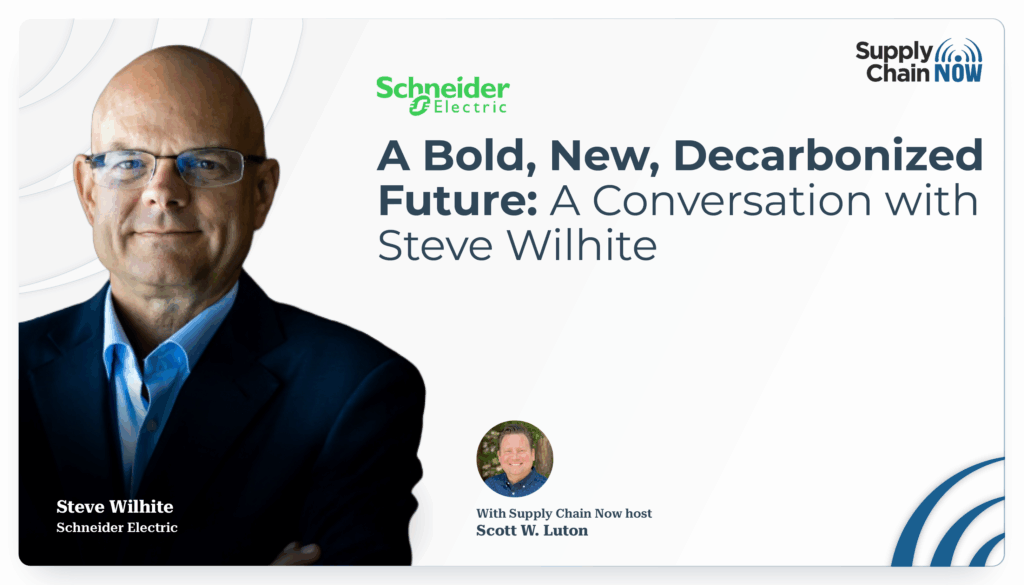
[00:00:39] Scott W. Luton: Hey everybody. Scott Luton with Supply Chain Now I’m here as we continue our coverage. Of the Innovation Summit North America 2025, which is powered by our friends at Schneider Electric. So here I’m joined by what my newest, best friend Steve Wilhite, who is an executive vice president with Schneider Electric Advisory Services.
[00:00:58] Scott W. Luton: Steve, how you doing? Hey, good, thanks Scott. It’s good to be here with you. It’s terrific to have you. I’ve already enjoyed all the pre-show conversations we were having and, and now we gotta talk about some industry stuff. You ready? Alright. We won’t make it boring. Okay, well let’s start with this and do our, uh, homework we’ve done on you.
[00:01:14] Scott W. Luton: We know that you love spending time with family. We know we love you, love to golf. We’ll get your handicap. Maybe it’s my escape. And we also understand that you love to enjoy bourbon. Good Kentucky Juice is at the top of the list. I’m with you, but you also love traveling the world and connecting with new people.
[00:01:31] Scott W. Luton: So on that last point. What was one of your favorite visits
[00:01:35] Steve Wilhite: around the world this year? Oh gosh. I had one trip that took me from the US to my team in Budapest, from Budapest, back to La LA back to Saudi Arabia, Saudi to Dubai, and Dubai to Bangkok before coming home. And I got to spend time with my teams in all those different places and I loved it.
[00:01:53] Steve Wilhite: It was a ton of fun. We’ve got a lot of young. Team members. I’m kind of, they call me grandpa ’cause I’m the old guy in the group. But interacting with our different teams around the world, hearing their perspectives, it’s fantastic.
[00:02:06] Scott W. Luton: Outstanding and, and all those beautiful places, you mentioned Dubai.
[00:02:09] Scott W. Luton: There’s some incredible, incredibly innovative things going on in Dubai, huh?
[00:02:12] Steve Wilhite: Yeah, there are. There are. And not only innovative. But it’s changing so fast. So I was there six months ago, then two weeks ago, and you can just see the changes in a very short period of time. It’s amazing to see how fast that changes, which kind of parallels with,
[00:02:26] Scott W. Luton: you know, advances in ai, which we’ll get to at some point.
[00:02:29] Scott W. Luton: We are gonna get to, and we’ll have the next interview in Dubai. How about that? Over a nice Kentucky juice, is that what you call it? Yeah. ’cause it’s available in Dubai now. All right, so changing gears, Steve, you bring a bevy of experience and expertise and leadership to the table. Let’s talk about your role with Schneider Electric.
[00:02:45] Scott W. Luton: So tell us more.
[00:02:46] Steve Wilhite: So I get to lead the, the global energy and sustainability business practice of the new SE advisory services. It does take me around the globe, but there’s about 3,300 of of our team members housed in this business. I’ve been in this space for a long time, really throughout my career. I was actually with a client the other day, or a prospect in a sales presentation.
[00:03:07] Steve Wilhite: Somebody actually put years of experience on the slide. It said 39, and I about fell over when I saw the slide and thought couldn’t we have just said a long time or decades, but it’s a space that’s fascinating within Schneider. And overall, just because it is changing all the time, so you can talk about 39 years of experience, but your years of experience that are relevant are really just a handful, even though the domain expertise goes back much further and is valuable, you know, it’s just changing so fast.
[00:03:34] Steve Wilhite: That’s part of what makes it fun.
[00:03:35] Scott W. Luton: It does, and, and you are doing all kinds of stuff with the advisory services working with. Wide variety of sectors on a wide variety of, of needs and opportunities. That’s gotta be pretty exciting to be involved in.
[00:03:46] Steve Wilhite: It is. And you know, when you think about the different sectors, we learn from our clients and from all these different sectors, and oftentimes companies think that, well, I, I’m a data center company so I can only learn from another data center, you know, organization.
[00:03:57] Steve Wilhite: But that’s just not the case. So there’s a lot of cross-learning that takes place. A lot of these clients share similar supply chains that, or different supply chains, but you can learn a lot. You know from that, the breadth of services. You know, our business is all about helping guide companies on their strategy and their ambitions, and then leading them to how we take action and actually see the outcomes.
[00:04:19] Steve Wilhite: I love that,
[00:04:20] Scott W. Luton: Steve. So let’s talk about one of those. Innovative client relationships you’ve got. So there’s been a ton of developments coming out of the Innovation summit already and we’re, we’re just wrapping up day one. As we record this interview, y’all have been working with Levi Strauss & Co.
[00:04:34] Steve Wilhite: Yes.
[00:04:35] Scott W. Luton: On a new program called the Energy Accelerator Program, or LEAP once you added the company name on the front end.
[00:04:41] Steve Wilhite: Yeah.
[00:04:41] Scott W. Luton: Tell us more about the program, why it’s significant.
[00:04:44] Steve Wilhite: Yeah. So. What companies are really struggling with right now is how do you engage the supply chain and the decarbonization effort? A lot of folks would call.
[00:04:52] Steve Wilhite: Scope one and Scope two. Simple addressable and low hanging fruit, even though there’s plenty of companies struggling with it, but Scope three and dealing with the supply chain that we can get to. We’ll talk more specifically maybe here in a little bit, but Levi Strauss and others have been struggling with how do they engage their supply chain to take action around renewables.
[00:05:11] Steve Wilhite: So what happens out there is large multinational companies can take advantage of. Accessing utility scale renewables in a way that’s very cost effective for them. But oftentimes those that exist in their supply chain don’t have the same level of access. So in a way, this is democratizing the access to renewable energy resources.
[00:05:31] Steve Wilhite: By bringing along these supply chain cohorts. So Levi Strauss says, we’re gonna engage our supply chain in India to really attack this and bring it together so that companies and supply chain ecosystems can come together in an aggregated fashion and address the challenge and go after it. And by the way, it’s the same thing with Marks and Spencer.
[00:05:50] Steve Wilhite: Uh, the launch of that program, you’re reading my mind a little bit, Steve. Okay. I’m sorry. And some of the press releases I think just went out today or yesterday or, or here in the last 24 hours. Similar type of, of program that’s called Re:Spark. Where they’re looking to do the same thing, to bring cohorts of their suppliers to the market, to be able to access renewable energy in a way that’s affordable, safe, reliable, resilient, you know, all of those things.
[00:06:14] Steve Wilhite: And by the way, the predecessors to these programs were things like, we worked with Walmart and their Gigaton project, uh, program years ago. Then we worked with Pepsi’s Renew program and a whole host of these programs all designed to bring these ecosystems to market in a very fluid way. There’s tons of
[00:06:31] Scott W. Luton: opportunities across supply chain ecosystems.
[00:06:34] Scott W. Luton: You never know when the, where the best next idea is gonna come from. And I think you’re illustrating the point why we’ve got to lean in and invest in as, as Schneider Electric is doing, has done for years. In the entire ecosystem. And to that point, I’ve got ano another data factoid here, data nugget. When it comes to supply chain decarbonization efforts, which you were just touching on, y’all have engaged 2,700 supplier companies to find new ways, new results, new gains, new approaches, new ideas.
[00:07:04] Scott W. Luton: Tell me more about that.
[00:07:05] Steve Wilhite: So those are 2,700 suppliers of our clients. In addition, we have. If you’re familiar with Schneider’s Zero Carbon Program five years ago, four years ago, Schneider stated an objective of we’re gonna reduce and work with our top thousand suppliers to reduce their carbon footprint by 50% by 2025.
[00:07:23] Steve Wilhite: We are very confident that we’ll hit that target this year, partly because it’s baked into my compensation system program along with many other people. I like how Frank you are, Steve. Yeah, I really appreciate that. Get right to the point. Yeah. If it’s not built into everybody’s, it’s a problem. Um. When we first engaged those top thousand suppliers, it was a matter of a week or two before all thousands signed up to be part of our program.
[00:07:46] Steve Wilhite: I think other clients that we’re working with have found some similar things where people are eager to stay in a company’s supply chain. We surveyed them. Within a few weeks, and a little more than 80% of them didn’t know what they signed up for. What they said is, yeah, I’ll reduce, well, what am I gonna reduce?
[00:08:02] Steve Wilhite: They had no clue. They didn’t know how to baseline, they didn’t understand what they were actually getting into. And so that embarked us on a journey of how do we help those clients, educate them and help them develop simple baselines that they can measure against and then take action against. So. Other companies, not just Schneider, are doing, following a similar path.
[00:08:22] Steve Wilhite: So we’re actually taking what we’ve developed for clients and internalized it at Schneider, learning from it, and then going external. So when we look at, as an example, the pharmaceutical industry, the whole industry came together to say we have a common supply chain. So hundreds of just the pharmaceutical supply chain came together in an industry ecosystem to do the exact same thing.
[00:08:44] Steve Wilhite: So when you say 2,700 suppliers, this is a. Multiplying exponential effect that will continue to grow by leaps and bounds, no pun intended, on the leap part. By the way, that’s a nice TA you don’t miss
[00:08:55] Scott W. Luton: much. Just, just all that you don’t. Alright, so we talked about LEAP. We’ve talked about Re:Spark, right? Those are just two great examples.
[00:09:03] Scott W. Luton: I wanna pick your brain here for a minute. So one of the big themes that we have touched on throughout the summit here today. Was the surging demand and energy, uh, energy demand, and electricity. You know, lots of different projections out there. I think earlier today at opening keynote. 200 gigawatts of new energy capacity just in the US alone by 2030.
[00:09:24] Scott W. Luton: You’ve got other estimates 3% annually through 2030. I think that’s more global. You mentioned there’s a lot of intents on lowering emissions decarbonization across our global supply chains, across these ecosystems. For folks that want to get there, but have. A variety of challenges and obstacles. What would be some advice these business leaders out there?
[00:09:46] Steve Wilhite: So one, get a plan together and not just throw up your hands and say, this is too complex and too tough. It is complex and tough, but one, to get a plan together as to how to start. Two, some companies get frozen analysis paralysis and they get stuck. And there are simple steps you can take to make progress.
[00:10:05] Steve Wilhite: And in the absence of taking those simple steps, you lose the sense of getting other ideas. And so the ideas will come from taking the simple steps. And so some piece of advice I’d give to anybody is get a plan together, step back. The other piece of it is, that’s critically important, is get your foundation of data together.
[00:10:23] Steve Wilhite: Because that is the platform on which all the actions that you take will be evaluated, implemented. I mean, all of those things. So if you don’t have your operation digitized or digitalized, you’re gonna have a a, a problem and a challenge. And so many of our clients were actually consulting on that journey as well.
[00:10:40] Scott W. Luton: Alright. So I love out out of your advice there. I love. You’re not just talking about it, you’re doing it. You’re helping organizations know where they are today, because if we don’t know where we are today, how do we know what goals to put out there? And certainly how to make progress towards those goals.
[00:10:57] Scott W. Luton: So I really appreciate that. The second thing I wanna touch on really before we kind of come down to home stretch you, you mentioned ai. There’s so many innovations that were just announced. Today alone, and you didn’t even hear about mine, right? So I wanna give you an opportunity when it comes to all the AI driven innovations that are out there, both here at Schneider Electric and out in industry.
[00:11:17] Scott W. Luton: What’s the top of your intrigue list, Steve?
[00:11:20] Steve Wilhite: Well, this is a real hot button for me. So we’ve been implementing, in my business, we have probably over close to 3000 corporate clients that are on our platform called Resource Advisor. Yes. Today. Saw
[00:11:31] Scott W. Luton: it earlier today on the innovation. Yes, yes. Square in the innovation
[00:11:34] Steve Wilhite: hub there.
[00:11:34] Steve Wilhite: Yeah, there we go. Yeah. So I mean, that’s been homegrown and developed and evolved over the years. And so as we look at the challenges of those 3000 clients, we’ve been layering on different forms of AI for many years and they continue to evolve and advance reinforcement learning, machine learning, robotic process automation.
[00:11:53] Steve Wilhite: All of that’s been kind of incorporated into Resource Advisor. But then along comes large language models. You get chat, GPT, generative ai, and the real linchpin of all that is agentic ai. So in a way, all the other stuff, were precursors for it, but that’s a real game changer in our business. And one of the things that we see in the market and determine was slapping ai, agentic AI on top of legacy systems is not going to be good enough.
[00:12:21] Steve Wilhite: So what we started really about two years ago was redoing our resource advisor platform from the bottom up to be AI native, so that as we layer in agentic ai. For the benefit of the clients, it will have a far bigger impact that’s already in place today. So our clients of resource advisor today, you’re getting a scoop here, Scott.
[00:12:42] Scott W. Luton: I, I feel like, and I tell you, I’m, I’m, where do I sign? Where do I sign?
[00:12:46] Steve Wilhite: There are agents that are already deployed. We’re not talking beta. They’re already deployed in production within this resource advisor and now the new resource advisor that’s coming out. So it’s already there. It’s under the water.
[00:12:58] Steve Wilhite: The client doesn’t see it, but what’s coming here in a few weeks is the first client facing agent Fred mentioned briefly from the platform today. Sarah? Yes, I saw Sarah in action earlier. Oh, did you? Yes. Okay, good. So we’d love to show you more. And Sarah is the first client facing, she has a team of agents that she can call on to act autonomously on behalf of the client.
[00:13:22] Steve Wilhite: And I wanna say, when I use the term autonomously, I wanna make sure that I emphasize a lot of people get afraid of that. Say, is this an agent that’s run amuck? What kind of guardrails? It’s safe. They have boundaries, but there’s also points, many points where human intervention. Takes place and is required.
[00:13:38] Steve Wilhite: And so it’s been an exciting start to the journey. I don’t think this will journey will ever end, by the way. Right. And that’s part of what
[00:13:45] Scott W. Luton: makes it fun. Steve, I’m with you. It is amazing. I’ve been, you know, the golden age of supply chain tech, business tech, you name it. And to your point at genetic AI really has been a big time, a game changer over the last 12 months or so.
[00:13:59] Scott W. Luton: Really quick, I wanna spike the football on your point there because it’s been a big theme. We can benefit from the innovation and the power of what AI brings to the table, but we don’t lose control. And that’s one of the points you’re making there. And then secondly, as I was being a part of a, a demo. On the floor with Sarah.
[00:14:17] Scott W. Luton: One of the big thrusts of the examples they shared is all the reporting that goes on, right? And it can take human teams months and months to pull together all this reporting. And what Sarah can do is get you to the 90% done so that humans can then focus on the final mile of the reporting where. They can save so much time and drudgery is what I’d call it.
[00:14:39] Scott W. Luton: Quick comment there and I’m gonna talk to you about Copenhagen.
[00:14:42] Steve Wilhite: Yeah, so it’s drudgery in the sense that it’s very, some of those are very repetitive tasks that are ideally suited for an agent. Some of those, though are very strategic tasks where the agent can step in. Specifically on the reporting. One of the key things that gets missed is on this reporting, it has to be auditable.
[00:14:58] Steve Wilhite: It is very hard for somebody, and my team could tell you very hard for them to audit my decision making process and criteria. How many times have you heard, well, why did you make that decision again? Then you gotta go back and you gotta think and figure out. The cool thing about the autonomous agent and Sarah acting on behalf and going through that reporting, everything is fully auditable.
[00:15:17] Steve Wilhite: Every decision Sarah makes, every step, Sarah takes every toolbox Sarah goes into. By the way, Sarah taps into other agents, so when Sarah calls on Anna. By the way, Anna is the name of our anomaly agent, or calls on Reggie. Reggie is the name of our registration agent. All of it’s completely auditable. So you go back and you have a complete audit trail as to how those decisions were made along the way.
[00:15:44] Steve Wilhite: That in and of itself is an enormous amount of time and effort, whether it’s ESG reporting, CSRD, whatever framework you’re having to tie to.
[00:15:52] Scott W. Luton: I love it. And one of my favorite elements that all of that. Rolls up into, as we free up hours and hours and hours of time for the beautiful human element to do more valuable, fulfilling, enjoyable work that can unlock more value.
[00:16:06] Steve Wilhite: Alright, so I wanna comment on one one Sure. If I can. Yeah. Unless you’re about to ask a question that goes No, you go right ahead, Steve. What you’re describing as collaborative intelligence. Well, that’s my next question to you. Okay. Or man, go ahead. Ask it. Is
[00:16:17] Scott W. Luton: Sarah back over there predicting what I’m gonna say next?
[00:16:20] Scott W. Luton: Alright, so you were in Copenhagen Yeah. A few weeks back with a bunch of business leaders, and I think you were speaking to this notion of collaborative intelligence. So perfect timing. Tell us more about
[00:16:29] Steve Wilhite: that. Yeah, I, I mean really it’s mind and machine and so this idea, I know there’s fear out there and concerns.
[00:16:35] Steve Wilhite: Will AI take my job? And one of the things I say to my own, some of my own kids is, I don’t know that AI will take your job, but somebody else using AI might take your job. And so I think it’s a good lesson for all of us. Keeps me sharp about what are the use cases, and it’s a combination of how do we amplify and augment human intelligence.
[00:16:56] Steve Wilhite: With the intelligence of machine learning, reinforcement learning, but agentic ai. So that’s where we talk about the collaborative approach and collaborative intelligence. It is. So that’s what Sarah’s meant to be, to come right alongside and be a collaborative agent, to work alongside me, to help me accomplish those goals and objectives.
[00:17:14] Steve Wilhite: I like it. Sarah,
[00:17:15] Scott W. Luton: Reggie, and what was the third
[00:17:16] Steve Wilhite: one? Anna? Anna. There’s like 15 of ’em. Okay. But Sarah’s the one the client will see. Yes. Sarah’s job is to tap into all of these agents. And by the way, I think. These agents are gonna continue to explode. Yes. I mean, there would be, there would be many of them, but they’re all very done in a very safe, kind of
[00:17:34] Scott W. Luton: constrained manner.
[00:17:35] Scott W. Luton: And we have full control.
[00:17:36] Steve Wilhite: Yeah, we do. We have full control.
[00:17:38] Scott W. Luton: Yeah. I wanna go back one, one more thing before I ask you one final question or so, you know, jobs. Tend to be always lost in Industrial Revolution. Yes. Right. For sure. That’s how it goes. Since the beginning of time. However, the great news there, and we talk about this a lot through all of our different shows we put out there, if folks are willing to learn, apply, and volunteer, they’re gonna.
[00:17:59] Scott W. Luton: I have lots and lots of opportunities in this incredible golden age of technology. Would you tend to agree with that?
[00:18:05] Steve Wilhite: Uh, completely agree. And, and it actually goes back to well ahead of companies really embracing this. We democratized it within my own business group. There’s a little over 3000 of us around the world, and we got this in the hands of over a thousand of our team members as fast as we could in a very disciplined.
[00:18:21] Steve Wilhite: Safe way. That’s where the use cases come from. And part of it was a cultural effect of how do we actually bring the organization along to embrace this? And instead of rejecting it and not opening their minds up to the use cases, we also did things like ran our own version of Shark Tank where we opened it up and said, Hey, any employee can form their own team.
[00:18:41] Steve Wilhite: They can join a team. And I just got done evaluating 20 some different teams, okay. In a Shark Tank format where the use cases are coming from our teams. So we see employees embracing this in a way. That’s, Hey, I’ve got a use case. I’ve got an idea here. Let’s, let’s look at this. Are you
[00:18:58] Scott W. Luton: nicer, like Mark Cuban or are you kind of straightforward like, Mr.
[00:19:01] Scott W. Luton: Wonderful.
[00:19:01] Steve Wilhite: Come, I’m so tender hearted on this stuff.
[00:19:05] Scott W. Luton: Alright, I wanna see that next tape. Call me Teddy Bear. Okay. All right. And you already break into rules. We established up front. I’ve counted at least three, five syllable words in this past five o’clock, so you’re breaking rules. All right. Um, alright, so gimme a drink.
[00:19:18] Scott W. Luton: You mentioned, you mentioned culture earlier. Yeah. And I got one big final question for you. We’re gonna make sure folks know I connect with you. So Schneider Electric has been around in the US alone, longer, across the globe, but us alone for over 135 years. Right. You were talking pre-show about. When you joined the organization, there’s some unique elements there.
[00:19:40] Scott W. Luton: What aspect or two, and there’s probably a longer list, but what’s a couple aspects of the culture that continues to fuel the success of the organ organization and better yet, the innovation that we’re
[00:19:52] Steve Wilhite: seeing here all week? So just a quick piece about the, I joined Schneider in 2011. I was CEO of a company that was acquired.
[00:19:59] Steve Wilhite: There were about 500 of us that came through that acquisition. And I can say this, nearly the entire management team that was in place at the time of the sale is still in the business. I love what I get to do. I love the people I get to do it with. And one of the key cultural things about Schneider is Schneider never asked me to be somebody I’m not.
[00:20:17] Steve Wilhite: Now, maybe they sent me to charm school two or three times, but they never asked me to be something I’m not. What they asked me to do is bring what we as a team, have to the table and figure out how can we innovate more? How can we extend this? How can we scale this? How can we bring this into the company?
[00:20:33] Steve Wilhite: I remember, you know, Jean Pascal, our, our chairman and former CEO. Really pushing me personally to, Hey, how can you make a difference here? What can you change? What can you bring to help shape our culture? And I think Schneider, I love the company and I think that openness. So a lot of people look at through a diversity lens very differently.
[00:20:52] Steve Wilhite: I think they looked at us coming in as bringing diverse views and diverse perspectives, not just judging diversity based on some exterior consideration, but what do we bring to the table? And the amount of, number of ideas that have been incorporated and integrated and that we’ve been allowed to go invest in and and do has been remarkable.
[00:21:11] Steve Wilhite: And so in that sense, culturally, it’s a very accepting company. And by the way, since then in my business alone, we’ve made five or six acquisitions. Most all of the management teams from each one of those acquisitions are still in the business. Really? Absolutely. They’re
[00:21:25] Scott W. Luton: on the beach somewhere and going suburban and you know, I mean, on occasion maybe we can, you know, well.
[00:21:31] Scott W. Luton: Sidebar, I’ve known you just for less than an hour, but you can tell that you love what you do and there’s so much passion. In fact, if we connect you to the power grid, we might catch up on some of that demand. I don’t know. Alright, last question, Steve. How can folks connect with you? They, if they’re interested in anything you’ve shared here today?
[00:21:49] Scott W. Luton: How? How can folks? Well easy.
[00:21:50] Steve Wilhite: LinkedIn, you can find me very easily. Steve Wilhite on LinkedIn. So that’s an easy place if you wanna go old and clunky, Steve.wilhite@se.com. So those are probably the easiest ways. Or you can visit the Schneider Sustainability SE Advisory Services, LinkedIn Post or, or, or address as well.
[00:22:07] Steve Wilhite: So, okay. But if you reach out, I’ll get back with you. Okay. So love to connect. Sounds like a promise. Outstanding. Hey, thank you. And by the way, how, how’s your Clemson football team doing here?
[00:22:16] Scott W. Luton: Oh, Steve, dirty dog. Uh, all right, we’ll cut that out for sure. Uh, Steve Wilhite, executive Vice President with.
[00:22:25] Scott W. Luton: Schneider Electric Advisory Services. Steve, really have enjoyed our time together here today. Thanks for joining us. Thank you, Scott. I really enjoyed it. Swell. You bet. And folks stick around as we continue our coverage of the Innovation Summit North America 2025, all powered by our friends here at Schneider Electric.
[00:22:41] Voiceover: Join the Supply Chain Now community. For more supply chain perspectives, news and innovation, check out supplychainnow.com. Subscribe to Supply Chain Now on YouTube and follow and listen to Supply Chain Now wherever you get your podcasts.