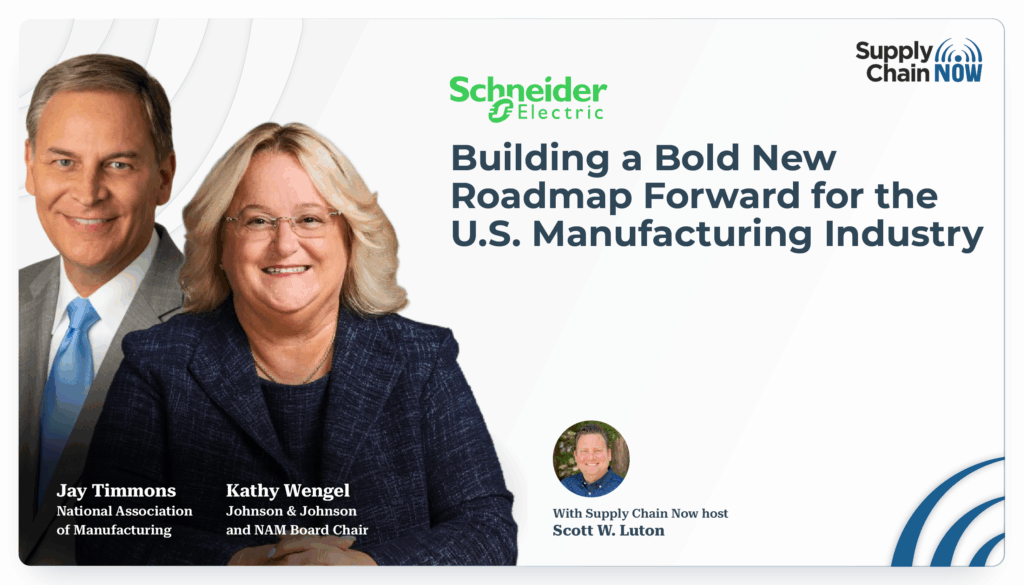
[00:00:00] Jay Timmons: The tariff policy has created the great pause. This economy is ready to explode in a very positive way, but we have to have the certainty and understand where all of these tariff policies are going. Who’s going to be charged what to bring things into this country that we need to build new manufacturing capacity.
[00:00:21] Voiceover: Welcome to Supply Chain Now the number one voice of supply chain. Join us as we share critical news, key insights, and real supply chain leadership from across the globe. One conversation at a time,
[00:00:34] Scott W. Luton: Hey everybody. Scott Luton at Supply Chain Now here in Las Vegas, where I’m at, the Innovation Summit, north America 2025.
[00:00:42] Scott W. Luton: All powered by our friends at Schneider Electric. I’m here. Joined by my two newest best friends. Jay Timmons, president, CEO, with the National Association of Manufacturers (NAM). Jay, how you doing? I’m doing great. This is an incredible
[00:00:54] Jay Timmons: conference, and we really learned some stuff already.
[00:00:57] Scott W. Luton: I’m with you. I, I was an opening keynote and was blown away.
[00:01:00] Scott W. Luton: And Kathy, Kathy, uh, Wengel. Executive Vice President, chief Technical Operations and Risk Officer with Johnson & Johnson. Kathy, how you doing?
[00:01:09] Kathy Wengel: I’m doing great, Scott.
[00:01:10] Scott W. Luton: It’s wonderful to be here with you. Wonderful. I’ve been tracking you. You’re a supply chain hall of famer, so I’ve been tracking you for quite some time.
[00:01:15] Scott W. Luton: I can’t wait to learn from you here today.
[00:01:17] Kathy Wengel: Well, same here. Right back at you. I’m thrilled to be
[00:01:19] Scott W. Luton: here. Alright, so Kathy and Jay, we got a lot to get into here today. Let’s level set on. A couple things first, right? So Jay, if you could, I’ve been tracking NAM for quite some time. I admire the work y’all do for one of my favorite sectors in the world.
[00:01:32] Scott W. Luton: Can you tell us a little bit more about the NAM and your role there? Yeah. Happy to do that. Uh, and one title
[00:01:37] Jay Timmons: that Kathy also holds is chair of the board of directors of the NAM. And so we have 14,000 member companies, just like Johnson and Johnson. Literally representing every single sector in every state, uh, from multinationals to the smallest mom and pop operations all across the country.
[00:01:56] Jay Timmons: And our job is to advocate on behalf of manufacturers when it comes to policy that will make us more competitive, both in the United States and internationally to Congress.
[00:02:06] Scott W. Luton: The White House, the agencies. You know, the manufacturing industry is so critical to the global economy, to our national economy, to mom and pops to every company out there.
[00:02:15] Scott W. Luton: And by the way,
[00:02:15] Jay Timmons: 90% of our members are those small and medium manufacturers. So it’s really all about, it’s all about
[00:02:21] Scott W. Luton: Main Street America. Love it, Jay. Okay, so Kathy, if you could touch on two things, your role at Johnson & Johnson, one of the most admired companies in the world, and secondly, as Jay pointed out, your leadership at NAM.
[00:02:33] Kathy Wengel: Well, thank you again to have us here and at Johnson and Johnson. I’m, uh. A career person at Johnson and Johnson, been there nearly 38 years. I’m currently the chief technical Operations and risk officer for the corporation, part of the executive committee, but came up through engineering, operations, quality supply chain, it lots of technical spaces essentially, which is why I’m now in that technical operations, but also the risk side of things and how we make sure we’re more resilient as a company.
[00:03:00] Kathy Wengel: We have such an important industry. We’re bringing transformational medical innovation to patients around the world and making sure that that great product gets there high quality every day. You know, people can’t wait when it’s time for their surgery or medicine. So that’s what I’m here to do, and I’ve been proud to be a member of the board of the NEM for almost a decade, and now to serve as chair in a really exciting time.
[00:03:24] Kathy Wengel: Where we see our industry transforming and what we can do to help represent, as Jay said, the ecosystem of everything from the tiniest to the biggest manufacturers. It’s really a, a privilege to get to represent them.
[00:03:36] Scott W. Luton: Kathy, I’m with you. I don’t know where you find the time, all that you do it at Johnson & Johnson to donate some of your thought leadership and, and hands-on leadership to NAM.
[00:03:45] Scott W. Luton: We’re very grateful for that. Okay, so Jay, I wanna ask you both. About this new comprehensive manufacturing strategy that y’all have created and have been advocating for. And we’ll start with the why, right? So why does the manufacturing industry need a new strategy moving forward? So every
[00:04:03] Jay Timmons: country that is successful, every economy that is successful is really grounded in a strong and thriving manufacturing base.
[00:04:11] Jay Timmons: And we’ve seen that. Throughout our history here in the United States, that that manufacturing has really enabled us to grow our economy, create a better quality of life for, for all Americans. So with that as the foundation, you gotta figure out, okay, well what makes us successful or what enables us to be competitive around the world?
[00:04:29] Jay Timmons: Because look, there are other countries that that would just love to take away our mantle of economic leadership. I mean, we don’t have to sit here and talk about which ones they are, but it’s kind of pretty obvious, right? So. The key is making sure that we have those right policies in place. And when you talk about our, our comprehensive agenda, think about issues like tax policy.
[00:04:49] Jay Timmons: You know, what reduces the cost of doing business here in the United States. United States regulatory policy. Not only reducing costs, but also making sure that we’re able to be efficient and productive. Think about energy supply. Are we accessing energy here at home to reduce that cost? Because manufacturers use 20%.
[00:05:07] Jay Timmons: Of the nation’s energy supply, that number’s gonna grow. By the way, with the advent of AI workforce policy, my colleague Carolyn Lee at the Manufacturing Institute, Kathy also, by the way, talking about the time she spends, she’s also on the board of directors of the institute. They focus on growing the manufacturing workforce of the future.
[00:05:25] Jay Timmons: And then of course, trade policy. Are we gonna sell our products around the country or around the world? Are we just gonna focus here on our domestic market? That’s never been particularly successful. The NAM was founded in 1895 on the thought of growing our, our reach in our markets and selling our products to around
[00:05:42] Scott W. Luton: the world.
[00:05:42] Scott W. Luton: Jay, I wish I had three hours to dive into that last response to share, but really quick before I get Kathy’s follow up thoughts. I love the work Carolyn is doing, especially securing the workforce pipeline, which is critical for any industry, especially the manufacturing industry. Alright, so Kathy, Jay just walked us through a variety, really the why we need a new strategy, and he mentioned a couple different elements which we’re gonna dive deeper into here in a second.
[00:06:06] Scott W. Luton: Your follow up thoughts, why do we need a new roadmap moving forward?
[00:06:10] Kathy Wengel: Well, number one, our industry is fundamentally changing with the advent of more technological innovation, the need and the desire to bring, continue to bring more people into the future of manufacturing the workforce of the future. We think there are still still many perceptions from the old days of what manufacturing is like, and we are here to really.
[00:06:30] Kathy Wengel: Demonstrate and show how advanced manufacturing is today, how it creates great career pathways for people from incredibly diverse backgrounds. And most importantly, because manufacturers are bringing incredible innovation as we see here at the summit, that are really transforming industries. And to do that though, we need.
[00:06:48] Kathy Wengel: Tax policy. We need regulatory policy. We need to have the energy we need, and we need that workforce. And to do that, our job here at the NAM is help amplify those needs and be able to work with the great team that Jay has, you know, in lockstep with government, with policy makers, at state, at national levels, to help make those pathways for manufacturers better and simpler.
[00:07:11] Scott W. Luton: Love that as you’re describing lots, the why. It’s like we need all of these ingredients to unleash a incredible new chapter of American manufacturing. And that’s kind of what y’all doing, unlocking those ingredients. So Jay, I wanna touch on, dive a little bit deeper on some of the core elements of this new comprehensive roadmap and strategy.
[00:07:30] Scott W. Luton: And I wanna start on something you kind of alluded to earlier, permitting reform. Why is that so essential?
[00:07:36] Jay Timmons: Well, Scott permitting reform is something that’s been. It’s been discussed ad nauseum, quite frankly in Congress in many administrations dating back, you know, several decades. Why is that important?
[00:07:48] Jay Timmons: It’s important because we’ve gotta be able to more quickly and expeditiously unlock America’s energy leadership and dominance here in this country. The Trump administration has been focused on what the president, I think, rightfully calls our ability to be. Dominant in, in energy here in the United States.
[00:08:07] Jay Timmons: Until recently, we were always a net importer of energy supply. I’d say probably that started to change really dramatically about 10 years ago. We’ve seen an unleashing of our potential when it comes to accessing new technologies, enabling us to access great supply of natural gas here in this country.
[00:08:25] Jay Timmons: We are focusing on new innovations when it comes to renewables. The thing that I think we’ve really gotta focus on most aggressively is our capacity to build out nuclear facilities, because nuclear is clearly going to be a way to provide that energy supply that we’re going to need. Uh, here at this conference, one of the things that Schneider is focusing on.
[00:08:46] Jay Timmons: Is the advent of artificial intelligence, ai, and the energy demands that will be required in order to power that system. So what we’re manufacturing now, or what we are producing in terms of energy in the United States, well, it’s good for today. It’s not good enough. For tomorrow. Permitting reform will help us unlock some of that.
[00:09:07] Jay Timmons: It’s also important not just for energy, but also for the very things that we make. So think of critical minerals here in the United States. Think of the fact that it takes 10 to 15 years. Just to permit a mine to allow us to mine copper and copper is so critical for electricity demand, so there are a number of reasons that permitting reform is necessary, but what we are lacking is the political will to get it done.
[00:09:32] Jay Timmons: At this point, everybody is talking about it. As I said, the administration wants to lead on it. They need to lean in, and they need to lean in heavily right now.
[00:09:40] Scott W. Luton: Jay, well said. And a couple quick points before I, uh, get Kathy’s take here. The permitting timeframes you mentioned it’s grown quite a bit here in the States, in other countries it’s as little as one to three years, right?
[00:09:52] Scott W. Luton: It’s what we’re up against. And then secondly, you mentioned nuclear power. I think it’s exciting, this new chapter of new nuclear power that I think we’re moving into. So we’ll see what that
[00:10:01] Jay Timmons: unlocks to. Can, can I say one thing about Please? Yeah.
[00:10:02] Scott W. Luton: You know,
[00:10:03] Jay Timmons: permitting reform, you know, this is not about making something less safe, right?
[00:10:08] Jay Timmons: Nobody wants that. This is about getting rid of duplication it, it’s about streamlining processes. It’s about eliminating kind of those legal hurdles that seem to be. Just thrown out to be impediments to progress or frankly to fatten the wallets of certain trial attorneys, right? So if we can kind of eliminate those types of barriers and really focus on what we need to focus on, which is how do we make a facility or how do we make sure a mine is safe and secure?
[00:10:38] Jay Timmons: That’s what permitting should be all about. It shouldn’t be, it shouldn’t be a political. Volleyball match, right? Yeah. Right. And and that’s what it’s really turned into in a lot of cases. Safety’s gotta be table
[00:10:49] Scott W. Luton: stakes is one things. Let’s focus on what we really need. The the issues at hand is what I’m hearing from you, Jay.
[00:10:53] Scott W. Luton: Alright, so Kathy, let’s talk a little bit more about workforce development. And I think you’re in a unique position to really talk about what the manufacturer industry needs, specifically when it comes to the workforce. What would you call out to our audience too?
[00:11:07] Kathy Wengel: So everything technical is at the basis of a great manufacturing workforce, and whether that is electricians, mechanics, mechanics, electro mechanical experts, then engineers and scientists, but also people who just love working with the equipment and love bringing things to life.
[00:11:26] Kathy Wengel: And so the message is really, those talents come from so many places and there are so many pathways. To get to careers in manufacturing. So what we do at the Manufacturing Institute is try to focus on certain pathways and help accelerate them. Veterans make America, and how we really help accelerate the transition from active military into industry.
[00:11:49] Kathy Wengel: There are so many translatable skills from the military into manufacturing. J and j is proud to have been hiring military veterans since the Spanish American War, but so many companies do that. So that’s a focus area. The fame program, an apprenticeship program started with Toyota, but really being give people pathways.
[00:12:08] Kathy Wengel: This is not about needing four year degrees for everything. Yes, in some jobs, but there are so many pathways and a lot of it’s also about inspiring the workforce, having them see modern manufacturing and understand that you can do everything from making the smallest part that can make a rocket ship, you know, take off to making transformational medicine that get us as close as we can to cures for cancer.
[00:12:32] Scott W. Luton: Kathy, oh, so much touch on and space supply chain. We’re gonna need tons of talent that leverage opportunities there as manufacturing low or low earth orbit, which I find absolutely intriguing.
[00:12:42] Jay Timmons: I got to see the veterans program that j and j has down in Jacksonville. Kathy took me down there and it’s really fascinating to see.
[00:12:50] Jay Timmons: So many folks who don’t understand what opportunities are available in manufacturing and, and frankly, how modern manufacturing gives you a new challenge every single day. It’s constantly evolving. And when I talked to those veterans, they were saying, when we were in the military, we weren’t sure what we were going to do when we came out, and j and j was right there to make sure that they understood what the pathway was for them.
[00:13:11] Jay Timmons: And it’s wildly successful.
[00:13:13] Kathy Wengel: Yeah. And now they make about 3 billion. ACU view brand contact lenses every year in that plant in Jacksonville.
[00:13:19] Jay Timmons: Really? For what? I’m, I’m very thankful for that. ’cause I’m wearing them right now. Uh,
[00:13:22] Kathy Wengel: and they would’ve never thought, oh, I can make contact lenses. No, but the technology, the equipment, the advances, it’s, yeah, it’s terrific.
[00:13:28] Scott W. Luton: So I wanna follow up one more thing on the workforce front. Yeah. One thing you’ve mentioned a couple times, Kathy, and I think it’s a message that we’ve got to shout from the mountain tops. And there’s two elements. Number one, my fellow veterans. There’s tremendous opportunities across global supply chain manufacturing.
[00:13:42] Scott W. Luton: You name it, we need your skill sets and experience, expertise, and number two. Kathy, it’s folks from all walks of life. You don’t have to have a four degree, you don’t have to be an engineer. We love those folks too. But there’s something really for everybody in the wild world of manufacturing. Would you agree?
[00:13:58] Kathy Wengel: I agree a hundred, a hundred percent. And to your point, and only in the active manufacturing and procurement. In logistics. Right. In planning all those elements that go into running the supply chains and manufacturing. I’ll leave you some numbers from my AM experience, but today there are 400,000 open manufacturing jobs in the United States, and that number is projected to grow to 2 million by 2030 with the growth of manufacturing, but 2 million jobs we can’t fill unless we help accelerate these pipelines from different backgrounds, from different educations and really, you know, create that environment that will.
[00:14:39] Kathy Wengel: Is the new manufacturing renaissance here.
[00:14:41] Jay Timmons: There’s a footnote on that, that number, that 2 million number, that number was calculated before President Trump came into office and said, look, I’m gonna focus on growing manufacturing capacity even more in the United States. So that 2 million number could, could grow exponentially.
[00:14:57] Jay Timmons: It’s remarkable. It is remarkable.
[00:14:58] Scott W. Luton: And that should be a call to action. We’ve gotta work together to not only solve the energy technology demand, which is only gonna continue to grow, we’re gonna touch on some of the innovations there, but also protect and grow the talent pipeline as well.
[00:15:11] Jay Timmons: And Scott, I don’t think most people understand how rewarding these jobs are, and I don’t mean just in terms of you love going to work every day.
[00:15:18] Jay Timmons: Because I hear that story every time I’m on a shop floor. It really is rewarding financially as well. Jim Farley, the CEO of Ford, just said how frustrated he is that he can’t get folks on the line for $120,000 a year starting right. Starting so, so the, these jobs can really pay enormously financially, but also in terms of really enjoying what you do every day.
[00:15:43] Scott W. Luton: Jay? Well said. I think in that same interview, Mr. Farley mentioned that Ford is working really hard to fill thousands of openings when it comes to maintainers, and nothing moves forward without our, our incredibly talented maintainers. Okay. Let’s talk about one more thing related to this. Comprehensive new strategy.
[00:16:00] Scott W. Luton: Everyone’s maybe favorite or least favorite topic trade policy. Right. This has been the, the year of tariffs in many ways. Hopefully we’re still, we’re gonna be gathering some more certainty as we move forward, but what would you, Jay, in the NAM community like to see moving forward when it comes to trade policy?
[00:16:16] Scott W. Luton: Well, you just
[00:16:16] Jay Timmons: said it certainty. So if you are a manufacturer, and again, you’re trying to figure out how to. Reduce costs so that you can invest more in the United States so that you can hire more people, so that you can raise wages and benefits. You have to have certainty across the board. I give a tremendous amount of credit to the president and to members of Congress for passing tax reform, not just passing tax reform.
[00:16:38] Jay Timmons: Making sure that the reforms that were passed in 2017 were made permanent. That sent a message to the entire world that America is indeed open for business. The president has also wrapped his arms around the regulatory system and tried to make sure that we’re modernizing and ensuring that those regulations and.
[00:16:55] Jay Timmons: Are consistent trade policy is an area where we’ve got to have that certainty as well. And look, the president believes in tariffs. That’s just flat out the case. So how do we respond to that? Well, we respond by saying, okay, where are we going to invest our next dollar? The president? And I think rightly so, once those dollars invested here in the United States, here’s a statistic that is, is a little mind blowing.
[00:17:20] Jay Timmons: Actually. Our economist, Victoria Bloom calculated that if we had every machine running in the United States and we had everybody on the line producing everything possible, if we were going to set up a new manufacturing facility here in the United States, we could only manufacture about 84% of the critical inputs necessary to build that factory.
[00:17:40] Jay Timmons: So what does that mean? Well. Today, not necessarily tomorrow, but today we would have to import 16% of the critical materials that would go into that new facility. Think, think in terms of specialty machines that we don’t make here in the United States right now. Some of those critical minerals I mentioned that we can’t mine here yet in the United States, if those are being tariffed and you have somebody, and I I, this is a real life example.
[00:18:05] Jay Timmons: A small business woman wanted to invest a hundred million dollars in new plant equipment. But with tariffs, it was gonna be 140 million. She didn’t have access to that capital, so she had to put a pause on that investment and, and my concern is that right now, this year, the tariff policy has created the great pause.
[00:18:25] Jay Timmons: This economy is ready to explode in a very positive way, but we have to have the certainty and understand where all of these tariff policies are going. Who’s going to be charged what to bring things into this country that we need to build new manufacturing capacity. It’s kind of a vicious circle and one that we’ve addressed with our manufacturing accelerator program, which would allow us to bring in those critical inputs, uh, through some sort of a speed pass.
[00:18:52] Jay Timmons: And duty free status to, to enable us to build that capacity,
[00:18:56] Scott W. Luton: Jay. Excellent. Uh, I tell you I wish I had more time here, is to gaining more and more certainty in the months ahead because I’ll tell you if I’ve learned anything in my time in global supply chain and manufacturing, if we know what the problem is, Kathy.
[00:19:08] Scott W. Luton: We can figure it out. Is that right? That’s for sure. Okay, so let’s talk about some more good news. Let’s shift gears. I failed all the classes in, in economics in college, so I’m gonna quickly move on to my favorite topic of good news and innovation, right, because it, it is truly a golden age of supply chain technology, of business technology.
[00:19:27] Scott W. Luton: Right now we’re here at a, at a conference that’s helping to unlock and having cross industry conversations to figure out how to. Power and fuel even more innovations in that regard. Jay, when it comes specifically to the manufacturing industry and you think of the bevy of innovations out there, what’s one in particular that you’re intrigued with here?
[00:19:47] Scott W. Luton: Well, let’s separate
[00:19:48] Jay Timmons: products and tools. Clearly, we’re here to talk about, at this conference, we’re here to talk about new technologies like artificial intelligence. I would say that that is a tool that has tremendous potential to improve quality of life for people all over the world because it will help us in terms of being more productive, more efficient.
[00:20:09] Jay Timmons: And just doing things better when it comes to products, and this is not because my, the chair of the board is sitting here, but I have always been intrigued with advancements in medical science and pharmaceuticals. My grandmother had polio, so I. I watched her struggle her entire life, and yet I never had to deal with that because the polio vaccine was there for me.
[00:20:31] Jay Timmons: My father died of COVID before the vaccine came out, and I was able to see millions and millions and millions of people’s lives saved because. Of a medical advancement that through that mRNA technology that didn’t exist or wasn’t utilized a decade ago, but we were able to bring that to life and save so many lives and, and, and ensure that the world actually survived.
[00:20:56] Jay Timmons: And manufacturers, quite frankly, at the NAM, were so proud to be a part of that effort to not only. Locate PPE all over the world when it was necessary during COVID, but afterwards help get folks to understand the importance of, of vaccine acceptance as, as that new technology came forward. So I get pretty excited when I think about those innovations Cures for cancer and cures for other diseases that we’re seeing.
[00:21:20] Jay Timmons: It’s really
[00:21:21] Scott W. Luton: amazing. Jay, I really appreciate your response and particularly the personal connections, uh, to your response. And Kathy, it really reminds me of the noble mission that our global supply chain manufacturing professionals, what they deliver on every day. ’cause as Jay points out, it can be a matter of life and death.
[00:21:38] Scott W. Luton: Right. We’ve supported a variety of humanitarian organizations and one great phrase, I keep going back to that, one of those leaders shared with me, no product, no program, right? And that’s the power of supply chain, at least in my book. And I’m sitting beside a supply chain Hall of Famer and, and Kathy Wengel.
[00:21:54] Scott W. Luton: Kathy, when you think of the innovations you’ve seen in your journey and what you’re seeing here in 2025 and beyond, what’s most exciting to you?
[00:22:02] Kathy Wengel: Well, one, I’ll build a little on what Jay said in, in my industry, and then I’ll go a little bit broader. So first, the acceleration of science and the acceleration of technology.
[00:22:13] Kathy Wengel: The intersection of those two things in the healthcare world is allowing us. To do things we could not even imagine 10 years ago with cell therapy, gene therapy. With cell therapy, we’re getting it as close to a cure as you can for certain types of cancers, multiple myeloma, other areas. Our ability in what we used to call our med device business is now a med tech business because there are chips and intelligence and every kind of device they’re allowing us to.
[00:22:41] Kathy Wengel: Really get to outcomes faster, which overall then helps reduce the cost of of care. To do that though, the way we’ve gotta bring those technologies. Into manufacturing. ’cause we have to be able to manufacture all of these great medical innovations, right? So the ability, I think, um, of course ai right? I know everyone’s talking about that and actually at that, so I’ll, I’ll pick another one, which is the acceleration and ubiquity of lower cost sensors and the ability of us, if I think back to what we were doing decades ago in terms of.
[00:23:14] Kathy Wengel: You know, having machines maybe count things, right? Maybe the first vision systems, right? Manufacturers have been using AI for three decades, right? Maybe not gen ai, but ai. But now what you can do with a very low cost sensor to really help optimize every part of your supply chain, to track products, to take medicines that need cold storage.
[00:23:36] Kathy Wengel: And when it leaves our control, we can actually track and see. Where it is, if it’s stuck at a transportation hub that may be going down for some reason, we can actually have an agentic AI actually calculate how long before the cold storage there goes out and automatically trigger something to go grab that product, get it back into our warehouse.
[00:23:57] Kathy Wengel: Rere refrigerate. And get it out. So, but those are all because of sensor technology that allows us to connect things and manufacture and trace in a, in a different way. So you put that there, you put ai and it’s a, it’s a different amazing world.
[00:24:13] Scott W. Luton: It is. It’s remarkable. It’s extraordinary.
[00:24:15] Jay Timmons: Well, Scott, I’m gonna add one, I’m gonna add one footnote there because I wanna bring it back to policy because at the NAM we’re about policy, not politics, process or personality, and.
[00:24:25] Jay Timmons: Unfortunately, if you listen to what Kathy just talked about, all the amazing advances in medical science, those can only be possible through investments. And when policy exists to make it more difficult for our companies to invest, and I’m gonna say for instance, price controls on pharmaceuticals. Okay.
[00:24:43] Jay Timmons: Our system is not perfect. We know that. But boy, it’s better than any place in the country. And instead of focusing on politically trying to make business the bad guys or make manufacturers the bad guys, let’s focus on the real problem. So in this case, pharmacy benefit manufacturers, right? They’re sucking money out of the system that could be used to help the the patient.
[00:25:05] Jay Timmons: And also to ensure that we can continue with these investments. That’s why policy’s so important. That’s right. And that’s what we do every day at the NAM.
[00:25:12] Scott W. Luton: Well, I think the great thing about manufacturing supply chain is we can get past politics and we can have the discussions where we might, might disagree on some things, but we align and move forward, and that’s good for everybody.
[00:25:23] Scott W. Luton: So I really appreciate y’all’s time here today, Jay Timmons. With the National Association Manufacturers. Thanks so much, Jay. Folks, you can learn more at nam.org and Hall of Famer, Kathy Wengel with Johnson & Johnson. Thanks so much for being here today as well. And folks, well leave it there. Stay tuned. We continue our coverage here at the Innovation Summit North America 2025, powered by our friends at Schneider Electric.
[00:25:45] Voiceover: Join the Supply Chain Now community. For more supply chain perspectives, news and innovation, check out supply chain now.com. Subscribe to Supply Chain Now on YouTube and follow and listen to Supply Chain Now wherever you get your podcasts.