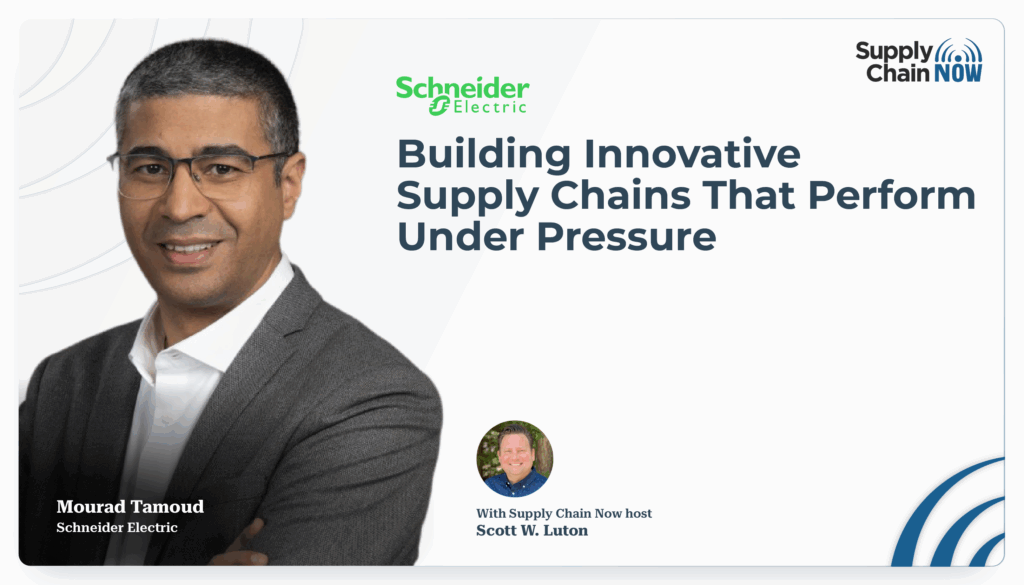
[00:00:00] Mourad Tamoud: At the end of the day, I really believe that we are in a people business and we are deep believers at Schneider Electric that great people make a great company. AI or digital would not be there if you don’t have the expertise, if you don’t have the talents inside the organization that are able to be future ready and prepare those transformations.
[00:00:23] Voice Over: Welcome to Supply Chain Now, the number one voice of supply chain. Join us as we share critical news, key insights, and real supply chain leadership from across the globe. One conversation at a time.
[00:00:35] Scott W. Luton: Hey everybody, Scott Luton with Supply Chain Now. I continue my coverage here at Innovation Summit North America 2025, powered by our friends at Schneider Electric, and I’m joined by my newest best friend, Mourad Tamoud with Schneider Electric. He serves as Chief Supply Chain Officer. Mourad, how you doing?
[00:00:53] Mourad Tamoud: Very good. Thank you, Scott, and thanks for enabling this conversation.
[00:00:58] Scott W. Luton: Definitely. I’ve been looking forward to it, so it’s great to meet you. I want to do this before we get into a lot of business topics. I want to ask you about what you do when you’re not doing big things out across global business. Okay? So what’s one hobby that you enjoy spending some time in?
[00:01:13] Mourad Tamoud: Well, I love to go out in nature, hike, and also I love photography, and that’s the moment where somewhere it enables me to clean my head and settle after travels and very exciting times managing a very large and complex supply chain like the one at Schneider Electric.
[00:01:37] Scott W. Luton: Yes. Doing big things, being innovative, and the clearing your head—I bet everybody out there listening or viewing can relate to that. We all need to find ways of clearing our heads. But you’ve got some high-falutin equipment to use, you were telling me earlier. What’s your favorite go-to camera?
[00:01:52] Mourad Tamoud: I use a Sony Alpha 7, so pretty nice device. And I mean, when you put your eye and observe the world through that lens, it’s really a moment of, again, relaxation for me.
[00:02:04] Scott W. Luton: Yes. Okay, we’re going to check out some of your photography next time, but thanks for sharing that. So let’s talk about this. You’ve spent almost 30 years with Schneider Electric. That is amazing. I bet you’ve got—when’s the book coming out? That’s my next question I should ask. But tell us—because a lot of folks will assume things about the CSCO role—tell us about what you do at Schneider Electric.
[00:02:27] Mourad Tamoud: I’ve been three decades now in supply chain in Schneider Electric, and I have seen an amazing journey and the evolution of the company, coming from a European French company to becoming a multi-global setup. And the size at which we operate has been a very exciting journey. Lived in seven different countries across these three decades and met fantastic people across the entire planet. So it has been a very, very rewarding experience.
[00:03:03] Scott W. Luton: Yes. From my earliest observations when I started digging in and meeting people at Schneider Electric, I’ve always admired how you engage your supply chain ecosystem and all your suppliers, and how there’s terrific innovation and problem-solving and breakthroughs that come from that approach. So that seems core to the culture here, huh?
[00:03:23] Mourad Tamoud: It is, and I think you’re bringing a very good point. The way of looking at supply chain the way it was three decades ago was more of a linear— you have a supplier delivering to our manufacturing, delivering to our distribution network, and that’s it. Today, the way modern supply chains are operating is much more of a network of networks. It’s more about an end-to-end view of that supply chain, embarking from the customer all the way back to the suppliers of the suppliers. We talk more and more about the Tier X of our vendors.
To just give you an illustration of how important those vendors and partners that are part of this system or ecosystem of supply chain is: we have the chance to be this week in Las Vegas doing our Innovation Summit. And in fact, we have invited 50 of our most critical vendors to be part of the event. So not only are we talking to them as vendors or suppliers or partners, but we are inviting them to join and listen to the entire strategy, the innovation that Schneider puts on the market, and we really treat them as part of the whole ecosystem.
[00:04:34] Scott W. Luton: I love it. More companies need to—and they have more and more in the last couple of decades—model that approach. I love it. And by the way, you mentioned nonlinear. When my son Ben heard me reference “supply webs” from time to time, it got him really excited. He’s a big Spider-Man fan, so who knows what might get ’em into supply chain. We need more balance.
[00:04:56] Scott W. Luton: Alright, supply chain resilience. Right. Let’s talk about that for a minute. So, a few weeks ago you spent time in Mexico as part of the World Economic Forum CSCO community meeting or event you were having. And I think from what I could tell, one of the big themes that came out of those discussions with all your peers and the attendees was: build supply chains that perform under pressure.
So I want to get you to expound on that a little bit. When you see those supply chain ecosystems and those business leaders that are truly building entities and organizations that can withstand all the pressure—the old pressure, the new pressure that we find here today—what are some common themes in their approaches?
[00:05:33] Mourad Tamoud: Well, look, the last five years have been pretty disruptive for any supply chain. Starting from the big event of 2020 with COVID, followed by the electronics crisis, and all the other events. What we see today is the life of a supply chain is a continuous succession of events and disruptions—going extremely fast, going deep in terms of the impacts. And the ability of designing supply chains that are anti-fragile, that are able to be resilient by structure, by design, is becoming extremely important.
And when we say that at Schneider Electric, we have developed our resilience plan and strategy—developing the notion of Power of Two, making sure that for every strategic product where it has an important impact to our customers, we would be able to have multiple plants able to produce. We go all the way back to Tier 1, Tier 2, Tier X vendors, understanding the single points of failure and building different ways of resilience. It can be dual sourcing, it can be strategic inventories, those can be long-term supply agreements with some of these partners. So having that notion—which helped us go from “just-in-time,” where I grew up my first 25 years, and now to “just-in-case,” being ready to face the disruptions, be it geopolitical, be it natural disasters, being many kinds of elements that we have been observing.
[00:07:10] Scott W. Luton: I love that. And also, where you started your response—I think COVID in particular has taught us just how fragile our global supply chains can be, right? Let’s talk about—let’s move from supply chain resilience to some supply chain strategy topics. Right? We talk with a lot of leaders in a variety of different sectors, especially in supply chain, dealing with, as I mentioned, old and new challenges. A couple of topics I want to get you to weigh in on: decoupling and regional sovereignty. When you hear those terms as it relates to the strategy you have here at Schneider Electric, what comes to your mind?
[00:07:45] Mourad Tamoud: Well, I think part of that notion of resilience, and also when we look at geopolitical tensions—be it wars in some areas of the world—the notion of reducing complexity, driving shorter supply chains, making sure that you become more regional for regional. Producing in Europe for customers based in Europe, producing in China for China, producing in the US for the customers in the US— all that gives you that additional agility, that additional resilience that is required in the world of today.
What we have seen in the last five years is that the notion of speed has significantly increased. We have also seen customers putting a lot of attention on business continuity, learning from the hard times of COVID and electronics shortages, etc. So our ability to drive that local, regional ecosystem is becoming absolutely critical. We sometimes call ourselves one of the most “glocal” companies in the world, with the notion of a multi-hub strategy—where we want to design, engage with the customer, design, industrialize, source, and manufacture in the country or in the region for the customers located in that region.
[00:09:00] Scott W. Luton: I want to follow up on that point there because that glocal strategy you mentioned is inherent to how business is done here at Schneider Electric. Share a few core aspects to that element of your overall strategy—and can you give me some examples?
[00:09:14] Mourad Tamoud: Well, look, we have seen that a few years ago what we call “regional rate” was around 85%. And what we are doing now is we are moving with the objective to be above 90%, and in some places 95%. What that means—what we sell in a given market, in a given region, is coming at 90% or more from that region. That includes manufacturing, that includes sourcing, that includes the raw materials that we are bringing to our supply chain. So we are very committed to simplify, to shorten that supply chain, and to ensure that we bring the right capabilities in the region where we are selling.
[00:10:02] Scott W. Luton: I like it. You’re being a good neighbor. A really good neighbor, huh? Thank you. Alright, so Schneider Electric has also been recognized not only as a good neighbor but as a lighthouse in digital transformation by the World Economic Forum and McKinsey, through a variety of different designations. That recognition has come for your smart factories that use Industry 4.0, your commitment to sustainability—which of course has been a big part of the conversations here—diversity, equity, inclusion. What are fundamental aspects to your approach at digital transformation that really have impacted its success—that’s clearly been recognized by third parties? And the billion-dollar, maybe trillion-dollar question: what’s next?
[00:10:42] Mourad Tamoud: Look, it has been a very exciting journey working on Industry 4.0, and we called it at Schneider Electric many years ago “Smart Factory” and “Smart Supply Chain,” with the idea of embracing IoT, embracing digital, starting to deploy new technologies on our sites, going with automated guided vehicles, connecting machines and collecting data, etc.
We formalized it better working with the World Economic Forum. We put a framework around that and we got seven sites that have been certified as Lighthouses. And what is exciting is, in fact, we don’t only have greenfield sites that have been recognized, but I’m super proud—and we are super proud—of 70-year-old sites like Lexington, Kentucky, where we were recognized as a Lighthouse, with a team that did an amazing job taking legacy processes and legacy buildings and bringing them up to speed. Connecting those devices, being able to adopt software and digital at all layers of the organization, and delivering value to the business in terms of efficiency, in terms of energy optimization, in terms of end-to-end visibility.
And I just give that example—seven of them are there all around the globe. We have in Europe, we have in Asia, and we have here in North America with Lexington, Juarez, and Monterrey, which have been also doing a great, great job.
[00:12:17] Scott W. Luton: That is outstanding. And I don’t want to make anybody mad out there, but my hunch is—and you tell me if you agree or disagree—when it comes to really cutting-edge technology and digital transformation, it’s probably a little bit easier with new sites when you’ve got a wide-open canvas versus sites that have been around, to your point, for 70 years. My hunch is—do you agree with that, first of all?
[00:12:37] Mourad Tamoud: And maybe one—I didn’t answer one of your questions before. You said “What’s next?”
[00:12:42] Scott W. Luton: Yes.
[00:12:43] Mourad Tamoud: And maybe to answer that—the last years we have really built the infrastructure and the backbone of our digital architecture. I do see today the acceleration on AI. And I’m sorry, I would not be doing my job if I would not talk about AI.
And the reality is, we see the power that comes from having done all the work we did with the Smart Supply Chain, Smart Factories, Smart Distribution Centers—collecting all these real-time data. Today, what it enables us—if you plug AI on—is the ability to improve your maintenance downtimes, how you improve your quality, how you bring visibility to customers, how you react faster to variations of the demand. So it’s limitless possibilities.
We have plenty of pilots, proof of concepts, that are running. We also address it from a real end-to-end perspective, with actions like autonomous planning—that’s something we are pretty proud to bring into life in the coming cycle—as well as our intelligent procurement.
[00:13:45] Mourad Tamoud: So a lot is going on in that field. And if I now take your last question—I mean, yeah, it is of course easier to digitize and build the state-of-the-art when you go from scratch and you have a white page and you build a new facility. You invest in new equipment that is AI-ready or digital-native-ready. But on the other side, what I saw happening in our brownfields, in our legacy facilities, when they were adopting those transformations, is the level of motivation, the level of engagement that you create with the people is just amazing.
[00:14:23] Scott W. Luton: And you’re reading my mind. That’s where I was going to go. Because my hunch is in those brownfield sites, as you mentioned, the culture— it might be one of the best elements to power digital transformation moving forward. Would you agree with that?
[00:14:37] Mourad Tamoud: I mean, you see in those sites people that are highly, highly committed to the success of the company. They love their product, they love their processes. Bringing them that extra layer of capabilities—we say “augmenting the power of the people”—I have seen really, really very interesting changes. And many of our legacy or historical sites in the US, in Europe, where we started many, many years ago, we saw the technology being deployed there, creating, as I said, a real differentiating motivation factor over there.
[00:15:13] Scott W. Luton: I love it. And then once they know it’s going to make their days easier, it’s going to allow them to find more success and contribute in easier ways. It’s a beautiful thing, and I love the augmentation element you shared.
Okay. You touched on a lot of innovation there—right? Current state and future state. I was out in the Innovation Park. I spent a bunch of my time there, and to our audience out there—it’s like a supply chain circus, a technology circus out there. It’s really cool. It doesn’t do it justice, but just use that visual for now. All sorts of innovations out there and out in the industry beyond Innovation Summit here in Las Vegas. What’s one innovation, Mourad, that you’re finding really intriguing right now?
[00:15:53] Mourad Tamoud: I mean, honestly, there are so many, so it’s very difficult—
[00:15:57] Scott W. Luton: Like picking your favorite kid.
[00:15:57] Mourad Tamoud: Yeah, so it’s difficult to answer the question. I mean, what we love in supply chain at Schneider Electric is the fact that we are fully involved and part of the innovation process—with our suppliers, with our own teams, with our engagement at the manufacturing level, etc. So a lot is going on, particularly on the hardware and on the software and digital.
If I have to pick one thing, it’s what’s coming next with EcoStruxure Foresight, which is our digital transformation platform that’s going to be used in our Digital Energy and Digital Buildings businesses. And we foresee a real opportunity to adopt the AI power to be able to extract faster value from all our processes, all our connected buildings that we have already deployed with the Smart Factory and the World Economic Forum Lighthouses.
[00:16:52] Scott W. Luton: Yeah, definitely see the same opportunity. And that’s going to be exciting rollouts and developments for the industry. So, as we come down the homestretch here, I want to look at a great article that I think you co-authored that really focused on finding competitiveness amidst all the geopolitical uncertainty.
It’s interesting—I was reading a separate article in recent weeks about how we try to quantify… how can we quantify uncertainty? Because we all feel it. And a lot of analysts and economists, folks a lot smarter than me, point to this being like historic levels of uncertainty. I don’t know. We’ll see.
But one of the key timeless takeaways from that article you wrote was you really wanted readers to take away that agility and collaboration are—
[00:17:36] Mourad Tamoud: Key.
[00:17:38] Scott W. Luton: —key. Expound on that perspective and advice— and if you can, in a real actionable manner.
[00:17:43] Mourad Tamoud: Yeah, look again, what we see now is that there is no way to consider that the world will be simpler and smoother.
[00:17:53] Scott W. Luton: We signed up for this, right?
[00:17:55] Mourad Tamoud: Indeed. We know that disruption is part of our daily life. And as we were saying, it’s just a succession of events.
I will illustrate—you mentioned innovation and collaboration. I will really illustrate that coming back to two things.
One is: modern supply chain has to be digital. Of course, we move stuff; we move products; we move parts; we add value. But that would not work if you don’t augment it through a digital layer, a digital twin—being able to run scenario planning, to be able to simulate events. I was exchanging with a colleague—the tariffs have, somewhere, forced us to accelerate our ability to simulate what’s happening.
We are today able to take a newly communicated tariff and instantly identify what could be the consequences. We are able to simulate the changes of sources and look at the consequences in terms of lead times, in terms of costs, in terms of availability—in months, in days. I’m very serious. We are today able, within 24–48 hours, to understand how it impacts our operations in terms of a new tariff.
So my comment here is really: digital is completely embedded and critical—crucial—to a modern supply chain. It also provides a real end-to-end capability and visibility—an ability to orchestrate for your customer. Customers are more and more asking not just the last mile, but they’re asking you to be able to provide them visibility and, I would say, the potential information from the upstream.
So that would be one of my takeaways on innovation.
Second element—and we could go on and on about innovation, because to be honest, the way we operate supply chain: we spoke about the Lighthouses. A manufacturing site today has nothing to do with the manufacturing site when I started in supply chain. You see today screens everywhere. You see zero paper. You see people having devices.
[00:20:08] Scott W. Luton: I would’ve liked some AI back in my metal stamping days, Mourad, where I lost several of my nine lives. But to your point—
[00:20:14] Mourad Tamoud: Right. No, absolutely. I mean, so one is about innovation. Second—you mentioned collaboration. It’s crucial. I mean, it’s collaboration with the business. It’s collaboration with our customers.
We see much greater levels of integration and collaborative work, be it co-planning with our distributors, be it building dedicated factories for some segments of customers or for some customers, collaborating with our suppliers—just understanding with them what is their product roadmap, what is our product roadmap, how these two are augmenting each other.
We see more and more the ability of our inputs helping them to develop the next generation of materials, of chips, that would fit the demand and the requirements of AI or the requirement of lower consumption.
[00:21:08] Scott W. Luton: We could be here all day talking about the cool things going on in the global supply chain, but I want—all of what you shared related to innovation and collaboration powers organizational agility too. And I know that was one of your other main points.
Before I wrap here, for those business leaders looking for more agility—beyond the technology and some of the cultural elements we’ve touched on here today—any other piece of advice that you could offer up?
[00:21:32] Mourad Tamoud: No, we talked a lot about technology, we talked a lot about AI, but at the end of the day I really believe that we are in a people business. And we are deep believers at Schneider Electric that great people make a great company. We invest a lot of our time, our energy in nurturing and grooming talents within the organization. We manage competencies.
And similarly, AI or digital would not be there if you don’t have the expertise, if you don’t have the talents inside the organization that are able to be future ready and prepare those transformations. So we are super passionate about the people piece. And I would say that—just linking all of what we do with the rest of the challenges we are facing.
[00:22:19] Scott W. Luton: I love it. What a great point to finish on—in this golden age of supply chain and business tech, it all comes back to the people, right?
[00:22:25] Mourad Tamoud: Absolutely.
[00:22:25] Scott W. Luton: Okay, Mourad, how can folks—if they want to learn anything more on all the great things you mentioned here today, and they want to connect with you, they want to maybe learn some photography tips from you—how can folks track you down?
[00:22:40] Mourad Tamoud: I mean, I have LinkedIn. I like it as a way to share thoughts and what we foresee as a vision, but also a way to interact with peers, interact with partners. And I like the way to use that tool to keep alive those discussions.
[00:22:56] Scott W. Luton: Outstanding. Well, Mourad Tamoud, Chief Supply Chain Officer with Schneider Electric—it’s been a pleasure. It surpassed my expectations coming in. I really enjoyed learning from you. I really appreciate your fresh perspective on all things supply chain and leadership, and we look forward to reconnecting soon. So thanks for being here.
[00:23:11] Mourad Tamoud: Thank you, Scott.
[00:23:13] Scott W. Luton: Folks, stick around as we continue our coverage of Innovation Summit North America 2025, right here in Las Vegas, and you can find it all at supplychainnow.com.
[00:23:25] Voice Over: Join the Supply Chain Now community. For more supply chain perspectives, news, and innovation, check out supplychainnow.com. Subscribe to Supply Chain Now on YouTube and follow and listen to Supply Chain Now wherever you get your podcasts.