[00:00:00] Toby Maier: You have a saying in DHL that trade always finds its way like the water finds its way through the rivers. And you can see a lot of these things happening at different pace and different local situations. It’s a complex region, but I think there’s never a dull moment. You never know what’s next, but overall, a lot of things moving in the right direction.
[00:00:19] Voice Over: Welcome to Supply Chain Now, the number one voice of supply chain. Join us as we share critical news, key insights, and real supply chain leadership from across the globe. One conversation at a time.
[00:00:32] Scott W. Luton: Hey, good morning, good afternoon, good evening, wherever you may be. Scott W. Luton and special guest co-host Yaseen Ahmid with you here on Supply Chain Now. Welcome to today’s show. Yaseen, how are we doing today?
[00:00:46] Yaseen Ahmid: Doing great today, Scott. Really looking forward to today’s conversation.
[00:00:50] Scott W. Luton: I am too. We’ve been working on this for quite some time. You know that I admire your leadership out there and I’m convinced you’ve got several clones because you stay really busy, Yaseen. So it’s great to carve out a little bit of time to interview another incredible supply chain leader, business leader out there making it happen. So today folks, as part of our ongoing supply chain leadership across Africa series, we welcome in an extraordinary supply chain leader that is on a mission to connect people, improve lives, and really change the world for the better. All while leading an impressive supply chain organization that’s making it all happen. In today’s conversation, we’re going to be dialing it in on some of the powerful forces that are changing the business landscape, really across the Middle East and Africa, how organizations are finding new ways to optimize reliability and visibility across enterprise.
[00:01:41] Scott W. Luton: Hey, when it comes to the proverbial next generation of supply chain leaders in Africa, what skills or mindsets will be critical to their success? All of this and much, much more Yaseen. This should be a terrific episode, huh?
[00:01:55] Yaseen Ahmid: No, likewise. I think similar sentiments. We’ve been planning this for a very long time and I think the conversation today is going to hit home, especially from South Africa. I’m really, really, really looking forward to today’s conversation.
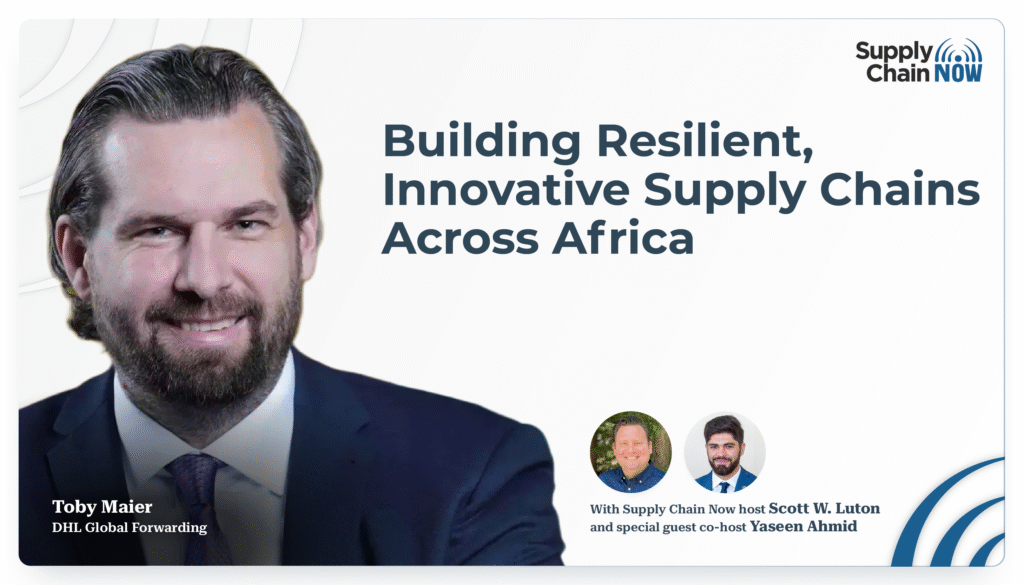
[00:02:07] Scott W. Luton: Hey, we’re supply chain nerds. We plan a lot, don’t we get seen? That’s how it goes. So folks, stick around for a great conversation. It’s going to offer up tons of actual insights by the truckload. So with all that said, I want to welcome in a wonderful guest joining us here today. Toby Maier serves as CEO for Middle East and Africa with DHL Global Forwarding. Now in this role, he leads a forwarding business with more than 3,000 highly skilled and motivated freight forwarders in this high growth and innovative part of the world. Prior to this role, Toby served in a variety of senior leadership roles in a variety of sectors, including of course supply chain, but also consulting, technology, automotive, and food and beverage. And as you’ll see here today, not only does Toby love to win, but it really enjoys tackling big challenges and finding solutions that no one else can find.
[00:02:56] Scott W. Luton: So let’s welcome in Toby Maier, CEO for Middle East and Africa with DHL Global Forwarding. Toby, how you doing today?
[00:03:03] Toby Maier: Very good. Thanks very much for having me, Scott and Yaseen. Looking forward to an insightful conversation.
[00:03:09] Scott W. Luton: We are too. And we’re going to get to the insightful stuff in a minute, Yaseen and Toby. But first, we’re going to start with a fun warmup question. We’re getting some tips folks in the green room pre-show session on some outstanding television series, and we’re talking some movies and stuff, and we found that Toby’s got a, I think he called it a man dungeon. So I love that. So Toby, when you’re not doing big things out there across global supply chain, what’s some of the good television and cinema to movies that you might would recommend to us? What’s your latest current favorite?
[00:03:42] Toby Maier: Yeah, so I’m really a big consumer of all these new binge watch options. I think one I can really highly recommend. I really enjoyed watching a lot. It’s called Zero, Zero, Zero. I saw it on Amazon Prime. It’s about a big shipment of trucks coming from Mexico, organized by some American US-based chippers ending up in Africa and totally in the end, finding its way to Italy. It was very special for me because certain areas, sports, I know very well. I think it was fun watching. Interesting to learn a bit about the world and how everything is interconnected. And if you haven’t seen it yet, it’s perhaps a hidden chap. Zero, zero, zero.
[00:04:24] Scott W. Luton: I wrote that down. I’m going to add that to my list. And Yaseen, have you checked out this zero, zero, zero yet?
[00:04:30] Yaseen Ahmid: I actually haven’t, Scott, but I know in our prior conversation with Toby, I was quite shocked to hear that he’s never watched Star Wars who load of the ring. So I’m definitely calling him out on that one. And we definitely have to set up another session where we go through all of those trilogies.
[00:04:47] Scott W. Luton: Hey, I’m with you, but I got to give Toby a pass and anyone out there that hasn’t because the Star Wars universe has gotten very complex with the 3000 sequels. I’ve got to have my son explain the five million plot lines and characters, so I can understand that. All right. And Yaseen, really quick, what’s one of your current favorites when you look at Amazon or you look at television, streaming, movies, you name it?
[00:05:11] Yaseen Ahmid: I think straight … Well, what’s something that comes straight to mind is Landman. It’s about an oil kind of baron talking about all of the different kind of complexities that they face in their daily operations. Yeah, that’s a show that I’ve really enjoyed recently.
[00:05:26] Scott W. Luton: Me too, Yaseen. And little tidbit there, Toby and Yaseen. Jason Hoke is one of our advisors and shareholders here at Supply Chain Now, and he was the executive producer of the podcast that Landman was based on. So he’s gone and met Billy Bob Thornton and been at the premieres and stuff. I’m so jealous. I just want to ride Jason’s coattails at a while, but that’s really good stuff. The landman, of course, Billy Bob’s character is good. Okay. So Toby and Yaseen, we got a lot of stuff to get down here today, a lot of stuff to learn from. It’s always the case in the wild, wild world of global supply chain. But Toby, I want to level set first. If you would, tell us initially about your path into the outstanding, the awesome world of supply chain and logistics.
[00:06:14] Toby Maier: Yeah, I think it’s a bit by accident, to be totally honest. So it’s a bit interesting because when I was young and finishing my school in Germany, I was thinking of what to study. And logistics always interested me, but I did end up studying general economics at university. Started working in finance and consulting, you mentioned it, and in foods in Switzerland. And I actually met my wife. Interestingly enough, on the day she returned from a six month stint in a university in Cape Town. We got a baby, we got a second baby, we decided to marry, and she was from Bon. Now, Bon is the old capital of Germany. You have two big corporates there. One is called Deutsche Telecom. I think T-Mobile, you guys know very well in the US. And the other big one is Nortepost DHL. Now, I had already worked for T-Mobile, so I wanted to try out the other company, which was Deutsche Port’s DHL.
[00:07:06] Toby Maier: That’s how I started there. It was almost 18 years ago now. And then I made my way through the different parts of the organization, worked a lot in the UK, finally moved to Johannesburg 10 years ago. And then after one year, Johannesburg was asked to move to Dubai, and here I am. So a bit by accident, but I have to be honest, I love it every day. It’s an amazing part of the whole, I think, ecosystems we have. And I have been in places in the last 10 years. If you would’ve told me 15 years ago that I would ever be in these places, I would’ve told you totally crazy. So the stuff you can see and experience is really one and a kind, and I think that’s one of the beauties in our industry.
[00:07:47] Scott W. Luton: Toby, what a wonderful start our conversation. And Yaseen, as he was explaining how he kind of found himself into this incredible industry and of course some of those family bonds there, it brought to my mind how it’s important to be intentional and deliberate, right? It’s really important. However, on the other hand, the power of serendipity and kind of creating our own luck is a wonderful, wonderful thing as well, huh?
[00:08:13] Yaseen Ahmid: It’s the classic stumbling into supply chain with professionals in the industry. Similar sentiments in my career as well started off as a sports management major and stumbled into supply chain. But it’s great to hear that Toby had and did spend some time in South Africa.
[00:08:32] Scott W. Luton: And our industry is better off due to all the wonderful folks that stumble into global supply chain. And what the good thing is we’re getting more and more intentional about recruiting the top talent as well. So that’s been really cool, especially in recent years. Okay. So Toby, as a follow-up, a lot of folks are going to make assumptions about what various CEOs do with their time and do in their role, but if you would tell us about your role as CEO for Middle East and Africa with DHL Global Forwarding. Tell
[00:09:02] Toby Maier: Us more. Well, I spend too much time in planes because the region is pretty big and people tend to underestimate how long it takes you to travel around. So I mean, flight from here to Cape Town is 10 hours to Morocco is eight hours. It’s all part of the region, plus being at the airport, plus clearing customs, plus immigration. So it is not always very, very easy to get around. We operate ourselves in 26 countries. So colleagues want to see your face, customers want to interact with you. So a lot of time is spent on the road, which I think is really important. Secondly, a lot of time is then spent with engaging with the own team because it’s the core of what we do is having the best people, empowering them, giving them all the tools they need to be successful. And then spending a lot of time with meeting partners, customers, suppliers.
[00:09:50] Toby Maier: End of the day, we orchestrate all the players in the logistic fields, all the asset owners and bring all the people together to create win-win situations. So traveling, a lot of interactions, that’s why they need attention on the weekends or in their vacations to calm down a little bit.
[00:10:08] Scott W. Luton: Hey, I get that completely. And Yaseen, I’ll tell you, he travels almost as much as you do, my friend. But 26 countries, I love that sentiment about being present and in person with both team members and customers and probably suppliers in the whole ecosystem. I love that emphasis and that importance placed on that. What’d you hear there, Yaseen?
[00:10:28] Yaseen Ahmid: I think to that point about Toby’s travels and then Avid use of LinkedIn and every single week, Toby’s in a new location. So I think I’m always trying to see if he’s traveling all around the continent.
[00:10:42] Scott W. Luton: 26 countries, that’s a big region. And on top of that, just the sheer size, but everything that’s going on in probably every single one of those 26 countries, which is just remarkable. You and I have talked about this before on shows and then in between the shows about the innovation we’re seeing across the entire continent of Africa. It’s remarkable. Okay. So Yaseen, you’re going to drive this next section with Toby talking about some of their logistics and their investment priorities. So I’m going to pass a baton. I’m looking forward to learn here a lot more from Toby.
[00:11:16] Yaseen Ahmid: No, I really appreciate that. So I think, Toby, you mentioned 26 countries. What do you see as two to three forces that are currently reshaping trade and logistics in the region right now?
[00:11:29] Toby Maier: I think there is a lot of things happening. I think first of all, of course, we have a president in the US who has imposed tariffs. One immediate consequence of this change is that trade patterns have shifted exports from China, which went to the US in the past, now find their way into the Middle East and Africa. I think that’s definitely a shift we can see because the goods are there and they have to be sold, so they will find a way to other and new consumers. We are currently seeing a lot of investments taking place, especially in the Middle East. I think pretty much every country in the GCC is trying to establish them as the logistics hub, challenging I think the leading position of the UAE, which is a big, big theme. And of course, we are all working on BCPs. We also see production shifts.
[00:12:16] Toby Maier: So I think something very interesting for the people in the region is that production came to Turkey. Now we see a shift to places like Egypt or Morocco happening at rapid pace. Challenge with the rest of Africa is that the infrastructure and the availability of electricity is not at the levels required to really have big scale industrial production taking place at this stage. Very interestingly, for example, I learned Ethiopia. Ethiopia have established certain areas, I think five special industrial zones, targeting to produce textiles for the American market. Now with the new tariffs and the exemption which used to be in place revoked, that has now converted into producing solar panels. So suddenly the guys in European not only export coffee, but also a lot of solar panels. We have a saying in DHL that trade always finds its way like the water finds its way through the rivers, and you can see a lot of these things happening at different pace, at different local situations.
[00:13:15] Toby Maier: It’s a complex region, but I think there’s never a dull moment. You never know what’s next, but overall, a lot of things moving in the right direction.
[00:13:23] Yaseen Ahmid: A couple comments there for, and some feedback for Scottsdale. I think the continent of Africa, Scott, you visited South Africa a couple of times. The workforce is both resilient, but also extremely adaptable to these constantly changing forces.
[00:13:39] Scott W. Luton: Massive opportunities with the brilliant workforce and all the people and all the interest in global supply chain and beyond, there’s a massive opportunity here, and that’s one of the reasons that we’re seeing innovation unlocked in so many countries across Africa. And one of the quick comment on what he said, we got to call this out. We’re going to steal this from Utobi. We may owe you some licenses or whatever, but trade will always find a way. Yaseen. That is a beautiful mantra. And I look at really the positive spin on that because when we can lock in some of the gains we make in moving the world forward and leaving no one behind, and we can find a business case for it, we can lock those gains in and then build on top of them. So we got our first t-shirt is from Toby. Trade will always find a way.
[00:14:25] Toby Maier: Yeah. I think there’s one other famous saying, which I like to use a lot and which actually connects very well with me personally, but I like to work for DHL. It’s a French philosoph by the name of Frederick Basita, who in the mid of the 19th century said, “If goods don’t cross borders, soldiers will.” For me, it’s always about trade bringing prosperity to people and making this planet a better place for everyone and having us peaceful work together. I know in these times it’s a bit tricky, but I think trade finds its way and trade really makes this world a better place.
[00:14:58] Scott W. Luton: Yaseen, that is all kidding aside, that’s really important and really speaks to the role, the incredible role and consequential role that global supply chain plays as a force for good in so many different ways. But your thoughts and we’ll move forward, Toby.
[00:15:13] Yaseen Ahmid: I completely agree with that, Scott. And I think with this idea of being a force for good, I know that Toby mentioned these big investments that are currently occurring in the Middle East and in Africa, which brings me to my next question, which is DHL has publicly shared a $300 million investment into the continent. Toby, at a high level, what is the investment meant to enable and what principles guide where it’s deployed?
[00:15:40] Toby Maier: So one of the big sectors as an example where we want to invest a lot of money is building infrastructure so we can have a better reliable supply chain for life science healthcare, meaning we can ensure we bring medical goods, medicines, vaccinations, and that sort of goods to 1.5 billion people living across Africa. Today, the infrastructure, as you know, seen is good in selected places. In Johannesburg, you’ll find top-notch facilities, no problem. In Nairobi, you might find, I would say, not the same level, but still good. If you then go to Entebbe in Uganda, it might already look very, very different. And again, the people across, that’s 1.5 billion and it’s fast growing. They all need access to affordable and safe and reliable medicines. And I think that’s something for us where we see an opportunity because we have all the connections we have via our express colleagues, the network bringing in planes and bringing in the goods, but they need to not just reach the airport, they need to reach the end consumer in a proper way.
[00:16:46] Toby Maier: So that’s one of the big topics we want to do. The 300 million we will invest is a minimum amount. We want to invest until 2030. Of course, if we find more opportunity, we’ll invest more, but I think the investment needed overall in Africa will be in the billions, if not trillion. So it’s any aspect of the supply chain, the roads, the ports, but also very importantly, regulation should be simplified and improved because we see too many goods and containers stuck in customs for too long time, which makes the whole supply chain super inefficient.
[00:17:17] Yaseen Ahmid: I think that’s incredible. And I mean, I just wanted to double click and take a deep dive on the thought process of around the life science decision. Was there a particular reasoning to focus on life sciences?
[00:17:29] Toby Maier: Well, it’s part of our Strategy 2030. So one of the sectors we have identified as a growth sector because of the … In Europe, you have an aging population. In this part of the world, you have a fast growing population. It’s really that we believe life science, healthcare need, more bespoke, more dedicated solution, which really provide end-to-end reliable solutions connecting the producers with the end consumers wherever they may be. So that’s just part of one of the strategic pillars. I think some of our competitors doing equal stuff. There is demand for this sector to get up a notch, and that’s why we’re doing it.
[00:18:03] Yaseen Ahmid: That’s fantastic. And I think talking about solving these issues for businesses on the continent, what do you see as some of the most important problems worth solving for African businesses and exporters over the next couple of years?
[00:18:18] Toby Maier: Yeah. I mean, I mentioned it earlier, and again, it’s one of the sectors we focus on is energy. We call it new energy, but there is a very clear correlation between the cost of energy and the prosperity in the country. Reliable access to cheap energy will drive prosperity in any country in the world and has been driving it. And that is something lacking. I mean, Jasin, you will know coming from South Africa, when I was there 10 years ago, we had load shedding, which pretty much means we had three times a week, four hours where there was simply no electricity in your neighborhood, and some had a generator, some didn’t, but you had to manage. Not having this reliable source of enough sufficient energy is really a challenge. Thinking ahead of the next big wave, so I think everybody talks about data centers and AI.
[00:19:02] Toby Maier: Data centers are needed is the basic for deploying AI. There is a huge demand of energy. And if you don’t have the energy, you will not have the data centers and you will miss out on the opportunity coming with AI. So I think these are two really core basics which are needed in Africa to create an even playing field. And then if you look at the whole supply chain, still find it mind-boggling. You go to places in Africa and you will find the American products, but at three, four, five, six times the prices, you’ll find them in the US. And part of that is because it’s incredibly expensive to get them delivered. So the cost per kilometer basis to deliver goods is a multiple of that, but it would be in Europe. The lowest disposable income have to pay the highest supply chain cost, which is I think somehow ironic is not good.
[00:19:54] Scott W. Luton: Yeah. Yaseen a lot of good stuff there from Toby, and I love your questions. A couple quick comments before we move forward and love to get you to respond and to get your thoughts to where you’re seeing the infrastructure. Every region in the entire world has massive infrastructure changes based largely on population changes or the velocity of change in business and consumer needs, business needs or whatever. We touched a couple times on energy, right? And I’m glad you mentioned load shedding, Toby, because we’ve been doing a series a long time. And some of our favorite folks in South Africa a couple years ago, we had the time at certain times when they had their generators, and inevitably they would drop out from time to time. It seems like it’s gotten better though. It seems like it’s gotten better, but in a greater sense, get this folks, I read a stat the other day that if you think of all the electricity that the country of Japan uses in a year, right?
[00:20:49] Scott W. Luton: Well, over the next several years, because of the changes in global needs, it’s basically like another Japan and all the energy demand coming onto the current global infrastructure. That is remarkable. And if we want to really realize the art of the possible with AI and many other, many, many other innovative technologies, we’re going to have to address that problem everywhere. Yaseen, when I think of infrastructure, I think very holistically, we touched on roads, we touched on energy. We also still have the digital divide we’re trying to bridge as well. So we got to eat our weedias for breakfast every morning because we got a lot of work to do in that regard. Your quick response here, Yaseen.
[00:21:28] Yaseen Ahmid: No, likewise. I think starting here in the US, interacting with a lot of my peers, I think one of the reasons why we want to make this podcast happen is to really deep dive into what the realities are operating on the continent. And I think Toby brought forward this infrastructure gap because it is prevalent and it is preventing the acceleration of business on the continent. When people talk about the implementation and the construction of large scale data centers, there’s no energy. And that’s the infrastructure that we have to develop right now to deploy those data centers to make it happen.
[00:22:02] Scott W. Luton: Yes. And maybe trade, going back to that mantra Toby mentioned, trade will help us find a way. And really quick aside, Yaseen, has the, it seems like to me, in my outside perspective looking in, that the reliable power access to that has gotten a little bit better in recent years in South Africa. You got a family there. You seeing that, Yaseen?
[00:22:26] Yaseen Ahmid: Yeah, I think it’s been an incredible turnaround. I think with the new government of National Unity, there’s definitely this shared sentiment of getting the country back on track with regards to its utilities. I think there’s still a long way to go, but they’re definitely making a fantastic effort.
[00:22:41] Scott W. Luton: Outstanding. We got to celebrate every inch and foot and step forward. Okay. So Toby, I want to kind of broaden out our conversation a little bit. We’re talking a minute ago about problems we’re solving and there’s no shortage of them, but there’s also some top priorities that we all know and probably talk about in our sleep. Some of those top priorities, of course, is improving reliability, resilience, visibility across our global supply chains, our ecosystems, but also doing all of that while reducing emissions and logistics. So I want to get you to weigh in, Toby. In your view, what are some levers that you’re seeing supply chain leaders and organizations pull to address those priorities? And then in a minute, I’d love to get some examples of what DHL is doing, but start with those levers that you’re seeing out there first.
[00:23:30] Toby Maier: I think one of the things is getting better organized. I think using available infrastructure as simple as it may sound. So there’s still a lot of trucks driving around empty to pick up something or to go back for making a delivery. So whatever we have in terms of capacity, let’s better use them altogether. I think that’s in the perfect sense. Whatever we do, let’s try to reduce the emissions. So if you need to drive with a truck from A to B, ensure it burns as less fuel as possible by planning in the best possible way. A lot of goes down to planning and supply chain and properly coordinating would all be so simple if all the things would fall in the right row all the time, which typically they don’t, as we all know. Then there is of course alternative fuels. So there is biofuels, we have sustainable aviation fuels helping us reduce then whatever emissions you still have.
[00:24:22] Toby Maier: Solar and wind energy to help fuel energy or battery-based vehicles, the EVs, for example. I think small trucks, very efficient in the meantime, very competitive even here in the Middle East. Big trucks still challenging and difficult. And I don’t think there is as clear path as an example. So there’s a lot of things we are working on. Good thing is it’s higher on our agenda. It’s one of the four strategic pillars in our company, so we have a lot of experience. Perhaps the last one, to give you a light GladGimicky Express colleagues have something called ALISI. And ALISI is a electric plane. So it’s supposed to go live next, I think two years, and it will fly, I think 400 kilometers in the US bringing urgent courier shipments. A couple of tons payload. Again, it will not replace the triple 7s we have on the air today, but it’s a first step into a different approach.
[00:25:18] Toby Maier: Let’s see how that will go.
[00:25:20] Scott W. Luton: Love those. As a big aviation nerd, I can’t wait to learn more about that. And speaking of, Yesen, I’m seeing that blimps are back. Folks are experimenting with new generational blimps. We’re seeing perhaps this move. We’ve talked a lot about energy here today and we’re talking about reduced emissions while protecting performance. Nuclear power moving into a new chapter. It’s interesting to watch the small modular reactors, which I’m not a nuclear engineer, but how the new applications for those across industry. But your thoughts, Yaseen, when you heard some of the levers that Toby sees organizations pulling on to protect these performance gains while doing right by our planet.
[00:26:00] Yaseen Ahmid: I think the drive and the intentionality from these organizations to really kind of explore these innovative solutions to combat climate change and to combat their emissions, I think is very inspiring. And similar sentiments on your aircraft, your passion for aircraft. I’m really interested to see this LSE project come to life in two years.
[00:26:21] Scott W. Luton: I am too. I am to have Toby back and give us an update. And we were talking about Artemis two in the pre-show. This is a fascinating time, folks. I know the launch window was just moved back to March, but when you’re trying to do human firsts, you’re going to have some setbacks and challenges. So hey, really quick, Toby, I want to ask you before I get, if there’s any other examples you want to share or DHL is moving the needle here that you’re really proud of, but with that reduction of emissions, that top priority, is there any play on that zero, zero, zero show that you watch? Do they
[00:26:56] Toby Maier: Address any emissions? How should I say this now? I think the Latin American entrepreneurs, they didn’t care so much about the Go Kreme they have. No, nothing to do with the sustainability aspect.
[00:27:09] Scott W. Luton: All right. Maybe next season. Next season, right? All right. So I love the plane. And Toby, what’s the name of the electric plane again? Alisi. Alisi. Okay. Love it. I can’t wait to have you back. We’ll get an update on that. Are there any other, when you think of, again, reliability, visibility, resilience, reducing emissions, you’ve talked about the immense priority y’all put on investing into your ecosystem and you’re making clearly some great investments in infrastructure. Anything else that you want to bring to the table in terms of an example where DHL has moved the needle in these other areas we were just talking about?
[00:27:43] Toby Maier: I can give you two concrete examples. So I think it’s 10 plus years ago. We were looking for our post-business in Germany, which is 150,000 plus people, so there were the post for Germany. We were looking for electric delivery vehicles and we couldn’t find. And we went to the big manufacturers in Germany, as you know, in automotive. We have some good names, but none were really kind of interested in offering us solutions. So in the end, we bought a startup and we built more than 20,000 of these vehicles ourselves and they are on the street. So our whole fleet, 60% of our fleet, I think by 2030, should be electrical for the smaller vehicles. Secondly, we are the number one airline, and we have a big airline in express, so we operate more than 300 planes. People often don’t connect that with DHL because for regulatory reasons, we have different airlines across the planet for landing rights and so forth, but we are the biggest consumer and customers of sustainable aviation fuels.
[00:28:42] Toby Maier: So we as people carrying urgent courier shipment and cargo actually invest more money in sustainable aviation fuel than those airlines carrying wheel passengers. I found that quite remarkable and we all are incentivized. So myself included, the board, our bonus depend to a certain extent on how well we do with what we call active decarbonization. So it’s not just some nice speeches and some nice window dressing. We really seriously have to work on that with our customers, with our suppliers in the whole ecosystem to be successful. And I can tell you, it’s very close to the heart of the board, very close to the heart of our group CEO, and it’s just part of making this planet a better place for everyone.
[00:29:23] Scott W. Luton: Yaseen, I had no idea. A fleet of 300 planes, I’m going to have to learn, dive much more into DHL’s air fleet. But kidding aside, what a lot that Toby just shared is when you tie compensation, executive leadership compensation to a decarbonization and other priorities, we’re going to find a way to move the needle because if trade always finds a way, and it does, as Toby said, compensation and what we tie compensation to also always finds a way. Yaseen, react to what we just heard there from Toby.
[00:29:54] Yaseen Ahmid: I actually didn’t know any of those statistics as well. I think the complexity behind the procurement So those sustainable air fuels is actually is quite remarkable. But I agree with you. This needs to be top of mind for organizations and implementing these kind of compensation metrics into CO2 emissions is very important.
[00:30:15] Scott W. Luton: No doubt. Yaseen, I think you’re in the middle of New York City today and I think our wonderful police officers are going somewhere. So hey, that’s what happens. We keep it real around here. All right. So Yaseen and Toby. Toby, I’m going to go next and talk talent a minute. That’s come up a couple times in this conversation here today. I want to talk about the intersection of talent and leadership. It’s a very critical intersection. So when you think about Toby, the next generation of supply chain leaders in Africa, who are the next Tobys and Yaseens out there, right? What skills, mindsets, or tools in your tool belt you think would be critical to fueling their success? What comes to mind, Toby?
[00:30:58] Toby Maier: That’s a very good question and it’s actually one of the biggest challenge I would say because reality is a lot of really good talents from Africa. If they are really talented, they make their ways into Europe, into the US, into other places like the Middle East, which means a constant track of talents. That is not easy to compensate. What is really critical, you have to be really resilient. You have to have ownership, but at the same time, you need to be humble and be able to connect to the people on the crowd. I still see in Africa, unfortunately, cases where people are working hard to get into a job, but just for the sake of being in the job and then laying back, and I’m now a director of X, Y, Z, and I want to take advantage of my position, which is not great.
[00:31:43] Toby Maier: I think it should be you want to get into the role so you can make a difference. So you can help your company, you can help your community, you can help your country to be a better place. So I think there is still a lot of opportunity there. Sometimes I would say the good news is the access to education has changed a lot. So with YouTube and the whole revolution of the internet, I think 20, 30 years ago, there was a lot of talk of how do we ping education to the continent. I think it’s available for those who want to consume. But again, it comes down to a lot of personal, how much people take ownership for their own education, how much interest they have, how curious they are, how they can also connect with other people and other cultures. I think it’s very important.
[00:32:23] Toby Maier: So it is not trivial. I think we also sometimes have the realities of people being part of communities which have expectations. Can give you a very simple example, Scott. So when I moved from Germany to South Africa, being German, German, we love the rules. So we will always stick to any rule and regulation you could think of and would never try to not be compliant. So I arrived in South Africa with my three kids back then, and my boss asked me whether I organized a domestic worker yesin it’s called correctly, I hope. And I didn’t do it because I didn’t know the regulation. I didn’t want to make any mistake. I’m on a visa as a foreigner, so I don’t want to risk my status in the country. So didn’t do it. My CEO said, “So hang on, you didn’t get a domestic worker.” I was like, “Yeah, because I’m afraid of doing something wrong.” And he looked at me and said, “Bro, the only reason to get in trouble is if you don’t hire a domestic worker because you’re not providing work to somebody, because you’re actually feeding a family with it.
[00:33:19] Toby Maier: “ So it was totally a different concept for me. And I think that’s such just as a Westerner, as a European, coming to the African community, taking care of each other was just something very different. So in Africa, there’s a very famous proverb, which is if you want to go fast, go alone, if you want to go far, go together. And I think that’s just something I had to learn. And it can be a real asset, but it can sometimes in a global world, which is perhaps sometimes dominated by the West, can be a challenge because there’s a different perception of certain situations.
[00:33:52] Scott W. Luton: Toby, we could have a whole podcast series based on that last response. There’s so much good stuff there. Yusin, I’m going to get you to comment on one of your favorite parts of his response. I’ve got a couple, and then I’m going to double down. You just gave us some great leadership advice to all of us here, but I’m going to double down on one more piece of leadership advice you would offer to early career professionals. But first, Yaseen, what’d you hear there?
[00:34:16] Yaseen Ahmid: I think that there’s this fine balance between the new implementations of technology, this rapid acceleration of AI and bringing skills and talent on board to be able to cope with this new technology that’s coming along the way. But I think, Toby, you really hit home with this kind of perception that foreigners or people from Europe, from the US, from Asia have when it comes to getting involved in the continent. And that is really trying to bring people along the way and creating this mass employment. But I think that companies like DHL are doing a fantastic job by being intentional about the way that they are upskilling and getting the talent in the younger kind of demographics involved in supply chain.
[00:35:02] Scott W. Luton: Well said, Yaseen. A couple of my favorite things that Toby just shared, and they’re very, very connected, made a big point taking care of each other. That means a lot of different things to a lot of different folks, whether it is providing opportunities and support, financial support, like it was in his anecdote there, or in this golden age of supply chain tech, making sure your people and your team members have the skills they need to advance or at least have the opportunity to raise their hand and volunteer to learn the skills because there’s so many opportunities, right? So many opportunities. Staying connected to people on the ground, I love that. Anyone that’s ever watched or listened to one of our shows, we talk a lot about going to the Gemba. And that phrase has been around for a long, long time, but it is a timeless, universal truth that the true experts are the people there on the line or in the facilities making it happen.
[00:35:54] Scott W. Luton: And we have so much to learn from those very talented people. So that was excellent perspective as well. Okay. So Toby, you’ve already given. That all this has been leadership advice, but think about this. Think about that early career professional. Maybe they’ve just finished up high school or maybe they just finished up college and they’ve landed in their first real job and they want to be a CEO like you. So what is one other leadership habit that you maybe had to learn the hard way or maybe it dawned on you a little bit later and you like to give these people we’re talking to a heads up on something, a leadership habit that will fuel their success early on. What comes to mind, Toby?
[00:36:37] Toby Maier: I think the most powerful tool managers have and they should use, and it’s typically difficult because I don’t know whether you know, but we call it the insights profile. It’s based on Myerprit’s type indicator, but there’s different colors. A lot of the managers are red, which means they want to get things done, they’re extroverted, they’re head driven, and they’re very good in giving instructions and being fast, managing deadlines, but they’re not so good in listening. And the most important thing is active listening. I think really not just listening so I can answer, but listening, I truly understand what is behind it. When I came to South Africa, it was quite amazing for me. I arrived there. It was the first time in Africa. I took the job. I was never put foot into any African country, not even Morocco or Egypt. So I took the job, went there, listened to a lot of people.
[00:37:29] Toby Maier: They all told me pretty much the same. I did what they told me and they were like, “My gosh, this guy is a genius.” And I was like, “I just do what you guys told me to do. “ But you have to buy in by the people. Typically, the organization very well knows where the weak points are, what the things are, which have to be changed. So I think just being humble, listen to the people and taking the time, which sometimes it’s hard. I’m also a red person, a red and yellow person doesn’t come naturally, but it’s so powerful. So invest the time, truly understand it, and then make sense out of it. I think that is really, really powerful. Toby,
[00:38:06] Scott W. Luton: That’s billion dollar advice in these inflationary times. Yaseen, your thoughts on what Toby just shared.
[00:38:12] Yaseen Ahmid: I’m a huge fan of … I believe the book is surrounded by idiots. I’m forgetting the name of the author, but it does break different people into or codes them into these different colors. I believe it’s red, yellow, green, and blue. But I completely agree with you, Toby. I think having that skill of active listening, something that I’m still definitely working on is a crucial tool of being able to understand your environment and how to influence your employees and inspire the people around you.
[00:38:42] Scott W. Luton: Well said, Yaseen. Well said. And I’ll tell you, this conversation’s a great example. I’m chomping at the bit to react to things that Toby’s saying and Yaseen is saying, but the reason that I am is because I’m really listening to this good stuff they’re sharing. I’m not always really good at that. And it’s such a great and simple lesson, but a powerful lesson that we all, I think, can do so much better, especially in this social media environment, right? We’re sharing so much. But the other thing that Toby has baked into a lot of his responses here today, at least in this second half, is ownership and ownership. And I’ll tell you, I got three kids and if there’s anything I try to impress upon them is that no one owes them anything. They’re going to have to own their journey and they’re going to have to do it.
[00:39:31] Scott W. Luton: And I’m going to support them to the end of the earth, but we’ve got to own the successes. We’ve got to own the challenges. We got to own how we behave, how we manage, how we lead. And Toby, you mentioned going fast a couple of times, but you implied going fast is important in this high velocity world, but we got to go fast, down the right path. Otherwise, going fast, we’re just getting further and further away from the goal. Toby, I’m going to give you, before we make sure folks can connect with you, anything you want to leave with us here today, and then we’re going to make sure folks know how to connect with you and all the good people at DHL.
[00:40:08] Toby Maier: Oh, listen, I think it’s about ownership. I think what I really like, and you alluded earlier to it, I think the logistics sector since COVID has gained a lot of more appreciation and attention. I think people woke up to the fact of what is happening behind the scenes. A lot of people doing a lot of hard work, managing a lot of difficult situation and unexpected events. What I would perhaps encourage everybody who’s young, talented, eager, perhaps a little adventurous, perhaps living in Europe or the US, take a risk, come and work in the Middle East and Africa and perhaps not just in Dubai, but work in Lagos, work in Akra, work in Dakar, work in Agadir. I’ll tell you, you’ll be surprised how amazing those places are, how busing these places are, and what kind of difference you can make, and how much you can learn in a short period of time.
[00:40:56] Toby Maier: It will change your careers. Unfortunately, and I think that’s something, we still struggle to find people willing to go that direction. It’s much easier to explore talents, but we need to get talents to go there. And it will change your life. And if you have been there three years and lived on the ground, you’ll have a different perspective on the world. I can guarantee that to you. And when you’re back wherever you want to go next, if you want to go back, because I’m stuck here now and I don’t want to go back, it’ll be something special. So I would just really encourage everybody to take some risk, explore something different. It might not be the ordinary. It might not be the comfort zone, but you need to get out of the comfort zone to really grow. So please do that. And I’m sure you’ll build an amazing career.
[00:41:37] Scott W. Luton: Well said, Toby. So my final question to you, Yaseen, you’re about to get the toughest question of the whole day because Toby shared a lot of good stuff with us. But Toby, how can folks connect with you and DHL Global Forwarding?
[00:41:49] Toby Maier: Yaseen alluded to that. So I’m very active on LinkedIn. So reach out on LinkedIn. You can follow. Typically when I’m traveling, I’m making some pictures. You will see a lot of my amazing colleagues from across the region. We call ourselves The Lion and Falcons, and we call ourselves the hot and spicy region because we’re a little bit different. We are the sexy part of a German big organization, the yellow machine, but we are there for all our customers and partners to make a true difference. We play hard, but we also can party hard. So it’s part of the whole package. Reach out. Whenever I’m speaking somewhere, typically you’ll see on LinkedIn as well. Of course, when you’re in Dubai, visit us in our amazing innovation center. It’s one of a kind where we showcase innovations and connect with all our partners and interested young people.
[00:42:33] Toby Maier: Actually, just this morning, I had the German school here in Dubai walk in to have a day here at the facility and learn about all the great stuff we do. So reach out, connect, and let’s stay in the conversation.
[00:42:44] Scott W. Luton: Outstanding. Toby Maier, CEO of Middle East and Africa with DHL Global Forwarding. Thank you so much for your time. And Toby, stick around for a second because we’re about to give a pop quiz to Yaseen here. I’m going to see his answer, but it’s good to be hot and spicy. It’s good being vanilla all the time. It’s be hot and spicy, folks. All right, Yaseen. Toby has really brought it here today. I’ve really enjoyed his down to earth grounded perspective and his advice and his analysis of the region and our industry, as well as the serendipitousness, if that’s a word, that brought him into this incredible industry. And of course, some of the secrets behind the success, but Yaseen, what is your single favorite takeaway from our conversation with Toby?
[00:43:33] Yaseen Ahmid: I couldn’t agree more with you, Scott. And I think this was an incredibly uplifting conversation with Toby. I think the main takeaway from this conversation have been taking a ton of notes throughout our session, but I think this intentionality and this act of listening is not just translated at a personal level, at a human interaction level. It’s being translated throughout DHL’s operations on the continent. I think through the conversation that we’ve had today, DHL is really trying to make an effort to uplift those that are in need. And I think with this $300 million investment that they recently made, it’s again, speaking to that intentionality and rarely listening to what’s looking and what’s really needed on the continent. So I think this was a fantastic session and I think I’m really excited to look forward to the impact that DHL has in the future.
[00:44:27] Scott W. Luton: Well said, Yaseen. And folks, if you don’t know, I tell you, Yaseen, I can’t keep up with all the different things you’re involved in and your leadership. I love it. I admire it. We need more of an industry. How can folks connect with you to learn more about anything you shared here today or to connect with you on something else?
[00:44:42] Yaseen Ahmid: I really appreciate that. Thanks, Scott. I’m really trying to just be like you. But yeah, thanks so much. I’m happy to connect on LinkedIn. It’s Y-A-S-E-E-N and then A- H-M-I-D. That’s the best way for people to get in touch and to keep connecting.
[00:44:58] Scott W. Luton: It’s just that easy. Okay, folks. I’ll tell you what, what a great conversation. I want to thank again Toby Maier, CEO for Middle East and Africa with DHL Global Forwarding. Toby, thank you so much for being here.
[00:45:09] Toby Maier: Thanks for having me.
[00:45:10] Scott W. Luton: We’re going to have you back soon, get an update on that electric plane. You got my attention with that. Big thanks to Yaseen Ahmed as well. Always a pleasure to collaborate and learn from you, Yaseen.
[00:45:19] Yaseen Ahmid: Likewise, Scott, it’s been a fantastic session.
[00:45:21] Scott W. Luton: No doubt. Okay, so folks to our Supply Chain Now global fam, hope you enjoyed this conversation as much as I have. I got 12 pages of notes today from Toby and Yaseen, but folks, you know your homework, right? You got to take one thing and there’s a wide array of options at your disposal. Take one thing from the great stuff we heard here from Toby and Yaseen and do something with it, right? Deed’s not words. That’s how we’ll keep transforming global supply chain and leave no one behind. So with all that said, Scott W. Luton challenging all of our listeners to a good gift forward, be the chains that’s needed. We’ll see you next time right back here on Supply Chain Now. Thanks everybody.
[00:46:00] Voice Over: Join the Supply Chain Now community for more supply chain perspectives, news and innovation. Check out supplychainnow.com. Subscribe to Supply Chain Now on YouTube and follow and listen to Supply Chain Now wherever you get your podcasts.