Intro/Outro (00:02):
Welcome to Supply Chain Now, the number one voice of supply chain. Join us as we share critical news, key insights, and real supply chain leadership from across the globe. One conversation at a time.
Scott Luton (00:15):
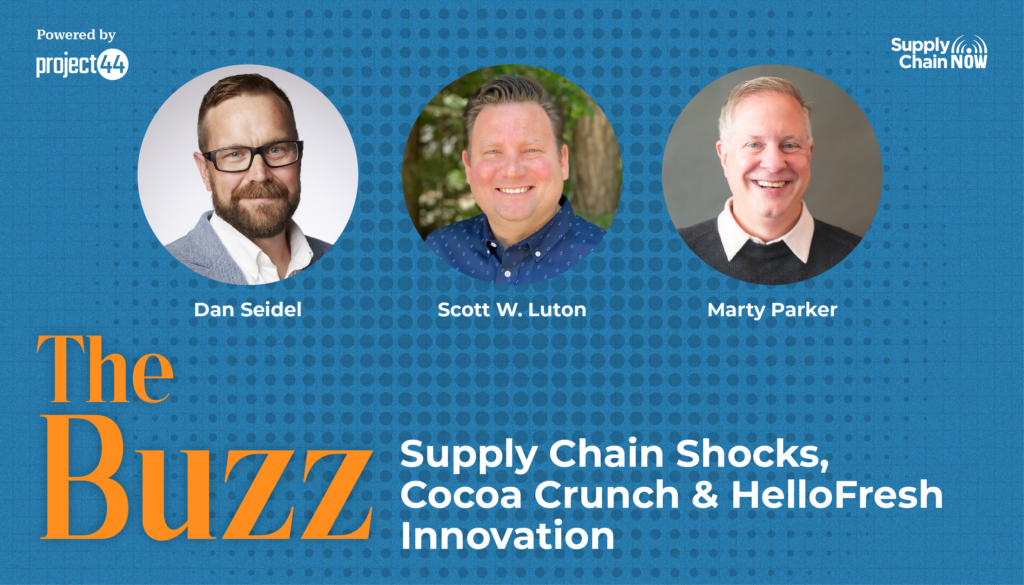
Hey, good morning, good afternoon, good evening, wherever you may be. Scott Luton and Marty Parker here with you on supply chain now. Welcome to today’s live stream. Hey Marty, how you doing?
Marty Parker (00:23):
I’m doing great. Scott, it’s beautiful here in Marietta and just thrilled to be here with you.
Scott Luton (00:28):
This and early fall, the best two times a year, I think, to be in Georgia. Would you agree?
Marty Parker (00:34):
Absolutely. Had to vacuum all that pollen up off the furniture today, but other than that, it’s outstanding.
Scott Luton (00:40):
That is exactly why early fall is my favorite of the two. No poll in early fall, but hey, I digress. Folks, today’s show is the buzz where every Monday at 12 in Eastern time, we discuss a variety of news and developments across global supply chain and business news that matters is what we like to call it. And the buzz is powered by our friends at Project44, the decision intelligence platform for the modern supply chain. Learn how to bring more visibility, certainty, and success into your supply chain organization by visiting project44.com. Okay, so Marty, we’ve got a big, big show here from a variety of perspectives. We’re going to touch on several big events coming up. We’re going to be mentioning some of the latest supply chain complications related to the ongoing military conflict in the Persian Gulf. We’ll look at the impact that continued high cocoa prices are having in the food industry.
(01:28):
That’s an interesting story. All that and a whole bunch more. And Marty, and today we got a great guest. In about 15 minutes or so, we’re bringing in Dan Seidel, global COO with HelloFresh. You’re going to enjoy Dan’s take on some of the most innovative things that they are doing. Marty, big show. Did you take your vitamins, eat your wheaties, whatever? You ready to go?
Marty Parker (01:48):
I am ready, my friend.
Scott Luton (01:49):
You are always ready. So folks buckle up for a big edition of The Buzz, powered by our friends at Project 44 right here today. And as Trisha says, happy buzz day. Say hello and let us know where you’re tuned in from. Thank you, Tricia. You and Amanda appreciate all that you do. She’s also already dropped a link to Project 44. And Alan Jacques says hello, Scott and Marty. Allen is, as we’ve established, the Rodney Dangerfield of global supply chain, right? And he calls the beautiful country of Canada home. Alan, remind me what part of Canada, my friend, but great to see it. Okay. So Marty, before we bring Dan on, we got three things we got to do. We got to do the work first, right? So let’s see. Up first, I want to talk about our latest edition of With That Said. Now, before I talk about some of the things, I challenge our audience to come up with a caption for the image we used where we’ve got the psychologist and the globe and the world getting together and have no caption participants for a little prize.
(02:47):
So throwing that out there, folks, we’re dropping a link to with that said, if you want to be in the running for winning a little small prize, give us your best caption for this image. Anyway, we led with several perspectives on a wide variety of topics, such as Marty. Greg Ip with the Wall Street Journal shared the idea that we could be looking at the Fed raising interest rates as one of their next moves. We touched on the malaise in one key economic sector, the US housing market, where new home sales in January here in the States, where they dropped to their lowest level since October 2022. That’s no bueno. We also touched on the big Uber investment in Rivian, which is a story we’ve been tracking for a long time. $1.25 billion from Uber up to $1.25 billion comes at a critical time for Rivian who’s launching a new line of cars this spring.
(03:34):
Folks, you can learn more about all of those perspectives and topics along with tools, resources, live events, all in the latest edition of with that said. Marty, did you get a chance to dive into what that said over the weekend?
Marty Parker (03:46):
I did. And it was terrific. I have to say there’s a lot of bad news in there, which is difficult. By the way, that picture, my dad used to say, “I’m having a big going under spell.” He was from South. And so your world looks like they’re having a big going under spell.
Scott Luton (04:04):
Doesn’t it know?
Marty Parker (04:04):
But the good news for me is just the rapid, rapid adoption of autonomous vehicles. And I’ve told my students I would pay $200,000 for an autonomous vehicle because I go 90 minutes to school and almost two hours home and I could get so much accomplished. It would be worth so much to me. So I’m really excited to see Waymo and RoboTaxi and Mercedes has got some great stuff. I just love seeing that happen. So some good news in the midst of our big going under spell.
Scott Luton (04:37):
I like it. I’m going to steal that phrase, number one. And folks, you’ll keep the captions coming. And number two, as I always believe, there is always good news if you go looking for it. And while the world’s going through quite a tough time right now, there’s always good news and innovation. And hey, Amanda and Trisha likes that too, a big going understand. So Marty, we might owe your family some dollars. Well,
Marty Parker (05:00):
There’s actually a preface to that, Scott. It comes from the TV show. Oh my gosh, I’m forgetting it. With the junkyard from the 70s.
Scott Luton (05:09):
Oh yeah. Sanford Son.
Marty Parker (05:11):
Yeah, Sanford and Son. And so dad would say, “I’m going to join Elizabeth. I’m having a big going under spell.” So I’m both together, my friend. Nobody but us is going to get that reference because it was so long ago, but yeah.
Scott Luton (05:25):
And one of the best theme songs written by a legendary music producer as well. All right, good stuff there. Folks, go check out with that said, Trisha dropped a link right there. You want to click away. And hey, if you want to have some fun, give us a great caption and we’ll see if we can’t throw out some prizes in the days ahead. Okay. So Marty, let’s see here. We’re going from with that said to item number two here in the A block. We’re going to talk about some big events coming up in the supply chain world. First, we’re headed off to Chicago. Decision 44, a free event hosted by our friends at Project 44. You can hear perspectives from leading companies such as Abercrombie and Fitch, Alcon, Eaton, Suntory, Tailored Brands and more. April 8th and 9th is free to attend, but you got to register.
(06:13):
And Marty, really quick, have you been in … This event is going to be at the Willis Tower, the famed Willis Tower, right in Chicago. Have you ever been in that building, Marty?
Marty Parker (06:21):
I haven’t. I’ve been to Chicago twice, but I have not been in that building.
Scott Luton (06:25):
It is awesome. It is so … Most of those iconic buildings, like securities on lockdown, you can’t have any fun, all that stuff. They’ve really, at least in my experience, I went to an event there last year and it was like a coworking place, a whole different vibe than what you’d find like a real button down corporate, really, really cool. So looking forward to that event. Trisha’s dropped a link. Your folks right there, you can learn more about decision 44. And also Alan, Ottawa. I knew that. Have you been to Ottawa, Marty?
Marty Parker (06:55):
No, it’s on our bucket list.
Scott Luton (06:57):
Me and you both. Well, hey, we’ll go up there and we’ll meet Alan Jacques and taught basketball, horses, many other things, and supply chain. All right. So that’s Chicago. Next up, we’re going to be in Dallas at the American Supply Chain Summit. 10th anniversary. How about that? And final passes still remain for the 10th annual American Supply Chain Summit from April 27th to the 28th. This exclusive summit will gather over 300 leaders and 50 expert speakers to discuss supply chain disruptions, resilience, digital transformation. Key themes also include, of course, supply chain management, but process optimization, procurement, sourcing, technology, innovation, and logistics. If you’re looking for a high impact opportunity to connect and learn, the American Supply Chain Summit could be the event for you. So check that out. We’re dropping a link right there in the chat. I know you’ve been to Dallas, right, Marty?
Marty Parker (07:48):
It’s another great city. And I assume the summit has a fee associated with it.
Scott Luton (07:54):
Yes. Yes. Unlike Decision 44 free event, there is an attendance fee at the American Supply Chain Summit. It’s a good call out, Marty.
Marty Parker (08:02):
Yeah. I might be finished teaching by then, so there might be a possibility of going. Are you going, Scott?
Scott Luton (08:08):
I am. I’ve got a great fireside chat teed up, my friend.
Marty Parker (08:11):
Okay. Let me look at my schedule because that sounds epic to me.
Scott Luton (08:16):
If Marty Parker is going to be there, you know it’s a place to be. So come join me, Marty. Well, we’ll connect with Tevin and Lori Boyer and some other friends and talk supply chain stuff. And Tricia, because she is Johnny on the spot, is also dropping a link to that. And then one final event, kind of different than the others. Folks, come join us. It’s that time of year again to celebrate this entire industry, this entire global industry. Every nation should have a supply chain day. Just because it’s called National Supply Chain Day, we’re celebrating the whole thing. April 29th is National Supply Chain Day. Plan to join us at 12 noon for a virtual event. That’s going to be featuring a wide range of supply chain leaders. And we have confirmed, Marty, we’ve confirmed, Billy Ray Taylor, the Billy Ray Taylor, author of the bestselling book, The Winning Link.
(09:01):
He is confirmed to be our keynote. That is outstanding. And Marty, I think you’re going to be there with us on the 29th. Is that right?
Marty Parker (09:07):
Yeah, I registered because I don’t have classes this year for the first time, so I will be an attendee.
Scott Luton (09:13):
Love it. Love it. Tricia has dropped the link to that as well. Thank you, Tricia. All right. So finally, we got to finish on a tough note, this kind of this A block before Dan joins us. Everything is in all fun and games, of course, in global supply chain. And so before we bring on our guest, I want us to both weigh in on some of the key supply chain ramifications that we’re tracking related to the Iran war. Now, what I’m going to share, Marty, is this morning, here’s a little bit of good news. I think the US announced a five-day pause in at least a component of its military strikes, right? That caused Brent Crude, which is really the global oil benchmark price to drop at least this morning below 104, 104 bucks a barrel. Now, that has since gone back up to about 106, so we’ll see.
(09:59):
But at least we’re a good bit away from the $200 per barrel, worst case scenario that some folks have been talking about. Now folks, I know most of our audience knows this, but oil touches just about everything in the global business world. Hence, the massive attention placed on its price changes and supply constraints. That’s why, right? From the packaging we use to the transportation move stuff, to the fuel that makes everything move. That’s why a lot of folks are tracking the price of oil. Now, beyond oil, pharmaceuticals, fertilizers, plastics, too many to name, check this out. Helium, Marty. Helium, some folks may not know, is used extensively in healthcare and technology. And that industry, sector, market, whatever you want to call it, has been deeply impacted. Here’s the dis you know. Cutter is the second largest producer of helium behind the US. And of course, that nation has been subjected to Iranian strikes on its infrastructure.
(10:55):
So we’re looking at, it’s going to take some time to rebuild the critical helium supply amongst many other things. So anyway, Marty, there’s so much we could track. What’s been something you’ve been keeping your finger on the pulse up?
Marty Parker (11:06):
So I was alive during the ’70s crisis, and this is different than COVID because it’s a spike. It’s fast. COVID was over a long period of time. So you really have to go back to the 1970s to see what something like this might cause. There’s a lot of discussion of stagflation because the Fed is going to be pretty powerless to do much about this. There’s also the lag time, which we learned about in COVID. So all the stuff that’s happening now is going to have ripple effects for at least six to 12 months, even if it’s stopped now. And the pricing, people can’t get straight because each day they don’t know what’s happening. So I think this one’s much bigger than people think it is, even if it’s stopped today. And we have the 1970s to look back on to understand those impacts.
Scott Luton (11:57):
Marty, it’s so true. I mean, you look at the LPG facilities and we got a lot of building back to do, to your point, even if it stopped right now at 12:15 PM Eastern time, we got a long global recovery in some of these sectors. So we’ll see. We’re going to keep tracking it folks. And of course, praying for cooling of the tensions and we’ll see where this five-day moratorium of sorts goes. Okay. Yeah. And
Marty Parker (12:22):
I’d add the American families that have been affected by injuries and deaths, we’re all praying for those American soldiers. That’s
Scott Luton (12:30):
Right. On a much, much lighter note, folks, we’re delighted to have a terrific guest join us here on the Buzz, powered by Project 44. Dan Seidel is the global chief operating officer at HelloFresh, where he leads global operations for the world’s premier integrated food solutions group. Now with over 26 years of experience, we’re breaking our 20-year rule there, Marty. We hadn’t done that in a long time. We’re breaking it. But with over 26 years of experience spanning robotics, industrial manufacturing, and complex supply chain sectors, Dan is indeed a transformational leader dedicated to scaling tech-driven operations and integrating advanced robotics to redefine how the world eats. Prior to this current role, Dan served in leadership roles at companies such as Amazon, Target, and Thomas & Betts. So please join me in welcoming Dan Seidel, global COO with HelloFresh. Hey, hey, Dan, how you doing today? Hi,
Dan Seidel (13:20):
Scott. Hi, Marty. Thanks for having me.
Scott Luton (13:21):
You bet. Really enjoyed the pre-show session. And Marty, going back to some of the cool robotics and autonomous things you’re excited about, I think we got the right guest today. Marty, what do you think?
Marty Parker (13:33):
Yeah, absolutely. We had a great time backstage learning about Dan and HelloFresh.
Scott Luton (13:38):
We did. We did. Lots of folks excited about HelloFresh, maybe more on that later in the session. But first, folks, it is the fun warmup question, Dan, right? Now, there’s lots of things to celebrate here today. It’s Melba Toast Day, not my favorite. It’s National Chip and Dip Day. It’s interesting. Now you’re getting a little closer. National Puppy Day, National Tamale Day. Loved all those. But also folks, it’s World Math Day. Now that’s not as exciting as maybe ruffles and some onion dip, but nevertheless, World Math Day, critical. And it’s being celebrated for the 19th year in a row here in 2026, but it’s been kind of a thing for several thousands of years. Dan, I want to ask you on this World Math Day. My hunch is you and Marty both are really good at math. You got to be to do what you do.
(14:25):
Who was one of your favorite math teachers of all time, Dan?This
Dan Seidel (14:28):
Is an easy one. Roy Huckle at Hackettstown High School spent, what, four years one way or another interacting with him through shop classes, math, algebra, CNC. He was the first person to bring coding, CNC coding and machining into the school and just have total respect.
Scott Luton (14:48):
Oh, Dan, I love that. It sounds like a Mr. Felton in my journey, industrial arts. And where was that at, Dan, the high
Dan Seidel (14:55):
School? Hackettstown, New Jersey, where M&Ms are made. That’s our big claim to fame. I went to Hackettstown where you smelled chocolate every day. You may think that’s a great thing, but you get pretty sick of it after a while.
Scott Luton (15:09):
Okay. Man, there’s a lot more of that story, Dan. Love it. Mari, that’s going to be tough to beat. Who’s one of your favorite all- time math teachers?
Marty Parker (15:15):
So this is easy. My mom, Carolyn Parker, she taught until she was 76. And we co-taught a class when I was in the eighth grade and we co-tutored math when I started in the ninth grade, and she’s genius and brilliant at it. And I think it’s protected her from things like Alzheimer’s.
Scott Luton (15:34):
And
Marty Parker (15:35):
Honestly, she taught me everything I know up until calculus. When I got into calculus one and two, I was a little bit past her abilities. But I will tell you, being tutoring cheerleaders when I was in the ninth grade is the greatest job I’ve ever had in my entire life. It was incredible.
Scott Luton (15:53):
Love
Marty Parker (15:53):
It. Love mom. Shout out to mom and her amazing math teaching abilities.
Scott Luton (15:58):
That’s awesome, Martin. That’s awesome. And by the way, calculus is beyond a lot of us, including myself. But love those memories. I would add, Ms. Porter was one of my favorite teachers of all time for that matter in my journey. She taught me in 10th grade geometry class, and she was able to make so much of math, so relatable, even to those of us like myself, that I still don’t have advanced math, or two Fs skills. And she was encouraging and empowering. So patient, man, there’s not much in life like a patient teacher, especially of advanced concepts. And she’s gone way too soon, but Ms. Porter was the best. All right. So Dan and Marty, a lot of good stuff there. I want to call out a couple folks really quick before we go on. We’re going to talk more about chocolate, Dan. You hit the right topic there with the Eminem capital of the world.
(16:51):
But Larry Klein, LK is tuned in from Albany. Larry, I hope 2026 brings you tons and tons of good health and it’s great to see you here today. And Robert, back with us from Cape Town, if I’m not mistaken, Robert, I think I’ve got that right. Great to see you again. Looking forward to you and Larry weighing in on some of the topics we’re talking about here today. All right, so we’re going to get to work. And Dan, you nailed it when you talked about chocolate, because our first story talks about cocoa prices, right? So we’re going to look at how some companies are dealing with the ongoing higher costs of cocoa, right? Our friends at Food Dive are reporting on how Mondelez is having to rethink its approach to chocolate innovation. The good news, and as me and Marty have established, there’s always some if you go looking for it, cocoa prices have come down from record highs seen in 2024.
(17:37):
And when I say record highs, think over $12,000 per metric ton. Now it’s around 3,200, $3,300 per metric ton. So you see when we say historic highs, really big highs. But still, even that 3,200, 3,300 is still elevated when you look at pricing historically. Now, West Africa, which produces about 70% of the world’s cocoa supplies continue to face poor harvest due to drought, tree diseases, crops that are overworked and are aging amongst many other factors. And it’s important to keep in mind cocoa supplies are bought about a year in advance by large companies like Mondelez. So they’re probably yet to fully benefit from the cocoa market coming back down to earth. So Mondelez, which sells about 95% of its chocolate products to Europe and emerging markets, is looking at various options of dealing with these heightened costs, including offering candy bars filled with nugget, caramel, nuts, and fruits.
(18:33):
Now, that would not get my vote. That would not get up. I’ll pay more. I don’t want my chocolate bars with fruit in them, Marty and Dan. Hershey is also looking at new products to combat cocoa prices such as … This one sounds good. Milk chocolate bars filled with crunchy waffle cone bits instead of extra chocolate. Man, sign me up for that one. So Dan, Dan, when you think … Look, we got so many constraints. Cocoa prices are just one of them. When you think of these innovations and how companies are finding a way, what are your thoughts?
Dan Seidel (19:02):
Yeah. First off, on cocoa itself, I see that as a canary in the coal mine. It’s one of the leading commodities that drive my concern as I look at food in my food distribution network and my supply base with climate risk and you called out all of the things that are making harvest harder and harder. How are we thinking about redundancy? And I’ll get a lot more into that, but I feel like this is just the beginning of a shift we need to make as anyone who deals with food based on climate change, based on all of the things that are causing what I’ll say, some pretty significant disruption in the food basis. So this is just a lead-in. And I also think it’s given suppliers the opportunity to really shorten pricing windows, change the way they look at contracts. This is just the tip of the spear, I think, as we talk about these things.
Scott Luton (19:55):
Dan, well said. Well said. Marty, your thoughts on this chocolate on the greater story here.
Marty Parker (19:59):
So I have a brownie recipe I’ve been making since I was 17, and it’s got the unsweetened baker’s chocolate squares in it. And I’ve noticed the price go up, but it’s minuscule if you sort of make it yourself, if you think of that way. And you hit the nail on the head, Scott. They really need to raise prices because prices communicate scarcity and consumers are smart and they’ll make their own decisions. And in my opinion, fillers are gross. I mean, you cannot taste the chocolate anymore. It’s like gross, grosser and grossest. And also think about if you’re buying yourself a piece of chocolate on an individual basis, it’s actually a small investment. And I agree with Dan, having that flexibility, which by the way, we’re going to talk about in the strategy section around your pricing is critical because you’ve got to raise them. You got
Scott Luton (20:54):
To
Marty Parker (20:54):
Do that.
Scott Luton (20:54):
Well said, Marty. It’s almost like the first couple chapters of the Willy Wonka and the chocolate factory book. Remember the family? Every single bite of the chocolate bar was a preciously guarded luxury, right? And it’s interesting that you said, share your perspective because now we’re all used to getting chocolate whenever we want it, even if it’s not great, a great chocolate like Robert, who’s in Durban, South Africa. When I went to South Africa, man, the chocolate there will blow your socks off, Marty and Dan. I tell you what, but regardless, a lot of good stuff there, Dan and Marty, appreciate y’all’s perspective. And we are going to touch on some corporate strategy elements that’s probably tied in nicely to this first story. All right. So Dan and Marty, where we’re going to go next? We’re going to how the Amazon relationship with the United States Postal Service is ever changing.
(21:44):
Big news here. As the Wall Street Journal reports that Amazon plans to reduce its postal volume by two thirds this year. Now for critical context, the USPS delivered billions of packages for Amazon in 2025, right? Has for years. ShipMatrix data says it was 6.6 billion. In fact, Amazon volume made up almost 15% of total United States postal service delivery volume last fiscal year. Now, the timing though of these moves that Amazon’s looking to make is related to several things, but notably, Amazon’s existing contract with the USPS expires in October. Plus, Amazon continues to deliver more and more of its orders. In fact, in 2025, in a first, Amazon delivered more of its parcels than the USPS did late last year, more than anyone else did for that matter. And important to note, there has been ongoing negotiations in this massive relationship, which still may yet impact Amazon’s final plans.
(22:37):
At the end of the day, the USPS continues to lose money, I think $9 billion in fiscal year 2025 alone. There is new leadership, right? New postmaster general, and change is certainly seen to be coming. So Dan, you might have a little bit of … And it’s been a little while since you were at Amazon, but I’m really curious to hear your take on these changes here.
Dan Seidel (22:55):
When I read this story, I don’t see this as a USPS problem. This is more of a last mile logistical problem. And here’s why Amazon will become, hands down, the largest last mile network in the United States. When that happens, Amazon will always prioritize their own units, but what comes next? How does that last mile market from a per mile, per mode, gig worker, all of the different modes that we all know they can bring to life pretty easily, how does that drive other third party or a 3PL last mile suppliers in a different direction? I think we were pretty stable as a last mile organization here in the United States when USPS was still had a good amount of volume and kind of controlled that market. But now with that cap kind of looks like disappearing, I’m a little concerned. Again, back to the strategy, we’ll talk about it in a little bit, but with obviously my business as being such a big factor, we’re already looking at ways to hedge that and such.
(23:57):
But yes, that’s my biggest worry.
Scott Luton (23:59):
Dan, well said, well said. Marty, I’d love to get your thoughts on this continued evolution in the Amazon USPS Love Fest. Your thoughts, Marty.
Marty Parker (24:08):
Yeah, so mine’s a completely different angle and I appreciate Dan’s. We as Americans have to decide what we’re going to do with USPS. Rural communities, these are Republican communities, by the way, depend on it. They depend on it for inexpensive deliveries in the middle of nowhere. If we turn that over to corporations and we turn that over to Amazon, folks are going to be paying a whole lot more for it. And so we do things for the public good all the time. We build roads, we build bridges, we build ports, and we have a decision to make. And I’m a big fan of writing letters and sending letters and cards because I’m a hundred years old or 91 years old, but think about that for a minute. You want to send a card to your grandmother from Amazon? Do you really want to pay $15 for that?
(24:57):
I don’t think so. So we have to make that decision. And the irony is the $9 billion, we throw that away in a day in this war, I mean a single day. So we have, as a society, a decision to make.
Scott Luton (25:12):
You’re right. It goes back to the why, right? When the USPS was first established, commerce, business, the world was much, much different. And we might have to revisit some of that, including the new Postmaster General, is looking to ask the powers that be for the ability to adjust prices differently rather than have to go through all the regulatory hurdles. So we shall see, but tell you, it’s a fascinating time to see this play out. And Dan, going back to your point, final mile just in general. It’s amazing what companies are doing. So we’ll see where this ends up. And by the way, folks, Tricia has dropped link to this story. She dropped a link to the earlier story. So don’t take our word for it. Go check it out yourself and give us your take. And I got to call out one more thing, Dan and Marty, because I missed this little nugget.
(25:53):
So earlier in that last story, Dan and Marty, we were talking about fruit field chocolate and LK says it sounds like a six cylinder Mustang. So yeah, that’s nice. And then if you can get a Mustang, get a big motor, right? A 5-0 or something. But yeah, it’s about as much fun. I
Marty Parker (26:11):
Drove a four cylinder Thunderbird. It’s like, that was the dumbest car I’ve ever had.
Scott Luton (26:19):
You got to get the real thing, right? Anyway, so we’ll keep tracking this Amazon USPS story. Appreciate Dan and Marty’s comments here. And we’ve been kind of referencing this next story a couple times. And here in a few minutes, we’re going to kind of dive deep in what the cool things Dan and the HelloFresh team are doing. It might surprise you along with some data and some factoids, but with this one story here I want to hit on. It looks at the continued evolution of corporate strategy, especially as disruption and volatility and uncertainty right now range supreme. So the World Economic Forum recently published this interesting story along these lines. It’s polling, the World Economic Forum’s polling that the article kind of speaks to reflects that 50% of business leaders anticipate either a turbulent or stormy business climate over the next two years. What gives them that idea?
(27:07):
I wonder. That figure rises to 57% over the next 10. That sounds low to me. One point though is made in this article that you all should go check out. It says, “It’s now clear that strategy is no longer about optimizing a working world. It is about navigating a highly uncertain one.” The article also suggests that companies are embracing a critical wrinkle in this disruptive volatile era. Business leaders must be able to quote, make informed predictions, withstand shocks and pivot quickly. It feels like the last five years. And speaking of five years, it talks about how five year strategies are now compressed into 12 month cycles. A wait and see approach it says is the riskiest move of them all. All right. So Dan, this article wasn’t necessarily written with supply chain in mind, but many of us in supply chain is like, where was this five years ago, eight years ago, you name it, at least to me.
(28:04):
But Dan, your comments here on how corporate strategy continues to evolve too.
Dan Seidel (28:07):
Sure. What, five, six years ago, or maybe even less than that, you were looking at building optimization, utilization, OE to ensure you were having the safest, highest quality, highest efficient process to deliver and delight for customers. Those are the easy things that you can control, right? Now that we’re seeing all of the other things going on in the world, now we need to build supply chain strategies that can sense, decide and make quick decisions and pivot in areas that we would’ve never dreamt we’d have to pivot before. When I think of KPIs, I actually reflected on this question. And again, you’d think about quality, safety, cost, all of the things that classically mattered. Now it’s like time to recover percent of items that are dual or triple or quadruple sourced. What is the supply chain disruption impact? What kind of indices do you have on each one?
(29:01):
How do you prioritize each one? What is the time for upstream things that possibly can make your business almost seamless while the inner workings are really troubled? In my case, how could we redefine the menu before the customer even knows we can’t get broccoli? How fast can we shift production in all those ways? So I feel like the playbook has gone from the classic lean playbook of safety, cost and quality to still delivering that experience, but you have so many different levers now you have to pull to ensure the customer’s protected from all the volatility we see on a daily basis.
Scott Luton (29:43):
Dan, yeah, limitless. It feels like levers to pull and to manage. Maybe if you’re lucky, I don’t know. Marty, your thoughts when it comes to this ever evolving approach to corporate strategy?
Marty Parker (29:56):
Yeah, Dan, that was brilliant. I’m going to go back and watch that again. Get the transcript around supply chain. So I do strategy. I’ve worked as a chief strategy officer in companies, and this varies. And my criticism to the article is the company size. Susan Cohen in our management department teaches a one-page strategy for small companies where every week, every two weeks, they’ve got it all on the board, whiteboard, they’re racing, moving it around. And I think mid-size companies can do this too. But frankly, it’s impossible for big companies, in my opinion, because of the complex customer interactions, the difficulties in supply chain and the contracts that they face, the approval processes. I was working on an HR process for a company that took 140 days to hire somebody.
Intro/Outro (30:47):
Wow.
Marty Parker (30:47):
And I just had this crazy idea, instead of spending 40 days approving it three times, why don’t we approve it in the beginning? I mean, companies are not as sophisticated as we think they are from a leadership perspective. And there is just no way that big companies are going to be able to do this unless they break themselves up into really small, flexible SBUs or something else. I think small companies are going to eat them alive in this environment. We’re seeing it like with ERP systems and other AI things. So I think Dan’s takes from the supply chain side. Mine’s from more of the corporate strategy side, but it’s tough.
Scott Luton (31:25):
It is. And hey, I’d pay a few bucks to hear both of y’all tackle it for several hours in our next session. We’re going to have to have you all come back. But Marty, really quick aside, you mentioned that 140 day timeframe to make a hiring decision. Think about it. If you’re a candidate, you’re a talented in- demand candidate. You meet them one day and then what is that? Three and a half months. I told you all my math stinks. Three and a half months later, you finally get the decision whether they want you to come on board or not. You’re not going to have top talent that’s willing to wait that long. Much less, think about the candidate experience, right? Anyway, Marty and Dan, really good stuff. I find both of your perspectives intriguing. And Jeremy’s back with us. Jeremy, he loves strategy as well.
(32:10):
And I don’t follow you exactly Scrooge versus Fezowig. Maybe I’m missing that analogy somewhere. Maybe I’m not smart. I’m not sure where Fezwick- It’s
Marty Parker (32:18):
From a Christmas, Carol. And I don’t know who … I know who Scrooge is. I can’t remember Fezzy Wig exactly.
Scott Luton (32:24):
Okay. So Jeremy, fill us in, but as always, it’s great to have you back. He always brings the perspective. Dan and Marty, a lot of good stuff. That really, that cool corporate strategy conversation deserves several hours of conversation. I thought it was a thought provoking article that we’re not going to do justice to here today, but that’s why Tricia has dropped the link right there. You can check it all out and give us your thoughts on how you see corporate strategy and leadership evolving. All right. So we’re about to dive deep into Dan’s perspective. Really cool as I was doing some homework on HelloFresh and we’re going to do some closer homework on HelloFresh because Dan, we are now official, right? I didn’t want to unbox the whole thing, but we’re using HelloFresh now. That shipment got here earlier today. But before we go there, folks, you know, we love sharing great resources.
(33:09):
It’s going to help your days and your weeks and your business year be more successful. So this from our friends at EasyPost, how are shipping teams using large language models already, both with and without permission? You can check out this practical guide from EasyPost that shows what’s really happening today and where the real opportunity is. We’re dropping a link right there in the chat. Check it out and let us know what you think. All right. So Dan, terrific to have you. We’re going to talk about HelloFresh now where you’re on a mission to change the way people eat forever. I love that. I’ve been working hard on how I can change better ways to eat, more on that later maybe, but for starters, especially from a supply chain perspective, let’s level set a bit. Tell us more about your operational supply chain footprint, I’ll call it, so we can level set with our folks out there.
Dan Seidel (33:58):
So we operate in 18 different countries. When you look at our total global footprint, North America, which is obviously US and Canada, we don’t have anything in Mexico makeup depending on the month or the quarter, 60 to 65% of the total volume. So as you can imagine, a high concentration of our customer base is here in the United States. When we think about our supply chain functionality, why I love this role and why I have decided to take it, as you shared, I worked for Thomas & Betts, an ABB company for almost 18 years and I love making stuff. I went to Amazon because of Kiva and at the time Amazon had just acquired Kiva and I wanted to get deeper into robotics. I learned supply chain and Target, same thing. This was the first opportunity I had in a role to apply all of my lean processing, technical manufacturing knowledge within the supply chain.
(34:55):
So why I bring this up now is within our US, our Canada, now Germany and Australia networks, we have two different types of supply chains. So we not only have the fulfillment model for our meal kit side, but we also have ready to eat. So what those are, I like to call them extremely high tech TV dinners and why they’re extremely high tech is they’re never frozen. We cook them not just in an oven, but we put a lot of calculated moisture and a lot of different cooking methods that other, we’ll say cooking industrial kitchens don’t do. And the reason why we do that is we bring the microwave experience to life as if you cooked it yourself. These things do not taste reheated. They are macro driven by nutritionalists. So we have different menu types, whether you’re on GLP-1 or you’re looking for added protein or you’re just looking for a daily balanced diet or some other diet that may exist in the world that you’re focusing on.
(36:01):
We have menus for that. So when you look at our supply chain, it’s multifaceted. We have local suppliers, as you can imagine. We have global suppliers for our proteins. So bringing that all together in each specific market has its unique challenges. As you can imagine, France, for instance,
(36:21):
If I ever brought in a cheese from across the border, they would have anarchy and we probably lose every sale overnight where maybe some other markets don’t care as much. So it’s an extremely market driven, cultural driven business because of how passionate food is for our customers.
Scott Luton (36:42):
Dan, I love it. And all of that, I’m going to ask you a question here in a second and if folks will already know the answer, I think. But Marty, really quick, first, that just sounds the scope, the size, all the different preferences and the factors. Dan runs a challenged supply chain organization that somehow finds a way of making all these people happy. Marty, your thoughts here.
Marty Parker (37:05):
So one, Dan, I didn’t realize you had the fresh ones. If those are available in the United States, I’m retiring from cooking today. Secondly, I’d really like the fresh ones from Germany because I’ve been to Germany so many times and I love German food. So we may have to air freight some of those over here. I digress. I think that is incredible because they’re customizing in these local markets with this really complex, and I don’t even know. I’m assuming manufacturing, supply chain, assembly, packaging, it just goes on and on and on. Yeah. And keeping the food safe is a huge deal. And the food scientists keeping it tasting good. So I’m hungry. If I had mine right now, I’d be going upstairs and nuking it right after the show.
Scott Luton (37:55):
We know what’s interesting. Go ahead, Dan.
Dan Seidel (37:57):
No, go ahead, Scott. I’m
Scott Luton (37:59):
Sorry. What’s interesting, because we just, as I mentioned, it’s always cool to have a leader from an organization that we just kind of had experience with. And I was, me and Amanda were placing our first order over the weekend. And it’s mass cost customization. And I mean that in a really true sense. It asks you like 12 different questions as it looks to kind of zero in on what your preference is from a culinary standpoint. And so then on the back end, kind of to your point, Marty, they have to manage all of those preferences at scale along the lines of what Des Dan was kind of sharing the footprint. It really is. It’s an amazing time to be in global supply chain. But Dan, before I continue, because I had a few other questions for you, I think you were going to comment on something you heard there from Marty.
Dan Seidel (38:42):
Yeah, just Marty, it’s factor. That’s the brand that’s the ready to cook. So all you do is, like I said, pop it in the microwave for two and a half minutes and it comes out delicious. But on that factor side, and even on the HelloFresh meal kit and all our different brands, you brought up safety, Scott, and that’s an interesting concept that obviously you know, right? 18 months, 20 months now has been here, and I would’ve never guessed the challenge of food. And what I mean by that is when I was in manufacturing, T6160 aluminum, you got the specs in, you know what to adjust the pressure to and the deep draw form stamp tool, right? Or if your nylon 66 came in and your plastic house and its moisture content was X, you knew where to set the barrel temp, right? This is food and it’s amazing how much variation and how many other headwinds we run into on a daily basis.
(39:38):
But one thing doesn’t change. And this was the awesome thing. If no one else takes anything away from food conversation here in supply chain is this. Lean principles, right? And back in my manufacturing days, we’re always critical to reduce working capital, to have a better process lead time for made to order items, all of those things, right? Everyone who’s flown chip before knows what I’m talking about. In food, we have been shrinking our process lead time so much. Well, Scott, you just said you just placed an order and you already have a box in your hand.
Scott Luton (40:10):
That’s right.
Dan Seidel (40:11):
We have been maniacally focused on processed lead time, reducing, eliminating variation, and guess what? Not for working capital, not for reacting to X, Y, Z, but to get fresher produce, fresher protein, just a much more delicious experience to your front door. And that’s like one of the key mantras I’ve been driving since coming on board is, listen, inventory is evil, especially when it comes to food. We want to turn this stuff really fast to push that much fresher experience to you, the customer.
Scott Luton (40:47):
Dan, love it. And that’s where we’re going next. But really quick, I want to bring in Jeremy’s comment here. Food is revered in many, many human cultures. Health equals happy people. That is right, Jeremy. That is right. So let’s do this. So Dan, earlier we touched on some of your almost 30 years of industry experience and here I go breaking our 20-year rule. Dan, I’m not supposed to break that 20-year role. We always say over 20. I broke it twice here today. Anyway, a lot of that experience comes in robotics and industrial manufacturing, global logistics. It’s some of those big names we mentioned already, Amazon and Target. And then coupling that with what you were describing and what me and Marty were talking about, the complexity of it all. I was going to ask you what makes HelloFresh one of the most sophisticated tech-driven supply chains out there, but really I would answer that because it has to be.
(41:33):
But Dan, expound on that if you would please.
Dan Seidel (41:36):
Yeah. Our secret sauce or our moat, I would say, is twofold. Without a doubt, our front end. So if you go to our user experience, it’s where the magic happens, right? We have that unique opportunity to make direct contact with our customer base. We have the ability to solicit live feedback on every recipe, on every trend. We have that unique ability to touch every customer to understand what they bring to the table from a passion perspective. And what we’ve also just deployed, it’s called our cookbook. So our web developers, our app developers have been working on this capability that is now live that if you see a delicious meal on TikTok or your favorite influencer chef and you’re like, “I have to have this. ” We may not have it yet in our portfolio, but we can use AI within our app to download, to decipher the video and our app then will give you the entire recipe, the contents needed to complete the recipe, cooktimes, the whole nine yards.
(42:41):
And it will be forever in your cookbook in the HelloFresh app. What is exciting to me is by bringing that to life, I have a gigantic uphill battle. You can imagine, I always use Heart of Palm for some reason. I don’t know. I love that route for some reason, but you can’t get it anywhere unless you go to a Brazilian steakhouse. That’s the only time I can get it. Anyway, imagine you see a recipe or Heart of Palm rather, Heart of Palm on it. And I haven’t qualified Heart of Palm. I haven’t done shelf life testing on Heart of Palm. I haven’t done any, we’ll call transportation sensitivities, the temperature time in transit. We are standing up as we speak a project and if you’re in Arizona or up the entire Pacific Northwest coast, we now have, it’s called Project 500. So what you were talking about, Scott, the designer ability you feel as you answer questions, we take that to the next level.
(43:38):
And what we’re piloting right now on the West Coast is what I’ll call infinite desirability for you, the customer, and what your likes are. So now I can imagine you went through that list and it probably narrowed you down to like 30 or 40 different recipes, tops, where now if you’re in those zip codes that are being tested, you’re probably limited to a hundred and you want to narrow it down even more. Or in the not too distant future, if I want that hard to palm and it’s not in my bill or in my SKU playbook, we’re building the capabilities right now to bring it on like that. So back to the strategy, back to how are we managing this supply chain, it really comes down to a few key points. It’s not just getting Guard Shack to Guard Shack, meaning the product in and kited and out the door fast.
(44:27):
It’s how are we onboarding SKUs? How are we partnering with suppliers to drive supplier development, redundancy? Because you can imagine, I get better broccoli in the Pacific Northwest compared to Arizona and different
Scott Luton (44:41):
Times
Dan Seidel (44:41):
Of the year, but sometimes I have to get it from Georgia or it’s all over. So building those relationships, what I like to call farm to box and not depending on a distributor to manage or broker the best, but get that again for speed and freshness, the product as fast as possible is what we’re working on, which is, as you can imagine, I’m taking it back to the robotics question, it is a monumentous task of utilizing AI visualization on inbound because of how we’ll say divergent our product could be that we protect our customers from, but we obviously see some interesting things. It’s how fast can we process? How can we not even warehouse to get it in just in time? These are all the things that AI and robotics are allowing us to do. And that scale proof of concept I shared out in the West Coast is fully roboticized with we’re using what I would like to call some of the latest technology, not only on the physical asset perspective, but also on how we’re managing those assets.
Scott Luton (45:45):
All delicious supply chain discussion is what I’d say. Marty, your thoughts on … Dan shared a lot there, a lot of different innovative, evolving things are taking place with an organization all to deliver fresh and oftentimes local and high quality, convenient options that also hit those certain preferences that we all have. Marty, you may not love tofu. I love tofu. Folks may think I’m weird. I love tofu. I really do. We
Marty Parker (46:13):
Can’t be friends
Scott Luton (46:14):
Anymore.That’s what afraid told me once. But Marty, react to what we heard there from Dan.
Marty Parker (46:19):
So two things. One, Dan’s comment about AI. I mean, I cook and I use Gemini because I can just hit a button and it goes to a Google Doc. And I take pictures of my pantry and my refrigerator and ask Gemini for recipes all the time that have four or five ingredients that I can cook in 30 minutes. So thank goodness this app is out there because I’m going to download it immediately and start using it. But the second point’s really important, Scott. You said the why. Let’s think about the why for a minute. This is the most hyper competitive service industry. I teach service ops on earth. There is nothing easy about being in the restaurant business or the grocery business or the HelloFresh business. Consumers can DoorDash, Uber Eats, Grubhub. They can go to their local grocery store who has a million fresh food items that are precooked.
Scott Luton (47:15):
I
Marty Parker (47:15):
Mean, they’ve got sushi for God’s sake. And look at the incredible pressure that that puts on a company like HelloFresh. And so their response is to beat them. Their response is to make it better. Their response is to make it faster. Their response is to keep your ass at home and not have to … Sorry, I cussed. I have to drive to the grocery store or wait for it, pay for those huge fees on Grubhub and Uber Eats and DoorDash. So I think the why here related to strategy, because in supply chain, there is no supply chain strategy without corporate strategy. It does not exist. You cannot do your supply chain without understanding that. And I think the why here is huge and it’s impressive what HelloFresh is doing under that incredible competitive pressure.
Scott Luton (48:05):
Wow, it is. And I can’t wait to experience it firsthand. So Dan and Marty, for the sake of time, because we’ve really enjoyed the food discussion here today for sure and all the other perspective. Y’all produced, Dan, what I found to be a pretty cool report to kind of dive into. And that’s the 2025, 2026 State of Home Cooking Report. And I get this folks, I’m going to share some of the key findings here and I’m going to get Dan to weigh in on some too. 93% of Americans plan to cook as much or more this year than they did last year. And that’s our household. 69% of adults have sit down dinners at home with others most or even every day of the week. I wish I could say that’s ours, but we go, we cook and we scatter to all corners of the house is what me and a man and three kids do.
(48:49):
71% find cooking to be more stress relieving than stressful. And as someone that just grilled for the last three nights take advantage of weather, it is so stress relieving. But Dan, when you think of this report, some of these trends, what would you call out?
Dan Seidel (49:05):
First to call out is, again, love that we’re getting data from our customer base. That’s why we’re here. Voice of the customer drives everything we do. So as I look at the report and as we obviously have a ton of conversations around what we’re learning each day, it comes around a few things. Speed to delivery, reaction to the customer desires, but let’s face it, quality. Both of y’all said it. If you can go to Target or if, hey, I know Target well, if you download the Target 360 app, you can have delivery. It just costs you something, but you have delivery to your home and have the same thing. But what they can’t deliver is a cooking experience. They cannot deliver a curated menu that we know based on what you tell us and what your search history and what you put in your cookbook, what your tastes and desires are.
(50:00):
And you’re only going to be as creative as your own personal creativity utilizing
Scott Luton (50:04):
Those
Dan Seidel (50:05):
Resources where we have a very large culinary team that has an immense amount of food science behind them where our calories are portioning our food waste is nil. It’s nil because we are giving you the exact ingredients, the exact cooking experience that you are looking for. And that experience comes down to how easy, as I shared when we were chatting before, my extent of cooking before HelloFresh was barbecuing once in a while, right? Throw some steaks or brats on the barbecue. And that was my skillset and pushing a button on a microwave once in a while. And I figure I better practice what I preach. So we’re very avid HelloFresh customers and it’s amazing what I can produce. I never cooked a day in my life and these meals are delicious. And I’m not saying it because I lead the organization, they are delicious.
(51:05):
And I really believe the key to that report is understanding what we need to flex in order to satisfy our customer. We need to be in service of the customer and ensure, again, we are getting you the fastest, shortest lead time possible. So the product you’re getting from us is pulled right out of the ground compared to if you’re getting it from Walmart or Target or wherever else. Who knows how long … Well, I know how long it’s been started Target supply chain. I won’t share, but it definitely has less of a fresh perspective than what we can deliver at HelloFresh
Scott Luton (51:41):
Now. Folks, check out the 2025, 2026 State of Home Cooking Report. And while you’re there, you might want to give HelloFresh a, kick the tires, take it out. I can’t speak. I’ve been impressed thus far. I can’t wait to taste it tonight, as early as tonight. We’ll see. But beyond all of that, I’m fascinated with the supply chain leadership innovation behind it. For the sake of time, Marty and Dan, we’re about to make sure folks … Marty, really quick, before we leave the state at home cooking reports, some of those trends, can you identify with any of those factoids I mentioned or did you see anything else in the report that really resonated with the Parker household?
Marty Parker (52:16):
Yeah. The short version, I eat a peanut butter and jelly sandwich with Cheetos and usually some disgusting candy in my car and my girls hate it. So I got to get factor because I’ve tried the horrible, cheap, frozen things. They’re awful. So Dan and I are going to talk about that and he’s going to give me his curated, tested list of ones and then AI’s going to figure out what I like. I love it. Yeah. Selfishly, it’s all about me, Scott, today.
Scott Luton (52:49):
Hey, stay tuned. We’ll give you an update and hopefully we’ll be successful at making sure Marty does not eat Cheetos and peanut butter together. Okay? So stay tuned. We’ll see if we can’t break the habit. All right. So really quick, I want to make sure folks, before we ask Dan and Marty how folks can connect with them both, I definitely want to bring more resources. Y’all know we’re passionate about that. Not only can you check out our live programming at the new supplychainnow.com, supplychainnow.com, but you can also check out our growing resource hub where we got all sorts of helpful content like this ebook from Keith Moore and the AutoScheduler AI team. Check this out. It’s focused on the high cost of labor firefighting and systemic attrition, a framework for labor orchestration in modern distribution. We got a link right there. You can check it out.
(53:37):
And Marty, really quick, we’re talking pre-show about an article I think you wrote and a presentation you’re given. And you had one piece of great advice to folks out there, CEOs out there that may view their frontline workers differently. You want to share that really quick, Marty?
Marty Parker (53:50):
Yeah, it’s an HBR article. It’s also a podcast link. And essentially, just treat your hourly workers exactly like your salaried workers. If you do that, you’ll have no issue. And do not think of them as mercenaries to just go down the road for 50 cents. That is not true. It is difficult for them. They do not want to leave you. So that’s the summary.
Scott Luton (54:15):
I appreciate that, Marty. I really do. And we got to respect all the folks. Even in this golden age of supply chain tech, which is amazing. We talk about some of those things today. It’s still the people. They get it done every day and we got to love and recognize and take care of them. Really quick, before I connect y’all, I want to go back. I’m looking forward here because I did a little Googling. Yes, I multitasked a little bit. And Jeremy was talking about earlier how we need to be more like Fezzywig versus Scrooge. And I was like, I know Scrooge, but I don’t know Fezzywig. Well, here it is, Dan and Marty. Fezewig was Scrooge’s old boss that appears, I think, as a ghost. And Fezewig is very generous. He’s everything that Scrooge isn’t. And so somewhere here, Jeremy had put a comment how we need to be more, we need to run companies more like Fezewick than Scrooge.
(55:04):
I can’t quite find it, but now it all makes sense. So well done, Jeremy, as always. Okay, let’s do this. Dan, again, with HelloFresh where they’re on a mission to change the way people eat forever. And check out that dish. Man, it looks delicious, making me hungry. Dan, how can folks connect with you? Maybe they want you to come in and keynote. Maybe they want to sit down and talk shop with you. Maybe they want to learn more about HelloFresh and how to be part of what seems to be a growing ecosystem. How can folks connect with you, Dan?
Dan Seidel (55:34):
Sure. You can find me on LinkedIn, Dan Seidel, HelloFresh, but love connecting. Love hearing other people’s perspectives and without a doubt, hear your story. I learn when I help others learn, and I’ll tell you, it’s just, I thrive on it. So please reach out.
Scott Luton (55:51):
Love it. And you will have folks reach out. I am certain of that, Dan. I really have enjoyed learning from you and Marty over the last hour. And Marty, same question. I think we can share this. So Marty, you’ve joined me for dozens of shows now, maybe over a hundred. Who knows? And we haven’t shared this little nugget related to the University of Georgia. And I think we can share that as it relates to supply chain education. Can you share anything publicly?
Marty Parker (56:15):
Yeah. So we are pursuing moving from an emphasis degree to a full-time supply chain degree. We’re hoping to do that by 2028. And since I’m 91 years old, I’m going to get out of this thing one of these days. And I want to leave a legacy. And Troy Montgomery, Thomas Beal and Derek Haywood are all working on that with us and we’re really excited about it.
Scott Luton (56:38):
That’s awesome. Well, we’re going to celebrate with you when that happens. Admire all the great work and industry and all the different ways you serve your students and help take care of them for a great, great future. And Marty- Yeah. And
Marty Parker (56:49):
I’m also Marty Parker, LinkedIn. I’m a top voice on LinkedIn. Please connect with me. Don’t just follow me or you can Google me. By the way, who Googles anymore, Scott? Why did you even say that? Gemini, me, ChatGPT me@martyparkerUGA, and you’ll see a lot of the stuff I do.
Scott Luton (57:07):
Outstanding. You read my mind. Well, Dan Sawdell, global COO with HelloFresh, really enjoy. I knew I would. Our team had done our homework on you. We knew we were in for a great session, and I’m so glad you joined us here, Dan.
Dan Seidel (57:21):
Oh, thanks for having me. I really enjoyed the hour and love to come back. That chat on supply chain sounds fantastic. Let us riff for a few hours. I don’t know how much we’d bore people, but …
Scott Luton (57:32):
I think it’d be terrific. And I bet a lot of our SE and global fan would enjoy it as well. So stay tuned, Dan.
Marty Parker (57:39):
Like a supply chain strategy series. We wouldn’t do it all at once, but I think people would love to see that.
Scott Luton (57:47):
I
Marty Parker (57:48):
Can see it. Scott, I’ll let you co-host with me.
Scott Luton (57:51):
No, no, no, no, no, no, no. Marty and Dan, that’s one. I would just get my popcorn and my Diet Coke and sit on the front row and watch y’all in action. But regardless, stay tuned folks. You never know what’s around the corner. But Dan, thank you for being here. Marty Parker, the one and only. Thank you so much for co-hosting with me here today on the buzz.
Marty Parker (58:07):
Oh, thrilled to do it. And do you want a key takeaway?
Scott Luton (58:11):
Oh, I would. Sure, Marty. We’ll get a bonus key takeaway. So
Marty Parker (58:13):
It’s easy. We started with bad news. We had good news with the autonomous vehicles and the beautiful news of HelloFresh. It’s easy. Be a fezzy wig. Don’t be a scrooge. Focus on the good things, not the bad things. With our algorithms and the world is the way it is. It’s easy to focus on the negative, but as supply chain professionals, let’s talk about what we can do instead of complaining about what we can’t do.
Scott Luton (58:38):
Marty, well said. I am so glad we got that in there. And Jeremy, thank you who says he still Googles. I’m with you, Jeremy. And Jeremy, thank you for giving us that vehicle, Scrooge versus Fezzy Wig. I think we got more traction coming on that one. Big thanks to our friends at Project44. Be sure to join me in Chicago at Decision44 in April. You can learn more at project44.com. Big thanks to Amanda and Trisha behind the scenes. Of course, big thanks to our global audience for being here with us. Folks, hope you enjoyed the show today. I sure did. Love Dan and Marty’s perspective, but here’s a challenge. You got homework. Take one thing you heard here today from Dan or from Marty. Share it with your team, put it into practice, do something with it. It’s all about deeds, not words. And with that said, on behalf of the entire supply chain now team, Scott Luton challenging you do good, get forward, be the change that’s needed.
(59:23):
We’ll see next time right back here on Supply Chain Now. Thanks everybody.
Intro/Outro (59:27):
Join the Supply Chain Now community for more supply chain perspectives, news and innovation. Check out supplychainnow.com. Subscribe to Supply Chain now on YouTube and follow and listen to Supply Chain Now wherever you get your podcasts.