Intro/Outro (00:02):
Welcome to Supply Chain Now, the number one voice of supply chain. Join us as we share critical news, key insights, and real supply chain leadership from across the globe. One conversation at a time.
Scott Luton (00:15):
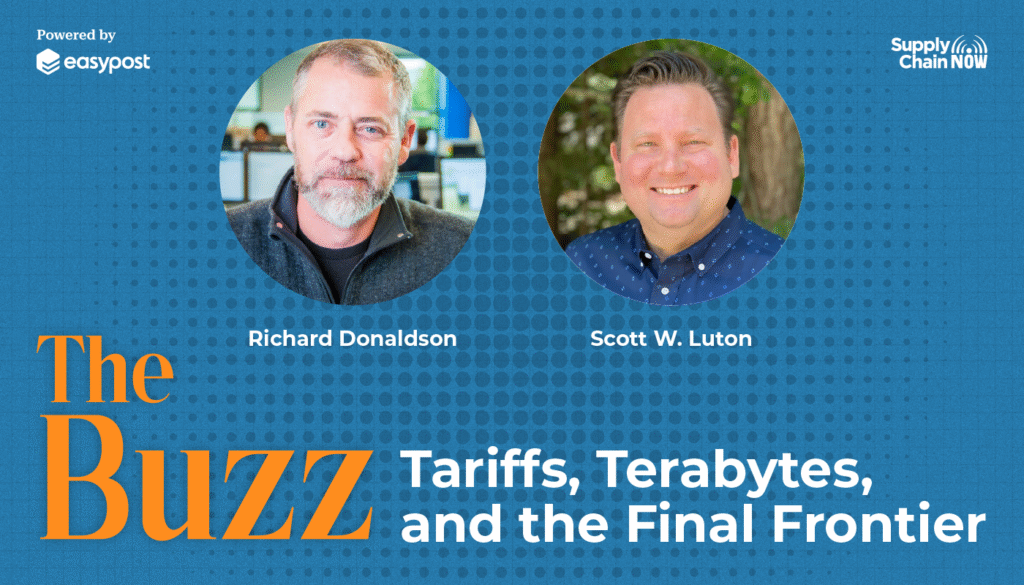
Hey, good morning, good afternoon, good evening, wherever you may be. Scott Lewton and Richard Donaldson here with you on supply chain now. Welcome to today’s live stream. Hey, Richard, how you doing today?
Richard Donaldson (00:24):
Good morning, Scott. Fabulous. It’s a Tuesday. It’s February, it’s 2026, and we’ve got a big year ahead of us and a big show and a big series, and it’s all about space.
Scott Luton (00:34):
That’s right. Big show, big day, big year, big series. Check, check, check. Folks, on today’s show, one more B. It’s all about the buzz where every Monday at 12 noon Eastern time, we discuss a variety of news and developments across global supply chain and business. News that matters is what we like to call it. And the buzz is powered by our friends at EasyPost who help make shipping easy, flexible, and scalable. Learn more about how you can simplify your shipping operations and delight your customers at easypost.com. Okay, Richard, first off, we got to keep it real folks. Y’all know you can trust us to keep things real. So the buzz is pre-recorded today, right? Because we’re out at Manifest right now. Really busy talking with folks, movers and shakers, interviewing some folks, but no worries. We’ll be back live next week. So we just wanted to put that out there.
(01:23):
But Richard, got a great show teed up. Let’s see here. We’re going to have a little extra dose of tech and space stuff. We’re going to be talking about the tentative US and India trade deal. We’re looking at the current data center footprint in the US. We’re going to have our Space Nerd update. Artemis two, SpaceX, data centers in space. I see that’s kind of like pigs in space. Oh, Muppet series.That’s like a little flashback. Yeah. We’re also going to take a look at CIO trends and keep an eye on in 2026. All that more. Richard, man, did you eat your wheaties this morning? Are you ready to go?
Richard Donaldson (01:56):
I’m jazzed already, man. Already about up at the air. Got a cup of cups of coffee in me. Ready to take flight.
Scott Luton (02:01):
That is right. I’ll tell you what, you operate around the clock, but folks, buckle up for a great edition of The Buzz powered by Easy Post right here today. Okay. So before we get into the news here on the Buzz, there’s three things I want to hit, Richard, and it’s going to take an interactive effort here. I’m going to be picking your brain a good bit here. So starting with food, chicken wings, hamburgers, pigs and blanket, you name it, talking about Super Bowl food. Now folks, again, we’re recording this before the Super Bowl. So we don’t even know the winner, but I bet it was a Seattle Seahawks is my hunch. But the game is really maybe the second most important thing, maybe the third after the commercials and the food. So Richard, real quick check-in. What is your go- to food-wise for Superbowl tailgating?
Richard Donaldson (02:47):
Okay. So you throw that out there and I’ll be dead honest, right? I’m a wing fanatic, right? Wings all day long. I eat them all … It doesn’t matter what day of you, 365. So Superbowl is just yet another excuse. So I don’t feel like that’s a fair answer. But I have a variation of pigs on a blanket where I take Pillsbury croissant dough that you find in the supermarket, use that as my blanket, take that out and roll up into it instead of traditional hotdogs, variations of chicken apple sausages,
Scott Luton (03:16):
Various
Richard Donaldson (03:16):
Mustards and various cheeses. And so it becomes kind of this croissantie kind of variation of pigs in a blanket. And that’s something I’ve been making for a long time for Super Bowls.
Scott Luton (03:27):
Man, I love it, Richard. I’m going to have to steal that recipe from you. But folks, whatever, whether you follow Richard’s lead or you have your own, we got to make food selections wisely because as you can see here from Retail Brew and Finance Buzz, they say that hosting a Super Bowl party is going to be 7.2% more expensive this year than last year. And get this a whopping 43.9% more expensive than in 2020. Gosh, chicken wings are almost up 25% on average year over year. So Richard, get ready. And veggie trays even up almost 20% year over year. So get ready and good luck to Seahawks and the Patriots, coast to coast. So number two, Richard, now that we’re starving, all I can think about is crispy, extra crispy chicken wings. Thank you so much, Richard. You too, of course. I’m excited to share a really cool initiative that Amanda and the team launched here at Supply Chain Now.
(04:19):
It is between the lines by supply chain now what we’re reading, thinking, and recommending. So this is a dedicated space for our community to share, exchange, reflect, and discuss. All folks are welcome, even if you aren’t a supply chain nerd like the rest of us are, right? In fact, we hope to have lots and lots of non-supply chain folks join us. In fact, I bet most of the books discussed and shared will have very little to do with global supply chain and that’s perfectly fine other than they all have one because you supply chain does touch everything. The first three recommendations are already in from Mary Kate, Tricia, and Amanda, and go check it out. We’re going to drop a link. You can go read those recommendations and add your own comments and all. And Richard, I got to ask you, my hunch is you’re a voracious reader.
(05:03):
What’s been one of your favorite recent reads?
Richard Donaldson (05:05):
Well, we’ve done this show a few times together, Scott, and my default is always to go back to my traditional science fiction. So my Isaac Asimovs were Robert Heinlands. But in fact, because we’re now talking about new, I did stumble into a new author his name’s Will White, W-I-G-H-T, and he wrote a series called The Cradle Series. And I really love reading fantasy, science fiction, The Habit, things like this. Well, this guy has got a spin. I’m just going to say it’s one of the most unique stories that I’ve read in quite some time where it doesn’t fall into any pattern that you would expect. I can’t even put terms to it. It’s sort of a soul, universal, possibly multiple dimensional science fiction. I mean, it’s so creative that when I started getting into it and then my brother, in all honesty, turned me onto it, I devoured, I think there’s like 13, 14 books in it and I think it plowed through them in about a month.
(05:58):
So it is Will White, it’s called the Cradle Series as in cradling and it is … I’ll leave it at that. If you dig it up, it’s fun, it’s unique. And it really, even in the context of kind of where we’re going, it’s a fresh perspective on, I guess, multidimensional science fiction/fantasy.
Scott Luton (06:18):
I like it. We need all the fresh perspective we can get. Richard, one question. What’s your brother’s name?
Richard Donaldson (06:23):
Chris.
Scott Luton (06:24):
Chris.
Richard Donaldson (06:24):
Yes. Chris Donaldson gets credit for that. So we’ll shout out to Chris Donaldson. He works at Cambria in Minnesota. So hey, there you go.
Scott Luton (06:32):
Outstanding. We’re going to have to add Chris and Richard to our list of reviewers. And folks, hey, this is a very collaborative, community driven thing. So come check out between the lines and of course we welcome your input. That’s going to be a lot of fun. Also, one more thing we welcome your participation in, National Supply Chain Day. Folks, it’s coming up April 29th. You may or may not know that Mary Kate, when she was at Georgia Pacific, she now serves as our fearless president here at Supply Chain Now. She’s the one that submitted the paperwork to create National Supply Chain Day while she was doing some really innovative things with GP. Well, ever since Mary Kate joined us, we’ve been looking to really reinvigorate and take National Supply Chain Day to all time new levels, most importantly because as incredible as the technology is in this golden age of global supply chain, hey, the people that make it happen every day, that’s a really big theme at what we’ve been doing now for years.
(07:26):
So come join us April 29th, 12 noon Eastern time as we have a slew of guests, keynote and lots of, lots of fun. So come check it out. Richard, do you have National Supply Chain Day circled in a red Sharpie on your calendar?
Richard Donaldson (07:40):
Well, Scott, you know how this works, man. I mean, we’ve all known each other for a long time and Mary Kate was actually my inspiration to launch International Supply Chain Day about 10, 12 years ago. And that sort of fizzled out a little bit, but I know I’ve even kicked over to Mary Kate, like you should take this nationally and internationally because at the end of the day, when we get back to space, it’s an international supply chain. It’s a global supply chain. That’s a unique perspective that I know she can bring into this. And she does amazing stuff. So absolutely.
Scott Luton (08:09):
No doubt. And every country should have a national supply chain day. I think we’ve talked about that before. So love Richard, we’re going to revisit that. No shortage of things going on. And folks, we hadn’t even gotten to work yet. We got to get down to some of the news stories here on the buzz powered by our friends at Easy Post. And we’re going to start with what I think maybe, Richard, is some good news. It might be tentative good news because all the details at the time of this recording haven’t come out. But the good news is, is that we evidently have a trade deal between the US and the great, wonderful, beautiful country of India. So based on social media reporting, I’m going to call it, mainly from the Oval Office, the US is, as part of the deal, is supposed to lower the country specific tariff rate from 25% to 18%.
(08:52):
The White House also reportedly agreed to remove an additional 25% tariff that it placed on India due to at the time its purchase of oil from Russia. President Trump has said that India has agreed to lower their tariffs as well as their non-tariff barriers for US imports all the way, he says to zero. We’ll see. And it’s also being reported that India has agreed to stop buying oil from Russia while agreeing to buy more than 500 billion in US products in areas such as coal, agriculture, energy, and technology. Again, none of this is official yet as of February 3rd, but we shall see. Richard, your thoughts on this tentative informal deal.
Richard Donaldson (09:31):
Well, as you kind of highlighted here, it sounds great. We’ll see how it plays out. We’re obviously going to, once this comes to live show, we’ll see the fruits of this labor. But I think in the context of number one, India purchasing oil now from the United States versus Russia, well, this is indicative of the overall global kind of geopolitical system that’s being restructured right now. So if you take in the beginning of the year, look at all these things as kind of dominoes, we’re resetting the stage or whether you like it or dislike it, Trump is resetting the stage through Marco Rubio and his efforts, both diplomatically and militarily. And you’re seeing even with the involvement we’ve had with Iran and destabilizing that area there, that’s going to yield some results. Well, that then cascades into the taking down of Maduro and Venezuela, allows a large major source of oil for a lot of these kind of nefarious countries.
(10:19):
That’s now yielding some results where we’re going to see it happen. This is yet another domino in that chain that’s happening where you’re going to see, I believe, the conclusion, which is reestablishing the global geopolitical spectrum to where it’s really kind of the United States. On one side, I think Europe has kind of become a little bit, not just secondary, almost tertiary, but India and China specifically, given their populations. And you’re looking at nearly half the world’s population of eight billion people contained between those two countries and China and India, they’re the major players. Russia is even tertiary at this point. Militarily, they can’t keep up. Their trade is all predicated on smoke and mirrors. And I think you’re starting to see all that really happening right now. And especially when you see countries that Russia’s living on its oil, that’s the only thing it’s really got in its back pocket.
(11:03):
And when major purchasers like India starts shifting over the United States, well, that just resets the whole stage. And I think that’s what you’re going to see over the next 12 to 18 months is that settling down and three major axes emerge.
Scott Luton (11:14):
Gosh, I wish my crystal ball was as smart as yours, Richard. Maybe I got to get some AI to inject in there.
Richard Donaldson (11:20):
That’s it is. I got AI in my year right now, sort of prompting me all that, right?
Scott Luton (11:24):
But Richard, very impressive. I really appreciate your outlook. And it really is fascinating. These global power or trade shifts tend not to take place as fast as, gosh, what we’ve seen the last 18 months, two years or so. And as you pointed out, I’m pretty sure the EU just had announced a trade deal with India in the last few weeks. Of course, we all saw the China and Canada trade relationship get rolled out. We’ll see where that goes. It is an interesting time full of geopolitical power shifts. So we’ll see how it plays out. But Richard, I tend to subscribe to your outlook there. Okay. Now we’re going to shift over, talk about a fast moving world to the world of data centers, the wide, busy world of data centers. Now, Richard, I stumbled across this on your LinkedIn feed, and I’m going to share this, what I thought was a pretty informative graphic.
(12:12):
This comes from Ben Walmsley over on LinkedIn. This is a map of US states and how many data centers was in each as of 2025. This may or may not surprise some folks. I bet it won’t surprise me the tech folks that Virginia leads the way with 665 data centers again as of last year. And you’ll see the note there, Ashburn, Virginia is a hotspot for all things tech. On the other side of the fence though, Vermont has three. That’s the fewest followed by Alaska with four. A little bit of a size disparity there. Even Rhode Island has more than double the count there in Vermont. And get this up. So Ben reports that almost 3,000 data centers are now under construction or being planned here in the US. Here in Georgia, you see we got 163, but at the end of the day, I guess it’s not really a race, Richard.
(13:02):
There’s lots of different opinions on data centers and where we build them. And it’s going to be really interesting to see that dynamic play out. But does anything related to these counts surprise you here or your thoughts here, Richard?
Richard Donaldson (13:14):
Yeah, nothing surprises me. And as you know, my background certainly coming up for 25 years in Silicon Valley was in data centers. So kind of played with all these people. I was part of some of these projects themselves. And if you look at that map carefully, what’s underneath it is the internet highway itself is where it exists. So those nexus points in California, San Francisco, Los Angeles, Dallas, Houston, our Phoenix, Dallas, Houston as you come across there, and then into Georgia, down to Florida, which then connects down to South America, up into Virginia, then back across Chicago, all the way back across to California, that loot is the internet broadband highway. It’s the biggest laying of the fiber that’s underneath the ground. So it’s not coincidental that these states are where these data centers have been deployed. And then you’re seeing these secondary and third markets develop just from the density of data centers in the primary data center locations.
(14:03):
Now the big change that’s happened, and then again, you nailed it. This isn’t about a race per se. If anything, it is just a capacity constraint. We need the data centers to run all of this digital stuff that we’re developing, AI, automation, airplanes, traffic, space, blah, blah, blah. However, the big game changer that I think, and we’re kind of getting to this is, this is still predicated on kind of fiber routes. Fiber being the primary way to move traffic around the world. So even the undersea cable system, you see the launch points. If you do look at this on a global basis, you’ll see it’s not coincidental that you have big data center builds with the Atlantic and Pacific routes, cable routes are laid. But the big game changer, the thing that throws us all out the window to some extent is space. If we now develop through Starlink SpaceX and continued broadband development that is as reliable, as secure as traditional fiber, which we will, then space itself decouples our land-based strategy.
(15:00):
And that will be the game changer of the next 20 years.
Scott Luton (15:02):
So hold that thought. I’m going to circle back, pull some more information there from you on that opportunity. So as we said, it’s not a race folks, but I got to point out, Richard, because you call Arizona home. If it was a race, Georgia with 163 and Arizona with 164, it’d be neck and neck.
Richard Donaldson (15:19):
That’s right. That’s right.
Scott Luton (15:20):
Well, side note though, as Richard can attest to, as you heard him there, he spent a ton of time in the data center space. Data center supply chain is big business. Meta recently announced an agreement with Corning is expected to be worth about $6 billion to support data center infrastructure build outs here in the US coming to a state near you. And another interesting supply chain topic here is many expect some extra pressure on the automotive industry in their efforts to protect their chip supply due to all the heightened demand from new data centers. Richard, your quick comment there.
Richard Donaldson (15:54):
So now you’re kind of touching on again, you need chips to drive a lot of this, whether it’s an automated vehicle, automated flying cars, which again, not to be too far out there, that’s coming. So if you look at the graphics chips and processors, and one of the reasons NVIDIA really kind of took over that market over Intel surpassed them because they emphasize the graphics processors, the GPUs about 20 years ago, 15 years ago. That is now what is driving most of the 3D kind of rendering. I mean, it’s games. It’s video games at the end of the day. So a 3D representation in a car, a plane or otherwise is using that heavy graphics processing unit. So this is really about chip constraints and where they’re being deployed and everything we build today, whether it’s a data center stacked with computers or a vehicle that’s stacked with a 3D processor that is making you save driving automatically for you, that’s all the same chip.
(16:44):
And so these chips now are being pulled into every facet of our, not only supply chain, but every fabric, the fabric of how we exist. And they’re cars, they’re in planes, they’re in future vehicles that we’re going to develop, they’re in boats, ships, blah, blah, blah, blah, blah. So what you’re really touching on here is where the chips are being pulled in all vertical markets where they once were sort of the domain of the computer IT market. That’s the big change right now.
Scott Luton (17:07):
Yeah, remarkable. Gosh, you can see it’s obvious that you did live a big chunk of your life in that space. Just a little bit. But that’s good. It’s a fascinating, high velocity, hour by hour, sometimes minute by minute update. So we’ll revisit soon. But hey, before we move into the data center potential and space and really our Space Nerd update, and I use that term very lovely because I’m a big space nerd, I want to share a quick message from our friends at EasyPost. Manifest. Folks, again, today is February 9th. I am right now at Manifest, which why we’re recording this. Lots of movers and shakers there. It’s been growing every year. And EasyPost is going to be on the ground having all sorts of real conversations, especially about AI. We invite you to join Lori Boyer and Tom Butts session that’s going to dive into how LLMs are changing the shipping game.
(17:57):
Then you can swing by their booth. Get this 777. How about that booth for booth number in Vegas? Go by booth 777, say hello, see what’s new. They got some cool giveaways. They won’t be giving away a data center, maybe not a Cadillac. But hey, some really cool stuff. Stop by, say hello to Lori, Tom, Kevin, and the gang booth 777. Okay, Richard, we are going to move into our Space Nerd update. We need another acronym, SNU. And again, folks, we’re not pointing fingers, lots of love, but I want to move to this topic of data centers in space. And I think I asked ChatGPT to give me a rendering of what that might look like. Yes. Now look at this, Richard. Really quick, before you talk about the potential, what’s the first thing that may be wrong about how ChatGPT envisions this? Any comments, sir?
Richard Donaldson (18:47):
Well, right off the gun, I mean, he’s looking at this, you kind of got these solar arrays. It’s a little dense. It’s too close to each other. I mean, it looks like more of a space station kind of thing. So
Scott Luton (18:57):
There’s
Richard Donaldson (18:57):
Not a lot of thinking inside some server racks and is it going to be open? Is it not going to be open? I mean, there’s a whole … Yeah, there’s a number of things pretty fast. But for a fun little rendering and to show you the potential of ChatGPT and any kind of AI, that’s kind of fun.
Scott Luton (19:11):
Yes. Oh, one more comment before I get you to weigh in on the possibility. When I saw this just this morning, I thought immediately about something you and I have talked about before, and that is the anti-collision technology that we’ve got to continue to develop and deploy up in low worth of orbit, what the right word is. And gosh, when you just see this vision, even if it isn’t right, that is the first thing that came to mind is how can we protect this massive trillion dollar investment of what the opportunity may require? Your quick thoughts there, Richard, and then tell us about the overall potential of what you see.
Richard Donaldson (19:44):
Yeah. Well, and again, this is a real thing. Now we’re talking about space development. We’re talking about a space supply chain, literally, right? So this is the first foray into our informational supply chain as we begin to build these out in the different orbits, so low, medium, higher earth orbits, understanding orbits, understanding space debris. I mean, forget just the junk of the stuff that we’ve shot up there. There’s the stuff that we don’t even know exists up there.You look at something like free eye Atlas, let’s not forget that just blew by the planet and we still don’t even know what that was at this point. I mean, we’re starting to, with this new field of vision, open up the aperture to the true infinite nature of space. And so as we begin to step up there, put our information highway up there, put our literal supply, true supply chains.
(20:29):
So feeding supplies to future astronauts and space travelers and back towards earth because this is a two-way supply chain. We’re going to want … I mean, you’ve seen there are discoveries where they’re saying there’s rocks made of full gold up there they find or full diamonds or pure water, natural water that’s sitting out there in space that they’ve identified. Well, how in the world are we going to get to that one? And then two, how does that return back to earth? So all of these things right off the gun is just that first step in. We’re going to screw up quite a bit as we normally would, as anybody would. I mean, if you look at any supply chain that’s built historically, we messed up a lot. That’s part of the adventure. People are going to be critical of that. That’s pretty normal. That’s what happens when you push the envelope, you’re an entrepreneur, you’re a discoverer.
(21:13):
Everyone looks at you with a little bit of like, “Oh my God, you can’t do that. ” Well, it’s happening, folks. And you can either get on board or not, and it’s going to lead in some discussions about some of the companies that are going to benefit from this like SpaceX and others. So it’s one of these things I look at that and I say, it’s kind of a fantasy view, but hey, if we built something like that and it works and it doesn’t work, at least we’re going to learn quite a bit from these first deployments.
Scott Luton (21:35):
Yes. So I got a quick follow-up question and then we’re going to give a quick update on Artemis two. You mentioned perhaps massive gold and diamonds and water up in space. How about maybe we can find massive minds of business certainty or humanity.
Richard Donaldson (21:51):
Okay. Okay. Now you’re getting into a very spiritual discussion, which I’m not sure. Yes, why open ourselves up to it? I’m with you, brother. Let’s make that happen.
Scott Luton (22:00):
So let me ask you a serious question. I’ll came aside. Seriously, based on what you know just today, and we know things are moving and especially in this era of the space exploration chapter, space supply chain, space business, if you had to give us a hard prediction, there’s a growing PR issue with some data centers. And we talked about this I think last time you joined us. You got some data centers who aim to make it like a gathering place to lessen some of the pushback from communities here on earth. How much potential do you think of shifting computing power, overall capacity to a space-based network versus what we have here? Initial thoughts there.
Richard Donaldson (22:39):
So I’m going to like it to another point that we’ve talked about before, which is the shift that we have in the global supply chain from linear to circular, and that kind of tease up new colleague that you’re bringing on the board to get into a lot of the circular topics. And we’re just in the middle of this decade, 2026, where this movement towards circular on planet earth to circularize our supply chain really just started in earnest about six years ago. And to your point, I wrote an article probably about seven, eight years ago calling this the decade of the circular supply chain. And we’re kind of on target right now. We’re kind of midway through, we’re doing all that. So I would then liken the same ratio to data center development on earth versus space-based. The 50 years, a hundred years from now, whatever, all things will be in space.
(23:24):
It just makes more sense. It doesn’t tax the planet as much. It doesn’t pull as much energy off the planet. It doesn’t require as many resources to maintain yada, yada, yada. I can do it on the list. And if we have connectivity down that’s secure and otherwise, why wouldn’t we want it floating around our earth? It’s safer, it’s easier, it’s more flexible, it’s more adaptable, it reaches everybody. So all of the check marks on how you want it … And by the way, free cooling, you’ve got potential unlimited energy sources up there that we don’t have to worry about anywhere down here. And which is the trend in data centers, both earth-based and space-based, is nuclear power.That’s common. That’s coming in full steam and all the data center operators are building new nuclear power generation, mini nuclear substations. Well, I don’t care as much if I have a nuclear power plant sitting at space and something goes wrong.
(24:08):
Well, okay, so what? So there’s just a lot of benefits to putting into the space. And so I think it’s the ratio of today we’re kind of like sub 1% space-based data centers versus 99.9% earth base. That ratio is going to shift over the next 25 years where I’m just putting a line in the sand. I think over the next 20 to 25 years, you’re going to get more fifty fifty.
Scott Luton (24:28):
Wow. Okay. I like it. I am writing this date down. It is February 3rd, 2026.
Richard Donaldson (24:36):
And you know how good predictions are, right? I mean, anyone can make one, but of course-
Scott Luton (24:39):
Hey, I’m just messing. I’m just messing up with you. Remember, I’m the guy that thought tariffs was only being used for negotiation purposes. So how crazy was I?
Intro/Outro (24:47):
Right, right.
Scott Luton (24:47):
Anyway, all right. So let’s keep going down this little quick space nerd update. The Artemis, this is so exciting. The launch of the Artemis is almost here, but as NBC News reports, at least today, we had a little setback yesterday, as I believe there was a hydrogen link, a leak during a test. So the launch window is being reported has been pushed back into March. So we got to wait a little bit longer before the exciting launch of Artemis two. But nevertheless, this is a monumental space campaign. Richard, and I’m not throwing stones at anybody, but I continue to, as I jump on podcasts and wear the green room, or if I have a cup of coffee out, I’m still amazed at how little awareness some folks are that aren’t as into space stuff as maybe me and you. There needs to be massive more awareness.
(25:34):
I mean, the ultimate goal of this campaign truly is establishing a permanent lunar base amongst other things. And despite all the long haul components related to space supply chain, which Richard touched on a couple times earlier, especially to supply, effectively supply in a safe manner, a lunar base, there’s tons of optimism around local sourcing options on the moon. Specifically, I think you mentioned this, Richard, there’s water ice. The scientists think there’s a ton of water ice that’s found on the moon’s south pole. So Richard, Artemis two, maybe we got to wait until March, but I’m glad that we’re taking the safe bets, right? Safe measures. Your thoughts here.
Richard Donaldson (26:17):
I think you hit them all, right? On the one hand, I wish our news cycles were more consumed with what this is, our exploration in space, Artemis, SpaceX, SpaceX IPO, which I know we’re going to talk about a little bit, but all the discoveries that we’re having, even 3I Atlas, right? Well, you and I have talked about that in previous shows, but here’s this giant object that no one really knows what it was. It did things that no one could really understand. All of our current knowledge doesn’t even touch this. It is truly the unknown, unknown. And to me and you right now, I mean, that feels like such a north star for humanity. What a rallying point for all of human beings to get out of this chaos that we seem to be in. And in defense of people, the news cycles are so fast and so tore it and things are changing so quickly right now.
(27:07):
It’s hard to keep up with just your daily life, much less all the chaos in the world and the rebalancing. You talked about India. I mean, we’re going through some growing pains right now. The structures that we’ve been used to post World War II are breaking down. That’s painful for the world and that’s painful for everyone’s kind of global psychology. So they’re kind of wrapped up in that. So I give some defense to it. But then just like you and I right now, I don’t understand why the media is not fanning the flame literally around these space rockets and space engines and space development because just like you and I talking to this, why can’t we look to the stars? I feel like, I mean, I didn’t live then, but I feel like this is what happened when Kennedy shot to the moon in the 60s.
(27:43):
It gave people something to really shoot for. Literally, it gave something to rally around, to be excited about, to kind of re-energize why we’re here. And to me, that feels almost existential in a development of humanity to get more attention to this because it is happening. It’s happening at a great pace. And honestly, as discoverers like, oh my God, we are stepping into the giant unknown, unknown. And you think we’re discovering stuff now. Wait, I mean, it’s going to be shocking what we run into, right? I mean, shocking.
Scott Luton (28:15):
No doubt. And what it will demand from our fellow supply chain- Everybody. Yeah, especially our supply chain management pros. Get ready. We’re adding a lot more chapters to the body of knowledge. And to touch on something you shared, made me think of when the fearless, incredible Apollo program
(28:32):
Came to a close for a variety of reasons, we won’t get into all that, but spending or PR or you name it, for a variety of reasons, all that knowledge got shelved and in many cases, sadly, it kind of disappeared and folks left the space industry and all this stuff, which is one of the biggest reasons why it took us so long to get back on the doorstep of lunar exploration. And the exciting thing about that, Richard, is assuming all this is successful is I think it’s here to stay. I think there’s a much bigger probability, especially where technology and other things are, that this truly opens up that chapter for good and then that becomes, and not to be too far out there, but that becomes a launching pad, no pun intended for what’s beyond the moon.
Richard Donaldson (29:16):
Mentioned this much before, but if you roll the clock back to when 1400s, 1492, when this guy, Chris Columbus, decided to step forth into what everyone thought was a flat world and sail out there.
Scott Luton (29:30):
Some people still do.
Richard Donaldson (29:31):
Right. Some people still do, fair enough, but we’ll see, what did that cascade into? Well, first of all, all the obstince and all the objection, “No, you can’t do this. No, it’s impossible.” He disproved that. Secondly, what that led to was, again, historically good and bad of this, but the East India Dutch Company, one of the most powerful conglomerates that basically ran the world that we still didn’t have sprinklings of those routes for the better part of four, or I guess 500 years, really, four or 500 years. So that’s what gave birth to the power of the net The kingdom. So we’re literally at that point in humanity’s expansion into space where we are the Christopher Columbus and maybe again, like or dislike Elon Musk is right there in that kind of first mover advantage, if you will. But we are at the precipice of developing companies that will make East India Dutch company look minuscule given the universal scale of what we’re stepping into.
(30:22):
I’ll
Scott Luton (30:22):
Tell you, exciting times, Richard, exciting times. So folks stick around and we’re going to keep our, for supply chain reasons and plenty of other reasons to see where Artemis two, when it launches and what lies ahead. Hey, really quick trivia fact toid. I found this out earlier. I’m a big mytholog was a big mythology fan as a kid. NASA chose the name Artemis for this ambitious campaign because Artemis is the Greek goddess of the moon and the twin sister of Apollo. So how cool is that? Little tip of the hat. Okay. So Richard, one last thing. Let’s see here. I believe CNBC is one of the many outlets reporting about a new SpaceX acquisition in the run up to the potential IPO. So I’d love to get between your technology and your investment finance and space passions. What do you see here?
Richard Donaldson (31:12):
Well, I mean, from an investment standpoint, I can’t wait. I’m bribing everyone I know to allow me early access to this IPO because this isn’t a question whether it’s already making money. It already has beyond the first mover advantage in this space. And to be blunt, I’ve misfired, no pun intended on a couple of the rocket companies that I thought were going to be right there, but it’s just too early. And I liken this back to investing in, I’ve been very long ever since my days in data center stocks. Well, investing in Equinix back in 2001 has done fairly well, I’ll be honest. And digital realty has done fairly well because these are the things that are going to persist throughout time. And this is where I kind of have a little bit of the Warren Buffet mentality, which is I only invest in things that I kind of understand even if it’s just fifty fifty, but it’s not speculative to me.
(32:03):
And I also look for longevity, things I can hold onto for 20, 30, 40, 50 years that aren’t going anywhere. SpaceX is hands down one of those unique opportunities. I mean, they are kind of the East India Dutch company that I’m referencing as of right now. They have the potential. They already are the biggest space explorer, the biggest space supply chain company. They’re providing connectivity. So the pillars of transport, information and transportation, if you take those three pillars as kind of our way to move into these things, they already own almost all three. And so there’s no … The seconds and the thirds haven’t even gotten to where they are yet. Blue Origin, everybody else is playing different games. Elon is playing, I don’t know what it’s go, 5G checkers, chess, whatever. I mean, he’s at a just different level. So the SpaceX IPO, not only I think it provides an incredible financial opportunity for people, but back to our point about visibility.
(32:56):
You get something like that out there as an IPO. Now all of a sudden there’s a bunch of businesses. I mean, let’s be honest, right? I mean, businesses are always looking for new opportunities. This is it. If you can get in on this game now at this ground level, oh my God, the upside is literally limitless. So I think it’s going to be a domino for the whole space, financial opportunities to become more relevant to people. And then when that happens, that’s when people start paying a lot of attention.
Scott Luton (33:21):
Love it. And with that comes many, many things, good things. Richard, good stuff. We’re going to keep an eye on SpaceX amongst many other space related things. All right. We got to get boring now. We got to bring it back down to earth, back down to the blue marble. Kidding, of course, only kidding. Well, look at what many CIOs are going to be prioritizing here on earth in 2026. And folks, I know this is not our typical addition of the buzz. We’re all out there with space and a lot of technology here today, but gosh, in this era of global supply chain, it’s all so interconnected. So bear with us here. I want to talk about this great article from CIO Dive, and they list four trends that CIOs will be challenged by this year. Richard, I’m going to share all four to get your reaction.
(34:09):
Number one, of course, we all know Agentic AI technology has taken a big step forward, but many organizations are going to need to implement a skills progression roadmap, as the article suggests, to figure out how to move effectively from human-driven to agent-driven processes and which processes. Number two, rescaling of the human workforce, of course, to better leverage AI. That’s been around for a long time, right? Number three, AI regulation efforts, and not necessarily at the federal government level globally, but even here in the various states which continue to move on here in the US. And then four, only more upward pressure on CIOs to return more on technology investment and not just AI, including the timeless challenge on the effective utilization of troves and troves of growing organizational data. Again, these are old but new themes, right? Both. Now, in the article, Heller Search SEO, Martha Heller said this in article, quote, “If you don’t get your data right, do you remember Radio Shack?
(35:08):
Do you remember Blockbuster? I think we’re going to see the have and the have not divide.” Richard, these priorities aren’t breaking new ground per se, but I would argue that we’re seeing new twists and new aspects of these challenges that CIOs and their teams are going to be tasked with. Your thoughts?
Richard Donaldson (35:29):
Yeah. And I think you hit them, right? I mean, these are the constant kind of interrogation of new technology. So if we go back even to the internet itself, at first everyone panned the internet, “Oh, it’s a fad, blah, blah, blah.” And you see how that turned out. AI is the internet, well, it’s different. It’s different technology, but it’s as fundamentally life changing, company changing, people changing, humanity changing, and we’re just beginning to understand it. So at the CIO level, I think, like you just said, even understanding how to use it. So that’s the training aspect of it. One of the things about AI and its limitation to say in my own experimentation with it quite a bit is that like any data system, garbage in, garbage out. So one of the keys to fundamentally using AI when you pull it, ChatGPT or whatever your choice is, is articulating a very thorough question that’s an accurate question.
(36:21):
It will spit back a very thorough, accurate response. If you have a biased question, it’s going to spit back a biased answer. That’s one of the fundamental things that you have to understand when using AI is it still seems almost sentient. It’s frighteningly sentient, right? But honestly, it’s kind of more of a reflection of you and what you are trying to pose. That’s a hard thing to fully understand because you’re not sure how to treat it. So just the training aspect of it. And then I’m going to tell you right now too, the flexibility that it has even currently is so pervasive. So whether it’s you want to have a relational dialogue at a therapist level, whether you want to have a business dialogue with finances and prepare spreadsheets. I mean, now the CFO can go to AI and say, “Okay, get all the corporate data relative to our last year’s financials and prepare and file my 10K or something like that.
(37:10):
” It can do that literally at those commands. So that even automation freeing up skills, like for some people that’ll scare people from, “Oh, my job’s going away.” Well, no, your job’s just changing. And so that’s another thing that CIOs are going to have to adapt with is modify their workforce in a way that takes advantage of AI, but also doesn’t artificially maintain legacy systems or processes that are actually very expensive and cumbersome. So there’s a lot to learn, a lot to do. And I think these are the kind of, again, kind of initial growing pains or realizations or epiphanies. And CIOs have got a lot of work in front of them because beyond the internet, I would argue that AI is arguably even more important than the internet itself because it is a business human being humanity amplification tool. And if you think of it in those terms, it’s as good as we make it and it just only buoys us up even more.
Scott Luton (38:07):
Well said, well said. And it’s only as bad as we make it or not make it.
Richard Donaldson (38:12):
Exactly, exactly. Exactly the point. Exactly the point.
Scott Luton (38:15):
So folks, send your CIO a box of cookies and maybe a nice bottle of wine. They got a tough year ahead of them for sure. And especially when they’re fighting for budgets, they’re fighting for people and they’re probably going to, like most, going to have to do less with more while the importance of what they do only rises. So we’ll see. Okay. Man, Richard, where did this hour go? Man, we’ve been having too much fun. But I want to share a couple resources, folks, as we like to do as we start to wrap this edition of the buzz. And I’m going to start with folks, visit our upcoming live programming page on the new supplychainnow.com. You’re going to see the latest live streams and webinars, probably the own demand versions as well as the new ones. And the new ones are important because we invite you to come out and share your perspective.
(39:05):
We’d love to see the comments and we’d like to celebrate great things you add to our live programming. So check that out. Secondly, we’ve been really busy building out our resource hub on our site at supplychainnow.com. You’re going to find white papers, news, ebooks, blogs such as this great one from Deborah Dolewich just came out in last week or two, which is really focused on the critical need for a lot more education in the reverse logistics and returns management space. Look at here, Deborah Dole, Tony Sheroda, and Rich Bolger. All in one shot, Richard. That’s quite a trinity of reverse logistics and circularity thinking. You’re also going to find our written interviews with folks out at events such as the Gartner Supply Chain Planning Summit last December in Denver. Got a slew of interviews there. Check it out. We’re dropping a link to that resource hub right there in the chat.
(39:50):
Richard, you were already up in the air this morning because you’re a certified pilot and I bet you’ll be back up in the air this afternoon, but in between those flights, in between your podcasts, in between keynotes, other things you do, how can folks connect with Richard Donaldson?
Richard Donaldson (40:06):
Easy peasy, breezy. On LinkedIn’s the best place to go and network there quite a bit. Socially, I’m pretty accessible on Facebook or Instagram if they choose that kind of more social side of things. But in LinkedIn for this audience, usually the best place to find me, I’m usually posting there kind of articles, probably going to get a little bit more intense this year, especially as we start doing more conversations around space and data centers and exploration and supply chain.
Scott Luton (40:28):
Outstanding. I can’t wait. I cannot wait. 2026 is going to be a great year on so many fronts and we’re going to break through this. I can’t remember the word you used. It wasn’t malaise. It’s a challenging time for a lot of folks. There’s a lot of friction out there and we want to acknowledge that. But hey, I’m also a glass half full because there’s also a ton on the other side of innovation and opportunity. And that’s where I like to spend most of my space between the ears thinking and doing. So anyway, big thanks, my esteemed co-host, Richard Donaldson. Richard, always a pleasure of my friend. Always a pleasure, Scott. Big thanks to our friends at EasyPost who are powering the buzz again all month long in February. They’re doing some really cool things, helping to make shipping easy, flexible, and scalable. Learn more at easypost.com.
(41:11):
Big thanks to Amanda and Trisha behind the scenes. And most importantly, big thanks to our global audience out there, our SCM global fan for being here with us. All the feedback we get. Thank you very much. But we’ll take the feedback, but I got one piece of feedback for everybody out there, one piece of homework. You got to take … Richard shared a lot of good stuff. I’ve got 12 pages of notes today, right? On data centers and space and investment opportunities. And of course, supply chain. Take one thing you heard here from Richard here today. Do something with it. Put it into practice deeds, not words, don’t waste the opportunity because they do abound. So with all that said on behalf of the entire supply chain now team, Scott Luten challenging you do good. Get forward. Be the change. Be part of the answer, folks.
(41:50):
Be the change that’s needed. And we’ll see you next time right back here on Supply Chain Now. Thanks everybody.
Intro/Outro (41:56):
Join the Supply Chain Now community for more supply chain perspectives, news and innovation. Check out supplychainnow.com. Subscribe to Supply Chain now on YouTube and follow and listen to Supply Chain Now wherever you get your podcasts.