

More
October 15, 2020
This Week on Supply Chain Now: October 12th – 16th
It’s been an exciting week here at Supply Chain Now! Catch up on all the latest episodes, interviews, conversations, and livestreams right here for all the hottest supply chain news! On Saturday, Scott and Greg welcomed Eric Johnson with JOC & Enrique Alvarez with Vector Global Logistics to the podcast! On Monday, Scott and Greg spotlight one of the strategic sponsor partners of the AIAG Supply Chain Summit, Surgere, as they welcome Robert Fink and Katie Lewis to the show. On Tuesday’s podcast episode, Scott & Greg welcomed Alex Pradhan, Product Strategy Leader with John Galt Solutions, to discuss the top three lessons learned in 2020 from a supply chain planning perspective. On Wednesday, Scott and Greg hosted the Supply Chain Buzz where they dove into the boom in warehouse employment, sustainability shifts within the business environment, and other hot supply chain news! On TECHquila Sunrise this Thursday, Jason Perez, CEO and founder of YARDZ, joined Greg White to talk about how he found the will and the skill to succeed in supply chain tech against all odds. And we wrapped up the week with JP Wiggins of 3Gtms and Kara…
supply chain planning
January 7, 2026
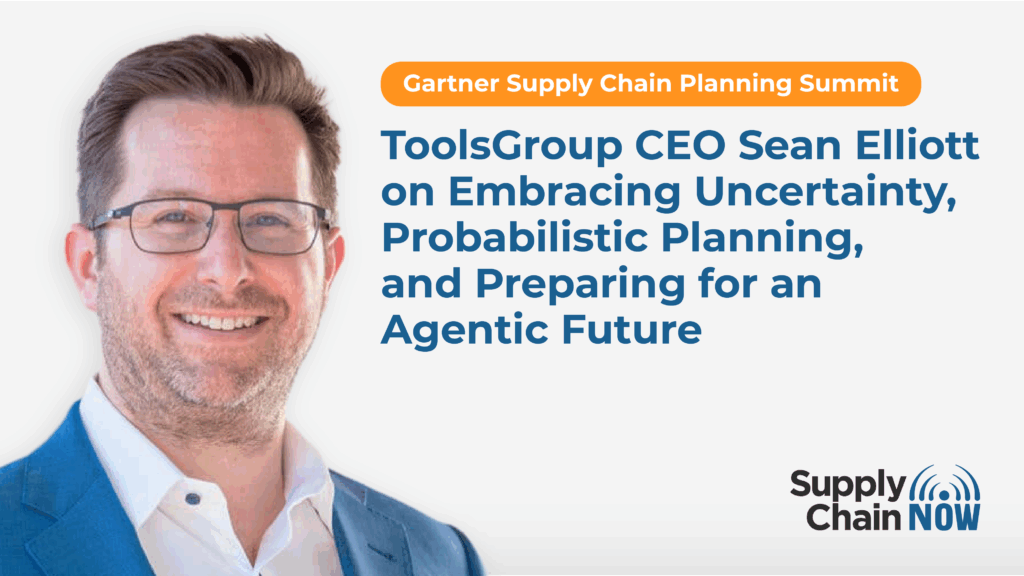
ToolsGroup CEO Sean Elliott on Embracing Uncertainty, Probabilistic Planning, and Preparing for an Agentic Future
At the Gartner Supply Chain Planning Summit in Denver, Scott Luton sat down with Sean Elliott, CEO of ToolsGroup, to discuss why uncertainty is no longer something supply chain leaders should fear—and how the right technology can turn volatility into advantage. Elliott brings decades of experience across supply chain execution and planning, a background that shapes his pragmatic leadership philosophy. As he noted, bad plans can cripple even the best execution environments, just as poor execution can undermine well-crafted plans. ToolsGroup’s mission sits squarely at that intersection. What Makes ToolsGroup Different Elliott described ToolsGroup as one of the few truly probabilistic planning providers in the market. While many vendors claim probabilistic capabilities, most stop at probabilistic forecasting. ToolsGroup goes further by embedding probabilistic thinking across the full breadth of its planning technology. The company’s belief is simple but powerful: uncertainty is not the enemy—it’s an asset. Rather than chasing forecast accuracy for its own sake, ToolsGroup focuses on business outcomes. What planning organizations really care about, Elliott argued, is having the right inventory in the right place at the right time to satisfy customers. Customer satisfaction—driven by availability, pricing, and service—is the ultimate goal. Probabilistic planning enables organizations to…