
More
human factor in supply chain
March 4, 2026
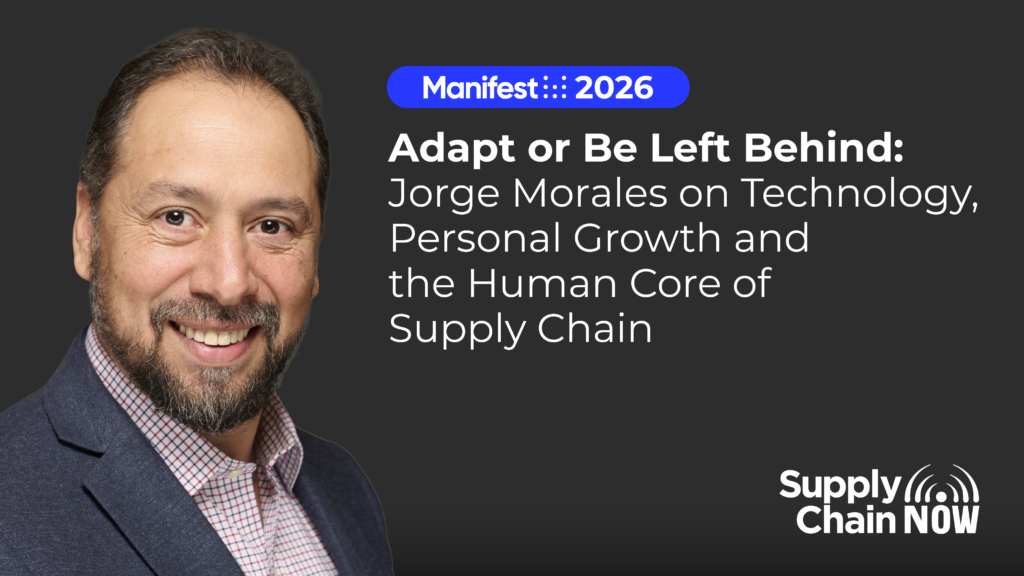
Adapt or Be Left Behind: Jorge Morales on Technology, Personal Growth and the Human Core of Supply Chain
At Manifest 2026, Scott Luton spent time with his friend, Jorge Morales, Global Chief Operating Officer of the International Supply Chain Education Alliance (ISCEA), for a conversation that centered not on hype, but on growth. ISCEA is a global certification body serving supply chain professionals around the world. But as Morales put it, “We’re in the knowledge business; but most of all, we’re in the personal growth business.” Through certifications, membership programs, advisory boards, and global events, ISCEA empowers professionals to stay current, expand their networks, and advance their careers. In a volatile era, that mission has never been more relevant. Beyond the AI Hype Cycle When asked about dominant themes from 2025 to 2026, Morales pointed to a shift in how the industry views technology. “Last year we were still in the bubble of the hype of AI,” he said. Many professionals feared being replaced or assumed AI would solve everything overnight. That perspective has matured. “Technology by itself is not what determines your level of success,” Morales explained. “Understanding the basics, knowing how things work; THAT is key.” AI and data tools remain critical across procurement, logistics, manufacturing, planning and more. But success depends on how organizations…
circular supply chain
April 10, 2026
Critical Mass: Inside the Coalition Building America’s Circular Supply Chain
written by Deborah Dull, on site at GreenBiz 2026 It started over drinks, 80s music, and a shared frustration that has probably launched more good organizations than any strategic planning process ever has. The Circular Supply Chain Coalition, or CSCC, came out of a realization that a lot of the right work was already happening, in reverse logistics, in remanufacturing, in local procurement, in community-based value chains, but nobody had connected it. The people doing the work were not in the same room. The companies with the materials were not talking to the processors who could recover them. The states with enabling policies were not linked to the investors looking for exactly those environments. So the coalition became, as its founders describe it, a collector of collectors. The focus right now is on three priority waste streams: batteries, semiconductors, and e-waste. These were not chosen randomly. They have two elements in common. They carry geopolitical consequence, meaning the supply chains behind them are controlled by other countries and that is a known vulnerability. And they have business cases that a CFO can actually evaluate. That second part matters more than people in the sustainability world usually admit. The hub…