

More
shippers
November 2, 2021
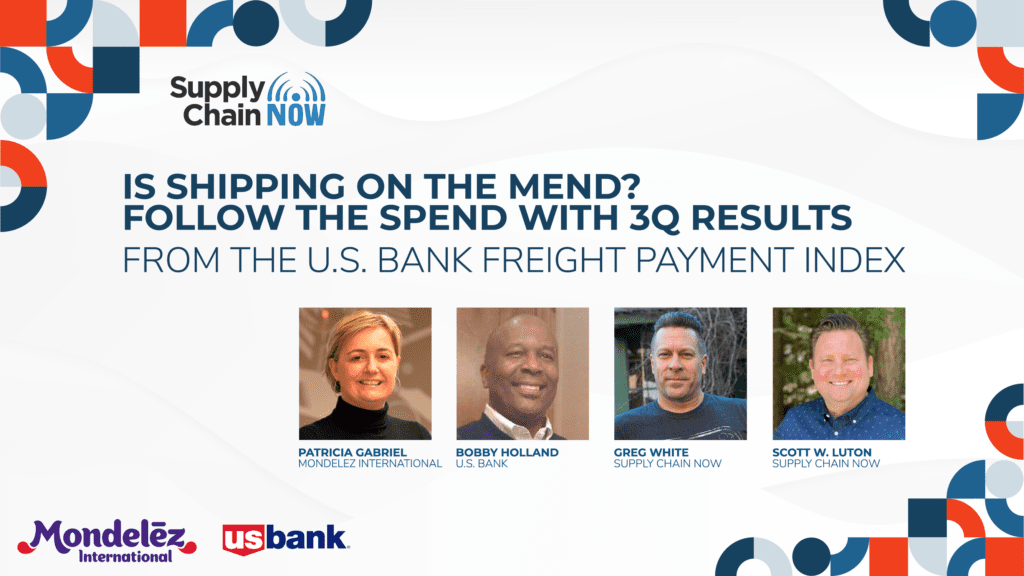
Is Shipping on the Mend? Follow the Spend with 3Q Results from the U.S. Bank Freight Payment Index
The U.S. Bank Freight Payment Index for 3Q 2021 has been released, and one thing remains clear: spend is up. More specifically, year over year, quarterly freight spend showed the second largest increase ever – rising 32.6% from 3Q 2020. What’s driving the dollars, and what can this increase tell us about the state of the supply chain across the country? Supply Chain Now co-hosts Scott Luton and Greg White recently sat down with Bobby Holland, Director, Freight Data Solutions at U.S. Bank, and Patricia Gabriel, Vice President US Customer Service & Logistics, at Mondelez International, to find out. Let’s review highlights from their discussion of the report – and take a look at what you need to consider moving forward. But first, what is the U.S. Bank Freight Payment Index? The U.S. Bank Freight Payment Index is a free report you can download each quarter to keep your finger on the pulse of freight shipping volumes and spend from both a national and regional perspective. The report uses actual transaction payment data, de-seasonalized and calendar adjusted for maximum comparability. How do I use it? When you’re asking the question, “What happened last quarter?” the U.S. Bank Freight Payment Index…
May 15, 2020
This Week in Supply Chain Now: May 9th-15th
Another great week here at Supply Chain Now! Have you listened to all the episodes? If not, no worries! Check them all out here: We added a special Saturday episode on May 9th and featured another speaker from the 2020 AIAG CR Summit, Eric Kane with Bloomberg, and his insights from the conference. On Monday, we continued our Supply Chain Super Trends series with Sarah Barnes-Humphrey with Let’s Talk Supply Chain. Supply Chain Super Trend #3 focused on a holistic approach to supply chain TALENT. Mike Griswold with Gartner joined us for another excellent livestream last week, and we published it as a podcast episode on Tuesday. He shared his latest observations on how COVID-19 is impacting global supply chains. A MUST-listen! We continued our interviews with the speakers from the AIAG CR Summit on Wednesday, with great insights from Dr. Assheton Carter with TDI Sustainability. Thursday we published our popular Supply Chain Buzz, with Scott and Greg sharing and discussing the latest news and events in Supply Chain and beyond. And on Friday, we wrapped up the interviews with the extrordinary speakers from the AIAG CR Summit, with Brian Rich…