

More

August 3, 2021
This Week In Supply Chain Now: July 26th – 30th
Stay up to date on all the latest conversations, interviews, and episodes we released this week here at Supply Chain Now. On Monday, we released 2 new episodes! On this episode of Digital Transformers, Kevin L. Jackson discusses how Enterprise Information Management Transforms with Mark Judson. On This Week in Business History, Scott Luton shares about 10 Cities with Business Ties You Didn’t Know! On Tuesday, we released an episode of TEKTOK with host, Karin Bursa. She was accompanied by Scott Luton and supply chain pioneer, Art Mesher. On Tuesday we also released an episode of TECHquila Sunrise with host Greg White and special guest Shannon Vaillancourt, CEO of Ratelinx. On Wednesday we released Supply Chain Today and Tomorrow hosted by Scott Luton and Greg White with special guest Mike Griswold from Gartner. On Thursday, we released a replay of the Supply Chain Buzz. In this episode, hosts Greg White and Scott Luton welcomed Jordon White from Crisp and Jerry Stephens from Outlier to discuss the current state of the food and retail supply chain. We ended the week on Friday with 2 episodes! We released another Dial P for Procurement episode! Hosts Kelly Barner and Scott Luton welcomed special…
fulfillment automation
February 20, 2026
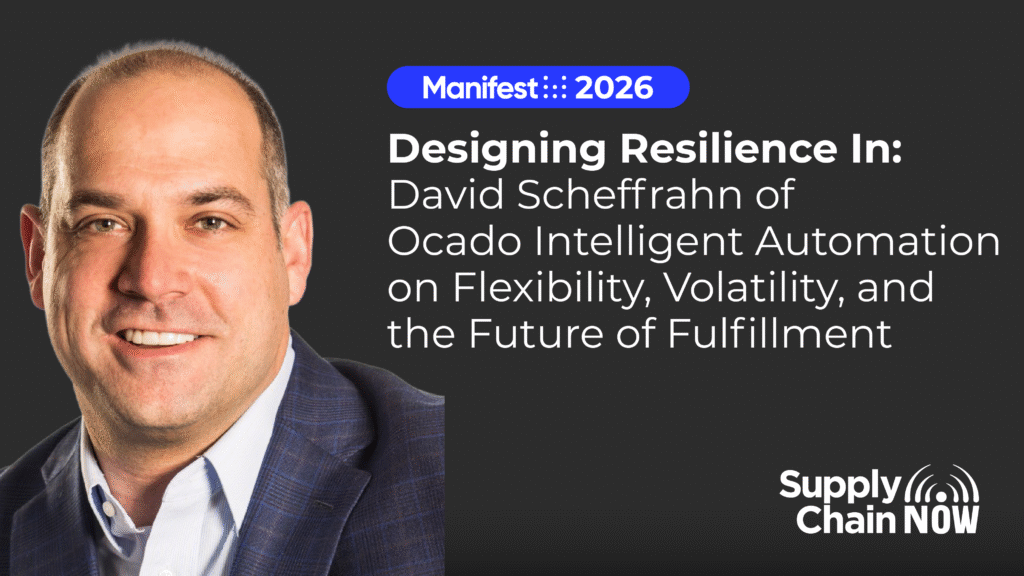
Designing Resilience In: David Scheffrahn of Ocado Intelligent Automation on Flexibility, Volatility, and the Future of Fulfillment
From Grocery Innovator to Global Tech Enabler At Manifest 2026, Scott Luton spent time with David Scheffrahn, Vice President of Sales with Ocado Intelligent Automation, to explore how fulfillment technology is evolving in an era defined by volatility. While Ocado is widely known in the UK and Europe for its e-commerce grocery leadership, Scheffrahn explained that the company’s North American focus is different. Over 25 years of building its own advanced grocery e-commerce and fulfillment operations, Ocado developed a powerful technology stack to drive efficiency. “What we’ve done in the last five years,” he shared, “has taken the tech stack that we built for our own use, and now we’re offering it to other companies to buy and use for their operations.” Today, Ocado supports 3PLs and global brands with end-to-end automation solutions that enable companies to maintain greater control over their omnichannel fulfillment, especially those looking for alternatives to marketplace giants. Volatility Hasn’t Gone Away When asked about dominant supply chain themes heading into 2026, Scheffrahn was direct: “Volatility has not gone away.” He described 2025 as “a massive shock in the system,” with tariffs and shifting trade policies forcing customers to pause projects and reassess strategy. “Almost…