
More
regulations
November 5, 2025
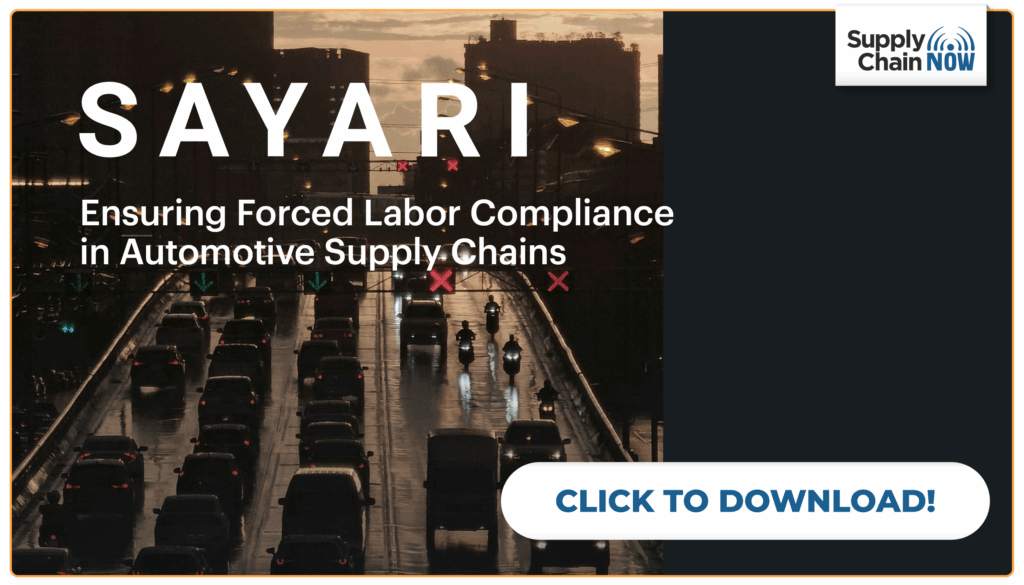
Ensuring Forced Labor Compliance in Automotive Supply Chains
Turn data into insight – map, monitor, and mitigate fortced labor risks across your value chain. Since the Uyghur Forced Labor Prevention Act (UFLPA) went into effect in 2022, sub-tier supply chain visibility has become an increasingly critical and ubiquitous prerequisite for import compliance. Automotive companies, due in no small part to their highly complex supply chains, are among the hardest hit by this requirement of anti-forced labor and ESG regulations. A recent study by Sayari analysts found that 95% of leading OEMs’ exposure to forced labor risk comes from sub-tier suppliers. The ability to identify and mitigate risks throughout their value chains is critical for OEMs aiming to minimize operational disruptions, avoid detentions, and maintain competitive advantage. Download the report to learn how Sayari is overcoming barriers to supply chain visibility, enabling OEMs to map their sub-tier supply chains, identify indirect exposure to forced labor risk, and foster greater supply chain resilience in an increasingly dynamic trade landscape. DOWNLOAD NOW
planning
April 22, 2026
From Planning to Decision Making
Supply chains are more volatile and interconnected than ever, but many planning processes still rely on disconnected systems, manual analysis, and spreadsheet-based interventions. This white paper explores how network optimization, supported by advances in optimization technology, workflow design, cloud computing, and AI, can help planning teams evaluate cross-functional trade-offs, respond faster to change, and move from static plans to continuous, decision-driven supply chain planning. Inside the White Paper: – Why traditional planning systems and network optimization evolved separately, and why that separation limits decision quality in today’s supply chains. – How network optimization helps evaluate cross-functional trade-offs across sourcing, production, inventory, transportation, fulfillment, service, cost, and capacity. – Why continuous network optimization is different from one-time strategic modeling, and how it can support recurring tactical and operational planning decisions. – How AI and configurable workflows can make optimization more usable for planners without requiring them to become modeling experts. – How planning systems and network optimization can work together in a feedback loop that improves decisions over time. Click here to download