

More
supply chain decision velocity
February 17, 2026
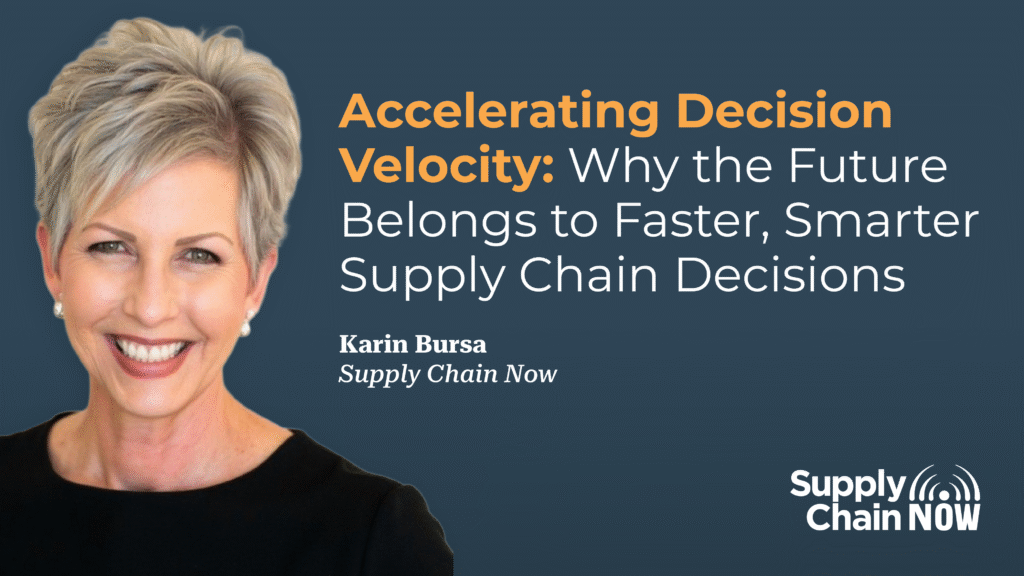
Accelerating Decision Velocity: Why the Future Belongs to Faster, Smarter Supply Chain Decisions
Special Guest Blog Post written by Karin Bursa, Supply Chain Industry Advisor and Supply Chain Now Host Here is a diagnostic question I use with supply chain leaders: when disruption hits, do your teams spend most of their time debating the data, debating the scenarios, debating the plan, or debating the decision? Or all of the above? Seriously though, in 2026, that distinction matters. Network shifts driven by tariffs, geopolitics, cost pressure, and sustainability are accelerating. Gartner’s 2025 U.S. Trade and Immigration Policy Survey indicate 77% of respondents selected network changes among their top actions in response to tariff impacts. [2] If the physical network is moving, the digital planning platform must move even faster. The environment is forcing decisions to be made faster, more frequently, and with more variables than ever before. Gartner says supply chain decisions are becoming 71% more complex, happening 52% more frequently, and need to be made 57% faster. That triple constraint cannot be accomplished with cadence-based batch planning cycles as a default operating model. This is why I am focused on a single, practical outcome for supply chain teams: accelerating decision velocity. The ability to move from data to insights to actions faster…
AI-powered supply chain solutions
March 5, 2026
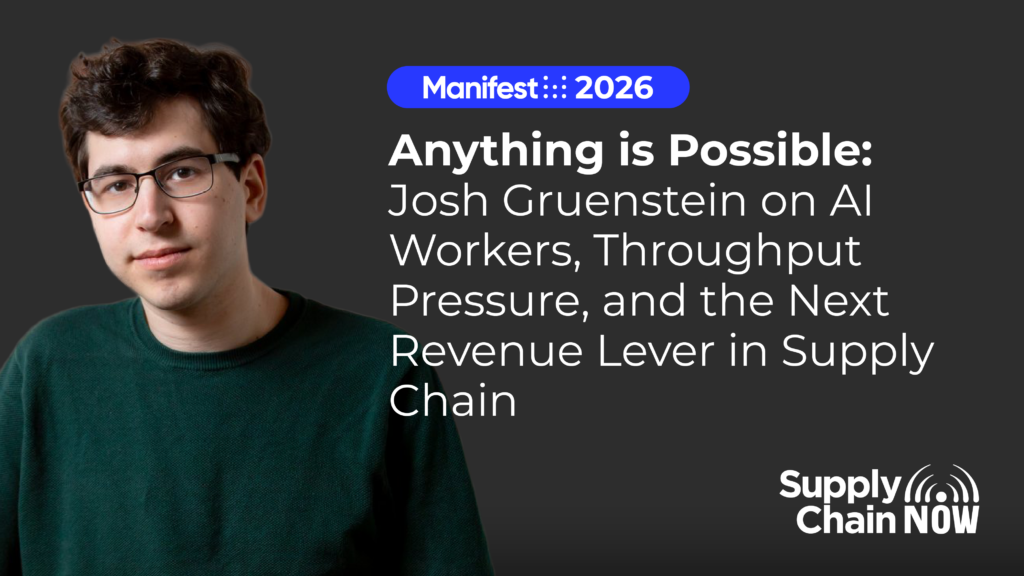
Anything is Possible: Josh Gruenstein on AI Workers, Throughput Pressure, and the Next Revenue Lever in Supply Chain
At Manifest 2026, Scott Luton spent time with Josh Gruenstein, Co-Founder and CEO of Tutor Intelligence, to talk about a future that’s no longer theoretical: AI-powered robot workers operating inside America’s warehouses and factories. And this isn’t a science experiment. It’s already happening. From MIT to the Warehouse Floor Gruenstein and his team came out of MIT’s Computer Science and AI Lab with a bold idea: build AI-powered robot workers that can handle the manual labor people don’t want to do. “We build physical robots,” Gruenstein explained. “We build AI models that enable robots to perceive their environments, and then we deploy those robots into factories and warehouses across the United States to do manual labor that people don’t want to do.” Unlike traditional automation projects that require massive capital outlays, Tutor Intelligence operates on a robots-as-a-service model. Companies can engage a Tutor robot for roughly $14–$18 an hour, creating a flexible, scalable path to automation without multimillion-dollar implementation risk. Automation Isn’t New. AI Is Changing the Playbook. When asked about dominant supply chain themes, Gruenstein pointed to a constant drumbeat: automation. But 2026 feels different. “Automation is obviously a constant theme,” he said. “What really seems different…