

More
supply chain planning
January 16, 2026
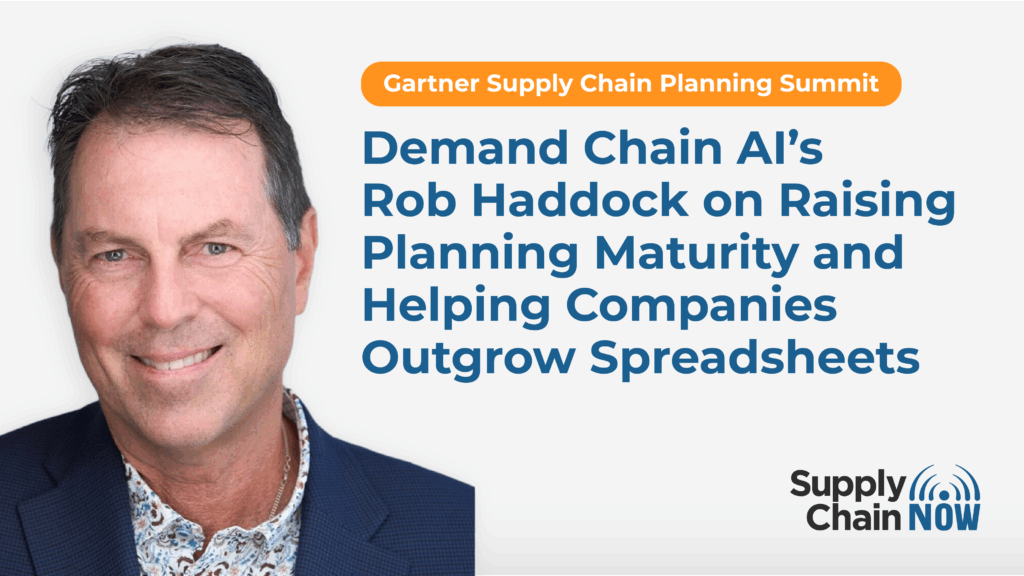
Demand Chain AI’s Rob Haddock on Raising Planning Maturity and Helping Companies Outgrow Spreadsheets
At the Gartner Supply Chain Planning Summit in Denver, Scott Luton caught up with Rob Haddock, a seasoned supply chain practitioner and advisor with Demand Chain AI, to discuss the persistent planning challenges organizations face—and why maturity, discipline, and optimization still matter more than buzzwords. Demand Chain AI blends consulting services with advanced supply chain technologies, focusing on optimization across trade promotion management, demand sensing, supply planning, and detailed production scheduling. Haddock’s role centers on helping organizations strengthen business processes—particularly sales and operations planning (S&OP), performance reporting, and the practical application of technology to improve execution on both the demand and supply sides. A Practitioner’s Perspective on Planning Gaps Haddock’s perspective is shaped by decades spent inside large, sophisticated supply chain organizations. Early in his career, he worked within an iconic, global beverage company where advanced planning environments were already in place—though, in hindsight, he admits those tools were sometimes underutilized. Today, Haddock spends much of his time working with small and mid-sized organizations that haven’t been as fortunate. In many of these environments, planning maturity is still low, foundational practices are missing, and—unsurprisingly—Excel remains the primary planning tool. “Basic business practices that have been around since the 1990s…

supply chain
September 18, 2025
Freight Audit & Payment: The Anchor for Supply Chains in Turbulent Times
Special Guest Blog Post written by Bart A. De Muynck The past few years have exposed just how fragile our supply chains can be. From tariff shocks to pandemic disruptions, from inflationary pressures to mounting parcel surcharges, the landscape has shifted beneath our feet. Companies that once managed logistics as a back-office function are now grappling with its role as a front-line business risk. What’s often missed in this conversation is the role of freight audit and payment (FAP). Long considered a tactical necessity, FAP has quietly become a strategic imperative. And as I explored in the Better Supply Chains Market Radar: Freight Audit & Payment, the companies that treat it that way are the ones best equipped to weather today’s volatility. Why FAP Has Become Mission-Critical When tariffs can add 15–20% to input costs almost overnight, or when the elimination of the U.S. de minimis exemption threatens to reshape cross-border e-commerce, companies need more than visibility. They need real-time intelligence and agility. Traditional FAP approaches—manual audits, siloed spreadsheets, reactive error correction—are no longer sufficient. Modern FAP platforms, powered by AI and advanced analytics, enable shippers to: Audit with precision at scale, uncovering hidden…