

More
foundational industries investment
February 23, 2026
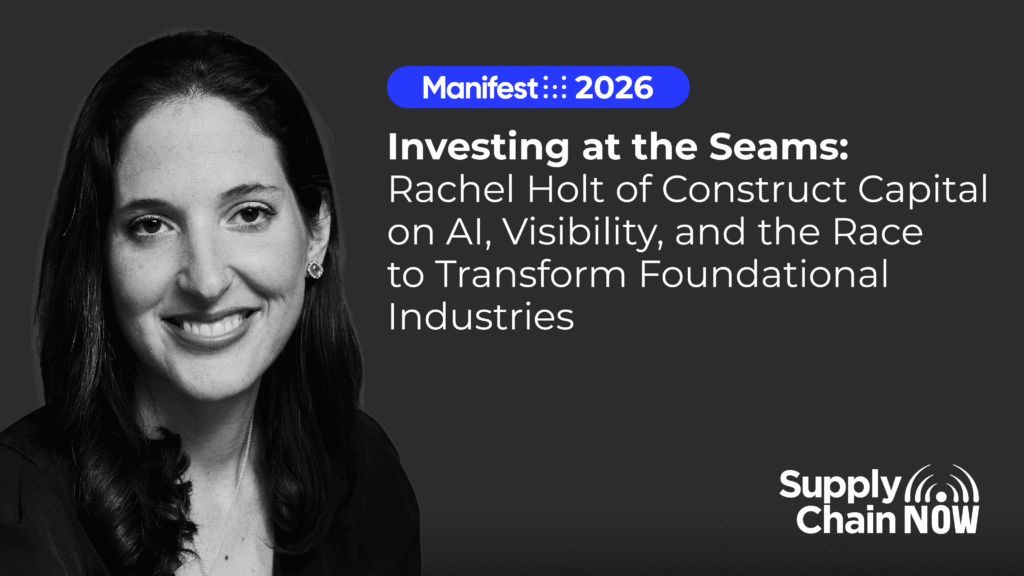
Investing at the Seams: Rachel Holt of Construct Capital on AI, Visibility, and the Race to Transform Foundational Industries
From Uber to Foundational Industries At Manifest 2026, Scott Luton sat down with Rachel Holt, Co-Founder and Managing Partner of Construct Capital, to explore how venture capital is fueling the next era of supply chain innovation. Construct Capital, now six years old, was founded in early 2020 with a bold thesis: transform foundational industries that represent nearly half of GDP: supply chain, logistics, manufacturing, mobility, infrastructure, and defense. When the fund launched, Holt recalls many skeptics asking whether supply chain and logistics were truly venture-scale opportunities. It echoed what she heard when she joined Uber in 2011, when transportation was considered slow moving and heavily regulated. Yet Uber went on to redefine personal logistics. Her final years at Uber brought a pivotal lesson. While the rides business operated with second-by-second visibility, the company’s e-bike and scooter supply chain operated in near darkness. Products shipped from China would disappear for weeks at sea, briefly reappear at ports, then stall again in customs. “We had no visibility, we had no ability to reroute,” Holt shared, as this Eureka moment would go on to help shape her investment focus. The Visibility Gap at the Seams Supply chain, Holt emphasized, is not monolithic.…
July 24, 2020
This Week on Supply Chain Now- July 20th-24th
What a week! Five episodes, four livestreams, and so much to listen to and watch! Did you catch all the episodes? If not, listen here! On Monday, we featured another great episode in This Week in Business History, where Scott looks back at some of the biggest historical events in business history for the week ahead. This week, he spoke about the business legacy of the Apollo missions. Supply Chain Now · “This Week in Business History for July 20th: The Legacy of the Apollo Program” Then on Tuesday, Chris Barnes proved that Supply Chain is in fact anything but boring with a cross-over episode of Supply Chain is Boring with Data & WMS Pioneer, special guest John Hill. Supply Chain Now · “Data Collection is Boring: Data and WMS Pioneer John Hill on Supply Chain is Boring” On Wednesday we published the Supply Chain Buzz, where Greg and Scott discussed the top supply chain news of the week, and were joined by special guest David Shillingford, Chairman of Resilience360. Supply Chain Now · “The Supply Chain Buzz for July 20th Featuring David Shillingford with Resilience360” On Thursday, we shared another great…