

More
May 1, 2020
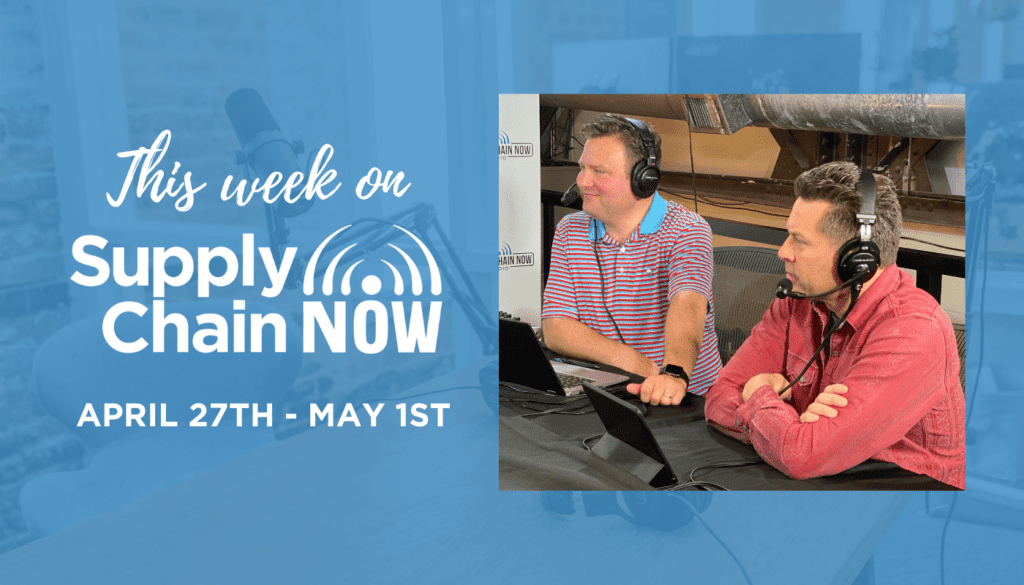
This Week at Supply Chain Now: April 27th – May 1st
BIG THINGS happening here at Supply Chain Now! Have you listened to all the episodes from this week? If not, no worries! Check them all out here: We started out the week wrapping up our last episode from MODEX 2020 with supply chain visionary Diego Pantoja-Navaja with Oracle. Supply Chain Now · “Supply Chain Visionary: Diego Pantoja-Navajas with Oracle” On Tuesday, Scott and Greg were joined by Enrique Alvarez and Adrian Purtill with Vector Global Logistics as they continued the Logistics with Purpose series with special guest Patrick Plonski with Books for Africa. Supply Chain Now · “Logistics with Purpose: Patrick Plonski, PhD with Books for Africa” Then we published the new and improved Supply Chain Buzz, with Scott and Greg sharing and discussing the latest news and events in Supply Chain and beyond. Supply Chain Now · “The Supply Chain Buzz: Week of April 27th” Scott and Greg were joined by Bobby Holland with U.S. Bank and Lee Klaskow with Bloomberg Intelligence on Thursday as they discussed the key takeaways from the Q1 2020 U.S. Bank Freight Payment Index. Supply Chain Now · “Analysis of Q1 2020 U.S. Bank Freight Payment…
resilience
November 5, 2025
Ensuring Forced Labor Compliance in Automotive Supply Chains
Turn data into insight – map, monitor, and mitigate fortced labor risks across your value chain. Since the Uyghur Forced Labor Prevention Act (UFLPA) went into effect in 2022, sub-tier supply chain visibility has become an increasingly critical and ubiquitous prerequisite for import compliance. Automotive companies, due in no small part to their highly complex supply chains, are among the hardest hit by this requirement of anti-forced labor and ESG regulations. A recent study by Sayari analysts found that 95% of leading OEMs’ exposure to forced labor risk comes from sub-tier suppliers. The ability to identify and mitigate risks throughout their value chains is critical for OEMs aiming to minimize operational disruptions, avoid detentions, and maintain competitive advantage. Download the report to learn how Sayari is overcoming barriers to supply chain visibility, enabling OEMs to map their sub-tier supply chains, identify indirect exposure to forced labor risk, and foster greater supply chain resilience in an increasingly dynamic trade landscape. DOWNLOAD NOW