

More
supply chain decision velocity
February 17, 2026
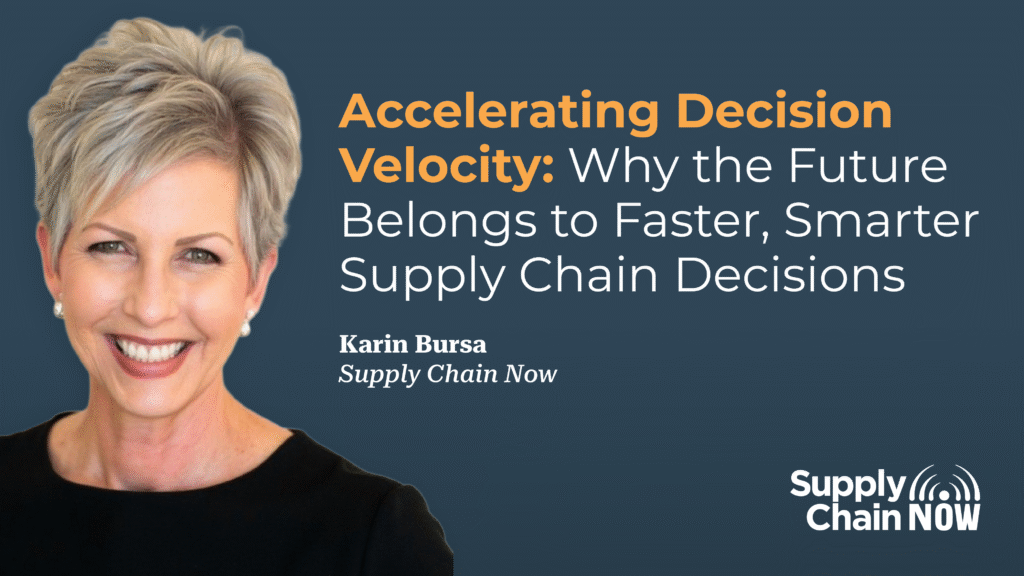
Accelerating Decision Velocity: Why the Future Belongs to Faster, Smarter Supply Chain Decisions
Special Guest Blog Post written by Karin Bursa, Supply Chain Industry Advisor and Supply Chain Now Host Here is a diagnostic question I use with supply chain leaders: when disruption hits, do your teams spend most of their time debating the data, debating the scenarios, debating the plan, or debating the decision? Or all of the above? Seriously though, in 2026, that distinction matters. Network shifts driven by tariffs, geopolitics, cost pressure, and sustainability are accelerating. Gartner’s 2025 U.S. Trade and Immigration Policy Survey indicate 77% of respondents selected network changes among their top actions in response to tariff impacts. [2] If the physical network is moving, the digital planning platform must move even faster. The environment is forcing decisions to be made faster, more frequently, and with more variables than ever before. Gartner says supply chain decisions are becoming 71% more complex, happening 52% more frequently, and need to be made 57% faster. That triple constraint cannot be accomplished with cadence-based batch planning cycles as a default operating model. This is why I am focused on a single, practical outcome for supply chain teams: accelerating decision velocity. The ability to move from data to insights to actions faster…

automated supply chain
October 25, 2024
Automation Advancements: 3 Businesses Leveraging Automation for Optimization
Prospects of supply chain automation have the industry abuzz. It’s even become a major sticking point in the International Longshoremen’s Association contract negotiations with the United States Maritime Alliance. The dockworkers do not want ports to automate processes out of fear they will lose their jobs to machines. Today, there are seemingly endless possibilities for optimization. Terms like generative artificial intelligence and machine learning have become commonplace in discussions about ways to gain efficiencies and reduce costs. Can man and machine work together as businesses leverage automation for optimization? Beyond the Buzz: Understanding the Automation Imperative Machine learning, a subset of artificial intelligence (AI), is described by Business News Daily as a later-stage development in which machines take in data on their own and then analyze it. Automation, on the other hand, is fixed on repetitive tasks; after a job is performed, an automation system “thinks no further.” The Business News Daily article explained that “automation involves an entire category of technologies that provide activity or work without human involvement,” while AI involves “a machine exhibiting and practicing something similar to what we describe as human thinking – that is, the ability to interact in thousands of ways with the…