
More
foundational industries investment
February 23, 2026
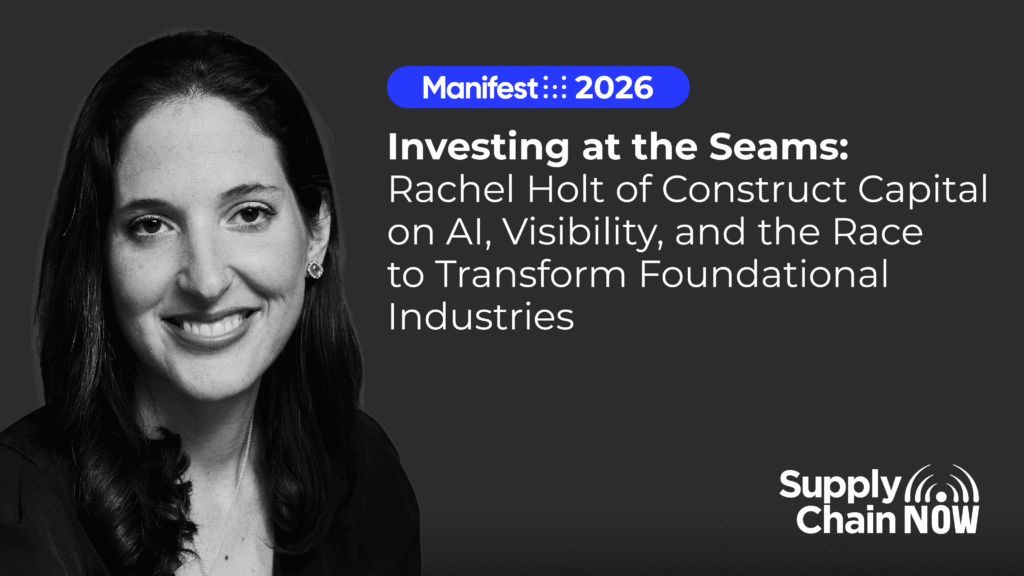
Investing at the Seams: Rachel Holt of Construct Capital on AI, Visibility, and the Race to Transform Foundational Industries
From Uber to Foundational Industries At Manifest 2026, Scott Luton sat down with Rachel Holt, Co-Founder and Managing Partner of Construct Capital, to explore how venture capital is fueling the next era of supply chain innovation. Construct Capital, now six years old, was founded in early 2020 with a bold thesis: transform foundational industries that represent nearly half of GDP: supply chain, logistics, manufacturing, mobility, infrastructure, and defense. When the fund launched, Holt recalls many skeptics asking whether supply chain and logistics were truly venture-scale opportunities. It echoed what she heard when she joined Uber in 2011, when transportation was considered slow moving and heavily regulated. Yet Uber went on to redefine personal logistics. Her final years at Uber brought a pivotal lesson. While the rides business operated with second-by-second visibility, the company’s e-bike and scooter supply chain operated in near darkness. Products shipped from China would disappear for weeks at sea, briefly reappear at ports, then stall again in customs. “We had no visibility, we had no ability to reroute,” Holt shared, as this Eureka moment would go on to help shape her investment focus. The Visibility Gap at the Seams Supply chain, Holt emphasized, is not monolithic.…

supply chain war room strategy
February 26, 2026
Inside the Supply Chain War Room: Max Garland on Backup Plans, Delivery Costs & the Human Side of Innovation
At Manifest 2026, Scott Luton shared a cup of coffee with Max Garland, Senior Reporter at Supply Chain Dive, an Informa TechTarget publication, for a boots-on-the-ground perspective from one of the industry’s most plugged-in observers. Garland covers freight, logistics, retail fulfillment, and parcel delivery: the parts of the supply chain where strategy meets reality. And after a bruising 2025, he sees an industry that’s not just reacting anymore. It’s recalibrating. From Plan B to Plan D If 2025 had a theme, Garland says it was contingency planning. “Last year was when a lot of companies were putting together those Plan B’s, Plan C’s, and Plan D’s,” he explained, pointing to tariff upheaval and shifting trade policy that forced leaders into constant reaction mode. Companies prioritized flexibility: diversifying sourcing, adjusting procurement strategies, and preparing for fires wherever they might spark. In 2026, that flexibility remains. But the tone has shifted. Now companies are “firming up their plans, fine-tuning, making sure those back-up plans are cost-effective as well.” It’s no longer just about avoiding disruption; it’s about operating efficiently within it. In other words, supply chain leaders aren’t just jumping over candlesticks anymore (like Jack from the old nursery rhyme). They’re…