

More
AI-powered supply chain solutions
March 5, 2026
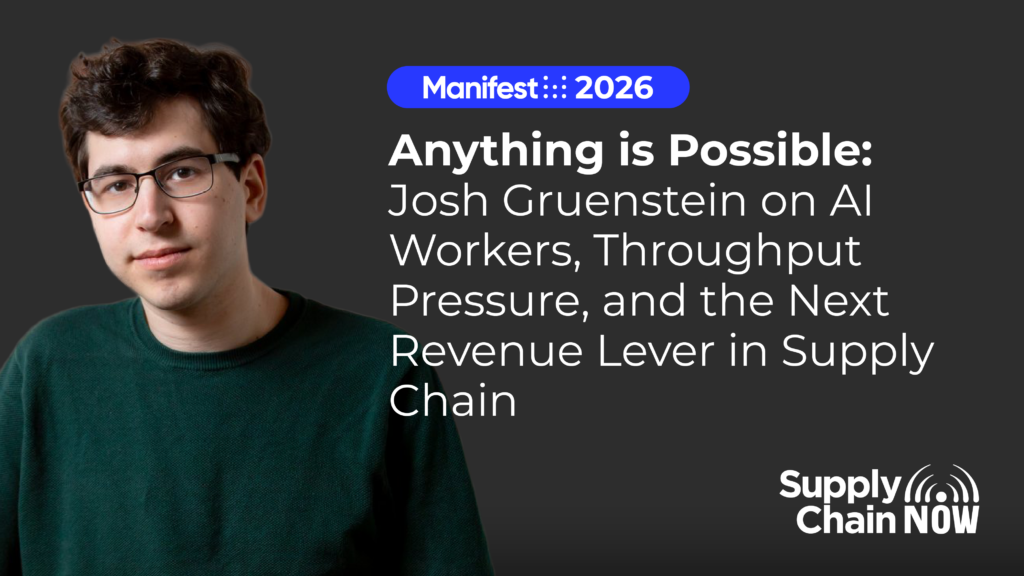
Anything is Possible: Josh Gruenstein on AI Workers, Throughput Pressure, and the Next Revenue Lever in Supply Chain
At Manifest 2026, Scott Luton spent time with Josh Gruenstein, Co-Founder and CEO of Tutor Intelligence, to talk about a future that’s no longer theoretical: AI-powered robot workers operating inside America’s warehouses and factories. And this isn’t a science experiment. It’s already happening. From MIT to the Warehouse Floor Gruenstein and his team came out of MIT’s Computer Science and AI Lab with a bold idea: build AI-powered robot workers that can handle the manual labor people don’t want to do. “We build physical robots,” Gruenstein explained. “We build AI models that enable robots to perceive their environments, and then we deploy those robots into factories and warehouses across the United States to do manual labor that people don’t want to do.” Unlike traditional automation projects that require massive capital outlays, Tutor Intelligence operates on a robots-as-a-service model. Companies can engage a Tutor robot for roughly $14–$18 an hour, creating a flexible, scalable path to automation without multimillion-dollar implementation risk. Automation Isn’t New. AI Is Changing the Playbook. When asked about dominant supply chain themes, Gruenstein pointed to a constant drumbeat: automation. But 2026 feels different. “Automation is obviously a constant theme,” he said. “What really seems different…

lean manufacturing examples
October 31, 2024
Supply Chain Now Guide to Lean Manufacturing: Tried, True, and Transformative
Lean manufacturing is all about reducing waste and increasing efficiency. Manufacturers have been implementing lean practices for decades and have stood the test of time. Now, with technological advancements, lean methodologies can be more transformative than ever before. “Integrating automation into lean manufacturing is a powerful strategy. Unlike traditional automation, which often aims to increase production capacity without considering real needs, lean automation focuses on the smart and selective application of technologies to meet specific continuous improvement goals and eliminate inefficiencies,” the Kaizen Institute said. “Digital transformation provides an unprecedented opportunity for implementing lean,” it continued. “When applied within lean, tools like the Internet of Things (IoT), artificial intelligence (AI), and data analytics can revolutionize how organizations detect and eliminate waste.” What is Lean Manufacturing? In “The Machine That Changed The World,” published in 1990, lean production is hailed as “Toyota’s secret weapon in the global car wars.” The Toyota Production System was developed following World War II from “a series of simple innovations … to provide both continuity in process flow and a wide variety in product offerings,” according to the Lean Enterprise Institute. In “Lean Thinking,” a 1996 follow-up to “The Machine That Changed The World,” authors James…