

More
AI warehouse optimization
February 19, 2026
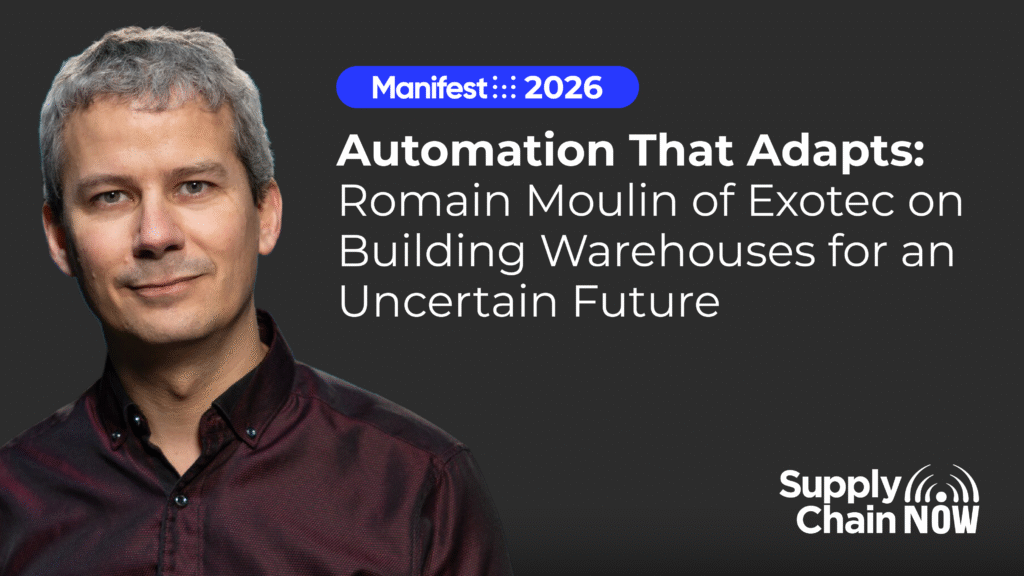
Automation That Adapts: Romain Moulin of Exotec on Building Warehouses for an Uncertain Future
Uncertainty Is the New Baseline At Manifest 2026, Scott Luton spoke with Romain Moulin, CEO and co-founder of Exotec, to discuss how warehouse automation is evolving in an era defined by volatility. “The big trend of last year was uncertainty,” Romain said, reflecting on 2025’s tariffs, economic tensions, and shifting trade dynamics. “Anything that would be done needed to deal with uncertainty.” Rather than waiting for stability, companies are designing operations that assume change is constant. “Anything that is going on now must be projects that are able to reorganize themselves,” he explained. Warehouses must be robust, agile and flexible as to whatever the next disruption brings. From Conveyors to Configurable Robotics Exotec is known for inventing 3D warehouse robots (Skypods) that move across the floor and climb racks up to 14 meters (46 feet) to retrieve totes and deliver them to operators. But beyond the visual wow factor, the real transformation is simplification. “The time of bespoke complex warehouses tailored to a very specific need is over,” Romain said. Customers are moving toward more generic, adaptable warehouses. Exotec replaces hardware complexity with intelligent software. “We don’t program the solution,” he noted. “We let the software find the best…
January 29, 2021
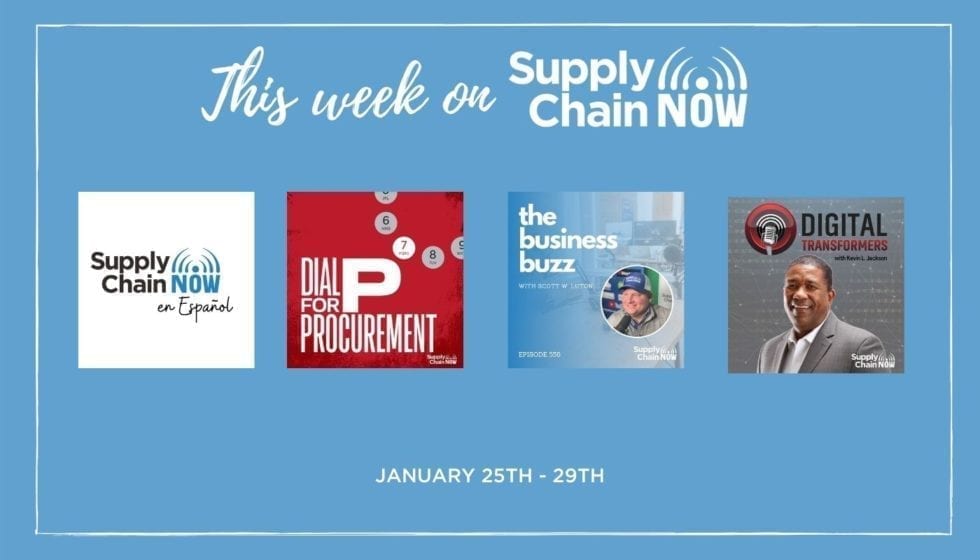
This Week on Supply Chain Now: January 25th – 29th
It’s been an exciting week here at Supply Chain Now! Catch up on all the latest episodes, interviews, conversations, and livestreams right here for all the hottest supply chain news! On Monday, we launched Dial P for Procurement with program co-hosts Kelly Barner & Scott Luton who welcomed two professionals who have put their procurement and supply chain experience to work in the service of others: Anna McGovern, Chief Supply Chain Officer at the Food Bank for New York City, and Kathy Fulton, Executive Director of the American Logistics Aid Network. On Tuesday, Laura Cyrus with Truckers Against Trafficking joined host Enrique Alvarez to share how supply chain & trucking workers are uniquely positioned to combat human trafficking. On Wednesday, we launched our new Digital Transformers series in partnership with Total Network Service. Check out our first episode as Scott Luton, Kevin L. Jackson, and special host Thomas Carter welcome Dave Stehlin and Chris Poli to the show. On Thursday, we released The Supply Chain Buzz with Kevin L. Jackson, Greg White, & Scott Luton who discuss leading stories from global supply chain and global business, including the skyrocketing costs of medical supplies, the impact of IoT…