

More

supply chain sustainability
August 29, 2024
Eco-Friendly Innovations: How Sustainable Practices Are Reshaping Supply Chains
Scope 3 emissions reportedly account for more than 70% of businesses’ carbon footprints. That huge percentage gives an indication of just how critical supply chain sustainability efforts are to the planet. Thankfully, a growing number of eco-friendly innovations are helping reshape global supply chains. Supply Chain Sustainability: An Industry Imperative in a Changing World It is becoming increasingly important for companies to accurately calculate their supply chain emissions and create an information-sharing ecosystem, according to Matthew Gardner, co-founder and managing partner of Sustainserv, a consulting firm that helps businesses implement sustainability strategies. Gardner said accounting for supply chain-related greenhouse gas emissions includes such challenges as: Data gathering of “materials, manufacturing processes, activities of second- and third-tier suppliers, and overall data governance and quality.” Calculation methodology that “reflects the realities of raw material sourcing, product manufacturing, transportation and distribution, and other life-cycle impacts that may affect reported greenhouse gas totals.” Supplier relationships, which can be strained as a result of emissions assessments. Businesses also need to keep in mind their relationships with consumers. PDI Technologies said 80% of U.S. consumers it surveyed were willing to pay more for sustainable products. “Between these statistics and the regulatory conversations that are happening in…
AI-powered supply chain solutions
March 5, 2026
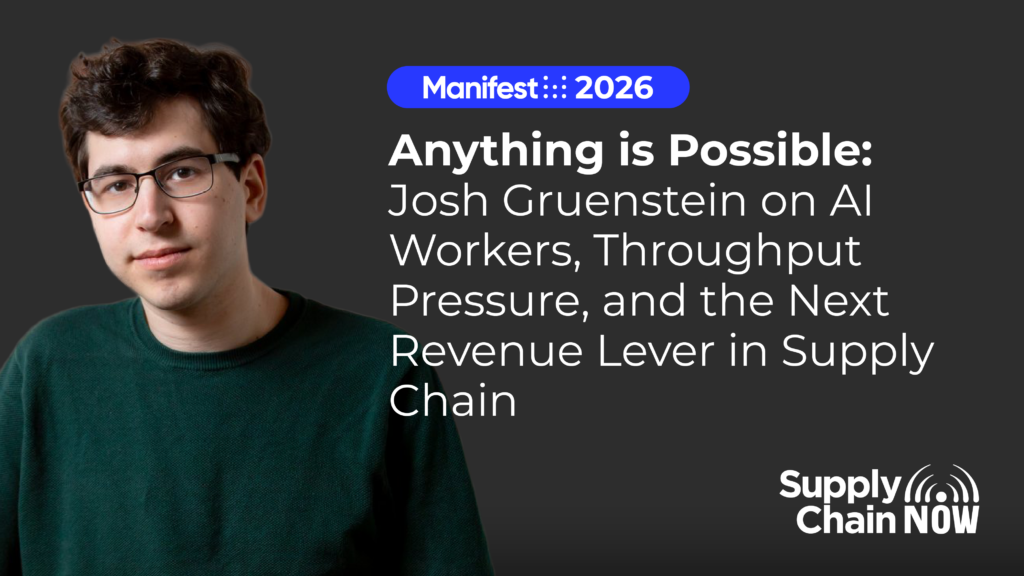
Anything is Possible: Josh Gruenstein on AI Workers, Throughput Pressure, and the Next Revenue Lever in Supply Chain
At Manifest 2026, Scott Luton spent time with Josh Gruenstein, Co-Founder and CEO of Tutor Intelligence, to talk about a future that’s no longer theoretical: AI-powered robot workers operating inside America’s warehouses and factories. And this isn’t a science experiment. It’s already happening. From MIT to the Warehouse Floor Gruenstein and his team came out of MIT’s Computer Science and AI Lab with a bold idea: build AI-powered robot workers that can handle the manual labor people don’t want to do. “We build physical robots,” Gruenstein explained. “We build AI models that enable robots to perceive their environments, and then we deploy those robots into factories and warehouses across the United States to do manual labor that people don’t want to do.” Unlike traditional automation projects that require massive capital outlays, Tutor Intelligence operates on a robots-as-a-service model. Companies can engage a Tutor robot for roughly $14–$18 an hour, creating a flexible, scalable path to automation without multimillion-dollar implementation risk. Automation Isn’t New. AI Is Changing the Playbook. When asked about dominant supply chain themes, Gruenstein pointed to a constant drumbeat: automation. But 2026 feels different. “Automation is obviously a constant theme,” he said. “What really seems different…