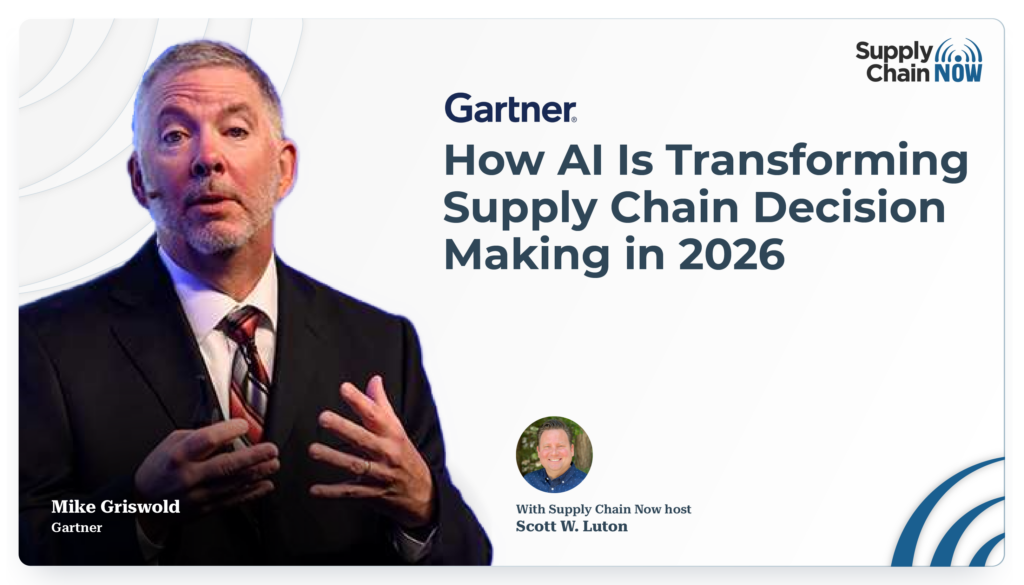
[00:00:00] Mike Griswold: Oftentimes what we see is that deployment of AI against a very specific problem doesn’t necessarily immediately result in automation. It does almost always, immediately result in augmentation.
[00:00:29] Scott W. Luton: Hey, good morning, good afternoon, good evening, wherever you may be. Scott Luton and always special guest, Mike Griswold with you here on Supply Chain Now welcome to today’s show. Hey Mike. How are you doing today?
[00:00:42] Mike Griswold: This is always one of the highlights of my week, so I’m excited to, uh, to spend some time with you and the folks that, uh, decide to watch us.
[00:00:49] Scott W. Luton: Uh, same. Uh, I learn a ton. I always leave here with, uh, at least one certification. Uh, learning from Mike Griswold and folks, we’ve been, this is one of our, I always say it’s our longest running, one of ’em longest running series, the most popular series supply chain today and tomorrow with Mike Griswold, uh, with Gartner. But not only is this the first show of 2026, but. been renewed. Me and Mike got nervous. The producers, you know, and the powers that be. We weren’t sure if we’re gonna be picked up, but we’ve been picked up for a sixth year in a row, Mike. It does not feel like six years.
[00:01:26] Mike Griswold: Uh, it does not, and I appreciate all of the things you had to do with the higher ups to, to get us to do another year. Uh, I’m looking forward to it. It’s always fun. Hopefully people get something out of it. Uh, either business or per or personally, but it’s a lot of fun. I enjoy spending time with, with you and Amanda and Joshua.
[00:01:44] Scott W. Luton: Same. I do too. Uh, and folks, as you may know by now, Mike serves as Vice President Analyst with Gartner, and he’s got terrific perspective and expertise that we enjoy diving into. Uh, on a monthly basis. So today we’re gonna be touching on some key takeaways from a supply chain event. I was out, um, at, out in Las Vegas. We’re gonna respond and comment on some of the great feedback we’ve gotten from audience members, which, hey, we’re always grateful for y’all. Keep it coming. we’re gonna. Talk about one of Mike’s favorite subjects, sales and operations planning, good old S and OP, that, and a whole bunch more. So stay tuned to walk through what I think is gonna be a great discussion with the one and only Mike Griswold. Okay. So Mike, we are gonna start. So you were telling me pre-show, and this will probably publish a couple weeks from now, so, I wanna celebrate your recent basketball results because I think y’all just won, uh, a tournament for the third time in four years. Is that right, Mike?
[00:02:41] Mike Griswold: Yes, we won our district, uh, championship for the third time in four years. So it’s, uh, a big accomplishment for us. It got us into the state tournament, which will start, um, after people have seen this. So we are, our tournament starts on Thursday. The 19th of February here in Idaho. So we’re excited about our chances, uh, to, to go to the tournament again, especially with this team.
[00:03:06] Mike Griswold: This team is very, very young it’s a good experience for them to be able to do that.
[00:03:10] Scott W. Luton: All right, so, so folks out there, I’m committed. I’m dedicated to finding film and footage of Mike in action coaching this talented team. So stick around. We might have to, uh, show that in the months to come, but congrats to the team. And that’s actually gonna be a great segue because the fun warmup question here today, Mike, is on one of your favorite topics and that is NCAA women’s basketball. And usually have a fun warmup question where we got three here Today we’re gonna see if Mike Griswold can defeat chat GPT when it comes to women’s basketball, NCAA basketball trivia. So you ready to go, Mike?
[00:03:48] Mike Griswold: I am, I don’t like my chances, but I am.
[00:03:52] Scott W. Luton: Okay. Alright. Here we go with the first one. The first one is, which program has won the most NCAA Division One Women’s Basketball National Championships. Is it Tennessee, Connecticut, Stanford, or South Carolina?
[00:04:05] Mike Griswold: this is an easy one because I’m a huge Yukon fan. It’s Connecticut. I think they’ve won 12. You may not be able to add up the other three and get to 12, so it’s Yukon by a, by a award margin. All done with the same coach too, by the way.
[00:04:19] Scott W. Luton: Okay, let’s see. He is right. Winner, winner. Chicken dinner, as they say. All right, so we’ll move from championships to other measures of performance and that this next, uh, question is who became the all-time leading score in NCAA division one basketball history, men’s or women’s in 2024.
[00:04:42] Mike Griswold: it was Kelsey Plum, but Caitlyn Clark is the one who took that over in 2024.
[00:04:48] Scott W. Luton: Okay, and I, I should have read the answers. So for folks that may be listening out there, it’s Sabrina Escu, I think I said that right. Kelsey Plum, Kaitlyn Clark and Diana, TESI. Did I say that
[00:05:00] Mike Griswold: Correct. Another Yukon alum. Yes,
[00:05:03] Scott W. Luton: Right, who can be found on ESPN regularly? So Mike answered Caitlyn Clark, and he is correct? All right. Mike, two for two.
[00:05:14] Scott W. Luton: Number three. This is a little trickier, so. Third question, third and final question. you notice the questions numbered four ’cause I didn’t like the third question Chad gave me. So, uh, player recorded the first triple double in NCAA women’s tournament history since the tournament expanded to 64 teams in 1994?
[00:05:36] Scott W. Luton: Now those options are Sabrina, INSQ, Cheryl Swoops, Shameika Holdsclaw, and Kaitlyn Clark.
[00:05:46] Mike Griswold: This is a tough one because Sheryl Swoopes and um, Holsclaw were both very, very good players. I don’t know though that if we, if we were recording triple doubles when they played. So that leads me to Sabrina and Kaitlin. I’m gonna, I’m gonna stick with Kaitlyn Clark.
[00:06:06] Mike Griswold: And, and think She’s the one that, that got the first one.
[00:06:10] Scott W. Luton: I was gonna make sure you saw the wording of the question, but no, since 1994. So let’s see if Mike,
[00:06:17] Mike Griswold: Oh,
[00:06:18] Scott W. Luton: Iku.
[00:06:19] Mike Griswold: Uh.
[00:06:20] Scott W. Luton: Now I’m just gonna tell y’all, in the good old days of Sports Center and for me, that was the nineties, right? heard swoop. Or holds claw. ’cause I think Holds Claw came a little bit later. They’re both Hall of Famers and they were on every single episode. Mike. They were amazing. I mean, Caitlyn Clark gets all the modern glory, but oh my gosh, those were amazing. Amazing Hall of Famers, huh?
[00:06:43] Mike Griswold: for sure. I mean, there, there’s been I think a lot of talk about, uh, women’s college basketball kind of since Caitlyn. Uh, but there was, and then certainly some of that translating to the WNBA, but there was a lot of really good women’s basketball being played, you know, before Caitlin played. Uh, and those two were certainly part of it.
[00:07:03] Scott W. Luton: So true. right. And I miss those good old days of Sports Center, uh, Stuart Scott and Charlie Steiner, and so many others. When Carl, um, one of my favorite moments, Mike, was when Carl Lewis sang the national anthem and he missed a lots, lots of notes, and Charlie Steiner could not get it together to
[00:07:22] Mike Griswold: Right.
[00:07:23] Scott W. Luton: that sports center.
[00:07:24] Scott W. Luton: So good. Anyway, alright, so Mike. let’s get to work here today. We got a lot of good stuff to get into here today. I wanna use our most recent edition. With that said, as a discussion vehicle, this is, uh, me and a great panel, out at Manifest 2026 in Las Vegas. but we used Manifest, as we captured key takeaways from the supply chain conference, and we shared those in this edition of the newsletter. I want to walk through, uh, and folks, this is just, just a tip at Iceberg, right? We interviewed over 20 folks. Uh, we led up great panel sessions I mentioned, and I had hundreds of sidebar informal chats and conversations. It was really, um, well done. so what we wanted to capture is some of the key themes that. We felt were prevalent, um, and new, right? Uh, these aren’t brand spanking new themes, but they’re very present. What we thought in our manifest conversations, and I’m gonna share those here today, and I’m gonna get Mike to respond and react and give us his thoughts. So, we got five of ’em here. Number one, the fusion era of human and technology collaboration. Number two. How industry is evolving from AI theater to really big measurable outcomes leveraging ai. Number three might be my favorite ones, and it might be the most arguable one, the end of Franken Systems, right? There was a lot of discussion around point systems versus orchestration platforms where we’re headed, where we are today and where we’re headed, right?
[00:09:04] Scott W. Luton: Lots of good debate to be had there. Augmentation before automation and then what some referred to as the shrinking gap between vision and execution, which is pretty exciting. Again, none of brand spanking new, uh, were prevalent. So Mike, when you see these themes and you think of global supply chain and this golden age of supply chain technology you’re in, what are your thoughts?
[00:09:29] Mike Griswold: those are really good, um, kinda summaries of, of what we hear our clients talking about and, and hear what people are asking. Uh, of us, you know, at Gartner, you know, one of them is the AI component is front and center and I think it underlined a lot of those, those summary. Um, points that, that you just highlighted.
[00:09:53] Mike Griswold: The, the automation piece in augmentation is probably one of the topics that, that my team spends the most time talking about. When you think about it from a, a talent perspective, you know, what we’re hearing and what we’re seeing and what we’re, you know, advising clients on is it really is more about augmentation right now.
[00:10:18] Mike Griswold: That augmentation comes from. I think what also is encapsulated in that summary is this movement from kind of proof of concepts and wondering what can AI do for me towards. Hey, I’ve got a specific problem. It meshes really well with AI and that’s how I’m gonna deploy ai. And oftentimes what we see is that deployment of AI against a very specific problem doesn’t necessarily immediately result in automation.
[00:10:53] Mike Griswold: It does almost always, immediately result in augmentation. How do we take and, and build and mesh what a person knows about the day-to-day activities of their job, the insights that they have either learned through experience and or just longevity. How do we marry that with the technology that is ai? So we have many, many more conversations around augmentation and how do you, fusion I think is a good way to describe it.
[00:11:24] Mike Griswold: How do we bring people. And technology and AI together. if folks read through your summary, which is very, very good around that, um, event, there’s a lot of discussion in there around. People moving from this kind of slide version of all the things AI could do for me to real world use cases of what AI is doing for people today.
[00:11:50] Mike Griswold: You know, we found during our top 25 briefing process, right, which will culminate in June with our 2026 supply chain top 25 or top 25, what we will are seeing and what will be in that output. Is where people, and where leaders are actually deploying AI to solve very specific problems and articulating what those problems are.
[00:12:15] Mike Griswold: So I know further down or farther down, whatever the, the grammatically correct use of the word is. Down in your, in your recap, you talk a little bit about this evolution and this moving towards. More demonstratable use cases, and I really think that’s where we are today. I think the, the jury is out and has rendered an opinion around the, the value and that there is value in ai.
[00:12:44] Mike Griswold: I think now what people are doing is saying, okay, AI is here. Ai, you know, can be really good for us. We now need to figure out how to deploy it. And, and to me, if I kind of distill. What your summary was, it was AI is here, we need to figure out how to use it, and we need how to figure out how to use it with people.
[00:13:05] Scott W. Luton: thank you for your remarks and thanks to everyone out there that contributed, uh, some of their perspective. We named a bunch of different folks that we met, run into and had conversations to make up that piece, uh, via with. That said, so y’all go check it out and uh, I got an extra follow up question for you, Mike, but I wanna make sure folks, folks, we’re gonna be at a variety of events, including one of our favorite events of the entire year, which we’ll touch on towards the end of the conversation.
[00:13:28] Scott W. Luton: Gartner Supply Chain Symposium. we’d love to get your key takeaways from these sessions of conversations, especially those powerful sidebar conversations that aren’t on stage. They’re not recorded. I mean, that’s where some really good stuff can be. one of the themes I don’t think I, I hit on, but something I’ve been thinking more about because we’re talking about, uh, this golden age of, of supply chain technology that requires lots of investment in many ways. and several folks, including my friend, uh, gee, talked about how they’re seeing lots of cash. An investment sidelined on weight, you know, this uncertain environment and the friction and, and the trade. And it’s interesting because I can see that and I can’t see that, right? Because we see lots of investment, right?
[00:14:15] Scott W. Luton: We see m and a activity coming back, including global supply chain. We’re seeing companies invest in systems. Technologies, AI and otherwise, but I definitely can see where some cash and capital has been parked as folks could try to, they wanna get a better s sense of certainty about what this year or next year is gonna look like.
[00:14:37] Scott W. Luton: Mike, your, your thoughts on that?
[00:14:39] Mike Griswold: it’s a tough environment. It’s a great observation because I, I, I do agree as, as we talk to clients, there are schools of thought about. Kind of taking a wait and see approach. You know, the caution that I give people, the caution that we give our clients is you have to be really careful about how long do you wait and see, right?
[00:14:59] Mike Griswold: Because not only. Do you run the risk of kind of missing out in terms of opportunity costs and taking advantage of, of things that maybe you might have either a, a technological or a process lead compared to the rest of the, of the market? Right. Waiting too long, someone is gonna fill that vacuum. Right. I think it was, I dunno if it was from Jurassic Park, but.
[00:15:25] Mike Griswold: nature abhors a vacuum. So if, if you, the collective, you as an organization are, are kind of cautious and, and hesitant and taking the wait and see approach, someone else probably isn’t. Now to be fair, not everyone that rushes in to fill a vacuum necessarily. Successful, but it’s probably safe to say that those that are last to fill the vacuum are gonna be at a disadvantage.
[00:15:54] Mike Griswold: So it just becomes really important to kind of trust your conviction. You know, we, we talk as coaches all the time, trust the process. So if you’ve gone through a process and you’ve evaluated. An initiative, whether that’s a technology or a process change, you feel comfortable about the underlying assumptions, whether it’s a technology need, business case, ROI, whatever it is, right?
[00:16:19] Mike Griswold: At some point, you’ve gotta trust the process and you’ve gotta be willing to step into that vacuum and fill it, because like I said, if you wait too long, someone else is gonna fill it. All those that fill it will not be unsuccessful, and you will potentially put yourself at a disadvantage if you wait too long.
[00:16:38] Scott W. Luton: Well said. And yeah, trust the process. I love that, especially as it applies to sports, but as it applies to business too. Right? Especially when we have thoroughly invested in, building out. Proven processes that are resilient but flexible we navigate through these, um, disruptive and uncertain chapters. Um, okay, Mike, good stuff there. Thanks for your great comments on those key takeaways. I can’t wait to get a collection of key takeaways in Orlando. Uh, we’ll talk about that in a second, but also. Takeaways and, and, um, inputs are all such a blessing, but so is feedback, right? Feedback is a blessing that always continues to give. And, um, I love seeing our audience weigh in on some of the conversations, both the ones I have with Mike and, and a lot of other folks here. Via Supply Chain Now, um, and about a month or so ago, and as we’re showing here on the screen, Jeremy Rothman Shore, who is the CTO at Intelli Chain, shared a few comments on LinkedIn about one of our past conversations.
[00:17:41] Scott W. Luton: Mike, I’m gonna read this. I’m gonna quote Jeremy and I’m gonna get Mike to, to kind of share what. his thoughts are. So, Jeremy said, quote, I really like this framing from Mike Griswold, VP of Supply Chain Research at Gartner on Scott Luton’s Supply Chain Now podcast, as he talked about organizations learning how to use the new powers of AI and supply chain technology. And Jeremy quotes you here, Mike. he says, Mike shared. We’ve never lacked data. We were held back by technology. Now we have more insights than we know what to do with captures the moment. Supply chain planning, Jeremy says is in right now. AI removes the old limits on data analysis, the real challenges combining machine intelligence. Scale speeds dimensionality. Try to say that five times fast with human intelligence, judgment, context, accountability. So insight actually turns into action. And then he goes on to say, in our work at Intelli Chain, my partner Roy hope I said that right? And I see this play out every day.
[00:18:46] Scott W. Luton: The value is an automation for its own sake, but using AI to bring more rigor and clarity into decisions that people still own and quote Mike, that is, I, I really enjoyed that. that is some, those are thoughts that will make you ponder. What’s your initial reaction to what Jeremy shared there?
[00:19:06] Mike Griswold: Yeah. First I appreciate Jeremy taking the time to, to watch you and I, and then provide us feedback, as you mentioned, super helpful and. I really appreciate that from Jeremy. I think it’s interesting because you and I have talked a lot on this show about data and, you know, the plethora of data we’ve had, and I think, you know, we, we always lamented this analysis paralysis, right?
[00:19:30] Mike Griswold: And I think we’ve actually entered potentially a different age of that because we have technology so. Pre ai. as Jeremy pointed out, we, we never lacked for data the analysis paralysis was because we had too much data and no way to sift it. I think we run the risk in today’s environment where technology now allows us to process that data.
[00:19:57] Mike Griswold: But it also allows us to ask so many more questions and, and ask for so many more iterations that we, we have the potential of running into a different type of analysis paralysis. Now it’s a case where we are potentially asking ourselves too many questions because we now have the technology that can process all of those questions very quickly.
[00:20:18] Mike Griswold: So I think for in, in today’s environment, and, and I think most people, myself included, would rather have. The latter problem than the former problem. Right? Because in the latter, we at least we’re getting insights, at least we’re getting answers to the questions. Now we could argue that maybe we’re asking too many questions, but at least we’re getting answers.
[00:20:38] Mike Griswold: I think the other part of Jeremy’s point, which is really important and, and how I think we get out of. The second type of analysis paralysis is by getting people involved, we mentioned in the, in the first segment about augmentation. This is, I think, the way through partnering people with ai that we move out of this second analysis paralysis potential framework into an area where humans are applying their own.
[00:21:08] Mike Griswold: Insights into looking at what’s coming out through some of the questions that we’re asking and not just asking questions for the sake of a question. ’cause I know I can. But really using our insights to drive smarter questions for our AI tools so that we can get to better answers. So I
[00:21:28] Mike Griswold: think it, it is coming back to this idea of augmentation.
[00:21:32] Mike Griswold: And how do we keep people involved in the process? Now that data really isn’t a limitation anymore. The limitation really comes down to how do we scope the type of of question that we have, and, and do we scope the answer such that it really solves a very specific business problem that we have.
[00:21:55] Scott W. Luton: said Mike, and you gave me two thoughts. amongst all of your, uh, feedback there, I wanna zero in on, um, Jeremy’s last line there, using AI to bring more rigor and clarity into decisions that people still own. And between that all of his perspective and some of what you shared, two thoughts, you know, frameworks. Right. Frameworks are so important, especially with complex problems and challenges, help you break that down into digestible pieces. Right. And I think from my own experience and what we’ve been, how we’ve been using ai, um, some very complicated challenges is the frameworks that’ll help you develop. been extremely helpful to do, especially number two. The second point, which is moving with that speed, you referenced speed a couple of times. the proper level of speed, right? When I think about the old school manner of solving. Challenges, I think about, those math classes back in the day in college where it would take three pieces of paper to, to work through all the different steps of the solution.
[00:23:01] Scott W. Luton: Right. And you got a lot of manual work. ’cause the calculator we had at the time didn’t give you frameworks and stuff. And I think of how I’m using, how we’re using AI today to help you arrive at those steps. So much faster. Right. And to your point, we’ve got to determine as we get more information and we get more, Intelligent machine inputs into these problem solving cycles. We could be in these cycles all day long. So it still takes human judgment, right? Especially major, complex, endless stage type of problem solving. But frameworks is one of my favorite things to use to break this stuff down and then speeding up our, time to arrive at these really important. milestones or stage gates, whatever you wanna call it. I mean, I’m seeing ma big time value being unlocked on our end. Yeah. Respond to that Mike, really quick and then we’re gonna move on.
[00:23:58] Mike Griswold: Yeah, frameworks are important. They provide the structure around which you want to, to solve a problem, whether it’s an, you know, using AI or not, right? The framework kind of tells you kind of where do I start? And probably more importantly, where do I stop? when do I know I have enough information for, to, to solve whatever problem I I was presented with to move forward?
[00:24:22] Mike Griswold: And I’ll give you, kind of an example on the personal side. So. I have, um, pre-game prayer responsibilities for, for our games with, with the basketball team. And, and normally I will kind of give it some thought in my head and I’ll come up with something and I, and I’ll deliver, uh, a pre-game message to the team.
[00:24:41] Mike Griswold: So before the district championship game, it was an important game. I didn’t wanna just do it off the cuff. So I went to, to chat GPT and I said, can you create for me a, a motivational pre-game prayer? For a high school girls basketball team in the district championship. And, and it did. But the reason I come back to the framework observation that you made is it wanted to continue to iterate and iterate and iterate.
[00:25:12] Mike Griswold: It gave me suggestion after suggestion, after suggestion, all of which were good. and all of which in some ways. Made this message that I wanted to deliver, you know, a little bit better and a little bit different. But frankly, Scott, I could still be there right now going back and forth with the prompts.
[00:25:33] Mike Griswold: And the reason I share that story is, is at some point I felt like I had enough. Right. Even though I knew I could get more, and I think it’s important for people that are solving, you know, that obviously isn’t, you know, a, a crippling business problem to solve, right. With my pregame message. But people that are dealing with those have to be able to recognize when is enough enough.
[00:25:58] Mike Griswold: And again, this comes back to this partnership between people and ai, right? That that augmentation discussion we’ve been having. Where at some point, you know, you’ve provided enough, it’s provided enough, it’s time to be done and then execute whatever you wanna execute against.
[00:26:18] Scott W. Luton: I love that, Mike, and I’m so glad you shared that moment. I tell you, Che was gonna have you, uh, hammering declarations on a, uh, church somewhere in Europe.
[00:26:26] Mike Griswold: Yes, yes,
[00:26:28] Scott W. Luton: so, but, you know, I’m gonna put this in, in nice terms, but there’s that phrase, p or get off the pot.
[00:26:33] Mike Griswold: exactly. Yes.
[00:26:35] Scott W. Luton: point you
[00:26:35] Mike Griswold: Yeah.
[00:26:36] Scott W. Luton: Hey, I’ve done my homework, I’ve done
[00:26:38] Mike Griswold: Yeah.
[00:26:38] Scott W. Luton: I don’t need to go more hours and hours of cycles because we gotta get to taking care of business.
[00:26:44] Mike Griswold: Yeah.
[00:26:46] Scott W. Luton: So good stuff there, Mike. Um, okay, so one topic, I shared this on the opener that you and I have talked about a lot over the years, uh, and I’ve learned a ton from you is sales and operations planning. I’ve gotten a little graphic here because, Eric Wilson. Always offers terrific perspective and expertise on S&OP just like you do. And Eric, recently, it’s a couple weeks ago, was polling folks on what the biggest obstacles are in S&OP or similar business processes. Eric, you can see here, offered a ton of various challenges he’s seen over the years, but also ran this survey. LinkedIn Surveys are a bit limiting, right? I think you only have four options and, and you have very limited characters. I really hope we can tweak that moving forward. So anyway, so this is an oversimplified version of a big conversation, but this out. The number one challenge was lack of management support at 46%, followed by cultural and global complexity at 27%. And. I can’t measure that impact at 22%. So I got a two part question for you, uh, Mike, and again, great work, uh, to Eric and all the great work he does in educating and helping folks work through and find a, a brighter path forward. But Mike, two parts. Your thoughts on those challenges or any others that you see regularly and how do you see business leaders overcoming and reach the big gains you can get with a. Vibrant, robust S&OP um, approach.
[00:28:21] Mike Griswold: Yeah. I appreciate Eric pulling all that together. It, it’s pretty similar to what we see here at Gartner when we talk to folks about S&OP kind of across industries. I think the, the lack of management support. Is is in some ways kind of a misnomer. It’s not that people don’t wanna support S&OP, it’s that we probably haven’t done a good enough job, uh, of educating around the value of S&OP because if you were to sit someone down and say, Hey, we need a process that’s gonna match, demand and supply profitably across multiple time horizons.
[00:28:58] Mike Griswold: Like, who wouldn’t sign up for that? Right? Who wouldn’t say, that’s a great idea. We need that in our organization. So some of that lack of support, I think comes down to the inability to really articulate what are we trying to do in S&OP and and what’s the value of solving some of that problems?
[00:29:16] Mike Griswold: That value piece, I think Eric highlighted near the bottom is, is really it. It can be hard. To come up with some end-to-end measures that measure the success of the process, right? We, we measure forecast accuracy. We can measure. You know, inventory impacts, we often struggle to manage, to manage and measure the connectivity of those, right?
[00:29:39] Mike Griswold: That when we have a good forecast and we manage demand well, and we profitably, profitably can respond to supply, it’s hard to measure those things from an end-to-end perspective. Right? And that kind of comes back to hard for us to convince people that, that the S&OP process is valuable. And then the last thing that I’ve seen a lot.
[00:29:59] Mike Griswold: Is people say, yes, we need an S&OP process. But as soon as you start to have those discussions, they immediately dissolve into a very tactical problem, meaning S&OP is designed for a six to nine month planning horizon, but, but but our S&OP meeting will deteriorate into. I’m outta stock in this warehouse with this SKU.
[00:30:26] Mike Griswold: So being able to recognize the distinctions that happen across different planning horizons and recognizing that you actually need an S&OP process, sales and operations planning, but you also need. An S&OE process, sales and operations execution. And you know, if I go back to our frameworks discussion, you need to understand the framework of both of those.
[00:30:52] Mike Griswold: Where are they separate, and then where do they intersect and overlap? those are the big challenges. Uh, along with the, correctly pointed out things from Eric as well.
[00:31:04] Scott W. Luton: Love that. Uh, planning and execution, we gotta have both,
[00:31:07] Mike Griswold: Yes,
[00:31:08] Scott W. Luton: Um, if we lay the best plans and don’t act on them, man, that’s a whole bunch of muda, and waste uhhuh.
[00:31:16] Mike Griswold: Hope is not a plan, so
[00:31:19] Scott W. Luton: not a plan. It really isn’t.
[00:31:21] Mike Griswold: it is not.
[00:31:22] Scott W. Luton: so I want to ask you. folks, you know, we mentioned earlier, uh, the Gartner Supply Chain Symposium. we’re planning and strategic leadership, certainly I bet there’ll be some S&OP conversations much, much more. it’s one of the greatest events, uh, of our yearly calendar, and I think we have an image here. This was us last year with the Noha Samara, Mike. Both are on my short list of some of my favorite, uh, industry personalities. And, uh, look at this quote she had on a billboard. Have you ever walked past yourself on a billboard, Mike?
[00:31:58] Mike Griswold: I’ve been fortunate that they have not, they’ve made the correct decision to not put me on a billboard, so I, I have, fortunately, I’ve not had to look at myself larger than life.
[00:32:08] Scott W. Luton: Oh gosh, that’s gotta be, um, the first time you see it. It’s gotta
[00:32:12] Mike Griswold: Oh,
[00:32:13] Scott W. Luton: take you back for a second. But
[00:32:14] Mike Griswold: yes.
[00:32:15] Scott W. Luton: this out. Uh, Mike, this quote she’s got here and we’ve, we’ve had Noha on to talk about this decision shaper, point of view, but she says, quote, the need for better decision making is right here, right now. Empower your supply chain planning teams to become decision shapers, steering and orchestrating the organization’s most critical business decisions. End quote, Mike. A couple comments there on decision Shapers, I.
[00:32:42] Mike Griswold: it’s interesting the, the evolution, and I think this really started during COVID. The evolution of the perception of the supply chain and, and supply chain professionals. I think, you know, pre COVID, when people took, frankly, the supply chain for granted, we were basically seen as, as really just an execution vehicle.
[00:33:03] Mike Griswold: People telling us what to do and when to do it, and us having to do it within those constraints and people not really understanding the constrained environment that a supply chain, you know, works in every day. I think as we come out of COVID, people started to understand that, that we have this thing called a supply chain.
[00:33:22] Mike Griswold: That can actually be a dynamic game changer for us if we let it and if we make the conscious decision that we want our supply chain to be a value driver for us, versus just someone that does things when they’re told. And I think as that has happened, this idea of decision shapers where the supply chain is actually being, you know, has a seat at the table to talk about.
[00:33:51] Mike Griswold: The, the architecture of a supply chain. how and where are we gonna put our supply chain assets? What do we need to invest in our supply chain so that we can make some of these decisions faster and better? So the, the supply chain is really, I think, four leading companies now. Yes. Uh, I’m sure even in your, event in Las Vegas, there were still people who probably defined their supply chain.
[00:34:16] Mike Griswold: As distribution centers and trucks. Right. And my advice to those people is you need to think about your supply chain differently. Because if you look at our supply chain, top 25 companies, just an as an example, they view their supply chain very differently. It’s a partner for growth. It’s a, it’s a driver of innovation, it’s a creator of market advantages.
[00:34:37] Mike Griswold: All the things that, you know, a decision shaper is, is going to be tasked with doing. So.
[00:34:44] Mike Griswold: This, this reorientation of how we think about our supply chain is really important. And, you know, I think, at our summits, you hear about that at a more functional level like planning, right? How do planners and the planning organization do that?
[00:35:00] Mike Griswold: And what you’ll hear this year at our event in Orlando is more broadly. How do supply chain leaders evolve their supply chain into more and more of that role?
[00:35:13] Scott W. Luton: folks may be surprised still a strong contingent of business leaders both in and outside of industry that might do think. When they hear the word supply chain, they don’t think holistic, they don’t think ecosystem. They really do think distribution of trucks. So we got some more work to do, but you know what, we’ve gained so much more awareness
[00:35:34] Mike Griswold: Yes.
[00:35:35] Scott W. Luton: the word and, and what’s behind it when you, when folks hear supply chain, especially for consumers.
[00:35:39] Scott W. Luton: So all grateful for that. Alright, so folks, uh, again, we wanna point out the dates ’cause this is a big opportunity. Uh, Gartner Supply Chain Symposium 2026 coming to Orlando, May 4th, fifth, and sixth. We’re delighted once again here at Supply Chain Now to serve as a media partner. We’re gonna be interviewing tons of movers and shakers at the conference. Had some of the best interviews all year. In Orlando last year in person, you know, as much as I enjoy the virtual, it’s great to get in person. And folks, if you wanna be part of that programming for Supply Chain Now reach out to Catherine Hints on our team, and if you wanna learn more about attending Symposium, you can go to Gartner.com and Mike, we talk about this all the time. greatest supply chain happy hour will be at, uh, symposium. Folks, you gotta jump in and, and throw some elbows, but between the kidding aside, between the networking and the keynotes and, and the sidebar conversations, it is a unique, very unique event.
[00:36:41] Scott W. Luton: Huh?
[00:36:42] Mike Griswold: Uh, it is. I mean, we, and I think, you know, I think it’s somewhat tongue in cheek. We, we refer to it as the world’s largest gathering of supply chain professionals. I don’t think it’s tongue in cheek anymore. I mean, I think the way this event has grown. From my time when we had, you know, 750 people at the Phoenician in Phoenix, Arizona when I was at a MR to, you know, probably close to 5,000 in Orlando in May.
[00:37:06] Mike Griswold: Um, it’s a testament to a couple things that you mentioned, Scott. One is the growing recognition of the importance of the supply chain and, and how you need a supply chain to move forward. And secondly, I think a recognition that. There are lots of different ways to run very successful supply chains. And the best way to learn about that is, is yes, listen to us at Gartner.
[00:37:31] Mike Griswold: That’s one way, but probably, as powerful a ways to hear from your peers, hear from someone that that is in. A similar boat is you. And, and just listen to them. let them explain what’s worked for them. Let them tell you what hasn’t worked for them. Let them tell you how they’re navigating all of the challenges that people are navigating today around resiliency and dealing with disruption and, and dealing with an ever-changing geopolitical landscape as it relates to the supply chain.
[00:38:01] Mike Griswold: So it is a great place to both formally and informally pick up nuggets around the supply chain.
[00:38:08] Scott W. Luton: Undoubtedly May 4th, fifth, and sixth folks, and you can go to gartner.com and we’ll also try to include a link on the show notes of this episode. Mike. Good stuff. Um, okay, Mike, the billion dollar question how can folks connect with the one only Mike Griswold?
[00:38:26] Mike Griswold: Sure email, LinkedIn, email’s probably, uh, a better connection vehicle right now, but. I do appreciate the things on LinkedIn and, and certainly how they prompted the discussion today, Scott, I think is certainly, um, valuable.
[00:38:40] Scott W. Luton: as you’ve got more championship, uh, journeys to come, someone may suggest a new framework for a prayer.
[00:38:47] Mike Griswold: sure.
[00:38:47] Scott W. Luton: Mike, so who knows what will hit your inbox after
[00:38:51] Mike Griswold: That would be great because I need one in a couple days, so that would be helpful.
[00:38:57] Scott W. Luton: So Mike Griswold, vice President Analyst with Gartner, Mike, always a pleasure. Really have enjoyed your perspective and expertise here today.
[00:39:04] Mike Griswold: Me too, as always. Looking forward to next time.
[00:39:07] Scott W. Luton: folks, hope you enjoyed this conversation with Mike. As much as I have this series, as much as I have big thanks to the Jeremy’s out there that are digesting and then giving. Us your take on what you hear or your own thoughts on these topics we talk about.
[00:39:22] Scott W. Luton: Y’all keep it coming and hey, if we miss that, ’cause I, I don’t always stumble across some of the, uh, feedback. Send it to us, tag Supply Chain Now or tag me and uh, shoot it to me via LinkedIn. I’d love to engage those conversations and share it here too. folks. You know your homework. Take one thing you heard here from Mike Griswold. Do something with it, right? Deeds, not words. You know the power of that. And with all that said, Scott Luton hoping to see you at symposium. Come May, but also challenge you. Do good, give forward, be the change that’s needed, and we’ll see you next time. Right back here on Supply Chain Now.
[00:39:56] Scott W. Luton: Thanks everybody.