[00:00:00] Voiceover: Welcome to Supply Chain Now, the number one voice of supply chain. Join us as we share critical news, key insights, and real supply chain leadership from across the globe. One conversation at a time.
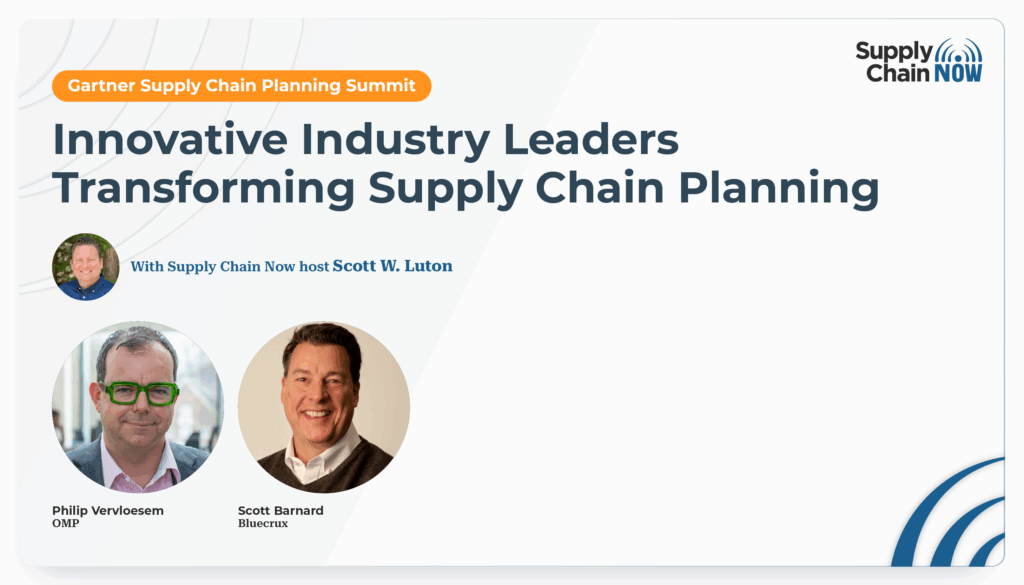
[00:00:14] Scott W. Luton: Hey, good morning, good afternoon, good evening, wherever you may be. Scott Luton here with you on Supply Chain Now. Welcome to today’s show in early December, 2025, I enjoyed venturing out to Denver for the Gartner Supply Chain Planning Summit. We took in a number of terrific conversations and presentations, including my brief chats with the two industry leaders that we are featuring here on today’s podcast.
[00:00:37] Scott W. Luton: You’re gonna hear first from a great discussion I had with Philip Vervloesem with OMP, and secondly, I’m gonna be sharing a chat I had with Scott Barnard with Bluecrux. Both Philip and Scott are doing big things in the industry as their firms continue to grow and expand while helping. Organizations innovate and find more success out in industry.
[00:01:02] Scott W. Luton: In fact, OMP and Bluecrux have become strategic partners in supply chain optimization as their organizations have been collaborating for over 10 years. Uniting Forces for a greater impact. Let’s tune in first to my chat with Philip Vervloesem with OMP. Philip, it is great to connect with you once again here at Gardner Supply Chain Planning Summit 2025 in Denver.
[00:01:27] Scott W. Luton: Save there. You have been busy.
[00:01:29] Philip Vervloesem: It’s been extremely busy. It’s kinda like the last sprint of the year for the busy sprint.
[00:01:33] Scott W. Luton: Well, plus where your booth is there. Y’all got pole position?
[00:01:36] Philip Vervloesem: Oh yes. This is perfect what I’m hearing. Oh yeah, yeah, absolutely. Absolutely. But I know
[00:01:38] Scott W. Luton: you’ve been talking and y’all work with.
[00:01:40] Scott W. Luton: A lot of movers and shakers across the industry. I think you presented here yeah. This week or heard of great things about the case study y’all presented. Yes. And of course we’ve enjoyed our past conversations. Having you on Supply Chain Now. You always bring us the best of the best, so we appreciate that.
[00:01:55] Scott W. Luton: But for that, for three folks out there, the three folks, maybe four that don’t know Philip, don’t. OMP, there’s still a few. Yeah. Tell us about what OMP does.
[00:02:05] Philip Vervloesem: Well, I think I can position it best based on what Tiago with Kraft Heinz presented yesterday because he is all about the drive to autonomous planning, driven by a dec decision centric way of working, monitoring it.
[00:02:17] Philip Vervloesem: So we did. We deliver the platform, we deliver the expertise to drive real results, real solutions, and getting our customers to that path. Um, I feel like, you know, a lot have changed, of course, but our base, our core is to have that, what we call unison planning, the solution suite. Yeah. That’s embedding all of the planning processes from strategic to operational and from sourcing to demand, and having that in an embedded way with the SAPs.
[00:02:44] Philip Vervloesem: And so from a data point of view, key, yes.
[00:02:48] Scott W. Luton: Doing supply chain, like it’s 2055, not like it’s 20, uh,
[00:02:52] Philip Vervloesem: 1985, right? Yes. Yeah. Yeah. And your role, OMP Philip? I’m the Chief Commercial Officer and heading Alto is also into new markets, so I’m commercially responsible for the global operations there. Yes. Also the liaison for the Gardner executives and the community as well, which we shape like we did two weeks ago at our conference in Miami.
[00:03:11] Philip Vervloesem: Yes. Both towards our key customers, uh, driving innovation, driving, of course the industry growth.
[00:03:16] Scott W. Luton: And Philip, I, I’ve met few people Yeah. That believe in the in-person conversation and relationship and invest in that regularly. Oh, yeah. Like you do, you, you live on a plane and there’s Well, everyone that knows you knows it, huh?
[00:03:28] Philip Vervloesem: Well, it’s, I, I wish there are electric planes, but, but no, I, I feel, uh, it’s a, it’s a value, especially Yes. In some of the new markets we’re expanding into Yeah. To build the right level of trust and be there with both our customers, potential customers and our alliances as well. That’s right.
[00:03:44] Scott W. Luton: You gotta take time and invest that fast time.
[00:03:46] Scott W. Luton: Absolutely. And as we craft new ways of doing things, correct? Yes. Alright. So you’ve already kind of touched on this a little bit, but when you think of some of the old and new challenges Yes. The supply chain planning teams are faced with, yeah.
[00:03:58] Philip Vervloesem: Yeah. What comes to mind? Well, I think the old challenge that hasn’t necessarily changed, but that’s key is of course delivering value.
[00:04:05] Philip Vervloesem: And we translated that in delivering real value, right? So it’s not just all the AI bus, but it’s really honing now on the zoning in, on the real. But what has changed there is that companies want value quick. They want an incremental, they want it actually ideally in like a self-funding way. Self-funding, ROI.
[00:04:25] Philip Vervloesem: So having that more agile approach to deliver the value in a very quick way, that’s one that comes together with our industry solution templates. Yes. As well as the expertise that we bring. On the other hand, our theme for the conference two weeks ago ago was riding the real wave. And so that’s really nicely aligned with our way of working and our future proofness as well.
[00:04:45] Philip Vervloesem: So one riding the real wave. Right. So not investing, not all the PL out there. Exactly. Investing in the right core innovation with our strategic customers. And that syncs up well with, I dunno if you saw the keynote here this week at Garner, but it was about how to go from the surface and some of the routine jobs that are of course are important to take over by Gen AI and so forth to go to the Deep Sea, right.
[00:05:08] Philip Vervloesem: And also go into that human machine collaboration, the governance around and forth. And I feel that is in many of our Korean for innovation initiatives. The key Yes. To get there. And you’re doing it, you’re doing
[00:05:20] Scott W. Luton: with your customers. Right. Because as that keynote pointed out, right, to go deep Yep. You’re finding some scary stuff.
[00:05:26] Philip Vervloesem: Yeah, yeah, yeah. To be fearless. Right. I remember like the big, uh, big slogan, be fearless. Yeah. That’s the thing. Like we like customers to experiment and then take it from the experiment of the pilot to industrialize it. Yeah. And you know, one of the best things
[00:05:40] Scott W. Luton: about the OMP approach. Is, we’re not talking about a two year implementation.
[00:05:45] Scott W. Luton: Right? Exactly. That’s two year return on investment. Yes. Yes. We’re talking as Jake Barr has said. Yep. Pointed out time and time again on some of our conversations. Yep. Hey, take the savings and the winnings from the first. Pilot.
[00:05:58] Philip Vervloesem: Yep.
[00:05:58] Scott W. Luton: And apply that to rollout apply. Exactly,
[00:06:00] Philip Vervloesem: exactly. That’s the self-funding part, right?
[00:06:01] Philip Vervloesem: Exactly. And so we worked out now a concept, we call it unison express, to combine a quick start approach from an implementation point of view to drive value together with this industry solution template that’s elevated a level higher as well.
[00:06:16] Scott W. Luton: So you’re already reading my mind. ’cause I was gonna ask you about yeah.
[00:06:19] Scott W. Luton: Some of the ways that OMP is helping address old new challenges. Yeah, you already covered some of those. Yeah. Is there anything else you want to make sure we spike your
[00:06:27] Philip Vervloesem: football on? The one other element that I wanted to mention that we also emphasize quite heavily on during our conference two weeks ago is Unison iq.
[00:06:35] Philip Vervloesem: Unison IQ is based on three pillars. It’s on what we call the AI engines that have been developed since a while, and that we now see even more used in the autonomous planning. Second one is our unison companion with the AI engine engine, the gen AI engine engine, to be able to really drive adoption, onboarding faster.
[00:06:52] Philip Vervloesem: Onboarding and productivity. Yeah, and then you have the agent side really upskilling both organically the AI agents, for example, explainability scenario planning, and so as well as being able to combine that with the ecosystem of externally upskilled agents and putting that all together.
[00:07:08] Scott W. Luton: Philip. It’s a powerful description of what y’all are doing.
[00:07:12] Scott W. Luton: Yeah. It’s very succinct. Right. We could be here for several hours to talk about the impact. Yeah, exactly. And the different industries you’re driving change along with your customers in, but it’s here. It’s not lip service.
[00:07:23] Philip Vervloesem: It’s
[00:07:23] Scott W. Luton: here. We got we. We gotta jump on the opportunity now.
[00:07:25] Philip Vervloesem: Exactly. Exactly. And that’s why we like to bring the guys like Kraft Heinz out to showcase also how they invested.
[00:07:30] Philip Vervloesem: Same with AstraZeneca a few weeks ago. Yeah, that was a, that was a, that was a good one, right? Yes, yes, yes. Okay.
[00:07:35] Scott W. Luton: So Philip, again, I know you’re on the move a lot getting out, talking with customers and prospective customers, helping them achieve breakthrough moments. Mm-hmm. And a lot more. But how can folks track you down if they want to be part of the OMP Express, I’m gonna call it?
[00:07:48] Philip Vervloesem: Yes. Yeah, yeah, exactly. So I would say there’s two ways. One. I, I think I’m enough on LinkedIn. Is it easy to just DM me or, or just put a poster there? So that’s easy. And our website contains all of the information as well from the events that we are organizing ourselves that you can connect to, of course, and all the assets that we bring out.
[00:08:05] Philip Vervloesem: So, yes. Love it. Phillip. Thanks so much. Thanks man. Alright, appreciate it. Alright,
[00:08:10] Scott W. Luton: next. Let’s tune in to my discussion out in Denver with Scott Barnard with Bluecrux. Scott. We’re here in Denver at the Gartner Supply Chain Planning Summit 2025. It’s been a gorgeous day and I’ve enjoyed the brisk weather out there in Denver.
[00:08:26] Scott W. Luton: Please stay hot, Georgia, right? You’re not as big of a cold weather fan, is that right? I’m not. I am not. I am a three season guy. Three seasons. Okay. So let me guess. Fall, summer, and spring. Exactly. Okay. Alright, well, I can deal with that too. Um, Colorado Summers I would love, oh, I bet Colorado winters not quite my, for the birds.
[00:08:46] Scott W. Luton: Alright, so let’s talk supply chain. And I want to first start, you know, look, Bluecrux is growing left and right. Globally, you got some great things going on here across the United States. Mm-hmm. I’ve enjoyed our past conversations. I’m looking forward to your take takeaway around supply chain planning here today.
[00:09:03] Scott W. Luton: But first off, for the three people out there that may be new to Bluecrux, tell us about what the company does and your role. Right,
[00:09:11] Scott Barnard: So Bluecrux is a value chain consulting and technology company. So what we are here to do is help organizations transform their supply chains into smart, efficient. And AI powered value chains.
[00:09:24] Scott Barnard: That’s our mission. Love it. We do that with a full suite of supply chain consulting services, so think a plan, source, make, deliver all through that spectrum. We help companies with operational challenges, strategic planning, organizational planning, all the way down to digitization, helping them implement digital tools along the supply chain as well.
[00:09:43] Scott Barnard: And then we have our own purpose-built internal digital tools that we bring to the industry. One is specifically for. Planning and scheduling in the pharmaceutical space. And the other is an analytics and decision making platform.
[00:09:56] Scott W. Luton: Okay. Quite a breadth Yes. Of products and services. And your role with Bluecrux?
[00:10:02] Scott Barnard: I am the managing director for North America for Bluecrux. So the US is my market and my, my focus and my passion.
[00:10:09] Scott W. Luton: Lots of growth opportunities, lots of innovation opportunities. And it sounds like based on what you just described, you’re helping a lot of companies find their own breakthrough moments in a wide variety of sectors.
[00:10:19] Scott W. Luton: Okay. So one of my favorite phrases, I say a lot I didn’t wanna listen to our podcast is What’s old is new again. Right? Because there’s so much truth in that. Yeah. Right. We take something from 50 years ago, slap a new label on it and, but it’s not new. But with all that said, we think of old and timeless challenges when it comes to supply chain planning and some of the new challenges, new twists to the craft.
[00:10:44] Scott W. Luton: What comes to your mind? Um,
[00:10:46] Scott Barnard: when I think of some challenges that have been there for a while and companies that have been striving for, it’s all about that resiliency and agility. How am I getting more resilient in my supply chain? How am I getting more agile in my ability to adjust my supply chain?
[00:10:59] Scott Barnard: Those have been challenges that have been, we’ve been talking about for five, 10 years. That’s right. In, in different ways. I think when I think of new challenges, it’s ai, right? So how are we adopting in that? And agility and resilience framework, how are we adopting AI to speed up that and better inform that decision making process?
[00:11:20] Scott Barnard: Right. To make us even more resilient and to make us more even more agile.
[00:11:24] Scott W. Luton: Yeah. Deliberately in a targeted manner. And with that, like we’ve heard here all today, that effective blend of the human and machine strategy. Right. Right. Good stuff. Alright, so let me ask you, this begs a question. Especially based in your earlier response, gimme one good way that you, that really excites you, that Bluecrux is helping to tackle those challenges.
[00:11:47] Scott W. Luton: God, we do
[00:11:47] Scott Barnard: so much, right? Uh, in that space might be we right to tackle so many use cases on the process side that we can talk about. I think back to what’s new was new challenges. I think one new challenge that’s exciting is again, how are we helping. In that AI space. Yeah. How are we helping with those a DM, those, those analytics and decision making decision intelligence platforms.
[00:12:10] Scott Barnard: So how we’re doing that with our Axon platform, I think is, is extremely exciting. We’re gonna be talking about that tomorrow morning. Okay. Here at the Gartner Supply Chain Planning Summit and really highlighting a fantastic use case where we’re literally helping organizations identify and save hundreds of millions of dollars in inventory.
[00:12:27] Scott Barnard: So it’s immensely impactful if done intelligently and if done correctly.
[00:12:32] Scott W. Luton: Oh, Scott, that’s terrific. And I should know this, but I’m gonna ask you again the name of that platform again? Axon. Axon, yes. I said that right? Correct. Spell that for me. A-X-O-N. Oh, just like it sounds. Exactly Axon. Okay. Well I’m looking forward to checking out that session and man.
[00:12:47] Scott W. Luton: Hundreds of millions of dollars that dog will hunt, as they say
[00:12:51] Scott Barnard: in Georgia. That
[00:12:52] Scott W. Luton: is
[00:12:52] Scott Barnard: ROI and speeds.
[00:12:53] Scott W. Luton: Yes. Yeah. Outstanding. Okay, so Scott, I bet you’re gonna have some folks based on what you just dropped there, I wanna connect with you, kind of pick your brain and what you’re doing globally and here across the us.
[00:13:04] Scott W. Luton: How can folks track you down, Scott?
[00:13:05] Scott Barnard: So track me down personally, super easy. I think LinkedIn is probably the easiest way to find me. Reach out. Uh, Scott Barnard on LinkedIn. Yep. You can also go to the Bluecrux page on LinkedIn. Send us messages there or you can find us and reach out to our website as well too bluecrux.com.
[00:13:22] Scott W. Luton: And you know this is not a spelling quiz. But Bluecrux. BLUECRUX.com. Correct. Okay, good stuff, Scott. I appreciate you spending some time with me today. Okay, everybody good stuff there from Philip and Scott. Now on a side note, you may want to mark your calendars for these big 2026 events from the Gartner team.
[00:13:43] Scott W. Luton: You can join us at Gartner Supply Chain Symposium in Orlando on May 4th, fifth and sixth, 2026. And the Supply Chain Planning Summit returns to Denver on November 2nd and third, 2026. You can learn more on both events and many others at gartner.com Folks, I hope you’ve enjoyed and learned from these conversations as much as I have.
[00:14:09] Scott W. Luton: You can find many other conversations on our new website at supplychainnow.com, specifically at the resource hub on our site. But you know your homework right? Take one thing that Philip or Scott shared here today and put it into action deeds, not words. That’s how we’ll continue to, to drive innovation in global supply chain.
[00:14:35] Scott W. Luton: And with all that said. This is Scott Luton here on behalf of the Supply Chain Now team, challenging you to do good, give forward and be the change that’s needed. And on that note, we’ll see next time right back here. On Supply Chain Now. Thanks everybody.
[00:14:52] Voiceover: Join the Supply Chain Now community for more supply chain perspectives, news and innovation, check out supplychainnow.com.
[00:14:59] Voiceover: Subscribe to Supply Chain Now on YouTube and follow and listen to Supply Chain Now wherever you get your podcasts.