[00:00:00] Tanner Dastrup: And so the goal is that all of that is going to be housed in one location, right to where we don’t have to pull our full truckload data from a spreadsheet, our LTL data from a TMS, and then our parcel data from the parcel carrier. All that is gonna be housed under one house, one location, and. We’re already seeing the benefits of that on the data side as well.
[00:00:22] Voiceover: Welcome to Supply Chain Now the number one voice of supply chain. Join us as we share critical news, key insights, and real supply chain leadership from across the globe. One conversation at a time.
[00:00:35] Scott W. Luton: Hey, good morning, good afternoon, good evening, wherever you may be. Scott Luton here with you on Supply Chain Now. We’ve got a terrific panel that’s gonna be offering up a case study full of actionable takeaways. We’re gonna be touching on a wide variety of topics from how to solve limited shipping flexibility. It’s always a challenge. How to overcome data and integration hurdles, how to powerfully automate your shipping processes.
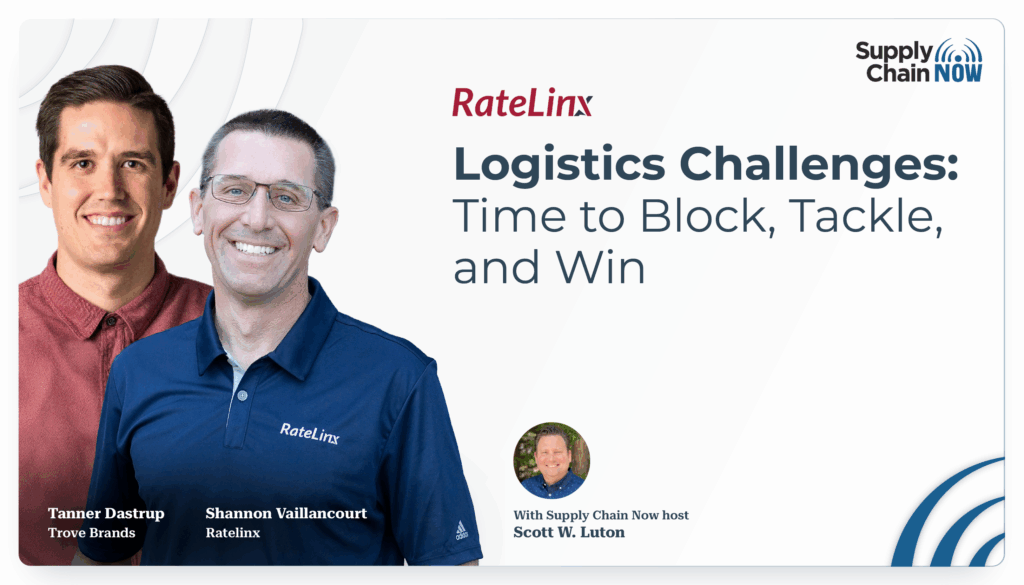
[00:00:57] Scott W. Luton: That’s gonna delight your customers and your team members. And better yet, how to select the right partner when it comes to innovative supply chain. Technology, all that, and much, much more. So we’re gonna jump right in. I wanna get to work. I wanna welcome in an outstanding panel, Tanner Dastrup, director of Logistics with Trove Brands.
[00:01:17] Scott W. Luton: Tanner brings more than 12 years experience with a growing organization, fine tuning, and excellent team that delivers for its customers. And joining Tanner and I today backed by proper demand. 30 year industry veteran and the innovative founder and CEO of RateLinx, Shannon Vaillancourt. Folks, you’re gonna enjoy hearing Shannon’s perspective on what Tanner and Trove Brands are doing and what he sees out in the industry.
[00:01:43] Scott W. Luton: So let’s welcome in. Shannon and Tanner. Hey Tanner, welcome in. How you doing?
[00:01:49] Tanner Dastrup: Doing well, thanks Scott.
[00:01:51] Scott W. Luton: Outstanding. It’s been great to meet you. Learn more about the great things you’re doing at Trove Brands. And Shannon, welcome in once again. How you doing? I’m doing pretty good. A little cold, but other than that, I’m doing just fine.
[00:02:03] Scott W. Luton: It is some abnormal weather out your neck of the woods, is that right? Yeah, just a little, little rainy this week. Oh man. Uh, we were talking pre-show. I was up in Vegas last couple days and it rained both days and hailed yesterday. Yeah. But interesting times. Regardless, we got a lot to get into here today and so Tanner and Shannon, great to have you both.
[00:02:23] Scott W. Luton: So I wanna start with this so we don’t get enough context. In this ever faster moving world. Tanner, I wanna offer up some valuable context First for everybody out there, can you tell us about yourself and give us a quick overview of what Trove Brands does?
[00:02:40] Tanner Dastrup: Yeah, absolutely. Well, first of all, thanks Scott for having me on the show today and excited to be here with you and Shannon.
[00:02:46] Tanner Dastrup: So, yeah, a little bit about me. As it was said, I’m the director of Logistics here at Trove Brands. Been with the company just about 12 years. And I actually first started off in the warehouse when it was just BlenderBottle at the time, and I was there for nine months or so, and then shortly moved into a logistics role where I was, uh, handling, you know, outbound shipments for parcel LTL.
[00:03:08] Tanner Dastrup: Then over the years, just grew with the company, so took on some leadership opportunities in a lead role supervisor. And now, uh, the director of logistics. So it’s been really cool to see not only the growth that I’ve seen personally, but just the growth of the company. And that kind of leads me into Trove Brands and who we are here at Trove Brands.
[00:03:28] Tanner Dastrup: Trove Brands is a, is it’s a collection of brands that’s really, you know, to simplify and improve everyday lives. So the owners, Kim and Steve, they founded a BlenderBottle in, in early 2000, uh, in Lehigh, Utah. And that’s where we’re headquartered today. And real quick just to dive into it, it’s kind of an interesting story.
[00:03:47] Tanner Dastrup: So I wanted to share how BlenderBottle came about. The owner, Steve Sorensen. He was, uh, traveling for work and he, he didn’t have time to stop and get breakfast. So he had a, a protein shake.
[00:03:58] Scott W. Luton: Okay.
[00:03:59] Tanner Dastrup: And he didn’t have anything to mix that protein shake. And so he says he had a cup and a spoon, and I think he just did his best, the best he could to mix up that powder and, you know, took a sip and it was just clunky powder.
[00:04:11] Tanner Dastrup: And I think he threw the rest away and went and bought a Snickers bar, and then went home and developed the whisk that goes into that BlenderBottle. And then the rest is history. So BlenderBottle saw some early success, really dominated that, that market of the Shaker Cup. And then over the years we added new brands to the wine.
[00:04:31] Tanner Dastrup: So we have Whiskware, which is like a snacking container. More recently, about five years ago, we came up with a wallet that was an in-house brand that has now just taken the world by storm. And it’s been really exciting to see the consumers grab onto that brand. It’s fun. Fun colors, limited color additions and waves, and it’s just been so exciting to see.
[00:04:53] Tanner Dastrup: And then more recently we’ve also gotten into the nutrition space. So both nutrition, clear whey protein, pre-workout, all that stuff. So a lot has happened over the years. In those 12 years it’s been quite a ride, but it’s been a fun one.
[00:05:08] Scott W. Luton: It sounds like it. And I love that origin story. And by the way, he mentioned Avana folks.
[00:05:13] Scott W. Luton: You may know I’m a kind of pseudo germaphobe as my kids tell me I am about to complete my order for those natural bottle cleaning tablets under the Avana brand. So folks, we’re all using water bottles these days to get you some cleaning tablets. You don’t wanna know if you, if you don’t clean those bottles, bad things happens.
[00:05:31] Scott W. Luton: Anyway. Shannon, man, you brought quite the story to us here today. I look forward to diving more into Tanner’s journey and, and the Trove Brands journey. But for folks that may have missed. Our con your conversations with us over the years, especially for our new audience members. Would you share a little bit more about yourself and RateLinx?
[00:05:50] Shannon Vaillancourt: Let’s see. I’ve been in the industry for about quite a while, over 30 years now that I’ve been doing what I’ve been doing. And you know, I just love working with companies like Trove Brands, helping them on the logistics and transportation side with our solutions. I always get a kick out of. Just learning about all these companies and how they came about and, and helping them with all their challenges that they have.
[00:06:14] Shannon Vaillancourt: So, looking forward to today’s conversation to share with the world and see how Trove Brands has a lot of unique things that they do and how we were able to help ’em out.
[00:06:25] Scott W. Luton: I’m with you. I’m looking forward to learning more. I got my notes ready. So let’s do this. Tanner, you have touched on your portfolio products, right?
[00:06:33] Scott W. Luton: All the different lot items I mentioned the one of my favorites, those, uh, those tablets. Let’s talk about the scale of your shipping operations and the mode you typically use. I think it’s important context. Tell us more.
[00:06:45] Tanner Dastrup: Yeah, absolutely. You know, when I first started the company, it was mostly parcel business to business with LTL of course, and then few full truckloads here or there.
[00:06:54] Tanner Dastrup: We weren’t quite at the size to sip ship, many full truckloads. And fast forward to today, you know, that’s changed significantly. You know, today full truckload is a massive part of what we do. LTL of course is still, you know, is a big shipping mode of ours as well as parcel B2B. And then another area that we’ve seen that’s grown rapidly has been our e-commerce.
[00:07:15] Tanner Dastrup: So parcel e-comm, you know, and as a wallet has taken off and as our websites, I guess, sales in general has taken off. E-commerce. We’ve seen that internally. And so I think as I look back to where we were, to where we are today, it’s a completely different company. Like completely different should be profile.
[00:07:33] Tanner Dastrup: But yeah, full truckloads, e-commerce. Really a bulk of what we do here today.
[00:07:38] Scott W. Luton: Okay. Outstanding Tanner. Well, you know, one of the big themes we’re talking about here today is these common obstacles that shippers face, right? I’m gonna start with one of the first ones, and we’re get Tanner and Shannon both to weigh in limited flexibility.
[00:07:51] Scott W. Luton: We need all the flexibility, agility, resilience, and patience we could get in a modern global supply chain. Tanner. How has a lack of shipping options slowed down your operations and driven higher costs, and most importantly, perhaps affected the customer experience?
[00:08:09] Tanner Dastrup: Yeah, it’s a great question. Focusing more on the parcel side, I feel like we didn’t have a lot of volume back in the day to really be diversified with multiple carriers, and so we kind of just did like a, a rule-based awarding system where it was, Hey, if it’s shifting to this location, this is the carrier.
[00:08:28] Tanner Dastrup: We really didn’t have a lot of options for, you know, the modes of transportation, the transit time. We didn’t have a lot of flexibility there. But as we’ve grown, you know, we’ve seen that our volume has been able to help us secure better pricing, but also diversify a little bit with our carrier mix. One thing that RateLinx has helped us out greatly is we didn’t have a system where we could rake shop e-commerce or parcel, right?
[00:08:51] Tanner Dastrup: And so we just kind of said, Hey. The shipping to this customer in this area use this carrier. Whereas today, we’re able to throw in every single order that we get into our system rate shop live. So we know, you know, is there a peak season surcharge there listed? Now you know what’s the transit time we can really dial in?
[00:09:10] Tanner Dastrup: Our shipping options and select the best carrier for the best price that’s gonna get to the customer quicker and cheaper. And that has been a huge home run for us. Yes,
[00:09:21] Scott W. Luton: Tanner, I love that. I’ll tell you, you just took me back to my earliest days in industry where I was shipping construction materials out to sites across, uh, north America, and we used three or four shippers based on the general region, right?
[00:09:35] Scott W. Luton: Oh my gosh. Very constrained Shannon to kind of broaden it out here. Those challenges and some of the perspective Tanner shared. When you think about what you see out across industry and all other companies you’re working with, how do limited shipping options and. Inconsistent carrier choices, affect costs, and that customer experience.
[00:09:55] Scott W. Luton: What strategies? Yeah. Are you a two part question, Shannon? You know, I gotta, I gotta sneak a second one. In what strategy? Make it hard,
[00:10:01] Shannon Vaillancourt: solve these challenges. It’s like, now I gotta, I gotta really concentrate here today. So the, uh, this is what I love about what we do is when you’re working with. Companies like Trove Brands.
[00:10:14] Shannon Vaillancourt: ’cause it’s, it’s interesting, you know, a lot of people wanna work with really, really big companies. And what I like about this size of company, right, right in the middle, right in the sweet spot is as they’re scaling, this is what they run into. ’cause what happened, you know, yesterday and what they were able to do yesterday.
[00:10:33] Shannon Vaillancourt: It’s not that it doesn’t work today, it’s that they just have more. More volume. So that instant is gonna happen more often. So by giving them a tool and software to help them make decisions faster, they’re able to now come up with real strategies and diversify the freight, which then allows ’em to tap into cost savings opportunities, service opportunities for customers, and being able to weigh both of those together.
[00:11:01] Shannon Vaillancourt: So now. That gets ’em to the next level. And it’s like that’s really what the technology is for, I think. Otherwise you can absolutely do it. We’ve always talked about this. You can absolutely do it. You just need a team of a lot of people. And for those that have talked with me a lot, you realize that unfortunately as as people, some days you’re just not on your a.
[00:11:22] Shannon Vaillancourt: You need that protein shake and you mix it up with a spoon. I couldn’t think of a more awful thing to try to drink than that. And now that I’ve got the, you know, after meeting with Trovan, going out to their headquarters, which is beautiful, by the way, getting my BlenderBottle a new one. It’s awesome. Yes.
[00:11:40] Shannon Vaillancourt: Um, and it, it, there’s no clumps. It’s the best ever. So now I can scale my protein as well, like they’re doing on the shipping side. So I
[00:11:49] Scott W. Luton: like it. I like your analogies there, Shannon, although a Snickers bar for breakfast. That sounds really good too. Tanner Shannon just touched on the drudgery, as I’ve heard some business leaders call it, of manual work, especially needless manual work.
[00:12:02] Scott W. Luton: So when it comes to managing shipping rates and carrier choices manually, that can be a big headache. I’ve been there, done that. How has this impact your ability to scale operations and of course, keep those costs under control?
[00:12:16] Tanner Dastrup: Yeah, no, that’s a great question. I have, I have two things that come to mind here.
[00:12:20] Tanner Dastrup: The first being with, with e-commerce, as I mentioned previously, you know, it was a very manual process where we had in rules that we would establish, right? And so what that would require is, hey, if it’s shipping to this customer in a PO box or a military base, or in this region or zone. We had to try and juggle all these rules manually, and it got to the, the point where you, we had to question if some of these rules were even accurate.
[00:12:49] Tanner Dastrup: And so, you know, we did see some issues in, with some orders where, you know, oh, we selected the wrong carrier for this in this region. Whereas now, you know, having a tool that can spit back rates and, and for a carrier that can’t take a certain area or zone won’t even rate. And so it, it really eliminates that guessing game and manual work.
[00:13:08] Tanner Dastrup: The other thing I wanted to hit up on was, uh, full truckload talk about manual process. This was a very manual process for us not too long ago, and I’m sure some people are gonna shriek a little bit or cringe when we say what this process was, but. You know, anytime we had an order that was a full truckload size, we would send out an email to our brokers and then we’d wait for all the quotes to come back in email, and then we would award that shipment through email, and then we’d have to go in and log the order details and that quote, and it was about as manual as it gets for full truckload.
[00:13:43] Tanner Dastrup: Fast forward to today in the system, having a, an option where we have an, an auction in our system where we plug in the order details. And then it, it fires out to our brokers. They can get on there, they can add their bids, they can go in there and they can add multiple bids if they really want the lane.
[00:14:01] Tanner Dastrup: And then on the invoicing side, because it was so manual before an email. Where did we get those invoices through email in the past. And so now they can upload those invoices in the system directly. We can go in, audit and approve all within the same system. And so looking back, I think we’re gonna laugh a little bit, you know, how that process was, but excited for this new system and having it all in one, one location, one software.
[00:14:29] Tanner Dastrup: And not having to try to try and juggle, you know, where was this awarded? What was the quoting on that again? Do I have to go in and, oh, we didn’t log it. It was about as manual as it gets. And fast forward to today, it’s, it’s automated.
[00:14:40] Scott W. Luton: Well on, on that. Fast forward to today. I mean, speed is what your response, I mean, we gotta move faster, but in your case, what you’re describing is not only moving faster at the pace of business, but moving smarter.
[00:14:53] Scott W. Luton: More successfully and more scalably, uh, uh, helping scalability. Lemme put it a different way. I need to have one of those sticker bars for breakfast this morning. Get my brain going. Shannon, I wanna follow up a, a similar question here. Why does limited automation and rate shopping often lead to those higher costs and scaling issues?
[00:15:12] Scott W. Luton: And, and again, talk about how else companies can overcome those obstacles. Kind of what Tanner was talking about.
[00:15:18] Shannon Vaillancourt: What’s funny is at least Tanner and the team were sending it out to multiple. Right carriers when they were emailing. I can’t tell you how often I run into it where they’ve got one and they’ve got the one.
[00:15:30] Shannon Vaillancourt: ’cause no, I get great rates. They take care of us. They take care of us. I’ve got great rates with this one broker and that’s how they do it. So they’re not even trying to find other options. They’re just going to one place. That is unfortunately how it works for a lot of people. So of course you could only imagine.
[00:15:51] Shannon Vaillancourt: What that would do to your price. And it’s like, you know, again, maybe some of the rates are good, but as we know with truckload, a lot of that is very, uh, very volatile. Prices are up and down depending on where equipment is. And then even getting back to your e-commerce side, as I’m sure as things grew, you were shipping to areas you’d never shipped to before, but it was covered.
[00:16:14] Shannon Vaillancourt: Probably in your old routing guide saying, well, I, this is who should probably do it. It’s like, you know, in this area it’s this carrier and then everything else, it’s this other carrier. And then all of a sudden you get introduced to, there’s a big wide world out there and not everybody delivers everywhere.
[00:16:33] Shannon Vaillancourt: And even if they do deliver there, maybe they shouldn’t deliver there. ’cause you know, we still got service that we gotta think about. And that’s where having a software. Do the work. It just allows you to move fast. You know, everyone talks about speed kills and it’s like, well, it does, unless you’re doing it, you know, the right way.
[00:16:53] Shannon Vaillancourt: And that’s where the technology just makes that decision over and over again, consistently and correctly. And that’s really what it comes down to.
[00:17:03] Scott W. Luton: Well said, Shannon. And of course, going back to the first part of your response, less options usually equals more cost, right? Mm-hmm. And of course, it’s gonna hinder.
[00:17:12] Scott W. Luton: Scalability and growth and problem solving and, and probably increase a lot more work on the team. You know, Tanner, as you’re talking about everything that was going into your email inboxes, oh my gosh, I was just picturing overflowing emails and I bet all of us can relate to that. A ton of manual work.
[00:17:28] Scott W. Luton: And, you know, the great news here, as we’re gonna touch on throughout the rest of the show, the, the best news is there’s a better way, there’s a better way to help provide our team members with better days. And better ways of serving customers. So Tanner, you touched on those invoices earlier, right? Or filling up in ml, uh, email inboxes.
[00:17:48] Scott W. Luton: A lot of companies on a similar note struggle with data and integration hurdles, right? You got a bunch of systems and none of ’em talk to each other. And whether that’s impacting freight audit discrepancies or ERP business intelligence connections or other things, how the challenges like that, how do they affect your ability to scale?
[00:18:07] Scott W. Luton: And get those critical realtime insights at Trove Brands. Tell us more about that, Tanner.
[00:18:14] Tanner Dastrup: Yeah, I think first on the integration side, as we were looking at a new system, a new TMS system, that was probably the first on the list is how does it integrate with our current ERP system. We actually moved to a new ERPA few years ago, and so that was.
[00:18:32] Tanner Dastrup: The number one on our list is how does it integrate? Not having to go from the ERP to a webpage to back to the ERP and and manually enter in details that we just awarded in the TMS, you know, was crucial for us where those things could communicate together. And we’ve seen that already where there are situations where we don’t even have to go to a webpage.
[00:18:54] Tanner Dastrup: The TMS, we can just, you know, rate shop and award orders within the ERP. It doesn’t sound big, but saving a couple clicks over time and over years is huge. So that alone, not having to remember, oh, okay, I’m in this system here now I have to pull up this system and click in this order here, that all can be managed within one, you know, our ERP, and that’s been a game changer for us Now on the data side.
[00:19:19] Tanner Dastrup: Very similar on the data side. We found ourselves having to go to multiple portals, whether it was a carrier portal or our TMS or what have you, to gather all of our data, our analysts on the team, she was taking notes and she’s like, okay, so I have to pull out this portal to get this information. I have to go here to pull this data.
[00:19:40] Tanner Dastrup: You know, and, and this transition to RateLinx is, is new for us. And so the goal is that all of that is going to be housed in one location, right? To where we don’t have to pull our full truckload data from a spreadsheet. Our, you know, our LTL data from a TMS, and then our parcel data from the parcel carrier.
[00:19:58] Tanner Dastrup: All that is gonna be housed under one house, one location, and we see we’re already seeing the benefits of that on the data side as well.
[00:20:05] Scott W. Luton: Tanner, that was outstanding. I, I gotta go back to earlier in your response clicks, folks, if anyone’s rolling their eyes off what he said about clicks. I just got back from the airport.
[00:20:15] Scott W. Luton: I’m not gonna tell you which one I was at. And I had to take a survey to get online access for free in the airport. I had to click it like 47 times to get the end of the survey. And by that time I was so frustrated. Well imagine team members having to do that 10 times a day every day. Oh, that adds up so fast.
[00:20:33] Scott W. Luton: Alright, so Shannon. You ready? I got another two-parter question for you. Okay. So what solutions have you seen companies use to overcome the hurdles that Tanner mentioned? He said, you know, first up into integration, right? Overcome the hurdles and scale effectively and share more about how Match Pay helps with invoicing discrepancies that, uh, a lot of folks are just oblivious to.
[00:20:57] Scott W. Luton: Tell us more, Shannon.
[00:20:58] Shannon Vaillancourt: Yeah. It’s funny. When customers go out to market, they’re looking for something that integrates to their. System. Right. And that’s good. But what I run into a lot is they have software that already integrates to their system, but what it doesn’t do is it doesn’t integrate into their process.
[00:21:18] Shannon Vaillancourt: And that’s where some of the things that Tanner was talking about, it’s, it’s about their process. Um, you know, so they’re able to quote freight directly from the ERP. And because that’s their process, right? But then I go to the next company, they don’t want to do it that way. They’re gonna do it a different way.
[00:21:35] Shannon Vaillancourt: You know? Do you have a system that is flexible enough to fit into your process? And do you have a partner that understands process as well? So I was actually talking with a company yesterday, and they have a product that they ship out that goes into two boxes. Okay? So you buy this item from them and it gets put into two boxes.
[00:21:56] Shannon Vaillancourt: And they’ve got, systems are all integrated, but for whatever reason, the shipping system doesn’t understand that this item goes into two boxes. So I guess they’re, whoever that is, whatever system that is told in the company, they need to stop doing that. And the problem is, it’s like 80% of their sales, it’s a top mover, this product that ships, you know?
[00:22:19] Shannon Vaillancourt: So imagine how do you handle that and connect all that together and then. Now you get an invoice in on the backend side of that stuff. So how do you know what your real freight cost is? Because when you ship it out, that’s what you’re accruing. That’s what you hope the freight is gonna cost. And then how do you actually match it all up at the end?
[00:22:40] Shannon Vaillancourt: And that’s where the match pay comes into play. And for a lot of customers that are out there, a lot of our companies that are leveraging this stuff, they have to be able to keep track of, you know, what was my real freight spend? Do I really have good information on my shipment information? ’cause if I’m doing these quotes, and maybe I’m using that to charge customers, or I’m using that to make decisions on freight cost, how accurate is it while the invoice tells you?
[00:23:12] Shannon Vaillancourt: And if you can match that back up to the original shipment, not only are you solving the whole settlement process, but now you’re really giving yourself. The business intelligence that you need to make sure that your strategies that you have in place are working correctly. ’cause it doesn’t do any good.
[00:23:31] Shannon Vaillancourt: If you’re shipping something out the door that you think weighs five pounds, that ends up weighing 15, it could completely change your decision on
[00:23:39] Scott W. Luton: what you’re doing. Early in your response, Shannon, really important. I loved your example, because the technology needs to meet the business with where it’s at and what’s working really well, but is already delighting the customers.
[00:23:53] Scott W. Luton: We don’t need to change any of that stuff to meet the technology, be outta the box, off
[00:23:58] Shannon Vaillancourt: the shelf. I mean, it’s like trove brands is growing for a reason. They’ve got that side figured out. Don’t make ’em change it. Right? What you wanna do is make it. You’re coming into Grease everything up, make it go faster, make it be easier.
[00:24:14] Shannon Vaillancourt: It’s, you know, get rid of the friction. Do that. Yeah, don’t
[00:24:16] Scott W. Luton: change it. It’s just silly man. That’s like telling Walter Peyton not to run, to catch more passes. Shannon, I know you’re a big Bears fan, right? That’s not thing to do. So, pivoting Shannon, uh, Tanner and Shannon from Big Picture Data Challenges to something a bit more specific.
[00:24:35] Scott W. Luton: And that’s your B2B lesson, truckload shipment. So Tanner, how do integration and rate visibility issues play out when you’re trying to give customers that all important accurate options and costs?
[00:24:49] Tanner Dastrup: Yeah, you know, it’s funny, I, I keep saying in the past, but I think it’s important to share where we’ve been and where we’re going and where we are today.
[00:24:59] Tanner Dastrup: I’m gonna do it again here and say in the past. Back to emails. We used to do a lot of quoting through emails for even our, our internal sales team. So, you know, our sales team, if they’re working with a customer and they’re trying to get a, a good quote on shipping to seal the deal with the customer, a lot of that was done through email.
[00:25:16] Tanner Dastrup: So they would send us over the details of where it’s shipping to, the quantities and everything. We would need to get an accurate quote, and then we would go rate shop it, and then we would reply in an email. And give ’em a quote. And the issue with that is, one, it was very manual, but two, there was a lot of time in between back and forth email.
[00:25:39] Tanner Dastrup: That quote a lot of times would change. And so what we’ve seen today is giving people access, even in the sales department to where they can go in. Again, going back to the integration piece, they can go in, create an order and run a quote themselves and see right then and there. How much is this gonna cost our customer?
[00:25:59] Tanner Dastrup: You know, is this gonna take a couple months? If it is, then I’m gonna rerun a new quote in a few months and see has that been updated? And so I think, you know, giving customers accurate costs and options has been crucial to streamlining the process, making it more automated, but also just helping with that relationship.
[00:26:18] Tanner Dastrup: I mean, a customer doesn’t want to get a quote. And then a few weeks later, find out that the market’s changed, and all of a sudden that’s, that’s increased significantly by giving them more real time quotes when it’s, uh, ready to ship or closer to ship, has been very helpful in all fronts.
[00:26:33] Scott W. Luton: Yes, Tanner, we, as you’re implying, as, as we all know, we wanna build trust with customers, and you can accumulate trust a number of different ways, but trust is built with every single interaction and transaction you have, including those quotes you mentioned.
[00:26:47] Scott W. Luton: Shannon, what patterns have you seen across industry when that B2B LTL checkout isn’t streamlined with shippers? And I know you know and can tell us where technology and process improvements can help solve these issues?
[00:27:01] Shannon Vaillancourt: LTL is probably one of the more difficult ones just because of the different.
[00:27:08] Shannon Vaillancourt: Pieces that are needed to rate an LTL shipment. And then now with some of the N-M-F-T-A changes on freight class with density based and all that stuff, it just makes it a little bit more complicated to get a good quote on that side. You know, how big is your pallet? How are you palletizing? Are your items subject to density based?
[00:27:31] Shannon Vaillancourt: Freight classes and then you just got a lot of other options out there on the LTL side and taking into account all the transit times. So, so that’s where that is, that is definitely a, a tough one that I see out there and that’s where the technology, again, is gonna cut through all that stuff, give you that nice quick, easy way to do, to get your answer and it’s accurate.
[00:27:55] Shannon Vaillancourt: And then also I think what it really does, it gives you control. So from a business perspective, if you’re putting rules in place around how you want to charge for that freight, maybe there’s free freight at a certain price level, order level, you can put all that in the system and, and it’s now, it’s instant, right?
[00:28:17] Shannon Vaillancourt: So the old days, you gotta tell everyone. So whoever was getting that original email had to have the instructions on how to send back the right rate. All that’s now in the system, you don’t have to worry about disseminating all that. And again, it’s speed. You know, now you just, it’s instant access. That’s the world we live in these days.
[00:28:37] Shannon Vaillancourt: Why? Why do I have to wait for something like that? And then, you know, at the scale as they keep growing and when you have one or two, that’s fine, but that’s not how it works anymore. They’ve got a lot more than one or two of these rolling through the system. So they need to be able to move fast and be accurate.
[00:28:56] Scott W. Luton: Uh, well said Shannon, so I could comment on so much there. Spreadsheets and emails are wonderful things, but we can run global supply chains or any supply chains using better tools these days. And to Shannon’s point and maintain control, use innovative technology, but still maintaining control. Okay, so Tanner and Shannon, we’ve explored the challenges around those, beat those pesky.
[00:29:18] Scott W. Luton: B2B LTL shipments that checkout accuracy, right? When we build trust with our customers. I wanna shift to another common pain point. Operational inefficiencies that come from managing both the warehouse and three PL workflows along with that inconsistent carrier selection We referenced a couple times earlier, so Tanner juggling warehouse.
[00:29:40] Scott W. Luton: Pick pack route workflows alongside three PL shipments. It can get really complicated. It can create lots of headaches, which is not good. Can you share why having two different shipping workflows slows down operations and effects scalability?
[00:29:55] Tanner Dastrup: Yeah, absolutely. Given the growth that we’ve seen, you know, over the years, we, we have outsourced two third parties, we could not handle the growth here within our own warehouse.
[00:30:05] Tanner Dastrup: And so being able to partner with some three pls was a major strategy of ours. In the past couple years. And so we feel like we had our operations here at the headquarters dialed in. ’cause we had years and years of time and automations and experience to do so. And you know, as we were outsourcing, we were finding that we were trying to juggle all these different processes.
[00:30:27] Tanner Dastrup: Okay, this third party, this is their process. We have to manually communicate these orders in a spreadsheet. And then manually send them the labels that they’re gonna print out. Bill of lading, the pallet labels, the case labels. We were finding that there was a lot of that manual back and forth that was causing that, you know, us to not only take time to send those, but also creating some errors.
[00:30:50] Tanner Dastrup: Now, you know, with this new system, being able to give them access to the system with limited permissions, they can go in there, they have visibility on the orders. They can print bill of ladings, pallet labels, case labels, all from the system. Looking back again, this is gonna be another situation where we’re gonna, we’re gonna laugh a little bit and say, I can’t believe we were doing that.
[00:31:11] Tanner Dastrup: I think it’s gonna improve not only just time and the process as a whole, but accuracy. And make sure that they’re getting the documentation that they need in a timely manner. They’re not waiting on us to send them information. They’re not waiting for us to send over those labels. And so really it’s, it’s allowed for us to streamline our processes regardless of where the orders are being shipped and fulfilled out of.
[00:31:34] Scott W. Luton: It’s good to have a healthy sense of humor. And Tanner, to your point, when I think about some of the ways I did things in industry and outside of industry years ago. I laugh and chuckle still. Mm-hmm. Including sometimes just last week. So when, last week maybe. Um, alright. So Shannon, on this topic of dual, or maybe even better way of putting it, dueling workflows and inconsistent three PL carrier choices, how does that really negatively impact organizations and what approaches are you seeing leading companies take to solve
[00:32:05] Shannon Vaillancourt: it?
[00:32:06] Shannon Vaillancourt: Yeah, I mean, you know, it’s funny, uh, we’re very, we have a lot of ingenuity as humans and it’s funny what we will. Make work is the way to, to look at it. And that’s where sometimes what I see a lot of companies do is they try to, you know, run everything the same way. And really it comes down to a training issue.
[00:32:27] Shannon Vaillancourt: Uh, so you’re either gonna make your three pl try to fit into your system and the way that you’re doing things, or you’re gonna turn yourself inside out. That’s where, again, having that flexibility, having a system that can integrate into the process, because yeah, that process with the three PL is a very different process than what you’re running at your own warehouse, and that’s where you’ve gotta really be flexible enough and have that automation there otherwise.
[00:32:57] Shannon Vaillancourt: Yeah, you’re just, you’re wasting a lot of time and energy. I mean, it’s like, like the guys on Apollo 13, you think they wanted to use a sock, but they had to. Right? And it’s like, well, we’re not, you know, on the moon, we’re not stock. There are other options that we can use here. That’s where I think having that flexibility, again, for me, it always comes down to process.
[00:33:19] Shannon Vaillancourt: That’s what I’ve learned, the technical nuts and bolts of everything. That’s not the hard part of what we do. It’s, it’s getting it into the process, understanding the process, and making it work within there. That’s the usability side of software that I think is overlooked a lot of times. That’s right.
[00:33:38] Scott W. Luton: We’ve been doing a lot of these shows and I’m a big old space nerd, but that might be the first time Apollo 13 and socks have been used as an effective supply chain analogy on a show. And it’s so true, Shannon. Sometimes we as humans just lock ourselves into limited options just with a mental block or because how we’ve done it that way or whatever, or maybe we’re fearful about.
[00:33:59] Scott W. Luton: Leaning into newer breakthroughs in technology and it doesn’t have to be this tough
[00:34:05] Shannon Vaillancourt: Yeah, it’s the devil, you know, sometimes really has a lot of power and, and I just don’t, I don’t get it. Yeah. Same.
[00:34:13] Scott W. Luton: Okay. So Tanner and Shannon, man, this is a wide ranging conversation in case study here today. We’ve covered, we just covered a workflow and, and lots of carrier challenges.
[00:34:22] Scott W. Luton: We’re gonna zoom out now to the global stage. And tackle visibility gaps that can exist, especially in international shipping. Chasing those containers around managing ocean rates. Mm-hmm. And hopefully reducing reliance some, some way, shape or form on forwarders. Right. Bringing our destiny within our own control.
[00:34:41] Scott W. Luton: So Tanner container tracking and connecting that data back to anyone’s ERP can be tricky. You talked about how integration was one of your top priorities. Can you share how these visibility challenges can play out in day-to-day operations? Yeah,
[00:34:55] Tanner Dastrup: absolutely. Yeah. Going back to your comment, Scott, about businesses being built on spreadsheets and emails, that’s what we were built on.
[00:35:03] Tanner Dastrup: Spreadsheets and emails, just about every process that we did, there was a spreadsheet that we were in, and that applies here as well for container tracking. You know, a lot of what we used to do in the past with continued tracking was a shared sheet with the forwarder. They would go in there and add updates to the container and say, Hey, this container’s delayed because of X, Y, or Z.
[00:35:25] Tanner Dastrup: Now, once we got into our new ERP, we found that there was a lot of fields for container updates. I mean, I think there’s probably 20 to 30 fields where you could get updates and status updates of where the container’s at, what’s happened to the container, when it’s gonna arrive, when’s the new must arrive by date.
[00:35:44] Tanner Dastrup: And we found that before RateLinx, you know, we were able to utilize those fields, but they had to be manually entered still. We would get what the forwarder would tell us, and we would go in and we’d update those fields manually. Now, with this automation and, and integration with, with RateLinx in our ERP, all of those fields can be updated automatically without having someone to go in and, and update those manually.
[00:36:09] Tanner Dastrup: And the reason why that’s so important, not just to. Remove the manual process. We have a lot of customers who are expecting product to arrive at their door on time. Mm-hmm. And that’s one of the biggest things that we oversee here at at Trove and, and, and on my team is. You know, on time in full to the customer.
[00:36:29] Tanner Dastrup: And even a weak delay over the ocean or at the port can really throw a, a, a, a wrench in our on time compliance to our retailers. And so having more updated real time visibility allows us to go to the customer ahead of time and say, Hey. There’s gonna be a slight delay. Can we get an extension? As opposed to a week before trying to knock on their door and say, Hey, we’re gonna be a little late, and they’re gonna kind of say, oh, sorry, chargeback is coming.
[00:36:57] Tanner Dastrup: Being able to communicate ahead of time and say, you know what? There’s gonna be some delays. We’re noticing this 30 days out, given that integration and that real-time visibility. So I would say even maybe more so above the improvements to the manual process, the visibility that it gives us and the data.
[00:37:16] Tanner Dastrup: And our ability to pivot and communicate upstream to the customer has been a game changer.
[00:37:22] Scott W. Luton: Yes. Oh, Tanner, I wanna, I wanna move upstream. Something you shared earlier when you were talking about manual work and, and Shannon, we’ve talked a lot about the risk that manual data entry call poses out there, including errors.
[00:37:34] Scott W. Luton: You know, I’ll never forget, years and years ago when I was in the food industry, I shipped out a ton of self-rising flour to a baking store right prior to their holiday baking season. And they didn’t want self-rising. They wanted normal flour. I got chewed up one end and out the other and spit out. I’ll never forget it.
[00:37:53] Scott W. Luton: But those errors, that manual data entry of any kind, just brings in the operations. It, it really poses a great risk to protecting that customer relationship and that trust. Your quick comment, Shannon, before I continue with Tanner.
[00:38:07] Shannon Vaillancourt: No, I mean, it, it, it comes down to the manual. I mean, you know, we gotta get that out of the process because.
[00:38:15] Shannon Vaillancourt: You’re gonna make a mistake. And you know the value of knowing, as I always say, I’m like sooner is always better than later at dealing with anything. As much as we sometimes would rather put it off sooner is always better than later. And then just the trust now and it just gets rid of all that anxiety goes away.
[00:38:34] Shannon Vaillancourt: ’cause it’s like you can now go look and you see what’s happening. There’s a lot of value to that just from the know-how of it. Yes.
[00:38:43] Scott W. Luton: And from a a, a sleeping at night ability for, you know, leadership team managers and even team members. Okay. So Tanner, back to kinda that global shipping, you know, juggling those ocean rates without a central nervous system, depending on forwarders too much.
[00:39:00] Scott W. Luton: It can slow things down. It can create bad things for organizations. How does all that impact your shipping operations?
[00:39:08] Tanner Dastrup: Yeah, impacts it greatly. I mean, we, on the invoicing side for containers, similar to what I addressed on the full truckload side, a lot of those invoices were coming through email. And then we’d have to go back and reference our pricing sheet with that forwarder.
[00:39:23] Tanner Dastrup: And with container invoices, they can get a little complicated at times. Uh, and so that was a very manual process as well of gathering those invoices through email, making sure they align based on our pricing sheet. And then the process of submitting those to accounting was pretty manual, where then accounting would go through this shared sheet and then have to manually enter those into our system.
[00:39:46] Tanner Dastrup: Our ERP. And so there was a lot of juggling there. Some invoices could fall through the cracks there, right? As. As you’re manually uploading invoices to, to accounting to review, there might be some that fall through the cracks. And so one of the things that we’re really pushing in the system today is to help centralize those invoices specifically for containers and for Ocean, right where those invoices are automatically uploaded in the system.
[00:40:13] Tanner Dastrup: We review those based on the pricing that we have uploaded in our system. And then it’s automatically pushed to our finance team once approved on our end. That maybe takes a couple clicks as opposed to drafting up emails, sending emails, and hoping that all the invoices were attached in the email.
[00:40:33] Scott W. Luton: Yeah, hope is not a great strategy as we all learned.
[00:40:36] Scott W. Luton: I think. Shannon, were you gonna add something there?
[00:40:38] Shannon Vaillancourt: Yeah, say hope is a scary strategy for sure, but it’s used a lot more than you think. That’s, that’s probably the. The sad reality of it.
[00:40:49] Scott W. Luton: Yeah. Chin, I’ll stick with you for a second. ’cause managing interna, you know, really juggling, managing, juggling whatever international shipments, rates and forwarders, it’s no small feat.
[00:40:58] Scott W. Luton: From your experience, what strategies have worked for companies to not only gain efficiencies, but to maintain and keep control?
[00:41:07] Shannon Vaillancourt: Yeah, I mean, you know, when Tanner said that ocean is a little more complicated, that’s an understatement. You know, there’s. It seems like they dream up new charges all the time, so to keep track of it all is a hard thing to do, and that’s why having clear, consistent process flow, and that’s really what the software allows you to do.
[00:41:27] Shannon Vaillancourt: You know, to me, software is all about control. It gives you that clean, consistent control all the time. It’s gonna do the same thing every time. The software doesn’t ever get sick. Doesn’t get tired, doesn’t get hungry. So because of that, it’s, you’re gonna get the consistency out of it. So if anything’s set up wrong, it’s gonna consistently do it.
[00:41:49] Shannon Vaillancourt: So it, it really stands out and then you fix it and you don’t have to worry about it again. And that’s really what, what I’ve learned, you know, as an engineer looking at processes, you always circle the parts that have people. Involved ’cause those are your risk points and that’s where you gotta try to eliminate, as bad as it sounds, you wanna try to make it as easy as possible for the human to do whatever they have to do and make it very pointed for them.
[00:42:15] Shannon Vaillancourt: And if you do that, you’re gonna get speed and you’re gonna get accuracy. Love that.
[00:42:20] Scott W. Luton: Okay, so we got a fast and furious finish and Tanner, I’m, we’re gonna kind of shift over. Into a new aspect of this conversation. You know, we’ve tackled five of the biggest shipping challenges out there from rate optimization and data hurdles to complex B2B, checkout, operational inefficiencies, international visibility gaps, people, and manual error challenges, right?
[00:42:45] Scott W. Luton: All that’s part of the daily equation. We’ve also explored some strategies to overcome all of that, making life easier for customers and team members alike. So when you think back, Tanner, you share, you touched on this a little bit earlier on, on maybe the front end of today’s segment. When you think, go back to your own TMS search that y’all poured due diligence into.
[00:43:04] Scott W. Luton: What features or issues would have been or were maybe deal breakers?
[00:43:09] Tanner Dastrup: Yeah, that’s a great question. We had a list. We had quite a list of requirements that we were looking for in a new system. Some deal breakers would’ve been not being able to directly integrate with our ERP. That actually narrowed down the search quite a bit as that was our number one requirement was that it needed to directly integrate with our ERP.
[00:43:30] Tanner Dastrup: Other deal breakers would’ve been not having the ability to do multi-mode rate shopping, eliminating the guesswork out of it. So if I have an order that maybe is in between a parcel and an LTL shouldn’t it, and I don’t know which one it should be, being able to rate, shop them both at the same time and let the system decide, ship this parcel, or ship this LTL.
[00:43:52] Tanner Dastrup: That was a requirement. I would say, obviously support on our account. Knowing that we would have a system that could grow with us that would be willing to grow and listen to our needs, that would’ve been a deal breaker if it was just an out of box solution. I think international, not having the ability to have container tracking, invoicing, making sure that the invoices were accurate and match pay, that would’ve been a deal breaker.
[00:44:19] Tanner Dastrup: And lastly, I would say having a place where we could gather clean data in one location. By not having that would’ve been a deal breaker. And so those were really all, there was more, but I would say in terms of the priorities, if one of those were not on the list, then we moved on and they were very crucial in our decision making process.
[00:44:42] Scott W. Luton: Alright, so Shannon, really quick, Tanner shared a, a bunch of, uh, non-negotiables, what they were looking for, and I bet you’ve heard a lot of those. Is there one that stood out that folks really need to appreciate and take this conversation? Shannon, the one
[00:44:55] Shannon Vaillancourt: that, that. That I look at from our perspective is, you know, when we’re dealing with companies out there and we’re talking with them, we like to make sure that it’s a fit, uh, because we’re gonna be working together a lot.
[00:45:10] Shannon Vaillancourt: And I think, you know, great the nuts and bolts of the technology. Obviously we gotta be able to deliver all the carriers that they need, do all the processes that they need. But then how do we work together? And that’s really more on the support side of things. ’cause implementing a system, I think is pretty easy to do.
[00:45:33] Shannon Vaillancourt: Because you’ve got one finish line. It’s a pretty finite scope. When you think about it and everyone’s motivated to get to the end, then things start changing. Businesses grow, businesses adapt. They’re gonna need changes made. They’re gonna have questions about stuff. Some of their ideas are gonna be great that they wanna do.
[00:45:55] Shannon Vaillancourt: Some are gonna be really awful. And do you have that type of partner on both sides that where you can have those conversations and come up with the right answers at the end of the day that actually work when deployed? Because it’s like, yeah, we can make software do whatever they want it to do, but should it not always
[00:46:18] Scott W. Luton: the end dollar question to be asking ourselves.
[00:46:20] Scott W. Luton: Yeah. Okay. Final question. We’re gonna share some resources. We’re right up here against it. But Tanner, and you look back and you reflect back. It sounds like you’re a very reflective person, much like I am. Maybe Shannon too. What lessons or advice would you share with our audience members and our esteemed colleagues out there that are also researching for the right TMS solution to replace their current one?
[00:46:42] Tanner Dastrup: Yeah, I would say measure twice, cut once. Moving to a system is a big lift, especially a company of the size where we’ve seen this growth, it’s taken a lot of time and resources, and so making sure that your patient in your research, that you have your, you know, your requirements listed up front and if something doesn’t meet or check out, then move on.
[00:47:04] Tanner Dastrup: You know? And I think a second part to that is, I kind of said this, you know, in my last response, but. Finding a solution that can be tailored to your needs and your processes. It’s funny, when we first met with Shannon and went over RateLinx, we did a couple demos and just about every question we asked, he was met with, yeah, we could, we could build that, we could do that for you.
[00:47:27] Tanner Dastrup: And at first I was like, I don’t know, like is he just trying to sell us on the system and then we go live and it’s not true or you know, we can’t have some of that capability, but. I was pleasantly surprised that as we have moved forward with RateLinx and gotten in the system and and shown what we need out of the system, everything has been able to be added or taken away or customized.
[00:47:53] Tanner Dastrup: And having a solution that can be tailored and can grow with your business, I think is, is in incredibly important. It was cool we were able to go down to, uh, Arizona for a RateLinx conference and. As we looked at the roadmap moving forward for RateLinx. One of the questions that Shannon asked was, what do you guys wanna see in the system?
[00:48:16] Tanner Dastrup: What do you guys want? And that, to me is crucial. Having a system that could be tailored to your needs should be in the top of everyone’s list.
[00:48:25] Scott W. Luton: Man, Tanner, I love that. And you’re right, I’ve seen Shannon in action multiple times. Do just that. And you know, the voice of the customer, it’s North Star and, and you know, customers are gonna bring you the best innovations, the best ideas out there.
[00:48:37] Scott W. Luton: So Shannon, I’ll get you to respond to that really quick and then I’m gonna, I’m gonna. Share some resources and, uh, wrap things up.
[00:48:43] Shannon Vaillancourt: No, I, you know, for me, I always think about solve the right problem. You know, that’s what it comes down to from on our perspective, is making sure we understand what problem we’re trying to solve, and that’s where we talk about our three Ds.
[00:48:56] Shannon Vaillancourt: You know, diagnose, develop, deploy, diagnose the problem. You can develop the right solution that when deployed actually works. And that’s why we always ask our customers, what do you guys want? This is your system. We definitely know how to write software and how to design software, but what problems do you guys have that you’re hoping to solve?
[00:49:16] Shannon Vaillancourt: That’s what we wanna know. That’s the direction we’re gonna move in. ’cause then it’ll actually be used. You know, that’s, that’s what we all want. Real quick. I, we had, I remember meeting with a customer once and they’re like, I don’t understand. You guys are just software people. You just write software. Why do you care?
[00:49:34] Shannon Vaillancourt: You know what you’re doing? And it’s like, well. We’re people still and we like to do things that are fulfilling and to us, when we can write something that actually goes into production is being used is actually a very fulfilling thing for us. So that’s why we don’t like to just be, you know, writing code constantly with no end in sight.
[00:49:54] Shannon Vaillancourt: There’s gotta be something that I’m delivering that is solving a problem, and that’s really how we operate and that’s why we work the way we do with our customers.
[00:50:04] Scott W. Luton: Love that Shannon, and, and we see it here over the last hour, really have enjoyed you and Tanner’s perspective and expertise and anecdotes and the journey.
[00:50:13] Scott W. Luton: And Tanner, thanks so much for taking the time, man. You’ve really helped us all see the best news here. There’s a better way. You don’t have to rely on emails and spreadsheets and mask and tape and dirty socks. Go back to that Apollo 13 analogy. That’s right. There’s a better way. So folks, if tenor’s perspective here wasn’t enough.
[00:50:32] Scott W. Luton: We got some more resources here. I want to invite y’all to check out a great case study from A&A Global and RateLinx. You can see there are some of those big numbers, 12 x faster processing, almost 600,000 labor savings. You can check that out. Better yet, you can even check out the conversation that Shannon and I had with A&A Global IT director, Brett Johnson.
[00:50:53] Scott W. Luton: That was a good one. Also be sure to connect with Shannon Vaillancourt with RateLinx. We’re gonna drop his LinkedIn link, I bet we’re gonna drop Tanner’s LinkedIn as well. So I think we had an earlier question or two for you, Tanner. I bet y’all know you’ll be up for the challenge based on what I’ve seen in these conversations.
[00:51:09] Scott W. Luton: So big thanks, Tanner. My tablets are on the way. I can’t wait to reconnect on that, but big thanks to everything you’ve shared here today. Congrats on y’all’s growth and innovation, an incredible journey. Tanner Dastrup. Director of Logistics with Trove Brands. Tanner, thanks so much for being here today.
[00:51:28] Tanner Dastrup: Thanks, Scott. It was awesome to be here with you guys.
[00:51:31] Scott W. Luton: You bet. And by the way, as Shannon and I learned, don’t mess with Tanner on the golf course. Folks. Don’t mess with him. He’s good. Big thanks, Tanner, as always. Shannon Vaillancourt, founder and CEO RateLinx. Shannon loved your perspective and you and Tanner’s joint journey here today.
[00:51:48] Shannon Vaillancourt: Oh my pleasure. And thank you, Tanner, for joining us today. I appreciate the time you took away from the day today. I know how busy you are. Absolutely.
[00:51:56] Scott W. Luton: Absolutely,
[00:51:56] Shannon Vaillancourt: absolutely.
[00:51:57] Scott W. Luton: And folks, big thanks to the smartest audience in all of global supply chain, but most importantly, take a page outta Tanner and Shannon’s book here.
[00:52:06] Scott W. Luton: Let’s do things differently. There’s so much a, a great opportunity to lean into some new, innovative ways of doing things that’s gonna benefit your customers. They’ll absolutely delight them. And make the days easier on your team members. So let’s do that, deeds not words. And with all that said, on behalf of the whole team here at Supply Chain Now, Scott Luton challenging.
[00:52:23] Scott W. Luton: You do good, give forward, be the change as needed. We’ll see you next time. Right back here on Supply Chain Now. Thanks everybody.
[00:52:31] Voiceover: Join the Supply Chain Now community. For more supply chain perspectives, news and innovation, check out supplychainnow.com. Subscribe to Supply Chain Now on YouTube and follow and listen to Supply Chain Now wherever you get your podcasts.