[00:00:00] Cort Comer: AI’s already changing supply chains globally. It’s in the news all the time,
but the impact that it’ll have on like the domestic landscape, price of electricity.
’cause at the end of
the day, most of the rates that we pay as rate payers as homeowners will be like the cost and issues
caused by like data centers will be passed to us.
[00:00:20] Cort Comer: And that’s not really widely known, but when your electricity bill is $300 a
month, because there’s a data center down the street. You won’t really put two and two together,
but it’s a huge problem and it’s not really talked about outside of the data center and energy space
because it’s so, you know, politically charged and extremely controversial.
[00:00:41] Voiceover: Welcome to Supply Chain Now the number one voice of supply chain. Join us
as we share critical news, key insights, and real supply chain leadership from across the globe.
One conversation at a time.
[00:00:53] Scott W . Luton: Hey, good morning, good afternoon, good evening, wherever you may be.
Scott Luton here with you again on supply chain.
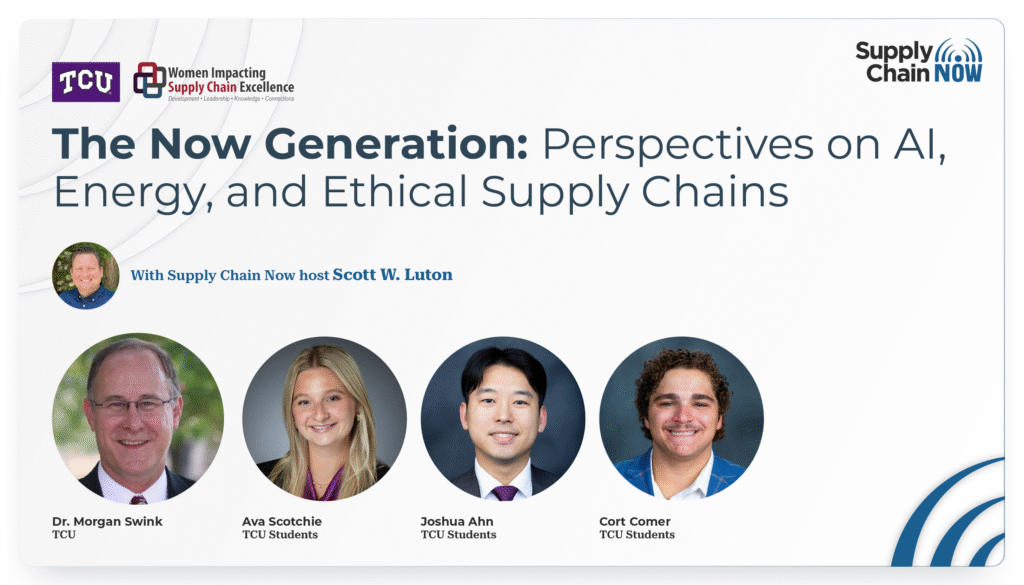
[00:00:58] Scott W . Luton: Now. Welcome to today’s show, folks. We’re continuing. One of my
favorite series here, one that we like to call the Now Generation, where we sit down with students
and professional educators from some of the leading colleges and universities around the world.
So check this out though. New for 2026. We’re delighted to partner with Dr. Stephanie Thomas and
the WISE organization at the University of Arkansas to power the now Generation series forward.
Y exists to to show students that supply chain is exciting, impactful, and full of opportunity. Now
this initiative creates community connect students with industry leaders and helps ’em build the
skills and confidence to launch meaningful careers.
[00:01:39] Scott W . Luton: You can learn more V to link right there. The show notes. Alright, so
folks, today we’re gonna feature a terrific school. It’s been growing left and right. I learned more
about it in a recent visit to DFW not too long ago. Texas Christian University. And when it comes to
supply chain management, TCU has been ranked as a top five program for best online, MBA in
supply chain management in the US and Top 20 for graduate supply chain programs in North
America by Gartner.
[00:02:08] Scott W . Luton: So get ready folks as we continue one of my absolute favorite series here
at Supply Chain Now. Alright, so let’s get down to work, and I wanna introduce our panel here
today, starting with my friend Dr. Morgan Swink, who’s back with us by Popular Demand. He’s got
some raving fans and our ecosystem here. He serves as West Chair and Professor of Supply Chain
Management at the Neeley School of Business at TCU.
[00:02:33] Scott W . Luton: He also. Executive director of the Center for Supply Chain Innovation.
And as I mentioned, I enjoyed meeting Morgan in person when I made a trip down to DFW earlier,
or actually it was last year, and learned some of the really cool things that he and his students have
been doing. Hey, Dr. Swink, how you doing today?
[00:02:51] Morgan Swink: I’m doing great, Scott. Thanks for having me today.
[00:02:53] Scott W . Luton: You bet. You bet. We’re not gonna get some of that delicious food we had
in uh uh, in Dallas, this go around, but we’ll make that happen later this year. How’s that sound?
[00:03:01] Morgan Swink: Sounds great.
[00:03:02] Scott W . Luton: All right, so joining me and Dr. Swink here today is a trio of supply chain
superstar students that are already doing big things.
[00:03:11] Scott W . Luton: That’s why they’re on the now generation series, and they got really
bright futurists. I wanna welcome in Ava Scotchie. Ava, did I say that right?
[00:03:19] Ava Scotchie: Ava Scotchie.
[00:03:20] Scott W . Luton: Scotchie, you’re good. And you, I nail, I usually, I nail that down
pre-show because as I like to tell folks, my last name is Luton. Everybody has said Lutton my entire
life, so I try to get it right.
[00:03:31] Scott W . Luton: Ava Scotchie, great to see you. Now. Ava is a senior at TCU. She’s double
majoring in the deadly combination. Of supply chain and finance. She serves as president of the
TCU Supply Chain Club this academic year. She also works to support the Center for Supply Chain
Innovation and the Neeley Navigators. How about that?
[00:03:50] Scott W . Luton: That’s an undergraduate, academic and advising club. She’s originally
from Chattanooga, Tennessee, which just might have worse traffic than Atlanta. And that is, uh,
strong words. But Ava, great to have you here today.
[00:04:03] Ava Scotchie: Thank you for having me.
[00:04:04] Scott W . Luton: You bet. Now Ava’s joined by Joshua Ahn also a senior at TCU, majoring
in supply and value chain management and business information systems and minoring in
Chinese man, uh, that is quite a trio.
[00:04:19] Scott W . Luton: Joshua’s worked at Amazon. He’s interned with Interstate Batteries and
Bell Textron. Those are some big names. Joshua also currently serves as a senior officer for the
TCU Supply Chain Club. Joshua, how you doing?
[00:04:32] Joshua Ahn: I’m doing great, Scott. How are you?
[00:04:34] Scott W . Luton: Wonderful. Great to have you here. And then finally, our cleanup hitter,
Cort comer.
[00:04:40] Scott W . Luton: Also a senior TCU majoring in supply chain with an energy business
minor. He’s also employed as an accounting and land development intern at Black Mountain Oil
and Gas Cort is originally from Fort Worth, Texas, famously known if you don’t know as where the
west begins. How about that? Cort great to see you here today.
[00:04:59] Scott W . Luton: How you doing?
[00:05:00] Cort Comer: Doing well, Mr. Luton.
[00:05:02] Scott W . Luton: Great to see y’all. All right, so Ava, Cort, Joshua, get ready. We’re gonna
learn more about you in just a minute, but I gotta ask you, Dr. Swink. You got a bunch of bright
students coming through. We’ve got three seniors here that probably have made a big impact on
the program before we get to know them a little better, you wanna foreshadow with the, um, the
brain trust we’ve got here.
[00:05:23] Scott W . Luton: Anything you wanna add about this trio of, of students?
[00:05:25] Morgan Swink: Well, they are some of the best and brightest you mentioned the club. We
have a supply chain club and I think all three of ’em are pretty involved with that. Ava being the,
the president and Joshua filling one of the officer’s roles there. So we, we might learn a little bit
more about that, but.
[00:05:39] Morgan Swink: They’re helping us in a lot of ways. I mean, they’re adding to the
intellectual clout of our classes and things like that with
[00:05:46] Scott W . Luton: love it,
[00:05:46] Morgan Swink: the, the serious brain power that they bring. But they’re also helping us
grow the program and do things like tours and events, and we can talk about all of that. But these
are some of the, the shakers and movers in our program for sure.
[00:05:58] Scott W . Luton: Oh, I love that Morgan. And it’s a good thing because as, as, uh, you
shared with me when we were together last TCU is growing. By leaps and bounds. Really
[00:06:06] Morgan Swink: crazy. Yeah.
[00:06:07] Scott W . Luton: Yeah. Um, okay, so Ava, Cort and Joshua, let’s get to know you a little
better before we start picking your brain more on global supply chain.
[00:06:15] Scott W . Luton: And Ava, I wanna circle back to you, uh, fearless President, uh, the
supply chain club. Love that. Uh, but I wanna ask you, uh, a little about your background. You
grew up in, in Chattanooga, is that right?
[00:06:26] Ava Scotchie: That’s right. My whole life.
[00:06:27] Scott W . Luton: Bunch of family. Your whole life, bunch of family still there.
[00:06:31] Ava Scotchie: Yes, my parents, my sister goes back home there.
[00:06:34] Ava Scotchie: I’m a twin, so she goes to Baylor University, but we always make it back to
Chattanooga.
[00:06:39] Scott W . Luton: Love that. And I gotta ask you this, so when you’re not doing supply chain
stuff, it sounds like you get, you do that a lot every day. What’s one passion or hobby that you have
kind of outside of, uh, of our favorite thing?
[00:06:52] Ava Scotchie: I enjoy golfing. I played in high school and middle school, and I still play a
little bit in college.
[00:06:57] Scott W . Luton: Okay. Uh, uh, Dr. Swink, you’re a golfer. Have, have, have y’all competed
yet?
[00:07:02] Morgan Swink: We have not. I, I don’t think we’ll compete. I wouldn’t bear compete, but I
would love to go out with Ava sometime. We’ll, we’ll definitely do that before she graduates.
[00:07:09] Morgan Swink: Uh, oh. Yeah. Awesome. Get a round in, for sure.
[00:07:12] Ava Scotchie: Mm-hmm.
[00:07:12] Scott W . Luton: One final question, Ava, before I, I, I move on to Joshua. Uh, if folks
spent, if they’re driving the interstate, I can’t remember the interstate it goes through, uh,
Chattanooga, but. Um, it’s the one we were talking about traffic a minute ago. Mm-hmm. If they
stop in and eat at one place, where would, where would you point people to?
[00:07:31] Ava Scotchie: That’s definitely a tough one, but I would probably say stir. It’s downtown
and it’s right by where the Chattanooga Choo was. So a lot of good history there. Ice cream, it’s just
a neat spot to visit.
[00:07:43] Scott W . Luton: Outstanding. You had me an ice cream, so stir in Chattanooga,
Tennessee. Okay, so Joshua, uh, I learned pre-show that you grew up, I believe in San Antonio,
Texas, um, which is really hot down there in south part of Texas, right, Joshua?
[00:07:59] Joshua Ahn: Oh yeah. It can definitely get really hot there. The summers.
[00:08:02] Scott W . Luton: Um, so when, when you’re not doing supply chain stuff and, and, uh,
between your studies and the supply chain club and any research and stuff, what’s one of your
hobbies or passions?
[00:08:14] Joshua Ahn: Well, I’d say I’m a amateur mu musician. I did drum line in high school and
I’ve been playing drum set for, what, 13 years now.
[00:08:24] Joshua Ahn: So I like to, you know, pick up gigs every once in a while outside.
[00:08:27] Scott W . Luton: Outstanding. Well Morgan, uh, for all your supply chain orchestration
talk, uh, Joshua is, is at the ready to add little, the drumbeat to those conversations. Huh.
[00:08:38] Morgan Swink: I love that. And this is so fun ’cause I’m learning ’cause I was a drummer
in high school also, and I have a son who’s a professional drummer.
[00:08:44] Morgan Swink: So
[00:08:44] Scott W . Luton: what,
[00:08:45] Morgan Swink: just all kinds of connections here. Uh,
[00:08:47] Scott W . Luton: man. Okay.
[00:08:48] Morgan Swink: It’s nice to know that about you.
[00:08:50] Scott W . Luton: Well, we’re gonna have to have y’all back and we’ll, we’ll dive more into
the music scene. Live music. I didn’t know that about, uh, you, Dr. Swink. Uh, blessed be the ties
that bond for sure. And, uh, Joshua, one more question and I, I think you moved to the Fort Worth
area.
[00:09:05] Scott W . Luton: You still have family in San Antonio?
[00:09:06] Joshua Ahn: I have an aunt that lives there, but other than that, my family is mostly
either here up in Dallas or. My extended family, both of them are in actually South Korea.
[00:09:16] Scott W . Luton: Okay. So in your your Texas town, your choice, what’s one food
recommendation you’d share with our audience here?
[00:09:26] Joshua Ahn: I mean, I would have to say if you’re ever in Dallas and you’re wanting
Korean food, going to this place called BCD Tofu House in Carrollton. Man, you’ll get the best tofu
stews. There it is. So good.
[00:09:42] Scott W . Luton: Love it. Oh man. Uh, y’all are making me hungry now. Okay, Joshua,
thank you for the inside tip there, and, uh, look forward to learning more about your, uh, musical
passion as well.
[00:09:54] Scott W . Luton: Kurt, great to see you here today. Uh, let’s start with where you say you
grew up in the Fort Worth area. Is that right?
[00:10:00] Cort Comer: Yes, sir. Born and raised.
[00:10:01] Scott W . Luton: Born and raised. And do y’all, is that a real tagline? Y’all talk about where
the west begins? Is that something that you knew about?
[00:10:08] Cort Comer: I mean, it’s on every police car, so if you’re around here long enough, I’m
sure you’ll see it.
[00:10:12] Cort Comer: Whether that’s good or bad is your choice.
[00:10:16] Scott W . Luton: All right. So when you’re not doing supply chain stuff, what’s your, uh,
what’s your passenger hobby?
[00:10:21] Cort Comer: I mean, I love oil and gas, like I do it for work, but it’s kind of an all or
nothing industry. So it occupies a lot of my extracurricular time, but I’m also a member of the
Texas Cattle Raisers Association.
[00:10:33] Cort Comer: My grandparents have a ranch, so I help
[00:10:34] Scott W . Luton: Wow.
[00:10:34] Cort Comer: Manage that and keep track of that.
[00:10:37] Scott W . Luton: Cort. I don’t think we’ve ever had anyone on the show whose family had a
ranch. I’ve got a thousand questions. We’ll have to have you back and, and ’cause of course, uh,
livestock or cattle ranching is big business in Texas and some of those other states out there, huh?
[00:10:52] Cort Comer: Yes sir.
[00:10:53] Scott W . Luton: Alright, so one same thing for you. Uh, folks. Go to Fort Worth. Where’s
the place you direct ’em to go eat something really good?
[00:11:00] Cort Comer: I got a few. If you want a chicken fried steak, lucille’s on buoy is extremely
good. It’s also Cajun food. Um. Charleston’s is also really good over on healing Good chicken fried
steak, Macy Gary Patterson there.
[00:11:12] Cort Comer: Um, and then Michael’s off seventh Street has like these quail sticks as a
starter and they’re extremely good too.
[00:11:18] Scott W . Luton: Okay, well I, I, I’ll share a little tip with y’all. I’ve got Georgia barbecue
coming. Here, uh, that I’m gonna dive into right after this interview, and I cannot wait. Uh,
Morgan, when he, he said Lucille’s, that always takes me to Kenny Rogers.
[00:11:33] Scott W . Luton: Kenny Rogers had a great song about Lucille, but did you know the, the
cattle and the ranching element here with, uh, Cort Morgan? I
[00:11:42] Morgan Swink: did not know that. I, I haven’t really spent any time with Cort, so I didn’t
know that. But I know we have a lot of students who are very interested in, in oil and gas and
energy.
[00:11:50] Morgan Swink: Somehow those two things seem to go together a lot. Uh, cattle ranches
and oil and gas.
[00:11:55] Scott W . Luton: No, uh, no doubt. And I’ll tell you, speaking of energy, uh, we’ve got some
big challenges we’re gonna have to solve to continue to fuel the, uh, all the AI innovations, uh, that
we’re seeing. So more on that later. Um, okay, so now that we’ve learned more about.
[00:12:10] Scott W . Luton: Cort, Joshua and Ava, uh, Dr. Swink, I know you’ve been with us
previously on a couple shows, really enjoyed those. But I just wanna get, wanna level set a bit with
your background and your current roles. Uh, share a little bit with us, with you, Morgan.
[00:12:26] Morgan Swink: Well, I grew up around here too. I grew up in Colleyville, actually, uh,
went to, uh, school over in Dallas.
[00:12:32] Morgan Swink: It’s a lot like TCU. We don’t like to say their name here, but, uh. Uh, and
then I worked for Texas Instruments for, uh, 10 years, uh, engineering, and, uh, moved into
product development and, and producibility and those kinds of things. More supply chain type
stuff. Uh, then I made the jump to academia and, uh, spent 10 years at Indiana University, go
Hoosiers.
[00:12:57] Morgan Swink: Very happy with them this year. Uh, then 12 years at Michigan State, and
then I’ve been here at TCU now, finally got back to Texas after all those years up in the Midwest.
I’ve been here for 15 years. Um, and it’s been great. I, it’s just a great career. You know, you get a
chance to stay in touch with what’s happening in business, but also be kind of in the academic
lifestyle and interact with really smart folks like kids here.
[00:13:21] Scott W . Luton: Yeah. They are doing some really cool things at, not only at the, with the
supply chain program, but uh, the Center for Supply Chain Innovation. Do a lot of robust
programming there as well, right, Morgan?
[00:13:35] Morgan Swink: Absolutely. Yeah. We’ve got some new programs. We’ve got a new project
initiative that all three of these students are in involved with that I can say more about later if we
have time.
[00:13:44] Morgan Swink: But, uh, it’s, it’s a great way, it’s engaging students with businesses in a
much more intense way. Um, lots of events going on. We have our big case competition coming up
in a few weeks, 20 different schools from around the country. We’ll be sending graduate students to
compete, uh, around a case that we wrote.
[00:14:03] Morgan Swink: With a, a not-for-profit organization this year called Operations Smile. It’s
gonna be really fun. So yeah, lots and lots of stuff going on.
[00:14:10] Scott W . Luton: Mm. Well good stuff. Uh, Dr. Swink, uh, really appreciate what you do.
I’m gonna learn more about operations, smile. I love how you’ve tied that nonprofit into some of
your, uh, programming and.
[00:14:19] Scott W . Luton: You’re tapping into Cort, Joshua and Ava, and putting them to work on
these case studies and other work. Really cool stuff. Um, alright, so I’m gonna circle back to you,
Ava. So when you think of, you know, it’s tough to keep up with everything going on just in one
region, in, in, in terms of, uh, the supply chain world, much less globally.
[00:14:38] Scott W . Luton: But if you had to pick one thing, one topic or trend or challenge. That
really is a big common theme across industry and supply chain that really intrigues you. What
would that be, Ava?
[00:14:50] Ava Scotchie: One topic recently that I’ve been interested in is reverse logistics. I got an
email a few weeks ago from one of my favorite companies that I shop with all the time that they
are starting to calculate their customer’s personal return rates.
[00:15:06] Ava Scotchie: So just looking at the value of the products that customers are buying
versus the value of their returns. And I guess maybe if you return too much, you might get some
fees added on, but luckily I’m in a clear, I’m able to still return for free. But I think this is
interesting moving forward with other companies and seeing how they balance customer
satisfaction with those, um, increasing costs for reverse logistics.
[00:15:32] Scott W . Luton: Ava. I’m fascinated with reverse logistics and returns management and
Morgan. In fact, we’ve got a live stream coming up soon with the folks at the national, um, retail
Federation. All about reverse and returns of tidal wave returns. But I was reading earlier, uh,
Morgan we’re talking about the weather and there’s a, there’s a bunch of folks that are trying to
return those generators that they splurged on.
[00:15:55] Scott W . Luton: And, uh, some places are hanging signs saying no returns of generators,
but Morgan returns. Is something in reverse logistics something we gotta get a better handle on?
[00:16:04] Morgan Swink: Yeah, for sure. It’s, it is a really interesting area, especially in
e-commerce where I think, I don’t know what the numbers are now, but they have been something
like 50 to 60% of orders are returned.
[00:16:15] Morgan Swink: It’s, it’s, and you get a lot of these repeat offenders, so to speak. Buying
whatever, whether it’s generators or clothes or, or whatever, trying monitoring back. So yeah, it’s
hugely costly. I think some companies are, are getting to the point where they realize that the
processing costs are more than the value of the item.
[00:16:34] Morgan Swink: Just as Ava kind of alluded to there a minute ago. So it’s a big area. It’s
huge area end, durable goods too. And if you think about. Yeah, lifetime product. Durable things
like refrigerators and washing machines and all that kinda stuff. You think, where does all that
stuff go? You know, how much of that actually gets recycled and repurposed?
[00:16:50] Morgan Swink: How much of it ends up in a land landfill? I still think we’re a long way
away from being able to, to process those things in a meaningful way. Then there’s the whole rare
earth stuff. I think you’ve seen it in the news lately. A lot more work around repurposing and
reprocessing E-waste, you know, phones and TVs and all that stuff to try to recapture.
[00:17:10] Morgan Swink: Rare earth outta that and automation to help with that. So it’s, it’s a really
interesting area across all kinds of business sectors.
[00:17:17] Scott W . Luton: Morgan, good stuff there. There’s so much going on in, as you and Ava
both are, are alluding to in the reverse logistics space, the return space and as we were talking
earlier, uh.
[00:17:27] Scott W . Luton: It’s more and more challenging for retailers out there and others to keep
up with the criminal aspect of, uh, the, the returns fraud gain. So we’ll keep our eye on that. Um,
okay, so Joshua, same question we posed to Ava. When you think of one particular topic or trend or
challenge in global supply chain, what intrigues you The most?
[00:17:48] Joshua Ahn: Hardest supply chain That’s really interesting to me is kind of like the
sustainability aspect of it, especially when it comes to the human cost of. Everything. Right. Uh,
obviously here in the US and most Western countries, we have very strong labor laws that protect
people from being overworked or being underpaid and stuff.
[00:18:10] Joshua Ahn: But now with a lot of these supply chains going global across multiple
different countries, it’s hard to keep track of all that, especially once you get into tertiary or even
fourth level suppliers. Right. And I’ve definitely seen that. Come up as an issue across my
experience in internships. And I, I would say like this particular thing’s been an interest to me for
a while, especially since I worked from Amazon.
[00:18:38] Joshua Ahn: Obviously they have a reputation when it comes to workers’ rights, but
when I compare the experience that I had to what I’ve heard from overseas, like it’s, it’s still
nothing compared to what we see like in other countries like India or Vietnam or Indonesia.
[00:18:56] Scott W . Luton: Joshua that, um, I find workforce in general to be fascinating as well.
[00:19:01] Scott W . Luton: We just had a, a great webinar session on the, the, the workforce
challenges that manufacturing in particular is being faced with. But no one’s immune Morgan, no
one’s immune from workforce challenges these days, huh?
[00:19:14] Morgan Swink: Yeah, and it is, as Joshua suggested, it’s just so hard to keep track of your
second, third, fourth year, uh, you know, suppliers, what’s actually happening there.
[00:19:22] Morgan Swink: You have really no influence. I, I wanna use this opportunity to put a plug
in too. I didn’t, I didn’t prep Joshua for this, but we, uh, we just launched a certificate for
sustainable business here in Neeley School. The center that I head up is sponsoring that, and it’s
been great. We’ve got about 40 students, uh, signed up already.
[00:19:40] Morgan Swink: It’s students from all over TCU business students, but other students as
well who can take a three course series on sustainability issues. And fair labor practices, you
know, human trafficking in terms of slave labor for work. Those are big parts of, of the supply
chains that we have to, we have to keep track of and make sense of when we can, uh, along with
environmental issues.
[00:20:03] Morgan Swink: You know, the social issues are huge.
[00:20:05] Scott W . Luton: That’s right. And you know, a lot of folks, uh, I have found in my journey,
uh, Joshua and, and Morgan, to your point, you know, modern day slavery and, and human
trafficking, it is so much more prevalent than the average person understands. And to y’all’s both
points, as you go deeper and deeper into lower tiers, you have lesser and lesser visibility.
[00:20:23] Scott W . Luton: You also have lesser and lesser. Visibility on your risk, much less the
travesty itself. So we gotta do a better job there. Good stuff. Joshua and Morgan. Okay. Cort, same
question. Topic, trend, issue, you name and that you’re really fascinated with across global supply
chain.
[00:20:37] Cort Comer: Funnily enough, you mentioned AI and data centers earlier and that was my
main point, so I thought you were gonna steal my thunder.
[00:20:43] Cort Comer: Uh, but you didn’t. I think it’s one of the unique places where oil and gas and
supply chain really mesh. Besides midstream logistics within oil and gas. The demand for power
land resources as well as supplying all the computers, potentially like generators and power
sourcing in-house on land is extremely important.
[00:21:05] Cort Comer: I mean, AI’s already changing supply chains globally. It’s in the news all the
time, but the impact that it’ll have on like the domestic landscape, price of electricity.
’cause at the
end of the day, most of the rates that we pay as rate payers as homeowners will be. The cost and
issues caused by like data centers will be passed to us, and that’s not really widely known, but
when your electricity bill is $300 a month, because there’s a data center down the street, you won’t
really put two and two together.
[00:21:34] Cort Comer: But it’s a huge problem and it’s not really talked about outside of the data
center and energy space because it’s so, you know, politically charged and extremely
controversial.
[00:21:45] Scott W . Luton: Cort. Uh, first off, I don’t get to steal anyone’s thunder ever Cort. They
don’t, lemme do that around here. But more to your point, those, those energy dynamics you
mentioned, uh, both the known and the unknown.
[00:21:58] Scott W . Luton: It really is thought provoking. And Morgan, um, you know, we were
talking about this, well, we talk about this a lot because the infrastructure, we have energy, but
also the holistic, when you think of infrastructure, water, energy, I mean, you name it, we’ve got so
much to upgrade and improve. But energy in particular, and electricity in particular, we’re we.
[00:22:17] Scott W . Luton: A lot of work to do in order to continue to, to meet the demand. Not only
is growing here in the States, but elsewhere. Your quick thoughts there, Dr. Swink?
[00:22:25] Morgan Swink: Yeah, for sure. I mean, there’s so many things to talk about here, but
Texas in particular, we have some challenges there because we have the advantage of having our
own electrical grid, you know, power grid.
[00:22:35] Morgan Swink: But there’s disadvantages with that too. We can’t share, we don’t share
across the states as well as some of the other states can. So we’re, we have some limitations there.
From a supply chain, especially the educational standpoint, the data center development build out
is really given us opportunity to think about supply chains even more broadly, right?
[00:22:55] Morgan Swink: Not just materials, but supply chains of energy, land, water, capital,
right? Even, you know, all the capital that’s getting soaked up into this. So it’s a great way to kind of
get students to think about. Supply chain beyond what you kind of normally think about trucks
and warehouses and stuff like that.
[00:23:14] Morgan Swink: It’ll be interesting to see how it shakes out. I don’t know if we’re gonna get
nuclear, uh, power plants at every. Data center or, or what, but, uh, somebody’s gonna have to
come up with a solution.
[00:23:23] Scott W . Luton: No doubt. No doubt. And I’m tracking the, um, didn’t they call ’em SMR,
the small module reactors that are being deployed these days?
[00:23:31] Scott W . Luton: It’ll be interesting. I’m, I, I am hopeful. I’m no energy nuclear, um, energy
engineer, but I’m hopeful we’re moving into a really innovative chapter when it comes to nuclear
power too, as part of the overall equation. Um, okay. So Ava Cort, Joshua, y’all’s radar is dead on
here today, and Morgan, appreciate your comments.
[00:23:52] Scott W . Luton: Ava, I’m gonna come back around to you. Uh, actually all three of y’all
are seniors. All three of y’all are seniors. So I bet y’all have a really good idea of what you wanna do
in industry and why, and once you, once you and, and really are already there, but as you kind of
navigate through your career, some the change that you want to lead and make happen.
[00:24:13] Scott W . Luton: So Ava. When you think of what you wanna do, why, and, and something
to change, you wanna drive what comes to mind?
[00:24:18] Ava Scotchie: Well last summer and then also after I graduate, I’ll be working in the food
and beverage industry. And so really I have enjoyed that because I know that somewhere down the
line I’m able to help someone have access to quality food whenever they need it.
[00:24:34] Ava Scotchie: So I’m very passionate about that. Um, I also have always been interested
in aerospace and would love to potentially get involved in that at some point. And then another
thing I’m interested in is. Network planning and facility design. Last year I was involved in a case
competition and the students that participated were tasked with making the facility better
designed and improving that process, and I think that’s something that I could.
[00:25:03] Ava Scotchie: Be very good at one day in the future. And so overall, the change that I
would like to make in whatever position I’m in, especially in the food and beverage industry, is just
making sure that the processes are efficient and reliable as possible.
[00:25:18] Scott W . Luton: I like it. Uh, you know, I spent a little time in my, in my career working
for Sysco Foods, big player in the, um, f and b space, uh, supplying a lot of independent
restaurants and was fascinated, and this is forever ago, but was really fascinated with.
[00:25:33] Scott W . Luton: They’re real. And you hear about customer service, like as a phrase, and
it’s real so generic, but they, Sysco Foods does such a great job of zeroing in on what independent
restaurants need, whether it’s their supply chain, right, or how they price their plates, their menus
and stuff. Yeah, outstanding company, incredible company.
[00:25:51] Scott W . Luton: Uh, Morgan, what’d you hear? Let’s see. F and b, aerospace network
planning efficient processes. What’d you hear there, Morgan?
[00:25:59] Morgan Swink: Lots of opportunity there. Ava, I, I don’t know if either wants me to out
her or not. She’s gonna work for PepsiCo, which is one of our, uh, Frito Lay in PepsiCo
[00:26:06] Scott W . Luton: Yeah.
[00:26:07] Morgan Swink: Is one of our, our big partners here.
[00:26:09] Morgan Swink: And, uh, there is lots of opportunity. I don’t know about the aerospace
part, but definitely for the facility and network planning as, as well as the other opportunities
there. But, uh, we, we love placing students with them. They hire a lot of our students every year
and usually our best and brightest. So congrats to, to Ava for getting that position.
[00:26:27] Scott W . Luton: Outstanding. Uh, Ava, really cool. Uh, congrats. I look forward to hearing
a lot more. Alright, so Joshua, same question. What do you wanna do in the industry and why,
including some of the change you wanna personally drive?
[00:26:39] Joshua Ahn: I definitely want to go into something that gets me plugged into, like the
global supply chain, whether that’s global manufacturing or logistics.
[00:26:49] Joshua Ahn: Honestly, I don’t really care. It’s all very interesting to me. Um, I can’t even
say if I have, there’s like a specific industry that I’m. Particularly interested in, because I’m just cur,
I tend to be curious about everything. Like if you couldn’t tell from my previous work experience,
like I’ve done e-comm, I’ve done distribution, I’ve done government contracting, contractor, I
think there’s.
[00:27:14] Joshua Ahn: Something that’s really interesting about every single industry out there. So
when it comes to that, I’m open to anything, but when it comes to what I want to do or what sort of
change I want to lead is I definitely want to kind of continue to push for more awareness on that
sustainability and ethics side of the global supply chain, because especially with like the internet
and us just be becoming more and more driven with all this information.
[00:27:42] Joshua Ahn: It’s more and more important that companies are aware of what’s happening
down their supply chain, up and down their supply chain, so that they can reduce and mitigate
any sort of risks that may be posed. So definitely one I’d, I’d like to really push forward more
visibility towards that area.
[00:28:03] Scott W . Luton: Joshua, um, there’s so many things about your response we could dive
into, but Morgan, I really wanna get you to comment two big things on the front end of his
response there.
[00:28:11] Scott W . Luton: He loves TA tasting a little bit of everything, but he really wants to be in
global business organizations. I love that. And then secondly, that natural curiosity that clearly he
has, he has enjoyed the Baskin Robbins approach, right? That natural curiosity will serve anyone
really, really well. What’d you hear there, Dr. Swink?
[00:28:30] Morgan Swink: Well, my, my reaction is it’s great that you’re going into supply chain,
Joshua,
’cause it’s, it’s the one career area. Um, there may be others, but it is a major career
opportunity to do lots of different kinds of things, right? Supply chain is end to end. Supply chain
covers every aspect of a, of a business.
[00:28:49] Morgan Swink: And all businesses are global today, right? So you’re gonna get
opportunities to. To interact with folks from around the world and the suppliers and customers
who represent all kinds of different cultures and tastes and beliefs. And, um, that’s what’s so fun to
me about supply chain and what I, I envision for folks like you are going out into, uh, the world.
[00:29:11] Morgan Swink: I think you know, Joshua, with your BIS combination, I think you can sell
yourself. As being somebody who can bring integration across different areas because you’ve got
these varied experiences and things like that, you’ve got a lot to offer to, uh, a, a big company, a big
global company that’s trying to.
[00:29:28] Morgan Swink: Integrate a lot of different activities across systems and across processes
and things like that. And sustainability is just, you know, cherry on top.
[00:29:37] Scott W . Luton: But that’s it. The rock and roll career doesn’t work out Joshua. Okay. So
we’ll see. Jury’s out on that. Uh, but, but well said Morgan. I like to say I stole this from somebody
some, some time, but, you know, global supply chain as, as partial as I am to American football.
[00:29:51] Scott W . Luton: Global supply chain is the best team sport, uh, in the world. Right? And
so Joshua, we’re gonna keep our finger on the pulse and see where you go. Okay. Cort, same
question. What do you wanna do and why? And what’s some of the change you wanna see out
there?
[00:30:05] Cort Comer: Um, it’s pretty obvious. Oil and gas is kind of my home intern there.
[00:30:10] Cort Comer: Love it. It’s probably where I’m gonna be home for my whole career. If
everything goes to plan within that space, it could be anywhere. There’s a lot of opportunity
everywhere at data centers. Energy and power, transmission, generation, distribution, all those
things. My impact and like where I see myself is more on the land side, like purchasing
procurement of land, you know, talking to homeowners, being the middleman, landman, seeing
myself interacting with, you know, whether that’s large customers or farmers.
[00:30:40] Cort Comer: I feel like I’m a pretty relatable person and I feel like that kind of fits my
niche extremely well. And also kind of changing how the energy and oil and gas industry is viewed
as a whole. You know, land Man’s made the news, but other than that, people know extremely little
about, you know, how advanced we are, how many steps we’ve taken to be sustainable, to take care
and of our owners.
[00:31:02] Cort Comer: And, you know, oil and gas we’ll make the news and it’s not really gonna go
anywhere, especially with power demand being the way that it is, but changing the way and
people’s perceptions, which is a lofty goal for one person. But
[00:31:13] Scott W . Luton: yes.
[00:31:14] Cort Comer: Um. Making sure that people understand what goes into turning your stove
on or powering your house from day to day, I think is extremely important.
[00:31:23] Scott W . Luton: Cort. I like it. And I’ve already learned from you who to blame when I get
these higher, uh, energy so soon. Uh, but no, you, you can a, you can absolutely tell you’re
passionate about it and I love that it took me a long time to find what I was most passionate about.
And all three of y’all have such a great headstart on that Cort.
[00:31:39] Scott W . Luton: How about a ranch, though? The ranch? Is that always gonna be a
connection for you? Are you so passionate about oil and gas? It’s, um, Hey, I’ll, I’ll stop, come back
by for barbecue. Uh, on the weekends
[00:31:51] Cort Comer: I hope it is, you know, kind of a weekend thing. Get away from the city and
kind of disconnect a little bit.
[00:31:57] Cort Comer: We’ll see how it fits in. But if I’m gonna be driving to the middle of nowhere
to make oil and gas deals, I’ll get. A little ranching on the side. Okay.
[00:32:06] Scott W . Luton: All right. So Morgan, what an interesting collection, uh, of passions and
kinda what they wanna do in the industry. What’d you hear there from Cort?
[00:32:14] Morgan Swink: Well, one thing me think, uh, you know, of a, a kind of a kinship there
Cort is we’re trying to do the same thing with supply chain.
[00:32:20] Morgan Swink: You know, not so much dispel a negative perception or anything like that,
but just raise the, the awareness and the perception. Of the supply chain that’s operating in the
background that everybody depends on, but everybody takes for granted. You know, COVID, of
course, helped, helped us live with that, kinda raising the awareness and, and the, I think,
gratitude in some people’s minds, you know, for, for the kinds of supply chains that we have and
how bad it can be when things don’t go the way they’re supposed to go.
[00:32:47] Morgan Swink: But it’s definitely helped us in terms of our visibility and, and growing
our major and, you know. Placing students in great, great positions and things like that. So if you
can do the same thing with oil and gas, you know, raise the visibility, turn it into a positively
perceived industry, that’ll be great.
[00:33:06] Morgan Swink: That’s wonderful. And Land Man’s got you a good start. So
[00:33:09] Cort Comer: I think it’s funny how you mentioned, uh, COVID because I feel like the
winter storm here in Texas that froze everything and everybody lost power. Did the same thing,
but almost worse. You know, why did we not have power? Why am I freezing? Well, when gas pipe’s
freezing, there’s no infrastructure, we tend to lose power.
[00:33:27] Morgan Swink: Yeah. It’s even more, I, I guess you can, you can kinda live with the fact
that your Amazon delivery was three days late, you know? But, uh, when your power goes off,
that’s a, that’s a whole nother level of discomfort. Yeah,
[00:33:36] Scott W . Luton: that’s right. Alright, so, uh, I’m gonna reverse the order here ’cause I
want, I’m gonna ask y’all next, I’m gonna get all of y’all to, to comment.
[00:33:44] Scott W . Luton: On what makes TCU supply chain program so successful? I added, you
know, on the front end I shared a couple of, um, grades or attributes, you know, lauding the
program. There’s a lot more than just that, but I wanna g get all of y’all to weigh in, especially. Not
only in terms of what makes it successful in your view, but how it’s prepared you to do the things
you’re gonna be doing, the big things you’re doing in industry.
[00:34:06] Scott W . Luton: So I’m gonna reverse order, I’m gonna go back to Cort here. And by the
way, can’t y’all just see Cort driving in his pickup truck across that ranch, making sure those cattle
gets in the right place? Cort? I can see that, man. Um, so what your, your thoughts, what makes the
supply chain program at TCU so, uh, so successful and how has it best prepared you?
[00:34:24] Cort Comer: I think TSU in general has incredibly good professors and staff. They really
seems like they care and I’ve been able to have a lot of personal relationships with them, which is
extremely important to me and and makes my learning experience so much better. But the
curriculum is designed in a way to kind of put you in the workplace position.
[00:34:42] Cort Comer: Open-ended, very much figure it out yourself, which is kind of how life is
versus them holding your hand. Of course, they’re there for health and help and stuff. I think it’s
really important how much they equip you to be able to solve stuff with limited instructions,
because when your boss puts something on your desk and there’s two lines and you have to figure
out what to do, that’s, you know, it’s really real advice that has helped me tremendously already,
and I’m still in college.
[00:35:08] Cort Comer: But I think the main thing is the faculty here really pour a lot into you and
expect things of you, which is too much, who is as much as expected, and that’s a great place to be
because. Pushing you to be a better student and a better, you know, young professional puts me
years ahead of my competitors who are in a classroom of 600 people and don’t have the one-to-one
or team interaction that we get here.
[00:35:32] Scott W . Luton: Cort well said. I love that quote you mentioned. And, um, the course, A
big tip of hat to the faculty and Morgan. I’m a good, I’m gonna get all three feedback and then get
you to weigh in on what we hear collectively, uh, but Cort. Thank you for that. Now, Joshua, I can
see you. Just jamming at your next gig.
[00:35:50] Scott W . Luton: And I gotta ask you, whiplash, the famous movie that I think won won
Academy Awards all about, uh, the passion of one drummer. Thumbs up or thumbs down on that
movie, Joshua,
[00:36:01] Joshua Ahn: when it comes to entertainment?
[00:36:02] Scott W . Luton: Yeah.
[00:36:03] Joshua Ahn: Thumbs up when it comes to maybe. The accuracy of what music school
looks like. I would probably say it comes down.
[00:36:11] Joshua Ahn: I don’t think the music professor out there really gets that physical, but I like
it. I like it. Definitely a very entertaining movie.
[00:36:20] Scott W . Luton: It was. Uh, okay, good. Uh, so drum teachers aren’t that bad. Okay.
Joshua. Um, alright, so the TCU Supply Chain Program incredibly successful. Comment on that
and including how it’s prepared you for that big global career, yours?
[00:36:36] Joshua Ahn: Yeah. Well, I mean, I don’t want to copy Cort here, but I really think it is the
faculty and the staff that we have, I mean, obviously they work really hard to prepare curriculum,
but one thing I’ve noticed is that they’re also very open to listening to student feedback and kinda
adjusting their curriculum to better suit.
[00:36:56] Joshua Ahn: Uh, what we’re seeing in internships, what we need for internships and
careers, right? I think almost every single supply chain class I’ve taken here at Neeley, the
professor at one point in the semester has always said, yeah, this is a little different from what
we’ve done in the past, but it’s better for you.
[00:37:15] Joshua Ahn: Right? A lot of the curriculum is very innovative there. It’s always. Being
updated. For example, like for global supply chain, which I took last semester with all the tariff
stuff happening. It was very interesting to see kind of all that play out real time as we’re learning it
in the classroom. Mm-hmm.
[00:37:33] Joshua Ahn: Right? So just having that tie into the real world, instead of everything being
solely theory or just. We’re just gonna be reading off the textbook all day, all week. Right. All right.
And yeah, I think that’s definitely one of the big reasons why it’s, this program’s great.
[00:37:53] Scott W . Luton: So Joshua, I thought we were gonna get to the whole conversation
without hearing the, the word tariff.
[00:37:57] Scott W . Luton: Uh, but that’s not the case. And I just saw earlier today as we’re recording
this on the 29th of, of January, uh, not when it’s released, but uh, when we’re recording it, they just
announced how. Much. The trade deficit has grown a doubled month to month, uh, here recently
as numbers just came out. So we’ll see where all that goes.
[00:38:15] Scott W . Luton: Uh, but Joshua, I love that, um, faculty feedback. We’ve got some themes
emerging here. Ava, same question. Your thoughts on the supply chain program and how it’s
prepared you for a big successful career, and I should say, Ava, I can see you, I’m not sure if it’s the
Master’s championship or the PGA or US Open, but I can see you hitting.
[00:38:35] Scott W . Luton: I bet you have a long drive, don’t you, Ava?
[00:38:38] Ava Scotchie: I wouldn’t say it’s that long. I’m, I’m better at putting and chipping and all
of that. Okay. But I’m not that good. I’m working on it, but I’m not that good.
[00:38:48] Scott W . Luton: Well, as, as I’ve heard more, the short game is what wins. Uh, yes. For
sure. Right.
[00:38:51] Morgan Swink: Yeah.
[00:38:52] Scott W . Luton: So, Ava, that’s
[00:38:53] Ava Scotchie: right.
[00:38:53] Scott W . Luton: Your thoughts on the program.
[00:38:55] Ava Scotchie: Yes. So I think what Cort and Joshua. Said is perfect. I also wanna add on
that the Center for Supply Chain offers so many different events that students can attend, and
personally, this has helped me a lot, network with professionals also obtain my internship and
full-time offer, especially case competitions, the site visits to surrounding companies.
[00:39:19] Ava Scotchie: Last semester we visited Amazon and also Shoppa’s Material Handling.
And then tomorrow actually we’re going to Cintas Corporation. So I think these are so valuable to
students to see, you know, the real world and how things actually work and what is needed in the
supply chain. We also have. Speakers that come here and share their thoughts.
[00:39:40] Ava Scotchie: They also will share recruiting tips to students because you know, at the
end of the day, we’re all here to learn, but also we need jobs. So I think that’s so important and the
Center has such great connections with industries surrounding in DFW . And that has just helped
me so much and prepared me for my career whenever I was a freshman.
[00:40:02] Ava Scotchie: I just think about how so uninvolved I was and I don’t even know what I did
with my days. I think just run around with my friends and it’s crazy to think that now I’m so
business oriented and I’ve developed all these leadership skills and the confidence that has really
helped me and I know it will help in my future.
[00:40:22] Scott W . Luton: Ava, love it. Uh, and you know, all of my college experience was like your
first year. Uh, so you’re light years ahead of me. But Morgan, you gotta, uh, you know, you gotta be
grinning from ear to ear hearing what Cort and Joshua and Ava. Uh, as they describe their
experience and the value of the program and, and, and your approach at curating and, and making
it really a living organism that grows and evolves as our industry does.
[00:40:47] Scott W . Luton: Your thoughts, what we heard there from the trio?
[00:40:50] Morgan Swink: Well, I’m very appreciative for those comments. Uh, and I, I know we do
have faculty and staff who work really hard. That’s T-C-U-T-C-U is a very high touch program. We
our, our school, you know, we do have the virtue of being a little bit smaller. We’re growing like
crazy, but we still have relatively smaller classes and we can do a lot of these tours and.
[00:41:13] Morgan Swink: Special events and things around smaller groups of students because we
have that kinda resource, you know, in terms of the number of students we have and the number
of faculty and staff we have to support them, so that’s amazing. Being in Dallas Fort Worth is also
amazing. That’s one of the reasons. I mean, this was my hometown, but I was really excited to
come back to TCU for that reason too, just to have access to all these great companies.
[00:41:37] Morgan Swink: And so that’s part of what the center’s all about is Ava suggested, you
know, trying to bring companies and students together, not just in the recruiting piece. That’s a big
part of it, but also in the experiential learning piece, all these tours and things. And as I mentioned
earlier, we’re doing projects now.
[00:41:52] Morgan Swink: So we’ve got these serious capstone projects that, uh, we’ve got 10 of them
this year for our 60 graduating students. Spread across those 10 projects. And these are real world
projects with statements of work that are pretty intense, you know, trying to deliver real value to
these companies along with creating a great learning experience.
[00:42:11] Morgan Swink: You know, like Cort mentioned, they’re gonna do a lot of things that they
have not covered in class, so they’re gonna be learning a lot as they go through this with a, with a
faculty mentor. So it’s, it’s just great. It’s fun to be at a place like TCU where we could do these kinds
of things with really bright students.
[00:42:27] Cort Comer: I’d love to touch on the capstone really quick. Sure. If you gimme the
opportunity. I think it’s so interesting, like I’m working with Shop As who Ava mentioned. They,
they went to last semester getting the opportunity to, to go tour the site and as Dr. Swink said,
commit real value to this company. I mean, they’re contracting us to help them plan their growth
plan.
[00:42:44] Cort Comer: Like not only is it real world experience with someone you can talk to that’s
a faculty advisor who you’ve already had before you already have a relationship with, but it’s also
an opportunity to. Recruit, refine your skills, maybe get a job offer if you deliver on the way that
you are. And like having that in your curriculum is, I think, a perfect example of what TCU wants
to do.
[00:43:04] Cort Comer: They wanna prepare you and equip you so that when you leave here, not
only will you find a job, but you’ll be able to succeed and excel and differentiate yourself from a
pool of other applicants.
[00:43:15] Scott W . Luton: I like it. Uh, Cort. Good stuff. Alright, so I wanna touch on, as we kind of
come down to home stretch here, Joshua Cort and Ava is trade shows.
[00:43:26] Scott W . Luton: Ava, have you been able to get out to a trade show yet?
[00:43:30] Ava Scotchie: I have not been able to make it out to one, but hopefully one day.
[00:43:33] Scott W . Luton: One day and, and you know, Modex. Uh, Gardner got got to go and
manifests in Vegas this week. We, and some of these places like Modex and Proma Morgan, they’re
free to go to that. Those are great deals.
[00:43:44] Scott W . Luton: 40,000 people at these places. So Ava will have to make that happen. Uh,
Cort. How about yourself?
[00:43:51] Cort Comer: I have not, personally. I’ve been to other things for different stuff. Like my
dad was in, I bt when I was growing up, so I’ve been to stuff like that, which is a completely
different industry, but I have not personally for supply chain.
[00:44:01] Scott W . Luton: Did you say I Bt
[00:44:03] Cort Comer: Yes sir.
[00:44:03] Scott W . Luton: What, what is that?
[00:44:05] Cort Comer: Uh, I know it’s Bankers of Texas. It’s like independent. Oh, it’s independent
bankers there. It’s
[00:44:11] Scott W . Luton: ah, it’s like a, it’s like a banking, a financial, uh, big organization. I
gotcha.
[00:44:15] Cort Comer: Exactly.
[00:44:15] Scott W . Luton: But that’s big business in a state like Texas, uh, Cort.
[00:44:18] Cort Comer: Yes, sir.
[00:44:19] Scott W . Luton: Uh, it, it brings me Morgan to JR Ewing.
[00:44:23] Scott W . Luton: I know he was the banker. That’s a daily reference, but, uh, alright, so
Joshua, Ava, and that’s, yeah. I was really old before I, I made my first industry trade show. It
wasn’t on my radar at all. Have you made one yet, Joshua?
[00:44:37] Joshua Ahn: I have. I actually went to the NRF Big Show with Dr. Swink this past month.
That was a really.
[00:44:45] Joshua Ahn: Really interesting experience. They had like a student program that went
with the overall trade show, so just being able to network with professionals there as well was
great. But going to the actual trade show and kinda seeing the kind of innovations and the topics
that all of these companies are looking at and what their concerns may be or like basically what
their focus is on it was very interesting to see all of that and.
[00:45:13] Joshua Ahn: Yeah, that trade show was really big. I was very overwhelmed when we first
walked into that building.
[00:45:18] Scott W . Luton: Alright, so Joshua, I’m so jealous. Uh, you went to the big show up in New
York City. I bet you had some really good food. Joshua. Oh man. Okay. You were gonna, don’t, are
you gonna try to make me hungry again?
[00:45:31] Scott W . Luton: Are you about to tell me what you had?
[00:45:33] Joshua Ahn: I actually went out to Flushing Queens and me and a couple of the other
students who went, we went to this Chinese restaurant called Mountain House. Oh man. It was so
good. Like it was probably some of the best Chinese I’ve had in the
[00:45:51] Scott W . Luton: Wow Mountain house in Queens.
[00:45:54] Scott W . Luton: Alright, I wrote that down. Uh, good stuff. Joshua, uh, Morgan. Trade
shows, you know, the, they’re, the value proposition for trade shows certainly has evolved and you,
you see some that are really keeping up kind of doing what with like y’all’s approach to the
program, living and breathing, right, based on how industry evolves and others are a bit more, not
picking on anybody, a little bit more old, uh, old fashioned, I’ll call it.
[00:46:17] Scott W . Luton: Your view on trade shows and the value they pose Morgan.
[00:46:21] Morgan Swink: Well as, as Josh Joshua mentioned, we just got back from NRFA couple
weeks ago. We actually partnered with the fashion merchandising school and took about 40 TC
students up there and it was great. And I do think there’s a lot of value in it. We used to be pretty
involved with CSNP and I and take students to both of those programs.
[00:46:40] Morgan Swink: We’ve kind of fallen off on that more recently. It’s just, just the time is is
fine. Students are really busy. It’s not faculty, it’s students who are so busy. They have a hard time
finding time to go to these things, but, uh, yeah, in general, I still think they’re a great way to give
students a lot of introduction to a broad set of topics, broad set of players in the industry in a very,
you know, condensed form.
[00:47:04] Morgan Swink: Plus, uh, they’re usually held in pretty nice places like New York City or
other places like that. So good to give them some exposure to those kinda locations as well.
[00:47:13] Scott W . Luton: Well said Morgan. And you know, you pick and choose your spots. It
really can be very rewarding, very productive, and I’m looking forward to we’re, I think we’re
covering about 10, uh, here in 20, 26 year really.
[00:47:23] Scott W . Luton: So, yeah, we’ll see. Alright, so, uh, I gotta ask you, Morgan, I’ve had just
the last hour. You know, enjoyed the interaction between you and Cort and Joshua and Ava, and I
know you’re just in talking with you. Uh, you’re passionate, you enjoy, it’s really fulfilling for you.
What’s a good day when you’re, you know, what do you experience in a really good day as you’re
exchanging views and thoughts and really learning from students as much as they learn from you?
[00:47:51] Scott W . Luton: Maybe your thoughts there, Morgan?
[00:47:54] Morgan Swink: Uh, there’s just a couple of things that happen occasionally that really
make it. Worthwhile from the student side. I mean, sometimes I just like to walk around campus
and just watch these students, you know, young, fresh, bright, energetic, you know, improving
people. It’s very energizing.
[00:48:09] Morgan Swink: Uh, for me, uh, now that I’m, you know, getting up in the ears and stuff,
just to walk around and see what’s happening in these kids’ lives is, uh, is very rewarding. And to
be able to be a part of that is, is very gratifying and, and a great part of my career. Sometimes when
I’m teaching a class. And it’s really strange ’cause I have no real, even I’ve, I’ve done this for 30
years, but I still don’t have a great barometer on how well that class went.
[00:48:37] Morgan Swink: ’cause sometimes I’ll think, wow, that was terrible. That class was
terrible. And some student will come up and say, man, that was really great today. That just
obviously pushed all kind of buttons, really is rewarding. It’s when they, you think things went
great and nobody says anything. That’s the other side of the coin, but.
[00:48:54] Morgan Swink: But yeah, just the chance to get to interact and every now and then,
you’ve got a few students like, like these folks who are here today who show a real interest in what
they’re doing. A lot of passion, a lot of energy. It’s just great. It’s a great lifestyle to be around folks
like this all the time.
[00:49:08] Scott W . Luton: I’m with you and, and it’s plenty of calls for very practical optimism of
where our industry’s going with bright folks like Joshua and Cort and Ava.
[00:49:17] Scott W . Luton: So really appreciate y’all taking some time here. Uh, Dr. Swink really
appreciate what you do in industry. You and, and, and these great educators are also practitioners.
You’re fueling the talent pipeline. Best of the best is coming into global supply chain, so I really
appreciate what groups like the supply chain program us, uh, TCU does.
[00:49:34] Scott W . Luton: Um, alright, so Ava Scotchie. Right, the pride of Chattanooga, Tennessee.
Uh, how can folks connect with Ava?
[00:49:43] Ava Scotchie: Through my LinkedIn, which is Ava Scotchie.
[00:49:46] Scott W . Luton: He’s just that easy. Okay, uh, Joshua Ahn, uh, I look forward to maybe
catching a gig of yours next time I come to DFW , but how can folks connect with you?
SHARE YOUR GENIUS 24[00:49:57] Joshua Ahn: I would say the same thing.
[00:49:58] Joshua Ahn: It’s LinkedIn, uh, joshua.j.one. It
[00:50:03] Scott W . Luton: is just that easy. All right. Cort comer. How can folks track you down
[00:50:09] Cort Comer: LinkedIn? It’s the best way to communicate. And TCU makes you have a
LinkedIn account. Really? We all have one.
[00:50:17] Scott W . Luton: That’s a, that is a unique, uh, aspect I hadn’t thought about, I hadn’t run
into. That’s, that’s terrific.
[00:50:22] Scott W . Luton: Uh, in Cort, are you offering a, um, an audit of anyone’s energy bills out
there, uh, you know, consulting there? Is that, is that something we can get from your Cort?
[00:50:31] Cort Comer: Uh, I don’t know. It should break it all down for you so you know what’s
going on.
[00:50:36] Scott W . Luton: That’s right. I’m only vesting. Uh, all right. Good stuff. Uh, Cort Comer,
Joshua Ahn, Ava Scotchie, and Dr.Morgan Swink. Let’s make sure folks know how to connect with
you, get involved with some of the program. You mentioned lots of different things that I would
imagine, uh, hiring managers or startups or big businesses. Retails you name it wouldn’t, won’t be
a part of. How can they track you down?
[00:50:59] Morgan Swink: Yeah, love to have conversations with anybody who’s, who’s interested.
[00:51:02] Morgan Swink: I’m on LinkedIn, of course, as well, just Morgan Swink. You’ll find me.
And then check out our programs. You just go to Neeley.tcu.edu and underneath the menu there,
you can find the Center for Supply Chain Innovation. Or even easier, just Google CSCI at TCU and
you’ll, you’ll find us. Um, lots of things to, to talk about and share for those of you who might be
interested.
[00:51:25] Scott W . Luton: Plenty of opportunities to engage in another powerful community here.
Uh, so good stuff. I wanna thank Dr. Morgan Swink, leading big things, big supply chain things,
especially at TCU. Dr. Swink, thanks for being here again.
[00:51:38] Morgan Swink: My pleasure. Thank you.
[00:51:40] Scott W . Luton: And thanks for bringing three incredible students. Thank you, Ava
Scotchie, uh, Joshua Ahn and Cort Comer. Uh, thank you each of y’all for being here, ensuring your
valuable perspective on supply chain, on the change you wanna drive. And on a really bright
future we’ve got here, uh, in the industry that we all love. Big thanks to Dr. Stephanie Thomas too
and wise. So go check that out.
[00:52:04] Scott W . Luton: Get involved with their incredible work supporting supply chain
students everywhere. Big thanks to our wonderful audience out there, the Supply Chain Now
Global fam, but you know the homework that we gotta charge you with right? Cort and Joshua and
Ava and Morgan shared a lot of great stuff here today. You gotta take one thing.
[00:52:22] Scott W . Luton: Take just one thing, do something with it, right? Deeds not words. That’s
how we’re gonna keep transforming global supply chain and leave no one behind. So on that note,
on behalf of the whole team here at Supply Chain Now, Scott Luton challenging you do good, give
forward, be the change that’s needed, and we’ll see you next time right back here on Supply Chain
Now.
[00:52:39] Scott W . Luton: Thanks everybody.
[00:52:41] Voiceover: Join the Supply Chain Now community. For more supply chain perspectives,
news and innovation, check out supplychainnow.com. Subscribe to Supply Chain Now on YouTube
and follow and listen to Supply Chain Now wherever you get your podcasts.