[00:00:00] Titus Fagan: I think the biggest thing that I’m prioritizing is how fast are they gonna throw me into to, to the job? Like, how fast are they gonna say, okay, you know what? Like, we trust that you’ve had this internship experience. We trust that you’ve. Had this knowledge in in college. Let’s put you in the deep end.
[00:00:17] Voiceover: Welcome to Supply Chain Now, the number one voice of supply chain. Join us as we share critical news, key insights, and real supply chain leadership from across the globe. One conversation at a time.
[00:00:30] Scott W. Luton: Hey, good morning, good afternoon, good evening, wherever you may be. Scott Luton with you here on Supply Chain Now.
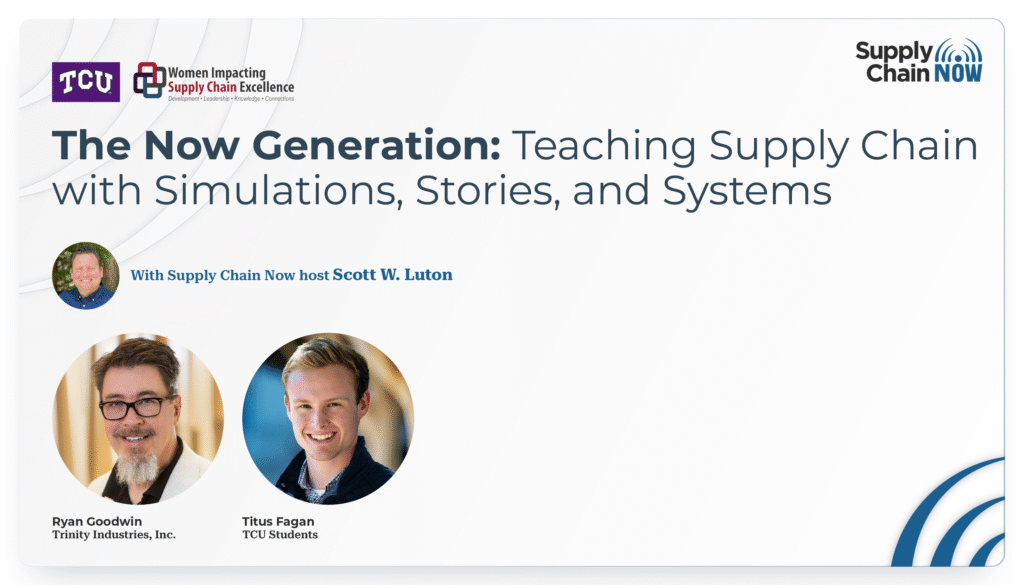
[00:00:35] Scott W. Luton: Welcome to today’s show, folks. Today we’re continuing. One of my favorite series, one that we like to call the Now Generation. And if you, if you first time you call, call the show. We don’t like saying the Next generation because these folks are already, as you’re gonna see here today, they’re already making an impact and they’re already here.
[00:00:54] Scott W. Luton: But on the series, we sit down with students and professional educators from some of the leading supply chain management programs and leading schools really around the world. But new for 2026. Hey, we’re delighted to partner with Dr. Stephanie Thomas and the WISE organization at The University of Arkansas to power The Now Generation series forward, now WISE exists to show students that supply chain is exciting, impactful, and full of opportunity.
[00:01:20] Scott W. Luton: This WISE initiative creates community. It connects students with industry leaders and helps ’em build the skills and confidence. To launch meaningful careers tell you Stephanie and the WISE team are doing incredible work, including offering some terrific programming and annual events. You can learn more by checking out the link we’ve got in the program notes below.
[00:01:39] Scott W. Luton: Alright, so today we are focused on what’s going on over in the great state of Texas and beyond at Texas Christian University. When it comes to supply chain management, TCU has been ranked as a top five program for best online, MBA in Supply Chain Management in the us. And a top 20 program for graduate supply chain programs in North America by Gartner.
[00:02:02] Scott W. Luton: Now, today is a follow up to our incredible podcast with Dr. Morgan Swink and a team of students. We’re gonna be interviewing a TCU adjunct professor and a past rock and roll guest here on the show, as well as a very talented student. So stay tuned for another terrific conversation. I love the series.
[00:02:20] Scott W. Luton: Always learn so much. So with that said, I wanna introduce our panel here today, starting with. My good friend Ryan Goodwin, an adjunct professor at TCU, but he also serves as a Senior Director of Supply Chain Technology and Innovation at Trinity Industries, where he spent over 10 years, or at least the last 10 years, aligning supply chain strategy with the corporate vision for success based in Dallas.
[00:02:44] Scott W. Luton: Get this, he’s also Co-founder of the Texas Tabletop Society. Very interesting. Ryan, welcome in. How you doing?
[00:02:51] Ryan Goodwin: I’m awesome, Scott. How have you been?
[00:02:53] Scott W. Luton: Terrific. I’m great. Uh, it’s so great to have you back. Enjoyed all of our interactions, including a, a great webinar we may touch on in a minute. But, uh, thanks for your time and you bring talent with you, Ryan, huh?
[00:03:06] Ryan Goodwin: Yeah, absolutely. Uh, when you asked about, uh, joining the podcast and having a student. Titus was the first one that popped to mind. Um, so, uh, I asked and uh, he was gracious enough to accept, uh, joining us on, uh, on the, the, the feed today.
[00:03:25] Scott W. Luton: Ryan, that is terrific. I ask and they shall deliver. So you let the cat outta the bag.
[00:03:30] Scott W. Luton: Titus Fagan is with us here today, a third year TCU student that’s studying this accounting. With a minor in energy business. How deadly is that combination? And as he’ll tell you, Titus really enjoyed his supply chain class that he is, uh, had with Professor Goodwin. Now he said to graduate in May 20, 27, but we’re gonna see if we can convert him over to supply chain today.
[00:03:52] Scott W. Luton: We’ll see. Kidding aside, we don’t interview many nons supply chain management majors, which is a really interesting aspect to today’s conversation. Takes a village folks, as we all know. Titus, welcome in. How you doing?
[00:04:04] Titus Fagan: I’m good Scott. Thanks for having me.
[00:04:06] Scott W. Luton: You bet. I am so glad when Ryan put the invitation out there, Titus say, oh yeah, I’m gonna bring it.
[00:04:12] Scott W. Luton: I’m gonna bring it. So it’s so great to have you here today. So let’s, let’s do this. Let’s, let’s not talk business for a second. Uh, and Titus, I really want to better understand on your weekends or your evenings when you got some free time, you don’t have to study or intern or any of that stuff. What’s one of your big hobbies?
[00:04:32] Titus Fagan: Yeah, I think the first thing that comes to mind for me is, uh, forecasting the weather. Um, it’s kind of a, a crazy side passion that I developed when I lived in Minnesota, but, you know, forecasting rain and thunderstorms and snowstorms, it’s, it’s been something that’s kind of gained some steam over the last four years for sure.
[00:04:52] Scott W. Luton: Titus, now that is, uh, I’m quickly cat. I wish I had AI here, but I’m quickly categorizing. Hundreds, uh, over almost 2000 conversations on the podcast. And I don’t think we’ve ever had someone that is a, um, whose hobby is forecasting weather. Ryan, I think that’s a great hobby, huh?
[00:05:10] Ryan Goodwin: Yeah. Uh, there was a. Article in the Wall Street Journal about companies having to use NVIDIA’s open source weather forecasting software because the government with the cutbacks have stopped forecasting some of this.
[00:05:23] Ryan Goodwin: So it’s, uh, maybe the hobby becomes the business at some point.
[00:05:27] Scott W. Luton: That’s right. And I think for additional context folks, uh, of course Titus is, he mentioned Minnesota, but now he’s based in Waco, Waco, Texas. And uh, you know, whenever I think of kind of the Midwest. And Waco may not be technically Midwest, but anyway, Kansas, Texas, Oklahoma.
[00:05:45] Scott W. Luton: Talk about how fast the weather changes. It’s gotta be fascinating to study it. And one more quick, um, uh, quick question for you, Titus, about hobbies in Waco. If folks traveling to Waco, let’s say they arrive tomorrow, they’re starving for a really good lunch, um, where would you send them?
[00:06:04] Titus Fagan: Yeah, there’s this really good West restaurant that’s based outta Waco, uh, called George’s, and it’s right on 35 heading down from Dallas to Austin.
[00:06:13] Titus Fagan: Um, really good. They’ve got a great chicken fried steak, good sweet tea. All the good southern food staples that you kind of have to have here in the South.
[00:06:22] Scott W. Luton: Ryan, we gotta, we gotta have a, a show on the road at George’s in Waco. You down.
[00:06:27] Ryan Goodwin: Yeah, absolutely.
[00:06:29] Scott W. Luton: All right. Um, alright, so really quick, Ryan, let’s ask you, uh, you know, you’re doing big things in industry.
[00:06:34] Scott W. Luton: We’ll learn more about that in just a second. But, you know, as a hobby, we were talking pre-show about Texas Tabletop Society,
[00:06:41] Ryan Goodwin: right?
[00:06:42] Scott W. Luton: Board games are, I’ll tell you, between pickleball and of course, video games, but board games and vinyl records are all back.
[00:06:51] Ryan Goodwin: Yeah.
[00:06:51] Scott W. Luton: Very, very popular. A quick blurb on what you do there at the society.
[00:06:55] Ryan Goodwin: We are a member driven space for people to come in and gather and play board games. You can bring your own board game, but we have probably over 11, 1200 board games, vintage collectible, a lot you can’t find anywhere else. So yeah, you just come in, make a reservation and, uh, play games and, uh, we’re, we’re very excited to, you know.
[00:07:19] Ryan Goodwin: The passion of being able to play games, but also to meet new people and, uh, get people to unplug and connect in the real world over, you know, a tangible physical item
[00:07:29] Scott W. Luton: that is, uh, love that. And I bet there’s probably a board game exchange somewhere that helps facilitate the buying and selling. But, and we talk in pre-show about one in particular that I always wanted as a kid, never got it called Axis and Allies.
[00:07:43] Scott W. Luton: And as you were say, saying, there’s lots of variations of that game, of that board game these days. Huh.
[00:07:48] Ryan Goodwin: Yeah. Yeah. It’s three or uh, probably 10 different versions. World War ii, world War I, Pacific Atlantic, battle of the Bulge. And then the designer, um, sorry, I’m gonna get a little off supply chain. You brought it up.
[00:08:04] Ryan Goodwin: The Larry Harris, the designer of that game, has a different version called War Room. The table, the board is about 10 by 10. And you, it comes with a little push rods to push the pieces around the boards, like in the movie. It’s pretty cool. That’s awesome. So it’s Axis and Allies times a million. And uh, of course we have a copy of that at the Tabletop Society as well.
[00:08:29] Scott W. Luton: Love it. If we could only keep all war on tabletops. Yeah. Ofs on the tabletop.
[00:08:34] Ryan Goodwin: Yes.
[00:08:35] Scott W. Luton: Um, but nevertheless, uh, okay. Um, Titus and Ryan, thanks for sharing a little bit about your personalities. And Titus I’ll be tuning into your forecast for what do you see coming into Atlanta, uh, the next few weeks, huh?
[00:08:48] Scott W. Luton: Hopefully no more ice and snow. Uh, but Ryan, uh, as I shared earlier, you joined us for a webinar on supply chain out here, uh, a year, maybe a year and a half ago. It was a great webinar. We got a lot of feedback. You and, and industry leaders, of course, uh, uh, Fred Bowman. From Conexus was there, but I wanna, before I revisit, revisit that theme, let’s make sure folks know a little about your practitioner background and, and your current roles.
[00:09:12] Scott W. Luton: ’cause you wear a couple different hats. Could you tell us more?
[00:09:15] Ryan Goodwin: Yeah. I joined Trinity Industries almost 12 years ago. At this point, I am currently the senior director of Supply chain Technology and innovation, which is awesome. I deliver innovative solutions under the guidance of our chief Supply chain officer.
[00:09:32] Ryan Goodwin: Michael Shin, he’s a real leader and visionary in the space. Got a great sourcing procurement background. Former GE guy. We spend recently a lot of our time delivering, I hate to say it, but automated solutions leveraging artificial intelligence, right? So it’s like not only a buzzword, but we are actually delivering those solutions with.
[00:09:55] Ryan Goodwin: Platform that really drives our innovation, integrates a lot of our supply chain technology systems, and allows us to build applications that link those systems. So if you think about planning MRP, our financial data, we integrated all on this platform. And then on top of it, layer in either, you know, programmatic solutions or artificially intelligent LLM driven solutions and some of the really exciting space.
[00:10:24] Ryan Goodwin: Or things that we’ve been doing is, if you’ve heard about vibe coding.
[00:10:29] Scott W. Luton: Yes.
[00:10:29] Ryan Goodwin: Um, the ability of a person that doesn’t have formal computer coding background to use artificial intelligence to build applications that leverage artificial intelligence. So we get into this whole weird mix of, you know, technology, creating the technology a person.
[00:10:53] Ryan Goodwin: You know, they may not necessarily, that’s a supply chain expert, but not a technology or coding expert. Now starting to dip into that space and people in my team have been pioneering the use of that technology too, to deliver solutions, which is pretty, it’s been pretty cool. Well, what does any of this thing have to do with supply chain?
[00:11:14] Ryan Goodwin: Well, we’re de delivering supply chain solutions, but you know, the platform is more of a technology driven platform at this point.
[00:11:22] Scott W. Luton: Ryan, fascinating stuff. We could spend a couple hours on some of the cool things you’re doing there. Bob coding is a very fascinating thing to, uh, to think through. And maybe, maybe one day it’ll enable me and my non-technology skill sets, uh, to do something there.
[00:11:36] Scott W. Luton: But, hey, Titus, how cool is it to, you know, be in classes led by Ryan or in other, you know, other parts of the business world led by practitioners that are doing it, not just teaching it. That’s gotta be cool, huh?
[00:11:50] Titus Fagan: Yeah, I mean, it honestly transforms the classroom experience because I learn much better from actual experience that my professors have.
[00:11:59] Titus Fagan: But I think, I mean, all of our students really do, it just adds so much value because they can actually add real life. Stories and experiences when they’re teaching the concepts in class. And, and I know that’s something that Professor Goodwin did a lot in class, and it’s one of the reasons why I really appreciated his supply chain class.
[00:12:16] Titus Fagan: I mean, there was one lecture when we talked for 45 minutes about the supply chain and logistics of a cruise ship, right? Mm-hmm. And getting all of the old stuff off of the boat and putting, putting all the new stuff on the ship in a timely fashion. And it really started to open my eyes to. See man, like there’s a lot move of moving pieces and moving parts to make that work.
[00:12:37] Titus Fagan: So it really did transform that classroom experience and it, and it does it elsewhere when people can bring in that real world, world real world experience.
[00:12:46] Scott W. Luton: I love it. Everything. Supply chain. And I love that that light bulb for you is going off so that as you move into high finance and energy, um, business, you can see.
[00:12:56] Scott W. Luton: Made the connections at the system level and ecosystem level. So that’s, that’s good stuff. Hey, um, one quick blur. I’m gonna, I’m gonna ask about a great quote you had Ryan, but I got an idea we should reach out. I think you said it was, uh, Larry Harris that was the game board maker. He made that big old 10.
[00:13:11] Scott W. Luton: That new 10 by 10 war game. He has got a supply. Massive board game that we can move stuff around on tables. Let’s reach out and see if you’ll, um, if you’ll take a, take a leap with us. We’ll see.
[00:13:23] Ryan Goodwin: Yeah.
[00:13:23] Scott W. Luton: Um, it, uh, that sometimes those days are best spent on tables rather than in reality, huh?
[00:13:29] Ryan Goodwin: Yeah.
[00:13:29] Scott W. Luton: Yeah. Alright, so Ryan, let me ask you about this because on your LinkedIn profile, as I was kind of seeing what you’re up to here lately, I saw one of your quotes that was on the big billboard in Times Square in New York City.
[00:13:42] Scott W. Luton: Yeah. And this is your quote. AI isn’t replacing the American dream, it’s finally making the dream real for workers in ways we’d never imagined. First. Titus, speak on that. What, what does that, where does that take your, your, your mind when you hear that?
[00:13:58] Titus Fagan: You know, I think the first thing that comes to mind for me is how AI can really help educate people and it help can help them connect to things that they don’t maybe fully understand yet, but AI can kind of fill those gaps.
[00:14:11] Titus Fagan: So that they can be propelled forward. Forward. You guys were talking about vibe coding and I think that’s one of the ways in which AI can be used to help people kinda realize that dream more. I have no formal coding experience, but I’ve used different AI models multiple times to write code for different data analytics, uh, projects that I’ve had in some of my classes, and it’s been really fascinating to be able to use that.
[00:14:36] Titus Fagan: But beyond that, I mean, you can use it in the finance world, you can use it in the accounting world. And I, I think it really brings and kind of lowers those barriers to entry for a lot of people who wouldn’t be able to have access to this information otherwise, if, if a AI didn’t exist,
[00:14:52] Scott W. Luton: well said Titus democratization is what I’m hearing with your answer there.
[00:14:56] Scott W. Luton: Alright, Ryan, your quote, you strike me as you kind of feel that in your bones. Uh, expound on that a bit if you would.
[00:15:03] Ryan Goodwin: I’d hate to, to say the Titus already said it, but I mean that’s, that’s really the beginning of it. I mean, I see it where some of the points I brought on. Is the ability, so the, the quote was, like you said, it was on a billboard sponsored by Palantir.
[00:15:17] Ryan Goodwin: I’ve spoken, I’ve participated in a lot of their conferences. They view their software and similar packages as like the Ironman armor for the American worker and it, it really will act as a force multiplier. So if you’ve got a very smart person that’s either got a lot of academic knowledge or a lot of practical knowledge or a lot of both.
[00:15:40] Ryan Goodwin: They may not be able to turn that into a technological application to help improve the business. And what artificial intelligence really does is lowers the, to, to what Titus said, lowers the barrier to entry to where it’s really, whatever your imagination can think of, you can create using artificial intelligence.
[00:16:03] Ryan Goodwin: If you can overcome the fear of, you know, that first step. And again, you know the. A quote from my, uh, one of my employees, one of the guys on my team is there’s this, it’s called AI FDE: Artificial Intelligence Forward Deployed Engineer. It’s an artificial intelligence that you can use to, it’s an integrated suite of vibe, coding, and data and analytics and just, it’s a partner to collaborate, to create applications and.
[00:16:34] Ryan Goodwin: One of the people on my team, longtime supply chain guy, years and years of supply chain experience. But you know, sometimes Excel could be potentially intimidating. You know, he took all of his Excel reports and used the AI FDE to bring them into Foundry where anybody, it’s no longer on Excel, on his desktop, that can get corrupted or deleted.
[00:16:56] Ryan Goodwin: It’s now an application living. On a productionized environment that anybody can get into. Then you’re like, well, what does that have to do with supply chain? Well, it’s all of our freight reports. He’d have to run ’em manually every month. And now some of them are automated because the data he used to get and type in and run is now integrated and some of the other ones he still has to go in and type into.
[00:17:20] Ryan Goodwin: But now again, it’s a productionized environment where anybody can do it. And he did it all using artificial intelligence, and it really accelerated his ability to do it. You know, I think there’s some sort of exponential curve here where more and more people will start trusting these tools, getting into them and using them.
[00:17:42] Ryan Goodwin: I still don’t know where all this ends up, but I, I feel like this is an extremely exciting time to be in many, many industries. Not just supply chain, but you know. Finance, accounting, energy. I mean, just these applications are limitless and really, really should the, the productivity of the American worker with these platforms is gonna just explode.
[00:18:07] Scott W. Luton: Sky’s limit. Uh, Titus what I heard there in just that one example with his, uh, colleague there is the elimination of manual work, the elimination of manual data entry, which is not fun. Been there, done that, saving tons of time. And all those things and more roll up to better accurate data. ’cause we’re humans, we all miss type rates.
[00:18:30] Scott W. Luton: And the rates, the error rates vary. Uh, you, it it’d surprise some folks, um, getting time back to be able to spend on more rewarding, critical thinking where we can bring more value to the table. And let’s face it, who likes the tedious spreadsheet? Clunky, I’m gonna call it. It really is. Can be a painful part of the day.
[00:18:48] Scott W. Luton: Titus, does that appeal to you?
[00:18:51] Titus Fagan: Oh yeah. I mean, it really appeals to me, even though as an accounting major, I have to say I love Excel. It’s one of my favorite things to, to, to use, especially once you know how to use it properly. But it’s, it’s appealing to me because especially, uh, in the. The field of accounting.
[00:19:07] Titus Fagan: I mean, that, that used to be what entry level accountants would do. They’d grab the data, they’d look at it manually, they’d figure out what they were looking for, and then they’d go enter it or they’d go, uh, report it or, or move it up the chain of command. And so now that there’s AI that helps gather that information and put it in a way that accountants could read that no longer has to be something that an entry level position would have to do.
[00:19:29] Titus Fagan: And in fact when I was interviewing with different accounting firms, that’s what I’ve been hearing is now they’re enabling and empowering entry level accounts to grow in their field much quicker and become much more proficient in the field a lot faster, which is only gonna help the company. And also, you know, me as a professional, uh, yes.
[00:19:48] Titus Fagan: To hopefully move up faster.
[00:19:50] Scott W. Luton: Titus Well said, Ryan, you’ve got a bright. Bright leader right here. Uh, I wish we had a couple more hours with Titus ’cause I gotta ask you lots of questions now, uh, based on, you’ve already established the bar here. So Titus, let’s start with this. We’ve kind of touched on some of the technological innovations going, uh, going on, not just in supply chain, but in a broader sense, right?
[00:20:12] Scott W. Luton: But what’s, if you look at global supply chain and you think about, I think you used a cruise ship example earlier. Which is a really fascinating one, but when you go further out a little more broadly out, what’s one topic or trend or or problem across global supply chain that really intrigues you right now?
[00:20:29] Titus Fagan: The biggest one for me right now I think is this concept of bottlenecks where you have all of this supply, but because of the transportation, you can’t get that supply to where it needs to go. The reason why I say that is because I’m, I’m really fascinated by the electric utility space. I think that’s one I’ll, I’ll go to with my minor in energy business.
[00:20:48] Titus Fagan: You know, there’s a lot of cases where, I shouldn’t say a lot of cases. There are cases though, where you have the. Electricity that could go to the customer, but because of transmission lines or uh, or too much traffic over those lines, they can’t get all that power to where it needs to go. And, and, and that’s a fascinating topic because there, uh, you see the convolutions, I guess, of, uh, where this, the chain of command or the supply chain messes with the, uh.
[00:21:16] Titus Fagan: The production. And, and I think that’s why it’s, it’s been such an interesting topic for me to learn about is because it’s just in everything, it’s pervasive. It, it goes in all different parts of business. Not just building the product and making the product, but also delivering it and then getting it to the customer.
[00:21:31] Titus Fagan: And so to me, I think that that bottleneck part or the part where. Supply chain, can’t get the supply to where the customers are, is, is really fascinating to me. And something that I, I wanna learn more about to see how aspiring professionals can help solve these issues.
[00:21:45] Scott W. Luton: Uh, Titus, uh, love your several things you touched on there, but Ryan, I’m gonna pick one in particular that’s had my attention.
[00:21:52] Scott W. Luton: Uh, a few months back I went to a conference hosted by Schneider Electric, and one of the major themes coming out of there was if we love all the innovation that AI and modern day technology and, and evolving technology offers a. That just should just add to our priority being placed on upgrading the infrastructure.
[00:22:13] Scott W. Luton: Right. And in fact, I saw one story in the last couple days, I think Danny Gonzalez at Industrial Sage put this on my radar, Ryan. It really focused on a, a power provider, energy provider, electricity provider that has 13 states and a portion of Washington DC amongst its, its, uh, geographic region and regulators and local governors.
[00:22:36] Scott W. Luton: Are trying to shift because the company is having a hard time keeping up with the electrical demand. They’re trying to shift the burden to build out the infrastructure, right? And new plants and whatnot to tech companies. Since if you probably look at volume, they’re big users. Ryan, your thoughts in general of our infrastructure challenges and your thoughts on, uh, on tech providers and, and their role in helping us, you know, um, overhaul our, our very dated and old infrastructure.
[00:23:04] Ryan Goodwin: Yeah, and I guess you can look at it both, you know, the, the grid perspective, right. You know, and that, you know, what is the most efficient way to move product from a logistics perspective is pipelines, you know, for oil or water. And most people, they’re like, that’s supply chain. Yeah, it is. It’s a delivery method, but also electricity in the wires or delivery method.
[00:23:26] Ryan Goodwin: I mean, you could. A Duracell battery is a, you know, an extreme example of, uh, transporting electricity or power. But the same discussion can be applied to the roads and bridges and railroads in the United States. Right. And there’s an, it’s a mixed model where if you get railroads, the railroad companies, becau, they own the roads.
[00:23:49] Ryan Goodwin: Right. And whereas. We think about us and we interact with streets, the government usually builds those tax dollars. And there’s different models of, you know, this road if, all right, so in Dallas we got Dallas North Tolle, which is a toll road, and then you’ve got 75, which is free. Very different experiences on both, but you know which one, it’s just a way to pay for these things.
[00:24:13] Ryan Goodwin: So if we’re talking about, I feel like particularly when it comes to infrastructure. It’s a classic public good. How do you properly price that? How do you get the government involved? And I feel like the beauty of the American experience is usually we figure out a way to have a joint corporate government delivery of these things.
[00:24:36] Ryan Goodwin: So as long as I feel like the spirit is there, as people are recognizing a problem and we’re getting all the people involved with solving the problems, because I mean, I think. If you were to tell people there’s gonna be an energy crunch 10 years ago when we were fracking everywhere, it was like this huge oil boom.
[00:24:57] Ryan Goodwin: And then like, we what?
[00:24:59] Scott W. Luton: Think you’re crazy,
[00:25:00] Ryan Goodwin: right? But we’d say artificial intelligence is gonna be real and it’s gonna spike. Demand. Everybody’d be like, what? You’re crazy, right? And so we’ve got this new technology. I think the government’s saying, well, you guys are the ones driving the, the demand. You guys should be part of the solution, which is.
[00:25:15] Ryan Goodwin: Again, completely ironic where they’re talking about opening Three Mile Island again, right? I mean the, the symbol of American industrial nuclear disaster and because the, the power demand is so much, everybody’s like, yeah, let’s open nukes. And I, which I’m a hundred percent in favor of. My grandfather was in the industry.
[00:25:36] Ryan Goodwin: He was on the Nautilus, the original powered submarine.
[00:25:38] Scott W. Luton: Really?
[00:25:39] Ryan Goodwin: Yeah. So I’ve always been, you know, maybe. Productized and being a proponent of nuclear power. But anyway, back to the infrastructure thing. So there’s a lot of solutions here and hopefully, you know, private public corporations can solve these supply chain issues both.
[00:25:57] Ryan Goodwin: Power transmission, which, you know, a lot of that power’s gonna power our factories. But then also the, the broader infrastructure of railways, roadways, bridge bridges, and, you know, seaports to keep the United States at the edge of being able to bring in product, but also hopefully export products. Yes. And having a world class infrastructure I think is really important.
[00:26:21] Scott W. Luton: Completely agree. And you know, when you, if you think you know the definition of infrastructure, I can promise you you’re not thinking broadly enough. It’s so holistic. I mean, Ryan just touched on a few things, but Titus, I’ll tell you, you mentioned bottlenecks, which is kind of what got us going, and I think we picked one of the biggest potential.
[00:26:41] Scott W. Luton: And growing real bottleneck out there with the energy, uh, infrastructure. Huh?
[00:26:45] Titus Fagan: Yeah, I mean, I’m obviously still learning. I’m not working in the field per se, but yeah, I mean, I think that’s the biggest thing with data centers right now being built out. And, you know, I’m not, we don’t need to go into this, this topic, but whether that’s a bubble or not, whether there’re overbuilding, whether there’s gonna be as much demand as people are thinking.
[00:27:02] Titus Fagan: It is, it is a concern. I mean, we’ve got a lot of people who are, are moving to Texas for various places, and that will require more demand or more energy, I mean, to match that demand and then transmission and the supply chain needs to be built out, or logistics, I should say, should be built out to, to be able to get that power to those people.
[00:27:19] Titus Fagan: And so it’s really fascinating. And, and even beyond the electric space, right? With moving oil and gas and liquified natural gas to, to our, um. Trading partners internationally. I mean, it’s just a, it’s a crazy field that has so many ties with supply chain and that’s kind of why I wanted to bring it up because it’s just, it’s, it’s growing right now.
[00:27:37] Titus Fagan: It’s a big field.
[00:27:38] Scott W. Luton: Tus. I love it. And well, I don’t wanna sleep on nuclear. I’m a big proponent, it kind of sounds like Ryan, of this new chapter of nuclear power. Uh, you know, we’re looking at. What do you call ’em? Small modular reactors and all the, so many different applications. And personally, my opinion folks, and look, I’m not, um, I’m not a nuclear physicist, but I don’t think you have to be one to have a educated opinion.
[00:28:03] Scott W. Luton: But I think just like green power, nuclear power is an important part of this power generation dilemma that not just the US but countries around the world. Certainly face and we don’t want it to limit not just our growth here, but the development of, of communities everywhere. So we’ll see how it unfolds.
[00:28:22] Scott W. Luton: Okay. Titus, here’s a big question. That last one was big. Gosh, I didn’t know it wasn’t, it was not McChrystal Ball where that went, uh, Ryan and Titus, where it would lead us. But the question I wanna pose to you, Titus, is what do you want to do in industry and why? And include. Yeah. Any thoughts on some of the change that you personally want to drive out in global business?
[00:28:45] Titus Fagan: Yeah, I think for me, when I think of what I want to change in industry, it more relates to the accounting world just because that’s kinda where my allegiance lies as, as of now. It could be changed, uh, after this discussion, but you know, the biggest thing I want to add or kind of change in the industry is bringing that more technological knowledge.
[00:29:04] Titus Fagan: To, uh, the accounting field. That was something that was, you know, brought up time and time again in all my interviews. Hey, we’re gonna rely on young people to help us understand these technologies. Obviously, they’re gonna educate themselves as well and not just put their, all of their trust in a few 21, 22 year olds coming outta college.
[00:29:23] Titus Fagan: But, you know, being able to use these new technologies is sometimes a challenge. Like, I finally got my parents using ai. It’s not a super, uh, high barrier, but you know how to prompt it correctly, right? What you can use it for, you can use it to modify spreadsheets like we were talking about earlier. You can use it in so many different ways than you at first realize.
[00:29:42] Titus Fagan: And so the biggest thing that I wanna help bring to the accounting world is, is, is that knowledge of being able to use technology. In data analytics. I just had a class on that. How can I bring that to the field in supply chain, right? I having an understanding of how getting a product to customer all works and, and so much more than that.
[00:30:01] Titus Fagan: So I think that’s really where I’m focusing right now. But again, I’m 21. That might change as I get closer to, to, to entering the field.
[00:30:09] Scott W. Luton: Titus, I I tell you, uh, I loved your response. I think you’re selling yourself short a little bit. ’cause I’ll tell you the 21, 22, I don’t know about you, Ryan. When I was 21 years old, I, I say this a lot, my focus was not on changing the world and, and in such a e eloquent and educated, uh, fashion that we heard there from Titus, I was, I was in pizza and, and beer mode, quite frankly, Ryan.
[00:30:33] Scott W. Luton: Right? But Ryan, hearing that and seeing, of course, having interaction with Todd and other really bright professionals entering or soon to enter the supply chain and really global business, that has got to be very rewarding. Huh.
[00:30:47] Ryan Goodwin: Yeah, I think it’s ironic. I mean, I feel like, and you probably were in the same boat, we get into the, the work world and it was very still hierarchical, command and control.
[00:30:58] Ryan Goodwin: Your boss said jump. It was always how high. Right. And I feel like there’s cer some of my coworkers can take a, an attitude that people entering the workforce today have an entitled attitude or you know, they want to be in charge immediately. And it’s sort of like, well you gotta, you know. Show your bones and, you know, invest and drudge and level up or whatever you want, you know, and I view it as with just vast macroeconomic trends.
[00:31:29] Ryan Goodwin: You know, the, the hollowing out of a lot of corporations. We’re gonna depend on ambitious young people to come in and help tr to his point, to help transform our companies. And I don’t think I, I, I don’t look at it as an entitled attitude. I look at it as a very open and aggressive attitude that they wanna make an impact right now, today.
[00:31:52] Ryan Goodwin: And it’s not like, oh, slow your roll, sit down and here, here’s a spreadsheet. Read this. It should be, no, it should be like, cool. You wanna make an impact? Here you go. You know, we still gotta deliver the good, so to speak, but when you ever, you’re looking at continuous improvement, whether it’s supply chain, accounting, uh, there’s always a list of stuff.
[00:32:12] Ryan Goodwin: That people wanna improve, and if you’re ambitious enough to help improve the bottom line of any company you’re at, we gotta figure out how to harness and unleash that creativity and ambition, right? Your discretionary ambition, you know, maybe yours and eyes was, you know, let’s get home and watch WWF, but you know, it, it could be.
[00:32:35] Ryan Goodwin: Oh no. I want to help transform the business. Cool. Let’s stay an hour after work and work on some stuff to make our job easier tomorrow. So I really, I working with TCU students every week, I, I see that ambition and I really want to push that in terms of, you know, what can you do for yourself? Go start your own company or.
[00:32:59] Ryan Goodwin: If you join a company, CR have a very entrepreneurial attitude and I think TCU does a good job of instilling that.
[00:33:06] Scott W. Luton: Well, and hold that thought, ’cause I, that’s one of the next questions I’m gonna ask Titus, but, but two quick things. Uh, first off, uh, growing up in the central Savannah River area, it was NWA on WTBS was my wrestling alliance of choice number one and long lived Dusty Rhodes American Dream.
[00:33:23] Scott W. Luton: And then secondly, um, I love how you put it about. What I heard, and you used really like eloquent words, but activating that pioneering and actionable spirit, right? These folks that really want to drive good change, and that’s some what we heard there from Titus Titus. When you think of, we don’t have to name names.
[00:33:41] Scott W. Luton: When you think of your future employer. Right. And you think of the culture and the, um, the workplace atmosphere. You know, Ryan mentioned some things, some really traditional things that were a big part of our earlier chapters. Todd, what’s a couple of things that you really are prioritizing with your future employers in terms of what work is like?
[00:34:02] Titus Fagan: I think the biggest thing that I’m prioritizing is how much are they gonna throw? How fast are they gonna throw me into to, to the job? Like, how fast are they gonna. Say, okay, you know what? Like we trust that you’ve had this internship experience. We trust that you’ve had this knowledge in in college.
[00:34:18] Titus Fagan: Let’s put you in the deep end, and obviously there’s gonna be people who supervise that explosion. If it happens, hopefully it doesn’t, but let’s get you deep into to what the accounting world really looks like as fast as possible. That’s really appealing to me because that’s the way you learn. One of my mentors that I look towards always says.
[00:34:39] Titus Fagan: Failure is the first attempt in learning. So the faster that I can get that experience for about failure or maybe not succeeding in in what I’m doing, the faster I’m gonna learn and faster I’m gonna know the proper way. And so that, that’s one of the things that makes me, something that I look for, I should say.
[00:34:55] Titus Fagan: And the second thing is just how collaborative of an environment is created around me. Because, you know, I think the best way to learn is, is working with others. And that’s what I think supply chain does really good at TCU, that that department is. We have a simulation game that we play the entire course.
[00:35:13] Titus Fagan: Of the semester and the, you have to collaborate because you have four different roles and they all connect. You have sales, you have supply chain, you have purchasing, you have operations or warehouse, right? So all of those industries, or all of those positions, I should say, rather need to be able to work together for you to be successful in that simulation.
[00:35:31] Titus Fagan: And it’s challenging, you know, because one person really knows their job really well and another person knows their job really well, but sometimes they don’t know the roles of the other person. So bridging that gap is really important. And I think really, uh, once you understand that, and once you build out a good team, you all just are propelled so much further if you were just by yourself.
[00:35:53] Titus Fagan: And so that an environment like that and an employer is something that I’m really looking forward to and something that I look forward as well.
[00:36:01] Scott W. Luton: Hiring manager, did you hear that? CEOs? Did you hear that? Uh, take it to heart. This is really what Tus just shared. I, I value it at face value from him, but really it folds up into a big common theme that I hear in a lot of these now generation shows.
[00:36:18] Scott W. Luton: Ryan, really quick wanna check in with you and what you heard there from Ryan in terms of what he prioritizes in the environments of his future employers.
[00:36:25] Ryan Goodwin: Hopefully, I, I think Tyler will agree. The class that I teach is for non supply chain majors, but business majors and what I always try to emphasize.
[00:36:36] Ryan Goodwin: Is, I’m trying to arm you with how to understand what’s going on in supply chain. So if you’re in finance or marketing or accounting, that when a supply chain professional is talking to you, you have something to hang your hat on and you, you have the beginnings of an understanding it appreciation of supply chain concepts, particularly that cross-functional nature, whereas you think a supply chain generically is.
[00:37:03] Ryan Goodwin: A thing, but it’s many linked things in functional areas across the company. So that cross-functional collaboration, both within the department, you know, ’cause accounting, you’re just like, oh, they’re ar that’s ap, you know, and it’s like supply chain people, that’s just like money, right? And then so, but, so you know, within our departments, people that want to collaborate and then across departments wanting to collaborate, I think.
[00:37:30] Ryan Goodwin: That’s a key driver to growing professionally in your career, but also helping your company, not just being siloed or allowing yourself to be siloed and just say, look, I’m only gonna do this and this is No, it’s, I think what we always admire are the people that want to collaborate and, you know, wanna work with.
[00:37:47] Ryan Goodwin: The broader team, but also the, the broader company.
[00:37:51] Scott W. Luton: Well said Ryan. We gotta be, uh, good leaders but also good followers and good collaborators. I’ll tell you, one of the worst things you can say, at least in my opinion is, Hey, that’s not my job. ’cause no one likes to work with folks that think, Hey, that’s not my job.
[00:38:05] Scott W. Luton: And it may be true, but still. So Titus Ryan, a couple of times has talked about basically the culture at TCU and the academic culture and the way that they bake certain. Aspects into their education and, and, um, delivery styles, I guess, for lack of a better phrase. Uh, I’m gonna ask you Titus, what makes, based on that and some other things you see, what makes TC U’S Supply Chain Management program successful or broader?
[00:38:33] Scott W. Luton: You know, it’s academic environment, successful. Uh, your thoughts there, Titus?
[00:38:38] Titus Fagan: Yeah, I think as it applies to supply chain, I think what makes that program or that class. Like Professor Goodwin said, it’s, it’s for non supply chain majors. I think what makes it super successful is the collaboration. I think I, I, me, I mentioned that earlier, but you know, bringing people together and then also giving them a real world application of supply chain through that simulation.
[00:38:58] Titus Fagan: I mean, that experience is invaluable. And for the first three or four weeks when you’re running that, you have no idea what’s going on. Your ROI is going down. Your warehouse is way overstocked. You’re not producing enough of your product and you’re like, what is going on? But once you start taking a step back and looking, okay, what area can I fix first?
[00:39:20] Titus Fagan: And then breaking it down into little bite-sized pieces, it starts to really make a difference. And by the end, you know, I think our team had an ROI of 30% or something like that, which is crazy, is really high. And um, it was just super fun and rewarding to see. Okay. It was super challenging. In fact, we were the last place team.
[00:39:38] Titus Fagan: Second week we went down to negative 36% into the rebound all the way to 30. So, you know, I think that’s what really does wonders for the supply chain program at TCU. Now in the broader community of the learning space at TCU, I think what really differentiates the TCU education and my perspective is the connection and the closeness between the professor and the student.
[00:40:02] Titus Fagan: And on top of that. This idea that this professor’s also learning, right? That the teacher scholar model where they’re teaching students, but they’re also learning more in their field so that they’re teaching the cutting edge of whatever subject they’re teaching to the now generation, like you’re saying.
[00:40:19] Titus Fagan: And, and I think that is, has just made my experience so much better, whether it’s in, you know, any business course or even in, I have a few, uh, non-business classes about talking about social media and being resilient in today’s world. All of these professors stand right beside you in that learning space and provide you with new insights that are being developed right now in the field.
[00:40:41] Titus Fagan: So it’s awesome. It’s fascinating. It’s such a gift, I, I would say to, to be able to be a student right now.
[00:40:46] Scott W. Luton: Titus, lemme ask you a dumb question because I think a, me and Ryan and all of our audience members probably can draw some conclusions here, but how has all that you just described in the overall environment at TCU best prepared you for a really successful and impactful career journey to come?
[00:41:02] Titus Fagan: Yeah, and I think the biggest thing is, is kind of what Professor Goodwin touched on, not siloing yourself. Right. What that type of education model really does is it, it makes me understand that it’s not just one topic, right? Accounting focuses on not just. The accounting side, but where all of those accounts are coming from, right?
[00:41:20] Titus Fagan: That relates to marketing as it relates to sales, as it relates to supply chain. So you can’t, you know, focus on each subject as it’s just the end of the, or the only thing in the world that matters. And so I, I think that learning model of. Educating students with new industry, uh, expertise as well as standing beside students really helps us broaden our perspective to go beyond what the classroom topic is.
[00:41:44] Titus Fagan: And that’s gonna, I, I think, pay hopefully massive dividends in, in the workforce when. I’m working on different clients that might be industries I’ve never heard of, but because it kind of ties back to some of the things I was taught, uh, in college, I’ll be able to be successful. So that, that’s the hope.
[00:42:02] Titus Fagan: Again, I have worked maybe two months fully in the, the corporate space as an intern this last summer. So I have, you know, really no, you know, backed evidence that shows that that’s what happens in, in the business world. But, you know, I can hope, right? I can hope.
[00:42:20] Scott W. Luton: You know, uh, while I hope I breathe, or while I breathe, I hope is actually South Carolina, my Home State’s, uh, motto, which I think is a really important one because hoping and envisioning a brighter future, more innovative future, a better future, I think it’s, uh, it’s something that has to happen every day.
[00:42:37] Scott W. Luton: Uh, I think of, of, of folks that no matter what reality is, right, they embrace it. But there’s all, you know, that optimism, I think fuels so much. Innovation and continuous improvement and big leadership gains. So yes, hope, hope, hope, Titus Hope. And do. Ryan, I wanna follow up with you on what Titus just shared there.
[00:42:57] Scott W. Luton: ’cause two part question here. Number one, react to what you heard there from Titus in terms of how all that you are doing at TCU, which is growing left and right by all accounts is impacting their that perspective and that potential that he spoke to. And then secondly, man. What are some of your, I mean this has gotta be rewarding to be kind of in your role, having these conversations and sharing, you know, seeing those light bulb moments that happen with the Tituss of the world.
[00:43:24] Scott W. Luton: So, two part question. React to what we heard and how cool is it to do what you do?
[00:43:29] Ryan Goodwin: I think he was spot on about the teacher aspect where everybody, TC continues to learn for good or bad the like. When Titus took my class two semesters ago, the class I’m teaching the semester after. It was different than the one I taught him.
[00:43:44] Ryan Goodwin: The, the common thread was that simulation. But ’cause I learned so much from teaching his class and I think his class wasn’t the same as the one before. I keep trying out new delivery methods, you know, like new concepts and it makes it fun and challenging. But like the class I’m teaching this time is totally different.
[00:44:04] Ryan Goodwin: Um, ’cause I’m taking advantage of new thoughts like the. This company Loca, just published a book called Introduction of Supply Chain. It’s free.
[00:44:18] Scott W. Luton: Okay.
[00:44:19] Ryan Goodwin: I a hundred percent recommending downloading it or reading it. It’s mind blowing, but it is the least introductory book I’ve ever read. It’s like, it’s like it showed a supply chain once you’re a supply chain expert.
[00:44:32] Ryan Goodwin: ’cause it really gets you to reframe the thinking. And the definition I gave to Titus is supply chain. Is, it’s the flow of goods and information and money from downstream for goods and information and money upstream. And the new def, I still teach that definition because it, it, it brings into information, goods and money, and the most important part is getting stuff to the customer or consumer.
[00:44:59] Ryan Goodwin: The new definition from the book is the mastery of optionality under variability to move physical goods. So when I read that, people are gonna be like, well, what the heck is he talking about? But it blew my mind. I’m like, wow, is this such a great way to think about supply chain? So using like new tools to help quickly change the curriculum where I use tools like artificial intelligence to say, Hey, here’s the old curriculum.
[00:45:25] Ryan Goodwin: I need help changing it to take advantage of these new thoughts and ideas, and it helps me go through and change things on a dime. So as a teacher, it’s really useful to keep things new and fresh, but also understanding having this like sort of playground to work with students on cutting edge stuff. But I can also apply that back to my day job and then also my side hustle of running a business.
[00:45:54] Ryan Goodwin: These are all things that all kind of, you get this flywheel going
[00:45:58] Scott W. Luton: Yeah.
[00:45:58] Ryan Goodwin: Of. You know, learning how to use these tools, applying the tools everywhere in your life, it’s really cool. And I’m still trying to figure out how to get the pastor at my church to use artificial intelligence. There we go. But, um, we’ll, we’ll, the pops make it tough.
[00:46:14] Ryan Goodwin: Rightly there’s kids thirds, but we, it’s still funny. Um, it’s, it’s really about how do you apply this everywhere in your life. And, uh, I’m, I’m having a blast doing it.
[00:46:25] Scott W. Luton: Yes.
[00:46:26] Ryan Goodwin: I feel like there was a two part in there. Did I hit both of them?
[00:46:30] Scott W. Luton: I, I think you did. I, I think you spoke, uh, volumes on both and, you know.
[00:46:35] Scott W. Luton: Okay. To your last point, I think it’s a healthy balance. You, it’s a healthy balance, and the balance will be different for different folks in different roles or in different preferences and, and comfort zones. And that’s okay. As long as, I think, I think the important thing, and I, I love hearing Titus has gotten his parents to kind of experiment a little bit.
[00:46:54] Scott W. Luton: I think it’s so important, even if you’re a skeptic and you just doubt the return experiment a little bit. Yeah. ’cause it’s gonna create some ideas and help you get some hours of your precious and very finite life back. Um, okay. Titus and Ryan, really good conversation here. I wanna ask you, Titus, you know, me and Ryan ran into each other at, um, in Orlando at Gartner Supply Chain Symposium.
[00:47:18] Scott W. Luton: One of the biggest one, the one of the, I think. Much well run and very valuable supply chain industry, charity, industry shows, uh, each year. Titus, have you been able to get out yet to a couple trade shows?
[00:47:31] Titus Fagan: I have not actually. I’ve never been to a trade show, unfortunately.
[00:47:36] Scott W. Luton: Well, we gotta change that. ’cause whether you’re in accounting or energy, uh, like I mentioned that Great Schneider Electric, that was a great, great event, eye-opening event or certainly supply chain.
[00:47:46] Scott W. Luton: We’ll have to give you some put on your radar and get you out. And by the way, Modex Titus is free to attend. It’s in Atlanta each year. They’re, they’re expecting like 40,000 people. Uh, and I know you like love supply chain and you know, the great thing about supply chain is that as you’ve already, you and Ryan already kind of share, touch, it touches everything.
[00:48:06] Scott W. Luton: So you go to a supply chain show, especially one of the big broad ones. Really everything is represented there. Ryan, how about you? You gonna be at Symposium again this year?
[00:48:16] Ryan Goodwin: Yep. Yeah, I’ll be at Symposium and. Just to remind you, I know we bumped into each other at manifest as well, so I’ll, uh, that’s
[00:48:22] Scott W. Luton: right.
[00:48:23] Ryan Goodwin: Yeah. I’ll, so we’re going out to manifest, uh, two weeks. Um, and we got tickets to see the, uh, what is it of Oz in the sphere. So we’re gonna go see a hundred, a hundred year old movie in, in a new venue. Um, so yeah, we’ll be out there and then, yeah, of course at the, uh, supply chain symposium in May.
[00:48:41] Scott W. Luton: Love it
[00:48:41] Ryan Goodwin: in Orlando will be there couple.
[00:48:44] Ryan Goodwin: Other ones that might pop up. You know, we we’re just at a, uh, user conference for TRO one of our, um, supply chain software providers, and we might be at, uh, the generics American Supply Chain Conference in April. And I’m not sure if we’ll make that one though.
[00:49:02] Scott W. Luton: Okay. Um, and, and that, that’s in Texas, right?
[00:49:05] Scott W. Luton: American Supply Chain Summit?
[00:49:06] Ryan Goodwin: Yeah, yeah, yeah. It’s here in Dallas, which is, I think we went last year. When I say we, the, the Trinity team, I think we’re gonna go this year. And so hopefully, if they’re listening, I know they’re Bo you know,
[00:49:17] Scott W. Luton: I’ve heard
[00:49:17] Ryan Goodwin: the things following up with us about getting us to go, but, we’ll, uh, because it’s local, we will, uh, I think we’ll be going again.
[00:49:24] Scott W. Luton: Awesome. Uh, all those are great well-regarded shows. And Titus, we’re gonna get you out. So whether it’s, uh, one of those he’s mentioned or, or maybe something in the finance industry, you know, FinTech is such a hot, hot space. And Atlanta here being, uh, FinTech Alley. Do you know that Titus Atlanta’s one of their nicknames is, is, uh.
[00:49:44] Scott W. Luton: Transaction alley, I think is what they call it. Um, so we’ll have to talk more. Uh, alright, so Titus, a couple last questions for you. Have you ever been to Vegas yet, Titus?
[00:49:54] Titus Fagan: I have not, but I really wanna go.
[00:49:56] Scott W. Luton: Okay. I
[00:49:56] Titus Fagan: have not been yet.
[00:49:58] Scott W. Luton: So we’re gonna get Ryan’s review of, uh, the Sphere and Wizard of Oz and maybe his people watching ’cause it’s the best people watching in the world.
[00:50:06] Scott W. Luton: Love Vegas, love shows, food, entertainment, and of course networking at these conferences. And Titus will have to get you up there too. Con, that’s a conference capital for sure. Um, okay. How can Ryan, let’s start with you, uh, at all these conferences. I bet you do some speaking, of course, you’re doing some teaching, you’re an entrepreneur, you’re driving supply chain change there at Trinity.
[00:50:29] Scott W. Luton: You stay pretty busy. But how can folks connect with you if they wanna compare notes or anything you’ve shared here today? Or maybe have you come in and speak?
[00:50:37] Ryan Goodwin: The best way, uh, is really LinkedIn. Um, you know it if. If you connect with me, please write a note and mention that you saw me here.
[00:50:47] Scott W. Luton: Mm.
[00:50:47] Ryan Goodwin: Um, ’cause I, I’m one of the funny ones.
[00:50:50] Ryan Goodwin: I tend to only link in to people that I’ve actually met, either put eyes on or shaking hands. Right. Um, which can be irritating, but I’m totally willing to link in with people that meet me through venues like that. So, but you just gotta reference it in the note. Um, and, uh, yeah, I’m the only Ryan Goodwin at Trinity Industries and I had shorter hair in the picture, but the beard’s still still gnarly, so he can, he can pick me up from my beard.
[00:51:18] Scott W. Luton: Love it. Love it. And we’re gonna get an update on the tabletop scene, uh, yeah. Soon. Uh, Ryan. Love that. Um, okay. Titus Titus Fagan, same question for you. How can folks track you down? They may wanna. Uh, recruit you to their team, or they may, may wanna pick your brain on anything you shared here today or, or have you speak or what have you.
[00:51:37] Scott W. Luton: How can folks track you down titles?
[00:51:39] Titus Fagan: Yeah, absolutely. It’s kinda the same way that Professor Goodwin throughout there, uh, LinkedIn. I’m the only Titus Fagan associated with TCU, so somewhat of a unique name, so hopefully you should be able to find it just, just fine. Um, but the same thing in the little notes.
[00:51:54] Titus Fagan: Also put, you know, on Supply Chain Now podcast would be the best way because, you know, I’m the same way. I don’t, I don’t usually connect with people that I don’t know or that aren’t from TCU specifically, just because, you know, you never know. So that would be helpful as well.
[00:52:07] Scott W. Luton: Awesome, tus good stuff. And I, I like y’all’s tips there.
[00:52:11] Scott W. Luton: It’s good to, uh, blessed to be the ties that bind and even more blessed are the, uh, informed ties that bind right when we connect the dots. Um, good stuff. Big thanks to Ryan Goodwin with TCU and Trinity Industries and, and much more. Ryan, appreciate what you do and, and, uh, not only in the industry driving innovation, but it’s a force multiplier effect by helping, you know, smart folks like Titus.
[00:52:36] Scott W. Luton: Better understand our world and be better prepared to go out and change it. So Brian, I really appreciate what you do.
[00:52:42] Ryan Goodwin: Thanks for having me on. Scott. As always, look forward to us running each running into each other at the conferences and, uh, next time I can hopefully join you here on a different topic.
[00:52:51] Scott W. Luton: Let’s do it. Let’s do it in person next time. Um, and Titus Fagan with TCU, a third year student, I can’t wait to see. What you do next. Big things coming for you. Tus. Thanks so much for joining us here today and sharing some of your perspective.
[00:53:07] Titus Fagan: Yeah, thank you so much for having me. It was such a, such a gift and honor to be on with y’all and, and learn more.
[00:53:12] Titus Fagan: As you know, I’m trying to figure out what my, my future holds for me.
[00:53:16] Scott W. Luton: Well, uh, it’s inarguable. It’s gonna be bright. Uh, it just depends on where, where you wanna do it, and, uh, I’m looking forward to getting updates from you. Uh, it’s a big thanks Titus. Also big thanks is Dr. Stephanie Thomas and WISE. Folks, love what WISE is doing.
[00:53:30] Scott W. Luton: Go find out, plug in support, what they’re doing. They’re really bringing communities of schools, supply chain students together across the country and beyond. You can check out the link right there. In the episode notes, of course, big thanks to our wonderful audience, SCN Global Fam. Really appreciate all the feedback and input and support.
[00:53:48] Scott W. Luton: Keep it coming. You make us better and stronger, and you’re why? Well, you are. Why we do what we do. So with all that said, folks, you know the homework. You gotta take something that Ryan or Titus said, do something with it. Right? Deeds not words. They, they brought a lot of actionable perspective. And whatever you do, Scott Luton, on behalf, the whole team here at Supply Chain Now challenging you to do good, give forward, be the change that’s needed.
[00:54:10] Scott W. Luton: We’ll see next time right back here. On Supply Chain Now. Thanks everybody.
[00:54:15] Voiceover: Join the Supply Chain Now community. For more supply chain perspectives, news and innovation, check out supplychainnow.com. Subscribe to Supply Chain Now on YouTube and follow and listen to Supply Chain Now wherever you get your podcasts.