[00:00:00] Mike Griswold: What we’re living now is kind of the new normal with disruptions and that level of uncertainty. And now to be successful, you need to figure out how do we manage through that. And how do we deliver value through that?
[00:00:16] Voiceover: Welcome to Supply Chain Now, the number one voice of supply chain. Join us as we share critical news, key insights, and real supply chain leadership from across the globe, one conversation at a time.
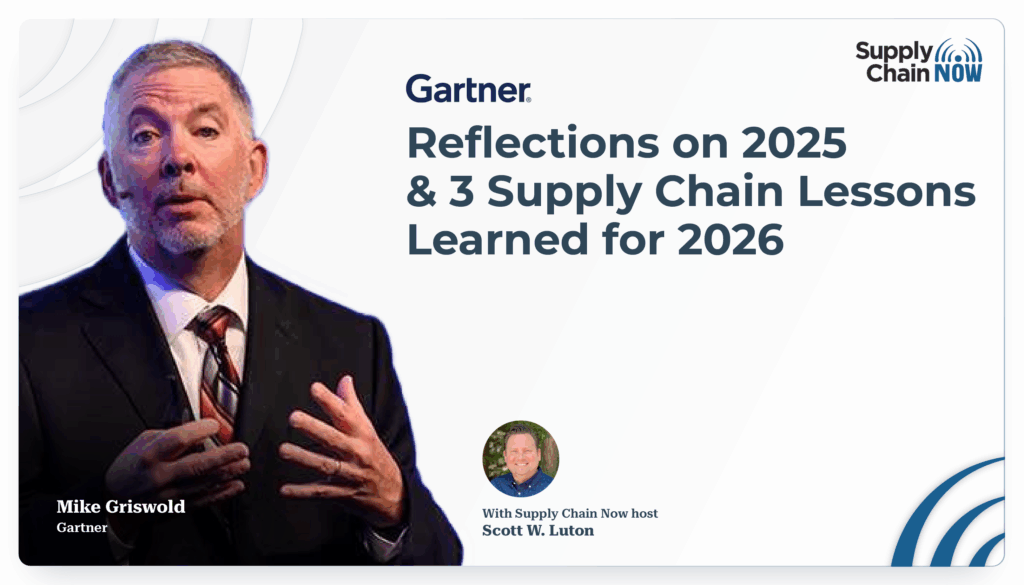
[00:00:29] Scott W. Luton: Hey, good morning, good afternoon, good evening, wherever you may be. Scott Luton and always special guest, Mike Griswold here with you on Supply Chain Now. Welcome to today’s show. Hey Mike. How you doing today?
[00:00:41] Mike Griswold: Doing very well. Thanks. It is cool and windy here in Boise today. But other than that, doing very well.
[00:00:48] Mike Griswold: Thanks.
[00:00:49] Scott W. Luton: Outstanding. Similar here. I’ve loved the cooler, more brisk temperatures in metro Atlanta. It’s been a, uh, a welcome relief. From some of the warmer than you like to think temperatures in, in the fall. First, lemme lemme tee up the show. Folks. You know today we continue one of our longest running and most popular series supply chain today and tomorrow with Mike Griswold with Gartner.
[00:01:12] Scott W. Luton: Mike, of course, serves as Vice President Analyst with Gartner. And today we’re gonna be sharing a few year in review thoughts. We’re gonna touch on a few moments from the Gartner Supply Chain Planning Summit. We’re even gonna embrace our inner space nerd a little bit. All that, and much, much more. So stay tuned as we walk through an outstanding discussion with the one only, Mike Griswold.
[00:01:34] Scott W. Luton: So now I think I can ask you this, so sometimes I get ahead of myself, Mike, I have found through some highly scientific research. It doesn’t quite meet the Mike Griswold research standard, but are you one of those that pack everything in until the final bell when it, when we’re going through holiday season, or do you like space and like to move into holiday season, personal holiday season as soon as possible.
[00:02:00] Scott W. Luton: Which bucket do you fall in?
[00:02:01] Mike Griswold: Yeah, I’m probably in that latter bucket a little bit more slowly into the season in terms of. Not trying to cram everything in at the very end, whether that’s shopping, whether that’s wrapping, all those types of things. I, I try to be a little bit more proactive around that.
[00:02:20] Mike Griswold: Not always successful. I’m sure there’ll be things I’ll be doing Christmas Eve evening, but I try to not land in that camp.
[00:02:30] Scott W. Luton: You know what? I’ve been trying for going on almost 50 years now and I fell miserably. I even tell myself at the end of this year, we’re not doing this again. And there we are. But tis the season folks, and you’re getting this in early January.
[00:02:43] Scott W. Luton: Happy, happy New Year to all of y’all out there. May this be your biggest year yet. Speaking of big years. Let’s take a look back, Mike, with this fun warmup question. ’cause this, this is one of my favorite topics I nerd out all the time on this topic. So folks, on today’s date, January 5th, back in 1972, an iconic consequential program was born, one that would go on to inspire countless individuals, really on a wide variety of levels.
[00:03:11] Scott W. Luton: On this date, president Nixon gave the order for NASA to create the famed Space Shuttle program. Back in 1972, January 5th, 1972. Now folks, a lot of folks may not know the incredible impact and return on that investment. Lemme share just a few, right? Just a few. And I’m biased, admittedly, the Space Shuttle program delivered.
[00:03:31] Scott W. Luton: On an incredible new technology, in a new technology age as it deployed, retrieved and repaired satellites in orbit, right? It saved and, and enabled saving the Hubble Space Telescope, which some call the most valuable scientific instrument ever built before the James Webb. We’ll see. We’ll see. We’re. Where they rank in history, shuttle technology helped pave the way for things like remote surgery and industrial robots.
[00:03:58] Scott W. Luton: It helped pioneer all sorts of advanced materials such as fire resistant materials and high performance composites. And the shuttle program also fueled computing software and systems engineering innovations such as one of many, many autonomous vehicle logic. So, Mike, your thoughts? I, again, I’m biased. I loved the space shuttle, loved it as a kid, couldn’t watch enough launches and, and updates your thoughts on that program.
[00:04:27] Mike Griswold: Yeah, I, I, I agree, Scott. I mean, I think it, it’s one of those things where we had a president that, at least for this particular topic. You had a vision similar to what Kennedy had around putting a man on the moon, right? Recognizing the value of having the ability to provide this type of service, if you will, in space through the space shuttle.
[00:04:52] Mike Griswold: I think the other thing that’s interesting is similar to the early space programs, you know, there were certainly setbacks in terms of, you know, losing two shuttle crews. Yet there was the fortitude to keep going on, recognizing that while those, you know, are, were certainly tragedies, the program itself was worth continuing.
[00:05:17] Mike Griswold: And I think there’s a lesson there from the standpoint of, of any, any major endeavor that you want to go and build or deliver or create is going to have setbacks. Some are going to be more tragic than others, but I think it’s, it’s how do you push through those? How do you continue to see the value in this endeavor, whatever it might be, and how do you rally the program through those, through that adversity, through those tragedies to continue to deliver the vision of that endeavor?
[00:05:57] Mike Griswold: And I think for the most part, we, we were able to do that. Be able to create and sustain a program that had incredible value. I think what’s probably most interesting to me in what you shared, Scott, were the things that people probably just don’t know about because we don’t talk about the byproducts that come out of these big endeavors.
[00:06:21] Mike Griswold: Right? If you look back over the course of history, there have been many offshoots of a great endeavor. That probably were never on the original radar screen to be an, an offshoot of that particular endeavor, yet we continue to learn from these, these big, ambitious types of initiatives. And I think that’s part of what makes these big initiatives so special as there’s things that will come out of it that probably were not on the original drawing board yet.
[00:06:54] Mike Griswold: You put a lot of smart people in a room and give them this task and provide. The ability for them to focus on the task, the byproducts that come out of that are usually pretty amazing.
[00:07:05] Scott W. Luton: Yes. Yes. And two final thoughts on my end there, Mike. ’cause you tricked a few thoughts. Number one, the James Webb Space telescope is truly transforming our understanding of the universe.
[00:07:17] Scott W. Luton: Right? And I wish I was smart enough scientifically to really lay all that out, but I’m, I’m tracking all the developments. And of course that stands on the shoulders of the, the current era, the Space program, the Apollo program, the Mercury Program, the Gemini, all that stuff. Right? And then secondly, what I find interesting and certainly has a supply chain tie in here, Mike, especially in the era of AI and the golden age of supply chain tech, is, if you think about it, what you just said on the front of your response, we landed on the moon thanks to JFK’s challenge to the whole country in 1969.
[00:07:55] Scott W. Luton: We know that for. A program like the shuttle program to hit a president’s desk and get a green light just three short years later. Uh, while we’re on the moon on a previous program, they were already thinking about what’s next. And so there’s a great lesson, I think for leaders everywhere that used to be.
[00:08:13] Scott W. Luton: We think about sitting on our laurels. It might meant, it might have meant years or months maybe, but now we’re talking about maybe hours or minutes. Right. Final thought there, Mike?
[00:08:23] Mike Griswold: No, it it’s one of those things where you’re, you’re spot on, Scott. I think particularly in today’s age, it is unrealistic, nor is it healthy to rest on what we accomplished like yesterday, right?
[00:08:39] Mike Griswold: Because there, there will be someone somewhere who is taking what we did yesterday and finding ways to improve it. You’re exactly right. It would’ve been, how easy would it have been to say when Neil Armstrong stepped on the moon? We’re done. We’ve accomplished what we wanted to accomplish. There’s no need for us to do anymore.
[00:09:01] Mike Griswold: Let’s pop the champagne. But you’re exactly right. If Nixon is approving this three years later, there must have been a whole lot of stuff going on in the subsequent years in order for that to, to transpire. So the message there is, is you wanna celebrate success. But you should not be seeing that success as like a final step.
[00:09:23] Mike Griswold: That’s right. Even if it might feel like one, like we’ve been to the moon, what else could we possibly do? Obviously there’s more that we could possibly do and we did.
[00:09:32] Scott W. Luton: That’s right. Folks, stick around. We’re gonna be talking more about space. Supply chain, certainly. In 2026 as it all unfolds. But we got a lot of stuff to get into here today and kind of this front end is kinda we’re showcasing one of the themes we’re gonna be that’s gonna really mark this conversation.
[00:09:47] Scott W. Luton: ’cause we’re gonna do a lot of reflecting on last year, what we learned, some of what we really need to carry into this year. And that’s where I wanna start. Mike, I wanna share this great read that I was checking out a couple weeks ago. It’s this end of year reflective piece from, and I, I apologize if I get these names wrong, Stan Aronow.
[00:10:06] Scott W. Luton: Is it Aronow? It is. Aronow, yep. Au. Okay. Stan Aronow. Thank you Stan. And Wade McDaniel at Gartner. So they touch on three major themes in this piece here that really define supply chain performance in 2025. And that will continue to impact industry in 2026 and beyond. So Mike, I’m gonna, um, get you to weigh in on two halves here.
[00:10:28] Scott W. Luton: We’re gonna talk about these three things through the 2025 lens, and then we’re gonna get you to weigh in as we look ahead to this year and beyond. So let’s name ’em first number one. Trade and tariffs from liberation to stabilization to realization. Secondly, AI and supply chains from pilots to scaled solutions.
[00:10:50] Scott W. Luton: And then thirdly, talent from the traditional pyramid to a new puzzle. So Mike, your general thoughts on those three, three big and meaty topics or any other reflections on the 2025 year that was in global supply chain?
[00:11:04] Mike Griswold: When I think about what our clients are asking us. And what, you know, our experts across the supply chain are talking to people about.
[00:11:16] Mike Griswold: These three buckets probably encompass in some form or fashion, 90, 95% of what we talked to people about the tariffs. One, certainly at the beginning of the year was a very hot topic for us. We published a lot of research on that and talked about. One of the things Stan and Wade talked about was kind of inventory and certainly the, the, the inventory concepts have been around the supply chain since we first had a supply chain, and I think inventory has taken lots of different, or played lots of different parts in a supply chain strategy.
[00:11:57] Mike Griswold: Think about the evolution from, you know, of just in time, right, which was the doctrine of supply chain inventory. Then COVID happens, and everyone really, I think COVID was the impetus for people to look at inventory as an asset, inventory management as a strategy, and how do we better utilize our inventory, both from a responsiveness and an agility perspective, but actually what do we need to have?
[00:12:26] Mike Griswold: I think what we’re learning on the tariffs piece though now as we moved into the end of 25 and the 26 is, is they’re here to stay. And now the advice is how do you incorporate the idea of tariffs into your overarching supply chain strategy, whether that’s how you design your network, where you source product, all those types of things.
[00:12:48] Mike Griswold: I think we, we’ve evolved from a very reactive stance to tariffs at the beginning of the year to now, a much more proactive response to tariffs as we move into 2026. The AI one I know will be one that we’ll talk about a lot today in our time together, and I think Stan and Wade’s description is very accurate.
[00:13:12] Mike Griswold: I think when we look at leading organizations, they are definitely moving from this idea of piloting AI to really honing in on, on very specific use cases, whether that’s in the planning area. Sourcing area, logistics area, wherever it might be, and really finding where the nuggets of value are that AI is gonna unlock for us, right?
[00:13:37] Mike Griswold: And that value, people often associate that value with, well, AI is gonna do stuff, so I need less people. And while that to some degree is true. I think the bigger AI value proposition is really an augmentation. How do we help people make better, faster decisions? We using AI as a tool to do that, not as replacing human experience, but augmenting the technology with human experience.
[00:14:13] Mike Griswold: And then the lastly is, is talent. And it definitely, my team looks at talent and org design. We are definitely influenced by ai, whether it’s what skills do we need, what type of people do we need, what’s the risk to our talent population from an AI implementation. But I also want to caution folks that there is a risk with all of this focus on ai, that we lose sight and we weaken.
[00:14:48] Mike Griswold: Some of our critical thinking skills, right? Because we’re pushing so much into AI and generative AI and things like chat GPT to do things for us that we are, we run the risk of kind of, for lack of a better term, Scott, dumbing down our employee base for some of those critical skills that are needed to actually help ask AI the right questions, right?
[00:15:17] Mike Griswold: So. The, those three areas, tariffs, AI, and talent, huge volume of interactions for us with our clients, and I would envision you and I probably having a similar topical discussion this time next year. I don’t foresee. Those three buckets really changing. I think there’ll be a lot more nuances to them this time next year, but I think those three buckets are gonna be pretty consistent into 2026.
[00:15:48] Scott W. Luton: So Mike, I wholeheartedly agree with you and I love how you put it and, and again, like you always do, you triggered a couple thoughts on my end. I’m gonna pick up on your last, one of your last points there. Uh, about the talent piece, and you mentioned the dumbing down effect that in some cases folks may be opting to say, oh gosh, this is gonna make my job so much easier.
[00:16:10] Scott W. Luton: Press less buttons, think less, and that’s a path. But I would encourage folks out there to really lean into the moment, learn more, upskill more. Go to your, your manager, your organization, say, Hey. I love what we’re doing here, but I really need to bolt on these skills so I can be, bring even more value. And that takes the small win or the big window of opportunity I’ll, I’ll call it, and makes it into a big window of opportunity.
[00:16:36] Scott W. Luton: So I love your point there, Mike. And then one, one more point that may be unpopular and folks may even disagree with it, but I’m gonna make probably, um. I bet a unique comparison to two schools of thought that are very valuable. One, again, both of ’em can be culprits, some scapegoats for job losses. So you’ve got lean methodology.
[00:16:58] Scott W. Luton: It’s been around for a long, long time, and the organizations that really apply it well know it’s a relentless pursuit of the elimination of waste. Not people, but waste. And I would argue that when Lean is. When is accurately applied, not the newfangled, we’re gonna have a reduction in force, but call it this, but when it’s really applied, it actually creates more jobs, opportunities, new business innovations, you name it.
[00:17:25] Scott W. Luton: ’cause it gets rid of the stuff that we shouldn’t be spending any time on ai. There’s a, there’s some kind of parallel there because while some folks will point to it and say, Hey, gosh, organizations left and right, they’re getting rid of people because of ai. However. If applied the right way. Again, it’s gonna create jobs, it’s gonna create new jobs, it’s gonna create new opportunities, new business, and so both will be a boogey man in some circles, but I see both as as powerful forces, one older and one much newer.
[00:17:58] Scott W. Luton: Your reactions to that, Mike,
[00:18:00] Mike Griswold: I’m with you, Scott, on this one. I think, you know, when we look at Lean and Six Sigma, you are exactly right in how you described them. They were designed. To kind of highlight inefficiencies in processes, waste in processes, and, and kind of find ways to get them out. But that process right, was fairly labor intensive and time consuming to find that, in terms of the whole process, the whole Six Sigma process in and of itself is a process, right?
[00:18:32] Mike Griswold: And it, and it took time. I think what AI has done for us. Is basically amped up the cycle times in terms of finding those inefficiencies. What people are learning is there, there is much more, let’s call it profit optimization opportunities with ai, and I would argue with Six Sigma. There are many more profit opportunities that are available to you when you do those things right than there are from a cost side.
[00:19:02] Mike Griswold: What I mean by that is you will get to a point where you’ve taken all the costs out you can take before you start actually hurting the business. Right? And there are many more opportunities to create profits when you do things more efficiently. So then there isn’t taking cost out. So I also think, and I’ll raise my hand first and say I, I have not read in great detail all of these stories about organizations and their workforce reduction.
[00:19:31] Mike Griswold: I would argue though, that if you actually look deep into that, AI is a very small actual reason for these workforce reductions. There are probably longstanding inefficiencies, change in market conditions, loss of customers. There’s probably a whole litany. Uh, not probably, there is a whole litany of reasons companies needed to come to these decisions.
[00:19:57] Mike Griswold: AI may be seen as an enabler, but I don’t know that it’s necessarily, you know, a top driver of why people are making some of these labor decisions. So some of that comes with, you know, we just have to do a better job of kinda really understanding these situations and really I think, understanding what is AI’s role in this.
[00:20:20] Mike Griswold: And I think more often than not, what we’ll find is it’s an enabler, not the driver. That’s right.
[00:20:26] Scott W. Luton: Well said, Mike. Well said. Uh, gotta get past the headlines, folks. Uh, yes. One of my points. Yes. Okay, so we’re gonna go back again to this p this great piece here, and folks go out and check it out. I, I read it on LinkedIn and we talked about 20, 25 reflections.
[00:20:43] Scott W. Luton: Now we’re gonna take those three key reflections and kind of project them forward a little bit like Mike did in his last response. I’m gonna get Mike to weigh in again. So the three lessons. Stan and Wade really point to all of us. One trade policy, as Mike mentioned earlier, it’s a vital dynamic input in the strategy not to be treated as a one-off exception.
[00:21:05] Scott W. Luton: Two, when it comes to ai, it’s no longer optional equipment or, uh, it’s no longer an optional experiment. Rather, it is a competitive differentiator that is only growing in its impact, right. Study after study shows that. And all that leads us to this final related point on my, one of my favorite topics of being talent.
[00:21:26] Scott W. Luton: Your talent strategy is now inseparable from your AI strategy. So Mike, your thoughts on those lessons that we’re trying to project into 2025?
[00:21:37] Mike Griswold: I think the lessons from Stan in way that they point out are, I think highly, highly valuable from the standpoint that. Our overarching advice right to, to chief supply chain officers is you need to ensure that your supply chain strategy is connected to whatever your corporate strategy is, and that you as a CSCO have not only visibility to that overarching strategy, but also can influence that.
[00:22:09] Mike Griswold: And I think it’s the same with these three observations from Stan and Wade is all three of these. Need to be part of your broader supply chain strategy and all three of them, while I know stand and weigh the linked talent strategy and AI strategy, those need to be together, which I agree with. I also think the broader tariff strategy needs to be viewed as part of your overarching supply chain strategy.
[00:22:39] Mike Griswold: ’cause it potentially can drive things like. Where am I gonna make stuff? Where am I gonna store stuff? Where am I gonna ship stuff from, right? Who am I gonna partner with to make stuff and ship stuff? So all three of these, you know, I would say in the past people would’ve looked at them kind of in isolation.
[00:22:59] Mike Griswold: And I think now as we looked to have better alignment between the supply chain strategy and the corporate strategy, these three things. I think become interconnected and fundamental to a 2026 supply chain strategy. Yes. My last observation, again, because it, I’m closer to it because of the, of the team that I have.
[00:23:24] Mike Griswold: We have to be really careful when we think about this intersect between the a i I strategy and the talent strategy. And it’s not from the standpoint where I, I disagree that those need to come together ’cause I do agree with that. But we have to recognize there, there is often going to be a fairly visible and different lead time to how we can tackle both ends of that strategy.
[00:23:56] Mike Griswold: What I mean by that is. It seems like every day there is new AI technology for us to think about and figure out how to use it and how, how to use it within the business perspective, how to use it from a technology perspective. That’s happening very rapidly. The ability though on the people side to actually absorb that, get skilled in that, and have an appropriate lead time to become proficient in that.
[00:24:25] Mike Griswold: Is much longer than what it is to see this new technology. So it’s almost like we’re, we’ve got two races we’re trying to run with the same group of people. And basically the talent side of this, if I use an old analogy, the talent side of this is kinda like a marathon, and the technology side of this is a sprint and how do we get the same population of people?
[00:24:52] Mike Griswold: To be able to successfully navigate those two races. That is the challenge. Yes. And that’s what we spend a whole lot of time talking to people about at Gartner.
[00:25:03] Scott W. Luton: So that all of those athletes will be ready to run and successfully tackle the incredible obstacle course, Olympic obstacle course that is global supply chain.
[00:25:13] Scott W. Luton: Right? Right. And sometimes you’re sprinting through it. So it’s doubly triply is challenging. Good stuff there, Mike. Appreciate your thoughts and perspective and again folks, great piece. Go out and check it out. We’ll include a link to it in the notes here. So. Mike, what we’re showing here now is, uh, some of our snapshots that we took from Gartner Supply Chain Planning Summit in Denver.
[00:25:36] Scott W. Luton: Folks that tune into this series that we’ve been talking about this for quite some time. I attended my first one in Denver, took place the first week or so of December, and in our newsletter with that said, which comes out almost every week on the one dated, let’s see. A few weeks back, it was December the, I think the 14th.
[00:25:55] Scott W. Luton: Folks, go check it out. When you go venture over to what that said on, especially on LinkedIn, you’ll find the whole library. So go check it out. We offered a couple select quotes from many, many conversations, presentations, you name it from a great event, the summit, and I wanna 0.1 out. You, Mike, I wanna get your reaction, uh, your general reaction.
[00:26:14] Scott W. Luton: But my dear friend, Jake Barr, AKA, the John Wayne of Global Supply Chain one, my favorite nicknames, and I swear it, it’s a perfect fit. He mentioned at the end of day one, as I was reconnected with him and our friend Karin Bursa, which I know you know as well, I was asking them both, Hey, get, what’s your key takeaways?
[00:26:33] Scott W. Luton: We talked about all kinds of stuff. The Kraft Heinz presentation was a good one. Noha Samara gave what I thought was my favorite presentation, speaking races. She really compared planning to a High Rocks race, which I, I thought was, was genius. But Jake struck me ’cause he mentioned as he was talking with various supply chain leaders.
[00:26:58] Scott W. Luton: More often than not, he was struck how they all had this. Proverbial deer in headlights. Look, zombie land I think he used when it comes to kind of trying to absorb truly modern, innovative, really AI driven, not just in lip service planning approaches and technologies and platforms and how organizations are using them today.
[00:27:20] Scott W. Luton: Competitors are using them today and he really urged for anyone to listen. Hey, we can’t act like it’s supply chain 19, 19 84. We gotta really lean in and embrace the current state of innovation. So I’d love to get your reaction to that, what you’re seeing. And again, it wasn’t a one broad brush. There’s lots of different approaches, very innovative, modern approaches, but your general thoughts to that and then what else Did you hear any sessions that you reflected on here a month or so later?
[00:27:48] Mike Griswold: I think, you know, as usual, Jake is spot on. I mean, I, I think the. We’re in a period now, particularly in the planning environment, where we have had significant technological breakthroughs through the use of AI that really can now manage the large quantities of data that we’ve always had access to, whether that’s customer data, sales data, whatever it might be.
[00:28:18] Mike Griswold: We’ve never lacked for data within the planning environment, right? We’ve always had our eye on, well, if I only do this, I could do this. I could do so much better as a planner, right? We’ve always been held back by technology, and I think we now are at a point where that is no longer the case. With the advent of technology, pretty much there is no data set that is too large.
[00:28:44] Mike Griswold: There are no kind of parameters or attributes. That I’d like to know that I can’t incorporate into some of these models. I think the real challenge becomes now that technology is not the barrier. How do I get my organization to realize when is enough analysis enough and now I need to move from that planning stage, that analysis stage.
[00:29:17] Mike Griswold: Into the execution stage. In the past, we were forced based on the technology to make some decisions because we just didn’t have the ability to create more insights. Now we have more insights than, frankly, we probably know what to do with. And we run into this overused term, but I think accurate analysis paralysis, right?
[00:29:42] Mike Griswold: So I think one of the things that, that Jake is highlighting is not only this idea of, wow, I’ve got all this new technology. I don’t know what to do with it. But I think what we’re seeing is, is the companies that are having the most success understand when enough models are enough, when enough analysis is enough.
[00:30:03] Mike Griswold: And we’re now just gonna move quickly and efficiently into execution. Piggybacking on the second party of your question, while I don’t have kind of a particular session or sessions that I would say my are my favorite, the messages that came through I think we’re important around some of the things that we experience that aren’t gonna change complexity.
[00:30:32] Mike Griswold: Volatility, like let’s call ’em the tees, right? Complexity, volatility, uncertainty. Those things aren’t gonna change, right? And as a supply chain professional, I, I need to kind of know that. But now what we’re seeing is companies kind of embracing those through the use of technology, through the use of upskilling their planners as an example, and being able to thrive in some of those.
[00:31:00] Mike Griswold: Worlds where we don’t have all the answers. And I think we spent a lot of time in that event trying to help people understand that what we’re living now is kind of the new normal, right? With disruptions and that level of uncertainty. And now to be successful, you need to, you need to figure out how do we manage through that.
[00:31:25] Mike Griswold: And how do we deliver value through that? You know, we talk a lot in these session, in our time together about my coaching, right? And one of the things we try to coach our girls on, which I think is very applicable here, is you have to be comfortable being uncomfortable. And I think ever since COVID. Right.
[00:31:49] Mike Griswold: The supply chains that have gotten really good at being comfortable, being uncomfortable are the ones that have had success. The ones that recognize every day I come to work, I’m gonna have some level of uncertainty, I’m gonna have some level of disruption. But I know as an organization, we have the tools and the capacity to move through that on a day in and day out basis.
[00:32:15] Mike Griswold: So. Getting comfortable, being uncomfortable, I think is going to need to be our supply chain kind of mindset for the next several years at least.
[00:32:27] Scott W. Luton: Mike well said. Gosh, that response. We could break it up into a multi-part year long webinar series. A lot of good actionable perspective. And I want a little note for anyone that’s been listening to our conversations or viewing them, you know what Mike’s talking about?
[00:32:42] Scott W. Luton: He’s talking about his, his legendary basketball coaching that we’ve talked relentlessly about for six years. I find it fascinating. Because there’s lots of parallels between basketball coaching, coaching athletes, and coaching and, and driving supply chain performance. It’s very interesting and I would just add one more thing.
[00:33:00] Scott W. Luton: Quick thing I’m about to ask you, Mike, the billion dollar challenge, right? What you’re gonna challenge supply chain leaders in this year, but one of my favorite things that I heard again at the summit. And I think it’s easy, especially for those of y’all like me, which, and there’s not many in our audience.
[00:33:19] Scott W. Luton: We’ve got the smartest audience, all of global supply chain. But I can be a little bit slow on the slow side, slow to pick things up. I can get kinda like maybe some of y’all out there get overwhelmed and all the velocity and the change and innovation. But the great news, the good news out there is you, when you, when you simplify, it doesn’t mean it’s simple, but when you really target.
[00:33:39] Scott W. Luton: New technology, including ai, and you start with what are your valuable people’s biggest headaches that you can apply it and blast it away, right? And incrementally build better, easier days for your people. It can really, especially the early winds, can really be that easy. Not that it is easy, but at least it’s, it’s easier, so might respond to that.
[00:34:03] Scott W. Luton: Then I’m gonna pose a billion dollar challenge.
[00:34:05] Mike Griswold: Yeah, I, I think you said it very well, Scott. We had in, let’s say, the last couple of years, I would say, I, what I’ve observed through talking to our clients at Gartner is we had AI running around trying to solve a problem, right? And that usually doesn’t end well.
[00:34:22] Mike Griswold: What ends up happening is you have, you know, investment in technology, you have difficulty proving the return on that. ’cause you, you haven’t really targeted a specific area. To address and then you get people disillusioned with the technology. I think what we’re seeing now is a much more thoughtful approach to AI and identifying where it can add value and being able to, to more surgically and, and in a more targeted fashion, figure out what problem do I have and is AI the right solution for that?
[00:35:03] Scott W. Luton: That is a perfect billion dollar question that everyone needs to answer because everything’s not an AI problem, folks. Right? Right. And the sooner we all realize it, the better off we’ll all be. So I’m gonna segue there, Mike, to another billion dollar question I’m gonna pose to you, right? You get a toughest question of the day.
[00:35:22] Scott W. Luton: If you could challenge supply chain leaders on one big thing this year and here in 2026, what would that be? Mike?
[00:35:31] Mike Griswold: I am gonna piggyback on what we just talked about around, through the, through the lens of ai. Well, you, you said it very well. Not every problem has an AI solution. It’s like the saying, if you have a hammer, every problem looks like a nail.
[00:35:44] Mike Griswold: Right? Right. And I think my challenge to folks is really. Kind of a multi-part challenge, right? The first part is, you know, just take, ’cause I’m old school, right? Take a piece of paper and just list out the three biggest challenges your organization has, right? Is it customer service? Is it fulfillment?
[00:36:06] Mike Griswold: Accuracy? Is it retaining people? Whatever it might be. And so in one column you’ve got three to five of your biggest challenges. In the second column, I would put. How am I going to know that I fixed this? What measures of success, right? If people are familiar with our research around the hierarchy of metrics, right?
[00:36:28] Mike Griswold: What are, for each of these three to five things, what are two or three metrics that I’m gonna be able to either have or create that will tell me, Bo, where do I stand today? And am I fixing the problem? And then in the third column, if I bring it full circle. What role, if any, does AI play in that particular challenge?
[00:36:52] Mike Griswold: I think if you build that very simple matrix and, and take a look at that, that’s my challenge because as you, uh, alluded to Scott, and as I see in talking to people or I hear as I talk to people, we still have people that can tell me, these are my five biggest problems, but can’t tell me how they’re gonna know when they’re done.
[00:37:14] Mike Griswold: And they’ve got their five biggest problems and all five of them they feel are solved by ai. It’s this cross-referencing of these three things. I think that if you do those, my challenge to you is to do that thing. I think you’ll have a much clearer picture on what you wanna focus on and prioritize in 2026.
[00:37:36] Scott W. Luton: I love it. That is some powerful clarity. If you can arrive at that degree of clarity. Man, you are really cooking with Grease and Mike, it’s not necessarily a Venn diagram, it might be more of a Griswold graph. Is that something? Yes.
[00:37:49] Mike Griswold: Um, yes. Yes. Because my sense, I mean, my sense, Scott is, is if you list those five things, there might be some overlap like you might see in a Venn diagram.
[00:38:01] Mike Griswold: But my sense is there’s also some things out there. That are a problem that are kind of on their own. Yes. That maybe aren’t interwoven in some other challenges you might have.
[00:38:12] Scott W. Luton: Yep. Well said. I like it. Actionable advice from the one and only Mike Griswold here today. So Mike, I hate to wrap up today’s conversation, but we’re gonna do so with more actionable suggestions.
[00:38:26] Scott W. Luton: And one thing that I wanna make sure is on everybody’s radar, we’ve really enjoyed it. I think I’ve been to three. Gartner Supply Chain Symposiums thus far. And the 2026 version is, it’s hard to believe we’re already talking about it, but that’s time’s velocity. It’s like business velocity. It’s not slowing down.
[00:38:42] Scott W. Luton: So let’s see, May 4th, fifth, and sixth in Orlando 2026, right? You’re gonna have the grandest gathering of c SCOs and senior supply chain leaders that are really transforming how global supply chain happens. And Mike, as we like to reference. The biggest supply chain cocktail session that you’re gonna find.
[00:39:05] Scott W. Luton: Yes. Maybe all of North America or more beyond. I don’t know, Mike, but that is quite a, that is quite something to behold, huh?
[00:39:13] Mike Griswold: Yeah. I mean we, we like to call it the world’s largest gathering of supply chain professionals, and no one has really challenged us on that, Scott, so I’m gonna assume it’s true. Un, until someone says, Hey, no, we have a bigger event that is focused.
[00:39:28] Mike Griswold: Directly on CSCOs and their direct reports. I’m gonna stand by my case that it is the world’s largest gathering of supply chain professionals.
[00:39:37] Scott W. Luton: I like it. I like it, folks. You can venture over to gartner.com. Check out the schedule, sign up, and if you can’t find it, you just reach out. We’ll make sure you can, you can get there.
[00:39:48] Scott W. Luton: Okay. So Mike Griswold speak, you know, tracking down valuable, trusted sources of sources of information. How can folks track you down Mike Griswold,
[00:39:57] Mike Griswold: uh, LinkedIn, or email mike.griswold@gartner.com. Happy to, to chat with folks and hopefully this, this resonates and if people have violent disagreements, I wanna hear about that as well.
[00:40:10] Scott W. Luton: We did too. We did too. And folks, if you do the Griswold graph, take a picture, send it to us. Right. We’d love to get your feedback. Yes. Have fun with that for sure. Okay. Mike Griswold, vice President Analyst with Gartner. Mike, always a pleasure. I think we’re wrapping up. I really think we just wrapped up, or, uh, ki we’re kicking off, I guess, year six of this series.
[00:40:33] Scott W. Luton: Mike, can you believe it?
[00:40:34] Mike Griswold: I cannot. What started as. I thought just a thing that we would do every once in a while has turned into something that I look forward to every month and hopefully your side of the house looks forward to it and maybe most importantly, hopefully people out there look forward to it.
[00:40:50] Scott W. Luton: You know what? Instead of going out and getting an MBAI chose to invest in this series and get a much more valuable MBA Mike a supply chain MBA. So I love it. Here’s to the most successful year yet. And, uh, always a pleasure. Mike Griswold, vice President Analyst with Gartner. Look forward to next month already.
[00:41:10] Scott W. Luton: Me too, folks. Hopefully you’ve enjoyed this conversation as much as I have. We jam packed so much into this hour, right. But hey. It comes with homework back to kind of the supply chain, NBA analogy I was using. You have to take one thing from Mike Griswold here today. Share it with your team, put it into practice.
[00:41:30] Scott W. Luton: Do something with it. I tell you, we can build a much brighter current and future state here in 2026, but it’s powered by deeds, not words. So with all that said, happy New Year again. Let’s go out and be consequential. And most importantly, I wanna challenge you. Do good, give forward, be the change that’s needed.
[00:41:48] Scott W. Luton: We’ll see you next time, right back here on Supply Chain Now. Thanks everybody.
[00:41:53] Voiceover: Join the Supply Chain Now community. For more supply chain perspectives, news and innovation, check out supplychainnow.com. Subscribe to Supply Chain Now on YouTube and follow and listen to Supply Chain Now wherever you get your podcasts.