[00:00:00] Scot Case: Consumers benefit greatly if you improve the returns process. Consumers benefit greatly if you give them options. Here’s a used option, here’s a new option. Which do you prefer? It’s an opportunity for some retailers and some luxury brands, for example, to attract new consumers. It might be easier for me to purchase a slightly worn or a previously loved handbag than it is to buy brand new, and hey, you might have just won a customer for a life.
[00:00:31] Voiceover: Welcome to Supply Chain Now the number one voice of supply chain. Join us as we share critical news, key insights, and real supply chain leadership from across the globe. One conversation at a time.
[00:00:44] Scott W. Luton: Hey, good morning, good afternoon, good evening, wherever you may be. Scott Luton and the one and only Deborah Dull here with you on Supply Chain Now.
[00:00:51] Scott W. Luton: Welcome. How are you doing today?
[00:00:54] Deborah Dull: Scott, I’m living the dream. How are you doing?
[00:00:57] Scott W. Luton: Wonderful, wonderful, wonderful. You are you stay on the road from here to there making things happen and it’s so great to have you back here on Supply Chain Now. And I like that blue sweater, Deborah.
[00:01:08] Deborah Dull: Thank you. I’m gonna get one.
[00:01:09] Deborah Dull: Thank you. It’s the Supply Chain Now. Color scheme
[00:01:13] Scott W. Luton: you fit right in. Always on brand. Deborah Dull, folks. Deborah’s here for many reasons, but. Chiefly, we got a big show here today. We both are talking about some of our favorite topics with some of our favorite people. So folks, today we’re diving into the world of reverse logistics, returns management, and circularity leadership.
[00:01:32] Scott W. Luton: We’re gonna be featuring key insights and takeaways from the biggest recent gathering of thought leaders in all those critical fields. And we’re gonna be sharing a few ways that you and your organization can jump into actionable conversations and programming that is driving progress forward in our global industry.
[00:01:47] Scott W. Luton: All that, and much, much more. Deborah now given your immense proven track record and making stuff happen in global business, I’m looking forward to your insights here today. Should be a good.
[00:01:58] Deborah Dull: Thank you, Scott. I can’t wait. This is a, a topic that’s so interesting to come up against and we’ll unpack more this week, or sorry, this hour.
[00:02:06] Deborah Dull: It’s gonna feel like a week. There’s gonna be so much interesting insight, but it’s a really, an amazing time to be in the field and there’s actually a lot of boosts and positive, um, momentum in the field. So I look, I really look forward to speaking with our guest today.
[00:02:18] Scott W. Luton: Same. And I really admire your passion and your action in this space.
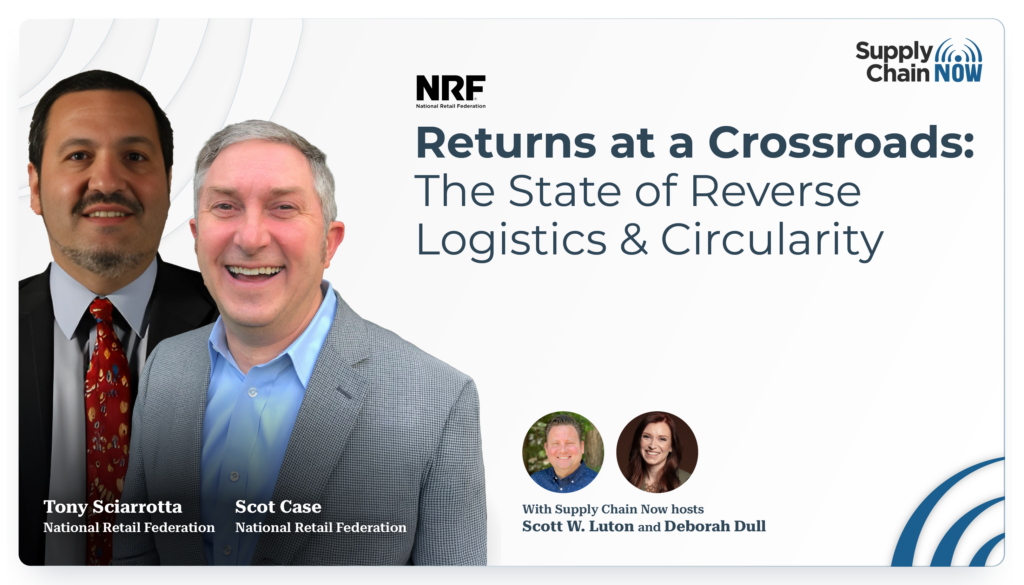
[00:02:22] Scott W. Luton: So Deborah, we gotta get to work. Hope you ate your Wheaties this morning and had your vitamins, whatever. I’m gonna welcome in our and and coffee. That’s right. Lots of coffee. Wanna welcome in our esteemed guests here today. Two dear friends of the show. Scot Case, Vice President of Sustainability with the National Retail Federation, and Tony Sciarrotta, Senior Director for Reverse Logistics and Circularity also with NRF, the Reverse and Returns guy.
[00:02:47] Scott W. Luton: I think as we have coined, let’s bring in Scot and Tony. Hey. Hey Scot. How you doing, my friend?
[00:02:54] Scot Case: Wonderful. Nice to see you again, sir.
[00:02:56] Scott W. Luton: You as well. And Tony, you’ve been here, I don’t know, a thousand times or two. Great to see you, my friend.
[00:03:01] Tony Sciarrotta: What an introduction and what a group to be with today. I’m, I’m happy, I’m honored.
[00:03:05] Tony Sciarrotta: Thank you.
[00:03:07] Scott W. Luton: I feel smarter just hanging out around the three of y’all, so thanks for rubbing them, some of y’all’s, uh, brilliance and intelligence off on me. Deborah, this has been the works for a while and, uh, you and I are really excited. What y’all don’t know is the fun warmup question I’m gonna pose to each of y’all before we get into all the good stuff.
[00:03:24] Scott W. Luton: Let’s see here. I’m gonna look at deep into my calendar of holidays here. It’s, uh, national Frozen Yogurt Day. Any Zack’s fans back in the day, it’s pay a compliment day. That’s an important one for all of us to remember. It is National Valentine’s Shopping Reminder Day, folks. February 14th. Don’t forget.
[00:03:43] Scott W. Luton: And this is where we’re gonna end on is bubble gum day. So as I was sharing, uh, my youth would never be the same without two of my faves, Hubba, Bubba, and Big League Chew, right? Made my dentist very happy. So I’m asking all of y’all the same thing, whether it’s bubble, gum or candy. What was one critical gum or candy part of your youth?
[00:04:03] Scott W. Luton: And Scot, I’m gonna start with you, my friend.
[00:04:06] Scot Case: I’m, I’m telling you, once you told me it was National Bubble Gum Day, I could not get, I could not get Big League Chew outta my mind. So I can remember being on the little league baseball field with the big league Chew, folded up and stuffed in my back pocket.
[00:04:20] Scot Case: So,
[00:04:21] Scott W. Luton: oh, I love it
[00:04:22] Scot Case: most as I ever got to. Professional baseball,
[00:04:24] Scott W. Luton: original flavor or grape, Scot,
[00:04:26] Scot Case: or, oh, grape was nasty. Oh, all original ones. All original.
[00:04:31] Scott W. Luton: Wonderful. All right, Tony, we’re kindred spirits, me and Scot in our big league two. What about you?
[00:04:35] Tony Sciarrotta: Well, it wasn’t around when I was growing up ’cause uh, I’ve been around a little too long sometimes.
[00:04:40] Tony Sciarrotta: But Bazooka was there and Bazooka Joe was my favorite, but I never learned how to blow bubbles very well. But Bazooka goes way back and Bazooka is the only one that was around when we were growing up.
[00:04:58] Scott W. Luton: You know the thing about is Bazooka, if it was pretty old, don’t bite down too quick ’cause you would break a tooth with those bricks, but I loved it too.
[00:05:06] Scott W. Luton: Alright, so Deborah, we got Bigly chew. We got Bazooka. What about you?
[00:05:11] Deborah Dull: We didn’t eat a lot of gum growing up to be totally honest, but if I could stick on the candy. Yeah. There’s a polarizing opinion on mint and chocolate together. Yes, I’m in the positive camp. So any comedy York peppermint patties, huge fan junior mints, if they’re a fresh, great.
[00:05:28] Deborah Dull: And then in my household, after ate the flat mints, my dad kept up in the upper special treat floor and maybe twice a month we got one square each. And I grew up thinking this was the most expensive possible chocolate you could have. And then later on when I started buying my own groceries, I realized they’re in fact, quite affordable.
[00:05:47] Deborah Dull: Um, but that was, that was the peak that we knew. It was a good Friday night when dad reached into that C cupboard and we got a after event.
[00:05:55] Scott W. Luton: Oh, I love that. And I thought you were all also gonna add thin mints from the Girl Scout cookies. Oh my gosh. Oh my gosh. We got all
[00:06:02] Deborah Dull: very addictive.
[00:06:03] Scott W. Luton: Yes. We gotta keep moving.
[00:06:04] Scott W. Luton: I can’t dwell on that too much. Well, Deborah, Tony and Scot, thank you so much. I appreciate you sharing and I was gonna ask you, Scot. How many of those books have you really read back behind you?
[00:06:14] Scot Case: I’m, I am a total nerd. Like I can pull ’em off. There’s handwriting in all of these books, so Okay. I am a nerd.
[00:06:21] Scot Case: I’ve even got to at least two of Deborah Dull’s books here. I’ve got Rich Bulger’s book here. I’ve got all sorts of.
[00:06:27] Scott W. Luton: Man.
[00:06:28] Scot Case: You’ve learned my reading, man.
[00:06:30] Scott W. Luton: Yeah, you
[00:06:31] Scot Case: got some readers,
[00:06:32] Scott W. Luton: so I’m gonna stick with that too. I’ve read all those too. I’ve read all those two. I can’t wait. Too good. That was a week. We gotta get into a lot of work here today.
[00:06:41] Scott W. Luton: We got a ton of stuff to get into. We’ve been a big. Fast start to the year already. But I wanna hold up ’cause context is so important. It’s important to level set, right? And that’s what you know. Scot, you’ve been with us before. I’ve enjoyed interviewing you in person in Vegas, other events and stuff.
[00:06:55] Scott W. Luton: Great to have you back with us on Supply Chain Now, two part question to kind of get the conversation going. If you would tell us more about your role in RF and what are some of NR F’S priorities when it comes to sustainability and reverse logistics.
[00:07:09] Scot Case: Whoa. Very cool. So yeah, I mean the, the short and dirty.
[00:07:12] Scot Case: I’m the VP of Sustainability at the National Retail Federation. Um, I just had my five year birthday, so happy birthday.
[00:07:19] Scott W. Luton: Congrats.
[00:07:20] Scot Case: NRF. Our primary focus is meeting the needs of the retail industry. So on a policy side, on an advocacy side, but also meeting the operational needs of retailers. So when issues pop up.
[00:07:35] Scot Case: NRF is well positioned to kind of work with the entire retail industry and find out what’s working, what are the challenges, what can we all do differently? And when it comes to the sustainability space, which is big and huge and broad, we can talk about renewable energy, we can talk about electric vehicles, we can talk about all sorts of issues,
[00:07:54] Voiceover: but
[00:07:55] Scot Case: what’s become really, really obvious to everybody.
[00:07:58] Scot Case: Is that sustainability is a nice to have, but you absolutely have to focus on the financial impacts. So no sustainability professional, myself included, has ever accomplished anything just by talking about let’s hug a tree or something. And what we actually have to do is figure out where is the business value.
[00:08:19] Scot Case: So when you can tell the CFO, you can tell the supply chain people, you can tell the marketing people that something is important to consumers and the bottom line, and it has free sustainability benefits, it’s a win.
[00:08:33] Tony Sciarrotta: Mm-hmm.
[00:08:33] Scot Case: And that’s how we ended up in the reverse logistics space, because it turns out, and we can go into greater detail later, but when something called e-commerce emerged, all of a sudden reverse logistics took on a new urgency.
[00:08:48] Scot Case: With more e-commerce, you had more returns, which created more costs, which created more potential for waste. So this is this beautiful intersection where we can work closely with the retail community to identify cost savings, reducing waste, improving consumer benefits. And creating environmental benefits at the same time.
[00:09:14] Scot Case: Mm-hmm. So that’s kind of where all these things wrap together and why reverse logistics has suddenly become the center of the sustainability community and absolutely the backbone of, of the circular economy.
[00:09:26] Scott W. Luton: Scot well said, gosh, we’re outta the gate running it. Only you and your eloquence could get me stopped from thinking more about those thin mints.
[00:09:35] Scott W. Luton: Uh, but well said, Scot, Deborah, weigh in. Really before I get, move to Tony, weigh in on what you just heard there from Scot Case.
[00:09:42] Deborah Dull: It’s a, it’s an interesting time. Everything that Scot said, of course is true. Interesting research this year. You know, there’s been a little bit of headwinds for the sustainability community with what many call an anti ESG movement.
[00:09:54] Deborah Dull: That the research is quite clear, regardless of who’s doing it. 85 to 87, 80 8% of companies are actually investing more into sustainability initiatives this year than they did last year. And so the momentum is there. They’re maybe not talking about it as much, which is why communities like NRF and these in-person discussions are so important because in order for us to all make better business decisions, we need to be able to share the learning, share what’s working, what’s not our bruised toes from stubbing them through this journey.
[00:10:25] Deborah Dull: And so these gathering spaces like those that Scot and Tony can put together for the community become important because as we spend more money, we, we expect to see the return, and companies are spending that because they are getting a return. So often when it’s a green decision, it’s actually good for business and we can unpack that one together later on.
[00:10:42] Scott W. Luton: Love that. And, uh, and, and hey, stubbing toes is part of it, right? ’cause everything we do isn’t gonna work. And that experimentation is so important. We’re better off for it. Okay. So Tony, you’ve been with us as I mentioned in in the pre-show a very often. I really enjoy, uh, your perspective and your journey, and of course our friendship, but for new folks to our audience, right?
[00:11:04] Scott W. Luton: That has joined us since you joined us last, it’s been. Almost two and a half years since NRF announced its acquisition of the Reverse Logistics Association. So what have been some of the benefits you’ve seen during that time, now that RLA is under the big powerful NRF umbrella?
[00:11:22] Tony Sciarrotta: I, I, I think you just kind of almost described it right there, Scott.
[00:11:26] Tony Sciarrotta: It’s the fact that. The NRF has helped amplify the voice of the RLA, and by amplification, I mean we’ve been the dark side. We’ve made lots of jokes about being the dark side. Nobody wants to talk about returns. They’re not on p and ls. There’s no vice presidents of returns management or reverse logistics anywhere at any major manufacturer or retailer.
[00:11:48] Tony Sciarrotta: So suddenly the National Retail Federation representing 5 million. Uh, businesses in the United States alone, uh, and going around the world now is talking about returns. So the rest of the world is gonna start talking about returns, the retailers and the manufacturers, and that’s the biggest benefit. The rest of it we do, we do the publications, we do all the important work, best practices we share, but now you’ve got this giant.
[00:12:16] Tony Sciarrotta: Voice telling it from the top of the ladder. We need to do something about returns. And it was a great fit with Scot and with the rest of the people at the NRF.
[00:12:27] Scot Case: I, I’m gonna tease Tony real fast. Like he talks about the dark side, and I always think Star Wars are evil, or, or, and it’s really not. I, it’s more just kind of, it’s a piece of the retail industry.
[00:12:38] Scot Case: Not a lot of people had turned the light on, so it was just not an area that was particularly important to the bottom line. Until online retail returns are a different beast than if I go into a dressing room, don’t like something and just put it back on the rack.
[00:12:57] Try
[00:12:57] Scot Case: and do that through an online process.
[00:13:00] Scot Case: There are all sorts of touch points and hidden costs and those kinds of things that what we’re trying to do is just shine a spotlight on it. So it’s not like it’s evil, it’s just dark.
[00:13:09] Scott W. Luton: Right. As a Star Wars fan, I knew exactly where telling you it was coming from. Uh, with that, but it’s not. No. But to your kid inside.
[00:13:16] Scott W. Luton: It isn’t evil, it’s just it. It needs more awareness. And to your point, Scot, a much bigger spotlight and that’s why I’m really excited about the marriage we’re seeing here and the opportunity we had to reach more people. Really quick, Deborah, I’m gonna get you to weigh in, but I’m a little bit slow sometimes.
[00:13:29] Scott W. Luton: That was as, I’ve really enjoyed meeting a variety of leaders from NRF, but Jonathan Gold I think was the poster from DC. And folks, if you’re not following Jonathan Gold, especially, all his work on trade and policy and customs and tariffs, yeah. Go find ’em on LinkedIn. You gotta be doing that. Alright, so Deborah, I wanna pick up on that last point before I move forward.
[00:13:50] Scott W. Luton: Awareness. You know, we’re gonna touch on a great project that you’re working on towards the latter half of today’s show, but shining a bigger light on the reverse, the returns and circularity space, the whole ecosystem is critically important. Your quick comments, Deborah.
[00:14:06] Deborah Dull: Spoiler alert guys. Darth Vader, complicated character.
[00:14:09] Deborah Dull: So even when we talk about dark side, there’s a, there’s depth to that. So go off and you’ve got, if you haven’t seen it yet, go find out. Uh, and I feel like that’s the case in, in our case, sometimes I joke and say that reverse is like a Harry Potter of the supply chain under the stairs tucked in the corner.
[00:14:24] Deborah Dull: And there’s usually only a half a dozen people in a re in returns team of a supply chain of 1500 or 2000. But what’s incredible to me is they have to do all of supply chain with a teeny, tiny team, immature systems that aren’t. Bent into the shape that they need it to. Right. And those are the heroics.
[00:14:44] Deborah Dull: Tony will talk about this. Nobody plans to be in this space, but once you get bit by the bug, you don’t leave because here comes all of our favorite parts of supply chain in this little area, tucked in the corner. And so once you discover it and how messy and interesting and so much potential and everything comes back, and so you have this entire system you need to manage.
[00:15:05] Deborah Dull: And it’s just so fascinating for the problem solvers that sit in supply chain and thrive in this industry. Once you get in, it’s hard to get out, but it is, it really is tough to get in. It’s almost like you gotta find, it’s a speakeasy. Maybe Lars arent rolling at the speakeasy of supply chain, Tony.
[00:15:20] Scott W. Luton: It, it’s so much truth and what all three of y’all shared there, but the opportunities are so immense and so I’m really excited about what lies ahead.
[00:15:29] Scott W. Luton: Alright. So we are going to look at a macro level, some of the trends impacting this space. Um, okay. I think we’ve set the table pretty effectively here, right? So I wanna offer up a few more thoughts as we continue to unpack things and ensure resources and perspective. And we’re gonna start with some of the macro trends that are impacting returns, reverse logistics and circularity.
[00:15:51] Scott W. Luton: And Tony, I’m gonna pop a visual up here we got from the NRF team, and if you’d lead us with some of these, some of these trends that’s shaping the landscape.
[00:16:00] Tony Sciarrotta: Well, I think Deborah hit on it earlier about the number of touchpoint that occur in Rev reverse logistics, the estimate it’s about seven times the forward supply chain.
[00:16:09] Tony Sciarrotta: And you can see here that not only are you multiple touchpoint, but they’re all important and they’re all different, and they’re all solutions that are available for any company to use. So you’ve got the secondary market, you’ve got the resale, the repair, the reuse, the trade-in the take back, the donate.
[00:16:27] Tony Sciarrotta: It’s amazing. It’s been reported that some of the, the thrift stores are doing more growth business in the last year than the primary retailers. And that’s exciting. ’cause that means people are noticing that there’s opportunities in vintage clothing in, in, uh, pre-owned and certified electronics. And it’s fantastic.
[00:16:48] Tony Sciarrotta: And, and again, the cornerstone of the circular economy is a good way to say it. And the macro trend is that it’s touching a lot more points now. A lot more and it’s no longer just throw it away into landfill. It’s find more things to do with it. I’m so proud of that.
[00:17:06] Scott W. Luton: Yes, Tony. Well said. The, the ree economy we touch on every time, uh, every conversation.
[00:17:11] Scott W. Luton: Billions, if not trillions. Uh, at this point in time, Deborah, I’m gonna get your comment after we see the trends that Scot wants to call out your thoughts.
[00:17:20] Scot Case: Yeah, no, I mean I, what I love about that graphic is it’s, you know, it reminds me again, the nerd. We’ve established the nerd, but it reminds me of those simple ecosystem graphics that were in our third grade science textbook, right?
[00:17:34] Scot Case: There are all these different little pieces that all have to work together, and that’s what we are seeing right now in the circular economy. There are all these different components that have historically tried to operate independently. But what we were doing within NRF and specifically at NRF Rev is trying to bring all of these elements together so we can collaborate more effectively.
[00:17:58] Scot Case: That’s where the solutions are gonna come from. But the big trends, I mean, the big trends are a couple of things. One costs, um, the, the economy has been fascinating year lately. The impacts of tariffs have been. Uh, traumatic for many. So, but these kinds of issues, the resale movement. The thrift movement, that’s a directly addressing consumers’ desires to reduce costs.
[00:18:22] Scot Case: At the same time, um, we’re looking at the rise of e-commerce, the increase in return rates and the costs of those e-commerce returns. So again, this whole revers logistics ecosystem, if you will, is finding ways to squeeze costs out of the system and more importantly, find additional value. So it’s no longer just a pure cost, it’s actually potential new revenue streams.
[00:18:47] Scot Case: I guess the third trend, third and final trend I would throw out there are the consumer benefits. It turns out consumers benefit greatly if you improve the returns process. Consumers benefit greatly if you give them options. Here’s a used option, here’s a new option. Which do you prefer? Um, it’s an opportunity for some retailers and some luxury brands, for example, to attract new consumers.
[00:19:12] Scot Case: It might be easier for me to purchase a slightly worn or a previously loved handbag than it is to buy brand new and, hey, you might have just won a customer for life. Not to mention as a consumer, I can clean out my closet. I have the opportunity to potentially resell things, donate things. It’s become easier for me as a consumer to make sure when I no longer need a product, I have a productive opportunity to share it with someone else in some way.
[00:19:44] Tony Sciarrotta: And, and let’s come back to macro trends. The one we haven’t touched on yet is improving the customer experience. Yeah, that’s the driver for returns in general. I mean, we’ve done surveys on this. We know that people return things, not because there’s something wrong with it. That’s the nightmare. 90% of that stuff that’s on the road coming back, nothing wrong with it.
[00:20:06] Tony Sciarrotta: So it’s that consumer experience that went wrong, because here we are online looking at each other, but when we meet and shake hands. That’s different. When the box shows up at your front door and you open it, you’ve got expectations built in, and if it doesn’t meet it or beat it, it’s going back. So people are really starting to learn.
[00:20:26] Tony Sciarrotta: It’s not just about making returns easy, that’s baseline. You have to do that. But how do you make the customer happier when you’re sending them a box? Then when they’re in the store and they see all the displays, and again, to Scot’s point earlier, returns are growing in e-commerce, but at brick and mortar, they’re fairly stable because you could put it back on the rack.
[00:20:45] Scott W. Luton: All right, so we, we can have a whole podcast series on y’all’s. Yeah. Last two responses, but Deborah, really quick. Scot said something, Deborah, that tariff trauma, man, we gotta keep it real. A lot of folks are experiencing that. What’d you hear there, Deborah? What are trends you’d like to point out?
[00:20:59] Deborah Dull: So much. So I’ll try to, I’ll try to be brief so we can cover more topic.
[00:21:04] Deborah Dull: If we continue on this speakeasy theme that now I’m gonna be stuck on, if we think about that graph we showed, those are all inroads into engaging in a circular economy, resale, reuse, donations, those are doors, those are the doors into the secret world of reverse, which I’m calling this speakeasy. And that’s, we might drop it off at a donation center and leave and go like, great, I did my part and I’m outta here.
[00:21:27] Deborah Dull: As a supply chain professional, I look at each of those doors and I think about the operations underneath. What do we need to do to support and enable a trade-in program? How are we gonna go and recondition and grade all of those items and keep ’em at their highest value so we, how can we resale, can we get ’em back on the shelf?
[00:21:42] Deborah Dull: At NRF, we heard a really interesting stats. Scot had a chance to interview IKEA in their pre-owned, pre loved. They only keep a hold of that product for 48 hours or less. That level of turns in a supply chain is unheard of in terms of getting inventory through your system. So it’s an interesting secret world.
[00:22:01] Deborah Dull: So I just wanna say everything on that graph is a door into this secret world of the dark side. And as people own up to, if they’re big returners, I do think it’s a dark side because people don’t wanna say like, oh yeah, I order every color one note on tariffs. Uh, I did a talk last year, uh, manifest. Next year I’m, or next week I’m going back to manifest.
[00:22:19] Deborah Dull: About the relationship between tariffs and a circular economy. One way to avoid those tariffs is to, of course source your items from within the country. And if you can resell it as it is, great if you can recondition it and put a little bit of work in, chained out a part and resell it, fantastic. It’s a faster experience.
[00:22:35] Deborah Dull: We have better tabs on it. We can watch that visibility a much better. And we’re supporting American businesses. And so have a think about that math, remanufacturing math got a big boost actually from the tariff discussions, and so I think it’s one of the most, one of the best wins that we’ve had at our back on circularity actually for a long time, which is a bit counterintuitive.
[00:22:56] Deborah Dull: I
[00:22:57] Scot Case: build on that, if I can. Scot, is there’s, there’s an aspect of this and the way Deborah was talking about it. There are also some legislative pressures, regulatory pressures that are entering the equation, typically known as extended producer responsibility, and it’s the idea that when you know someone makes, um, this, uh, sweater, there is a need to ensure that the infrastructure exists.
[00:23:22] Scot Case: That when I no longer want this sweater. I have someplace productive to return it, whether it is a resale platform, whether it is a donation opportunity, whether it is a recycling opportunity. So, uh, the state of California, for example, recently passed a law on extended producer responsibility in the textile space.
[00:23:42] Scot Case: And what that means is consumers will be paying, whether they know it or not, a small fee. For every textile item they purchase. That small fee is going to be used to ensure the infrastructure exists to manage the products when they’re no longer wanted by the consumer. And where this ties into our ecosystem is those fees might be variable based on how easy it is for me to.
[00:24:11] Scot Case: Properly return this particular item versus another item. So that’s another important piece of the conversation. But I’m still gonna push back on Tony and Deborah. It’s not the part we’re turning on the lights. Basically. Take a look at this opportunity.
[00:24:29] Scott W. Luton: I like it. I like it. There’s room for all of that here.
[00:24:32] Scott W. Luton: And, and hey, bring in more sunshine into any, in any challenge and complexity is, is the way to go, the way I look at it. Okay, Deborah, Tony, and Scot. I really wish we had a couple extra hours. I love the kindred spirits and camaraderie and hey, I’m getting informed listening to all three of y’all here. We could spend all day on trends.
[00:24:50] Scott W. Luton: We didn’t mention fraud, I don’t think. And fraud of course is a big one going in the return space. All the retailers getting their head around that. Folks, if you are one of those retailers, connect with Scot, Tony, and Deborah. They’ve got resources. But let’s shift over to this terrific event that took place in New York City a month or so ago.
[00:25:07] Scott W. Luton: And Scot, I’m gonna lead off here. I’m gonna show a great pic, several great pictures of this event. NRF Rev is what we’re talking about. Tell us if you would, what is the event all about and who all attended?
[00:25:17] Scot Case: Wow. Well that’s, that’s heavy right there. The, uh, now former CEO of Ikea, USA. So what NRF Rev was all about, it’s reverse logistics and revenue.
[00:25:30] Scot Case: Uh, I also like to say end revolution ’cause there’s a circularity component to it, but it really is the opportunity to kind of turn on the light in the reverse logistics space and show this entire vast ecosystem. There are lots of people that were gathering in round tables in conversations on the stage, and they were all just comparing notes because we needed to bring in person, everybody together.
[00:25:56] Scot Case: You are in resale, you are there, you are in repair. You were there. Um, you were in refurbishment or repackaging, or you were a software layer to help explain, you know, how all these pieces connected. You were in fraud detection. All of these are components of that ecosystem. And what we were doing is bringing everyone together around reverse logistics, revenue, circularity, to kind of say, what can we all do together to create better value for the consumer, better value for the retailers and the manufacturers, and create these wonderful circularity or sustainability benefits.
[00:26:32] Scot Case: Mm-hmm. So, absolutely amazing event that kind of built on some of the work that Tony had done previously. But bringing it to a, a new audience. More retailers were there. It was connected with the big show. So just around this, the corner up the block, 41,000 retailers all focused on this. So it was our way of spotlighting.
[00:26:53] Scot Case: Yeah. What had been in the dark.
[00:26:55] Scott W. Luton: I hate to miss it, but Deborah was there. We’re gonna, Deborah’s taking just a second. I shared a, a variety of images. Folks, if you’re watching us versus listening, and a couple things I just want to share really quick for Tony comments. I love these working round tables.
[00:27:07] Scott W. Luton: Yeah. Where you get practitioners talking about and exchanging views, intel solutions, challenges that’s critical to moving not only creating awareness, but moving the industry forward and. I think there was a great breakfast here celebrating women, incredible, incredible things in reverse logistics and a greater ecosystem.
[00:27:25] Scott W. Luton: I love that designated dedicated time as well. Tony, we’re talking about NRF Rev, and you’ve got a great track record, and now you’ve further amplified of bringing industry professionals together and creating these learning and networking opportunities. Your thoughts of what NRF Rev presented?
[00:27:41] Tony Sciarrotta: Well, it’s, uh, it was presenting an opportunity for new faces, new people to be there, and we had a large percentage of new attendees, which is great to build on, as we said, opening the light as everyone needs to say more of and not so dark, but also a lot of retailers.
[00:27:59] Tony Sciarrotta: In the past, retailers weren’t always as strong a a a a group at the RLA events, but at the NRF event, it’s focused because retailers are the center of this returns universe, right? Uh, people make things, sell things, and people buy things, but it’s the retailer that is right in middle. Um, I also have to say, I, I loved one of the comments and when you talk about people from the stage, Daniela from Phillips, which is my old home, all right?
[00:28:26] Tony Sciarrotta: I was there, right? 25 years. And she did a great description of, of about. F refurbished products, she said, ’cause she was promoting the fact that Phillips is now offering refurbished electric toothbrushes. And that may be scary to some people, but let’s turn the light on. And she said from the stage, did you eat at a restaurant last night?
[00:28:47] Tony Sciarrotta: Everyone raises their hands. Do you realize your fork is basically a refurbished product that you were using Eat your dinner with at the restaurant? And I just love the way she did that. And it’s so true. We think that’s why I talk about it’s the dark side because people think that way, but it’s not.
[00:29:03] Tony Sciarrotta: It’s every day we live it and we just don’t even think about it. Like she presented so well, Daniella Gu from Phillips.
[00:29:11] Scott W. Luton: I love that Tony. And hey, as a former buser and dishwasher in restaurants, I’ve participated and created an area economy. I guess Deborah, Scot and Tony shared a lot of great stuff and, and I can’t wait to be back at NRF Rev next year.
[00:29:24] Scott W. Luton: You were there. You were talking from one end to the other end. We’ve got a great collection of some of those highlights we’ll share in a little bit, but what’d you see there, Deborah?
[00:29:34] Deborah Dull: Thanks for, uh, letting me go as Supply Chain Now, Scot, I proudly wore the T-shirt and had a, a series of really thoughtful conversations.
[00:29:42] Deborah Dull: RLA historically has been one of my favorite conferences to go to because it has a practitioner’s lens and because people show up ready to talk and I don’t mean ready to sell, I mean ready to talk. It really open, really willing to get into the hard parts that sometimes people are a little shy to share what’s hard.
[00:30:01] Deborah Dull: In their day, and I’m so happy to say that as the fold into NRF has happened, that spirit has remained. And so it, it was a really lovely chance to watch RLA part two, and I’m looking forward to having that expand more. Some of those sentiments have been captured. Thanks to you. I was able to write a, a blog piece really with an idea from Tony that this is a trillion dollar industry.
[00:30:26] Deborah Dull: That shoot, we really haven’t formalized. We don’t have, and I mean reverse logistics here, we don’t have degree programs. We barely have one textbook that Scot has on his desk right now. Mm. We don’t have certifications. We don’t have this. We have, this is our one conference really, that we have as an industry, which is why it’s so precious to all of us who go to it.
[00:30:45] Deborah Dull: So absolutely delighted that with the fold in the spirit remains as a big headline. Definitely join us next year to get a chance to experience this, and then I have shared some of those key takeaways. Uh, and a couple of different ways on the Supply Chain Now platform.
[00:30:57] Scott W. Luton: And we’re gonna, we’re gonna share and make sure everyone knows exactly where you can go find that.
[00:31:02] Scott W. Luton: And Trisha has dropped the link to nrfrev.com. That’s where you can learn more about this year’s event and of course, probably get ready for next year. So let’s get into some of the key takeaways from NRF Rev 2026. It just wrapped up a couple weeks ago. And Scot, I’m gonna start with you. What were some of the most compelling key takeaways from your perspective?
[00:31:24] Scot Case: Wow. Yeah, there’s a long list. We don’t have enough time. I, I think, but the biggest, the biggest one I really would kind of point out is the power of bringing everybody together. In person to truly collaborate. We had, uh, more than 900 participants at the event. 350 of them participated in those round tables, having conversations, sharing stories.
[00:31:49] Scot Case: So it’s the power of collaboration. Uh, we can’t address EPR. We can’t improve consumer experiences. We can’t reduce costs. Unless we all understand how we’re each operating in this circular economy space, in this reverse logistics space. So just the power of collaboration, probably my top number one. It’s just always wonderful to see it in practice.
[00:32:12] Scott W. Luton: Y you know, before I move to you, Tony, I’ve seen the up close and personal. It’s, I think all three of y’all maybe in Dallas at what? At, uh, at one of the events. And really you get in a room. With a couple of hundred leaders in this space doing big things from a variety of perspectives, you start to see opportunities, right?
[00:32:30] Scott W. Luton: Kinda what you’re talking about, Scot. And so the future is very, very bright. And it takes these vehicles that brings this talent from whatever side you wanna call it, it brings in the same room because really what industry doesn’t. Benefit from that diverse perspective of experiences and, and challenges and successes.
[00:32:49] Scott W. Luton: Right. Tony, you’ve been at this for a long time, but what’s some of your key takeaway or two from nr? Rev. Rev?
[00:32:55] Tony Sciarrotta: Well, I, I like the term that Deborah and Scot have been using about practitioners. It’s, it’s, it’s great to be in a room where you talk to people who understand the pain involved, and that’s a, that’s a big deal.
[00:33:08] Tony Sciarrotta: We’ve mentioned before, there’s not a lot of graduates in reverse logistics and, and that’s a shame. And sometimes it, it needs to go beyond more than just the supply chain world. And that’s what I saw in NRF Rev, that more people were there from more spaces for more industries. It was kind of. You know, it’s not a bad comparison to say, it was sort of like being at a medical conference because you’re talking a language in a return space that not everyone outside of it understands.
[00:33:36] Tony Sciarrotta: So having people talk to each other to see these important ideas. And the other factor is. There’s never one silver bullet to solve the returns problem. We’ve heard the terms, it’s, it’s about repair, refurbishment, reselling, trade-ins. It’s everything.
[00:33:53] Scott W. Luton: Tony, you’re right. Going back to the earlier comment, you know, bringing true practitioners at all levels of experience into the room, and that’s certainly what I’ve really appreciated about y’all’s approach at creating these vehicles that deliver the conversations and the moments and the learnings.
[00:34:08] Scott W. Luton: Y’all sharing a few here, Deborah, beyond what Scot and Tony shared? Key takeaways from NRF Rev.
[00:34:16] Deborah Dull: Uh, I shared the one that really delighted me. How quickly these products are moving through. Uh, when they are captured. There’s a term called urban mining, which is what it sounds like. How do we mine, how do we collect materials and products from our cities instead of from the planet?
[00:34:32] Deborah Dull: And that trend continues, you know, take back programs and collection bins, whether you’ve ever dropped off an orphan electronic at a Best Buy, for example. Our examples of urban mining, a goodwill donation is an example actually of urban mining where we take items that have gone rogue out in our lives and returned it into the economy to be used and sold again.
[00:34:51] Deborah Dull: And what’s interesting now, alongside the trend mentioned earlier with secondhand shops revenue increasing, one of the checks that the younger generation does now is the resale value of a new item or even a used item. They’re gonna buy it and say. Can I sell this again in three or four months? And if so, what’s that re resale value.
[00:35:10] Deborah Dull: It’s something that many of us might have done, you know, when we buy a car or a house and start to think about how that would work, but in a microwave. And so as we think about, uh, the great deal it is on buying a new smartphone used, you can save half. And a lot of the times that works also. So the conversation around, look, for a long times brands were a little cold on participating in resale because they worried it would hurt their brands.
[00:35:34] Deborah Dull: And you hear the. Bad stories of luxury brands ruining their products before they throw them away so that nobody can resell them on a gray market, but the ship has sailed. Resale is happening, and so now it becomes how do you want to participate to take a piece of the experience that your customer is having?
[00:35:50] Deborah Dull: They are your customer. It is your brand. Whether you sold it and got any revenue, auto it or not, it’s happening. Those conversations I think are fascinating and we get exposed to that now on the operations side, and of course, the more context we have, we can provide a better service to that brand. To enable that experience to happen.
[00:36:07] Scott W. Luton: Got a, the game. The game is, uh, has started. It’s the Super Bowl. Y’all gotta get involved, right? But good stuff there, Deborah, Tony and Scot, and folks, that’s just the tip, tip, tip of the iceberg. There’s a whole bunch more connect with these three dynamos and I’m sure they’ll give you a full download, including some, and we’ll make it really easy towards the end.
[00:36:26] Scott W. Luton: But really quick, Scot and Deborah, one of y’all. May have, rich had, uh, mentioned our friend Rich Bulger, who also was there. Folks, check out his great book going Circular, the Evolution of Reverse Logistics into a competitive Weapon. Rich is a dynamo and a good friend as well. Okay, let’s shift over from key takeaways from NRF Rev 2026.
[00:36:48] Scott W. Luton: And now we’re looking ahead because there’s a tremendous opportunity, Scot, for leadership from the reverse side of global supply chain, no matter what you call it, to join NRF and participate in programs like this and other actionable programming that you offer year round. So what’s some of your thoughts there, Scot?
[00:37:04] Scot Case: Ooh. I love that question, Scott. Well, I’m, I’m gonna start, I’m gonna start focused just on the reverse side and the circularity side, and then get even bigger. So on the reverse logistics side, the circularity side, we have a number of different working groups. So we have a European working group. We have.
[00:37:22] Scot Case: Uh, uh, reverse logistics and electronics, reverse logistics and fashion women in reverse logistics, the European reverse logistics. So there’s a lot of kind of, let’s dig deep into those areas. But the bigger opportunity now that reverse logistics is a, a priority within the National Retail Federation is we can begin to help the industry piece together what Deborah was describing, because it turns out.
[00:37:48] Scot Case: Sorry to say, but reverse logistics people don’t make all the decisions. You actually have to bring together everyone inside an organization, everyone inside the industry. So what NRF does, we have our reverse logistics working group. We have our sustainability councils, but we also have councils for. The lawyers, the compliance professionals, the marketing people, the forward supply chain people.
[00:38:12] Scot Case: Shout out to John Gold, the lawyers. What we are able to do is help the broader industry, see how all these pieces of the ecosystem connect together. And that’s the real power given what we’re doing with NRF Rev and connecting it with everything going on at the NRF Big show and all of the programming that National Retail Federation has throughout the year.
[00:38:35] Scot Case: So it’s an amazing opportunity to shine a spotlight on this piece of the industry, save money, improve consumer experiences, find new revenue streams, and maybe just do some really cool sustainability circular economy things while we’re at it.
[00:38:52] Scott W. Luton: Love it. So much opportunity and I love you how you mentioned Scot, the global component, right?
[00:38:58] Scott W. Luton: Uh, because if you go to their events, you’re gonna find folks from all parts, really all parts of the world. And I love what the work you’re doing in other parts of the world with those events. Because you know as much as we can learn, I’m gonna use the wrong words here. As much as we can learn in tri industry here, like North America, imagine it as a hundred x.
[00:39:18] Scott W. Luton: When you truly make it global conversations, and I know that you are doing a ton of that as well, Scot, Tony, really quick before we shift over to a great initiative that Deborah has been leading, we never have enough time with these conversations. Anything you want to add to Tony, the programming opportunities that year round.
[00:39:35] Tony Sciarrotta: I wanna emphasize what Scot was bringing up about the impact of the National Retail Federation being in Washington, dc some of these things that we talked about. You know what, what happens in Europe first tends to come over here, right? And, and in addition to extended producer responsibility laws that are coming over here, we’re seeing things like right to repair reusable packaging.
[00:39:58] Tony Sciarrotta: Digital product Passport, a new code being put on product so they can be tracked and traced back to the point of origin for potential opportunities, but also for making sure that the supply chain stays clean. So there’s a lot of things coming from Europe towards us and having the National Retail Federation in Washington C make sure that there’s some influence on what happens legislatively to affect our retail economy and our retail community.
[00:40:27] Scott W. Luton: Okay. So, uh, Scot and Tony, I think this big initiative is on y’all’s radar as well, because NRF Rev served as a great. Kinda input to an outstanding podcast project that Deborah Dull put together and we published here recently. Remade in America. Remade in America Supply Chain Now special feature and it’s full.
[00:40:50] Scott W. Luton: Tony makes appearances. Scot, I think, makes appearances. Deborah, of course, your piecing together these perspectives from from folks across this vibrant ecosystem that Scot and Tony and you have been describing today. Tell us more about this podcast project.
[00:41:04] Deborah Dull: Absolutely. Thank you very much. And again, thanks for lending me part of the platform to make this happen.
[00:41:09] Deborah Dull: I’d always been fascinated by storytelling type of podcasts that are almost like investigative reporting. One that comes to mind is like the serial podcast, a miniseries that goes down the path of trying to figure out the solve a mystery really. And. All those of us in our industry, our life is a little bit of an indu, uh, a mystery.
[00:41:28] Deborah Dull: We have to go and find the number and find where it went and how did it get from here to here and what happened to that email and where’s that shipment. And I think that’s the allure of our industry for us. There’s millions of us. And to me that means there’s enough of a listenership who’s interested in understanding a story behind this dark side that now has a spotlight on it.
[00:41:47] Deborah Dull: So the idea is how do we paint a picture and weave a story to a different kind of a podcast? So there are interviews, uh, I speak to nine people in 35 minutes, but instead of a, a series of, of question answers, it’s a story that flows to say, look. Where does everything go? When you send something back?
[00:42:09] Deborah Dull: Where is that? When you send it away? Where is away when you donate it, what happens then? And this episode that just came out on Wednesday serves as a pilot to understand the, the appetite of our community for media like this. And then ideally we can launch and start to look at some of the challenges that we see.
[00:42:26] Deborah Dull: Across the reverse space in the, the constraints placed both by private sector and inadvertently by the public sector, by legislation that gets in the way sometimes of the innovation that we wanna do. There’s a big push to want to bring manufacturing back to the us. The ecosystems around manufacturing centers are vast.
[00:42:47] Deborah Dull: You know, it’s not just a standalone factory. They buy from factories who buy from factories, who buy from factories. Genes have, you know, six different tiers at least these are complicated. So as we start thinking about how, what can we do in America? That’s really what I spend a lot of my time thinking about of how do we put people to work and how do we bring innovation and how do we reinfuse activity into America’s heartland and our manufacturing belts that we have, but have been turned down on the volume in recent years.
[00:43:13] Deborah Dull: And so how do we turn them back up again? I don’t think we can totally make net new. Uh, and that’s what this podcast goes and makes a pitch of sorts to our community.
[00:43:22] Scott W. Luton: Love it Deborah. And folks, no matter where you are in the world, in industry, you name it, you can learn something. I promise you that’s gonna give you a light bulb to go off in Remade in America.
[00:43:34] Scott W. Luton: Um, okay, Scot, Tony, and Deborah, I really wish we had a second hour here today, but this is what we’re gonna do. We’re gonna make sure everyone knows how to connect with y’all. If you wanna mention a specific event that needs to be on their radar, you’re more than welcome to do that. I know y’all stay busy with lots of ’em and then.
[00:43:51] Scott W. Luton: We’re getting, Deborah’s got the toughest question today. The key takeaway from these two dynamos, Deborah Dol. So get ready. All right. I know you’re up for the task though. So let’s do this. Tony, if folks wanna connect with you to learn anything about what’s been offered up here today, how can they connect with you, Tony?
[00:44:08] Tony Sciarrotta: I do think LinkedIn is the best way. There’s only a couple of Tony Sciarrotta in the entire LinkedIn universe, so that makes it easy. If you could spell it right, you’re gonna find me and I, and I get messages all the time and try to respond to them as quick as possible. That’s the best way. Uh, you know, I’m based here in Atlanta, Eastern time like you, Scott.
[00:44:27] Tony Sciarrotta: I’ve been fortunate to connect around the world with organizations that generally try to bring in reverse logistics in some way at many of these major events. Uh, so I’ll be speaking at some more this year or as the year goes on, but I wanna share that I think I’m gonna go forward talking about the, uh, reverse logistics and returns world being like a speakeasy.
[00:44:48] Tony Sciarrotta: I love that analogy that Deborah threw out there because not only is it the magic knock to get in and find it, but there’s usually good music playing inside, and that’s my part of the passion, right? So love that speakeasies.
[00:45:04] Scot Case: I am, I’m gonna push back again. I’m gonna bus down the door to the speakeasy. Like this is not some kind of unique club.
[00:45:11] Scot Case: Oh. This is what we’re trying to do is invite everybody into the community. ’cause I think that the biggest challenge is. Not everybody knows what everybody else is doing, right? So what Nalt is doing is bringing our platform to say, Hey, let’s all gather around and figure out how to solve these challenges.
[00:45:30] Scot Case: But sky, your question was how do you find me?
[00:45:32] Scott W. Luton: Yes.
[00:45:33] Scot Case: So, you know, you can do the LinkedIn thing. Just note you spell, I spell my name properly with one T style. I just wanna like flag that as more resource efficient and more sustainable. Um, but honestly, the best thing anyone can do is hit the NRF website, nrf.com.
[00:45:50] Scot Case: There’s so many things there. Um, this is where we’re gonna connect all of these different pieces. I love reverse logistics. Reverse logistics. It’s amazing. Circularity is amazing, but it all exists within a broader context. And the real opportunities. When we bring the full power of the retail industry, the broader community of, of manufacturers that serve the retail industry, that’s where we’re gonna solve these problems.
[00:46:16] Scot Case: So,
[00:46:17] Tony Sciarrotta: mm-hmm.
[00:46:17] Scot Case: Go speakeasy, bang. Open the door. Everybody’s invited. It’s a big disco party. Everybody can have fun and find your way to contribute to the bigger hole. Make money doing it. Do good doing it.
[00:46:31] Scott W. Luton: And you know, we, we’ve got to have everybody under the tent because we got some problems that we just have to solve and it’s gonna take some common and very different thinking to do just that.
[00:46:41] Scott W. Luton: So well said. Scot. Speakeasy open to everybody. Come on in. And really quick, Deborah, before I get your patent key takeaway, can we just say and agree, I gotta go back to this picture. Scot loves what he does. I can hear his laugh, almost his giggle in this great shot and we need passionate people driving change industry for sure.
[00:47:01] Scott W. Luton: So good stuff there, Scot and Tony. That’s right. What a great one. Alright, so Deborah, first off, key question, key takeaway here today. There’s a ton of them. What is it from your perspective?
[00:47:16] Deborah Dull: Patented. Key takeaway from today’s discussion is the toothbrush, and this is why it’s difficult to make unit economics work to resale items.
[00:47:27] Deborah Dull: It’s difficult for big brands to figure out how to take back items, process them, make sure they’re safe, make sure they’re functional, and make sure they’re proud of the work to put their brand on it, to go sell it again. So as a celebration of how far our industry has come. The fact that we can sell an electric toothbrush again and make money, uh, is a huge deal.
[00:47:46] Deborah Dull: So I wanna highlight that as the work that Phillips has done, they’ve always been seen as a, as a leader, and they are in this space. And it also represents all the players that Scot mentioned. Yes, there’s supply chain and there’s legal and there’s finance. There’s an entire group of people who need to come to the table in order for that toothbrush to be resold again.
[00:48:07] Deborah Dull: So I am so delighted that we’ve gotten down to, yes, the electric toothbrushes are more expensive than manual toothbrushes, but shoot, they’re a lot cheaper than a car or a phone. And so the fact that our infrastructure has gotten to a place to allow us to do that should be a real celebration for us and give us a lot of optimism that if we can do it with an electric toothbrush, guys, we can do it with a.
[00:48:26] Deborah Dull: So I have always optimism for our industry, so I wanna use that as the example. And I’m gonna start, uh, weaving that into the toxic gift, Tony. So thanks for sharing that today,
[00:48:35] Scott W. Luton: Deborah. Well said. And by the way, I, I think the electric toothbrush was a Smurf’s hit from the 1980s, Tony, with the check out, that little piece of music trivia.
[00:48:43] Scott W. Luton: Okay. Uh, so Deborah, uh, let’s make sure, uh, you’re doing some really cool things at Trillium really quick. How can folks track you down, whether it’s circularity. Whether it is the podcast, whether it is digital transformation, how can folks find Deborah? A
[00:49:00] Deborah Dull: hundred percent. I’m active on LinkedIn. Of course, I’m not as fast as Tony and replying, so please have patience with me in getting back, but I, I will do my darnest to get back to everybody.
[00:49:08] Deborah Dull: Life is quick, uh, at Trillium Digital Services. We’re a, a newer company, but gosh, moving really quickly. And my goal this year is to spend as much of my time as I can on looking at the technology gaps in the reverse space. We have all the components, but we need someone to put them together, and that’s what I’ve asked my team to help and go and solve.
[00:49:26] Deborah Dull: It is conference season. I’m headed to, uh, manifest next week. I’ve got two joint events with the folks at Conaxis. I’ve got one speaking event for overhaul. Wow. And then I move on to a conference called Haida in Dallas, which is for the. A medical association and folks who move the supplies behind the medical industry.
[00:49:42] Deborah Dull: So it is the season for speaking and sharing. AI is the topic du jour. I just got a book out last week on self-driving supply chains. Very, very fascinating. I am assured, I am telling it’s gonna be, it’s gonna be old in two months. Read it now. Uh, but you kind of have to be brave to put a perspective out in an innovative space.
[00:50:02] Deborah Dull: So that’s what I spend my days doing now, but circularity continues to hold my heart and I actually think age genix is going to be the key to doing, uh, after sales at scale.
[00:50:10] Tony Sciarrotta: Scott, if, if, if I can throw in one last note, you go back 20 years. There were not this many voices in our industry, and I’m so proud of the new and younger voices that are out there.
[00:50:21] Tony Sciarrotta: It used to be just me and a couple of academics talking about this stuff. And that was sort of fun, but too geeky and I’m so proud to see the universe expanding. Even if I like my own little speakeasy, I’m proud to see the universe expanding. It is to where everyone’s paying more attention because partly the voice of the National Retail Federation.
[00:50:43] Tony Sciarrotta: And so I just wanna throw that out there. Make sure everyone knows the club’s bigger now. Thank you.
[00:50:48] Scott W. Luton: It is and there’s a much, uh, bigger be, uh, spotlight being shined on topics that we’ve needed to get to for a long time. And I’m really excited about where Scot and Tony and Deborah are leading the respective conversations to drive change.
[00:51:02] Scott W. Luton: Folks, we’ve included Scot’s LinkedIn, URL Me Sure to check that out. We included a link to Trillium and we included a link to Deborah on LinkedIn as well in addition to Tony. And a little quick tip for Tony’s last name. Folks mess up my last name all the time. He told me a little trick way back when, if you know that song Ma Sharon from the eighties, it’s Ma Sharonda.
[00:51:24] Scott W. Luton: Yeah, ma Sharonda. That’s how you say Tony’s last name. It’s just that easy, right?
[00:51:28] Tony Sciarrotta: I’m the only
[00:51:28] Scott W. Luton: stuck
[00:51:29] with
[00:51:29] Scott W. Luton: speaker
[00:51:29] Tony Sciarrotta: with on stage that gets to have his own music soundtrack when I get to talk. So yes. Love it. I love that part. Thank you Scott for that.
[00:51:37] Scott W. Luton: You bet. All right folks, what a great conversation. What a great, well, I think well spent hour as we wrap.
[00:51:43] Scott W. Luton: Big thanks Scot Case. Appreciate your leadership. Thanks, uh, vice president of sustainability with the National Retail Federation, your own the Move Driving Change in industry, and having a great time doing it. Thanks for being here, Scot.
[00:51:57] Scot Case: Thank you. Always have fun.
[00:51:59] Scott W. Luton: Definitely do it again soon. Tony Sciarrotta, senior director for Reverse Logistics and circularity.
[00:52:04] Scott W. Luton: Great to see you, enjoy your perspective, and hey, have a great time at Jazz Fest. I think you’ll be there soon, right?
[00:52:11] Tony Sciarrotta: Just a couple months away and looking very forward to it. And I will point out that you, you’ve all been gracious to me over the years, and I love having your voice amplify this part of the industry.
[00:52:23] Tony Sciarrotta: But I, I, when I am finished. Whenever I get to retire as what Scot called me on stage at NRF is the godfather of returns, but I, the fact that I’m Italian is okay with that. So we’ll have fun with that one.
[00:52:37] Scott W. Luton: Hey then thank you for that blessing, Scot. I’m gonna steal that from you ’cause it’s so apropos.
[00:52:43] Scott W. Luton: Always like good time. And Deborah Dull always a pleasure. Really appreciate what you’re doing. A a among on many fronts. But folks, make sure you tune in to Remade in America. De thanks so much for being here.
[00:52:56] Deborah Dull: Thank you as always, Scott.
[00:52:57] Scott W. Luton: Folks, hope you enjoyed this conversation as much as I have. I tell you what, I’ve got my.
[00:53:02] Scott W. Luton: 18 pages of notes today. But you know the homework you’ve got, right? You know the homework you’ve got, you gotta take at least one thing that you heard there from Scot and from Tony and from Deborah and do something with it. Right? Deeds not words. That’s how we’re gonna drive transformation for our entire industry and leave no one behind.
[00:53:21] Scott W. Luton: So with all that said, on behalf of the Supply Chain Now team at your service. This is Scott Luton and challenging. You to do good, give forward, be the change that’s needed, and we’ll see you next time. Right back here on Supply Chain Now. Thanks everybody.
[00:53:35] Voiceover: Join the Supply Chain Now community. For more supply chain perspectives, news and innovation, check out supplychainnow.com.
[00:53:42] Voiceover: Subscribe to Supply Chain Now on YouTube and follow and listen to Supply Chain Now wherever you get your podcasts.