[00:00:00] Dave Nemo: Always be looking for the next things that’s coming up so you don’t fall off a cliff or get swallowed up. So do what you do as well as you can embrace it and make it yours, but always kind of keep your eye on that door over there, red door opening or closing. And if it’s opening, maybe you wanna go through that and see what’s next, because if that opens, it may just blow this card away.
[00:00:27] Voiceover: Welcome to Supply Chain Now the number one voice of supply chain. Join us as we share critical news, key insights, and real supply chain leadership from across the globe, one conversation at a time.
[00:00:40] Scott Luton: Hey, good morning, good afternoon, good evening, wherever you may be. Scott Luton and special guest host Tony Sciarrotta.
[00:00:47] Scott Luton: With you here on Supply Chain Now, welcome to today’s show. Hey Tony. How you doing today,
[00:00:52] Tony Sciarrotta: Scott? Couldn’t be better. It’s a new year. New ideas, new opportunities, and a lot of fun to be had somewhere.
[00:00:59] Scott Luton: And if we’re not having fun, we’re doing it wrong. Is that right? That’s right, that’s right. It was great to reconnect with you over coffee throughout the holidays, even though as our guest is gonna probably remind us again, the holidays have not stopped down in the great state of Louisiana, so stick around for that.
[00:01:16] Scott Luton: But folks. Do we have a show for you today te I am delighted to be interviewing a supply chain media legend here. We’re gonna be gaining insights and perspectives from this hall of famer that’s been creating popular and engaging content and formative content across a multitude of channels for over 50 years.
[00:01:35] Scott Luton: Content, almost purpose built, especially for our professional truck drivers out there. And we all know the critical role that our truck drivers play in global supply chain and beyond Tony, are mentally categorizing all the shows we’ve done here. And I think this would be one of the most special and unique shows that we together have been part of.
[00:01:54] Scott Luton: Is that right?
[00:01:55] Tony Sciarrotta: Absolutely. Um, you have on a, a, a wonderful human, a great conversationalist, and somebody who’s got a lot of great history and stories to share.
[00:02:05] Scott Luton: So let’s not waste any more time. Folks, stick around for what’s gonna be a great conversation that will offer up tons of actionable insights by the truckload I had.
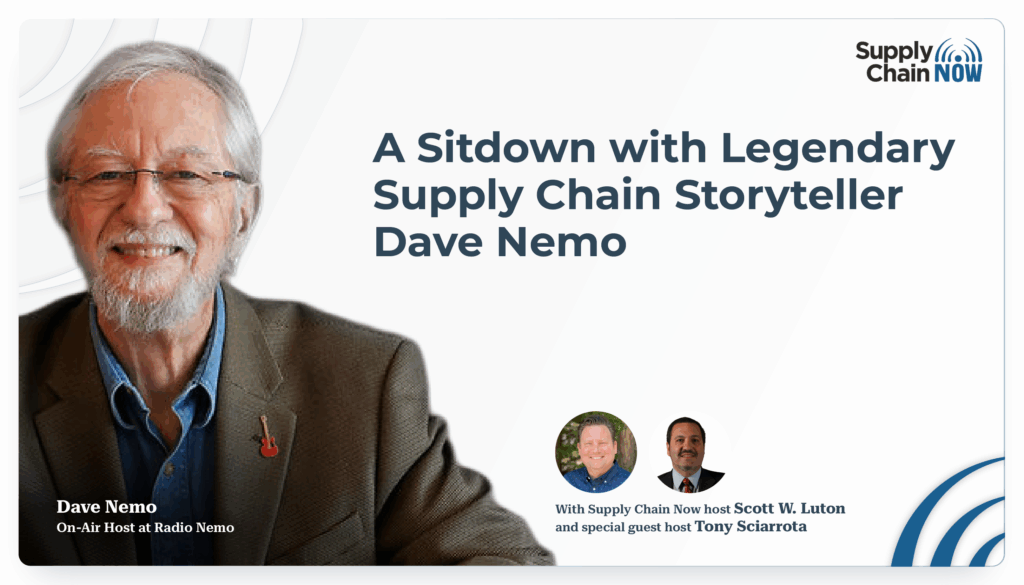
[00:02:14] Scott Luton: I’m sorry I had to do that. Had to do that. So I wanna introduce our special guest here today. So Dave Nemo is an American radio personality whose show focus is on news and entertainment, especially for truck drivers. Now, his program, Nemo Nation, which is a flagship show of RadioNemo now streams on my heart.
[00:02:33] Scott Luton: Radio, radionemo.com, YouTube live, Facebook Live, and other platforms. Now I really enjoyed joining Dave and the gang on RadioNemo Live a few months back, but well before streaming and his long run on satellite radio. Dave was best known as the host of the Road Gang and Overnight Truckers Show broadcast from W-W-L-A-M Radio in New Orleans and heard nationwide through its clear channel.
[00:03:01] Scott Luton: Uh, signal. He started as a weekend and fill in host behind Charlie Douglas and eventually took over as the main host Nemo. Later joined Road Dogg, which was then Open Road at its inception, EXIM Radio. And that’s where Dave Nemo first hit my radar as I was fighting Atlanta traffic in the mornings and other times.
[00:03:22] Scott Luton: Over the past 55 years, he has combined music, humor, trivia, history, and essential road and weather updates to keep drivers informed, alert, and safe. He has worked across AM radio, satellite radio, and now digital streaming, adapting to the industry while maintaining his connection with over the road drivers.
[00:03:43] Scott Luton: So I wanna welcome in. With all that said, Dave Nemo, the legendary on Air host at RadioNemo. Dave, how you doing today?
[00:03:52] Dave Nemo: Wow. Uh, I’d like to meet that guys. Thank you, Scott. That was you went overboard and thank you so much. That was a beautiful introduction. Not so much serve, but I appreciate that. That’s like the 30,000 foot beat.
[00:04:06] Dave Nemo: But you know, you just made me think about something. I always make these references to, uh, you never know. Does life imitate art or does art imitate life? If you take a look at the, uh, the smart watches and our cell phones and everything, you go back to the 1930s of Chester Gold and his Dick Tracy Gizmos and the, and the wrist radio.
[00:04:27] Dave Nemo: I mean, he bumped that up and now we have, so, um, I started off on Radio FM really got started the year I was born and I was on FM for a little while too. And then the satellite radio thing that wasn’t born and now the internet wasn’t born. And, and my. Half century. I mean, when you think about civilizations, well, you know, they did this for 500 years, 2000 years, wouldn’t do stuff for 20 minutes and it’s gone.
[00:05:00] Dave Nemo: And these things are almost, they’re related, right? Because it’s electronics and it’s all of that stuff. But they’re disassociated too. Like you can hear an AM radio on a computer. Station on a smartphone. Well, Dave, crazy stuff.
[00:05:19] Scott Luton: It’s, and we’re gonna talk about all of it because even though in the grand scheme of things, we’re all here for like 20 minutes.
[00:05:25] Scott Luton: You certainly have made the most of your 20 minutes in the grand scheme of things. And, uh, we really appreciate what you do. And I would argue, Tony, I’d love for you to weigh in here before we move forward with, uh, Dave Nemo. You know, there’s a plethora of content, digital and otherwise related to global supply chain related to trucking or warehousing or you name it, manufacturer, what have you.
[00:05:45] Scott Luton: And all those come from trailblazers like Dave that made it. Interesting and important and cool and valuable to do it. So Tony, we, we, we got a trailblazer here. Huh?
[00:05:58] Tony Sciarrotta: We have a trailblazer. And it’s important to think about this because there’s so much content these days that overwhelms us. We can’t keep up with it all.
[00:06:06] Tony Sciarrotta: But the trailblazers had a good sense of what’s important and find ways to communicate that to people and, and entertain at the same time. And that’s a, that’s a delicate balance, right? That’s true. It’s a challenge of entertaining and communicating important stuff, and I love that Dave’s done that for so long.
[00:06:22] Tony Sciarrotta: It’s a natural talent, I believe. I’m not sure I have much of it, but the two of you, Scott, I’m really proud of, of what you’ve done, of course. And Dave, what you’ve done, and there’s more people like you all. It’s just hard to find them.
[00:06:36] Scott Luton: So folks out there that are either tuned in watching us or maybe they’re listening to the podcast, this is gonna be a unique and a special show.
[00:06:44] Scott Luton: But especially given what Tony and I were just talking about, the plethora of content is even more important to go back to folks that we’re doing it in the earliest of days. ’cause that’s what really has inspired us all. So Dave, before we get into your broadcasting career, ’cause that’s where we’re gonna gonna focus a lot of our time here today.
[00:06:59] Scott Luton: You are well known for many things, but you’re a big time music lover and as is Tony. So I wanna explore that a little bit with a little fun warmup question. You’re part of a band called Jedi Mind Trick, so any of our Star Wars fellow lovers out there know exactly what we’re talking about. Tell us about the band.
[00:07:17] Dave Nemo: Oh, well, the band wear a six piece band. My daughter Amy is the, uh, lead vocalist and, uh, bass player. And I’m on a Latin percussion. I’ve played congas and bongos bells and whistles, literally speaking. And my license, she gave me a license plate holder a few years back, says More cowbells. So that’s real water.
[00:07:37] Scott Luton: Love it. Little SNL reference there as well. And I wanna ask you one more thing before I get Tony to, to put chime in here about, um, music. When you think about whether it’s part of the influence that drives Jedi mind tricks, I mean what, what y’all play or just your longtime love of music, what are some of your top musical influences?
[00:07:57] Dave Nemo: Drums, uh, regular drums where you play stick. You know, I, I switched to Latin percussion. I tell people that, well, I just didn’t wanna hit things with sticks anymore, you know, but Joe, more the drummer with, uh, the Dave Brubeck Quartet was my icon in, uh, drumming and, uh, had the chance. My mom, when I was in high school, my mom took me to, um, concert at Municipal Auditorium here in Nashville.
[00:08:23] Dave Nemo: I’m in in New Orleans, and it was a totally memorable experience. But yeah, he is my musical influence. In terms of the drums, I would say that, uh, he. Oh, I don’t know. There, there’s, so, there’s so many musicians, and then I love classical music. And back in the late fifties and such, if you went to the grocery store, there was always something there that was on the subscription, so to speak.
[00:08:49] Dave Nemo: We had a set of funky Wagners encyclopedia from the grocery store. Yeah, yeah. Tony, I, you guys probably don’t remember, you’re not old enough to that
[00:08:58] Scott Luton: stuff.
[00:08:58] Dave Nemo: I, I, we had every week they’d have volume one, volume two, and you go out and buy or ditches. They had ditches, well, they had records. And my mom came home with a three albums set of the first three symphonies by Chi Kowski.
[00:09:14] Dave Nemo: Wow. And a war. And our just loved them. So that kinda launched that musical, uh, thing. And then coming to New Orleans when I was a kid, was little in Mississippi. I fell in love with Al Hertz. The trumpet played, and I have a King Edward cigar box from one of the Mid-American truck shows back from the mid eighties in my closet.
[00:09:38] Dave Nemo: And in it is a postcard from Al Hurt. I wrote him a letter, he wrote me back. My next door neighbor, Sid Casting here was Al’s, longtime guitar player. He went out, moved in, we met. Couldn’t believe it. Couldn’t believe. Wow. Yeah. So there was a point to be made there, and I don’t remember what it was, but it ended well.
[00:10:00] Dave Nemo: So I, I came to New Orleans and moved to New Orleans. I couldn’t believe that we were moving to New Orleans. It was like going, it was like Nirvana, you know? And we lived, um, on the West Bank of the river in Al Jr’s, which is part of New Orleans itself. Part of Orleans Parish. That’s like a counting. And we got there on a Friday night, we went to bed.
[00:10:23] Dave Nemo: And woke up and, and I, I woke up Saturday morning and heard music woke me up. So we don’t have a radio on who plugged in yet. And I, I, where’s this music come from? I opened the front door and there is a funeral pro session going past my house. Wow.
[00:10:43] Tony Sciarrotta: Second line.
[00:10:45] Dave Nemo: Yes. And when they came back out, they were playing the uptempo stuff and I, I said, I have arrived my, where, I mean, just unbelievable.
[00:10:54] Dave Nemo: So that, that was my musical introduction to New Orleans, you know? Love it. Lot people want the music thing, but I know that’s not what we’re here.
[00:11:01] Scott Luton: Well, uh, I wanna pull, pull something out, Tony, because it’s someone that has been going to, I think your upcoming Jazz Fest attendance is gonna be your 28th year in a row there in New Orleans.
[00:11:11] Scott Luton: Tony, uh, Dave mentioned, man moving to New Orleans. If you love music, it is like going to Mecca. Tony, comment on that. And any of those musical influences that Dave just mentioned. There’s some
[00:11:22] Tony Sciarrotta: great music cities around the country, but nothing takes, well, part of it with New Orleans too is, is not just the music scene, but the food, the ambiance, the whole work that they do to keep going and keep doing more.
[00:11:36] Tony Sciarrotta: The musical influences are literally on, on every street, every corner. In fact, buskers originated, I think in New Orleans playing on the streets, and Jimmy Buffet started there playing on the streets. So you’ve got this not only musical selection in all of the bars and Bourbon Street is for amateurs. Go to Frenchman Street, discover the real classic venues, and then walked down Royal Street.
[00:12:01] Tony Sciarrotta: And I think, I don’t know how they arrange it, but the buskers have every other corner, and they’re amazing. And I’ve bought CDs there and listened to them and throw some money in the hat. It’s unique. And as you know, Scott, I, I go to Nashville, I go to Memphis, I go to Chicago. All these other music scenes, you don’t see that plethora.
[00:12:19] Tony Sciarrotta: Of buskers who are just there because this is passion, right? And we share it in other areas. Of course, Scott, you know that I’m the dark side passion guy, but we, we share the passion and music becomes a passion and these people are doing it because they love it, not because they’re making a lot of money on the street.
[00:12:38] Tony Sciarrotta: So that’s an amazing part about New Orleans to see that aspect.
[00:12:42] Scott Luton: Lots of folks chasing the passions and maybe the paycheck hopefully will come as I’ve always been told. And by the way, little, little reference there. Most folks out there across our Supply Chain Now family know Tony Sciarrotta. ’cause he’s very passionate about the reverse logistics, that return side of global supply chain.
[00:12:58] Scott Luton: So just, just connecting dots on that reference there. Okay. So Dave Nemo, uh, we’re gonna get into more of your 55 year broadcast career in just a second. But I’m curious, before you got behind a mic and started delighting folks, you know, around the world, how’d you make a living long before your broadcast career?
[00:13:17] Scott Luton: I
[00:13:17] Dave Nemo: started my. Okay. When I moved to New Orleans, my stepfather was on the river, and so I went to work for Barnes lying here that he worked for a summer job in high school, in college weekends and that sort of thing. So I did that for seven years and really that was one of the reasons that there were a couple of reasons why I was accepted into the trucking community.
[00:13:44] Dave Nemo: Yeah. And Marley Douglas, of course, who invented and and originated trucking radio, told me, and going back to music, I played the grip up here in New Orleans when I was in high school and college, and we played everything rock rhythm and blues. Country music. So I knew Conway from Twitty, if you know what I mean, and, and I was the only one there because you’re, you’re in New Orleans, uh, and you’re gonna start playing country music for a bunch of truck drivers.
[00:14:11] Dave Nemo: I mean, come on, you know, that’s crazy. Right. When I came back from the Army, he and I met and we came to the realization that, you know, I, I can work with you ’cause I kinda know what you’re doing here with the music. Because at that time the rules of regs had been in place since the, um, motor Carrier Act, I think in 1935 started the whole thing of the hours of service and, and, and everything, and all of that was in place.
[00:14:34] Dave Nemo: Trucking was regulated. So everybody had their lanes. And, uh, he told me, um, that the only, uh, thing that I needed to be was myself. He said, if you tried to be something you’re not, pretend you know something that you don’t know, these guys will spot you in a second because they’ve been lying to. Cheated shortchange every day of their life.
[00:14:58] Dave Nemo: Mm. If you’re just yourself, it’s all you can do. They’ll either like you or not. Well, while I was, I came out of the army, didn’t go to Vietnam, but I did go to Korea during Vietnam. I mean, that’s, you know where that goes. But they, and then I worked on the river and there was an affinity between the road and the river.
[00:15:17] Dave Nemo: Not so much between the railroads and the river and the, and the, I don’t know, but the guys on the river and the guys on the roads. In fact, Johnny Cash back in 1970 had a TV show, and he had a big, long medley. We played it a lot on the road gang, talking about the sailor on the concrete sea. So there was that finity with the, uh, the army, the river, the music.
[00:15:40] Dave Nemo: I followed his advice and I was just me. And there I am. There it is going through under the radar. When you work at night at a radio station, you are under the radar, if you know what I mean. If you can chi things growing and the program director doesn’t get a call at two o’clock in the morning, you are golden.
[00:16:00] Dave Nemo: And when you’re going to the station about maybe four times a year during the daytime, Hey Dave, how are you doing? You know? And if you’re there every day, it’s like, oh man, there’s Nemo again. So it was the best of both worlds, you know?
[00:16:15] Scott Luton: So Tony, I, I love the Gene. We got a little bit of the genesis story from Dave there, and I love that life universal lesson about being yourself, right?
[00:16:23] Scott Luton: And the power of authenticity. What’d you hear there from his earliest days before? His legendary broadcast career, Tony,
[00:16:31] Tony Sciarrotta: I’m amazed that somehow music took him down that road, and that’s, that’s interesting and amazing. Yeah, and of course it’s, it’s hard to live in a city like New Orleans without music affecting your life somehow.
[00:16:42] Tony Sciarrotta: But who would’ve thought it would take you to the radio station and the truck driving community and, and have them welcome you? But if you’ve got that, that drive that you’re pushing yourself, being yourself, and you’re not bringing something artificial in, that’s what worked for Dave. And it works. Really, that’s a good basic rule for anyone in life is being yourself.
[00:17:03] Tony Sciarrotta: And it’s, of course, that’s a great rule, but yourself comes from where you live, what you do. And Dave, I love that connection of music and the road.
[00:17:12] Scott Luton: Agreed. Tony. So Dave, if I understood you correctly, ’cause the next thing before we get into your AM radio days, the passion for serving our incredible truck driving professional community, which all they don’t, they never get enough credit.
[00:17:25] Scott Luton: It seems like part of it came from your days in the army, certainly. Uh, your love for music, kind of some of the, the crowd. You were in the rivers as you referenced a couple times, but also if I heard you right, you spent some of your summers at a trucking company. Is that where, uh, part-time you had a part-time job at?
[00:17:42] Scott Luton: Did I hear that right?
[00:17:44] Dave Nemo: No. Um, no. I, I didn’t, I never, uh, I, I never had any connection with trucking. I think I may have told this story before, but my introduction to trucking was running outta gas on my wave, um, on Highway 90 from New Orleans over to Texas. Me and a buddy were heading over to, uh, his hometown.
[00:18:07] Dave Nemo: And I had a 1958 Volkswagen and it didn’t have a gas gauge. They had a little lever. There are two gas tanks in the, in one of those old Volkswagens, and you guys probably know this, but very quickly, there’s like a 10 gallon tank and there’s a one gallon tank. And the one gallon tank is your reserve tank.
[00:18:28] Dave Nemo: So if you’re driving down the road and you’re driving and all of a sudden your car starts sputtering a little bit, you are running outta gas. There’s a little foot lever that you just flip with your foot and the one gallon dumps into the big tank. And there you go. You have to remember though, is when you fill up the car, you need to flick that back so you close the little one gallon so it doesn’t just flow on through.
[00:18:55] Dave Nemo: And of course, the only time I ever took a trip was the only time I ever ran out to do that. And I don’t think we were stopped for, I didn’t even have time to start walking. Before a guy stopped. And this is the truth, it’s true. I opened up that door and it was like, whoa, I’ve never seen so much tan Naga hide all my life.
[00:19:16] Dave Nemo: ’cause it was a cab over. So you have the doghouse right there, and there was a beautiful truck. And I got in and I thought, wow, this is cool. Get to the gas station. Another guy brings me back to the car. Wow. Wrong. So if that doesn’t affect you as a high school kid, 300 miles away from home in the middle of nowhere.
[00:19:38] Dave Nemo: Right then there it is. So yeah. And, and then of course the military connection there. My goodness gracious, alive, 19, what would be one of, when I came back for, I came back at 70, no, I came back in 71 and, um. When did that come? 71 or two, one of those seventies. And there were so many guys, uh, coming in and out.
[00:20:01] Dave Nemo: We get them, we all the phone calls and, and the letters and stuff like that. It was just the constant flow of, uh, just in and out of the military, either to the road or back on the road.
[00:20:13] Scott Luton: I gotta go back to the story because I can imagine, you know, my dad drove church buses as a volunteer and we started with the small, really old school bus.
[00:20:24] Scott Luton: And as the church grew, we’d get a turtle top and then we had an MCI and I was, man, I was infatuated with that thing and the CBS and the big steering wheel and just the air brakes as you came to a stop and, and it, all that stuff. So I can imagine, Tony. As Dave is telling that story about running outta gas and having a great truck driver stop and pick him up and then have another truck driver take him back.
[00:20:49] Scott Luton: No wonder the impact that would have on a 18 or 19-year-old. Is that what you heard too?
[00:20:55] Tony Sciarrotta: I heard that too. And, and then, and then I think about my son who does this as well, Scott, and I hope to think that he does the same thing for somebody walking down the highway like Dave and helps him out and connects with them.
[00:21:07] Tony Sciarrotta: And somehow my son fell in love with the cab as well. He lives in it. Right. Dave, you live in that almost 30 days straight. You stop and do your laundry once in a while. I can’t imagine how good they smell sometimes in the cab, but we need people like that. Scott. I mean this country runs on trucking.
[00:21:25] Tony Sciarrotta: That’s right. And And it’s such an important, and of course you know this well, but I thought about what Dave said and, and yes, not only an impression on an 18-year-old. I remember telling my son this story about being in college and driving. It was not a semi trailer. It was just a big long bed and I got a thrill out of it.
[00:21:44] Tony Sciarrotta: It’s something that resonates just like other things in life. Right Dave? That, that’s amazing. I’m with you. Yeah.
[00:21:50] Scott Luton: So, alright, so folks out there viewing or listening, now that you understand the initial eureka moment that Dave had far earlier in the career, his career, it’s all gonna come full circle here as we walk through his broadcasting career in three main sections.
[00:22:06] Scott Luton: We’re gonna talk about the earliest of the radio days am and a little bit of FM radio days from WW l am radio in New Orleans. Then we’re gonna talk about his days, uh, where he hit my radar and par. Millions of others probably with Road Dogg Radio at XM Radio, which is has continued to, um, do big things and then now streaming.
[00:22:26] Scott Luton: You heard Dave earlier talk about the technological evolutions. He’s done it all. So, Dave, I wanna start back in the earliest days of your 55 year podcasting journey where you were behind the mic at WW l Am Radio in New Orleans. Tell us a little bit more about that. Okay,
[00:22:44] Dave Nemo: I’ll back up a little bit. This is going to predate meeting Charlie, predate the army.
[00:22:49] Dave Nemo: Yep. So I’m in high school when I met the truck driver on the road, and then in college I started college at Loyola here in New Orleans. And Loyola University is where WW l uh, was. Invented or born, it was a science project in Bo Bay Hall in the original quadrangle, which is still there. Wow. St. Charles in 1922, and by the 1930s they were a, what was known as a clear channel station.
[00:23:18] Dave Nemo: Now there is a company. In broadcasting called Clear Channel. Don’t anyone even think there is an iota of similarity there. It’s totally, completely different. Clear Channel was a designation that the federal government, the FCC, the Federal Communications Commission, gave to certain what they call legacy stations or heritage stations to broadcast big city quality radio to quote the far flung distant community, because we’re talking about the depression years.
[00:23:51] Dave Nemo: If you have three letters in your alphabet, in your call letters like W-W-L-W-L-S-K-O-A, that meant you were around a little bit longer than most, and then they went to the four letter in. Incidentally, in, in terms of radio, this is a m and fm. If you have a w. At the, as the first letter, like a WWL or WLS, you’re east of the Mississippi.
[00:24:16] Dave Nemo: If you have a K, like A-K-W-K-H in Shreveport or KOA in, uh, we KA someplace in Denver. Maybe California or something. Yeah, it’s south there. Well, it’s, yeah, you would know at least that it’s west of the river. W as in Ks. There are a couple of exceptions.
[00:24:33] Scott Luton: I didn’t know that. We were talking pre-show Dave about Art Bell and who, uh, LED Coast AM for a long time and he had several phone, he had separate phone lines for different geographic listeners.
[00:24:46] Scott Luton: Mm-hmm. And I didn’t make that connection. You just shared between. If stations begin with a W versus if they begin with a K and what that meant geographically until maybe last week. So I know, I know a lot of folks out there watching, listening, they’re gonna learn something here today, even if that’s the only thing.
[00:25:01] Scott Luton: So clearly you’re was
[00:25:02] Dave Nemo: a big movement. I lemme just interject something here for folks who may not know this, and you guys may already know this. There is a, a, a serious movement to, uh, reallocate AM Now and do away with the AM radio stations. They’re already doing it all over in Scandinavia to some degree.
[00:25:19] Dave Nemo: Really? They just need the, they need the bandwidth. They just need the space.
[00:25:23] Scott Luton: Okay. Yeah. So with, with getting your start at one of the earliest radio channels out there, WWL Radio in New Orleans, is that right?
[00:25:33] Dave Nemo: Yes. Okay. So I interrupted my own story. I’m sorry. I’m gonna try to stay on track here, Scott. All good.
[00:25:40] Dave Nemo: We got a lot to talk about. Okay. So I don’t go back as far as 1922. I, uh, was a student at Loyola and I was in the Department of Communications, which is a brand new department. Anybody who learned radio, television or film in college before then was in the speech and drama department. We had a television station, we had a radio station.
[00:26:02] Dave Nemo: We had film labs and the whole nine yards, dark rooms, everything really nice. And now it’s in a world class. It was, it was a nice facility in the basement of the suit and center when I was there. It’s a three story standalone building now world renowned, uh, department. I was the program director of the radio station and the people at WW l said, we now have this department of communications at the school.
[00:26:31] Dave Nemo: We don’t have any kids here. We gotta get a kid. So they put out a call to get air checks, sample tapes at check resume. We all send ’em in. A year later. Literally, I was a sophomore then, I mean a junior. Then when I was a senior, the receptionist in the department said, when I came downstairs, said, Hey, Dave, John Peeler called for you.
[00:26:57] Dave Nemo: And I honestly couldn’t wonder why John Peeler had called me. Now, John Peeler was a, a celebrity here in New Orleans, and he was the program director of the radio station. He also had a great television show in the late sixties called Saturday Hop. Let’s take off. And, and I know a lot of stations around the country had takeoffs on Dick Clark’s American Bandstand, right?
[00:27:16] Dave Nemo: So Saturday hop. So he was, and, and he, he, uh, called me and said, you still want that job? I said, yep. And so I started off doing some Saturday and Sunday mornings on, uh, 6:00 AM to noon. Um, and then worked that for a while. Then my, uh, lottery number came up and I joined the Army, wound up doing Nemo’s night beat on a FK and Armed Forces Career Network and, uh, Seoul y Army Air Force Base.
[00:27:42] Dave Nemo: All of that’s changed pretty much now as I understand and came back home. Then Charlie Douglas started the Road Gang, who had been playing big band music all night long and came back and. So wait a minute, there’s a guy playing country music for truck drivers on WWL, that role. Okay. If Seinfeld had been around, I’d would say, well that’s Bizaro world.
[00:28:07] Dave Nemo: Right. You know, and then I entered that Bizaro world and here we are and that’s big Bizaro world. So that’s kind of the, that’s kind of it in a sense. Yeah. Him as such. Yeah.
[00:28:17] Scott Luton: I love it. Alright. So you’ve referenced Charlie Douglas a couple times. We’ll, we’re gonna come back to that. But Tony really quick.
[00:28:23] Scott Luton: Dave gave us a little bit of a, beyond his story, uh, he touched on, gosh, Nemo’s night beat. I love that. While he was in the Army, he touched on kind of the, the earliest origins of radio and kind of the different genres and whatnot. What you hear there in, in that first chapter, that radio chapter of Dave’s career, I
[00:28:43] Tony Sciarrotta: think it’s interesting that.
[00:28:46] Tony Sciarrotta: Dave submitted this tape, and it’s that whole history of, of the Darth Vader voices of command. And that that’s the image that comes to my mind. And somehow Dave’s voice carried that way to them, to whoever listened to it. And it’s just, it’s kind like music. You, you have that ear and those professors, those instructors, those leaders are like, that’s the voice I want.
[00:29:09] Tony Sciarrotta: Yep. And how they decide that is almost intuition. ’cause it’s not like you can measure on a graph and say, oh, Dave’s voice hits the right spots in the mid-range and the uppers, and you didn’t do that. It was just intuition. Mm-hmm. And somehow that, that intuition caught Dave into that cycle that became, and, and Dave, that’s how life is sometimes.
[00:29:30] Tony Sciarrotta: Isn’t it Just you, you don’t even expect it or know it. And it happens. And somebody made that decision about your voice, and that’s so cool in many ways.
[00:29:40] Scott Luton: Mm.
[00:29:40] Dave Nemo: Yeah. And the only guy that didn’t hear that was me, because I. I spent my early years trying to tell him, because John was a very slender, tall, slender guy.
[00:29:54] Dave Nemo: And if you sat in front of his desk, and I did and I felt it. And as he was talking to him, if he was moving his head, you could feel his voice in your chest as he Wow. Wow. On you. And he told me, he said, look, he says, you have a light voice. He says, you don’t like that now? He says, but when you get to be older, you’re gonna like it.
[00:30:16] Dave Nemo: Mm.
[00:30:17] Scott Luton: And I knew so, and he knew what he was talking about clearly. I wanna circle back. You mentioned to John Peel a couple times. Of course you’ve mentioned Charlie Douglas a few times. Mm-hmm. And I’m still piecing together your whole journey, it seems like. He was a bit of a mentor. He gave you an early opportunity, and eventually I think you would replace Mr.
[00:30:36] Scott Luton: Douglas as the main host there at WWL. Is that right, Dave?
[00:30:40] Dave Nemo: Yeah. He went on to do his, uh, his dream was to be with the Grand Bell Opry. He wanted to be, uh, he announced ground so that that was his thing. And he, uh, got the call to go to Nashville and did, and I wound up getting the slot. I wasn’t, it wasn’t not an automatic thing by any means, but I did manage to hang in there.
[00:31:00] Scott Luton: He,
[00:31:00] Dave Nemo: well, I’m still hanging in, so there we are. But
[00:31:02] Scott Luton: more after establishing yourself as that main host on WWL AM Radio in New Orleans. Playing great music over the night for our, our precious truck drivers. And also adding, folding in, as I understand it, information history trivia that inter playing up the entertainment factor.
[00:31:23] Scott Luton: Right. Because I bet I’ve never driven, you know, I can’t say I’ve never driven, I’ve never even had a chance to drive one of those church buses I was talking about. But I have driven to some long road trips and gosh, if you’re listening to the wrong thing on the radio, you’re gonna z and and take a snooze and park places you don’t wanna park.
[00:31:41] Scott Luton: When did you get the call to join? What I believe, road Dog, which was Open road, I think, uh, when it first opened up. When did you get that call from? I think it was XM Radio. Dave.
[00:31:53] Dave Nemo: I was working for a company that bolded, uh, after, let’s see, we’re trying to figure this out here. I was losing my position. And I needed to find someplace else.
[00:32:06] Dave Nemo: So I called an, uh, a friend that I had worked with before Mickey McIntyre. She’s passed away now, um, many, many years. Mm-hmm. And we got together and she said, you know, I just, I just started working for this company and, uh, it’s called Driver Direct. And what it is is a short range, uh, FM signal. And they broadcast at truck stops.
[00:32:27] Dave Nemo: So when you, you get to the exit, uh, at the truck stop, you can hear the signal. That is how, um, the radio station that Loyola worked. Uh, you plugged in a radio into the wall socket and tuned to an, uh, sort of weird frequency way at the end of the dial. And there we were, if you were plugged in to the electrical system, it was a pretty cool system.
[00:32:51] Dave Nemo: Uh, it was sort of like that. So I said, Hey man, let’s do it. But then things changed and um, I wound up calling Sirius because Truck and Bozo and Bill Mack were already gonna be on XM. So I didn’t think there was any reason for me to call them. ’cause they already got those guys. And I called Sirius and they said at that time, this is early on, they said, well, we don’t think we need a trucking channel.
[00:33:18] Dave Nemo: Wow. And I saw, oh, exactly. Amazing. I was told later on, well, you know what, those were a bunch of TV guys putting that together. They didn’t know what they were talking about. But that, you know, you knew a hearing there. The, the fact of the matter is that’s what I was told. And then they said, yeah, we got Truck and Bozo and Bill Mack, we want you too.
[00:33:39] Dave Nemo: So boom, we all wound up. Together on the thing is like, wow, could not believe it because yeah, we were all competitors. Dale Summers truck and Bozo, he was out of, uh, Cincinnati, WLW, which rolls off the tongue a lot easier than WWL. So, yes. Yeah. Yeah. I listen to Nemo all the time on WLW Okay. Question. Um, and then Bill’s out of, uh, WBAP out of, uh, Dallas Fort Worth.
[00:34:08] Dave Nemo: And so we wound up, I mean, to me it was, I’m in the picture, so this is a horrible way to say it, but there’s an iconic photograph of the three of us. Um, but Diaz there at MidAmerica because the satellite radio brought all that together. Three competitors banging it out all night long on the AM radio. And the typical, the typical listener, the typical experience be, and the, and, and the traveling salesman said,
[00:34:40] Dave Nemo: and then sound radio, as I mentioned earlier, and something that wasn’t even in, well, president Eisenhower made of satellite radio broadcast in 1958. And it is, you can’t understand. I mean, it was just totally, you know, beyond, you know, unrecognizable. But yeah. So all, all of that, all of these weird things, you know, people together pull people apart, this juggernaut that we’re on, you know,
[00:35:07] Scott Luton: it is so true.
[00:35:09] Scott Luton: But the cool, the great part of that story when y’all got your crew together, right? And I love how competitors can all of a sudden be compadres, right? Yeah. And build really consequential things. Yeah. We were
[00:35:20] Dave Nemo: friends behind the scene and yeah, we were friends, you know.
[00:35:24] Scott Luton: And that, whether you call it open road or, or road dog, which is what it was when I would tune in open road,
[00:35:29] Dave Nemo: which, which XM. Yeah.
[00:35:31] Dave Nemo: There is, is the dog star.
[00:35:33] Scott Luton: Ah, okay. All right. But y’all, y’all gathered a massive listing Audience, folks would tune in drivers and otherwise, uh, clearly your trio there. You hit the right tune. Dave, I know you’re a pretty humble guy, but you developed, you and the, the trio developed quite a following.
[00:35:52] Dave Nemo: It opened up the, it, it opened up the clock.
[00:35:56] Dave Nemo: Remember, those am radio stations were only good at night. And the clear channel aspect of those radio stations were only good from local sunset to local sunrise. So if there was a station in Lenexa, Kansas on the same frequency as one, the WWL, that station would go off the air at sunset, we would take over.
[00:36:20] Dave Nemo: Then at sunrise they’d come back on and there was no take delay, there was no anything. You either heard it or you missed it, period. End of story. Or it’s like Zig Ziglar’s puffs of air, you know? So when we came onto the satellite radio, and then by this time of course, Sirius all had a lineup as well.
[00:36:43] Dave Nemo: Mark Willis, who is still with uh, them, is, was, was, uh, on, I’m real bad at remembering names off the top of my head, but Jim, you know what I’m getting at. So people here and there, but now. You could hear us not only between Kansas City and St. Louis, but in Kansas City and St. Louis in the daytime at night, in the afternoon.
[00:37:06] Dave Nemo: Didn’t matter. It just opened up the entire world of trucking. It also opened up the world of trucking for the people who drove a desk, people who were in the terminals, who were in the offices. And so, uh, there, there was an explosion of sorts. And that explosion was really a, a vast expansion into the rest of the day, uh, nighttime.
[00:37:31] Dave Nemo: And then that was happening too, I think 25 years ago as trucking was really, really be essentially becoming solar powered as, as they say. And Tony, what I, I wanna ask Tony, what do you think about that solar powered thing? Well, that’s sort of like a slogan, but you know what I mean. In other words, trucking to me, lived at night.
[00:37:54] Dave Nemo: The long, I’m talking long haul now, but I was there and so I didn’t, I don’t know what was going on during the daytime, but I think overall trucking did do a, uh, uh, a, uh, solar change, you know, from moonlight to sunlight now because of the regionalization with the, the vast expansion of regionalization for one thing.
[00:38:15] Scott Luton: Hmm.
[00:38:15] Dave Nemo: If that
[00:38:16] Tony Sciarrotta: makes any sense. I, I, it makes sense. But I, I haven’t watched that one enough, Dave, to, to really know My son hasn’t talked much about that either. I don’t
[00:38:24] Dave Nemo: think anybody has really.
[00:38:25] Tony Sciarrotta: But Dave, you’re also talking about back in the day. The truckers could drive and did drive more hours than they should sometimes.
[00:38:33] Tony Sciarrotta: Right now they’re heavily regulated, so they’re trying to put their 11 hour stint, which I think is the maximum hours they can drive a day. Right. And they’re gonna listen to you, but, but they change. So it’s not always the at night thing that it used to be not as comet. Correct. And so, which is why your marriage with satellite also worked because daytime shows now had more attention than just the nighttime shows, and that was a, a good thing
[00:39:00] Dave Nemo: for you.
[00:39:00] Dave Nemo: Your responsibility is different to a degree. Um, and it radio was broken. Radio and television are broken up into what are called day parts. There are certain type of programming in different parts of the day. Radio was broken up into morning drive, midday, mid-morning midday, and then afternoon drive, and then overnight.
[00:39:23] Dave Nemo: And, uh, you don’t do the the thing, the same thing at midnight as you do at noon, but you know, Scott, what you, how you opened up the show here. Good morning, good afternoon, good evening. Whichever the case may be because it doesn’t matter anymore ’cause people wanna hear what they want to hear, where they wanna hear it, when they wanna hear it.
[00:39:44] Dave Nemo: And for as long as they want to hear it,
[00:39:47] Scott Luton: you’re giving me a great segue ’cause that’s where we’re going the next stage. So we talked about that’s the
[00:39:52] Dave Nemo: best radio guy. I can hear it. Tommy.
[00:39:54] Scott Luton: Perfect handoff. You’ve given us a great insight into the AM Radio days. Gosh, I hope AM Radio doesn’t go anywhere ’cause I still love, I listen to more AM radio than probably anything else.
[00:40:05] Scott Luton: I hope it doesn’t go anywhere. Well
[00:40:06] Dave Nemo: there’s, yeah, but there is a cer look. They didn’t think the penny would go away either, but that’s
[00:40:12] Scott Luton: true. That’s a good point. That’s been interesting. Signs popping up at the checkout stand. Huh? We’ve talked about satellite radio. And I love lots of your observations and your story there, but one of my favorite parts of what you just shared before we get into streaming is how it broadened the tent, right?
[00:40:29] Scott Luton: No longer was it for a very spec as much for very specific demographic, but new folks could learn more trucking lingo, trucking information. They could piece together what was important to the trucking community. I love that. We need a lot more of that in global supply chain. All of that leads now to your segue with folks are tuning in on demand when they’ve got time or when they want to do it.
[00:40:55] Scott Luton: That’s the beautiful thing streaming. So you have in this newest chapter with Nemo Nation, you’ve got a variety of shows. Tell us more about your new streaming chapter to your career.
[00:41:06] Dave Nemo: Okay. It was a, and it still is a learning process for me, Tony and Scott. I’d love to know how much you knew before you got into, uh, the podcasting and stuff like that.
[00:41:18] Dave Nemo: For me, on the surface, it seems like, oh, it’s the same thing. Only different. It’s 6 0 1, half a dozen of the other. You just on the radio here with a microphone. You’re gonna be podcasting with a microphone and that’s it. No, the dynamic is totally different. The focus is totally different and the timing is incredibly different.
[00:41:40] Dave Nemo: We have a nine to 12 guests in a four, you know, four hour period in 10 minute, 15 and 30 minute segments. And it’s all designed scientifically by Jimmy Mack. Who is our, uh, program director and it’s fast paced. It’s now that I’m taking the training wheels off, I’m really loving it. I’m loving the energy of it all and the purpose of it because everything is then pulled out and posted up.
[00:42:09] Dave Nemo: So you have like Ta Petros Maintenance Matters page with Kevin Lindsay. There’s a page, there’s a page for Wreaths Across America. There’s a page for St. Christopher. There’s a page for Highway Health, Ted Talk for TMC. And so again, you can pick and choose. And I understand, I, I was told, um, early on said one of the things drivers that have been doing now for a long time is at the beginning of their shift when they’re ready to roll, they have their podcasts all lined up and they just.
[00:42:39] Dave Nemo: Put the button in there, we’re set to go. And now we’re part of that, which is so very cool because it’s the latest greatest. And I guess if I’m around for the next 20 minutes from now, Tony, it will be completely different. Hopefully we’ll be on that platform too, right? I don’t know. Have your brain talk to my brain.
[00:42:59] Tony Sciarrotta: I think we’re getting close to that, Dave. The, uh, the cell’s gonna be inside the head next, right?
[00:43:04] Dave Nemo: Exactly. Yeah. Throw phone. Yeah.
[00:43:09] Scott Luton: So, uh, folks, if you wanna learn more about this current chapter and connect with Dave and the team, radionemo.com, Dave, I think that’s the best, where they can find out about all of the shows you mentioned.
[00:43:20] Scott Luton: Is that right?
[00:43:21] Dave Nemo: That is correct. That’s our base, radionemo.com. You can hear our programs@radionemo.com or on, uh, iHeartRadio, Spotify, Odyssey, uh, YouTube and all of that stuff. We have a chat on YouTube, so that’s a lot of fun, but it’s difficult to drive and chat on YouTube, so we don’t have a lot of folks there.
[00:43:41] Dave Nemo: Most of the folks are on the other platforms. Yeah.
[00:43:44] Scott Luton: Well, you know what? I think you in a great market here in Atlanta of drivers that, that drive and chat at the same time. So maybe because they’re, they’re doing it. I’ll tell you, you drive down two five, everybody’s doing everything but driving,
[00:43:56] Dave Nemo: oh my goodness.
[00:43:58] Dave Nemo: Used to be 23-year-old girls. Now it’s 65-year-old man up there doing this. Oh God.
[00:44:04] Scott Luton: All right. So, you know, we could be here for 6, 10, 20 hours, you know, kind of talk about those three chapters or what you hit at a high level. But I appreciate you walking us through that, Tony, before I, I’m gonna talk more about our overlooked or way too often overlooked professional truck driver community and ask Dave about some of his interactions there.
[00:44:23] Scott Luton: But Tony, as we walk, as you heard those three chapters to Dave’s career. Again, very succinct. Based on the time we have here, what was one of your favorite parts of between AM radio, satellite radio, and of course now streaming? Your thoughts?
[00:44:42] Tony Sciarrotta: My favorite part is that Dave had the flexibility as well as the vision to say, you know what?
[00:44:48] Tony Sciarrotta: I’m not gonna stay in one place, right? I’m gonna move with the world. And that is, is so important that you need to do that. I come from an analog world myself. I remember being in college selling vinyl records and stereo systems with record players. You gotta be willing to move on and move forward, and yet.
[00:45:07] Tony Sciarrotta: What you learned in those early years clearly comes through with Dave. With, with being on AM radio, it certainly teaches you a certain road to go down. And even though there’s bypasses and cutoffs, you can stay on the main road and pick up things along the way. And of course, in a trucker’s world, that’s what you’re doing.
[00:45:24] Tony Sciarrotta: You pick up things along the way.
[00:45:26] Scott Luton: You, you painted quite a visual there, Tony, a little driving analogy there. But to your, to your big point that Dave illustrates into the one you’re calling out in this ever faster velocity world, we’re in supply chain and otherwise we gotta learn something new at least every day, maybe six things, uh, new every day and not be fearful of moving into new chapters.
[00:45:47] Scott Luton: Where to what Dave was mentioning earlier a minute ago, you know, when I started our digital media here, I didn’t know anything. I knew I, I liked certain conversations, right? I knew this much. And of course we’ve learned a little bit over the years, but learning something new every single day. Dave, I wanna switch gears here for a minute.
[00:46:04] Scott Luton: ’cause I can only imagine. All the interactions you’ve had with your, your fans and, and truck drivers and all the listeners and whatnot over the years, when you think spec, uh, specifically to our wonderful truck drivers out there, folk good folks like James at Tony’s son, he mentioned earlier, that are critical to our society, to global supply chain to business, to our everyday lives.
[00:46:28] Scott Luton: Can you share a moment or a, a interaction with one of your listeners that may have either changed your life or maybe, and again, I know you’re a humble guy, but maybe changed your view of the impact you’ve been making over the years in folks’ journeys.
[00:46:43] Dave Nemo: There? There’s one particular story and, and I have told the story before, but it’s the story.
[00:46:49] Dave Nemo: This is 1988. We went to Dallas for a truck show and it was at the apparel marked. It’s right off I 35. So if you, you can exit onto the parking lot itself directly. There’s not even a street to get to the parking lot once you get off the highway here in the parking lot. And it was ideal because you could get right back off again.
[00:47:14] Dave Nemo: But, um, there was only there for one year because the, uh, the lot wasn’t pre prepared for the tractor trailers. But at any rate, we are there. We have a booth, you know, and we’re setting up and this guy comes in and he says, Hey, you gonna be here for a while? And uh, I looked at my wife, says, yeah, yeah, we’re gonna be here till it’s closed.
[00:47:32] Dave Nemo: He says, okay, well I’ll be back just before we fix it, until the other show was closed. Now he comes back and he’s got this old yellow piece of paper, some big piece of paper, like a, looks like a piece of parchment. You, you know, that you’ve seen that stuff. And it had the black and electrical tape all around it, framed around it.
[00:47:53] Dave Nemo: And it was a poem called I am the American Trucker. It was about this long. Mm, it was, it was, well, it’s about three minutes long, um, if you’ve read it, ideas right. But there’s a story there too. But he says, I want you to have this. I said, well, well, what is this? And he gave me the story. He says, I found this.
[00:48:13] Dave Nemo: He said, I don’t who wrote it. And he didn’t write. He says, and, and I said, I, I used to have it taped up on the headliner in the, in the camp. And, um, I said, well, well, you thank you. You know, so you leave the truck show as everybody does with all these bags of stuff. And I got cigar boxes full of stuff, as I mentioned.
[00:48:33] Dave Nemo: Well, and with the Albert letter in there, the postcard. But it went into the music library on the, on the bench where everything else went, in February of 89. I’m in the studio. We’re on the third floor. This is on the North Rampart Street location of the radio station. It’s a restaurant now. Anything that closes in New Orleans will be a restaurant once it reopens, by the way.
[00:49:00] Dave Nemo: Right. So I’m at the studio by myself because John Parker hadn’t come in yet. I’m just there a little early and the phone rings when we go on at 11. Ah, it’s about, I don’t know, quarter to 10 or something like this. And I don’t know even why I answered it. ’cause you don’t really answer the phones if nobody’s calling you.
[00:49:19] Dave Nemo: And nobody would be calling me at that time. But I picked it up. Right. And it was the guy’s wife, Carl Fry was his name, and he hauled bulk salt up and down I 35, mainly up through the Kansas area. For those who, who may not be familiar. Bulk salts are big blocks of salt. And you may see ’em out in fields where cows, or they’re sometimes called cow licks ’cause they, those animals need salt, especially in the heat.
[00:49:48] Dave Nemo: So this services, those farm animals, the herd animals, and she said he was in the trunk. Every cell in my body just went boom because he died. But because I never recorded his right. So I go into the, uh, library, I find it, I go over here. I remember that the B side of convoy by CW McCall was America the beautiful.
[00:50:21] Dave Nemo: And so I put that on, put the tape in and recorded the, and then I played it that night. And then. Through the years have been playing it, um, rerecorded me. In fact, it’s interesting that I’m gonna rerecord it again now because something, uh, happened to denigrate the recording we had. Um, so, and yeah, that was an exceedingly meaningful on a number of levels and for a number of reasons very recently.
[00:50:52] Dave Nemo: I’ll tell you something, I’m, if you, if you got time for one more story, a little bit more. Yes. Recent? No. Very recently, one of our dear friends and and longtime listeners, uh, had a chance to hang with him a few on a few occasions through the years, you know, because everybody’s long distance. He is out in California now and his name is Dennis.
[00:51:12] Dave Nemo: But he, um, had prostate cancer and came on to show and talked about it. And the next thing you know, Jimmy Mack has, uh, someone talking about prostate cancer on the, uh, show on our Highway to health series. ’cause a 30 minute series we do weekly and have been for years and years. And the response that the drivers gave, not only to Dennis, but to the idea that, yeah, we’re talking about this openly and stuff like that, that is significant.
[00:51:41] Dave Nemo: That, that sort of thing, and those sorts of things happen throughout the decades. And, and, and they just, they just add up, add up, add up, you know.
[00:51:51] Scott Luton: Yeah, I can only imagine just the two anecdotes you shared and the importance and, and um, it gives you a lot of clarity, at least to me as I perceived your stories about the importance, the, the importance of that moment in, in those in the truck driver’s life or the importance of the more we talk about things, especially with like prostate cancer, the more hopefully light bulbs go off that, hey, number one, this is okay to talk about openly and number two, and I might need to go get checked.
[00:52:21] Scott Luton: Mm-hmm. And I mean, you’re saving lot. I think the more we can, the more commonplace we can make those topics be talked about. Tony, I’m kind of thinking out loud ’cause I’m still, I’m still processing that first story, um, that Dave shared. But your thoughts, Tony.
[00:52:35] Tony Sciarrotta: I don’t have good stories like that yet. I’m still gonna be doing this a bit, and we’ll see what comes around.
[00:52:41] Tony Sciarrotta: I think from my side, the similarity is when I think about the stuff that we throw away and that we dump and we’re dumping on the planet, we’re pulling it outta the planet. We’re dumping it back. It, I, I share that, that concern that we should be trying to make a difference. And I know that sometimes we make a difference without even realizing it, because we share these stories.
[00:53:04] Scott Luton: Mm-hmm.
[00:53:04] Tony Sciarrotta: And I think that’s what, what has happened with Dave is to continue sharing that story does get people a thing. It’s like, we, we can all make a difference. Yes, no doubt. And, and we should, we should be trying.
[00:53:16] Scott Luton: And even, you know, Dave, I bet to your point, Tony, I bet there’s some days that, that, you know, ’cause I don’t know about you.
[00:53:22] Scott Luton: Every day is a little different. Some days you feel it, every conversation, every segue, everything’s hitting. And other days it’s like, man. My brain’s in a fog, let’s just get through it. But on those la, on those days, like the latter, right? You can be oblivious of the impact you’re making. And I can’t remember who said it way back when in history, and I’m gonna paraphrase a quote ’cause I’m also not good sometimes picking up names.
[00:53:45] Scott Luton: But you never know if something goes something like this, you never know whose sermon your words are gonna be on any given day. Right. And it’s just what someone needs to hear at the right time, the right place. And Dave, I know that that’s been a lot of that Yeah. In your career. I’m gonna shift gears. I wish we had a couple more hours with you today, but I, I do wanna pose, there’s a couple things I wanna pose to you here before we make sure folks know how to connect with you and the team, Jimmy and the team radionemo.com.
[00:54:13] Scott Luton: But I gotta ask this question, I’m gonna ask you too, Tony, if you were elected Dave Global Supply Chain Czar, and you could immediately fix one challenge or problem that truck drivers regularly experience. With a wave of your wand or whatever Azar would carry, what would that be? Dave? You
[00:54:35] Dave Nemo: need the right tool for the job.
[00:54:38] Dave Nemo: And I’ve heard that ever since I knew what the tool was. You gotta have the right tool for the job. And I believe one of the core reasons, and a lot of folks don’t agree with this, but I believe that the electronic logging device has become the core reason in the catalyst for a lot of supply chain problems in terms of the drivers who are the motors of the supply chain.
[00:55:01] Dave Nemo: You know, forget what’s under the hood, right? The drivers of the motors and the engines of the economy. So. The ELD is the right tool for the job. If you are a regulator, it’s a beautiful tool for the job if you are a regulator, because it boils it right down to the very second. Just like 55 years of broadcasting boils down to every second human beings and the environment of the highway does not allow for that in any way, shape or form in any universe.
[00:55:34] Dave Nemo: Bring the ELD back to the logging standards of the paper log. Run it in 15 minute segments. Let the drivers have some human wiggle room so humans can do the jobs that humans do if you don’t want the human there, you know, when the ELD came out, my little tag, you know, my tagline was, yeah, not all we gotta do is get rid of these pesky humans.
[00:56:09] Scott Luton: Uh, I love, I love it. And, and you know, ELD for folks out there that may be new electronic logging devices, I think is what the acronym stands for. And, and Dave, it’s the automated tracking systems that have been regulated and replaced. To your point, Dave, the manual logging paperwork that a lot of drivers would have previously.
[00:56:27] Scott Luton: But Tony, you gotta weigh in. So Dave was a czar and he’s, he’s doing away with the modern ELD and embracing the humanity in the cab and embracing the wiggle room that humans need. Your thoughts, Tony, comment on that or comment on what you do is global supply chains are,
[00:56:44] Tony Sciarrotta: if I was the czar, I don’t know if it’s the ELD alone that’s affecting it, but I remember this adage from a sustainability expert saying, you know, if you think about things like your cars and trucks.
[00:56:58] Tony Sciarrotta: They’re spending 90% of the time not being utilized. They’re sitting somewhere. They’re sitting, waiting somewhere. And if you could fix that and get rid of the weights, we would be running smooth. And that to me, and I know from my son listening to him, but I just reflect on it and thinking, yeah, I buy this really nice car and it sits unused 90% of the time, so we have to get a little more efficient if we’re gonna take it to the next level.
[00:57:28] Tony Sciarrotta: Maybe the ELD modifications are an answer, but I just know that the wait times that these truckers, and they’re not built to wait. They’re built to move, and for them to sit in line to get unloaded or to sit, and the unloading process takes twice as long for whatever kinds of reasons. That’s what a, a czar should be working on is let’s get rid of the weights and let these people do what they do.
[00:57:55] Scott Luton: I like it. I like it. I’ll tell ya, if we all had to sit in front of a, a clothes washer or clothes dryer as our stuff was getting, uh, processed, and just sit there and wait, not get paid, maybe we’d have more sense of urgency to fix this. What you’re, you’re pointing out, Tony, because we should, but we’re gonna bring y’all back.
[00:58:13] Scott Luton: We’ll have some more czar discussions. I hate that we’re kind of running outta time here, but Dave, I’ll do this. Uh, I wanna pick your brain, get some advice from you. There’s so much more to your story than what we’re able to get to here today. Again, through those chapters, through reinventing yourself, while still protecting the mission and, and who you are and all that authenticity, what advice would you give to that next generation of broadcasters or content creators, especially those that are trying to serve, you know, that specific community out there?
[00:58:43] Dave Nemo: I would say something similar to what you said, Tony, and that is. Always be looking for the next things that’s coming up so you don’t fall off a cliff or get swallowed up. So do what you do as well as you can embrace it and make it yours, but always kind of keep your eye on that door over there, red door opening or closing.
[00:59:06] Dave Nemo: And if it’s opening, maybe you wanna go through that and see what’s next, because if that opens, it may just blow this card away, you know? So, yeah. But I also wanna, Ronnie, I just wanna also compliment Scott, this guy really listens when you talk. And Scott, I wanna compliment you on that. I can’t tell you how many times I’ve heard people say, yeah.
[00:59:29] Dave Nemo: You know, and, uh, I’ve been living in Boston most of my life, and I, I, I really love it there. And a few minutes later, I understand, uh, you live over on the East Coast, don’t you, man. Sharp. You’re the best man.
[00:59:44] Scott Luton: Well, hey Dave, we try and sometimes on some days the ginkgo below kicks in and, and pay attention.
[00:59:52] Scott Luton: But you’ve got a, you’ve got such a, um, I, I appreciate that, number one. But, um, I love the storytelling and, uh, I love your advice and about especially keeping that one eye on the door and if it’s closing or, or, or opening. But for me, this conversation with you here, other conversations we’ve had, Tony over the years, I love that the art of storytelling, what’s old is new again.
[01:00:16] Scott Luton: And I think more and more folks coming into industry is starting to understand the immense value of storytelling. Whether you do it like Dave Dimo, right? Or if you do it, you’re making a business case in a boardroom. They all require stories that relate, that people can relate to and pick up on. And folks remember facts.
[01:00:37] Scott Luton: And everything you’re telling them, much better if you put it into a story like Dave Nemo is a master of. So, Dave, let’s, I wanna double check. Wanna make sure that folks connect with your great programming now, radionemo.com. And of course, you, you can find on all those platforms that Dave mentioned earlier.
[01:00:55] Scott Luton: Dave, anywhere else you want to suggest folks come and connect with you, whether it’s your programming, uh, your show, uh, Nemo Nation or Jedi Mind Trick. Are you gonna be playing at the Jazz Fest, Dave?
[01:01:07] Dave Nemo: No. We’ll be there, but my field, we won’t be playing. radionemo.com is a, is a place to start sub if you subscribe there, that’ll be cool.
[01:01:17] Dave Nemo: And we have a new a newsletter gauge illumination. As you know, the gauge is on the truck gauge illumination. Jimmy Max is putting that together. The first edition comes out Friday. So we go to radionemo.com and subscribe. Uh, and then we’re also on iHeartRadio and Odyssey, uh, live 365, YouTube, as I mentioned, Spotify and all of those.
[01:01:41] Dave Nemo: Um, so we have, we streamline Monday through Friday. These are central times, central time as truck drivers used to call Central Real Time back in the sixties. Just you pick one, but your regular route carrier never knew where they were gonna be, right? So just pick a time and stick with it. So we’re on from 7:00 AM to 11:00 AM Monday through Friday.
[01:02:02] Dave Nemo: Nemo Nation, that’s me and Jimmy Mac on Mondays, and then Road Gang Radio. Tuesdays through Fridays. The first two hours is Jimmy Mack on how to make a living on the road. The second two hours is Jimmy and Lindsay together on how to have a life on the road. And then on Wednesdays at Noon Central, it’s, we should write.
[01:02:29] Dave Nemo: Lindsey talks to songwriters, uh, book authors, uh, all kinds of folks who write, and the inspiration and the power of writing it’s called We Should Write, and that’s an hour long thing on, um, Wednesdays at noon. So I think that covers much of the basis.
[01:02:45] Scott Luton: Love it. radionemo.com. You can learn more, more about all of what Dave just shared, and of course, check out all those platforms I mentioned, including my favorite, which is YouTube.
[01:02:55] Scott Luton: And, and as David pointed out earlier, not only can you tune in and watch, you can chat if you’re not driving. And that’s always fun to engage that way. Um, we
[01:03:04] Dave Nemo: respond too.
[01:03:05] Scott Luton: That’s right. They do, they do respond. They’re really good at that. Tony, I’m gonna mention National Truck Driver Appreciation Week in just a second, given kind of the, the main focus of our conversation here today.
[01:03:15] Scott Luton: But you get to be another question because Dave has shared a lot, a lot here today, and there’s so much more to the story. Uh, maybe some chapters where Dave might have to kill us if he tells us, but Tony, what was one of your favorite lessons learned from the Dave Nemo over the last, uh, hour and some change?
[01:03:34] Tony Sciarrotta: I relate to Dave as I approach the length of career he’s had. I think to myself, Dave and others learned to change and I think I referenced the fact that I used to be an analog record player guy and now I’ve had to learn to be digital. And that’s the path of life, is you better find ways to change. And Dave showed how he changed successfully.
[01:04:01] Tony Sciarrotta: And Dave, I appreciate what you said. The door opens. You might not want to be the first one through the door, but you don’t wanna be the last one through the door ’cause you may not make it. I think that’s the key takeaway today. Watch the doors open, go for it, take a look, and don’t be afraid to follow people through it.
[01:04:17] Scott Luton: Well said. And I, I gotta just add one more little musical analogy here. It’s interesting, isn’t it? We go from eight tracks to cassette tapes to CDs, of course. Um, vinyl records first. I should have mentioned that first. Then to digital media streaming and now vinyl records are back. I think there’s more vinyl records sold than CDs and many other mediums these days.
[01:04:39] Scott Luton: Folks want that, all the pops and stuff. That’s really cool. What’s
[01:04:45] Dave Nemo: Dave talking to a guy Yesterday we were talking about the fact that, you know, records have been backed. Cut sets are coming back.
[01:04:54] Scott Luton: Who would
[01:04:55] Dave Nemo: want your brain?
[01:04:58] Scott Luton: What?
[01:04:59] Dave Nemo: Wow, man. Who knows?
[01:05:00] Scott Luton: Maybe brain answers coming back too. We’ll see. Um, folks, given the industry that Dave has served for decades now, it’s really important to call this out to be good ambassadors of the truck driving community as well.
[01:05:14] Scott Luton: National Truck Driver Appreciation Week for 2026. This set for September 13th through the 19th. Yes, there should, they should have 52 weeks, but at least that one week added to your calendar come up with a way of showing your gratitude to this critical part of global supply chain, as Dave I think mentioned the real motors.
[01:05:34] Scott Luton: Forget what’s under the cab, as he said, the real motors behind what makes supply chain happen. Okay, big thanks Dave Nemo. Man, I really enjoyed more of your story here today. I admire what you’ve done. Really appreciate what you continue to do. And Dave, we look forward to having you back soon, maybe later this year.
[01:05:55] Scott Luton: How about that? Dave,
[01:05:56] Dave Nemo: listen, I’ll make up some more stories. Scott, man, we’re blending to you,
[01:06:02] Scott Luton: Dave, a pleasure. Thanks for being here, folks. Make sure you tune in, learn more on everything we’ve touched on at radionemo.com. Big thanks to my fearless and special guest, co-host, Tony Sciarrotta. Tony, admire what you’ve been doing.
[01:06:17] Scott Luton: We’re, for all the things returns, reverse, you name it. Tony, where would you, where can folks connect with you?
[01:06:25] Tony Sciarrotta: My name’s a challenge, but if they can find me on LinkedIn, there’s only one Tony Sciarrotta out there. You’ve put it on the screen and you know that that old email address, tony@rla.org still works.
[01:06:37] Tony Sciarrotta: And sciarrottat@nrf.com works. And you can find me, do a quick search with anything close to my name, put I like this reverse and returns guy. Put that into Google search and I should be there on the first page or two or three, you know, so thank you, Scott.
[01:06:54] Scott Luton: You bet you could definitely find Dave and Tony amongst many, many others at Jazz Fest and beautiful city of New Orleans.
[01:07:01] Scott Luton: Okay, yeah, to our audience members out there, folks, you’ve got some homework from this great show here today. Hopefully you enjoyed it as much as I have. I’ve got my 18 pages of notes as my dogs are going crazy just outside the home studio, but your homework is simple. Take one thing you here from Dave and or Tony, there’s lots of actual.
[01:07:22] Scott Luton: Expertise. They shared stories and anecdotes. Take one thing, put it into practice. It’s all about deeds, not words, right? Actions, what drives all of our, all the opportunities out there. So with all that said, Scott Luton challenging all of you out there on behalf of the whole supply chain. Now team, do good, give forward, be the change that’s stated.
[01:07:40] Scott Luton: We’ll see next time right back here on Supply Chain Now. Thanks everybody.
[01:07:45] Voiceover: Join the Supply Chain Now community. For more supply chain perspectives, news and innovation, check out supplychainnow.com. Subscribe to Supply Chain Now on YouTube and follow and listen to supply chain. Now wherever you get your podcasts.