[00:00:00] Don DeLash: In terms of getting the right content, I just think when you get to that consultative approach, really super curious approach about how the end user’s business, the customer’s business is going to work, I think when you have that curiosity, you build trust and you build understanding, the glossy sales pitch is, I think that’s okay, but I think you got to have content. You got to have qualification and quantification because ultimately it’s going to come down to an ROI decision, an ROI discussion at some point.
[00:00:30] Voice Over: Welcome to Supply Chain Now, the number one voice of supply chain. Join us as we share critical news, key insights, and real supply chain leadership from across the globe. One conversation at a time.
[00:00:42] Scott W. Luton: Hey, good morning, good afternoon, good evening. Wherever you may be. Scott W. Luton here with you on Supply Chain Now. Welcome to today’s show. Folks, on today’s show, we’re bringing back one of our faves. This is an industry leader that’s been driving tech transformation, innovation, and really big outcomes across industry for years. Now, today in particular, we’re going to be diving into Smart Logistics 101. Well, it’d be something like that. We’re going to be getting proven expertise and insights into how you can build the best approach for implementing modern technology and automation into your operation, especially from a warehousing point of view. We’ll talk about planning to implementation to the critical aftercare that a lot of folks will mail in, right? Plus, we’re going to be sharing some of our favorite use cases that illustrate the art of the technological possible. Say that five times fast, but in very practical terms, all this and much, much more.
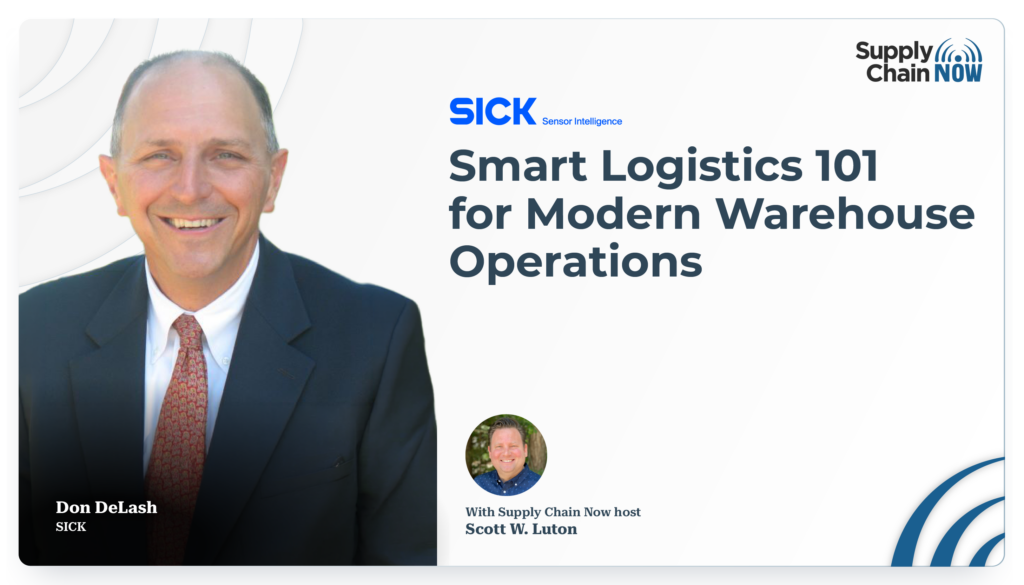
[00:01:35] Scott W. Luton: So stick around folks for a great conversation that’s going to be offering up tons of actionable insights by the truckload. So I want to welcome in our terrific guest joining us here today. He brings over 25 years of logistics automation expertise and success to the table, having worked in a variety of functional roles to include project management, finance, and sales leadership. And I can tell you, I thoroughly enjoyed spending some time with our guest at Modex 2026 with about 50,000 I hear of our dearest friends all-time record at Modex. So please join me in welcoming Don DeLash, Sales Director Logistics Automation with SICK Sensor Intelligence. Don, how you doing?
[00:02:18] Don DeLash: Good. Thanks, Scott. Appreciate it. Good to see you again as well.
[00:02:21] Scott W. Luton: You as well. I’ll tell you, y’all were busy, busy at Modex. I bet you had about there’s 50,000 people there. I bet you spoke to about 40,000 of them. Don, does that sound about right? Yeah.
[00:02:31] Don DeLash: 42,300, I think was the number.
[00:02:34] Scott W. Luton: Oh gosh. Well, you know what though? Beyond Modex, and we’re going to dive into … We got a lot of good stuff dive into here today. But one thing I admire, and what came up a little bit in the pre-show, is beyond all the big things you’re doing in the industry and have for some time, you have been what we like to call giving forward in a meaningful way for a long time with a couple different initiatives. Where’s one of your favorite charitable initiatives you’re involved in, Don?
[00:03:01] Don DeLash: Yeah. So I’ll bring up two. One is I live near Philadelphia. I’m halfway between Philadelphia and Allentown in Bucks County, PA. And there’s a rescue mission called Allentown Rescue Mission. And they take in homeless, they take in people who are struggling with addiction. They put people on their feet. They’ve helped find them jobs. They house them overnight, bring them in on a cold winter night. And we do a lot of charity for them. We make meals. We serve meals to the folks up there. I’ve taken up our youth group. I’ve taken up friends. I’ve taken up people from my team. So it’s a good team building exercise as well. And it just really feels good that people are very thankful. It’s a great organization. They serve thousands of people, so it really helps.
[00:03:46] Scott W. Luton: And is the name of that Code Blue Shelter?
[00:03:50] Don DeLash: Yeah. The Code Blue Shelter is something more local. That happens here around the Doylestown area where it’s a relatively affluent area, I’d say. And the Code Blue Shelter takes in, believe it or not, there’s homeless people here and people don’t have any place to stay. So during the winter months, the Code Blue Shelter opens up every night and we feed them, we house them, we give them a cot, we give them a warm breakfast in the morning and a cup of coffee and we take care of them all winter long. So that’s a local shelter.
[00:04:23] Scott W. Luton: That is incredibly admirable. And it’s so practical, right? I mean, and homelessness is an issue around the globe, right up under our nose. It impacts no matter where you are, big towns, small towns, all points in between. And it’s just a travesty. I appreciate what you do. What was the name of the first organization, Don?
[00:04:43] Don DeLash: The Allentown Rescue Mission.
[00:04:46] Scott W. Luton: Allentown Rescue Mission. Outstanding.
[00:04:48] Don DeLash: Allentown Rescue Mission. I’ll say something about the Code Blue Shelter. Two things amaze people. One is that there are actually a lot of homeless people right around here, but the other one is how many volunteers silently volunteer and do this work. We have probably almost 200 people that volunteer. So it’s a rotation. Every night there’s people staffing it. And these people are unsung heroes to be sure.
[00:05:13] Scott W. Luton: Very true. And I’m going to probably butcher this quote, what your perspective reminds me of and a noble mission that so many volunteers help out with in these organizations you mentioned. And I think it was St. Francis of Assisi, if I’m saying that right. And it said something about deliver your gospel message because it might be the only sermon that folks here today. And he was really focused on preaching the virtue of action. And Don, you strike me as someone with a strong bias for action, my friend.
[00:05:45] Don DeLash: Yep. We try, that’s for sure. That’s the calling.
[00:05:48] Scott W. Luton: Well, admire what you do. And you’re also very active when it comes to global supply chain. You and the SICK organization has been on the move. And before we get into some of your expertise, I want to level set on your professional background, which I think folks will appreciate the context. So prior to your current role, you’ve been, as I mentioned in the intro over 25 years, prior to your current role, what’s a role or two, a key role or two that really shaped your worldview of how you view industry and opportunity and innovation?
[00:06:19] Don DeLash: Yeah. So I’d say that’s a good question, Scott. Early in my career, I was a project manager and for systems integration for automation for retail logistics and parcel and postal industries and some food and beverage companies type projects too. And my boss used to throw a folder on my desk and say, “You own this job.” And from that moment until the moment the customer was satisfied, which could be six, nine, 12 months later, a year and a half later, I owned everything about it. And it really taught me about looking at things from a customer perspective, from a quality perspective for sure, from a communication perspective. And I wasn’t the greatest project manager. A lot of times I learned on the job, but I learned that if you take care of the customer and you really have a deep curiosity and an understanding of what they’re trying to accomplish, that’s what they appreciated.
[00:07:13] Don DeLash: So that was the shape to me. I think that applies whether I’m dealing with new customers, existing customers, internal customers, and even customers outside of work. So it was interesting for me.
[00:07:24] Scott W. Luton: And that mindset clearly, Don, has followed over and spilled over into your current role at SICK. And we’re going to talk about some of your mantra here in a second. And I think we’ll shed more light on how you view taking care of your customers and bringing maximum value to the table. But first, tell us about what your current role is at SICK.
[00:07:43] Don DeLash: So I lead our logistics automation team, which we’re responsible for logistics automation, a little bit more than that. Also, the things that go around it, like digital solutions, safety solutions, and the technologies that apply to logistics automation. What that means is if you walked around a distribution center, a warehouse, a fulfillment center, you would see SICK solutions, moving packages, controlling robots, controlling automatic guided vehicles, gathering data, our sensor network gathering data from the various machines and equipment that are operating in the distribution center. So we tie all that together and deliver a lot of value for our customers.
[00:08:25] Scott W. Luton: And the SICK organization has been on the move, growing left and right, expanding into all sorts of sectors, which we’ll touch on later. Don, it’s got to be a great organization to be a part of, huh?
[00:08:36] Don DeLash: Yeah. I mean, we have such a broad range of solutions and technologies. It’s almost hard to keep control of it and keep on top of it. So we real giant focus on the things that are not only current, but what’s next. Our customers count on us to know what are the trends in technology and the market. And maybe we’ll talk about that a little bit, Scott, but we need to deliver that kind of message to not only this basket of products and solutions, but the know-how and the experience and how to apply it all. That’s the value we add.
[00:09:09] Scott W. Luton: And that came up during our conversation. One of the many things came in our conversation at Modex and that clearly being the bringer of innovation and trends and opportunities is a role I think you take very seriously with your customers, huh?
[00:09:22] Don DeLash: Yeah, absolutely. I mean, they count on us. Sometimes they tell us that, sometimes they don’t, but we have to always realize that they’re going to hear it from somebody. We want them to hear it from us and we want them to hear it accurately because we know we deliver the real deal. We don’t sugarcoat stuff and we don’t press one type of technology or one type of solution. We can advise, provide consultation and advisory services and input in a pretty value add way for customers.
[00:09:52] Scott W. Luton: Sounds like you really value being that trusted advisor. It’s a really important role. It’s not a new phrase, but still, I think there’s not a whole bunch of practice of organizations being and serving in that trusted advisor role, huh?
[00:10:07] Don DeLash: Well, I think that term, trusted advisor, you see that all the sales training workbooks and textbooks and all that. And I think it’s overused because just think of those two words, trusted takes a while, especially with the stakes. I’m going to spend tens or hundreds of thousands of dollars with you or millions of dollars with you. How much trust do you need before that happens a lot? An advisor, companies that make capital expenditures and purchase automation, these are big complex customers. They got a lot of advisors. So what would make me be, or my team be an advisor to a customer, a retail customer, a parcel distribution customer, a third party logistics customer or a food and beverage company? It’s something you really have to earn, both those words independently and sometimes together. So that’s what we focus on.
[00:11:01] Scott W. Luton: Don, I am striking that phrase from my lexicon because now that I think about it, you’re right, it is highly overused and very infrequently is it really delivered upon. So really appreciated that perspective. But also, before we start talking, getting some of your thoughts in terms of a smarter approach to all things technology and automation and the like, I’ve been researching you a little bit and researching your track record a little bit, Don, you didn’t even know, but you’ve got this mantra that I’ve come across, and I’m going to paraphrase this a bit, I believe, but differentiate, add value, kill waste, build people, build processes, be creative. Tell us, is that some of the secret sauce that’s made you successful in the industry and why maybe you’re real valuable to your partners and customers?
[00:11:52] Don DeLash: Yeah, it is a secret sauce and maybe I shouldn’t have told everybody that by posting it.
[00:11:56] Scott W. Luton: It’s out and open now. It’s out the open.
[00:11:58] Don DeLash: Geez, I blew it. But absolutely, Scott. I mean, you can think about it right down to the kernel. I mean, there’s people out there that, there’s me out there that compete with me every day. And when they get out of bed, I’ve got to differentiate. I’ve got to build my team so we’re better, the team around me. I’ve got to be more creative than them. I’ve got to be quicker and more agile than them. So because that’s business. And when you take that from a personal level, team level, company level, and all the different adjacencies to that, I think that’s really the guidepost for what I would consider has led me to where I am and given me the experiences and the successes I have.
[00:12:38] Scott W. Luton: I’m with you, Don. I’m with you. In a sea of the same, how can we really differentiate and stick out and use that to create an inbound? That’s what folks go to, right? So they don’t want more of the same, like the cookie cutter approach. But as we start to kind of pivot our conversation and we start to think about global supply chain and the critical role that today’s warehouses, I mean, they’ve always played a critical role, but I think that it’s only grown in criticality, if that’s a word. They’re a major part of meeting the ever-growing customer expectations.
[00:13:14] Voice Over: So
[00:13:15] Scott W. Luton: When you think about, and I bet you’ve been in over 5,227 warehouses, I’m just taking a stab at it. When you think about what may surprise some folks that haven’t been into a warehouse here lately, what would that be?
[00:13:29] Don DeLash: Well, I’ll tell you, one of the things I noticed recently is the quiet. When you walk into a distribution center, even though there’s a lot of automation, a lot of stuff, it’s gotten a lot quieter. And I may have mentioned this at Modex. I mean, it’s pretty quiet out there on the floor. I think technology’s gotten more digital or solid state. I think equipment is a lot more efficient. Not too long ago, 10, 12, 15 years ago, if you walked into a distribution center, boy, it was loud and there’s a lot of maintenance and there’s a lot of dirt. These are pretty clean operations now. That’s the first thing I think from a sensory point of view that you would notice. It’s what I notice. I think another thing, Scott, is just the, I think the amount of stuff moving around on the floor. You could walk around a distribution center and, okay, there’s a fork truck beep beep.
[00:14:18] Don DeLash: Now there’s AGVs and there’s tugs and there’s unmanned fork trucks and automated guided vehicles and mobile robots and things moving around and just robots. And there’s a lot of movement where the people are. And I think that’s another thing that’s maybe a bit surprising.
[00:14:38] Scott W. Luton: A flurry of silent activity. It really is a remarkable time. I’m going to ask you maybe an obvious question, but you never know where all the folks tuned in, watching or listening, where they are on their journey. A minute ago, I talked about how customer expectations continue. The Amazon effect is also cliche, but it is still alive and well, right? As it continues to push more and
[00:15:03] Voice Over: More
[00:15:03] Scott W. Luton: Customers asking, “Hey, why can’t this be like this? Or why do I have to wait?” Or what have you. Why is smart automation even more critical in today’s environment in the warehouse industry?
[00:15:14] Don DeLash: Yeah, I mean, you mentioned that the Amazon effect and it’s not just the Amazon effect. I mean, there are companies in, Amazon’s in e-commerce, retail, let’s say company, but automotive, consumer goods, electronics, retail distribution, general logistics, food and beverage I mentioned, they’re all in the party now. And I think some areas like grocery and grocery distribution where it’s a different style of product that’s perishable, it’s not really conducive to a lot of automation. I think that’s flipped. We see a lot of grocery kind of automation in frozen, refrigerated and ambient environments. What happens now in technology is when you climb Mount Everest, I never did and I’m not a climber, but don’t they go from base camp to 15,000 feet back to 10, and then they go to 20,000 feet back to 15. And they do that to acclimate and see where the limits are or see where they have a limited approach.
[00:16:17] Don DeLash: I think technology, in a way, you may see some big stories, but it happens in smaller ways too, in specific application ways. I don’t think companies should shy away from pushing maybe beyond and then reverting back to what works. We see the big companies like the ones you mentioned, they push beyond and some things they abandon and they don’t go forward with. And we see that in our work, but we support that because I think that that’s how ultimately you move forward. If you crawl to the edge, others are building bridges or building ways to get over that chasm before you are. So I think some intelligent risk is a smart thing that way.
[00:16:57] Scott W. Luton: Yep. And smart automation, of course, is helping organizations not only experiment along the lines that you were referencing, which is so important to not sitting on your laurels, right? Yeah. I think we make a lot of assumptions when times are good, we’re making a lot of assumptions. Some organizations can make assumptions that, “Hey, this is how it’s going to be for a while.” But as I like to say, Don, the market is always asking and some people don’t listen. The market’s always asking, “Hey, what have you done for me lately?” And it’s so important to do exactly what you’re suggesting, regularly experiment. Some things will stick and some won’t have the value we may think, but of course, smart technology, smart automation is how, especially those things that stick, how we can bake that into organizations oftentimes. Is that right?
[00:17:42] Don DeLash: Yeah, you said it. I mean, I think experimentation’s a keyword you use there can be small experiments to find out if a certain technology will perform in a certain environment, in a cold environment or a high throughput environment or a non-singulated package environment, whatever bulkflow environment. Experimentation is definitely, as technology moves forward faster, I think experimentation is catching up to it. Hopefully we see more of it now, which I think is a real positive thing because we learned from the successes and the failures of them, right? So I think that’s okay.
[00:18:19] Scott W. Luton: It is. And gosh, if you’re not failing out there, folks, you’re not experimenting enough. You’re playing it too safe, especially in this incredible time that we’re all in global supply chain.
[00:18:29] Don DeLash: Yeah. Take it from an expert. Scott, I thought you were going to read all my failures before, so thanks for not doing that.
[00:18:35] Scott W. Luton: I got those in this folder over here. No kidding. I’m only kidding. All right. So one more thing before we get into how you have found and help organizations find that sound approach to smart logistics and automation, I want to ask you one more thing for context upfront. That definition, I mentioned smart logistics a couple times so far. How do you think that has evolved, that notion of smart logistics over the last five or six years?
[00:19:02] Don DeLash: Well, I think two things and one emerging thing. The two things are like just digital transformation, the ability of sensors to do more in a smaller package. I mean, just look at your car or your little Roomba vacuum cleaner or whatever or your fridge. I mean, the sensing technology that’s out there, sensors are really smart now. The second thing is analytics. So what if sensors are smarter? It’s the analytics engines that really bring that to life because they do predictive maintenance, they do trending, they send you an email if you hit a threshold of motor temperature, whatever the case may be. So the analytics, taking all that smart data from the sensors, whatever they may be, and building analytics around it is the real engine. And now we have, of course, the turbo is the AI on top of it, which is really emerging quickly.
[00:19:55] Don DeLash: I think when you’ve put AI, it’s going to take that analytics, the intelligence, artificial we call it, but it’s real data and it’s going to drive predictive maintenance sounds great. Well, with analytics, it actually really happens and you can trust it and you can depend on it. So that’s becoming reality pretty quickly.
[00:20:17] Scott W. Luton: I love it. And quick shout out, by the way, to all the incredibly talented maintainers that keep fleets and factories going around the world that never get any attention and never any recognition. Huh Don, is that right?
[00:20:30] Don DeLash: Yeah. I was in a plant yesterday and afterwards I was saying, “So what are the folks like that work in the plant?” And I said what you said, I said, “Just solid people.” I mean, Unsung Heroes just back there hauling stuff and moving the equipments and replacing dyes and just really just salted the earth stuff. And I just look at them and say, “Boy, it’s the backbone of a plant, an industry, and ultimately the nation.” So I think it’s really, really important. That’s a great call out, Scott.
[00:21:02] Scott W. Luton: Hey, I couldn’t have said it better than what you just said. And industry takes those good folks for granted, but nevertheless, I want to keep one thing. You talked about sensors and analytics and AI. And my hunch is the SICK organization is baking a lot of those innovative approaches and technologies into this proven approach that I’m about to ask you about when it comes to planning, implementing, scaling, and then locking in the gains that a smart logistics automation strategy can really deliver and support and empower those talented people we were just referencing. So we’re going to break this up into … We’re going to overly simplify because we only have an hour, Don, we could talk for hours about your rules of thumb that you’ve developed over time, but let’s start with the first of three, and that’s crafting the plan. So as we’re getting started planning these initiatives and the strategies, what are the absolute critical elements of crafting the plan?
[00:22:01] Don DeLash: Yeah. We talked about this at Modex. There’s no shortage of options. I mean, there are, I don’t know how many, thousand exhibitors or whatever. I’m probably underestimating at Modex and so many different technologies and so many different people who can be consultants and create to be trusted advisors. So in terms of that, you really want to work with partners that understand your business, have a really high level of curiosity about your business and have a really good attitude about finding a way, right? Because companies are out there doing things that I don’t know about. It’ll emerge. So there’s always a way. We can find a way. So choose good partners that will help you get where you want to go with your interest in mind as someone who wants to automate and put smart technologies and smart automation in place. That’s the first thing, I think.
[00:22:51] Don DeLash: And it may be multiple partners, but good partners and good advisors is number one. And then we talked about don’t boil the ocean, so to speak. A project that’s meaningful, maybe the best approach is phasing in because in a project that’s going to take a year to install or implement or ramp up, technology’s going to change over the course of that year. And there may be revisions, there may be new versions, there may be new capabilities or processes that come available that can impact phase two or phase three of a project. So I always think to think about things as phasing in and experimenting as we talked about is not something that works all the time or it’s not always the right decision, but I don’t think we should skip it. I think it’s always a good idea to do things that way.
[00:23:39] Scott W. Luton: I’m with you. And so two big things I heard there is the right scope, targeting the right problem with the right solution and the right scope. Let’s not try to go out there and fight every fight. And then secondly, once we’ve got that determined, or maybe in parallel perhaps, the selection process to find the right partners. Don, do you find that selection process, which selection for technologies and partners, or you name it, has been around since the cave man days, right? But a lot of folks don’t apply a rigorous process to selection. And sometimes, oftentimes, that can lead arriving at the slickest sales presentation versus the right partner. Do you find that, Don?
[00:24:25] Don DeLash: I mean, it can happen. I don’t know how often it happens, but it’s not uncommon, I would assume. I think when you talked about, you just said it’s the word scope. And I think that reminded me that in the planning phase also, if I go back a second, I think the objectives that you want are really critical too and to communicate those. We want to a lot of times put in a pilot system or a beta test system or something. Well, what does success look like? And sometimes the customers, the users don’t really know yet. They haven’t determined it. And we really want to nail that down and make sure we understand and we’re aligned so we’re working on the right things that impact the customer. In terms of getting the right content, I just think when you get to that consultative approach, really super curious approach about how the end user’s business, the customer’s business is going to work, I think when you have that curiosity, you build trust and you build understanding and the glossy sales pitch is, I think that’s okay, but I think you got to have content.
[00:25:28] Don DeLash: You got to have qualification and quantification because ultimately it’s going to come down to an ROI decision, an ROI discussion at some point. So we want to make sure, look, we’re a global company, we have a new campus SICK does in Minneapolis. It’s beautiful. It’s awesome. We want everybody to come up and visit us. That’s all good stuff. And we tell our customers that because we want them to know we’re a solid company and we’re progressing and leading forward. But at the end of the day, if our systems can provide X improvement or eliminate X waste, what does that mean to the business? That’s where the decisions are made. So both are important, but we don’t want to overlook the real meat.
[00:26:08] Scott W. Luton: Well said, Don. Folks, don’t mail in your selection process. And if you do, you do it at your own peril for sure. All right. So let’s talk about scaling projects from pilot mode to enterprise-wide implementation. I know there’s a long list of important things to keep in mind there, but what’s on your short list of suggestions there, Don?
[00:26:29] Don DeLash: Well, I do think from a provider point of view and from a customer or user point of view, I think it’s important to think about these economies of scale. I think I mentioned phasing and experimenting. If you overdo that, you’re going to lose a lot of economies and build a lot of redundancy and duplication and therefore a lot of waste. So we don’t want to do that. I think a good solid plan for a rollout of a project, like you say, enterprise-wide, I don’t think this is new news, but a good plan there will really … And then stick to the execution. And the journey never goes exactly as we expect. There’s always bumps and turns in the road, but I think it’s important to be able to stay the course and stay the course unless the dynamics change, unless there’s new discovery or there’s an industry, something makes a big, big shift in an industry or something like that.
[00:27:23] Don DeLash: But I think those are pretty rare. You can’t wait and plan for those things. You have to be able just to respond to them. So I think enterprise-wide solutions are usually having that broader strategic look and then executing underneath it is just, it’s just really smart.
[00:27:39] Scott W. Luton: Don, I’m with you. I was spending some time yesterday with a brilliant technologist with one of my favorite retail companies, right? Think spring season. What do you need in spring season? You need lawn and garden and do-it-yourself projects. And he was with one of the big ones, right? They might’ve had a blue aprons on. I might’ve given it away there, but I admire this company and they’ve made great gains in their continued customer experience. And he has been involved in lots of AI projects. And Don, something you just shared there kind of took me to one of my key takeaways there. And he really stressed modern day leadership, we’re going to plan it, we’re going to plan these initiatives, but when there’s the first bump in the road, because there will be bumps in the road, right? Either be surprises despite our best efforts, we need leaders and professionals that their hair doesn’t pop on fire.
[00:28:32] Scott W. Luton: We got to lean into, solve it, and then move on to really the next stage, the next speed bump, you name it. That goes with the territory, huh, Don?
[00:28:41] Don DeLash: Yeah. Well, I tell our team all the time, what we do is really, really hard. It’s really complex. It is not easy. That’s why there’s only a handful of companies in the world that do what SICK does. And a lot of companies can say that. And a lot of customers like the one you mentioned, who I know is on the cutting edge, we work with them too. It’s complex work, so unplanned things are going to happen, data’s going to be discovered that we didn’t count on. It just happens. Adaptability to those things has to be built into a plan. A really, really rigid plan, whether it’s by a technology supply provider like us or a technology user, a really rigid plan is usually not going to come to fruition, got to build in some flexibility and some adaptation. And the way to do that, I think are some really meaningful checkpoints, whether it’s in the time during the concept phase, planning phase, implementation phase, startup operation, I think checkpoints along the way in all those places help to keep alignment and help to keep moving towards the ultimate goal.
[00:29:49] Scott W. Luton: Well, and Don, you’re reading my mind a little bit because when I think of checkpoints and I think of bumps in the road, even maybe after the initial implementation is done, I think Think of aftercare. It’s a term been around forever. Some organizations take it very seriously. Others do not. What would be your thoughts in terms of what your customers find most valuable about your approach to aftercare?
[00:30:13] Don DeLash: Well, one thing I think in general, I would apply this to just the industry in general, is when we talk about innovation, you think AI, you think a machine, you think a sensor, you think a vision system, whatever, a palletizer, a robot. You can innovate share vision support too. We need to continue to be innovative there. In our industry, because I mentioned very complex and it’s a complex rollout and it’s a complex startup and a complex operation in a lot of cases. But look, I took my car to the mechanic last week and had the brakes done. And by the time I got home, I have a survey from them. How do we do? What else can we do for you? Do you want to make a next appointment? If a little mechanic shop up the road can do that, we have to think about how do technology companies and innovative companies like us in this industry, how do all of us do that better for our customers as well?
[00:31:11] Don DeLash: So what works I think is currently, Scott, that flexibility. Designing, engineering, installing these systems is tough. Operating them shouldn’t be tough, but it’s critical. It’s mission critical. One of our systems goes down, the sensors go offline. We shut down lines. We don’t fill trucks. We don’t get deliveries to people’s doorsteps. So being responsive, having an adaptable or a flexible support and aftercare program, as you said, is really critical because every company has different needs. You need to be able to put together a program that works for them.
[00:31:49] Scott W. Luton: Yep. What you just mentioned there about what happens when things go wrong in the worst of cases reminds me of the two rules of continuous improvement that I learned a long time ago. And you may have heard these rules too. Rule number one is do not interrupt orders going out the door. And rule number two is follow rule number one. Have you heard of those two rules, Don?
[00:32:14] Don DeLash: Yes, I have. Yes.
[00:32:19] Scott W. Luton: Yes. And things are going to happen. I want to stress that folks. But with organizations that have a robust aftercare program, they bake that into the plan. And going back to selection, I beat this dead horse a lot because I’ve been part of organizations that we have really failed miserably at selection. Ask about aftercare. Ask about when things go wrong. If you’re not, you’re missing out. Don, your final thought before I get into some use cases.
[00:32:46] Don DeLash: Yeah, I think that that’s critical. Like I said, innovation doesn’t stop with the stuff you hold in your hand or the software. And the planning doesn’t either. You have to take it all the way back to aftercare because once your provider, your technology partner leaves and moves on, you own it. You run it. You need to be confident that, hey, somebody’s got your back and we definitely want to plan for that. And a lot of times should be spent there. No question.
[00:33:15] Scott W. Luton: Okay. So Don, I bet we could be here for a couple hours talking about some of your favorite anecdotes, the moments of change, transformation stories and whatnot. And also, I think it’s an important note for folks that may be new to SICK. Y’all work in all kinds of industries, automotive, consumer goods, electronics, many, many more. But across all of that, what’s been one or two of your favorite use cases that really delivered really big time ROI, Don?
[00:33:45] Don DeLash: I think number one is, I mean, safety is the fastest growing part of our logistics business for the moment. And for the reasons that I mentioned earlier, more stuff moving around, more people interacting with machines, more machines flying around assets and people. So safety isn’t something that’s a nice to have anymore. It’s a must have. So I think some really cool safety solutions that we’ve done around … Think of where people and machines interact in a kind of a chaotic area. Like you said, don’t stop orders going out the door. Where does that happen on the loading dock? So we’ve got some really cool partnerships where we’re implementing dock door safety solutions with the door itself, with the dock area, with the machines, with the people that enter the dock area, with the machines that traverse in and out of the dock area. All that’s coordinated to make sure the area stays safe.
[00:34:41] Don DeLash: That’s really cool and it’s really emerging. We say the same about, again, around the dock for … We see a lot of the emergence of robotic or automated truck unloading and depalletizing. So around those areas, a lot of safety concerns, so a lot of development and implementation and expenditures around safety. So when we think automation and these a higher mix, faster, safety’s got to be involved. So a couple good safety applications. And you think about some of the machinery, stretch wrapper machines, they’re pretty simple, but they got a lot of inertia, a lot of weight behind them. We see quite commonly not a lot of safety. I mean, you can kind of walk into one of these machines. And even if there’s guarding, physical guarding, it doesn’t mean somebody’s not inside the guarding already when it locks and you turn the machine on. So we have technology that’ll actually detect the heartbeat of a person before the machine starts.
[00:35:38] Don DeLash: So I think safety advancements are really cool. At the end of the day, you mentioned ROI. Well, how do you measure ROI with that? It’s people first and sort of ROI second, but that’s the responsibility of the companies and there’s a responsibility of us as a technology provider as well. So those are some pretty cool applications, some use cases. I think another one, Scott, if I could, is the marriage and the synergy of imaging and vision technology and AI. So just the ability to, at a much more accurate rate, determine, is this package damaged? Is this box … Is the corner busted? Is the flap open? Is the tape ripped off? Are there two identical packages? I ordered one toast. Don’t ship me two toasters. You just gave me a toaster that I’m going to give to my neighbor for Christmas. So when you take an image and you feed it into an AI system that’s learned what a single package is, what a damaged package is, what a duplicate or multiple packages are, what the wrong package is, what a box is, what’s something that can be palletized.
[00:36:48] Don DeLash: Don’t palletize this. It’s paper towels. Don’t put it on the bottom of a pallet. It’ll crush. There’s just so much intelligence that can be built in when you marry vision and AI. And we see that in so many different applications. It’s really very, very powerful.
[00:37:04] Scott W. Luton: And Don, what I heard there in that last example you shared is that AI at the edge. If you think about an average person working in the warehouse that we were referencing earlier, the folks that make it happen for the entire world every day, you think about how many micro decisions they’ve got to make in a given day, right? Pallets, picking, what goes where, who does ship where, all this stuff, right? If we can put technology that really can eliminate a lot of those micro decisions, or if not eliminate it, humans having to make them, giving them the best information to make it so easy right there in a palm of their hands, right there where they are. It’s a wonderful story here in the golden age of supply chain tech, right?
[00:37:51] Don DeLash: Yeah. I just saw on the paper this week, this sort of argument of like AI, is it going to take everybody’s job? This tote, I’m supposed to put 12 cell phones in it. Did I put 13 in or 12? Well, that won’t happen in an AI-based robotic vision verification type system. You can bang it. It’s going to be 12 all the time. So the human can do more intelligent work or more value added work, things like that. And I think ultimately that’s where we’re going to try and I think it’s going to empower more of that, more brain power. I mean, nothing like the human brain and the human muscles. So I think we just have to apply. They’ll be applied differently and in a more valuable way in the future, but it’s a journey to get there and the argument’s going to continue. But I think ultimately we’ll find ways to take these micro decisions and dangerous decisions, things like that out of the hands of people as much and let people do more creative things and people do more impactful things.
[00:38:56] Scott W. Luton: I completely agree with you. I’m not diminishing anything that’s done out there, but I’ve unloaded trucks before.
[00:39:03] Scott W. Luton: That is not fun work. And as I recall, I didn’t get paid too well to do it, right? Yeah. I think my back still hurts. Well, there’s a reason why it’s tough to get in recent years, enough folks to do stuff like that, because it’s not appealing for many folks. Don, you know where I’m going, the great thing is technology is, to your point, more and more taking on some of these very high manual, tedious, in some cases, dangerous tasks. And to your point, enabling those workers that were willing to learn and step into new roles and give them more fulfilling work, more rewarding work. I think it’s a wonderful trend.
[00:39:43] Don DeLash: Well, I think this facility I mentioned that I was in earlier this week and these operators are the salt of the earth. I mean, just dedicated to doing the job well, I was there because this company wants to automate some of that. They’re actually hiring more people, but the automation is going to take the dangerous jobs, the super repetitive jobs, those things away where let the operators, instead of doing that, oversee the technology and set up the technology and speed up the technology, change the configurations when the product run changes, let the operators do those things and operate the machinery, let them fly the plane. That’s how this company sees automation implementation. And I think ultimately that’s what will happen, whether they phase that in or whether they do A and then B and then C, but I think ultimately that’s where they want to get to.
[00:40:37] Don DeLash: And I think that’s really smart.
[00:40:39] Scott W. Luton: I like it, Don. I like it. And folks, having spent some time with Don at Modex, he has got thousand stories of use cases and cool things they’re doing. So I want to make sure, Don, folks know how to connect with you to talk shop or maybe to look at what SICK can do for them or get your thoughts on the industry. So what’s the easiest way for folks to connect with the Don DeLash?
[00:41:03] Don DeLash: Yeah. So the easiest way right now is it’s just easiest can be Don.delash@sick.com. Pretty simple. Or if you want to get SICK in general, it’s info@sick.com. Very, very easy. So we try to make it an easy journey to find us and to open it up. We always want to help. That’s our goal. And I think there’s a lot of opportunity out there. You saw it at Modex, we certainly saw it at Modex and we’re happy to be part of the evolution here. I
[00:41:33] Scott W. Luton: Love it. I’ll tell you industry and evolution’s right, faster and faster evolution. It’s amazing. And not just global supply chain, but global business and I admire. And I wish I could better understand some of the high end, high technical stuff that you and your team are doing, but I’m getting there. I’m getting there, Don. You got a
[00:41:49] Don DeLash: Pretty good grip on it. You got a pretty grip on it. Yeah, I could learn a few tricks from you. No question.
[00:41:56] Scott W. Luton: Done. Enjoyed our talent MODEX. Enjoyed our time here today. Thank you. So much for being here. Again, appreciate what you do on the personal side and really appreciate what you’re doing out in industry and we’ll have to have you back soon.
[00:42:08] Don DeLash: Yeah. Thank you, Scott. I really enjoyed it. I appreciate it. Great to talk with you.
[00:42:12] Scott W. Luton: Folks, we’ve been talking with Don DeLash with SICK Sensor Intelligence. Folks, make sure you reach out to him via email or via LinkedIn or go to the company webpage to learn more about the cool things they’re doing. And by the way, I hope you enjoyed this conversation as much as I have. I really enjoy talking with Don and learning more from him, but there’s homework. There’s homework. You got to take one thing from all the wealth of good stuff and advice that Don shared here today. Take one thing, do something with it, right? Deeds not words. That’s how we’re going to keep transforming global supply chain and not leaving anyone behind. So with all that said, Scott W. Luton here challenging all of our wonderful audience out there. Do good, give forward, be the chains that’s needed. And we’ll see you next time right back here on Supply Chain Now.
[00:42:53] Scott W. Luton: Thanks everybody.
[00:42:55] Voice Over: Join the Supply Chain Now community for more supply chain perspectives, news and innovation. Check out supplychainnow.com. Subscribe to Supply Chain Now on YouTube and follow and listen to Supply Chain Now wherever you get your podcasts.