[00:00:00] Kurt Heusner: When the warehouse becomes a bottleneck, you just can’t do business. It’s just that symbol. If fulfillment can’t keep up with growth, inventory numbers aren’t trusted. Leadership is constantly reconciling discrepancies, and the phrase I hear most often is the system says we have it. But we can’t find it.
[00:00:23] Voiceover: Welcome to Supply Chain Now, the number one voice of supply chain. Join us as we share critical news, key insights, and real supply chain leadership from across the globe. One conversation at a time.
[00:00:36] Scott W. Luton: Hey, good morning, good afternoon, good evening, wherever you may be. Scott Luton here with you on Supply Chain Now.
[00:00:42] Scott W. Luton: Welcome to today’s show, folks. Today we welcome in a business leader who has spent his entire career in the small and medium sized business technology space, helping organizations find extraordinary new levels of success. So in today’s conversation, we’re gonna be dialing in on a variety of topics, including warehouse automation, especially in the SMB world.
[00:01:03] Scott W. Luton: We’ll discuss helpful insights on how to. Evaluate warehouse management systems based on your organizational needs. We’re gonna gain some bend there. Done that perspective on how to optimize your ERPs performance. We’ll even explore how old and new technologies are working together to find new innovations out in the industry.
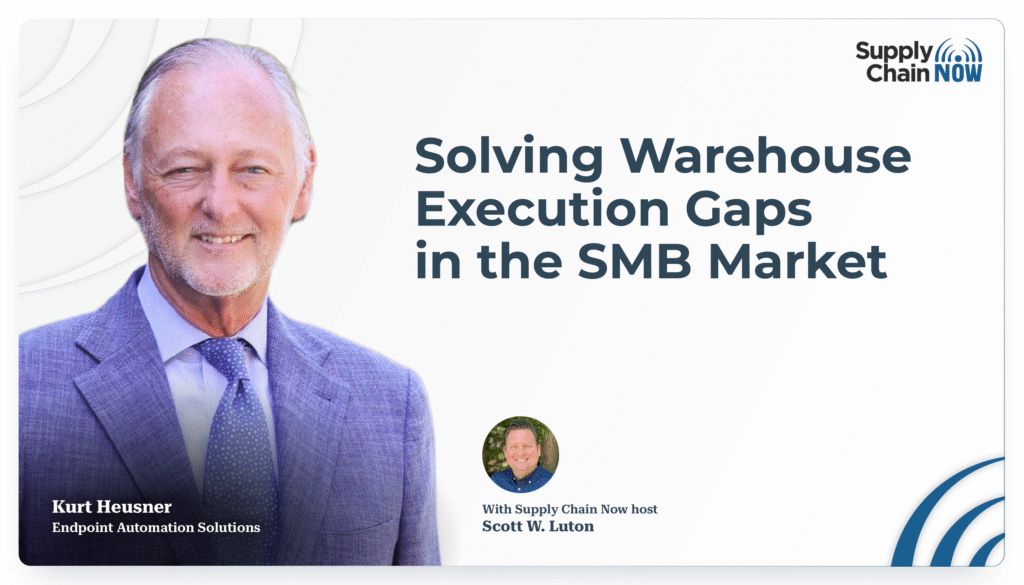
[00:01:20] Scott W. Luton: All that. And much, much more. And we may touch on a little bit of music. We got a big music fan here. So folks stick around for a great conversation that’s gonna offer up tons of actionable insights by the truckload. So I wanna welcome in our wonderful guest joining me here today, Kurt Heusner. Joined Endpoint Automation Solutions as CEO in May 2025, bringing with him that career long, very valuable focus on the s and b market.
[00:01:46] Scott W. Luton: Most recently, he served as General Manager and EVP at ShareFile where he scaled that s and b focus software company to over 250 million in annual recurring revenue. Wow. Prior to share file, Kurt spent 11 years at Citrix in various executive leadership positions, including senior vice president, America’s commercial business, and vice president of Worldwide Professional Services.
[00:02:10] Scott W. Luton: He is also held executive roles at Dell and Van Star. Now, Kurt’s experience spans both entrepreneurial ventures and established organizations delivering consistent success in developing. Go to market strategies and building high performing teams, especially around SMB customers. Let’s welcome in. Kurt Heusner, CEO of Endpoint Automation Solutions.
[00:02:32] Scott W. Luton: Hey, Kurt, how you doing?
[00:02:34] Kurt Heusner: Wow. Thanks Scott. I’m gonna take you everywhere with me.
[00:02:38] Scott W. Luton: You’ve been busy and successful, uh, and I’m delighted to be able to learn from you and, and, and share some of your perspective and expertise with our audience. But, and I’m happy to hit row with you anytime, but I wanna ask you this though, Kurt, because I learned in the pre-show that you’re a fellow big time music lover and when you’re not doing big things in in end-to-end supply chain, you’re traveling.
[00:03:01] Scott W. Luton: Taking in, uh, NOLA, uh, new Orleans Jazz Fest, Austin City Limits shows, all kind of stuff. What has been one of your favorite music moments?
[00:03:09] Kurt Heusner: Well, thanks again for, uh, having me, Scott, and, uh, you should know that our company and our team is a big fan of your, uh, your show. So thanks for having us. I’ll give you both a disappointing and, and a hopeful moment.
[00:03:24] Kurt Heusner: So one year we, uh, we’re very excited. It was the 50th anniversary of. The New Orleans Jazz Fest. And for some that were excited about the, that year it was publicized that the Rolling Stones were gonna play, if you’ll remember it. The kink in the armor was that, um, if you’ll remember, um, Mick Jagger had a minor heart attack and was, had to take some time off.
[00:03:53] Scott W. Luton: Wow.
[00:03:54] Kurt Heusner: So they, they got, uh, somebody as a backup, which was Stevie Nicks. And she got the flu. And then they just kept going. So, um, they, they made up for it. The year after that they had the Rolling Stones. So I think my favorite of all the times I’ve been there was the Rolling Stones at the event. But
[00:04:16] Scott W. Luton: I bet, I bet.
[00:04:18] Scott W. Luton: And gosh, sometimes things just aren’t meant to happen. Is that right, Kurt?
[00:04:21] Kurt Heusner: Yeah.
[00:04:22] Scott W. Luton: Fate still rules Supreme. But you know, Tony, my dear friend, Tony Sciarrotta, has been going to Jazz Fest for decades, if I’m not mistaken. And, uh, I’ve heard about the, not only the music, but the food and just the wonderful time. So I’m gonna have to meet you down there at some point.
[00:04:38] Scott W. Luton: Soon I’m
[00:04:39] Kurt Heusner: joining us.
[00:04:40] Scott W. Luton: Go
[00:04:40] Kurt Heusner: every year
[00:04:41] Scott W. Luton: we’ll do it. And of course, Austin City Limits and some of those shows are incredible too, but equally as incredible, quite frankly. Has been your journey. It’s, you know, I was able to share a little bit of it, uh, as we introduced you, but we got a lot to unpack here today, and I think a lot of great actionable been there, done that perspective to share with our audience.
[00:04:58] Scott W. Luton: So let’s start with, with your journey and some of its key themes. And I wanna start with one of my favorite elements of your background. That’s. All of your experience, really your entire career in that small and medium sized business software world, you know, share file Citrix now Endpoint. What drew you to warehouse automation in the first place and why SMBs specifically in this space?
[00:05:22] Scott W. Luton: Kurt?
[00:05:23] Kurt Heusner: Yeah, I think I’ll maybe reverse it a little bit with you, Scott. I’ve actually served with all the businesses. I’ve had responsibility for anything from consumer businesses. To the largest enterprises in the world and anything US based to every geography in the world as well. So it’s like I’ve seen all types of customers and frankly, I’m just drawn to this kind of s and b mid-market, uh, customer because they get so much immediate value out of your interaction.
[00:06:00] Kurt Heusner: And it’s either it works or it doesn’t. They give you very direct feedback. There’s no politics and they’re so appreciative when things do work that they, the relationships gets fostered beyond that. So I’ve just, I’ve found it a place that I just appreciate the people that I get to work with most in that size of kind of business.
[00:06:22] Kurt Heusner: And then. The warehouse automation was a more recent, I’ve had all types of technologies that I’ve represented over my life, but you know, this drew me in based on the fact that the warehouse itself is where strategy meets business reality Every day, you know more and more. We as consumers, whether you’re a B2B business or you’re a B2C business, the expectations are so high for instantaneous information about where your order is, how many days till it’s gonna ship, when is it gonna be your hands, all the specifics of, uh, about that product.
[00:07:05] Kurt Heusner: And so it is a place where. They ha struggle with systems and being able to afford systems that aren’t just purely relevant to that business, but it also allows them to be competitive with very large businesses if they invest in the right ways and get it implemented in the right way. So I love the space and I love this part where the people are so appreciative of your interaction with them every day.
[00:07:35] Scott W. Luton: Kurt, love it. Uh, two quick points based on what I heard there. Number one, I’m with you. My journey has included stops at, uh, small manufacturing organizations in South Carolina and here in Georgia, and the people. The people that are committed to delighting customers and solving problems and growing the business through the biggest disruptions is contagious.
[00:07:53] Scott W. Luton: That camaraderie. And then secondly, your, your comment about, you know, having all the information so we can make good, fast, and confident decisions. It reminds me of one of my favorite little anecdotes, if you’ve heard of, um. The SEK company, which is well known for its pickles. It’s not part of the big C conglomerates.
[00:08:09] Scott W. Luton: But, um, Joe Veek was a longtime, I think second generation leader in that business, ICEO for a long time. And one of his mantras was, give me good news fast, but bad news faster. Yeah. And I think we could all relate to that on so many different levels. Um,
[00:08:25] Kurt Heusner: absolutely.
[00:08:25] Scott W. Luton: And it makes me a little hungry. Uh, hey, cools with some sandwiches.
[00:08:29] Scott W. Luton: Right? But anyway, you’re a pretty humble individual. I want to kind of revisit one part of your journey ’cause at Share file, like I mentioned earlier, you scaled the organization to $250 million in annual re recurring revenue, serving again the s and b space. Now, what lessons from that incredible experience and performance are you bringing to Endpoint?
[00:08:52] Scott W. Luton: And a little two parter here. How was selling warehouse automation to SMBs different from other software?
[00:08:59] Kurt Heusner: First? Kurt didn’t do it. He had a great team.
[00:09:02] Scott W. Luton: That’s right.
[00:09:02] Kurt Heusner: Uh, that he, uh, was able to put in place that helped me to achieve anything that I was able to do. It’s, uh, attributed to all those, and hopefully that’s the same thing that I’m trying to build within, uh, culture and the team, uh, of the end point as we are there.
[00:09:20] Kurt Heusner: But, um, look, we, we were able to. You know, satisfy a set of SMB customers. We ultimately had over 80,000 customers in that space, which is a lot as you make you recognize, and trying to keep them all satisfied with what we are doing on an ongoing basis. It’s difficult because SMBs don’t buy software for aspiration.
[00:09:49] Kurt Heusner: They buy it to fix pains that’s costing them money today.
[00:09:53] Voiceover: Yep.
[00:09:53] Kurt Heusner: Time to value is everything for them. So for me, the things that, you know, I’ve learned that actually in every, every business that I’ve had is, it’s probably true, but particularly in SMB because they have to get value out of it. Otherwise they just can’t continue to invest.
[00:10:12] Kurt Heusner: So it’s this time to value beats, feature depth every time. Adoption matters more than kind of architecture. Reliability beats novelty and simplicity wins, especially when teams are lean. So, you know, these are all things that probably, you know, I’ve learned about SMBs and tried to apply in each of the SMB type of businesses that I’ve had responsibility for.
[00:10:41] Scott W. Luton: Kurt, I love it. Every dollar counts. That’s kind of one of the things I’m hearing there, and it’s so true. It’s so true. And then I loved how you started talking about culture, uh, whether it’s the rear view mirror or, or here today, you know, I interviewed a, uh, a genius technologist. That has launched rockets and, and been a part of spaceman, all the highest tech stuff you can think of.
[00:11:03] Scott W. Luton: And uh, this was just another week or so and we were talking AI and stuff and I gotta say he mentioned culture more often than anything else when we were talking about how to really, uh, make the mess, best progress with technology today. And that’s a lot of what you had in your, uh, response and perspective as well.
[00:11:21] Scott W. Luton: Alright, so you’ve seen a lot of companies. In your, uh, journey here, try to serve the mid-market, but end up going up market or down market. What’s, uh, you, you spoke to this a little bit, but what, what else do you see as a unique challenge of serving small manufacturers and of course distributors?
[00:11:39] Kurt Heusner: Yeah, I think it’s with software in general, but I, uh, it’s even exponentially more significant I think, in this warehouse and ERP space because either you have those.
[00:11:51] Kurt Heusner: Enterprise level companies that try to reduce the features available, thinking that SMBs or mid-market companies don’t need some of that same functionality. Or you have some that are, you know, smaller, uh, companies, software companies that are trying to serve s and b that just can’t scale to the complexity of customers over time.
[00:12:19] Kurt Heusner: And so. It, it really becomes important what market are you trying to serve and with what features and for what period of time. Because there is a point in time where you may be too large, you’re a large mid-market company and you’re scaling to a very large global or international or significant complexity company you may need to implement with a more enterprise centric company, but.
[00:12:48] Kurt Heusner: I think it’s really important to find the right company to serve the segment where you are across the different maturity curves that you may evolve through, over what period of time you kind of have to know what’s your plan over what period of time and how do I expect to change and can that person serve me.
[00:13:10] Kurt Heusner: Over that, uh, extended period. Some can servee in really small increments, so it just means you’re gonna have to pick up and change too many times across that maturity curve. You want to be able to do that over a extended period of time while making sure that you can do the things you need to in each of those phases of your maturity.
[00:13:32] Scott W. Luton: Yeah, Kurt, well said. And, and I go back to also to your previous response, talking about the intense focus on time to serve and adoption and, and solving that pain. You gotta be really committed, uh, I think, and really know, know what you’re doing to really serve the s and b space, especially the lower mid-market, I’ll call it, because.
[00:13:51] Scott W. Luton: You’re threatening the, and in some cases you’ve got the livelihood of the organization and, and the small team that depends on those jobs at risk and at stake. So you clearly have developed, you and your team develop quite a
[00:14:01] Kurt Heusner: well, Scott, I think, I think that is right on target is one of the challenges you find is, you know, that.
[00:14:09] Kurt Heusner: Complexity of operations with limited resources. Like they don’t have a WMS project team and they don’t have a change management team, and they don’t have an extra IT team. So every decision has to justify itself operationally. So, and it has to serve them well, which requires focus. Restraint, like not trying to over complicate it and respect for, um, how their business runs and how do you make sure that they’re getting right outcomes out of it.
[00:14:42] Kurt Heusner: Not overburdening it just for the sake of implementing technology.
[00:14:46] Scott W. Luton: Right. And as we all know, the years of implementation cycles are long gone. Uh, we measured those in in weeks or days sometimes. Uh, yeah. So good stuff there. Uh, Kurt, yeah, I wanna shift gears a minute here. I wanna talk more about. Some aspects of the evolution that’s taking place in some technology circles, especially as you’ve got, you know, true standalone platforms and then lots of ERP add-ons and other things.
[00:15:09] Scott W. Luton: Endpoint started, if I’m not mistaken, as scanco. It was deeply integrated with ERPs like sage and, and Acumatica. And now you’re positioning as a standalone, true standalone platform. Walk us through that evolution and, and why’d you elect to make the shift?
[00:15:25] Kurt Heusner: Well, just to be clear, we still. Serve that market.
[00:15:29] Kurt Heusner: And that’s a majority of our customers to this day. But what we were finding is a couple of different scenarios. One is where a customer wants to remain on the same ERP, but their warehouses has more complexity or needs more complexity of operations than what can be handled inside the ERP. And so instead of being embedded into the ERP, we want to integrate.
[00:15:56] Kurt Heusner: To that ERP. So that’s one scenario. The other is where we have customers that do feel like they need to change either their financial system or their ERP and make a change, but don’t want to change all of their warehouse processes as they make that change. So they want it kind of to be standalone and again, integrate into it in the same ways that they might, uh, have in their previous ERP.
[00:16:26] Kurt Heusner: But they don’t want to have to go through that whole change management effort with their existing team. The, it’s working well with their existing team. It’s scaling to their operations. And so it’s in no scenarios, we wanted to have a versatile alternative to that embedded, uh, ERP solution
[00:16:45] Scott W. Luton: Options are a good thing, right?
[00:16:47] Scott W. Luton: Options, especially proven options that work are a great thing. Kurt. Huh?
[00:16:52] Kurt Heusner: Yeah, absolutely.
[00:16:53] Scott W. Luton: When you think of, of words we hear out in the market, you know, modularity of course plug and play. What’s one I I hear all the time? Um, rip and rip and repeat or some, some version of that.
[00:17:05] Kurt Heusner: Rip and replace.
[00:17:06] Scott W. Luton: That’s right.
[00:17:06] Scott W. Luton: Rip and replace. Uh, I I need one more cup of coffee. Hey, what do all those things actually mean, especially for a warehouse manager evaluating Endpoint and. How’s it different from traditional WMS implementations?
[00:17:21] Kurt Heusner: You know, traditional WMS is you buy all in and you implement. Everything is one big implementation project, and as we know, over a long history of technology projects, many of them, when you, you bite off that much and you’re trying to change that much within the organization, a lot of those projects just fail.
[00:17:45] Kurt Heusner: And whereas if you could approach it in a more, in a smaller modular kind of way, start with the most measurable problem and expand from there, you’re likely to have more success than you are if you try and bite off too much. What we’re trying to do is break our portfolio. Actually into bite-sized chunks that you can really try and solve a problem and then move on to the next problem, versus having to boil the ocean.
[00:18:13] Kurt Heusner: Buying everything all at once,
[00:18:15] Scott W. Luton: Kurt, it’s really effective, uh, because what you don’t want to ever do, ever, ever, ever is stop orders from getting out the door, right?
[00:18:22] Kurt Heusner: That’s right.
[00:18:23] Scott W. Luton: So if to your point, if we can in a very targeted surgical, sequential manner. You kind of stagegate it. So we’re continued to drive improvement, but in a more digestible format.
[00:18:34] Scott W. Luton: And we’re solving people’s problems as we do it. That’s, uh, we kind of get our cake and eat it too, huh?
[00:18:39] Kurt Heusner: Well, I think that the people, part of that is what’s really critical that you just said the technology probably could be implemented and you could create the processes and so forth, but can the people on the team consume it in a way that they can execute?
[00:18:57] Kurt Heusner: In the same way, that same way, or better than how they are today. And so a W Warehouse manager needs to start with, where is that pain and what’s the fastest way to success? That allows you to continue to get the human side of it, the adoption side of it to, for those people to feel like they’re a part of the change versus the change being imposed on them.
[00:19:23] Scott W. Luton: Yes. Do it with your people, not to your people. As a mantra, I’ve shared a thousand times, stole it from somewhere. So I wanna put a final point on the you. You’ve spoken this a little bit, but I wanna circle back one more time because I know these are conversations you and the team have daily. Right? And I also know that either folks are.
[00:19:41] Scott W. Luton: We got a portion of our audience that are tuned in and watching us, or maybe they’re listening, listening to us on, at their lunch break or maybe on their, on their commute and they’re thinking, and these folks are on some in the mid-market thinking, Hey, my ERP, we already got a warehouse module. Why do I even need a separate, entirely separate WMS software package or platform?
[00:19:59] Scott W. Luton: How do you, your thoughts there? How do you answer that concern?
[00:20:03] Kurt Heusner: Yeah. You may not, to be honest, I’m not, uh, gonna overstate. There are times when. It’s good enough. What we’re in place to do is to expand beyond the ERP as an embedded option that’s beyond those capabilities that are built into the ERP itself.
[00:20:23] Scott W. Luton: Hmm.
[00:20:24] Kurt Heusner: And then beyond that, as I said, if you really go beyond that from a complexity and maturity perspective. How do you get a more integrated solution that can scale beyond maybe where that ERP is while still leaving the E, the ERP, the core ERP in place? The ERP is there to keep score. The WWMS is there to run execution and you may be able to do one of those three options that I kind of described.
[00:20:54] Scott W. Luton: Yeah.
[00:20:55] Kurt Heusner: Um, but the alternatives. Is what we’re trying to put in place to allow a customer to, uh, make decisions over, over a longer period of time to be able to sustain over a longer part of their maturity.
[00:21:10] Scott W. Luton: You know, uh, that’s a fresh perspective. I appreciate that. Um, and you know, sometimes. What works for business today will still work for the business a year from now based on how complexity or growth or other things evolve, uh, to your point.
[00:21:24] Scott W. Luton: And in other cases, you need something different next week, uh, explosive growth or complexity or what have you. So I bet you’ve, uh, when’s the book coming out, Kurt? ’cause I bet you’ve seen many of different business cases and, and, and in common and also very unique situations, huh?
[00:21:40] Kurt Heusner: Yeah, it’s been fun.
[00:21:41] Scott W. Luton: Yeah.
[00:21:41] Kurt Heusner: I mean it’s, it’s, it’s fun to solve. Customers problems. I mean, throughout my career, the thing that motivates, motivates me most is helping those customers to find success consistently has been incredibly rewarding. And then the people on the team that have gotten to grow in their careers. Through experiencing that with their customers and being able to, you know, grow their careers to executives and CEOs and so forth.
[00:22:13] Kurt Heusner: You know, those are the two things that have really made my career rewarding.
[00:22:18] Scott W. Luton: I love it. Uh, Kurt, I love how you started that response. Um, uh, and you can tell it’s rewarding. You’re very passionate about what you shared, but hey, I love solving problems and I wish we had more simple problems. Like, uh, the other day, uh, I had some screws get loose on a doorknob.
[00:22:32] Scott W. Luton: It’s such an easy beat. Beautiful fix, right? Just takes two seconds. I wish we had more problems like that, but hey, all of ’em are fulfilling to solve, especially for customers, your hardworking customers, and helping elevate the people. Uh, to your point,
[00:22:46] Kurt Heusner: Hey, problem solving’s fun.
[00:22:47] Scott W. Luton: It is
[00:22:48] Kurt Heusner: if you take it that way, and if you try and, uh, really work through it, um, and make sure that everybody’s kind of on the same page and understanding the problem, um, you know, so many times.
[00:23:02] Kurt Heusner: You find that teams are just disparately understanding,
[00:23:06] Scott W. Luton: right.
[00:23:07] Kurt Heusner: Kind of the problem. And we in particular find this frankly from the executives within a team to the management and operations team, to the people on the floor doing the work. The gap between each of their expectations and experiences. Is one of the things that we have to navigate very thoroughly as they’re implementing, especially technology for the first time.
[00:23:35] Voiceover: Yeah.
[00:23:35] Kurt Heusner: If they have a little more experience, then you can talk them through it and they already, uh, kind of understand that. But those that are going from very manual to, uh, much more automation, you know, that’s where we find they get stuck is they, they each have different. Perspectives on where and what they get from the technology.
[00:23:56] Scott W. Luton: Kurt, that is a very savvy perspective and, and it makes me think of this morning, um, because we’re humans, we don’t know what we don’t know. That’s something we all have to accept. My oldest is a, uh, still a relatively early driver and she’s never driven. In the ice and precipitation and conditions we’ve had here in the last week or so.
[00:24:16] Scott W. Luton: Uh, and so she didn’t know what she didn’t know. That’s
[00:24:18] Voiceover: right. So
[00:24:18] Scott W. Luton: despite her massive eye rolls, me and her mother talked to her about, Hey, we gotta slow down, take, you know, all the different preps. But to your point, because if you have an experience and lived through certain. Developments and challenges and whatever.
[00:24:33] Scott W. Luton: You really don’t know what you don’t know. I wanna shift over. I wanna, I, you know, I’m a big old history nerd and I wanna talk about, uh, with you, uh, here, Kurt, the barcodes, decades long legacy. I wanna start with a little historical anecdote. I, I’ve been sharing a couple times in recent months, so.
[00:24:49] Scott W. Luton: According to this day in tech history.com. Great site folks. Check it out. It was on October 7th, 1952 that American inventors, Norman Joseph Woodland and Bernard Silver are granted us patent. Write this down. It to be a trivia. Uh, you can win a gift card at your local bar. US patent 2 6 1 2 9 9 4. Four classifying apparatus and method.
[00:25:13] Scott W. Luton: It was described as article of classification through the medium of identifying patterns. Now today, we better know these identifying patterns as barcodes now. So the inventors that reward the uh, uh, the patent woodland and silver eventually sold their patent. For $15,000 and were later though inducted into the inventor hall of fame.
[00:25:33] Scott W. Luton: Now, I wonder if they had any inkling what they did would still be, um, really important all these years later. But as you know, on June 26th, 1974, cashier share in Buchanan scanned a 10 pack of regularly Juicy Fruit Gum for purchase in Ohio. The first time ever. So I told you I was our history nerd again over 50 years ago, that the scan 75 years ago roughly, that the, that the, uh, identifying patterns was first coined.
[00:26:05] Scott W. Luton: Yet barcoding is still the backbone of most warehouse operations. Why has this classic technology Kurt endured,
[00:26:11] Kurt Heusner: because it just works. Barcodes are simple, reliable, and universally understood. You know, they’ve endured over. You know, think about all the technology cycles that have happened with the, over that kind of 40, 50 year period of time.
[00:26:30] Kurt Heusner: And think of one technology that has consistently worked without ambiguity for people that has consistently performed, uh, you know, over that, you know, over that extended period of time. And does today is still the fundamental part. You know, every scan. Converts physical work into trusted digital data. I have a funny kind of story here.
[00:26:55] Kurt Heusner: The, um, 40 years ago I told my wife, this is the same wife that loves to go to those, uh, all those concerts with me. I have an idea we’re gonna start a company that does barcoding, tickets to festivals, events, all these kind of things. If I had only stayed with that idea, uh, I’d probably be a slightly different place today than, than where I am.
[00:27:26] Kurt Heusner: But I believed in the technology even then, and it’s kind of rooted still today in kind of how we think about. That same kind of process, converting physical into digital data that helps us to accelerate the pace by which we can, uh, make dependable decisions.
[00:27:46] Scott W. Luton: Well, let’s, let’s stick with that for a minute, because barcoding, as we both know, is that bridge, you know, turn that physical pick into a digital transaction.
[00:27:54] Scott W. Luton: Kinda what you just shared there, a little bit of supply chain poetry. How does that philosophy still shape your product roadmap, Kurt?
[00:28:00] Kurt Heusner: I mean, it’s at the core, I think we, I think we just inherently. It’s one of those core elements of our culture because we come from that as opposed to coming from the technology, the opposite side, from the software side.
[00:28:15] Kurt Heusner: It’s just rooted in how we even think about the movement. Whether it be, you know, very simple barcode scanners to, you know. The continuing advancement of RFID and robotics and, uh, AI ultimately as it, it becomes a part of the execution system. So it’s a core part of us helping to reduce the friction between that physical and the system accuracy is around the transparency that we kind of talked about earlier is how do you bring that transparency to all those people, again, across those different layers of the company.
[00:28:54] Kurt Heusner: Uh, that helps ’em to do everything faster, uh, and better for their customers.
[00:28:59] Scott W. Luton: And when we’re doing things that reduce friction, we tend to be solving lots of problems big and small. Uh, I love that. Um, one more quick call up question here. Uh, speak to the relationship between barcode driven WMS and newer technologies, you know, RFID and computer vision and autonomous robots, all that stuff.
[00:29:17] Scott W. Luton: Are those complimentary in your eyes or is there some sequencing that companies gotta follow?
[00:29:22] Kurt Heusner: Yeah, I, I, I really think it is. You, you said it exactly. They’re completely complimentary and it is a sequencing of maturity of what you can implement without overburdening your company. So if your core data isn’t accurate, advanced automation just accelerates bad decisions.
[00:29:43] Kurt Heusner: You know, you should start with simple to me barcoding, WMS capabilities with operational discipline and get your data to be trusted. And then once you’ve gotten that foundation in place. And it’s solid, then I think you can kind of keep layering in a sequencing of these more advanced, uh, kind of capabilities to ensure that you can, you’re getting that same level of consistent execution that you expected.
[00:30:12] Scott W. Luton: Yeah, Kurt, I bet, uh, as we talk about. The sequencing or the steps, the, um, the approach a company should take, especially in the SMB uh, world. I bet that’s really where you and your team and all the experience, you become supply chain sherpas to some degree and you help folks not only make, and this is just my hunch, you help folks not only make, like we were trying to do with my daughter earlier today, take the right steps, but equally, if not more important, avoid taking the big missteps.
[00:30:40] Scott W. Luton: Uh, your quick comment there, Kurt.
[00:30:42] Kurt Heusner: Yeah, I mean, a lot of our customers may be implementing either features or functions or capabilities for the first time, and they’re relying on us to help them through that journey. And, you know, it’s, it’s their job. It’s their. Success. It’s their livelihood. It’s, you know, again, across all those layers, you know, it could create their career.
[00:31:11] Kurt Heusner: It could challenge their career. So we find it’s just super important to take a very pragmatic approach. And really help them to understand what are they trying to accomplish and, and help them through that journey.
[00:31:25] Scott W. Luton: Alright, so I wanna, this, this next little section, I got a couple questions I think will be some of the most important perspective we’re gonna share here today.
[00:31:33] Scott W. Luton: All of it’s been good stuff. I’ve got my three pages of notes already and we still got a lot more to go. But Kurt, when, when you think of. Organizations that are trying to truly optimize their return from their ERP. You know, a lot of manufacturers and distributors run on Sage and Acumatica and NetSuite and Dynamics, right?
[00:31:52] Scott W. Luton: These ERPs have warehouse or inventory modules. Uh, when does a company know they’ve outgrown that and gotta have more robust WMS, Kurt,
[00:32:02] Kurt Heusner: when the warehouse becomes a bottleneck, you just can’t do business. It’s just that symbol. If fulfillment can’t keep up with growth. Inventory numbers aren’t trusted.
[00:32:13] Kurt Heusner: Leadership is constantly reconciled. Discrepancies. Those are all signals. You know when manual workarounds crop up and all of a sudden you see spreadsheets coming out to try and compare notes, manual workarounds, error rates start skyrocketing. You’re ordering more inventory than you used to because.
[00:32:37] Kurt Heusner: Something’s wrong. You’re having to hold more just to, uh, be able to fulfill with the rates You need long onboarding times, and the phrase I hear most often is, the system says we have it, but we can’t find it. So it, that’s not an ERP problem. That’s sitting. It could be, I guess, you know, ultimately if it’s not reporting it up, but somewhere in the tracking that’s happening out in that warehouse is fundamentally where the problem is.
[00:33:07] Scott W. Luton: Yeah. Kurt, you just walked us through a ton of telltale signs there. Pain points is big red flags. You, you’ve been there and done it clearly as you I was going, you were taking me back through different. Parts of my journey, but I wanna, do you
[00:33:21] Kurt Heusner: remember those?
[00:33:22] Scott W. Luton: I do. Those are, those are some good days because in, in, on one hand, because a team comes together to delight the customer, right?
[00:33:30] Scott W. Luton: And that, those are some of my favorite days. But I think on the other hand, it created so much more work and, and manual work and it took our time and attention away from other customers and it made for longer days. I mean, some folks would stay. You know, we’d give up holidays in some cases, or we’d stay late to get orders out, taking time from your family and whatnot.
[00:33:51] Scott W. Luton: So that quickly cancels out the good, uh, camaraderie and, and sense of accomplishment. I wanna get your comment just on that first, and then I got, I wanna circle back around on a couple things you shared there in all those telltale signs.
[00:34:05] Kurt Heusner: Yeah. I think what, you know, going back to what you were just saying is.
[00:34:09] Kurt Heusner: It breaks down the fundamental trust between people on the team too and then the system more broadly. So I think, um, it can bring you together, as you said, if you all swarm it in the right way and, and take the right steps and not overreact to, uh, certain things that you may, uh, see in the information.
[00:34:31] Kurt Heusner: But it also can be a fracturing of the team, right? And, and or functions. And so. You know, that’s where we find that we do sort of interventions at times to kind of bring them all back together and say, wait, wait, wait. Let’s get back to the fundamentals. Let’s look at what’s here and let’s try and, uh, problem solve the issue that’s here.
[00:34:51] Kurt Heusner: So,
[00:34:51] Scott W. Luton: yes. Um, alright. So I’m gonna, uh, got two quick follow-ups and then we’re gonna, uh, talk about a great educational program that you and the team have invested in that folks can take advantage of, especially if you’re a small manufacturer out there. You mentioned trust. I was trying to keep up at least seven times in the last couple responses, and I we’re kindred spirits.
[00:35:12] Scott W. Luton: Because trust when teams have trust and when teams have trust with their systems. Oh gosh. Scaling and taking care of the customer and growing and, uh, eliminating friction. You know, it doesn’t, it’s not easy, but it gets easier. Would you just double down on the immense. Importance of teams trusting the technology platforms, WMS and beyond, that they have and rely on each and every day.
[00:35:39] Kurt Heusner: Any high performing team is, we’re in that period of time. Exciting. End of year on all these, uh, you know, the NFL and high performing teams. You can see it in them. They just trust each other.
[00:35:53] Scott W. Luton: Yeah.
[00:35:54] Kurt Heusner: To perform and they rely on each other and it’s very visible that that trust is there. You can also see it in any of the companies that we’re working on when it’s there and when it is not there.
[00:36:06] Kurt Heusner: And so a lot of what we’re trying to do is help to educate them frankly, on. What are the things they need to do when they encounter some of these challenges with the technology that they just don’t revert back to some of their old methods just because it was comfortable. I think if they can fix it, then they can move forward faster and then they can continue to compete ’cause.
[00:36:34] Kurt Heusner: Going forward is gonna help you to compete with the industry going backward, probably doesn’t you, you gotta, you can’t, you gotta keep your eye on the ball of what you were intending to do. And that is about being a high performing team, high performing company, operating on behalf of the customers that you’re trying to sell to.
[00:36:55] Kurt Heusner: Those are the things that we’re kind of looking for as we are trying to help them.
[00:36:59] Scott W. Luton: Love it. Well said. Um, alright. One final thing. You mentioned spreadsheets. ’cause everyone traditionally has their own spreadsheet, their own set of data, and we’ve all been a part of, at some point in our, our journeys, maybe even today, duping it out with different spreadsheets.
[00:37:14] Scott W. Luton: One of my favorite stories last year. Was a, a big automotive manufacturer that wanted to provide a whole bunch more visibility to its, uh, supply base. Right. And I’m talking round numbers, I think from 15 weeks to 52 weeks. Right. And one of the core parts of how they did that is they replaced. I wanna say dozens of really big spreadsheets, probably tons of macros and all kinds of linkages.
[00:37:41] Scott W. Luton: Remember when the links would break, all that stuff. Those were tough times with AI driven platforms, right? And technologies that really eliminated a lot of the manual updates, all that stuff. That was a powerful anecdote. And you know, any opportunity, Kurt, that we can, where again. When it works to eliminate spreadsheets, we still, everyone still does plenty of stuff on spreadsheets, um, you know, home office, home budgets, right?
[00:38:10] Kurt Heusner: Yeah.
[00:38:10] Scott W. Luton: To, in the, in the, in the, uh, workplace. But man, we can eliminate some of those big old dinosaur spreadsheets. Life can get easier, huh?
[00:38:19] Kurt Heusner: Well, and I think it’s slow,
[00:38:22] Scott W. Luton: right?
[00:38:22] Kurt Heusner: It’s part of the problem in a, in a world that every day is changing and accelerating in its change. If you can’t keep up, you fall behind and you’re not competitive in what you do.
[00:38:35] Kurt Heusner: So I think the more that you can get towards automation, clear, well-defined data. That then allows you to take advantage of, frankly, AI or machine learning. You know, spreadsheets aren’t gonna get you to ai,
[00:38:53] Scott W. Luton: so they’re gonna hold you back until you know that velocity that I think business world, certainly in supply chain velocity picks up a little bit, or maybe a lot, some days, but every single day.
[00:39:03] Scott W. Luton: And when I think of spreadsheets or lots of manual work or those workarounds you mentioned, all those things don’t help. Organizations and teams move faster to your point, and it’s really challenging to scale. So good stuff there. Kurt, I feel like I’ve just had a, a, the, a supply chain therapy moment with you.
[00:39:21] Scott W. Luton: I’m reliving some of my challenges in the, in the past, but as folks kidding aside, there’s such a better way of doing things here today. And Kurt, I love how you are bringing that, especially. To the s and b market. Speaking a great example. You’re launching a cohort-based learning program for, especially for small manufacturers.
[00:39:39] Scott W. Luton: I love that. Walk us through, if you would, what it looks like who’s in the co cohort, what will they do together? How, how’s it all work, Kurt?
[00:39:47] Kurt Heusner: Yeah. We’re actually lo launching a peer community, you know, as opposed to us trying to engage with every single customer and work through their problems. We felt that we, if we could bring together.
[00:40:00] Kurt Heusner: Different cohorts within different communities and create kind of learning opportunities within those groupings that that would be a better way for them to advance what they’re doing. We can’t necessarily know every sub-vertical and vertical that, uh, all these industries are competing in, but if we could bring together groups of people that are in them for them to share their ideas and they’re maturing as a.
[00:40:27] Kurt Heusner: Go through their learning journey for both their people and for, you know, across the different, uh, levels and roles that, you know, we feel like we were giving back.
[00:40:36] Scott W. Luton: Mm.
[00:40:36] Kurt Heusner: And so we started, uh, we started a small kind of communities and we’re gonna keep building it as we go and find success. Uh, with it. You can go to endpointas.com/community, uh, to get access to it. And we’re just gonna keep building out different, uh, uh, cohorts, you know, from executives to warehouse managers to warehouse workers to all types of industries. And so you’ll see more and more that will add over time, uh, in this place. So be looking for and, um.
[00:41:14] Kurt Heusner: Registering to participate and maybe help us to understand one that you’d like to bring together, and we will help to do that.
[00:41:21] Scott W. Luton: Kurt, I love that investment that you and the team are making of time and energy and the facilitation of, uh, sharing intel and experiences and, and probably a little bit of pain, but lots, lots of successes.
[00:41:34] Scott W. Luton: And folks, you can take advantage of that. And as you heard there from Kurt, they want your feedback right, on what segments or sectors you think could really serve. Uh, from a portion of this peer community in, uh, endpointas.com/community, is that right, Kurt?
[00:41:51] Kurt Heusner: Yeah. Community.
[00:41:53] Scott W. Luton: Okay. Outstanding. Um, Kurt in general, I bet you’ll have some folks that wanna sit down and have a cup of coffee or, or grab a zoom or something with you.
[00:42:00] Scott W. Luton: Um, how can folks connect with you and the team on the move, Kurt?
[00:42:05] Kurt Heusner: Well, like I said, just endpointas.com and you know, reach out to us and we look forward to engaging with you directly there. I’m glad for anybody to go on LinkedIn. It’s, uh, LinkedIn slash Kurt Heusner as it’s spelled right here. Not how it sounds, but how, how it looks here.
[00:42:27] Kurt Heusner: And I’d be glad to engage you as well.
[00:42:30] Scott W. Luton: Outstanding and, and, uh, talk supply chain talk, warehouse talk, manufacturing, talk music. But you got some other music experiences to share and of course lots of sports. What Niners and um, Bengals. And you, uh, university of Texas, you got, you got a lot of, uh, fan allegiances.
[00:42:49] Scott W. Luton: Is that right, Kurt?
[00:42:50] Kurt Heusner: All, all around the country.
[00:42:52] Scott W. Luton: All around the country. Outstanding.
[00:42:54] Kurt Heusner: Hey Scott, one other thing. Yeah. Just back to your comment on the investing back in the community. We just launched this week, a new opportunity for those. Companies that are struggling with being able to implement technology for the first time.
[00:43:12] Kurt Heusner: We created a grant program that allows, we’re going to be basically giving away a grant per quarter where we’re investing back in somebody where we give them the software and the implementation for a year. Wow. Um, there you have to go out and apply, but once you apply, you know, we’re gonna evaluate the best and then we’re gonna document the whole process, uh, with a, uh, a documentary filmmaker about how that looks, uh, from our perspective and their perspective that will actually give to that customer so that they can use it in, in describing their own journey.
[00:43:54] Kurt Heusner: It’s a, it’s another way that between giving back to the people in our community or giving back to the companies in, in our community that we’re serving, how do we, um, get them there faster?
[00:44:06] Scott W. Luton: Kurt, I love that idea and I love that you’re acting on it. It’s such a unique. Offering, and I bet you’re gonna, I bet folks you’re gonna, you’re gonna have to come up with a standalone platform just to keep up with all the applications.
[00:44:19] Scott W. Luton: I bet. Extremely valuable. Uh, so well done. Kudos to you and the Endpoint team. Alright, well, Kurt, I really enjoyed your perspective. I, I wish we had a couple more hours. Uh, I really find your perspective and what you’ve done and how you view industry as a, as a, a breath of fresh air. So you’re gonna have to come back.
[00:44:38] Scott W. Luton: Kurt Heusner, CEO of Endpoint Automation Solutions, and give us an update as we work our way deeper into 2026, huh?
[00:44:45] Kurt Heusner: Yeah. Maybe we can bring back one of our, uh, grant winners and come back and. Talk through, uh, their whole, their whole evolution that they went through with us,
[00:44:56] Scott W. Luton: Kurt, I love that idea. So folks, go to endpointas.com, go apply for that grant even without.
[00:45:06] Scott W. Luton: Any interview, it’s go
[00:45:07] Kurt Heusner: ahead, endpointas.com/operatorsgrant.
[00:45:12] Scott W. Luton: Okay,
[00:45:13] Kurt Heusner: all one word operators. Grant, all one word.
[00:45:16] Scott W. Luton: Don’t walk, run and do that. Folks, take advantage of the great opportunity with or without an interview. It is very valuable. It’s what a lot of companies aren’t doing, and so check it out. So big.
[00:45:26] Scott W. Luton: Thanks. Uh, Kurt Heusner, our CEO of Endpoint Automation Solutions. Kurt, thanks so much for being here.
[00:45:32] Kurt Heusner: Well, thank you so much. I enjoyed the conversation.
[00:45:35] Scott W. Luton: We’re gonna do it again soon. So folks, to our Supply Chain Now, global fam, I, I tell you what, I hope you enjoy this conversation as much as I have. I really enjoyed Kurt’s perspective and his, uh, his view of things, uh, from that again, that been there, done that perspective.
[00:45:51] Scott W. Luton: But I know you know your homework, right? And the good thing is you’ve got lots and lots of options. Kurt offered up a ton of what I found to be practical and actionable perspective. Your homework is you gotta take one thing and put it, do something with it, put it in action, apply for the grant, uh, change your approach to technology, no matter what type of technology.
[00:46:11] Scott W. Luton: That’s how we’re gonna continue to transform global supply chain in our organizations, right? Deeds, not words. So with all that said. Scott Luton Challenge each of our listeners, Hey, do good, give forward, be the change that’s needed. And on that note, we’ll see you next time. Right back here on Supply Chain Now.
[00:46:25] Scott W. Luton: Thanks everybody.
[00:46:27] Voiceover: Join the Supply Chain Now community. For more supply chain perspectives, news and innovation, check out supplychainnow.com. Subscribe to Supply Chain Now on YouTube and follow and listen to Supply Chain Now wherever you get your podcasts.