[00:00:00] Thato Moloi: you have to be continuously learning. in a space where there’s new information coming in every single day, you are not gonna change anything by using, the same mentality, the same thinking, and the same knowledge that you’ve had for the past 20 years.
[00:00:28] Scott W. Luton: Hey, good morning, good afternoon, good evening, wherever you may be. Scott Luton with you here on Supply Chain. Now welcome to today’s show, folks. We got a great episode here today. We’re continuing our supply Chain Leadership across Africa series, which has been an important component of our mission for years.
[00:00:46] Scott W. Luton: Now, I gotta go back and count the years, uh, and we’ve just had some of the best, most intriguing conversations as part of this series. In fact, we had to bring back one of our faves today. Uh, that’s made a, a couple appearances on this great series. As we get the latest and greatest, uh, from the supply chain leader, we’re gonna be diving into a lot of topics such as several of the top trends impacting African supply chains and really many others.
[00:01:11] Scott W. Luton: A sneak peek into one of the best supply chain conferences of the year and. Keep it real moment on core elements to successful leadership, be it in supply chain or otherwise, all that, and a whole bunch more. So stick around with us. So I wanna introduce our guest here today. As I mentioned, he’s a repeat guest.
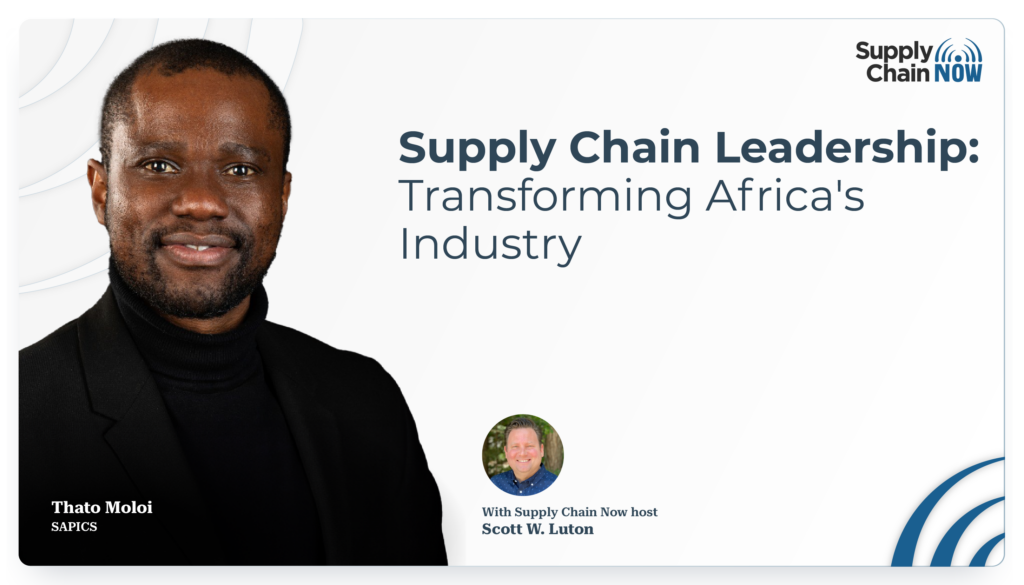
[00:01:30] Scott W. Luton: He’s one of our faves. Thato Moloi has spent over 20 years in global supply chain, especially in a variety of leadership roles in the logistics sector. Currently, he’s serving in a management role in the world of contract logistics. But for several years now, Tado has served as president of SAPICS, a supply chain management community that is on a mission to elevate, educate, and empower professionals and organizations across Africa and beyond.
[00:01:57] Scott W. Luton: You’re gonna enjoy Thato’s perspective and passion here today. I wanna welcome in Thato Maloi. Hey, hey Thato. How you doing?
[00:02:05] Thato Moloi: I am good. Thanks Scott, for having me again. It’s always a pleasure to meet up with you. Last saw you in Cape Town, um, at the conference, so great conversations then. I’m looking forward to the conversation
[00:02:16] Thato Moloi: today.
[00:02:17] Scott W. Luton: Same. I went back and visited, uh, our last sit down. Really enjoyed it. And I’ll tell you, you were like the mayor for the conference. I was. I was fortunate to get 30 minutes. ’cause you had thousands of folks that wanted to get time with one Thato Malloy. Huh?
[00:02:31] Thato Moloi: Yeah. It’s, it’s always a busy time, right? And I think for the community, it’s a, a time for us to connect and that’s why our platform exists and that’s why SAPICS exists, um, to bring supply chain professionals together. Um, it’s always good seeing, um, colleagues, um, that either worked with in the past or working with currently, um, some of our competitors in the industry just to come together, share ideas, and just to connect.
[00:02:55] Thato Moloi: it’s a home for us, supply chain professionals. Yep.
[00:02:58] Scott W. Luton: It is, uh, Africa for business is open for business rather. It’s one of the, one of your mantras. When we last connected, uh, you also really drove home to point how important it is that we gotta find new ways of collaborating, uh, with where things are. And that probably has only gotten more important since we last sat down.
[00:03:17] Scott W. Luton: I had someone share with me while when I was in Cape Town at SAPICS last time, and she said, and I think it was Angelina, she said that forever when you come to SAPICS the annual conference, you leave a different person and Thato that is what I’ve experienced from attending a couple of the SAPICS’ annual conferences.
[00:03:38] Scott W. Luton: Do you see the same thing?
[00:03:40] Thato Moloi: Yeah, 100%. I mean, the, you just listening to, to the topics, right? Some of the insights that are being shared. Uh, by the different speakers you are definitely going to live with, um, one or two things that you can, meaningfully implement in your personal career. And I mean, those are the, the great things that we walk away with.
[00:03:57] Thato Moloi: And secondly, um, I mean the level of networking that happens there, a lot of people have done some great business, you know, uh, make new customers there and have created lifetime partnerships. Um, so there’s always something to look forward to. So always something that you leave with. I mean, it’s not just the Cape Town is not just a great city, you know?
[00:04:16] Thato Moloi: Um, I think it it also elevates, the conference in itself and I’m sure, um, you got a chance to, look around and see what, um, the country’s all about.
[00:04:26] Scott W. Luton: we’re gonna talk about the SAPICS annual conference here, uh, on the second half of today’s, uh, sit down with Thato, but first Thato. let’s start with a fun warmup question. See, we’re getting all into the good stuff before I even, uh, throw this out to you. So, so I wanna ask you. When you’re not moving mountains in global supply chain and, and leading things and doing things on your evenings or maybe your weekends, what’s one of your favorite hobbies or passions in this life?
[00:04:55] Thato Moloi: I,
[00:04:55] Thato Moloi: must say, um, having to spend, um, a bit of quality time with, uh, my daughter, um, I think that’s, uh, probably. The most, uh, meaningful, uh, moments of life and, uh, what you essentially cherish the most? I think, um, she’s currently in, almost at the end of, uh, primary school, um, about to go to high school.
[00:05:16] Thato Moloi: So a big transition, uh, for all of us. So it’s the last years of, her jumping onto, uh, becoming a teenager and, uh, I’m being told all sorts of stories. So, uh, trying to enjoy as much as I can, uh, while she was still, uh, young.
[00:05:32] Scott W. Luton: Oh, I love that. I can relate to that. Thato, our, kids are at that age and a little bit older and, uh, I tell ya, um, I’m trying to hang on to each day ’cause they’re getting so much older, so faster. And while it’s terrific as a parent and fulfilling and, and wonderful to see, it’s sad. I’m, I’m be honest, it is sad to see them.
[00:05:53] Scott W. Luton: ’cause you know, we had some so much great times as you know, when they were young and kids and toddlers. But hey, that’s how life works, huh?
[00:06:02] Thato Moloi: and, you know, you have to embrace the moments and, uh, look, I’m, I’m hanging on as much as I can,
[00:06:08] Thato Moloi: we can’t wait to see what, uh, high school presents as
[00:06:11] Thato Moloi: well.
[00:06:12] Scott W. Luton: That’s right. Hang on tight, Thato. Hang on tight. That’s what I’m doing. Um, okay, let’s refresh as, as we kind of get into, uh, our topics here today. I wanna refresh, especially and, and inform our newer audience members of your journey. I shared a little bit about it in, intro earlier, but from that professional standpoint, tell us about your journey and a little bit about what you do now.
[00:06:35] Thato Moloi: I’ve spent my entire, uh, career within the supply chain world, um, served in various, um, roles. Um, across the, the supply chain world, I’ve been in distribution as a distribution, manager. Um, I’ve been a, uh, in the warehousing space, I’ve been a general manager, in contract logistics.
[00:06:54] Thato Moloi: Uh, I’ve played in the solutions development space, um, where we’re bringing, uh, tech people in process together, designing solutions. Uh, for some of our customers, I’ve worked with a poor range, um, of customers, from Nike, Devo, sugar, uh, freaking entity. worked with, um, Unilever, um, locally, worked with, uh, the likes of Defi, under the AIC brand.
[00:07:19] Thato Moloi: Uh, so various, different, uh, supply chains recently in the cold store space as well. particularly exporting fruit. So wide range of, uh, experience within, um, supply chain. served as an md um, over. Organization, uh, within the country logistics space, uh, currently, area head, um, in my space looking after, a country logistics, um, entity, um, Southern Africa and the islands.
[00:07:47] Thato Moloi: So I’ve been various roles, largely, you know, different experiences across the supply chain, world.
[00:07:55] Scott W. Luton: Thato I gotta ask you, uh, gosh, you’ve worked with some really, companies, a lot of folks admire, uh, Unilever, uh, in particular cold storage you mentioned, and fruit. what fruit was it that, uh, you were involved in?
[00:08:07] Thato Moloi: Yeah, so it’s uh, mainly, um, in the export of citrus grapes, um, stone fruit, so different categories, of, uh, fruit that we export, um, to the European market, um, middle East, um, different, export destinations. Um, essentially, you know, typical supply chain fruit comes in?
[00:08:27] Thato Moloi: warm, uh, we chill it, load into reefer containers, for export.
[00:08:33] Scott W. Luton: I bet that is a fascinating industry that a lot of folks that enjoy all those fruits have no idea about. And of course, cold storage is a rapidly expanding, uh, portion, market, uh, across global supply chain. did that have you looking at your, at the fruit in the, in the grocery store or the market a little bit differently
[00:08:53] Scott W. Luton: Thato?
[00:08:54] Thato Moloi: 100%. And I mean the, the complexity, of that, um, supply chain network, is quite dynamic and very seasonal. Um, because you’re so dependent on, um, in South Africa weather, it rains, you know, if we’re getting, having a good season, the quality of the weather. Then you also have to deal with supply chain constraints, um, you know, performance of the port, out of Cape Town, every now and then we get wind bound.
[00:09:19] Thato Moloi: So, um, we can load. but I mean, again, you think about the fruit in itself, it, it needs to move, right? It’s a high, um, throughput, uh, product. It doesn’t sit in your warehousing space. So dealing with all of that complexity, having to hit your destination, um, within a, a set period of time before you know, your fruit deteriorates.
[00:09:38] Thato Moloi: So there’s a quite a lot of complexity and a lot of planning, um, that goes into, uh, managing each and every single category of fruit. There’s, you know, compliant, different compliance, aspects that you deal with in going into different, um, channels, um, of the supply chain, you know, exporting to America or exporting to Europe.
[00:09:57] Thato Moloi: It’s different to exporting to the Middle East, um, different, um, requirements to access those markets. So these are all some of the, aspects, um, of the supply chain that you need to consider, in your design. And it’s a, I mean, building a cold store in itself, it’s a. a large investment, to get on the ground and get running and you, you again have so many dependencies, to essentially make it work.
[00:10:18] Scott W. Luton: That’s right. And of course, energy, uh, we’re seeing, uh, in particular the spike for electricity demand, Dramatically increasing around the world. and I’m just gonna ask you one more thing and, and we’re then we’re gonna talk about these six trends that, that, um, I think you and the Apix team have identified.
[00:10:34] Scott W. Luton: would you agree or disagree that if you can really succeed in the cold storage sector, that you can succeed in a lot of places? Would you agree with that Thato?
[00:10:45] Thato Moloi: Yeah, I think so. I, I believe so. I think the, the, just the complexity, um, and, the thinking, uh, behind, um, designing a, a cold chain, uh, let me put it, that a cold chain, design, um, and the level of a complexity there, you, you’d be able to translate that. Uh, into any industry? Uh, I, I believe
[00:11:04] Thato Moloi: so, Yeah.
[00:11:05] Thato Moloi: specific, uh, verticals that I’ve, I’ve served. I think coaching definitely, uh, one of the most complex
[00:11:12] Thato Moloi: ones. Yeah.
[00:11:12] Scott W. Luton: I’m with you. I’m with you, and now you’ve made me starving for a tangerine or apples, which we have in our kitchen. Uh, so thank you for that. I gotta, I gotta hold off to lunch. Um, okay. Thato, it’s always a pleasure to reconnect with you. Uh, I look forward to doing so in person, soon, maybe at, uh, SAPICS Conference, which we’re gonna touch on later.
[00:11:31] Scott W. Luton: But I wanna talk about, I think y’all are publishing, I think Safe is publishing or has published, a press release on six trends that here in 2026 are impacting supply chains, really across Africa. And folks, no matter where you are, you’ll probably see how this, these trends are, are impacting your supply chain organization as well.
[00:11:53] Scott W. Luton: So I’m gonna kind of work through these one by one Thato, and some we might dive deeper and others we’ll just maybe, uh, talk about for a minute or two. But I wanna start with the first one, which is moving into a state of really perma crisis. Your thoughts, Thato.
[00:12:09] Thato Moloi: essentially Scott, it’s all about, um, adoption, right? and how do you build supply chains that are resilient, and able to. Um, absorb, these, um, global shocks. And I think we in a current state where, these global shocks that are essentially affecting our supply chains be, are becoming a permanent world that we actually live in.
[00:12:30] Thato Moloi: how do you one design, uh, supply chain that can effectively respond and have the right level of agility to actually, you know, contain and, and be able to serve, its customers, um, and essentially keep humanity going. what does that mean? And I think that article is, is essentially highlighting these key elements that we need to consider, as a continent.
[00:12:51] Thato Moloi: what are the key elements that as supply chain leaders, we need to, you know, ensure we embed, in our supply
[00:12:57] Thato Moloi: chain?
[00:12:58] Scott W. Luton: Yes. You know, Thato, I’ve seen various research, uh, from, a wide variety of respected parties. That points to a couple things related to this. This first trend, number one, which you identified that the disruptions. A hundred years ago, right? Came at a certain frequency, but now fast forward to 2026, they’re coming regularly and they’re bigger.
[00:13:21] Scott W. Luton: that’s just the facts folks. And then secondly, what that directly impacts amongst other things. But one of the things that impacts, but is the decision making that has to take place, uh, everywhere in global business, but especially in supply chain. I wish I had the Gartner numbers, uh, in their research, but basically it said, uh, their research pointed to, faster decisions, more decisions with more pressure on the decisions.
[00:13:45] Scott W. Luton: Right? And I don’t know about you Thato, but I feel that in my bones, and as I’ve, I’ve talked with a variety of folks over the, over the years. Oftentimes for me, it’s not one decision here or one decision there that makes it so difficult in supply chain or business, or you name it, it is the totality of constant decisions that you and the team.
[00:14:09] Scott W. Luton: Uh, the teams and the professionals have to make, your thoughts on, those comments?
[00:14:14] Thato Moloi: I.
[00:14:14] Thato Moloi: mean, that’s a fundamental point, right? what’s important is what informs those decisions, right? for you to be able to make quality decisions. It’s, it’s all about information. It’s all about data. making, uh, data driven decisions on a daily basis,
[00:14:28] Thato Moloi: you know, how quickly can you get the information that allows you to make those particular decisions? And this is why, we speak about, um, technology as one of the, Ever trending trends, um, and its evolution and how it’s, it’s actually supporting and helping us make those, those decisions.
[00:14:43] Thato Moloi: You know, we seeing how, um, technology within our space has, evolved, in this world that we live in. And it’s, it’s helping us make those, um, quality, quality decisions or making quicker decisions. Information flow is becoming, you know, in a world where we be getting fed a lot of information, how do we quickly make sense of that information?
[00:15:02] Thato Moloi: And this is why, ai, um, is forever a, topic, um, on a daily basis. And how can we quickly, um, you know, adopt, um, these tools in our world to make those, quality decisions and, and help us move from the old manual way of doing, um, things because. there is no room for it anymore.
[00:15:21] Thato Moloi: the way things are moving so quickly, there is no time for human beings to spend a lot of time trying to make sense of information and data in order for us to make, decisions and, quality decisions.
[00:15:33] Scott W. Luton: especially on the small decisions in many cases can be successfully automated and it frees up that time so that humans can apply their unique judgment superpowers on, on some of the bigger decisions that aren’t as easily, um, automated and may in some cases may never be automated.
[00:15:50] Scott W. Luton: I don’t know. But one quick, uh, we’re gonna talk about AI in just a second. You mentioned it, but I was able tattoed the other day, to sit in on a conversation about quantum computing. Now Thato that is way above my pay grade, and in, in many ways, I’m surprised they let me sit in on that because I didn’t qualify.
[00:16:08] Scott W. Luton: But it is amazing where we are, where we’re headed and, and how, uh, quantum computing is a, is. Approaching this tipping point and it’s gonna take even this golden age of supply chain tech that we’re in right now, it’s gonna multiply that times a thousand. It’s gonna be amazing. So we’ll see. Uh, but you mentioned AI and the second trend that, that you and the team have identified is how AI has moved, continues to move from experimental for so many professionals and organizations out there to really essential, tell us more
[00:16:42] Scott W. Luton: Thato
[00:16:43] Thato Moloi: when we talk about the conference later on, um, every year, um, there’s always a buzzword. And I.
[00:16:50] Thato Moloi: mean, few years back, you’d go to every conference, blockchain was the, was the big word, some years, you know, Demand planning was a, you know, the buzzword. And I think we, we got into a world where AI became the, the topical, um, conversation and a, a lot of themes, but what’s.
[00:17:08] Thato Moloi: Relevant now is how do we practically apply, um, technology in, in our world. And what we’ve seen, um, over the past couple of years is the practical application of, um, AI tools in logistics and in su in supply chain. And just to be, practical. I mean, we’ve seen quite a, a large, amount of adoption around warehouse automation, um, just robotics and smart picking, which is, you know, creating efficiencies, um, for a lot of the, um, warehouses, um, locally, I mean, in some instances you’re seeing, um, a lot of NTT start to play with augmented reality, and AI vision systems and, you know, all the clever, technology it’s there.
[00:17:46] Thato Moloi: Whereas, um, a couple of years back, um, all of these were just ideas, but we, there’s practical, um, application of this tech in, in our warehouses, in Africa. AI driven inventory management. I mean, you spoke about making big decisions, how do we elevate, your general workers to make better decisions around where am I going to put this inventory to generate the, you know, the highest efficiency in the, in the warehouse, making those decisions on a daily basis.
[00:18:14] Thato Moloi: you know, historically all of this was done on a manual spreadsheet. Uh, people trying to figure out exactly where to, allocate inventory with within a warehouse, even broader, where to, if you’ve got multiple warehouses in your supply chain, where am I going to allocate inventory? And which inventory sits where.
[00:18:30] Thato Moloi: And people would run these, you know, complex, um, spreadsheets, or in some instances there’s not even a scientific, calculation that supports or a data-driven, decision that actually supports where we actually going to locate inventory in order to better, um, service our, our customers. We are seeing, you know, better tools in our spaces that are actually informing and capacitating people to make quality decisions around where inventory should sit and what we’re seeing, um, particularly in FMCG, I mean the, the big thing now is how do we reduce working capital in inventory?
[00:19:02] Thato Moloi: You know, holding in, in different areas is essentially seen as, in some instances waste. But you need it in order to give you the high responsiveness and the agility in your, in your network. So how do we use technology to strike a good balance? And I think now, um, with, you know, all the tools that are available to us and that we are applying, you get, you’re getting, entities, um, that are able to actually, you know, manage inventory at the optimal level.
[00:19:29] Thato Moloi: and I can go on and on. you look at organizations such as checkers with the 60 60 app and how they’re using route optimization to, you know, be able to deliver an order, uh, from the moment you actually press, you know, pay, um, and secure the order in 60 minutes. It’s, it’s at your door. I mean, these, these are, things that we able to enjoy, but these are, you know, this is tech working for us in, in, in supply chain.
[00:19:54] Thato Moloi: how do you reduce waste in, in supply chain? We spoke about inventory planning, but how do you reduce in an FMCG or in a retail space where you’re doing perishables? How do you reduce waste? you see it, and again, I’m gonna use ShopRite as the benchmark because you see in the, in the performance as a retailer, the gp, you know, is running at probably the most optimal GP in any organization, one run because of the technology they use in order to predict, you know, what the consumer wants and where should they be producing, and, you know, um, holding inventory and whatnot to produce.
[00:20:31] Thato Moloi: And they’ve reduced, I mean, in, in some of the articles they talk about 11% reduction in, in waste, um, food waste, um, when perishable. I mean, that’s, for me is an amazing use of, technology. And you know, for me, one of the things that I’ve, I’m obsessed with again. In, in supply chain is around people and safety and, you know, the ability to actually use technology, in warehouses to protect people.
[00:20:55] Thato Moloi: Um, you know, with, um, technology that does in some instances predictive maintenance, um, on some of the machinery, but also, um, the ability to monitor unsafe working behavior. in a facility where you can detect, then you, you know, instead of having, trying to have policemen in the warehouse looking, you know, there’s, you can only have so many, um, shake reps in a, in a facility.
[00:21:17] Thato Moloi: But, you know, with ai, um, you’ve got a good tool that’s able to predict any, you know, unsafe working behaviors and flag it so that we can, we can respond, um, and do something about these things. You look at customer service, customers are essentially always asking the same question. Um, so chat bots, simple solution, you know.
[00:21:37] Thato Moloi: Put a question in there, then you get your, responses and your ets or, um, whatever it is that you need. So there’s a whole range, um, of, you know, trends that we are, we are seeing and it’s continually evolving and evolving and evolving. And I look at, specifically take a lot, which is, um, one of the bigger e-commerce, uh, platforms, um, locally.
[00:22:00] Thato Moloi: And if you look at, I mean, any e-commerce, especially if they’re doing the execution or the e fulfillment themselves on a platform business, it’s essentially a, a supply chain organization. Right. And I look at take a lot and I mean, they competing. A lot of heads in South Africa with, uh, Amazon, you know, but you look at the, the level of technology they’ve, they’ve been able to introduce on robotics and automation.
[00:22:24] Thato Moloi: Um, I mean, one of the, the big, implementations, they, they did with Gig Plus, massive fleet, um, they introduced with sorting, robots. I think they talk about the ability to do over 50,000 pesos a day, uh, from one of their, their facilities. So there’s real good momentum, um, around technology.
[00:22:44] Thato Moloi: And I, and like you said, I mean, this is just the, the start, right? we need to see, or we are far away from seeing, um, the ceiling, um, of what technology can actually do for us. And we gotta move away from. Thinking that, technology responsible automation, is here to take away jobs.
[00:23:04] Thato Moloi: I think it’s, it’s actually here to create jobs and we need to, we need to embrace it.
[00:23:08] Scott W. Luton: Thato, I think we found something you’re pretty passionate about. So I’ll tell you what, you, you could have a whole series, I think, on, on where technology is today, all the different ways it’s being utilized, how it’s, uh, certainly empowering the workforce, which we’re gonna touch on next. But I, I wanted to add one more quick comment.
[00:23:27] Scott W. Luton: While AI certainly has moved from experimental to essential, it’s really important for us to keep experimenting with all the different ways and new ways that, not just ai, but all technologies can help, our organizations and especially help our people delight our customers and have more fulfilling and rewarding work, which is where we go next.
[00:23:47] Scott W. Luton: Number three. Workforce evolution. Now, you touched on this a minute ago. You touched on the, uh, the evolving roles, a couple of them, a couple examples, uh, in global supply chain. Give us some more thoughts on how the workforce will continue to evolve this year.
[00:24:02] Thato Moloi: again, education is actually one of my, passions and tech people development. And, uh, we’re looking at, you know, which courses are, in the local institutions are getting the high hatred or, where are the new or the.
[00:24:18] Thato Moloi: Call it students. Um, gravitating towards and supply chain is actually at the top of the list. So we have this big or huge quantum of, supply chain graduates that are coming out of our local institutions. And if I go back a few years back, supply chain as a formal qualification locally was actually non-existent.
[00:24:41] Thato Moloi: A lot of, people that ended up in supply chain were coming from different, disciplines in academia. You put engineers, your engineers, you, I mean finance people, um, coming in and essentially a bunch of people that end up, in supply chain without a formal qualification in supply chain.
[00:24:58] Thato Moloi: So we,we getting a lot of, um, trained supply chain, um, qualified individuals coming into the industry at a junior level. Where I think we need to close the gap is curating, um, a growth path for these graduates that are coming into, a workspace. What does a typical career for a supply chain professional coming out of, um, a local institutions look like?
[00:25:25] Thato Moloi: You know, how do we curate that journey for them and what does, you know, good look like? Um, it’s easy for professions. Um, you know, like someone who’s a chartered accountant, that journey is pretty much curated. You know, they understand these are the, you know, roles. This is where I’m gonna go if I need to uplift myself.
[00:25:43] Thato Moloi: This is, you know, some of the, um, add-ons that I.
[00:25:46] Thato Moloi: I can do. So supply chain is still evolving, and trying to actually professionalize, um, uh, ourselves. And I think in that sphere, we, Still organizing. we trying to professionalize, um, what a prof professional supply chain, um, individual actually looks like in the sphere.
[00:26:04] Thato Moloi: So still a bit of a gap there that we need to, we, we need to work on. And that’s why organizations such as, um, SAPICS exist, um, because part of our, our journey and our roadmap is to actually curate, um, that journey and try to, you know, professionalize and uplift the, supply chain, um, community in itself.
[00:26:23] Thato Moloi: Um, so that’s one of the, big things. But we spoke about, you know, how automation is, is also, uh, changing our, our space. I think we definitely, in some key, Technical, aspects of, um, supply chain. We still find that our space, um, is still lacking some of the key key skill sets, not enough, operational engineers, in our space.
[00:26:48] Thato Moloi: So it’s essentially a fight for key resources and key skills to keep. And now we, we are com competing in the global, um, economy. where jobs in Europe in the US are accessible and available to everyone. And as technology keeps on evolving in a space, you need more, you know, tech oriented skills in the business.
[00:27:08] Thato Moloi: And unfortunately, you start competing with the banks. So now you, you’re competing for scarce resources across multiple industries and verticals. Now, if you want a good, uh, WMS developer, you essentially fighting for a couple of, you know, scarce. Local resources that are available.
[00:27:27] Thato Moloi: And then how do you then compete in the global, um, economy for quality resources around tech, around, warehouse design. Um, the more technical aspect. And I think that’s where we, you know, we need to close the gap. We need to train more people in that,particular space.
[00:27:43] Scott W. Luton: SAPICS serves a wonderful role in closing that gap to your earlier comments. So, um, and hey, let’s face it, we got gaps and opportunities everywhere around the world. Uh, some of the same, some of the different, but to admire what you’re doing there, I’m gonna, for the sake of time, I’m gonna share the fourth and fifth trend and just get your reaction to both of these.
[00:28:05] Scott W. Luton: And we, now we’re gonna touch on the sixth one. So the fourth trend. Geopolitics, regionalization and anywhere but China. And the fifth trend, climate, circularity, and cost precision. Now, Thato, it’s not fair to put all six of those, big themes in front of you and get you to comment, but what are you most, out of, all the, trend number four and five?
[00:28:27] Scott W. Luton: What’s the first thing that comes to your mind? Thato
[00:28:29] Thato Moloi: Scott, it’s about supply chain resilience. that comment was, particularly around supply chain resilience and not, the analogy or in there, um, around China is actually much broader than that. Um, because it’s about how do you move from, uh, identifying a key dependency, you know, and unlocking constraints within your supply chain.
[00:28:50] Thato Moloi: And that’s what it’s, essentially about we used to speak about white sun, black swans. It actually doesn’t matter. Um, you, you need to be ready, um, to respond, um, to any shock that’s actually coming your way.
[00:29:02] Thato Moloi: And what we, we saw, um, you know, post COVID that, shocked everyone was, everybody started thinking around, okay, um, if this gets disrupted, if that, you know, gets disrupted, how are we going to survive? Can we keep going if we don’t have energy for a month? You know, I remember having to work on bcps around what happens when you don’t have energy for two months?
[00:29:25] Thato Moloi: Uh, will you be able to continue executing? What happens when you don’t have water? Um, for, um, water supply is disrupted. will you be able to continue, um, you know, shipping, um, product to your customers? Um, and how long can you, can you actually last? So your BCP plans became so much broader and one of my favorite codes, and it’s a, one of the professors that taught me used to speak about, one of the famous generals, um, Dwight, Eisenhower.
[00:29:53] Thato Moloi: And he, he speaks about, you know, in, preparing for, for battle, he found that cleanse are useless, but planning is in indispensable, it took me a while to actually understand that because at that point was just the code. But there’s so much power in that because planning actually, in itself, or the plan that you produce at the end, like preparing a budget, it’s actually useless, but it’s what you learn in the process of actually.
[00:30:18] Thato Moloi: That’s what this is about. It’s about actually planning at a strategic level and bringing it through the different layers. Have you thought widely and broadly enough, um, around your customers, around, um, all the, the factors that may impact, your supply chain network and how have you incorporated all those elements into your supply chain design, to be, uh, more agile and be able to respond to any shocks?
[00:30:42] Thato Moloi: Right? Um, and it’s about diversifying your supply chain network and expanding it. Uh, we spoke earlier on around, um, the cold chain, um, industry. And the reality is in, you know, South Africa, there’s going to be weather, there’s disruptions. what happens when it rains?
[00:31:00] Thato Moloi: For, you know, a couple of weeks or we get, you know, heavy, heavy winds we can’t ship out of Cape Town. And it’s about have you thought about, okay, can we divert, where do we go? Is the, do I have the right, capacity to divert, into a different, um, supply chain? Because for you to try and make the decision once the event has actually happened and you don’t have the plan already and you haven’t assessed, if you can do it, then you’ve got the capacity, whether it be trucks or people to actually execute it, then you’ve got an entire season, um, that’s lost.
[00:31:35] Thato Moloi: And I mean, that’s catastrophic if you, if you are a farmer, right? But it’s about thinking about, well, if this shuts down maybe I dive to pe, but I, have, I set up that network? Do I have the suppliers in that region? Do I have a, a cost that I, I can access out of pe or can I, you know, the, the trucks that can actually support that late.
[00:31:53] Thato Moloi: Um, that’s essentially what, it’s all about people are decentralizing their models, right? Um, after understanding that, well, you know, in some social disruptions or political disruptions, if your inventory is locked into one province, you may not be able to execute, in different markets because roads are closed or there’s people writing, et cetera.
[00:32:16] Thato Moloi: Well, maybe you need to have a, a supply chain that’s, you know, built with some sort of agility in it. Now I’ve got multiple warehouses, maybe smaller may create, a situation where you are holding far more inventory. But guess what? You’ve got the technology to better predict and tell you what size of inventory do you need to hold in those different locations.
[00:32:35] Thato Moloi: So it’s about having those plans. We’ve seen now, a lot of organizations are more comfortable with outsourcing their, their supply chain, right? Because some realize that actually we compete on marketing, not necessarily supply chain. We are comfortable to share the network with our competitors, from an execution point of view.
[00:32:55] Thato Moloi: So people are moving into multi principle facilities, right? And being serviced by one three pl. Uh, but you, you got two brands that compete in the same warehouse, being picked by the same pickers or the same, under the same processes executing or moving in the same tracks, um, et cetera. So those are the, are the decisions.
[00:33:15] Thato Moloi: And when I talk about resilience, have You thought about these, different, um, elements?
[00:33:20] Scott W. Luton: I wanna go back to the Eisenhower quote. It’s such a good one. And I’ll tell you, few plans, are accurate. Many are not even remotely accurate. Right. But to the quote and to the point you’re making too, the process, it’s one of those, it’s one of those unique, uh, things in business where the process of going through planning oftentimes is more valuable than the outcome itself.
[00:33:43] Scott W. Luton: And it’s really interesting to think about. So that’s a great quote to add to today’s conversation. Uh, Thato. Um, okay. Finally. We’re about to get into the conference here in a second, but I wanna don’t wanna overlook the sixth trend, which I think is a, um, is a wonderful, uh, trend to share. And that is a defining year for African supply chains.
[00:34:04] Scott W. Luton: Tata, your quick comments there.
[00:34:06] Thato Moloi: all about growth. all about innovation. Um, again, the key word, um, collaboration. how do we, leverage the platform and the base that we, strong base that we’ve, we’ve built over these years, um, to essentially drive growth. Um, and that’s what we’re referring to. Um, and if you look at the, where, where we are in a, in a position and, the evolution, um, over time, I think yet again, we find ourself in a position where the opportunity, um, for that growth and for transformation, um, to happen across the continent it’s big, it’s immense.
[00:34:45] Thato Moloi: I mean, people talk about, um, the size of the, you know, population and you know, what, what it means in the future and where the, the growth is going to come from. I mean, it all organizations, um, across the globe recognize. Um, the potential that Africa possesses, long term, right. Um, now the question is, building the infrastructure, uh, which is on the back of, you know, supply chain decisions that actually is going to ultimately carry, that growth.
[00:35:15] Thato Moloi: And essentially that’s what we are talking about.
[00:35:18] Scott W. Luton: All about growth, innovation, a bright new future, a bright new current state I’d argue, and, and a brighter, even a brighter new future. And it takes real leadership. And I appreciate what you and, uh, the SAPICS organization and the board the community is doing in that regard. Um, speaking of the SAPICS Annual Conference, I’ve been fortunate to go to a, a couple of times, but I’ve captured some wonderful interviews.
[00:35:41] Scott W. Luton: We’ve got all those in our YouTube channel. Folks, you can go find them. We got playlists set up, um, this year in 2026. It’s the 48th annual conference, but this is the 60th anniversary of SAPICS Man. time flies when you’re having fun, as they say. This year’s theme, Thato, legacy, the leadership.
[00:36:00] Scott W. Luton: Why was this one chosen for the conference?
[00:36:04] Thato Moloi: to recognize, um, you know, the years that have gone into building this, this platform, and I I talk about it today as a, as a platform. vast community business, government, The supply chain professionals all coming together, under one umbrella with a common cause.
[00:36:22] Thato Moloi: Um, it’s about recognizing, um, how we, we got you and the evolution, um, of supply chain in itself. But, you know, evolution of supply chain in the context, um, of, South Africa and Africa. I think it’s about celebrating that, celebrating the people that have come before us, celebrating the many, um, presidents that have come before me, the board members that have come before me, and essentially also celebrating, um, the supply chain professionals.
[00:36:50] Thato Moloi: And we saying, look, you know, we’ve done so much to get, um, to where, where we are and now we at a stage where we need to actually, take what we have and what, the people that have gotten us to where we are and move it forward and grow it, um, beyond, what we’ve, um, seen over the, many years, um, that, that got us to where we are.
[00:37:11] Thato Moloi: So it’s a celebration, of supply chain, uh, professionals, um, and our, our global partners and all the people that have walked the journey with us. Um, and we, went with the theme because we are also inviting, and opening it up because every year we try to keep a specific theme, which sometimes, um, you know, locks in a specific vertical.
[00:37:34] Thato Moloi: And every year, you know, we get a lot of feedback, um, from, uh, our members. We get a lot of feedbacks from, uh, you know, sponsors and they want to say, ah, but you know, this year we were so focused on this particular topic, and supply chain is so broad, right? It’s so broad that it is difficult to actually cover every single component and topic within supply chain and do it justice.
[00:37:55] Thato Moloi: In, in the few days that we have when we, when we connect, and I think this year was the year where we, we wanted to actually open it up and say, Hey, let’s bring everybody back together and let’s, you know, have a, conversation around supply chain as a whole with, um, all of our, our people.
[00:38:13] Scott W. Luton: I like it. Quite a legacy, tons of leadership. I look forward to, uh, the conference. So tell me this, Thato, if you had to pick a couple of things, because there’s lots you, lots to do, lots to engage in at the SA Pix annual conference, but what’s a couple of things you’re looking forward to here in 2020 for the 2026 version of this event?
[00:38:35] Thato Moloi: there’s a lot. Um, I’m actually, I was actually looking at the, speaker list, um, and uh, I don’t know if I’m gonna get into trouble by. Mentioning or talking about before it gets published, but there’s a lot of, um, interesting topics. on the list, I must say. quality international speakers, quality, local South African speakers a good blend.
[00:38:55] Thato Moloi: Um, we’ve got three broad topics, that we’ve kind of, uh, sectioned. Uh, we’ve got stream A where we are talking about strategy, um, resilience and leadership. We’ve got stream B where it’s ai, digital and technology. We’ve got stream C where it’s operations, uh, visibility and optimization. So I think the Speaker Selection Committee and the committee that worked on this program did an amazing job in trying to synthesize the topics that everybody wants to hear and to try capture, uh, where we are globally and put it into, you know, um, or curate a program that, um, speaks to everybody within the, profession.
[00:39:34] Thato Moloi: So, what am I more excited about? I think the, the network and the connection with people that are some I haven’t seen in a, in a while. Uh, I think it’s always a great time to meet some of the sharpest minds in, in supply chain to, you know, pick, uh, one or two, um, brains when, when I’m there. Uh, for free, free consulting, you know, uh, over, um, a drink or two is also great.
[00:39:56] Thato Moloi: Um, so it’s gonna be a, an amazing, amazing, amazing, conference.
[00:40:01] Scott W. Luton: Outstanding. Don’t let ’em send you an invoice. Thato, don’t let ’em send you an invoice. Uh, and the, you know, and, and dozens of countries will be represented. I think when I attended last, last year, I think it was over 50 countries represented. that is outstanding. Um, okay, so Thato, folks can learn more at
[00:40:18] Scott W. Luton: sapics.com folks, S-A-P-I-C-S.com. Go check it out. learn more about all the programming that Thato and the board and the community offer year round. Um, okay, so we’re coming down to home stretch, Thato, I really enjoyed the conversation as always.
[00:40:33] Scott W. Luton: I think this is your third or fourth appearance here on supply chain. Now let’s, uh, we gotta double that. We gotta double it. Thato. alright, so here’s a keep it real moment that I promised in the intro. So, when it comes toto to the critical elements of global supply chain leadership, those, uh, elements that really fuel organizational excellence and real performance, what are two or three essentials there?
[00:40:59] Thato Moloi: firstly, you will never reach a point where You can or cannot learn or be saturated with supply chain knowledge, the world that we live in. And for you to lead, you have to be continuously learning. in a space where there’s new information coming in every single day, you are not gonna change anything by using, um, the same mentality, the same thinking, and the same knowledge that you’ve had for the past 20 years.
[00:41:27] Thato Moloi: We live in a world where we need to evolve, and it comes with, um, keeping in touch, educating yourself. Do you understand the latest and greatest trends? Are you watching what, the, Brains in supply chain, uh, people are talking about or doing the latest trends. Are you keeping up with those, with those trends?
[00:41:46] Thato Moloi: Are you watching, um, you know, what’s happening globally? Um, are you benchmarking, um, consistently benchmarking in terms of what are the, what’s the greatest and newest, whether it be from a technology point of view, uh, whether it be from a people management point of view, because how you lead in this, day and age is also different to how people were led.
[00:42:05] Thato Moloi: Um, you know, years ago, we’ve got a new, newer generation of, colleagues that are coming into the, into the industry and how they consume and see the world, um, is completely different, um, to some of us that joined, uh, the profession years ago. So how do you stay, um, relatable and relevant?
[00:42:23] Thato Moloi: With, those trends and those people, and for you to be able to lead them, you actually have to understand them. we are living in the, in the digital world now. We are all connected. Um, as a leader, it’s your responsibility to actually understand these things. So for me is you have to stay, educating yourself continuously.
[00:42:41] Thato Moloi: you have to learn from others as well. Some that obviously that came before you so you don’t make the same mistakes. I think key, um, elements, some of the lessons that we, we learn in the professional space. Some people have lent them ages ago, so, uh. Always good to, you know, stay in touch and, have the ability to reflect, on one’s, um, self, how you lead, how you go about, um, doing your work, what you understand of the environment that you, that you’re in.
[00:43:08] Thato Moloi: So these are some of the, key things, I think it’s not even a, a supply chain conversation. I think this is a, general conversation in any, work environment, any workspace. you have to understand, the broader context and the environment in which you operate in.
[00:43:23] Thato Moloi: And it can only come with you reinventing and reeducating yourself continuously. I mean, 10 years ago, would we be doing this, um, podcast interview with, you know, I’m sitting all the way in, um, South Africa, you, you in the us Probably not, but this is, this is the new world and, we have to embrace it, but it also comes with, you know, being responsible around, um, educating yourself and fully appreciating and understand these things.
[00:43:52] Thato Moloi: So education, is at the forefront. You can never get to a point where you know, everything.
[00:43:57] Scott W. Luton: You can never get enough education. Learn something new every day, folks. Learn something new every day. Uh, it’s like that old adage. Uh. An apple a day keeps the doctor away. Thato, going back to the fruit. Fruit earlier. Um, okay, so Thato, I got two questions for you. One’s an easy one because we’re gonna make sure folks know how to connect with you, but one is a more, uh, intriguing one because when we sat down in Cape Town, about, uh, seven months or so ago, eight months ago, as we started to wrap that interview, you were speaking passionately about a couple things and I, and I got some quotes here I wanna, uh, reread to you and get your comments on.
[00:44:35] Scott W. Luton: So you talked about how important it was to quote, fight the traditional views of Africa. You talked about quote, we aren’t as far behind as people think we are. And then you also mentioned, which I love your, one of your mantras, quote, Africa is ready for business, uh, which I heard I bet 12 times during my last visit to Cape Town, which is wonderful and, and beautiful and, and what I found to be true.
[00:45:00] Scott W. Luton: So. When you think about those things and the mission you’re on, related to those, uh, those statements, what comes to mind? Are you, have you been making some progress? What? What are your thoughts?
[00:45:11] Thato Moloi: I actually need to update the ready for business because we are in business. I mean, I shared with you some of the, when I was speaking about technology, um, earlier on, I wasn’t talking about an ideal state. I was talking about. Um, in today’s current terms, what, we able to do and what we are able to, um, deliver.
[00:45:29] Thato Moloi: So we are, at that level, um, we are, um, competing at a global context. And, um, in some instances we actually winning, um, in terms of how we, we be executing and going about, just purely from a, a supply chain point of view. So in some instances, the world could also learn from, um, some of, the activities and, uh, what we are doing, um, in, in, Africa as well.
[00:45:53] Thato Moloi: So, a bit of an update, on that statement. Um, I think we, we progressing and we progressing at a very rapid rate. Um, if I look at the, you know, supply chains, Five years back, in comparison to where we are today, there’s a big shift. Um, we, it’s continuously evolving the adoption of, technology, whether that be just purely warehouse, um, management systems.
[00:46:19] Thato Moloi: we’ve evolved, quite a long way, the level of the quality of implementation, the quality of the individuals in the, in the supply chain industry. And I’m sure Scott, you, you got to meet, quite a few people when you were, you were here. Um, I think, high caliber individuals in the, in the industry across the board.
[00:46:35] Thato Moloi: So yeah, I’m still very energized. still very passionate, um, very optimistic in terms of where we are going and, sounds a bit strange. Uh, I say optimistic. Today, um, considering what’s happening globally, but we have to stay optimistic. You know, we have to believe that, um, in the global context, we will, as a human race get, get it right.
[00:46:58] Thato Moloi:
[00:46:58] Scott W. Luton: Yes, I’m, I’m with you. Practical optimism, action driven optimism. And you know, the great thing about global supply chain and the wonderful army of professionals globally that makes it happen is they empower trade. Right at the heart of it, they make trade happen. And someone famous once said that if trade doesn’t cross borders, that soldiers will.
[00:47:21] Scott W. Luton: And so that, when I think about the noble mission that, that the global supply chain community has of, of really preventing conflict, and we could always do better as a world, we could always do better, but that is, um, that’s a great way of looking at the noble mission in maybe a little different context in this one, that, uh, I admire so many practitioners out there.
[00:47:43] Scott W. Luton: Such as yourself that, that go to work every day making it happen. Uh, so we’ll see. I’m, I’m optimistic too. I’m practically optimistic and we got a lot of stuff to get, uh, to work on to get better. Um, okay. So Thato really have enjoyed your perspective. I knew I would, I love sitting down and, and chatting with you and learning, uh, your point of view and what you see and what you’re doing, and of course, what the SAPICS organization’s doing.
[00:48:08] Scott W. Luton: If folks want to connect with you on anything you shared, whether it’s SAPICS or whether they want you to come in and give a keynote somewhere, or do business with you or whatever, they wanna be part of the Thato Moloi fan club like I am, how can folks connect with you?
[00:48:24] Thato Moloi: the best, um, way to stay in touch with me is definitely via LinkedIn. Thato Moloi on LinkedIn, uh, should be easy to find. Um, you
[00:48:33] Thato Moloi: can just drop me a, a message there and I’ll be sure to respond.
[00:48:37] Scott W. Luton: man, I wish most things in life were that easy, especially most things in supply chain. But ah, ILAs, that’s not where we are. Um, Thato really enjoyed, uh, reconnecting with you, my friend. Really admire the leadership, all that you’re investing, uh, into the good of industry and the good of, our global craft that is, uh, the supply chain community.
[00:48:57] Scott W. Luton: And I look forward to reconnecting with you again soon. Hopefully. Who knows, maybe, maybe this conference this year and if not this year, next year, I look forward to be being back in Cape Town. Thank you, Thato.
[00:49:09] Thato Moloi: Thank you so much, Scott. We can’t, you know, obviously can’t wait to see you. Uh, hopefully you can join us, and uh, we can connect and maybe we can go on that fund ride together this time
[00:49:19] Thato Moloi: around.
[00:49:20] Scott W. Luton: that’s right. Uh, I don’t have any, um, I wish I had some really smart consulting to, uh, and free consulting to give you, but, uh, who knows, after a couple adult beverages, who knows. Alright, folks. Wanna thank Thato Moloi, uh, president of SAPICS. Uh, please if SAPICS isn’t on your radar and if their annual conference isn’t on your radar.
[00:49:41] Scott W. Luton: Google it, join it, come out and engage, get involved. That is a wonderful, wonderful conference and I really appreciate what Thato and the SAPICS team is doing. But hey, y’all know folks, your homework here today, number one, I hope you enjoyed this conversation with ThatoMalloy as much as I have. But take one thing.
[00:49:59] Scott W. Luton: He shared so much and so much of it was actionable. Take one thing you shared, do something with it, share it with a team, share it with a friend, share it with your mom, but do something with it. Deeds not words. That’s how we’re gonna continue transforming global supply chain and leave no one behind. And with all that said, on behalf of Supply Chain now, team Scott Luton challenge.
[00:50:18] Scott W. Luton: You do good, give forward, be the change that’s needed, and we’ll see you next time, right back here on Supply Chain now. Thanks everybody.