Intro/Outro (00:02):
Welcome to Supply Chain Now, the number one voice of supply chain. Join us as we share critical news, key insights, and real supply chain leadership from across the globe. One conversation at a time.
Scott Luton (00:14):
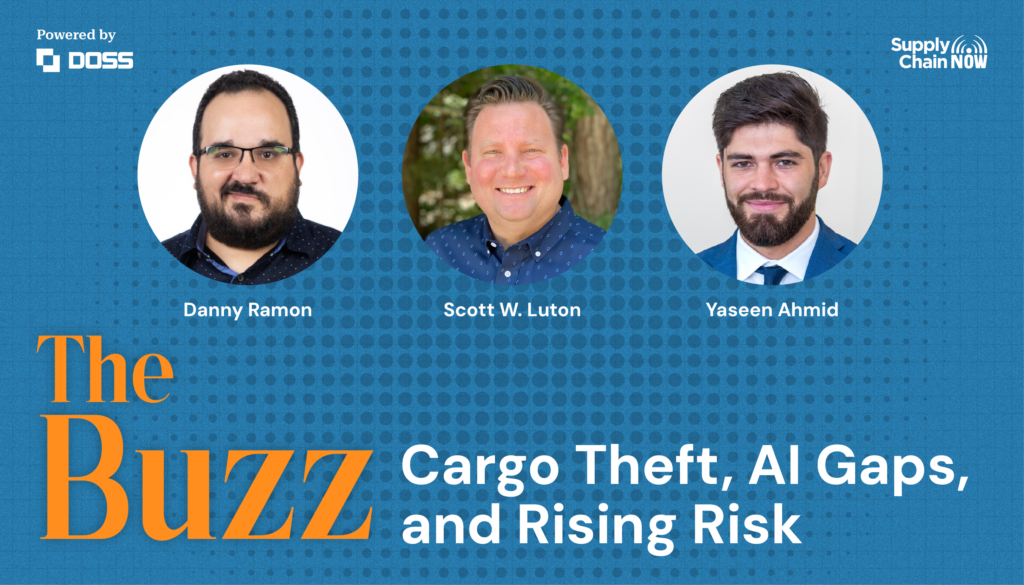
Hey, good morning, good afternoon, good evening, wherever you may be. Scott Luton and Yasin Ahmed with you here on Supply Chain now. Welcome to today’s live stream. Hey, Yasin. How you doing today?
Yaseen Ahmid (00:24):
Scott, I’m doing great. As always, looking forward to our conversation.
Scott Luton (00:28):
I am too. You always are part of some big conversations here at Supply Chain Now. It’s great to have you back for another big one here because folks, today it’s the buzz. Where every Monday at 12 noon Eastern time, we discuss a variety of news and developments across global supply chain and business. News that matters is what we like to call it. Now, the buzz is powered by our friends over at DOS, who have been on move here lately. It’s the world’s first adaptive resource platform. If you want to learn how DOS gives companies real-time visibility into their operational data and connects it seamlessly to the financial systems that run their business, you can visit doss.com. Okay, Yuseen. Let’s see, big show tuned up here today. We got the latest on the straight of Hormuz. We’re going to dive into that. Everybody’s probably tired of that phrase, but it’s not going away anytime soon.
(01:15):
We’ll touch on AI readiness training. Does it work? It might be a little counterintuitive part of our discussion here today. Cargo theft, blowing up. Are your supply chain secure? We’ll talk about it. All of that stuff and much, much more. And in about 15 minutes or so, we’re bringing in a special guest. Danny Ramon with Overhaul is going to be joining us. You’re going to enjoy Danny’s perspective on cargo theft and much, much more. Now, we got a big show here today, as I mentioned to you, seen. Have you had your Wheaties? Did you take your Flintstones vitamins? Are you ready to go?
Yaseen Ahmid (01:44):
I’m ready to rock and roll. It’s actually a very exciting conversation. And when I saw the lineup and that Danny’s going to be joining us.
Scott Luton (01:50):
All right. Man, you and me, we might be second cousins you’re seeing. We think a lot of light. Really quick, Tricia is wishing Happy Buzz Day to all. Say hello. Let us know where you’re watching from. Do that, please folks. We’d like to connect the dots. This is a global conversation as supply chain discussion should be. To that end, our friend, Alan Jacques is here today. The pride of Ottawa. Alan, I hope I’ve got that right. I should know this by now. I saw Alan’s been on the move at Logi Pharma, if I’m not mistaken, not too long ago. So Alan, I know you’re having some big conversations. Also, Tricia is dropped the link to DOS. Go check out what our friends at DOS are up to. Okay. Yasin, we’ve got four things that we want to dive into before Danny Ramon joins us. Okay?
(02:34):
And I’m going to start with one of my favorite things, and that is the latest edition of With That Said. Now, check this out. Look at all these wonderful people that we interviewed at Modex. This is just a tip of the iceberg. Look how cool, calm, and collected in the face of global disruption that they can stay. You see, that’s a pretty good snapshot there, huh?
Yaseen Ahmid (02:54):
Yeah. Smilings through the disruption and the stress from all of these geopolitical disruptions, right?
Scott Luton (02:59):
They are. Maintaining cool under pressure. So in this edition, with that said, not only did we mention a couple of key takeaways from Modec, which was a great show, stay tuned for tons of coverage in the coming weeks. But in this addition, we led with some of the developments across industries, such as fuel surcharges and annual rate increases in first quarter 2026. All that led to what the TD Cowan AFS Freight Index said was a record high quarter for ground delivery costs. The combat higher costs everywhere, of course. Organizations are leaning more and more into AI. We touched on Tractor Supply Company. I’ve seen they have really refined their approach when it comes to how their team uses AI. And this targeted approach has led to improved forecasting, inventory flow and employee productivity. Google made a big recent commitment to invest in the US manufacturing workforce.
(03:49):
This, they’re contributing $10 million to the Manufacturing Institute, helped train 40,000 manufacturing workers on essential AI skills. Wow. So folks, all of that and much, much more dive into this edition of with that said, you’ll also find our upcoming events, especially our live events. You don’t want to miss that. Let’s see, Yasin, did you miss this edition of what that said, or did you dive in over the weekend?
Yaseen Ahmid (04:14):
I’m an avid reader. I always look forward to the publications. I think one of the pieces that I really enjoyed in this week’s article was the declining rates or kind of the automotive shift. So affordability when it comes to new vehicles and that consumers are looking for vehicles that are exceeding or less than $50,000. So I thought that was quite an interesting read, especially in my capacity as the president of the electric vehicles organization of Columbia. I think that it is a sentiment that a lot of consumers are feeling.
Scott Luton (04:43):
I’m with you. And by the way, you wear lots of hats, you seen. I’m convinced you got a couple clones out there given all that you do. But to your point, it’s fascinating to keep up with the automotive industry. And of course, it’s such a critical sector of global business that impacts so many things. And to your point, I think the average cost for automobile here in the US, $51,000 last year. And to your point, especially with where we’re seeing cost increases everywhere else, we’re looking for some deals in the automotive world. Is that right, Yasin?
Yaseen Ahmid (05:10):
Yeah, no, definitely. Especially now with all of these disruptions, it’s the sourcing of critical components yet again that we saw during COVID that’s going to be driving up the prices of these vehicles. And so we’ve also seen a shift to locally manufactured vehicles. So yeah, hopefully the prices do decrease, but for the foreseeable future, I don’t think so.
Scott Luton (05:29):
I don’t think so either. I think that’s a good prediction. All right. So that’s the first of four things right quick. Alan is confirming. I knew it was Ottawa, Alan. I knew, and I should know that by now. Let’s give us a weather report up there in beautiful Ottawa. Aweas is back with us. Hey, Away. It’s great to see. I think he hails from Pakistan. Let us know what part of that beautiful country you’re in. I think I’ve got that right, but great to see you here. All right. So number two on my list. Let’s see. We’re talking about one of my favorite times of the year you’re seeing. It’s National Supply Chain Day. That’s right. April 29th. Every year, National Supply Chain Day. Please join us at 12 noon for a virtual event that’s going to be featuring a wide range of supply chain leaders.
(06:09):
Our keynote is the amazing Billy Ray Taylor, author of the bestselling book, The Winning Link. Lots of stories. Lots of stories from his mama, which I love. Ms. Vera keeps it very real, but very actionable. We’re also going to be recognized in three incredible people and/or organizations. We got to keep it kind of ambiguous where there are significant contributions towards our industry. Join us 12 noon, April 29th. Seen, is this on your calendar?
Yaseen Ahmid (06:35):
Yes. Mark Dorfson’s last year, keen celebrator of national supply
Scott Luton (06:39):
Chain. Such an elegant way of putting it. A keen celebrator of national supply chain. Yesen, I can listen to you read a phone book, I think, with your …
Yaseen Ahmid (06:46):
I can return the compliment straight back to you, Scott.
Scott Luton (06:48):
All right. And Trisha is making it easy, folks. She’s dropped a link. Go check it out and come join us and bring your thoughts and perspective. One of our favorite parts. Let’s see here. That was number two. Number three, folks, we were just talking Modex was last week. Your hard work and supply chain now team had a full plate or two. Well, there’s no rest for the weary because in a couple weeks, we got Gartner Supply Chain Symposium and Expo, May 4th through the 6th down there in Orlando, which I bet is already heating up. And folks, if you hadn’t been to a symposium yet with our forensic partner, you’re missing out. Check out what Sarah had mentioned here. “Amazing conference that has shown time and time again. It’s worth its cost 10 times over. Now you’ve seen. I got to break up my calculator or my abacus maybe, but if it’s a 10X return on investment, I think that’s not a bad deal.
(07:39):
Would you agree?
Yaseen Ahmid (07:39):
Yeah. I mean, who would turn that down, right?
Scott Luton (07:41):
That’s right. Folks, come join us and Trisha’s dropping a link right there. Also, Aspa Tsquared, who holds down the forest on YouTube, bring on the nourishment Tsquared says, and the beef barbecue and slaw. T squared. We’re going to have to duke it out maybe about our barbecue preferences. We’ll see. Yasin? Are you a fan of barbecue?
Yaseen Ahmid (08:03):
Coming from South Africa, we’ve got our own type of barbecue. It’s called brine, different type of flavoring and seasoning to the meats. But when I came to the US, Texas barbecue has changed my mind. I absolutely feel that.
Scott Luton (08:14):
You know what? I can appreciate how Texas barbecue changes your mind. You come to Georgia or South Carolina and our barbecue will change your life. So let’s make that happen, Yasin, okay? Definitely. Hey, we love debating barbecue. It’s one of the best, tastiest debates to have. All right. One more thing before we bring on a great guest and Danny Ramon. And Yasin, one thing we talk a lot about, we get a lot of questions around is optimizing supply chain careers, right? A lot of folks looking to be promoted up through their organization or they’re looking for a new venture, a new opportunity. And I bet you’ve seen, since you lead Luna, I bet you’ve seen a million resumes from supply chain professionals across the globe, the good, the bad, and the ugly. And my resume back in today, I’m sure will be part of the ugly category.
(09:00):
So let me ask you this, a real practical question. What are three key tips for supply chain professionals looking to optimize their resumes out there you’re seeing?
Yaseen Ahmid (09:09):
Yeah, I think it’s a great question. And to your point previously, we’ve seen resumes from across the board, experienced hires, non-experienced hires from different regions, from different functions. So when it comes to kind of three strong tips, just keeping it very simple is quantifying your impact with hard numbers. So not just describing your responsibilities, but really showing results and including metrics tied to things like cost savings, reduction and service levels. And then secondly is really showing where you can create value across the supply chain. So show that you’ve got some sort of end-to-end supply chain relevance and make it clear where you sit in the value chain. Is it in procurement? Is it in planning? Is it in logistics or warehousing? This really just kind of helps you and positions you as someone who understands the broader system. The third one is use role-specific language and tools.
(10:00):
Do you use things like Excel, SAP, Power BI? Do you understand SNOPs? All of those kind of good aspects and assets to a resume really make you stand out to an employer.
Scott Luton (10:11):
I like it. You see, those are three very been there, done that, actionable tips for folks out there. I would add one more. When you send your resume out, rather than sending out for folks to distribute it for you, because everybody asks for that, try to target someone, a hiring manager or someone that can really give you constructive feedback on your resume. Now, we all know AI is disrupting this industry, right? And maybe you can ask an AI bot for its feedback too, but lean into that critical feedback because I’ll tell you, you’re saying from my perspective, because I’ve done it, I’ve made the mistake. We have seven page resumes in some cases, right? And no one’s going to read it and so much of it doesn’t matter. We got to be succinct to the point and it needs to be a living and breathing document.
(10:54):
Your final word here, you’re seeing, and then we’re going to bring on our guest.
Yaseen Ahmid (10:57):
Yeah, that’s a great piece of advice. And look for the hiring manager. Look for someone that works at the company that you’re interested in. And just ask for a quick conversation to see if there’s kind of keywords that you can insert into your document that kind of reflect the culture and the way that those teams operate. Because at the end of the day, we’ll be a hiring manager that takes a look at your documents and they want to see those flavors translated accurately.
Scott Luton (11:19):
Well said. And even if you don’t get the job with one hiring manager, get that feedback. That’s a gift oftentimes. Even if you’re not going to get the gig, get the feedback. So good stuff there, Yusein. I really appreciate that. Good afternoon. From Scotland, a bit late to the party. Apologies. Let me know who this is. Tricia and Amanda. And hey, at least you’re here, my friend. At least you’re here better late than never, as they say. We’ve got a great guest, Yasin joining us here today on the buzz powered by our friends at Doss. Annie Ramon has been working in supply chain security for over 15 years, and he’s been specializing in supply chain intelligence for the last 13. He studies both cargo theft and any factor that can affect the flow of cargo through the supply chain to identify how variables might interfere with that critical flow of global logistics.
(12:07):
And I’m here to tell you, he is on a mission to spread awareness of cargo theft as well as promote supply chain visibility across the globe. And thanks to that mission, he’s been quoted or published in tons of leading industry publications. That’s why we have to have movers and shakers right here on the buzz. Yasin. Please join me in welcoming Danny Ramon, director of intelligence and response with overhaul. Hey, hey, Danny, how you doing today?
Danny Ramon (12:32):
I’m doing great. Scott, thanks for having me. How are you doing? How are you doing?
Yaseen Ahmid (12:36):
Doing great, Danny. I’m really looking forward to our conversation.
Scott Luton (12:39):
Awesome. Same. Same. And we’re doing great. We had a great weekend. It’s a productive weekend. And Danny, I know what it’s like down in Austin, and I don’t know what it’s like where Yasin is, and we’ll find out where he is in a minute. Here in Georgia, it is cold. It’s brisk today. I love it. It’s like a early spring day, but that 117 degrees is right around the corner. Danny, what’s it like in Austin?
Danny Ramon (13:00):
It is Texas cold in Austin right now, which means about 70 degrees. It’s hoody weather for us.
Scott Luton (13:06):
Okay. Good, good. And you seen where are you at and is it cool, hot, what?
Yaseen Ahmid (13:10):
I’m calling from New York today. The weather needs to make up its mind. It’s been boiling hots and then freezing cold and then windy, rainy. Just really looking forward to the sun weather.
Scott Luton (13:21):
We need some weather certainty, what you’re saying, Yasin. Well, hey, this is Felix. Felix is tuned in from Scotland. Well, great to have you here today, Felix. Looking forward to your perspective. And Awayas, yes, thanks Scott for mentioning Pakistan, a beautiful country. We’re feeling proud to host a Peace Talks between United States and Iran. We’re very thankful for what you and your wonderful country is doing, Hawaiia. So thanks so much for being here. Looking forward to your perspective. Sahar, freezing here in DC. Well, hey, I get a jacket. Hey, the conversation’s going to heat you up. And to that end, before we get into topics, important stuff here today, Danny. I got to start with a little fun and warmup question because I’ve been snooping. I’ve been preparing for today’s show. I’ve been doing some reading up on your background. Danny, I’ve been checking you out.
(14:04):
And something on your LinkedIn profile really caught my eye and stirred my curiosity because you served about a decade or so ago as a beer Sherpa in Austin. It’s got to be the coolest role that one could have. Tell us what you did, Danny.
Danny Ramon (14:17):
Yeah, it was definitely one of the coolest titles. I can’t take credit for coming up with a title. That was my predecessor, Bob Gallaghan, who now works as a lobbyist for the Craft Beer Association in
Intro/Outro (14:27):
Minnesota.
Danny Ramon (14:27):
Wow. But I was essentially a craft beer tour guide, but not at any one dedicated brewery. We worked with all of the craft breweries around town and I would kind of lead the bus doing three stops in a day at various craft breweries, nerding out with the people about the beer, of course, sampling it. I got to actually tell people I was a professional beer drinker for a few years there.
Scott Luton (14:49):
Oh, Danny, that’s such a great gig. And I can only imagine the stories you can’t get to here today. Yasin, I’m not sure if you’ve ever had the opportunity to be in a beer Sherpa, but what’s one of the coolest roles you’ve ever been a part of?
Yaseen Ahmid (15:01):
I mean, I don’t think I could match Danny’s position there. I think a lot of my friends would be very envious of that role. But yeah, I think one of the coolest positions that I had was during COVID, I was down for a couple of dollars. And so I had a friend that ran a restaurant and so I was chopping up onions and cooking cheese steaks for a couple of weeks.
Scott Luton (15:18):
Okay. All right. Everyone should work in the restaurant business. I think the world and society will be a much nicer place, but Yasin won’t have to make me hungry with that one. Between the beer and sandwiches, man. Yes and
Yaseen Ahmid (15:31):
Sandwiches. Yeah.
Scott Luton (15:32):
All right. One last comment here. Before we dive in, T-squared says here in Georgia, can’t go outside with a parachute. You’re going to be airborne quickly. And before we get to know it, that’s right. It’s been windy up and down the East Coast here lately. So stay safe out there, folks. All right. So getting the work here on the buzz powered by our friends at Doss, I want to start with the latest of what’s going on across what is now perhaps the world’s best known supply chain choke point, right? The strait of Harmuz. And again, big thanks to Hawaiians and Pakistan for letting cooler heads prevail. But as the AP reported earlier, this morning, the US attacked and seized an Iranian flag cargo ship over the weekend that was said to have attempted to evade the ongoing naval blockade. This of course threatens to disrupt the ongoing negotiations towards an end to said conflict.
(16:18):
I tell you, it’s like Groundhog Day, right? A movie with Bill Murray. It’s on again, off again, on again, off again. But all signs say that the strait of Harmus, at least as of an hour or so ago, is still officially closed again. But a vessel here and there has attempted and some have succeeded passing through the waterway with an Indian flagged oil tanker doing so on Saturday. That is very few and very far between. We’re going to see how this week unfolds. But you see it in Danny. In recent weeks, we’ve touched on a variety of ramifications related to the shutdown of traffic through the strait of Harmus, beyond the obvious being oil, which of course touches everything. So we have touched here on the buzz on helium. We’ve talked about fertilizer, but there’s so much more such as Naptha. I hope I’m saying that right, Danny, and Yasin.
(17:01):
I had to slow down a minute because there’s a few tricky syllables there. Naptha. It’s a critical input used to produce plastics, packaging, and a whole bunch more. And that is a ton of potential to increase costs across global supply chains everywhere, right? And did you think about aluminum? Japan Times has reported that it’s going to take major producers in the Middle East at least a year to restore full production of aluminum. That particularly impacts Japan, which imports about 30% of its total supply of aluminum from the Middle East. A million butterfly effects to track here, which is why global business has got to have some resolution to the crisis in the Persian Gulf. So Danny, your thoughts on what we’re seeing, some of the ramifications, you name it.
Danny Ramon (17:41):
It’s really interesting how folks are discovering all the second and third order kind of knock-on effects that you were mentioning, right? As you mentioned, Huel touches everything, right? So yeah, everyone is like, obviously fuel prices are going up, but people don’t think how that first domino is going to affect the next domino and the next domino and the next domino. Everything runs on fuel. Fuel is power, right? There are countries that require Batari LNG in order to power their national infrastructure. And when that starts becoming limited or more expensive, obviously it’s tougher for them to power some of their more power intensive industries. One of the things I’m thinking is Taiwan. Taiwan is responsible for 90% of global advanced chip production. They rely heavily on Qatari LNG for their energy needs. And if that goes away, they’ve got to start readjusting. Another one to think of is Brazil, not huge in terms of production of fuel or anything like that, but they are one of the main global producers of refined sugar.
(18:38):
And the sugar refineries with a couple of minor tweaks to their processes can be changed from refining sugar to producing biofuel, which they may do to offset rising fuel costs. And if that happens, then we’re looking at a global increase in sugar prices. I mean, the amount of things that are touched seemingly goes on forever, and I have no doubt it would eventually reach on … The knock-on effects of this will be that all things rise in price globally.
Scott Luton (19:04):
All things rise in price globally. That is not good news you’re seeing. What are some things you’re tracking related to what we’re seeing in the Persian Gulf?
Yaseen Ahmid (19:12):
Yeah, I think those were some excellent points that Danny brought up. I think my main concerns are for the global South countries that have to face the ramifications of the supply squeezes, especially when it comes to things like helium and kind of fertilizer. A lot of these farmers depend quite heavily on quality fertilizer, support not just their livelihoods, but their local communities. So I think we’re going to perpetuate these kind of hunger food insecurity constraints that we’re finding right now in global south countries. So that’s where my main concern is. But like Danny had mentioned, Japan is having to cancel their international flights because there’s no fuel or their aircraft. So these knock-on effects are being felt throughout the global ecosystem. And I think humans will always find a way to kind of make the most of their situation and will always find a way to adapt.
(20:01):
Just like how Dani had mentioned, you’ve got those sugar refineries that are going to be turning sugar into ethanol and into biofuels. Tough times create tougher people. And so hopefully we’ll find maybe new ways to navigate this global ecosystem.
Scott Luton (20:15):
Well, and I’ll put a book in on this conversation here with your last comment there because Danny and y’all might be seeing and hearing the same major theme out there. I think it was Winston Churchill or some politician that said, you never let a good crisis go to waste. And I mean that very respectfully, right? Very seriously because the great thing over the last year and some change since uncertainty has really continued to skyrocket and disruption is some of the leading organizations out there have taken this time to truly invest. And you know what was that saying? Go still sharpen steel or something like that. I’m telling you, we’re going to see tangible innovation come out of this year and a half. It’s not fun right now perhaps, but it reminds me of the phrase, one of my favorites, “This too shall pass. It may pass like a kidney stone, but this too shall pass.” Okay.
(21:00):
On to our next topic really quick. Hey, Mr. Tomcat. Great to see you. Thank you. I hope you are well, Scott and the supply chain now crew. So Mr. Tomcat, I’m putting you on the spot. He puts together some great supply chain haikus, Danny and you seen. So we’ll see if Tomcat can come through this time. Really quick, I want to touch on one other quick update before we continue with Danny and you’re seeing here on the buzz powered by our friends at DOS. And that is, as reported by Supply Chain DIO, the US Customs and Border Protection is launching a claims portal today to process tariff refunds. We’re going to track this story. More than that next few days, I think one prediction is it’s going to be quite the herky jerky process for many. A lot of folks out there are curious to see if that Supreme Court decision is going to be appealed, we shall see.
(21:44):
So stay tuned on that. All right. So moving right along, let’s talk about AI readiness training, because we all know that’s how many organizations are attempting to navigate this era here in the golden age of supply chain tech. But let’s talk about it in what may be a pretty encounterintuitive way. CIO Dov shares that Dossibo, I think it’s name, Docebo, Dossibo. Anyway, it’s a learning platform folks, D-O-C-E-B-O. It conducted its 2026 AI readiness gap report and has recently released some key findings. 85% of employees say they can’t apply the AI training that they’ve gotten directly to their day-to-day jobs. 56% of workers surveyed say they’re overwhelmed by the pre-AI manual tasks of their work. So they don’t have time to learn the tools that are supposed to save them time. 78% say the training takes place outside of the tools they currently use, which really hurts the ROI of the training.
(22:36):
One important nugget this article by CIO Di points out, some of the AI readiness training out there may assume that every employee has the same basic understanding and acceptance of AI. That’s an important fallacy, and it’s got to be taken into consideration as you plan the training and plan your approach, especially as we seek to optimize successful adoption of new technology, which always seems to be an Achilles heel. So Danny, when it comes to all things AI, and in particular AI readiness training, what are you seeing out there, Danny?
Danny Ramon (23:07):
You know, that life cycle is really fast in AI. You brought up one point to me that really speaks out about what the employees were saying about their AI training, and that’s like, I forget, 70 some percent of them said that their training took place outside of the tools that they’re actually supposed to be using for their job in AI. And that is one of those things. AI is just growing so quickly. I made this comment to a friend of mine the other day that AI is basically at about the thought processing level of like a 13 or 14 year old.This was about eight or nine months ago, right? But I was saying what was scary about that is that a year ago it was at about a six-year-old level.
(23:44):
So it’s going quickly. And now I made that statement about eight or nine months ago. It’s probably at about an 18, 19, maybe 20-year-old level again. It’s been a while since I’ve talked to a teenager or a 20-year-old, so I don’t know where we’re at nowadays, but it’s just growing by leaps and bounds and it’s so scary fast. By the time you design and implement a training, chances are those tools are obsolete. It’s got to be much in my mind, and I’m not an AI expert. I’m not a process implementation expert, but it’s got to be much more holistic rather than piecemeal focused. You have to pick AI from a holistic standpoint. What is it? Understand it. Are you comfortable using it? If not, let’s get you comfortable using it. Let’s get you to understand why it’s okay to use it and when it might not be okay to use it.
Scott Luton (24:25):
Yeah. Excellent points, Danny. I appreciate those. And the thing I’d add, and you’ll seem to get your take here, is the survey, one of those nuggets was how much pressure that team members feel, right? They’re overwhelmed. I’ve seen that’s a very prevalent thing, especially in those organizations that don’t have a targeted, effective approach to not just AI, but really all new technology. You’re seeing your thoughts.
Yaseen Ahmid (24:47):
I completely agree with both of your takes. I think that my concern is that with the rapid adoption of gen AI and just AI in general, I’m under the firm belief that there’s a bubble and that at a point in time, relatively sooner than later, there’s going to come this realization that there’s been a rapid inflation and just kind of mass investment into assets that don’t necessarily make sense. I mean, we’ve seen all birds pivot from a sustainable shoe manufacturer to a firm that is now rolling out the data centers and purchasing these AI assets and inflating their stock price by 600% in one day. But my main concern, like how Danny had mentioned, you’ve got these firms that are trying to play catch up, but in my opinion, I think that they’re pouring investment into areas that don’t typically make sense. And I think that they should be training their employees on maybe how to think instead of how to adapt to these tools that are rapidly advancing.
(25:42):
I think that’s where they would be seeing their return on investment.
Scott Luton (25:46):
Well said. And I would add to that aftercare, right? Meaning after said technology is implemented aftercare, it’s always been important. I think it’s on a whole new level now, thanks to some of the stresses put on the workforce. Danny and Yuseen, I want to tackle a couple comments here before we go to where we’re going next. Let’s see. Going back to what we’re seeing in the Persian Gulf, Hawaii says the war has triggered a global fertilizer crisis by disrupting shipping through Hormuz, stalling roughly 30% of global fertilizer trade. Goodness gracious. Now, Mr. Tomcat, he has stepped up to the challenge. Here’s a haiku on the current oil supply chain woes, crude routes for a install, logistics trace new slow arcs, inventory size. Well done. Well done. You came through once again. That’s right. That’s right, Danny. And finally, Tsquared. Tsquared always references Rudy. He’s well known for it.
(26:38):
And Rudy stands for the referential universal digital indexer from the Jetsons, right? It was that machine that had one button to do stuff. So he says Tsquared, imagine how the Rudys and the landscape are feeling when some are obsolete before it’s fully leveraged. Oh my gosh, what’s such a great point there, T squared that Danny referenced earlier. All right, one more story. This is going to set us up for the next segment of the buzz here because folks, if you know me at all, you know I love my Kit Kats, so much so that my dear friend Jenny Froom had a pallet of Kit Kats ready for my arrival at Cape Town you seen back in the day, a year or two ago, which is why I can’t believe I’m late to this story here from our friends at Confectionary News and many, many other outlets about the grand Kit Kat heist.
(27:21):
Sounds like a Muppet movie or something, a truck carrying 413,793 Kit Kats evidently disappeared between the Italy production site and the shipment’s destination in Poland. Nestle said in a statement, “We’ve always encouraged people to have a break with Kit Kat that seems thieves have taken the message to literally made a break with more than 12 tons of our chocolate.” As of this morning, this heist took place in March, late March. As of this morning, don’t see any update on the missing deliciousness if it’s been found or not, but many are reporting as to how this has become a PR masterclass for Nestle turning lemons in the lemonade. And one of the things they’re having fun with is I think they’re putting out, I think they did a stunt here where they’ve got all this security securing this Kit Kat delivery. So they’ve had a little fun with a tough situation.
(28:11):
Danny, this is right up your alley. What do you see here playing out with Kit Kat?
Danny Ramon (28:15):
Yeah, I see the classic Michael Scott win, win, win situation going on here, right? They’ve really taken what could have been a relatively minor loss for them and an inconvenience really, and turned it into more than the money that they lost in advertising. It’s been great. It’s been a story that’s traveled for them that’s awesome. What I love about it is that they’ve also issued a Kit Kat tracker because the Kit Kats that were stolen were actually shaped like F1 cars and they were for cross promoting with the F1 races. Apparently Kit Kat is now the official chocolate of F1. I don’t know how you work that, but in any case. So they actually put a tracker online with a heavy suspicion that these were going to make it back into the legitimate supply chain. And I fully agree with that. Thieves don’t steal things without a way to make money from them, going to have a channel to liquidate them.
(29:02):
And so they put up a tracker where customers could check the serial number or the batch number on their F1 edition KitCast and see if it was part of the stolen load, which is a cool interactive thing. It’s going to make people go out and buy more of those Kit Kats, see if they got the “golden ticket,” and just have that cool story, right? But it also provides reverse contact tracing for their investigations team. Where did our stolen Kit Kats end up? What channels might they have traveled through, right? It’s a masterclass, not only in marketing, but in post-event investigations as well.
Scott Luton (29:31):
We could focus this whole edition of the Buds on this one story, especially with Danny’s expertise. You seen your thoughts related to the grand Kit-Kat heist.
Yaseen Ahmid (29:43):
I mean, I thought I loved Kit-Kats a lot, but I don’t think I’d steal 12 tons of Kit-Kats from a truck.
Scott Luton (29:50):
Oh my gosh, seriously. It’s unbelievable, right? Unbelievable. And we’re going to see, kind of to Danny’s point, that now the barcode is going to bring Ging up a big red flag and warning. It almost made me feel guilty as I finished off my tail fin of the F1 Kit Kat I had this morning that I didn’t pay attention to the red flag. So Tip, only kidding. See, Danny was about to make a note of that and authorities were going to be at my house. Kidding aside, but we are going to see. We’re going to see if it can be found 12 tons of Kit Kats. Oh my gosh. Let’s see here. Tom Kat, how does one sell Kit Kats from the gray market? I don’t know, especially now since they are going to have that red flag technology. Kurai says, “Take a break. Here’s from Istanbul on the way to Athens.
(30:34):
And now I want a Kit Kat.” And that is, by the way, that is the Kara Koze. Great to see you, Kurai. Look forward to your latest geopolitical eureka moments. And we need Inspector Klusau on the case. We do, Tom Kat. We do.
Danny Ramon (30:49):
To the question of how do you get stolen Kit Kats back into the legitimate market. It’s far easier than a lot of people assume. Interesting. One of the things that’s changed since COVID, especially stateside, and we’re seeing it more and more in Europe as well, is the organized criminal landscape has changed. It used to be the traditional … I’m part of the crew that’s going to go steal a truck.
Intro/Outro (31:10):
I was
Danny Ramon (31:10):
Turned out there by my boss. My boss has a fence contact. The fence contact has distributors. Every person in this chain is taking a cut. Now we’ve got the criminal direct to consumer pipeline where through etail websites, social media marketplaces, and major retailers, excuse me, that allow third party sellers on their website. It’s much, much easier to move this product. It also changes the calculus of what’s a worthwhile load to steal if you’re all of a sudden collecting 100% of the proceeds rather than 20 or 30%.
Scott Luton (31:40):
See, we’ve got the right guy at the right time on the right edition of the Buzz here today. And he’s spreading the brilliance all the way around. That’s right. Good points there, Danny. All right. So really quick, hold that thought because the next segment is going to be, we’re going to dive more into cargo security, or in this case maybe cargo insecurity. So stay tuned on that folks. But before we get there, I want to share one more note around our friends, Wiley Jones and the DOS team. Folks, in many cases, ERP is broken. To fix it, DOS has created something completely new. DOS ARP is the adaptive application core that combines a modular system of record with no code forms and workflows all to manage and automate core operations. And guess what? It deploys three times faster than most alternatives and speeds up every step of your value chain by 10X or more.
(32:27):
That ain’t bad. It’s all part of the DOS operations cloud, which is unleashing enterprises everywhere. Kick the tires on DOS, take a demo, and you can learn more at doss.com. Okay. As promised Danny and Yasin, we’re going to dive in a little bit deeper on all things cargo theft. And Danny, beyond our beloved KitKats, right? And Yaseen’s a big fan now too. What are some other of your, I’m not going to call them favorite recent examples, but other recent examples of cargo theft that you’ve been tracking here lately?
Danny Ramon (32:56):
There’s been a lot of interesting ones over the last two years, three years, 15 years even. About three years ago, there was a truckload of Cadbury eggs stolen in the UK in July, well after Easter, but they eat Cadbury cream eggs all year round there. One of the big ones that I think has been making its way through mainstream media over the last couple years is a tequila theft. Guy Fieri, Sammy Hagar’s tequila theft.
Intro/Outro (33:19):
Right.
Danny Ramon (33:19):
A couple of really interesting points about that one. One, how it differs from the KitCat theft. They stole aged tequila. You can’t just hire up the production line and pump out another two truckloads of aged tequila. It
(33:32):
Takes time. So that obviously was a bigger impact for them. But another one is it was stolen along the border, which was previously up till now even, has been very uncommon. We’ve had checkpoints, CBP checkpoints north and south of the US border ever since NAFTA. And they check every commercial vehicle that crosses through them, checking their paperwork, et cetera. What that means is that organized cargo criminals really didn’t want to mess with any area near the US border because there was that barrier to them crossing farther into the country to liquidate that product. I’m not saying cargo theft didn’t happen. Cargo theft definitely happened along the border. It just wasn’t as much as you would expect for how dense cargo traffic was. And it was because anything that was stolen in that area would have to be liquidated in that area.
(34:18):
Now, one of the things that’s changed in the last three years, three and a half years, is it’s become standard operating procedure for some of these organized to alter the paperwork, alter the bill of lading as part of their theft scheme. When you do that, when you’re creating new paperwork, you’re essentially laundering that freight. The standard operating procedure of stealing that freight now gives you the paperwork that you need to go and cross those checkpoints. It also gives you the paperwork you need to deal with any of the various state agencies that all independently control the movement and sale of alcohol within their borders. So that’s a double whammy there. Alcohol has previously been very infrequently hit because paperwork required to liquidate it. And the area near the border on the US side has been a relatively low activity area. Now that criminals are by matter of course, creating new paperwork for the loads they steal, it’s opening up not just new geographical areas of the country, it’s opening up new product verticals as well that used to be much more difficult for them, specifically alcohol and tobacco.
Scott Luton (35:21):
The folks, Danny mentioned paperwork a couple times. Don’t assume that if you have a highly digitized supply chain that you may be immune, because we’re going to touch on some of the ways that the bad folks, the bad actors are compromising. Even the modern digital tools we use platforms to use across global supply chain. Really quick, Yasin. Let’s see here. He mentioned whoever eats Cadbury eggs year round, those are my kind of people, so I got to go connect with them. But he mentioned Cadbury eggs, aged tequila, and of course using paperwork, changing paperwork to helpful, even the shrewdest of authorities. What’d you hear there from Danny, you seen?
Yaseen Ahmid (35:58):
I think I’m really interested in returning back. Danny, we’ve talked a lot about physical assets. So we’ve talked about chocolate or we’ve talked about these Cadbury eggs, but when it comes to tequila, which is obviously a liquid, how do you think fully there’s a way to actually just repackage this alcohol into another state or into a different packaging. It doesn’t necessarily have to be in its original bottle, right?
Danny Ramon (36:26):
Yeah, but that would be more work. And criminals are like water. They’re going to go for the path of least resistance. The stolen tequila, there’s two containers of it that were stolen. One of them was recovered. The other one wasn’t, and my bet is that that tequila is unchanged aside from maybe improper storage, unchanged on store shelves right now. That’s what they want. They want to sell it with as little work as possible and make as much money as possible.
Scott Luton (36:48):
That is.
Danny Ramon (36:49):
It is scary how easy it is to reinsert illicit goods into the legitimate supply chain. It
Scott Luton (36:55):
Is.
Danny Ramon (36:55):
Part of it is it’s 2026, and this is an industry that still runs on ink and paper with lading and things like that. And it’s largely because we operate on fractured systems.
Scott Luton (37:04):
And those fracture systems, the change point controls where they all connect, those oftentimes are big weaknesses, whether it’s for the thieves in this case, or really processes to break down and much, much more. Hey, really quick, all of this really is why you’ve got to be more informed. And I spent some of my weekend diving into some research y’all recently put out there, Danny, our friends of overhaul. It released a 2025 US and Canada Cargo Theft Report. And I want to ask you, I’m sure in the image of just the first of many, many pages, love the breakdown. And by the way, if y’all can see that red dotted chart line there, that’s what’s projected for 2026. And guess what? It’s not going down. But Danny, tell us some of the key takeaways from this research.
Danny Ramon (37:47):
Couple of key takeaways for me. One is 2025 saw a 16% increase year over year from 2024. That’s already a significant percentage, but you have to kind of take a step back and put that into context that that is after a solid half decade of record shattering increases year over year, quarter after quarter continued. So this is not just a 16% jump. It is a 16% jump on top of five years of record breaking jumps. So this is the new normal. The new normal is continued sustained increase in risk. And as you mentioned, looking at that red dotted line, we’re projecting another 13% increase over the course of 2026. So far, we’re on track to exceed that. Global events, socioeconomics, what they are. Whenever things go up in demand and become harder to get and/or more expensive, they become targets for theft. But the other thing that has been kind of happening in general over our reports that we release every quarter is that cargo theft has grown to such a different game now.
(38:49):
Pre-pandemic, pre- COVID, it was very much, you’d look at it and everything was trending the one main type of cargo theft, which was straight theft, which is, I’m just going to take the tractor trailer from the driver when he’s not looking, when he’s not around. But now we’ve got strategic thefts, fraudulent thefts, which are stealing. Shipments are the guys who doing legitimate business with a couple dozen different MOs that they can mix, match, and layer. Some of them use technology, some of them use social engineering, some of them use various other methods. And then we’ve got large scale Pilfridge crews where Pilfridge used to be just like punk kids popping the back doors on trailers in a truck stop in the middle of the night, hoping maybe they’d find a PlayStation or something. Now we’re dealing with professional crews who have gained in tradecraft, reinvested into their operations in terms of hardware and are able to bucket brigade an entire 53-foot trailer empty in less than 10 minutes, very clear that they’re not working by the hour.
(39:42):
So now when we look at these trends that are in the report, because these are umbrella trends, right, you can’t really pick out the trends that we used to be able to pick out because we’re not looking at one type of crime. We’re looking at cargo theft split across three different arenas, and each of those arenas has different subsets within it. And so people will look at those maps, and those maps are great. I always warn people, don’t just apply security where the map is red and
Intro/Outro (40:06):
Forget
Danny Ramon (40:07):
About security where the map is green because risk isn’t necessarily defined by geography. A lot of times, most times risk is defined by what’s in the truck and where did you come from because that determines who’s coming after you and what methods they’re going to use to try and take your cargo.
Scott Luton (40:22):
So before I share this next thought and you see and get you to comment, I want to just double down on Danny’s disclaimer. Don’t read into these hotspots I’m going to share and think that that’s like a hundred percent of all data. Let’s see here. Cargo theft and US continues to show higher incidents. This is from Danny’s research near freight hubs in large cities leading to hotspots in states such as California and Texas, which ranked first and second in terms of cargo theft risk. In particular, cities of Memphis, Dallas, and right here in the ATL, hotspots for illicit activity and losing cargo and freight. Sectors, electronics, 22%, that might be intuitive. That’s followed by food and drinks. This might be kind of going back to our Caterbury eggs and tequila, home and garden and clothing and shoes. I know the shoes part, but clothing makes sense too.
(41:11):
Yasin, here’s a whole bunch of actionable, I think, advice and really some startling facts and figures here. Your thoughts?
Yaseen Ahmid (41:18):
I really, really enjoying your insights and your advice here, Daniel. But I think there’s an inkling that I think these kind of rising theft and pilfrage that we’re finding in these supply chains is due to the rising cost of living, right? I would attribute it to the rising cost of living, kind of the hardship that people are having to result to living a life of theft and stealing these assets. So I was very interested to see that 43% of this theft is helpless, simply just pilfrage, just kind of like you mentioned. Sorry if you can hear the spiron in the background. Scott’s always lucky with the ambulances in New York, but- They’re
Scott Luton (42:03):
Going to get the bad actors. That’s good news. You’re going to get a bad act.
Yaseen Ahmid (42:07):
At least you know that it’s not a prerecord and that we’re actually shooting live.
Scott Luton (42:11):
That’s right. I want to take what you said there, you seen. I want to take what you said and just ask Danny this really quick. I know y’all have done research for a long time. Do y’all see a linkage between inflation rates and higher costs through higher cargo theft activity?
Danny Ramon (42:26):
Yeah, 100%, right? As I mentioned before, the change in the criminal structure, criminal direct to consumer means that cost density is no longer the number one driver of desire for these thieves and what they’re targeting. It’s still a factor. The most value I can squeeze into every cubic inch is going to make it more attractive. But because I’m no longer delivering it to my boss who’s going to deliver it to the fence and I’m going to get paid as soon as I drop it off, my desire is to get paid as quickly as possible. So the quicker I can sell it, the quicker I can liquidate it, the quicker I can turn my criminal efforts into cash
(42:56):
Is going to be the number one driver. And when we look at who’s committing cargo theft, I mean, yeah, there are the folks who are pressed into it by economic hardship. There’s also multiple crews operating in the United States, unfortunately, who are connected to transnational criminal organizations of the worst caliber. Oh, man. And we’re talking like they’ve got resources and knowledge and networks at their disposal that we until recently have not really been assuming that they had, but we’ve assisted in the recovery of cargo and the capture of organized cargo thieves. One comes to mind in California. This is just one example, comes to mind in California. I can’t remember if it was two or three folks who were arrested, but there were two fully automatic weapons that were recovered with high capacity magazines, $50,000 in cash and two pounds of methamphetamines. Wow. These are water white levels of illicit substances.
(43:46):
These folks are connected to some of the worst organizations on the planet. And unfortunately, that gives them a pipeline into illicit narcotics. It gives them a pipeline into human trafficking where they can bring in folks in the indentured servitude style of like, “Hey, you’ve got to pay your trip off now, so we’re going to make you a truck driver and you’re going to do things and not ask questions.”
Scott Luton (44:07):
Terrible.
Danny Ramon (44:08):
Yeah.
Scott Luton (44:08):
Terrible.
Danny Ramon (44:09):
Crazy.
Scott Luton (44:10):
It is getting crazy. And that Walter White reference, it’s kind of halfway kid and half not because trains are not immune. We’ve seen train heights and acts of vivy there too. Hey, for the sake of time, Danny, we’re having way too much fun. Really enjoy learning from you and you seeing both. I’m going to ask you a two-part question just for the sake of time. I want you, if you would touch on how bad actors are exploiting those digital tools that we kind of teased earlier. And then number two, give us two or three things that folks got to do to help mitigate this growing risk. And your thoughts on those two questions.
Danny Ramon (44:43):
So like I mentioned before, the supply chain is operating off of fractured systems. Nobody’s operating on the same system except for the systems that are mandated federally for people to use. And that’s where it’s exploited because people are … How should I put this? People are expecting those tools to do more than they are designed to do. They are not security tools. They are simply compliance tools to occasionally check on location and things like that. They don’t have the detailed information you need to actually check on the condition of your cargo or the state of your supply chain. Criminals are using that. They know the systems. They’ve been embedded in the supply chains for years at this point. They know where the gaps are. They know where the vulnerabilities are. They’re exploiting that. Now, when it comes to what companies need to do, for me, it’s always visibility.
(45:26):
You can’t fix a problem that you don’t know that you have, or if you don’t know the source of that problem. There’s so many potential vulnerabilities in the supply chain that unless you’ve got granular visibility, you’re not going to know where the actual problem is, and you’re not going to know that you probably have multiple vulnerabilities that need to be addressed in rank order, right? Because like I mentioned, criminals are like water, looking for the path of least resistance. They’ve got a couple dozen different technology and AI enabled methods that they can use to penetrate your security. And if you only patch one vulnerability, they have a path of escalation that they can follow.
Scott Luton (45:58):
All right. Yasin. You know what? Folks, Danny, I bet your LinkedIn and your email may be blowing up here in a minute because a lot of folks can use a Danny Ramon right now. And if you don’t realize why you might need Danny Ramon, we need to sit down and have a separate conversation. You seen React to how Danny addressed both of those bad actors are compromising our digital systems thanks to the fractured nature of global supply chain maybe. And then of course, what to do about it. You seen your thoughts.
Yaseen Ahmid (46:27):
I think coming from South Africa, I think pilfrage and kind of logistics and freight theft is a big issue. But I think Danny has really brought to, has put in a spotlight how sophisticated some of these organizations kind of going to the extent to really get the product that they’re looking for and these kind of assets that they’re looking to steal. But super thankful for Danny’s time. I’ve really enjoyed today’s conversation.
Scott Luton (46:53):
I have too. I have too. Got a couple of quick comments there. First off, folks, go check out the report that I mentioned earlier that overhaul is providing. It’s easy to download. It’s chockfull of nuggets, data-driven nuggets that’s going to surprise you. And Trisha’s dropped link right there. Amanda says, “This is so fascinating to me. ” So consumers could be, and in some cases likely are, purchasing stolen goods right off store shelves.
Danny Ramon (47:17):
More often than you might think.
Scott Luton (47:18):
Wow. How about that? Why it says cargo theft is now considered a standard cost of doing business with costs ultimately passed on to consumers.
Danny Ramon (47:27):
Costs are definitely passed on. I think a lot of folks aren’t aware that it is part of the cost that they’re including to consumers. Only the folks who are plugged in and have that visibility are aware that it is affecting their bottom line.
Scott Luton (47:36):
Man, okay. Eye opening conversation here on the buzz powered by our friends at DOS. All right, so folks, we’re going to make sure you know how to connect with Danny and overall team and Yasin in just a second. But again, I would urge you at least, at least one action you got to take today is go download this report and check it out. Don’t take our word for it. Go find what the data right there will say. All right. So before we close here, I’ll offer a couple other resources. Number one, if you like, truly live conversations. As you’ve seen this called out, right? If this was recorded, we would have done some magical editing on the good folks going after the bad guys there in New York. But hey, if you like live programming, check out all of our scheduled upcoming live program. We’re going to drop a link to do that.
(48:19):
Cause you don’t want to miss episodes like this Friday live. We’ve got a talent management playbook for supply chain leaders. We got the Rodney Apple who’s joined by Chris Gaffney and my dear friend Scott Degrood have done big things with some big supply chain organizations that are going to offer up some actionable tips. So you want to join us this Friday. Then the resource hub where great things like that report, you’ll find eBooks, white papers and much, much more. Real exciting stuff you’ve seen. Danny, I’m not doing it justice. But folks, check out this thing from our friends at OptiLogic supply chain decision velocity starts with data agility. You’re going to find how organizations can make better, faster, more confident supply chain decisions. You’ll find that and so many other resources in our apply named Resource Hub. Okay. So Danny Ramon, I really enjoyed your perspective.
(49:09):
I know it’s just a tip of the iceberg. That hour went by or the 45 minutes or so we spent with you and went by so fast. How can folks connect with you and the great folks over at Overhaul?
Danny Ramon (49:19):
Yeah. If you don’t catch that link that Scott put up there, you can always look us up at over-hall.com. All of our reports are available there, not just for the US and Canada, but also Mexico, Brazil as well. And you can always look me up on LinkedIn, Danny Ramon of Overhaul. I’m always doing my best to put out open source, sometimes privileged source, actionable intelligence that can affect your decision making across the supply chain.
Scott Luton (49:43):
Outstanding, Danny. Outstanding. And I think this is Felix, by the way, who says great session. Thanks guys. We’ll be on the lookout for those Kit Kats. Helix, call me when you find them. Call me. Okay. And Tricia has also dropped Overhaul. And again, that’s over. If you’re listening to the podcast where you play over-hall.com, check that out and choose drop link Danny’s LinkedIn profile. One click away, folks. We’re trying to make it easy. Yasin, I’m Ahmed. I really have enjoyed your perspective once again. You always join us for big shows here. How can folks track you down whether they want to pick your brain on some of the boards you sit on or some of your thoughts on the now generation or of course optimizing their resume? How can folks track you down?
Yaseen Ahmid (50:26):
Yeah, thank you so much. Thanks so much, Scott. And thanks, Danny. I really enjoyed today’s talks. But yeah, happy for you to connect with me on LinkedIn. You can find me Yasin Ahmed, just as my name is here. Yeah, you can also connect with me through Luna, which is our resume review service. It’s luna-resume.com.
Scott Luton (50:44):
Outstanding. It’s just that easy. And Maria, I’m with you. I thought that was a great session. Danny and Yasin brought it. Very actionable session and hope this finds you well in a beautiful country of Spain. Let’s see here. Tricia dropped Yasin’s LinkedIn handle as well as Luna. Luna-resume.com. Check it out. All right, folks, really have enjoyed today’s excellent edition of The Buzz. We went over by about two minutes. My bad, my bad. Hey, I want to thank Danny Ramon with overhaul. Danny, thanks so much for being here, my friend.
Danny Ramon (51:14):
Thanks for having me, Scott. It was great.
Scott Luton (51:15):
You bet. It was. Very informative, very actionable. I want to thank my fantastic co-host, Yasin Ahmed. Yasin, thanks so much for being here, my friend.
Yaseen Ahmid (51:23):
Thank you, Scott. Thanks for the opportunity.
Scott Luton (51:25):
You bet. Big thanks to our friends at DOS. Folks learn more about the innovative things they’re doing at DOS, D-O-S-S.com. Of course, big thanks to man and Tricia, behind the scenes making production happen each and every time. Most importantly, big thanks to our global audience for being here with us. Loved all the feedback. I know we couldn’t hit everybody’s comment and question. Great to have y’all here on the 2nd to last Monday of April, 2026. Hard to believe. Here’s the homework, folks. Danny and Yasin both brought plenty. Hate one thing you heard here today from Danny or Yasin and do something with it, share it with your team, put it into practice, right? It’s all about deeds, not words. That’s how we’re going to keep transforming global supply chain and secure our ecosystems, all the bad actors out there. And with all that said, on behalf of the entire supply chain ow team, Scott Lewton challenging you, do good.
(52:09):
Get forward. Be the change that’s needed. We’ll see you next time right back here on Supply Chain Now. Thanks everybody.
Intro/Outro (52:16):
Join the Supply Chain Now community for more supply chain perspectives, news and innovation. Check out supplychainnow.com. Subscribe to Supply Chain now on YouTube and follow and listen to Supply Chain Now wherever you get your podcasts.