Intro/Outro (00:02):
Welcome to Supply Chain Now, the number one voice of supply chain. Join us as we share critical news, key insights, and real supply chain leadership from across the globe. One conversation at a time.
Scott Luton (00:15):
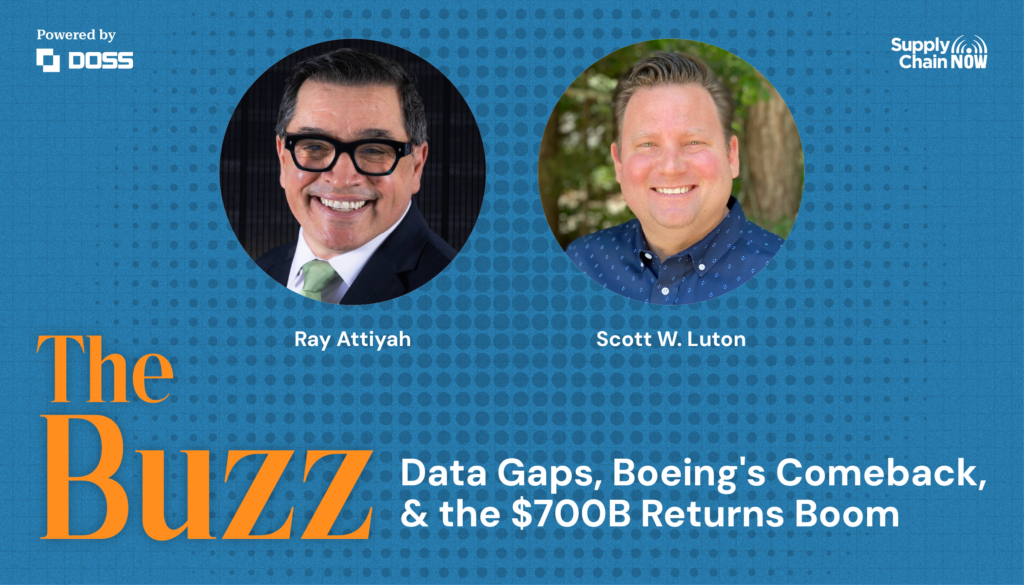
Hey, good morning, good afternoon, good evening, wherever you may be. Scott Luton and special guest host, Ray Attiyah, one of the best out there here with you on Supply Chain Now. Welcome to today’s live stream. Hey, Ray, how you doing today?
Ray Attiyah (00:27):
I am wonderful. Thank you so much for having me, Scott.
Scott Luton (00:30):
Well, back by Popular Demand. Did you know you’re in demand, Ray?
Ray Attiyah (00:33):
No, I did not. Other than all the text messages and calls and asking me to do it from Scott Lewton, the number one voice in supply chain.
Scott Luton (00:41):
Oh, you’re too kind. Folks, we’re going to have a great time here today. On today’s show, as you know, it’s The Buzz, where every Monday at 12 noon Eastern time, we discuss a variety of news and developments across global supply chain and business news that matters is what we like to call it. Now the buzz is powered by our friends at DOS. DOS is the world’s first adaptive resource platform to learn more about how DOS gives companies real-time visibility into their operational data and connects it seamlessly to the financial systems that run their businesses, visit doss.com. Okay, so Ray, big show teed up. We’re talking UPS and returns. We’re going to be taking a look at how decision-making is going or not going in manufacturing. We’re going to take a look at how Boeing is doing and its continued turnaround, all that and much, much more.
(01:29):
Did you have your weeds? Did you have your Flipstone vitamins? Are you ready to go?
Ray Attiyah (01:32):
I’m ready. I’m ready, Scott. Let’s go.
Scott Luton (01:34):
All right. So folks, one last heads up. Today’s edition of The Buzz has been pre-recorded because I’m on the road at yet another event. Lots of events first half of the year. Y’all know we like to keep it real, but good news is we’re going to be back live next week. And regardless folks, buckle up our big edition of the Buzz powered by Doss right here today. Okay. So the first thing I want to share four things and we’re getting into some news. And the first thing I’m going to share is the Reds. Now folks, Ray is based in the Cincinnati area. And Ray, you’re a big Reds fan, right?
Ray Attiyah (02:04):
I am. If you see the Reds here. Now I have to say I’m also a big Yankees fan. So I’m a Reds and Yankees fan. So I root for the Reds unless they’re playing the Yankees, but I am a huge Res fan. And that’s what brought me to Cincinnati, the big machine back in the ’70s.
Scott Luton (02:19):
So that’s a combination. You don’t find too much out there, the Reds and the Yankees, but so you know that Major League Baseball has implemented the ABS challenge where pitchers, catchers, and batters can challenge the umpire’s calls on balls and strikes. When batters, for example, as they’re in the batter’s box and they don’t like the call, they can touch their helmet like within two seconds and there’ll be a instant video review leaning on some really highfalutin technologies, made a big impact on the game. And just last week as the graphic here shares, the Reds challenged the call late in the game and it was instrumental and they won the challenge and it was instrumental in their win over the Minnesota Twins. Now, Ray, I really found this fascinating beyond the balls and strikes and the baseball component here, right? Although I liked it thus far.
(03:06):
But in the bigger sense, it’s kind of like man versus machine where technology is reviewing human umpires judgment calls. That’s really intriguing your thoughts in the broader sense, Ray.
Ray Attiyah (03:17):
So first of all, that challenge with the twins was literally the last play of the game. It was a strike that was challenged to end the game. So that was a very unique situation. So when I look at it, my framing is really you’re empowering the front line, the catcher, the pitcher, the batter. They’re the ones closest to the work. They’re the ones who see what’s happening and they have now a power challenge, those in authority. They’ve been using VAR in soccer. My wife and I met playing soccer, so soccer is huge for us. And in soccer, I love it because there’s very few goals and they make a huge difference. In baseball, there’s a lot of pitches, a lot of balls, a lot of strikes, and people can react a little bit by swinging a little bit outside the strike zone, knowing that the umpire has a wider range.
(04:04):
But now a catcher who has the ability to see it up their head. I was a catcher and you learn how to frame a both. I came here, you frame it. So we went from influencing the umpire who’s behind us to now we have a very black and white opportunity for us to challenge. And I had a wonderful teacher in fifth grade, Mr. Mann, and he allowed the students to challenge their grades. And he really taught us how to challenge it, but doing it in a respectful way. So what you see this as, so if you don’t like your grade, you would challenge it. Now, he also told you that if you challenge it and I look back and I find something else wrong with it, your grades could go down. So it’s not just a free unlimited number of challenges. You actually have a penalty if you’re wrong.
(04:50):
Interesting. What I saw with that, it was empowering. When I see this, I see the picture, the catcher, the batters are now empowered. You have a lot less people being thrown out of the game. The difference in soccer is that VAR, video assistant review, can only be called by the referee or somebody in the booth. They don’t empower the frontline. So that’s the biggest thing that I see that is so unique about baseball. It’s quick. It does put transparency. And if you saw one of the early games with the Reds, one of the umpires got the first six challenges wrong. So the crowd is booing. It was just brutal.
Scott Luton (05:26):
It’s taken, got to be on your game more so than ever before if you’re going to be a Major League umpire. And one more thing also, Ray, is interesting because you think of this from the business implications and you think about some of the human decisions, first off, how technology is empowering better and better supply chain decisions for the beautiful human element out there. But in this kind of case, I wonder how long before machines are going to be like, Scott, don’t send it that way, send that package this way. I’m challenging you. Ray, it’s an incredible time to be in the golden ages of supply chain tech, huh?
Ray Attiyah (06:01):
So it definitely is a human enabled system. So it’s not just … Because ultimately if you said, “Okay, let’s just get rid of the umpire in general and just make it robotic.” And you have, just like tennis did, tennis has removed the entire, other than the one referee and the chair, they removed the lineups. So it is right now a technology that enables and adds to them, but it also, you have to then give the referees and the umpires a lot of credit because people watch a replay, especially in football over and over and over again. And you still can’t tell whether or not that ball was caught. And they’re supposed to make this split second decision in real time, real speed, have to see it and make a decision. So you have to appreciate the situation that they’re in with a lot more respect because they’ve got to make that decision right then and there without the use of technology.
Scott Luton (06:53):
Let me just say, Ray, let me just say the late Eric Greg, it was a 1997 National League Championship series. If the ABS challenge was around in that travesty of a robbery of a game against my beloved Braves, where Eric Greg was given two feet on either side of the plate to the rookie phenom, Levon Hernandez, where was the ABS challenge when we needed it? But
Ray Attiyah (07:18):
Nevertheless- Well, I also thought you were bringing this, so you could talk about baseball, given that the Braves right now have the number one record, and then you decided to record this on this day so that when we’re having this recording, they’re number one so that if we happen to go live in a couple days, they may not be- We just edit it. So they’re number one, the Yankees and the Reds are sitting in number one in their division. So this is a perfect day for this. But I’ll tell you, the one ABS I wish they did was the Detroit Lions, I’m sorry, the Detroit Tigers. Where I’m going with this, the perfect game that was ruined by miscall it- The call it first
Scott Luton (07:53):
Base.
Ray Attiyah (07:54):
Exactly. Those of you are watching watch that. But here’s what’s interesting. I love the pitcher’s reaction when he just lost the perfect game, lost a no hitter and just looks at the umpire like. And then the- Grace.
Scott Luton (08:07):
Grace is a good thing, right? It was. It was. Grace is a good thing. In business, in competition, you name it, because it’s a tough job for the human umpires in the broadest sense of that word. All right. So really quick, to all of our Reds fans, Yankees fans and Braves fans out there, congrats. Your first place early on, we’ll see how it goes out, the season plays out. So Ray, we got a lot to get to. I want to share a couple quick things for folks. Folks y’all know it’s all about resources and giving opportunities to network and learn. We got a big event coming up, April 29th, just a couple days. National Supply Chain Day. So plan on joining us at 12 noon for a virtual event. It’s going to feature a wide range of supply chain leaders. Our keynote is the amazing Billy Ray Taylor, author of the bestselling book, The Winning Link.
(08:51):
I almost got that right. Plus we’re going to be recognizing some incredible people, organizations come join us on April 29th. Ray, that’s on your calendar, right?
Ray Attiyah (08:59):
It will be now.
Scott Luton (09:00):
Okay, good. That’s the perfect answer. All right. So also on the heels of an incredible MODEX where they set records here in Atlanta, MODEX at 50,000 people, according to the data, biggest MODEX in history right here in Atlanta. Well, we were there, interviewed a bunch of folks, and now we’re heading to Orlando May 4th through the 6th with Gartner Supply Chain Symposium. This is the place to be, especially for senior supply chain leaders. If you’re there, give us a shout. We’d love to connect. And I’ll tell you, Ray, this place right here, symposium in Orlando, it is according to the scientists out there, folks that track these things. It’s the largest supply chain happy hour in the universe. How about that, Ray?
Ray Attiyah (09:39):
You know what? A good happy hour with some good observes is always wonderful. That’s
Scott Luton (09:44):
Right. And talking about our favorite subject, right? So, and speaking of Gartner Supply Chain Symposium, hey, if you’re there, you got to meet our friend’s decision spot at the event. Are you running supply chain decisions on spreadsheets? Come on, be honest. You know a lot of folks are out there. The decision spot is changing that. You can find them at booth 1218 at Gartner in Orlando. And we’ll drop the link so you can learn more about decision spot right here. And last thing before we jump into a few news stories. Ray, I love a good case study. I know you like a good case study, right?
Ray Attiyah (10:15):
And I’m using the word case story now because everybody
Scott Luton (10:18):
Loves
Ray Attiyah (10:19):
Stories. So a case study is technical, written in a certain way, but case story is one that you remember, you link onto. Gent was one of my old clients and I remember the story of how the name came about and the employee saying I run this place. So when they tell a story, and that was 2003 or we’re talking about 13 years ago, I remember that story the way it was told.
Scott Luton (10:41):
Love it. Case story. From this point forward, it’s a proclamation. Well, our friends at EasyPost just published a great case story focused on how a leading omnichannel 3PL named Case with a K, partnered with the team and was able to reduce costs, improve delivery performance, and most importantly, elevate the customer experience, knock their socks off. You can download a copy and learn more and learn about how you can do that right there via the link below. Okay. So Ray, we got to get to work now. Let’s go. And dive into some new stories here on the buzz powered by our friends at DOS. And first up, we’re talking about one of my favorite topics. And we’re talking pre-show, Ray. We have covered the world of returns and reverse logistics like few have in the last five or six years. It’s fascinating. Well, here, as reported by the Wall Street Journal, returns space is only getting bigger, right?
(11:32):
And folks, there’s lots of figures, different figures out there. But one thing you can take to the bank, we all really like buying and returning stuff. The Wall Street Journal here says returns just in US Ray. Get this, write this down. $706 billion a year, just in the US. Get more into this business, and this is where the return space is getting bigger. UPS had acquired happy returns from PayPal back in 2023, and now they’re ramping up operations. Happy returns, in case you didn’t know, is a software and logistics business that handles returns for retailers, makes it easier. And they help to ensure that the returns process is a positive one when it comes to the overall customer experience. And we all know that the returns experience is now an even bigger part of the brand experience that we all measure consciously and subconsciously. Happy returns, get this ray.
(12:22):
Happy returns is adding another 1,700 locations in the US for consumers to drop off their returns, which will bring its total footprint to some 10,000 locations, getting UPS more and more into the returns revenue gain. Executives at UPS say that the complexity of returns management means higher profits to be smarter business, especially in a very challenging and fast evolving freight market. And by the way, what’s that phrase monkey see monkey do? Well, for what it’s worth, FedEx launched a competitor called Easy Returns in March 2025, which now has 3,000 locations across the US. So Ray, when it comes to returns, whether it’s the supply chain behind them or the customer experience, what are some of your thoughts here?
Ray Attiyah (13:07):
My first thought goes to loyalty. How do you use the return process, the return experience to actually increase customer loyalty? There was a good book written that talks about customer experiences that says most people think that wowing a customer is the best way to build loyalty. And research shows actually the best way to build loyalty is how quickly do you resolve an issue? Oh, the more one step process, one call, one positive experience when you have an issue, I mean, imagine calling your healthcare provider or insurance or anyone and you get routed five different times, you got to make three calls, three emails, that breaks down loyalty. But if you wow them with, “You know what? I’m going to take care of this. There’s nothing more you need to do. Here’s how it’s done.” Wow. I was not expecting that. That’s what you build loyalty on.
(13:59):
So if you can create a return process and actually when they do and process the return, you actually then incentivize them to make another purchase. So imagine in that same experience where, guess what? You have a return, like an apparel, take something that is a high value item and you make that process so easy for them that they want to make another purchase with you. So that’s when I think of that process is not the logistics aspect of getting the item back, but actually increasing the bond with the customer and the consumer.
Scott Luton (14:31):
So Ray, let me ask you this. Love your perspective there. I’m asking you a personal question. So as Amanda and Trisha know this, and big thanks to them both for all their wonderful production leadership. I hate returning anything. I really do. I hate it. And so I don’t very, very, very infrequently. Ray, are you a prolific returner or not?
Ray Attiyah (14:51):
I am not. So I don’t think many in our family are. I know I have a sister that is. We’re
Scott Luton (14:56):
Getting to the good stuff now.
Ray Attiyah (14:57):
Yeah. And she’s got high standards and if it doesn’t meet something. So I tend to probably research it. Actually, we just- Same. We just purchased the bag for our trip that we’re taking here in the summer and they came in. It was supposed to be a medium and my wife asked me to measure it. So I’m measuring and she’s like, “It doesn’t seem like it’s a medium. I think it’s pretty big.” But we don’t tend to be … But here’s the thing, I do return items and I love being able to just to walk into a UPS store and hand them the item. But even now, you could take it to Kohl’s. Amazon has the return process there in certain states with Kohl’s. So you walk into the store, you return something and they put it all the way in the back so you have to walk by everything.
(15:37):
And then also the Whole Foods, they make it easy. But I’ll tell you, when you go to Whole Foods, align for returns is ridiculous. But the UPS- Where- Go ahead.
Scott Luton (15:47):
Ray, I heard they got a new name at Whole Foods. I think I’ve heard it called Whole Paycheck.
Ray Attiyah (15:51):
Oh, yes. Is that right? Is that right? The cost of the food. Yes. Yes, exactly. Well,
Scott Luton (15:56):
Hey, you mentioned UPS Store. Folks, over the course of my entire entrepreneurial journey, the UPS store has been a terrific resource. And to Ray’s point, man, it’s wonderful to be able to walk in there with your Amazon return or other things. It’s one thing you can quickly check off your list. So big shout out to the UPS store. And by the way, Amanda says behind the scenes, she is a return enthusiast. That’s a creative way of putting it. So it’s a creative way of putting Amanda.
Ray Attiyah (16:20):
Well, as long as she doesn’t get blacklisted from certain groups because now they’re watching the algorithm determining whether or not you’re a profitable customer or not. So otherwise you get-
Scott Luton (16:30):
That’s right.
Ray Attiyah (16:30):
It’s like in soccer, you get relegated to the limited return policy.
Scott Luton (16:35):
Well, and we’ll cover this on another show, but there’s big time organized crime and bad actors in the return space. And it’s really a chronic problem. More to come on
Ray Attiyah (16:44):
That. Sending serial back in Lego boxes.
Scott Luton (16:46):
That’s right. Yeah. Fake batteries and power tools. I mean, you name it. I mean, when you’re talking about at least one account, a $706 billion industry, of course it’s going to
Ray Attiyah (16:58):
Be targeted by the bad act. And AI is going to help that where people then have to take a picture of it before they send it.
Scott Luton (17:04):
That’s right. Going back to the story here, that’s part of the happy returns business model, using AI to help crack
Ray Attiyah (17:11):
Down
Scott Luton (17:11):
On fraud. So we’ll see how that goes. Seems like business is good as business is expanding. We got to get to our next topic. And that is decision making in the manufacturing space, right? As manufacturing dive reports here, there’s a recent survey published by our friends at L2L that offer up some what I think is interesting, maybe not surprising takeaways, but interesting takeaways nonetheless. Now, LTL surveyed some 600 manufacturing leaders across the US and found, here’s a couple nuggets. 55% of manufacturers rely on automated machine data while 50% still depend on manual frontline input. That 50 should be a lot higher, I think. 30% of respondents said that their data reflects the shop floor in real time. That seems high. And only 21% said they find it easy to access the data that they need. I can relate to them. Like with my metal stamping days, Ray, I was on an endless search seems like for the data I needed.
(18:04):
Get this, this 9% said that they could identify root causes in real time, which leads oftentimes to their teams being stuck in costly growth, stagnating, firefighting mode. But again, these numbers don’t necessarily surprise me, Ray. I know you’ve worked with thousands of manufacturers out there. Do they surprise you? Your thoughts, Ray?
Ray Attiyah (18:23):
Actually, some of those numbers are better than I expected. Same. So what I think still the missing gap is establishing decision making methodology. Without a decision making methodology, it’s hard for you to then automate the system. So for example, now that we have so much technology, you want the data to then go to the next step to say, “Here’s what you should do with it. ” But with the absence of standards, don’t have standards, it’s hard to make the decision. So for example, is the data telling you to hire? Is the data telling you that you should add a second shift? Is the data telling you you should look for another supplier? So that’s the next piece in the evolution is do we know what decisions we want to make and do we create the algorithm for the organization to listen to what the automated enabler tells you to do?
(19:15):
So you think about what do you do with it? Do you hire more? Do you have to do reviews? So think of the decisions and ask yourself, okay, how do we make those decisions and how do we now tie that into the data? Again, there’s data, there’s information, there’s insights. Then there’s actually actionable actions that maybe you automate that where the next step is for it to actually take the action and post a job based on this. So I think that’s the area where a lot of organizations don’t have agreement on the decision making systems, the management systems that then says, “Okay, here’s how we then use the data.” Because I see a lot of conflict in meetings that says, “Here’s the data. Let’s just do that we have one source of truth.” The next step is, all right, what do we do with it?
(20:00):
Do we all agree on how we interpret it and how we act?
Scott Luton (20:03):
Two thoughts come to mind here listening to your take on this story here in manufacturing dive. One is I go back to that 9% figure from the survey, right? 9% said they could identify root causes in real time, allowing them assumably to solve the issue, put it to bed, and move on and fight the next battle. Folks, that we got to get there, right? Because firefighting mode, I think everyone likes to save the day. And Ray, we’ve talked about this timelessly over the years. Everyone likes to save the day, but it might feel good in the moment, but it’s so costly. It’s costly to the team member, it’s costly to the organization. And when you think about the impact down the line, especially if it just repeatedly happens, the cost to the ecosystem, suppliers, customers, you name it. And then the second thing I was going to mention, something you mentioned there, Ray, was I put this out on social media one time a couple years ago.
(20:56):
And Ray, oh my gosh, I had so many haters just throwing stones at me, but let’s stick to my guns here. Visibility is not enough. Ray just mentioned the difference in information and data. And then eventually he said, “And you’ve got actions you can take, what it tells you. ” And that’s where it’s an amazing time to be where we are. We still have lots more visibility to get, especially in deeper tiers and whatnot. But if we’re only gathering visibility, it’s not good enough. Our people need solutions and they need to know what to do next. Ray, get your final thought here and we’re going to move forward.
Ray Attiyah (21:28):
So I think it’s back to what you said about, okay, do we have the actions? The question then becomes is when you have 9% that have identified the root cause, is that action being able to be taken by a frontline employee or is it still required to go through levels of approval? I think that’s the element that when you have an organization that’s exceptional, excellent, well run, then you know that somebody on second shift sees the data, they understand the root cause and they’re empowered to take action without having to get approval. That’s the next level because we’re going to get into some of this discussion here is when I look at last year, when I look at years where it’s extremely challenging, it requires a tremendous amount of mental energy to focus on the strategic initiatives. But when we’re firefighting in the day-to-day operations, we are exhausted when it comes to the ability to think strategically.
Scott Luton (22:20):
And we are going to talk a lot more about that stuff here in just a minute. Really quick, before I get you to share one trend you’re tracking in manufacturing, I want to go back for one quick comment and then I’m going to get your take. I kind of laughed a minute ago, folks, when I mentioned that I was kind of in a very painful part of my career when I was in metal stamping and I was tracking down data. One of the worst projects, my least favorite projects in my entire life, Ray, we supplied parts to a tier two automotive supplier and we created some bad parts. But what I had to do as we quarantined the parts, we were trying to get and make sure we had separated all the good parts and the bad parts. I had to go around to all the check sheets that each machine operator manually tracked and basically had to prove through all of our manual traceability to our automotive customer that until they were confident that we completely caught the bad parts and it won’t happen again.
(23:10):
Ray, I’m going to tell you, I’d rather today get seven cavities filled in the same day than go back to that three week project.That was purgatory. Ray, it was purgatory. Let me ask you this, Ray. And again, I’m not throwing … Hey, I loved all the wonderfully talented people across manufacturing, some of my favorite parts of my career. But when you think of the wonderful, our beloved manufacturing industry, what’s one trend you’re tracking more than others right now, Ray?
Ray Attiyah (23:33):
So the one trend that I’m looking at, and you just mentioned working for that small metal stamping company, the biggest trend that I’m looking at is the ability for small midsize manufacturers to stay independent. When I look at the cost of technology, cyber, AI, and then you add on to it, operating casualty insurance, not to mention healthcare insurance, the rising cost of the talent that we should be paying a lot more for anyway, the material prices. So it’s extremely challenging for an independent, privately held, family-owned manufacturer to not just survive, but thrive to have the ability for them to put in funding to support their growth. So that’s the trend that I’m looking for. I mean, if you look at the jobs report, I believe it was November of last year and you saw that there was a hundred, I believe it was 120,000 or 140,000 job losses in small businesses.
(24:29):
The bigger companies were hiring, but the small companies were the ones being devastated. And I think that’s true, not just for manufacturing. I think that’s across the entire ecosystem and businesses. The smaller companies right now … When I started my first business almost 30 years ago, it was a lot easier. I could go to my chamber, I can get healthcare. It wasn’t that expensive to put on a server, buy a software package, and then you owned it. Nowadays, you’re buying software, you’re paying subscription, you add up all, you have all the cost of litigation. It’s just very difficult for the small guys. So that’s the trend that I’m looking at for small manufacturers is their ability to thrive. And last year was just devastating for many of them. I actually had one of them tell me he didn’t know if he would be able to put his daughter through college given the tariffs and some of the dynamics, you got banks watching their credit, customers pulling back on orders.
(25:26):
They don’t have the pricing power to be able to push some of those price increases in, but at the same time, their big customers or suppliers are pushing them on them. So I think that’s the challenge that I’m watching is how do they thrive? I was part of my investment plans. I had a manufacturing company, so I stay close to them now that we’ve sold them, but they’ve got bigger company support. And I think to this day, if it was just us, aluminum prices, for example, what’s happening with the Strait Hermus and Smelters, it’s challenging.
Scott Luton (25:57):
Yep. I’m with you. And of course, the historic levels of uncertainty. And of course that doesn’t just impact manufacturing, but you lay out what Ray just laid out in terms of challenges and friction and constraints and obstacles for manufacturing leaders and their workforces out there, pile historic uncertainty on so many different levels. On top of all that, it’s tough time. It’s tough time. All right, let’s do this. We’re about to enter the Rayatia Zone. You’re going to enjoy some of the questions on Posarate in just a second here on the Buzz Powered by DOS. But we got one more news story and we’ve got one message here from our friends, Wiley Jones and the DOS team. Folks, many things are not working good. Some say ERP is broken. To fix it, DOS has created something completely new. DOS ARP is the adaptive application core that combines the modular system of record with no code forms and workflows all to manage and automate core operations.
(26:51):
And guess what? It deploys three times faster than most alternatives and speeds up every step of your value chain by 10X or more. Hey, kick the tires on DOS, take a demo and learn more and be sure to connect with Wiley and the team. Learn more at doss.com. Okay, Ray, speaking of manufacturing, one interesting story that I have been tracking, we’ve been checking in on regularly is the Boeing story. Let’s see here. So looking at a continued Boeing turnaround story reports, CNBC reports that the company has narrowed its loss in the first quarter and has increased deliveries of key aircraft. Company leadership, and they got a new CEO that started about a year and some change ago, right? He had quite a task ahead of him. Company leadership reported that first quarter results were pretty promising. Sales rose 14%. Their net loss year over year for the quarter fell to seven million versus 31 million a year prior.
(27:42):
And in the months ahead, perhaps as early as summer, Boeing plans to ramp up production of its best selling 737 max from 42 units a month to 47 units a month. Of course, this aircraft in particular has had all sorts of challenges, including that infamous blowout of a door panel, or I think it was a door plug in January 2024 that Ray, if you remember that time a couple years ago, that footage of that door plug being blown out, man, that was just on like repeat on every news channel. It just added to the woes that Boeing has lived through, but they’re making a limited progress. Your thoughts on how Boeing, your thoughts on Boeing.
Ray Attiyah (28:22):
Oh, Boeing has lost customer and consumer confidence. And as you mentioned, the challenge that you had at the metal stamping company when you had a quality issue and you had to spend three weeks working on that quality control, the best you can do is go from not confident to neutral. And especially when the process of identifying the root cost took so long. I believe it was the 737, was it the 737 Max or which one were the ones also in Indonesia and Ethiopian airlines that crashed? I think wasn’t it the Max as well?
Scott Luton (28:55):
I think it was. I’ll double check. We’ll see if Amanda
Ray Attiyah (28:58):
Can hook
Scott Luton (28:58):
Us
Ray Attiyah (28:58):
Up there. But it was Boeing. It was Boeing. And what happened was they were going to market so fast with these products and they were trying to, I believe what I heard in one of my reading was basically trying to get around the regulations that required the pilots to go through extensive training. So they said, “Well, we’re not going to call it a major shift.” Well, guess what? The pilots were not prepared for that. So you lose confidence in not just the equipment or the quality of the systems, but also the integrity of the organization. And that is decades to repair. People still remember the gas tanks blowing up from the 70s.
(29:38):
The Pinto, right? Yeah. This is the devastating blow for Boeing. I mean, I can tell you when I fly with my wife, she says it’s not one of those new airlines. So we’re looking out which airline we’re flying and which aircraft. So I think the door is opened up for Airbus. And I think this is the … And again, my book and some of those, I talk about the ability to say yes, bold Lee. So it was definitely an opportunity for the competitors that opened the door. And it also makes people who want to join Boeing as employees skeptical. Do you want to join an organization that has that? So the word that you used a second ago was confident. And I think the devastating element for Boeing is confidence. Yes, you can cut your losses. Yes, you can increase production, but the question becomes is what does it take for you to win back the confidence that has been eroded?
(30:31):
And I don’t know if they’ve made that significant of a turnaround and admission to make people confident that the organization owns those problems.
Scott Luton (30:41):
Yes. Ray, good stuff. Folks, a couple quick thoughts based on what Ray shared. Number one, there is a terrific, I think it’s a Wall Street Journal or a Netflix documentary that came out two, three years ago during the height of the Boeing challenges. And it really does a great job examining how the culture had really eroded over time. They moved to headquarters and they had labor battles and quality issues. It’s outstanding if you want to better understand what Boeing’s trying to recover from. Secondly, yes, it was the 737 Max. I had two big fatal crashes, Lion Air Flight 610 in October 2018, and Ethiopian airlines flight 302 in March 2019. Big fatalities there. So one last thought, it’s intriguing. I’ll tip my hat because look, automotive, aviation, housing. I mean, you think about a short list of industries that are critical to economies and workforces and careers out there.
(31:34):
Boeing had its work cut out for it to recover. And it looks like, Ray, one final word, the new leadership, and I can’t find, maybe Amanda can find their new CEO that came on a year and a half or so ago. It looks like there might be a pulse at the culture they’re rebuilding. Are you prepared to offer any high fives just yet or should we wait a little while?
Ray Attiyah (31:55):
I think when we look at the relationship that they have with the frontline employees, if they can really rebuild that relationship with the frontline, I think that we would start fist bumping. We’ll start with the fist bump there. Because again, reputation-wise, they’ve had some missteps when it comes to employee relations and a number of other factors when it comes to supporting the frontline.
Scott Luton (32:18):
Right. Leadership. Leadership failures from what I’ve seen read. Okay. And it was Kelly Ortberg. He is the still relatively new president, CEO. He joined in August 2024. And gosh, Kelly is doing something I bet a lot of folks had no interest in trying to do. All right. Shifting gears. Get ready for the way back machine, Ray. I think that was on some show at some point. Check this out. Look at that smiling glowing face, Rayatia. So folks, you may have caught this episode. This was back 20-
Ray Attiyah (32:47):
Before my ophthalmologist told me, okay, enough already, you got to start wearing glasses more often.
Scott Luton (32:53):
Well, sharp glasses. They look great, Ray. It’s hard to believe this is already a year and some change ago, but this was way back in January 2025, right? And we focused this episode, if folks caught it, on some of your tips for optimizing leadership effectiveness. Now, as part of this conversation, we dove into some of your big predictions. I’m going to ask you, and thank you for being willing. I’m going to ask you, what do you think you got right on that episode, and what do you think you got wrong, Ray?
Ray Attiyah (33:22):
So you’re basically doing the ABS on me.
Scott Luton (33:25):
That’s right. I’m tapping my head up helmet.
Ray Attiyah (33:27):
That’s right. Okay. Now let’s see here. So that was a fun episode. I loved it. And it was really exciting. So I think I said, and again, the viewers and others can decide whether or not they’re right or wrong. So one of the things I said was, I believe last year, 2025 was going to be a year of deceleration. And I think I was right with that one. Now, some people showed me their revenue numbers and their revenue numbers went up a little bit. And I said, okay, show me your units. So your revenue numbers may have gone up, but is that because you also increased your prices because of tariff costs and things of that nature? So they went back and they looked at their units and they were a little bit down. So I thought last year was going to be a year of deceleration.
(34:06):
I thought it was going to be extremely disruptive. And so I think I was pretty right on that. Yep. What I was wrong about
Scott Luton (34:13):
Good. Really quick, before you go to what you’re wrong, and I really appreciate your … A lot of folks like Sportscasters and weather forecasters, they never revisit their predictions because they don’t like talking about where they’re wrong. So I appreciate your willingness, but really quick. I’ll say one thing.
Ray Attiyah (34:26):
And by the way, if you don’t mind, I’ve got my FC team here, so I’m going to be chugging here a little plug for FC Cincinnati.
Scott Luton (34:33):
I love it. All right. So back in, I think we recorded that in December 2024, and we published it in January 2025, as I recall. Now, if y’all remember back in that timeframe, the new administration was a couple months in talk of tariffs and
Ray Attiyah (34:47):
Negotiations. Well, they went in yet. Oh, that’s right.
Scott Luton (34:50):
That’s right. The elections had been had. Correct. They weren’t inaugurated until January. That’s right. That’s right. But as we published that episode and as we were having those conversations, the talk of tariffs and trade negotiations, all that was starting to crescendo. Now, Ray, I remember specifically talking during that episode, and I felt pretty good that all of that was talk and we wouldn’t see nearly the amount of action and friction with every single trading partner essentially. Ray, how wrong was I? Because I’m going to tell you, we have fought with everybody trade policy wise, so that’s where I certainly got it wrong. What did you get wrong, Ray?
Ray Attiyah (35:30):
So what I got wrong was I thought it was going to be a deceleration year, but then I thought people then need to spend their time on strategy. And I believe that the biggest focus was going to be on their strategy to focus on growth. And looking back at it, the ones who did the best were the ones who really focused on execution. They were able to spend their time really sharpening their supply chains, working with their customers, patting down the hatches on their costs, cost controls, and really stabilize their business during all that disruption. So they were not investing in new bold growth at that time because there were too much uncertainty. They were making sure that their core business was solid. So I thought that because of the deceleration, that then people would then spend their time on growth and strategy. But the ones who did exceptionally well on worked on execution.
(36:22):
So execution was paramount there. I think that another area that I thought that I said that I believe was going to be a key element was, as we talked about earlier, storytelling. I thought people would have to do a better job of storytelling during those disruptive times. They did do that and they did well because they had to tell the story to their employees what was happening, tell their story to them. And as far as talent goes, the shift from more talent to probably be more precise, I would say that one was in the middle. So yes, we need more talent, but it’s not just volume, but different types of talent. And the last one I’d say I got wrong was the push on sustainability. I was and I own a solar company. What we saw last year was a significant rush toward cost reduction, was driving the solar production more so than the ESG or sustainable strategies.
(37:17):
When we saw, especially where we are in the PGM network, everybody’s talking about data centers and we need more energy. The shift was more from a, we want to do it right for the environment to, we got to do it for a sustainable business. We saw many more customers come to us than I thought that were related to cost reduction. So they’re now making their own energy rather than buying it, a makeup. But that was one that I was probably the very wrong on.
Scott Luton (37:46):
Well, I appreciate your frank assessment, but your crystal ball probably works better than most folks I had known in my journey. But hey, even the experts in the betting markets that know more than I’ll ever know in my lifetime get a lot of stuff wrong.
Ray Attiyah (38:04):
And the volume was much higher, but it was for the different reason. Just like the M&A. I actually said M&A activity was going to be up. Third quarter was a record quarter, I believe. But overall, the overall M&A activity was driven by a few mega deals. So the number of deals weren’t as high as I expected, but I think this year will be huge for M&A activity, both in mega deals, but also a number of smaller deals. A lot of companies that have been on their businesses for some time. Last year’s tariffs prevented people from exiting businesses because they don’t want to exit them at a tough year. So that’s one area that was in the middle there.
Scott Luton (38:42):
All right. So Ray, do you hear this sound?
Ray Attiyah (38:45):
Yes.
Scott Luton (38:46):
I’m writing down that last prediction that 2026, I’m writing this down, is going to be a banner year for M&A activity.
Ray Attiyah (38:55):
I am very confident about that one.
Scott Luton (38:57):
Okay, good, good, good. All right. Speaking of confidence, speaking of confidence, I am confident that more folks need to be reading The Fearless Frontline. Let me tell you what it’s about. So this here, this is a book that many folks have ever seen me that are tuned into a show. Usually it’s right over a left shoulder. I had to look down and see which shoulders it was. Yeah, it’s right over Ray’s two. And by the way- Where
Ray Attiyah (39:18):
Is it?
Scott Luton (39:19):
This one’s in my hand. Usually it’s on that rack. Really quick, before I talk about the Fearless Frontline, I want to give a shout out to my dear friend, Will Quinn. This is a brand new book. He just published Modern Warehouse Management. It’s now available. I think it officially launches on National Supply Chain Day. But folks, Will is the warehouse guy. Go check out the book. Congratulations, Will. That’s right. Okay. So Ray, again, usually this sits right there behind me on the left shoulder. You see I’ve got it dog eared up and stuff from some of my favorite parts. And now this came out a long time ago, long time ago was a big bestseller. And we’re dropping a link folks where you can find used copies of it on your Amazon at least. What are some of your favorite key elements? If folks picked this up and read it over a weekend, what’s a couple things you hope that they would take from it?
Ray Attiyah (40:05):
Good question. So I think the focus on your top performers. Organizations, they talk about having standards, but often they spend too much of their time with their poor performers and build systems around their poorest employees. And those become speed humps for your top performers. So I think if you build your systems around your top performers, you will be surprised and relieved of how liberating that is for your management team, your top performers to empower them to run the business on their own so that the organization can focus on improve and grow. So that’s one of the key elements. If there’s one thing I tell people is if you were to take one thing, is spend the majority of your time with your top performers. The other one is really the business. Everybody talks about working on the business, not in the business. We have a lot of people who are firefighters.
(40:55):
We talked about that earlier, firefighting, firefighting. Well, guess what? Often the best firefighters are also the arsonists.
Scott Luton (41:02):
Ooh,
Ray Attiyah (41:02):
I like it. And they create fires, so they become more relevant. They create chaos so that they can solve it. They enjoy that realm of chaos because they thrive in that. They know how to operate in a firefighting mode. What they don’t have skills in is how do you build a vision, build a future, create. So the whole idea of running proof grow is standardize and systematize your frontline, build the ability to say yes, the ability to be bold, the ability to create confidence. And then you spend your time making proactive improvements to enable growth that keeps you relevant. Growth is not about size. Growth is about being relevant. And if you look at organizations now that are investing in different technologies, maintaining relevance, when a company compares and says, okay, supply chain now is an organization, is it valuable? Well, they’re going to look and say, okay, how relevant is it?
(41:56):
What do you have that’s unique? Yeah. Yes, how big it is. But they also want to say, “Okay, what’s your intellectual property? What’s your reach?” Things of that nature. So a business needs to stay relevant, and that is the job of the senior growth team. Their job is to focus on where are we at five years from now. My wife isn’t a horticulture and she asked me, “When’s the best time to plant a tree?” And the answer is 20 years ago. And so ultimately, when is the time for us to have competitive advantage? We should have started that a long time ago so that we’re not in a price competition and we have slim margins. So how are you separating yourself? So that’s the job of the senior leadership team, is to be thinking about the future. The middle managers, their job is to build the systems that enable growth and simplify the run, and then the frontline owns the business.
(42:47):
They own the run. Manufacturing, as you saw from your metal stamping company, they had a second and third shift. Well, they were able to run that business with a frontline supervisor. Why can’t they run first shift with the frontline supervisor? And then the rest of the management team focuses on improving and growing the business. So that’s the essence of it. So the first book was called The Freest Frontline. When we ran out, it was actually a top 30 business book of the year. We decided to focus into, “You know what? The frontline part of it is just one piece of the whole methodology.” So then we rebranded it under Run, improve, grow. Same content, but we wanted to focus more on the methodology rather than one of the benefits, which is a frontline that could run the business without management involvement.
Scott Luton (43:28):
All right. So folks, you can find used copies of Run Improve Grow or the Fearless Frontline, but Ray, you have got some big news, related news. And I know it’s top secret. I’m not sure what you can tell me without lots of lawyers coming after us here. But when it comes to mfg.inc, where are you going next?
Ray Attiyah (43:49):
So we’re building a team that has helped build that Runproof growth system over the last few decades. And so they are going to be launching here in a few weeks. What we’re doing is we’re taking Run Improve Grow and we’re giving in a new home. Run Improve Grow in the past was under consulting business, training business that we had Definity Partners. We sold that business. I have the rights to the Run Improve Grow methodology. So we licensed that out to the company that purchased it and providing it as a license opportunity for others. So we’re creating MFG.inc to focus on US manufacturers, and we’re housing running proof grow into that. So it’s going to be a training method, which is going to be providing frontline leadership training that’s going to use the best in person with digital. And then we’re going to be developing methodologies for people to license.
(44:42):
If you have an HR consulting business, an association, accounting firm, an IT firm that specializes in manufacturing and want to use this run improve grow methodology, we’d license that out. So some of the team, the band has come back together. You know some of these folks like Rich Carey and Dandy Agostino, and then you’ve met Jamie Bryant, who’s the president. And she helped me with the books. So she’s a whiz when it comes to intellectual property and digital strategies. So we’ve got a number of folks that we’re bringing back together, but it’s really taking, run and proof, grow, housing it. And then when we had the consulting business, we could only touch certain companies in the regions we were in, but now we’re going to be able to impact all manufacturers across the whole country.
Scott Luton (45:25):
Love it. Now folks, admittedly, and I’m going to be blatant about this, I’m very partial. I spent about two and a half years working with Ray and the team working for them and seeing the results that Run Improve Grow had on organization after organization. Okay? So I’m very partial, but I’m going to tell you, and I bet if you reach out to Ray and the team, they can give you all the case stories that you would like. But when that fearless frontline, those incredibly talented people that can do so much that are truly the experts in any organization, when you empower them systematically methodology, how you manage what you build, process-wise, you name it, you empower them to truly run the business, you free up all this extra time, or really for the whole organization, but especially for the senior leaders to focus on innovating and growing the company, big things happen, big things happen.
(46:17):
And one last comment, and then Ray, I’m going to have a couple more questions for you. Frontline is not just this … And Ray, we’ve talked about this a lot. The frontline isn’t just the operators. They also help innovate. They also help identify growth opportunities, continuous improvement opportunities. It is some of the biggest not so secret sauce that so many organizations out there just ignore. So anyway, Ray, your final comment around what the change you want to create out there and what you’re going to be doing with mfg.inc.
Ray Attiyah (46:46):
So in America, I believe there’s about 11 or 12 million manufacturing employees in this country. 80% of them are a frontline employee, and they report to a frontline supervisor. So frontline supervisors typically lead 80% of the workforce, and they represent about 5% of the total number of employees in a company is a frontline supervisor. But people join companies and quit bosses. I know my daughters have worked in Chipotle and other restaurants and other places, and they come and tell me how awesome it is because of their boss, not because of Chipotle, but because of their boss. And when things change, they quickly can go down when that leader changes. So we’re going to be launching in the early third quarter, this frontline leadership certification. It’s going to be bolder than we’ve ever made before. It’s going to be built on the Running Proof Grow methodology, but we’re focusing on manufacturing frontline supervisors, and that, again, leads 80% of the workforce.
(47:44):
And on a daily basis, they see all the areas to improve and they can take ownership. So that’s one way for you to leverage 80% of your workforce. And when you’re able to have confidence in your frontline, as we talked about the word confidence earlier, that allows senior leadership, not just time-wise, but decision. You’ve heard the term decision fatigue, decisions you make, they’re more exhausted. There’s a book called-
Scott Luton (48:07):
I’m very familiar with decision fatigue, Ray.
Ray Attiyah (48:10):
Yeah. So there’s a book, if you ever want a good speaker, Dr. David Rock, but he’s got a book and says, every time you make a decision, it consumes energy, consumes oxygen. I had somebody who read my book when it was a manuscript telling me their science behind run improve growth. And I thanked them for that. I went and read the book from David Rock and Dr. Rock, and he was exactly it. The more decisions you make, then you’re taking away opportunities from the growth side. So that frontline leadership and allowing them to own the run will free up and liberate leaders, be able to focus on improvement and growth. And then the other element is as we build, how do you build the confidence? We’re going to be in the third quarter, I’m sorry, fourth quarter, building a methodology to license the whole runproof growth process that you saw that we did create a spark that will be available toward the end of the year.
Scott Luton (49:00):
All right. So folks, go check it out. We’re going to make sure you know how to connect with Ray Tia here in a second. Ray, we’re running out of time. I knew this was going to be a big bonus edition of the buzz. So folks bear with us. But Ray, in as few words as you can, and you think of one thing that you’d love, kind of going back to global supply chain and this incredible challenging time for so many organizations and team members and leaders, what’s one thing you challenge supply chain leaders with as we work our way through the rest of this real challenging year?
Ray Attiyah (49:28):
I think everybody’s going to have a challenge when it comes to talent. I think everybody’s going to have a challenge comes to decision making. I think everybody’s going to have a challenge to creating new growth. So one area to really compensate all that is remove the barriers for your top performers. I call them speed humps. So speed humps are the speed bumps you see in communities because somebody drove too fast so that we slow everybody down. Let’s remove the speed humps so that your top performers can be empowered. And what I see often is I see organizations put in more and more speed humps. It’s a lot easier to put them in than to remove them. So build your policies, build your HR systems, build your reward systems around your top performers. I like it. Spend your time with them, but build your systems around them and you’ll be amazed of how liberating is for them and how liberating it is for you.
Scott Luton (50:19):
That’s right. Good stuff, Ray. And Ray’s given us all permission to shoot 65 miles per hour through our favorite neighborhood. Did you hear that? Kidding, kidding. But folks, that’s actionable perspective. And it’s based on been there, done that experiences from the many transformations that Ray and the team have been part of. Okay. So before we close, before we make sure folks know how to connect with Ray, again, thanks for everybody being here on this recorded edition of The Buzz, Powered by Our Friends at Doss. We’re back live next week. I want to share a couple of resources with folks, including our upcoming live programming. It’s usually each week we’ve got two or three live shows. You can go check everything that’s currently scheduled right there on our upcoming live programming tab at the new, I’m going to still call it new. It’s about a year old now, the newsupplychainnow.com.
(51:03):
And while you’re there, and Ray, make sure this is on your calendar too, our resource hub. No, that’s not the sexiest name in the world, but it is a vault of perspective and white papers and actionable insights and a whole bunch more, such as we got this great piece from our friends at Intersystems. Why track and trace is essential for modern supply chains. It kind of speaks to one of my favorite terms we’ve had some fun with over the years. Provenance. Ray, provenance. So many great conversations we had around that. But folks, check out that piece from Intersystems and much, much more at the resource hub, which can be found again at supplychainnow.com. Okay. So Ray,
Ray Attiyah (51:42):
Yes, sir.
Scott Luton (51:42):
You’re here, you’re there, you’re everywhere, you’re meeting and working with the movers and shakers across industry. There’s a lot more. We’re going to have to bring you back on and talk about the whole solar energy. That’s a fascinating space. But in the meantime, what’s the easiest way for folks to track down and have a conversation with the one and only Rayatia?
Ray Attiyah (52:00):
Probably the easiest way is my LinkedIn profile. So I’m sure you can leave it in there, but you could also follow Running Proof Grow. You can follow my investment company, Bold Promise is Delivered, or which is the one that’s going to be coming out with a new website in June here, MFG.inc. That’s the best way to reach out and connect with Jamie Bryant, Rich Carey, Dandy Agostino. They are incredible, an incredible team. That’s chapter nine of my book, Build the Dream Team.
Scott Luton (52:26):
Build the Dream Team. It’s one of the chapters. I skipped over that chapter, Ray. I got to go back and reread it.
Ray Attiyah (52:31):
I always tell people when they read the books, start with chapter nine, then go back and read chapters one through five. And then six, seven, and eight is probably the advanced section if you want, but start with nine and then you’ll understand why one through five matter so much.
Scott Luton (52:45):
Love it. And we’re dropping the link. You check out the book. And folks, whatever you do, right? Even if you don’t get help from Ray and the MFG.inc team, this run and improve, grow model, right? This run and prove grow mindset is so powerful. So get your help from somewhere. And if you need reasons and you can’t find reasons, do it for your people if for no other reason, but I’ll have to park it there. Ray, big thanks. God, my friend. You’re so awesome. The bold and fearless Rayatia. Ray, the bold and fearless Rayatia. Thanks for being here, my friend.
Ray Attiyah (53:17):
Scott, you’re doing exactly what I always tell people is stay relevant, be bold. Starting this business is inspiring. And Scott, it’s always a pleasure being with you and everybody on your team who’s made this process easy to just connect with you and just get up on this podcast and just have a chat with you. It’s awesome.
Scott Luton (53:35):
It’s the best thing we’ve ever done together and big shout out to Amanda and Trisha and the whole team behind us that makes production happen. Big thanks to our friends at DOS. Hey, learn more about the innovative things they’re doing over at DOS, EOSS.com. And most importantly, folks, the reason we do it all, big thanks to our global audience to SC and GlobalFam. Appreciate all the feedback and the input and conversations. Keep it all coming. Feedback they say, Ray, feedback is a blessing. Would you agree?
Ray Attiyah (54:02):
Absolutely. And you have to, as you said, the critics, when they give you feedback for your stuff, that means you’ve hit an emotion and sometimes you may not like it, but you have to ask yourself, what are they asking and what did they not know? So I’m going to don’t let it get you down, but let it fuel you.
Scott Luton (54:19):
That’s right. Turn it into fuel and keep on marching forward, folks. We heard a lot. Thanks for joining us here on the buzz, folks. You’ve got homework. We’ve got a lot of great actionable perspective from Raya Tia here. You got to take one thing. Just take one thing, do something with it, right? Share it with your team, put it into practice. It’s all about deeds, not words. That’s how we’re going to keep transforming global business and not leave anybody behind. And with that said, on behalf of the entire Supply Chain Now team, Scott Lutin challenged you, do good, forward, be the change that’s needed. And we’ll see you next time right back here on Supply Chain Now. Thanks everybody.
Intro/Outro (54:52):
Join the Supply Chain Now community for more supply chain perspectives, news and innovation. Check out supplychainnow.com. Subscribe to Supply Chain now on YouTube and follow and listen to Supply Chain Now wherever you get your podcasts.