[00:00:00] Ryan Fletcher: What makes a great titanium economy lesson here is it’s impossible to predict a perfect cycle. You can’t say they got lucky, they won because they had operational muscle and, and the discipline to go and take action with a, with a through cycle mentality, thinking, okay, we’re gonna make, we know we’re gonna be here in five and 10 years.
[00:00:19] Ryan Fletcher: What are we gonna do to create a position of strength? Even in times when it may not be something that a lot of others are, are saying, Hey, now is the time to invest.
[00:00:29] Voiceover: Welcome to Supply Chain Now the number one voice of supply chain. Join us as we share critical news, key insights, and real supply chain leadership from across the globe, one conversation at a time.
[00:00:41] Scott W. Luton: Hey, good morning, good afternoon, good evening, wherever you may be, Scott Luton and the one only Karin Bursa with you here on Supply Chain Now welcome to today’s show. Hey Karin, how you doing today?
[00:00:52] Karin Bursa: I’m doing great Scott. There’s certainly no shortage of activities and challenges. In the world of supply chain and it’s important work.
[00:01:01] Karin Bursa: So, um, I’m interested to learn some new information from our guests today.
[00:01:06] Scott W. Luton: Me and you both, and, and these folks are helping solve some of those challenges big and small that you’re referencing. But folks on today’s show, we’re diving into the titanium economy and some of the innovation and leadership lessons that it can really teach us all.
[00:01:19] Scott W. Luton: Now, if you’re new to the phrase or the the noun titanium economy, hopefully I made my English teacher happy there. No worries. We’re gonna define it and we’re gonna share why it matters. We’re also gonna be speaking, as Karin mentioned, to a couple of business leaders that will offer their expert perspective on key benchmarking examples and initiatives that we can apply all elsewhere in industry.
[00:01:40] Scott W. Luton: We’re gonna be touching on in interesting observations as it relates to supply chain disruptions and what leading organizations are doing to overcome them all. How AI is reshaping the business landscape, as well as some of the industry trends that might just be flying under the radar. That more supply chain leaders need to be aware of.
[00:01:58] Scott W. Luton: More business leaders need to be aware of all that and a whole bunch more. Karin, you ready for a great episode here today?
[00:02:05] Karin Bursa: Absolutely. You really piqued my interest with those items that may be flying under the radar, so hopefully there’s some low hanging fruit we can take advantage
[00:02:14] Scott W. Luton: of. I’m with you.
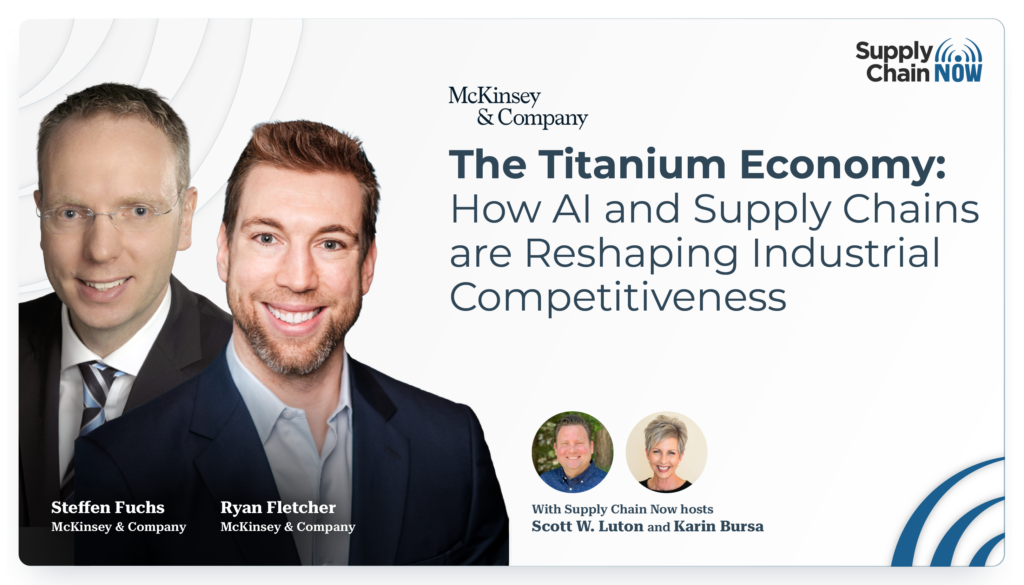
[00:02:15] Scott W. Luton: It’s always what’s in our blind spot, right? Yeah. We gotta shine a bigger light there, but folks stick around for a great conversation that’s gonna offer up tons of actionable insights by the truckload. So let’s welcome in. Our wonderful guest joining us here today. I wanna start by introducing Steffen f Senior partner with McKinsey & Company now as global leader of McKinsey’s Industrials work.
[00:02:36] Scott W. Luton: Steffen helps companies reimagine their business models through AI and turns ambitious goals into measurable outcomes. Sounds poetic. He works alongside senior leaders to craft strategies that accelerate growth, protect margins, and build true actionable resilience while ensuring organizations can deliver at scale with confidence.
[00:02:56] Scott W. Luton: Steffen brings a unique perspective shaped by hands-on managerial experience earlier in his career, and 25 years of advising CEOs and boards now across automotive, semiconductors, energy, and transport. Steffen has guided transformations that have unlocked billions in value while de-risking execution.
[00:03:16] Scott W. Luton: Steffen, welcome in. How you doing?
[00:03:19] Steffen Fuchs: Good. How are you, Scott? Thanks for having me.
[00:03:21] Scott W. Luton: Wonderful. Great to have you here. Well, you’re joined Steffen by your colleague, Ryan Fletcher, partner at McKinsey & Company. Now, Ryan is a partner in McKinsey’s Advanced Industries Practice, which serves companies across industrials and electronics.
[00:03:35] Scott W. Luton: Semiconductors, automotive and assembly and aerospace and defense. He’s got a very diverse work portfolio. It covers a wide range of initiatives from shaping enterprise and portfolio strategies to accelerate profitable growth and expand global market positions to driving cross-functional performance transformations across operations, supply chains, and commercial organizations, and much, much more.
[00:03:59] Scott W. Luton: Now, prior to joining McKinsey, check this out. Ryan built and led the LED business of a mid-cap lighting manufacturer. He served as an optical engineer at the US Department of Energy and he helped bring solar power to off-grid communities in South America. Very cool. But Ryan, welcome in. How you doing?
[00:04:19] Ryan Fletcher: Thank you. Doing great, Scott. Karin, thanks so much for having us.
[00:04:22] Scott W. Luton: You bet. So Karin, we have got between Steffen’s background and what he’s up to today and Ryan’s background and what he’s doing today. We might have to have a three hour podcast. What you think cor.
[00:04:33] Karin Bursa: Oh, I love the fact that they both have such strong practitioner roots in their experience and then have now parlayed that in to helping other companies.
[00:04:42] Karin Bursa: I think it gives ’em a very unique and practical point of view as they serve some pretty complex industries.
[00:04:48] Scott W. Luton: Yes, just reading through their bios and their backgrounds, Ryan and Steffen, y’all must have the superpower of taking the very, very complex and breaking it down for teams to understand and do and bite-size pieces and that, or those are true superpowers.
[00:05:04] Scott W. Luton: Alright, so let’s do this Karin. We like starting with the fun warmup question to learn a little bit of the human side of our guests. And Steffen, we’ve done our homework and we understand that you and your family are the biggest March Madness fans. This side of the Mississippi, I think that’s the western side of the Mississippi, Steffen, is that right?
[00:05:22] Steffen Fuchs: That is true. I’m not sure we’re the biggest, but we’re certainly deep into March Madness since it’s. It’s just, uh, happening right now. I think we’re super excited to see if either the SMU Mustangs are gonna make it and take it all the way, or if the Duke Blue Devils are coming through. That’s the division in our household, Scott, and looking forward to seeing how this plays out.
[00:05:41] Scott W. Luton: Well, good luck. Good luck to Duke and SMU. Good luck to Karin’s Auburn Tigers. Good luck to Mike Clemson Tigers. And I’ll tell you, Steffen, whoever in your family are big Duke fans, they probably have the best chance of being really happy this March. Would you agree?
[00:05:56] Steffen Fuchs: Definitely. But that’s the beauty of March Madness, right?
[00:05:59] Steffen Fuchs: That’s why it’s called madness. I mean, we, we’ve seen miracles happening.
[00:06:02] Scott W. Luton: Oh, I’m with you. I’m with you. There’s big part of the beauty. Um, okay, so Ryan, now things are starting to make sense now. As I was sharing your, your background earlier, we were talking in the pre show about some of your theater industry work, and lighting, of course is really big and really important in those settings.
[00:06:19] Scott W. Luton: So I’ve gotta ask you, Ryan, what did you do in the theater scene?
[00:06:24] Ryan Fletcher: Yeah, great question Scott. Um, it was a bit of a niche industry. Uh, I was a entertainment lighting designer, so I would go and, and do the lighting for musical theater, concerts, different types of live events. And it was quite a while back, but it was a outlet for artistic endeavors in that I could, the only one I could really do, I can’t paint, can’t draw, can’t play a musical instrument for the life of me.
[00:06:45] Ryan Fletcher: But something about lighting clicked. And someone was telling me the other day, we were talking about this, like, that’s why you’re in industrials. And I was like, well, tell me more. And they, they said, well, if the gear isn’t installed, the lighting gear isn’t installed and programmed and addressed and commissioned and everything works and sequence, no one sees it.
[00:07:03] Ryan Fletcher: And that’s probably why you, uh, you like to do the behind the scenes things that actually end up creating the, uh, the event on stage that the, the glam part always gets the attention, but the behind the scenes capability is what makes it real. And I thought that is pretty akin to industrials in, in many ways.
[00:07:19] Scott W. Luton: Ryan, I hear Karin a supply chain analogy to what Ryan just shared there because as we all know, supply chain makes it happen every day. But Karin, between Steffen’s love for March and his family’s love for March Madness and Ryan’s deep lighting and also theater roots and that passion, we’ve got quite a panel teed up to talk business leadership because there’s all sorts of parallels with those things, huh?
[00:07:45] Karin Bursa: Absolutely. You got teamwork going, um, you got tough competition and uh, you’ve got to make things work and you don’t want it to be, when it fails that it gets the attention, it’s when the outcome is successful. So for Ryan, the production is successful and gets rave reviews. He’s been a big part of that or have been a big part of that in the lighting business
[00:08:08] Scott W. Luton: because the tournament.
[00:08:09] Scott W. Luton: And the show must both go on, right?
[00:08:12] Karin Bursa: Go on. Yes. Yes.
[00:08:13] Scott W. Luton: Alright, Steffen and Ryan, I promise not too many more dad jokes. Uh, Karin knows I’m bad about that. But anyway, great to have y’all here. Love your backgrounds. I look forward to learning from really all three of y’all here today. So let’s start with this.
[00:08:23] Scott W. Luton: Let’s do some more level setting. Now, I shared a very high level summary of some of your background. Didn’t do it justice, but I wanna just get both of y’all starting with you, Steffen, shed a little bit more light on your journey to this point. And maybe what folks really need to would be, it’d be helpful for them to understand about your professional background, Steffen.
[00:08:42] Steffen Fuchs: Yeah, well thank you and great to be both, both of you, Karin, and, and Scott. Look, I think the professional background in a nutshell, I think you actually, uh, synthesized it well, is this notion of like, I like to make things happen. And so you called it, I think poetry, I call it impact, which is like the ability to say, at the end of the day, I define myself as helping my clients do their job, make their job better every.
[00:09:06] Steffen Fuchs: And if that happens to me, that’s poetry and that is impact. And so no better way than in supply chain. And my very first job actually was in a manufacturing plant, planning the supply chain, seeing parts coming, going to the assembly line, cars rolling off at the end. There’s actually poetry and there’s, I guess, theater, if we wanna stick with that analogy from Ryan in that.
[00:09:28] Steffen Fuchs: And so translating that into business now on a global scale, as you said, I help lead our industrial practice, which means everything we do with clients across the 13 economy, across auto suppliers, semiconductor data centers and the like, these are complex supply chains. These are things that move that I have obviously many tier one, tier two, tier three supply chains that are truly global in this day and age.
[00:09:53] Steffen Fuchs: That gets disrupted through geopolitics and all other things. But at the same time, the opportunities are truly amazing. And for the last five, six years, I’ve helped clients make sense of. How does artificial intelligence create resilience in those supply chains? Creates agility in those supply chains, creates a stronger customer orientation in those supply chains.
[00:10:14] Steffen Fuchs: And when you put these things together, it is actually quite exciting. And so I’m actually quite optimistic about where we’re headed as a, as an industry as a whole, uh, as a, as a world economy. I think AI will, will allow us to be even more productive than we are today.
[00:10:29] Scott W. Luton: Well said, Steffen. And you’ve had a lot of making sense of stuff over the last five or six years, as you said.
[00:10:35] Scott W. Luton: There’s been a lot of stuff to, to better understand really quick. Ryan, same question, uh, again, I shared some of your background, really impressed with both of y’all’s and what you’ve been up to, simplifying the very complex. What else about your background in particular would our audience find helpful?
[00:10:51] Ryan Fletcher: Yeah, I think I started my career building a business that kind of helped to transform a, a mid-cap company. And, and what I found from that was. Pretty energizing when you take a company that’s a leader in its segment, even if that segment is, is very specific and niche and making, setting them up for success in the future, it’s an incredibly powerful journey to do.
[00:11:11] Ryan Fletcher: And, and, you know, while I’ve been in consulting, I’ve had the privilege to meet with executives from a ton of companies that we would say in broad industrials. And, and the folks who are mid-cap, really inspirational about their ambition, their longevity, their, you would say resilience and through cycle mentality.
[00:11:29] Ryan Fletcher: And, and they’re really often unique approaches to value creation that have worked for them. They’re not taking someone else’s playbook, it’s something they’ve created over a long period of time and crafted their culture around. And, um, it, it became clear to me that many of these guys are the unsung heroes of our modern economy.
[00:11:45] Ryan Fletcher: And so I was. Energized by getting to know them and helping, helping them on their journey in many kind of unique and creative ways. And so I, I kind of took up the mantle of, of leading this, the mid-cap segment of, of the broad industrial client service for us. And it’s, um, it’s been something that I think we’ve been able to, and I’ve been able to, to be part of the journey of a, of a lot of people in a lot of different segments and sectors where, you know, we, we carve up this industry, we’ll look at all the, uh, the different verticals we find there’s over a hundred micro vertical in the titanium economy.
[00:12:17] Ryan Fletcher: Mm-hmm. And, um, these are the guys that keep the real economy running. They’re behind the scenes as we talked. They’re in the middle of manufacturing and infrastructure and energy systems and ai, uh, and they’re the supply chains that everything depends on. And so I, I find it to be a, I find it be really thrilling to help, uh, many of these, uh, many of these clients with their, their value creation for growth in their next horizons.
[00:12:38] Ryan Fletcher: And I, and I think I, I kinda like. Serving them much better because again, they fly behind the scenes and, and they have outscale impact. I think for the public recognition they get.
[00:12:48] Scott W. Luton: Ryan, a lot of good stuff there. And Karin, big themes, execution, transformation, innovation, learning from unsung heroes are some this, some of the best part of the conversation we’ll probably talk about here today, but Karin, your thoughts when we heard there from Steffen and Ryan?
[00:13:04] Karin Bursa: Yeah, I, I really like the characterization of, of both Steffen’s background and Ryan’s background, but also feeding into this market of innovation. And oftentimes these companies are competing with much larger organizations and so they need to do that with greater agility, sometimes faster innovation or response to new opportunities in the market.
[00:13:27] Karin Bursa: And they don’t necessarily have the deep. Bench strength maybe that you would find in some of the larger companies. So that can be a curse and a blessing, um, a as they work towards those goals. So I think it’s important to have trusted advisors to help you crystallize those priorities and look for the opportunities to have the biggest impact.
[00:13:49] Scott W. Luton: Yes, yes. Because a lot of companies don’t have, to your point, those armies and armies of resources and team members to help unlock, uh, and solve today’s challenges. Good stuff. Their Karin. Okay. I wanna shift along into one of our, our big themes here today, the titanium economy. Now, again, folks, I gotta tell you, I don’t go way back with that definition of a, a part of our global industry.
[00:14:13] Scott W. Luton: So we’re gonna start so we don’t leave anyone behind. Ryan, tell us, summarize, if you would, what the titanium economy is, why it matters, and kind of what you were just suggesting, the impact these companies can have on the broader US and global economy for that matter.
[00:14:29] Ryan Fletcher: Yeah, sure. This is Scott. I, I think we like to think of these guys as the small mid-cap industrial businesses that as we talk, don’t really get any of the headlines or many of the headlines, but we would all notice pretty immediately if they weren’t there because they, they make the things that move and maintain every basic part of our physical world.
[00:14:48] Ryan Fletcher: And you know, what’s interesting to us is, is that how they win? It’s, it’s focused, it’s execution, it’s discipline, it’s, it’s a ton of applied engineering. You know, it’s innovation that happens really close to the product, really close to the shop floor. It’s tangible. And, you know, they have, tend to have a pretty impactful ripple effect when these companies grow.
[00:15:09] Ryan Fletcher: You don’t just get the growth in the organization. You get capabilities, you get good jobs in, in many regions that are not, you know, take the US for example, not the two coasts that benefit from tech and finance. It’s other parts of the us And you get these strong regional ecosystems that develop around.
[00:15:25] Ryan Fletcher: So that you know, it, it’s increasingly true in, in developing markets as well. And um, the reason that this matters, of course, is that industrial activity is a huge multiplier and growing economies, it’s a faster path to building this domestic capability and, and to moving up the value chain. And so when, you know, when we think of titanium economy as a term, you know, we try, tried to come up with a term for this a few years ago and we thought, okay, mid cap, small cap.
[00:15:51] Ryan Fletcher: You know, there’s a bunch of different things around it. We thought, well, what really, what are the hallmarks of this industry? And we thought, okay, like titanium as a metal, you know, very strong relative to their weight, relative to their size, extremely corrosion resistant, right? And have economic returns that in many cases rivals those of tech.
[00:16:10] Ryan Fletcher: When you look over a long time horizon, uh, including through recessions and disruption and COVID and so forth. And the third is that if you lined up a bunch of metals on the table, unless you’re a metallurgist, you probably, I would struggle to pick out the one that’s titanium. And so if they truly fly under the radar of a lot of our kind of public perception, and I think that there’s a, it’s an element of, of, you know, when you support this segment of the economy, you support the growth of the, the economy overall.
[00:16:39] Scott W. Luton: I, we’re getting a certification in the metallurgy here today. I love that, Ryan. It makes, but it makes per kidding sound. It makes perfect sense. Steffen, what would you add to what folks need to know about what the titanium economy is?
[00:16:52] Steffen Fuchs: Look, I think the one thing I would probably add is it’s, for me, it’s the backbone of many global economies.
[00:16:59] Steffen Fuchs: I mean, I grew up in Germany and as I think about, what is Germany known for, it’s the middle stunt, right? Mid-cap companies, exactly what Ryan described, which essentially is what he’s describing as the titanium economy. I think 60 plus percent of German, GDP is. In those companies. And if you think about, I think Karin, I really loved your point around innovation.
[00:17:18] Steffen Fuchs: How did they compete on a global scale? They innovate and they export. And when we, when we look across the globe, that’s exactly what’s happening in many economies. It’s the unsung heroes, it’s the, the focus Ryan said that are not on either one of the coasts in the us. They’re kind of like in the middle of the country.
[00:17:35] Steffen Fuchs: And that’s, I think, the part where we’re quite excited about because they do bring job growth, they do bring innovation to that part of the world. And I think it’s a misperception to think about them as, as companies that are not leading edge. I do think many of these players are leading edge players in their segment.
[00:17:51] Steffen Fuchs: And if you take the a hundred micro-verticals that Ryan described, there’s a lot of space to innovate. And so it is, uh, it is a core part, I think of the DNA of any economy. And I think particularly in the US core, part of what makes the middle of our country, so to speak, really vibrant and and productive.
[00:18:07] Scott W. Luton: With lots of opportunities to learn, to grow, to innovate. Karin, what you hear there from Ryan and Steffen as we kind of defined and then some the titanium economy.
[00:18:17] Karin Bursa: Yeah. I love the, the classification of titanium economy in, in the way that Ryan described it because of the strength and yet lightweight agility, um, and ability to pivot and see opportunities.
[00:18:30] Karin Bursa: I also think it’s this backbone. Steffen mentioned that word in in his description as well, that they are connecting multiple hundreds and thousands of other supply chains. They’re critical to the infrastructure in the global networks of lots and lots of other manufacturers across the globe as well. So chances are every manufacturer or logistics operator is depending on many of these businesses to perform and deliver services for their customers as well.
[00:19:02] Karin Bursa: So when they sneeze. The whole value chain can catch a cold and when they succeed, the whole value chain can succeed as well. So they’re really pivotal partners and they provide services and products componentry that gets consumed in a number of other industries as well. And I do think that theme of innovation and looking for opportunities or finding the niches that are available to them, you know, there’s a great phrase that says the riches are in the niches.
[00:19:36] Karin Bursa: And a lot of these companies have grown up because they, their founders have seen those niche opportunities to provide service and product and innovation to others.
[00:19:48] Scott W. Luton: Yes, yes. Very well said. I love the quote too. Alright, so Ryan, back to you. In 2022, a trio of authors, including some former colleagues or maybe current colleagues of of you both published the book, the Titanium Economy, how Industrial Technology Can Create a Better, faster, stronger America.
[00:20:06] Scott W. Luton: And it went on to be a, a national bestseller. So since this book came out, lemme do my hard math four years ago, how has the titanium economy landscape evolved?
[00:20:16] Ryan Fletcher: Great question, Scott. And I would even say, you know, most of the research for the book we did in 2020 and 2021. So we were at the kind of the early days of, of COVID in, in the time.
[00:20:26] Ryan Fletcher: And so I’d even, I’d even put it five, six years ago, you know, over this time what’s happened and I, I would say the biggest change is that the titanium economy has, has gone from what we had called at the time, underappreciated very specifically used that term in the book. And many of, many of the, um, companies in the space had had told us that over and over and over again to much more obviously strategic and.
[00:20:48] Ryan Fletcher: Yeah, this was kind of like, if we think of the supply chain angle a few years ago, the resilience in supply chain capacity, they, they were talked about like it was insurance, and now they’re viewed as a absolutely critical source of advantage. And it’s a huge mindset shift. And the companies, I would say haven’t changed as much as the context had in, in, in like 2021 is 2022.
[00:21:12] Ryan Fletcher: People were asking, how do we get back to efficiency? And now it’s much more how do we stay competitive and be robust at the same time? And how do we balance globalization with regionalization and how do we balance the, the, you know, the a step change in, in, in capacity and ensuring that we have throughput Because the volatility that everyone’s experienced has really made, um, reliability, availability and lead times just as important as like the unit cost had been.
[00:21:39] Ryan Fletcher: And what’s interesting is when we look at, um, the, the value creation in the sector, and we take public companies as an example, we look at multiples as an indication of. Of the kind of beliefs in, in valuation, we’ve actually seen multiple growth in the titanium economy, outpacing tech, consumer, other industries.
[00:21:57] Ryan Fletcher: And, and before when we did the research for the book, we’ve actually seen multiples that under pace those industries indicating that, that the recognition of titanium economies and midcap industrials is, is getting much more, much higher. And the investment willingness from both public and private capital has been increasing.
[00:22:15] Ryan Fletcher: The second one I’ll add though, is just that very obviously I think AI has pulled titanium economy into the spotlight. And while AI feels incredibly digital to us, it’s also incredibly physical to deploy it at scale. We need data centers, we need power in those data centers. Uh, we need cooling, we need construction switch gear, uh, it is transformers, racks, cabling, and then all the industrial automation, the precision components upstream.
[00:22:38] Ryan Fletcher: And so building ai, you know, it kind of really means building the digital infrastructure and. You know, it runs on, it runs on the titanium economy and so many of the companies either active in the space or increasingly being pulled into the space to support the growth and the build out of ai. So I think overall, I’m, I’m personally much more bullish than I was in 2022 because the, the demand drivers in the context are much more clear now, I think, than they were before, and much more durable that they’re, these are really, these companies are really the growth enablers for the next era of the economy.
[00:23:12] Scott W. Luton: I love your constructive optimism. Steffen, I’ve got a different question for you and feel free to add additional comment on how we’ve seen things evolve, but does the titanium economy hold true globally? And how do geopolitics and domestic industrial policy influence these companies, Steffen?
[00:23:33] Steffen Fuchs: Yeah. So we absolutely believe that it holds true globally, and I think for a couple of reasons we just mentioned it.
[00:23:40] Steffen Fuchs: I talked about the German Milton, which is the, I think the prime example of that as an example across the pond. Same is true if you think about Italy, you think about India, you think about Japan. I mean, all these economies are essentially built around very similar structures, that backbone that I described before.
[00:23:56] Steffen Fuchs: If you wanna think about differently in the, the way Iran just described it, the system integrators that essentially take tier three or tier two supply chains that integrated to then supply into the primary, um, oe. I think that’s really the way to think about it. And so we see this across the globe. And some of our latest research we’ve done on this topic, and we’re working on, on some refinement on this thinking from 2022, actually demonstrated that not just a framework was true, but the importance of those players around the globe is probably even greater today than it ever was before.
[00:24:30] Steffen Fuchs: And so as we regionalize and, uh, deglobalize in a way as a global economy, we feel very strongly that the titanium economy. Micro-verticals and those companies in those micro-verticals will continue to succeed and grow. Second, I think what’s really important is that the outcomes, to your point and their success, are heavily shaped by policy, right?
[00:24:53] Steffen Fuchs: When you think about what happened in the United States with the CHIPS Act, that is a policy decision. The CHIPS act therefore drives investment. That investment goes from semiconductor and data centers through that value chain that Ryan just described. And so I would think about policy, almost like there’s a demand signal.
[00:25:11] Steffen Fuchs: Wherever you are around the world, when you see the policy being implemented, European regulation, US regulation, other parts of the world, that is effectively a demand signal that there’s greater demand for that part of the economy and it will grow. And, and in that point, along those lines, I think it is important to think about them as system integrators and therefore, system systemically important.
[00:25:35] Steffen Fuchs: Yeah. Without them things don’t happen. As Ron said. And I think the third piece is, look, geopolitics will continue to play a role. I think, uh, I read a fascinating book a couple of years ago around, uh, not just the de-globalization, but this notion of like how the world is reordering itself. And I do think we see that play out around the world, uh, today.
[00:25:56] Steffen Fuchs: And as geopolitics continue to shape the narrative, businesses will need to adapt and they will need to adjust to the new realities. And I think with that comes opportunity and whether there is opportunity, there’s growth, and whether there’s growth, there will be more of these players and people will figure out how to innovate.
[00:26:12] Steffen Fuchs: And the flip side of the coin is also true if, I’m sure Karin and, and Scott, if you think back, why did we have globalization was because we had a push towards certain parts of the world where we felt like we could in increase economies of scale and or innovation and alike. And now I think that brings things back to home, so to speak.
[00:26:30] Steffen Fuchs: So we feel very strongly about that. We see the same examples play out in China. Subsidies in China State demand shaping, that’s effectively a form of policy. Same in Italy, I mentioned that, or, or the Macon India campaign that is being, uh, being run with a particular focus on manufacturing programs. All these things are in place around the globe to create economic stimulus.
[00:26:55] Steffen Fuchs: That economic stimulus benefits the titanium economy players.
[00:26:58] Scott W. Luton: So, Karin, lemme get you to weigh in here. We talked about landscape shifting and then we talked about how the titanium economy kind of really holds up when taking globally, right? Mm-hmm. I wanna add one more thing here ’cause I uncovered where McKinsey, I think McKinsey research noted, we talked, Steffen touched on industrial policy actions.
[00:27:16] Scott W. Luton: All of that globally has quadrupled since 2017. We’ve seen it really in a, in a, a hyper increase in recent months it seems like. But Karin way in overheard there from Ryan and Steffen in terms of the ever shifting landscape at home and abroad.
[00:27:31] Karin Bursa: Yeah, I, I think the biggest shift that impacted all businesses certainly was COVID and looking at de-risking as far as single supplier or looking at multi-sourcing or nearshoring.
[00:27:43] Karin Bursa: All of this is true in the titanium economy, just as it is in consumer goods, that businesses were incented. And certainly now as you look at the US tariff actions, that’s driving some restructuring as well, both from an incentive perspective, but also from a penalty perspective. So I really think that the big message, what I’m hearing from Steffen and from Ryan, is that, you know, we’ve moved from this cost optimized business model to a business model that needs to be shock ready and resilient.
[00:28:16] Karin Bursa: And, and looking at those opportunities across the globe, not just in our backyard, but as we grow the businesses or as this titanium economy continues to make a bigger and bigger impact supplier, diversification, localization in some areas, certainly government compliance is a big part of that as well.
[00:28:37] Karin Bursa: So it’s not just cost savings, we can’t save our way to growth. It’s also that amplification or ability to innovate and be faster, more agile in the way changes are, are implemented or opportunities are harnessed.
[00:28:53] Scott W. Luton: Excellent. So Karin, Ryan and Steffen, we got a lot more good stuff to get to. I’m completely nerding out on all things titanium economy here today.
[00:29:01] Scott W. Luton: So Ryan, I, I wanna kind of shift the conversation a bit. So. What are some major initiatives that titanium economy players have implemented to respond to some of the supply chain disruptions we’ve already mentioned and plenty others We haven’t and or all the geopolitical uncertainty, which of course we’ve seen even, even mu much more increase in recent days.
[00:29:22] Scott W. Luton: And have we seen a lot of companies, I think I know the answer to this, but ha have you seen a lot of companies changing their manufacturing footprint or localizing or making other supplier shifts? Ryan, your thoughts?
[00:29:34] Ryan Fletcher: Yeah, I, I think, I think all of the above, right? Karin, you, you mentioned shock ready and resilient.
[00:29:39] Ryan Fletcher: It just made me think a couple weeks ago, A CEO told me that his favorite KPI lately is Dave, since last surprise. This is right after the tariff. The tariff stuff got kinda struck down this Supreme report. So it’s like how many more shocks the system can you get? And it comes to resilience, of course is the, the name of the game.
[00:29:54] Ryan Fletcher: But there’s kind of the outside things, the inside things that we’re seeing on the outside. You know, people are talking about multi-sourcing on critical inputs and identifying those bottlenecks in supply chain and finding some regionalization and some capacity in other places to, to give flexibility.
[00:30:10] Ryan Fletcher: But on the inside, what we found bear out is that a lot of companies didn’t actually have good visibility on who their tier two and tier three and tier four suppliers, where those actual parts were coming from. And this got worn out because when terrorists were announced last year, I think it was around April, it was rather sudden than a, a bunch of folks that, that, um, I was talking to said, gosh, we know who our supplier is for this subsystem, but we have no clue who the other five or six suppliers are for all these other parts.
[00:30:41] Ryan Fletcher: And by the way, we invoice, we get invoices from these guys. Our supplier says they get invoices from here, but the part’s actually made over here, and the material for that part comes in over here. So you know how the, how the heck were we gonna figure this out? And I think the positive thing that wore out from this.
[00:30:56] Ryan Fletcher: Tariffs aside is that many of the companies who have succeeded, I think in, in adapting resilience, have figured out how to map that supply chain and how to really, and that’s exposed for them more bottlenecks and critical parts of, of, of, you know, sourcing that they may not have otherwise been aware of were risk points in their system.
[00:31:16] Ryan Fletcher: The second is, I would say is network and footprint. There, there is real change right there, there, you know, most titanium economy companies have been considering, if not actually acting on new production locations. And the broader trend of course is regionalization starting to become somewhat mainstream for areas in which they believe there’ll be go forward demand.
[00:31:37] Ryan Fletcher: So, you know, the data center one bears out a lot. Of course anything physical, ai, things that are, that have trends saying, look, okay, let’s set up a final assembly capability in this region because we know we have, our customers are gonna need to source from that for a while. The third I would just say is, is their speed and the operating model around that speed.
[00:31:55] Ryan Fletcher: And it’s, it’s scenario planning. It’s risk sensing, it’s it’s intelligence and as Steffen was mentioning, digital and AI so that they can be aware of disruption faster and respond faster to it. And a lot of that stuff really for, especially for a lot of these guys who are high mix and low volume, is just the awareness point.
[00:32:15] Ryan Fletcher: The sooner they’re aware of something in their network, the faster that they can consider their actions and actually then take action to, to correct it. So I, I think the best players in the space are not just going on defense. They’re using this to become much more reliable partners to their customers, shorter lead times, higher service levels, and using resilience as a competitive advantage, not just cost and performance.
[00:32:38] Ryan Fletcher: I
[00:32:39] Scott W. Luton: love that, Ryan, and, and I love how days since last surprise is gonna be showing up on dashboards everywhere. That’s kind of, Karin reminds me of my favorites, one of my favorite sayings. Uh, give me good news fast, gimme bad news faster. But Karin, what do we, what’d you hear there from Ryan before I prompt him?
[00:32:53] Scott W. Luton: Maybe for another example or so.
[00:32:55] Karin Bursa: Yeah, I, what we’re hearing is there’s significant complexity and opportunity and physical network changes do take time. As much as, you know, as technologists, we’d like to say, you know, we can move these sourcing initiatives pretty quickly. It takes time and initiative to make sure we’re getting the same quality, those same lead time, reliability, et cetera.
[00:33:18] Karin Bursa: But Ryan also mentioned a very important point, and that’s understanding your supplier network, not just tier one, but tier two, tier three, because there could be risk lingering there that you’re not aware of. You know, we continue to need to have more visibility of. The nodes, the critical nodes in our supply chain.
[00:33:39] Scott W. Luton: Hmm. Alright. So Ryan, uh, you shared a couple different, I’d call ’em maybe pseudo examples. Is, is there anything else you wanna share really quick that illustrates, uh, your points you were making?
[00:33:48] Ryan Fletcher: Yeah, I’d say there, there’s one other example I think that, that comes to mind here is that there’s a mid-cap, mid-cap manufacturing in the US that decided they would take an engineering, an engineering lens, I would almost say an engineering first approach to hand, to, to resilience.
[00:34:02] Ryan Fletcher: So they, they didn’t go to their supply chain and say, we’re gonna try and dual source everything. You know, they’re pretty high mix, lower volume. So it’s, it’s, it’s tough to really do that profitably and effectively. But they did a, they did do not anon bottlenecks in, in the chain, throughout the chain. And they found there was a small set of, of single source long lead time components.
[00:34:21] Ryan Fletcher: And then they, they tacked it from both sides. So they did go through the supply chain and qualify some alternatives, but then they really went back to engineering and. Figured out, all right, how do we adapt our product and in many ways, simplify our products. We either reduce the number of variances, vari variations we need of components, or we adapt the product to, to accommodate alternative components if we have to put that into play without materially impacting the performance of the product.
[00:34:45] Ryan Fletcher: And I, I thought that was really, really smart, really unique, and it, and it came up, you know, it comes up, I think time and time again of looking at it as a systems problem. Like Karin, Scott, you both had mentioned this supply chain as a overall optimization, not just in its own function by any means, but to get the type of resilience that the shocks to the system have pushed a lot of the te company economy companies to do it, it really requires going to the other parts of the operating model.
[00:35:10] Ryan Fletcher: And so I thought that was a, a pretty, uh, a, a pretty astute approach to, uh, you know, to, to further adding resilience in the, in the product development process.
[00:35:19] Scott W. Luton: Astute Deed Ryan and I appreciate that. I bet you’ve got. A litany of more examples. We’re gonna have to have you and Steffen back to share much more.
[00:35:27] Scott W. Luton: Uh, Steffen, I got a question for you. ’cause I, I am out in the cold here ’cause this is new to me and I, I, I guess I’m showcasing my ignorance at times. Amanda says, I do that a lot. My, my dear wife, but Steffen, the great amplification cycle. Uh, tell us what it is and why it matters.
[00:35:43] Steffen Fuchs: Well, this wouldn’t be a good podcast with two consultants without a framework, right?
[00:35:46] Steffen Fuchs: That we have to define. So what is the great amplification cycle? Look, I think it’s actually quite simple. We think about this as we talk about Titan economy, the significance of those companies in the economy. And so we’re really defining inclusive and sustainable growth. And when you think about how you do that and how you break that down, it amplifies from having good jobs, good talent, that then creates net new opportunities.
[00:36:11] Steffen Fuchs: And that’s the amplification that we’re seeing. And as companies are starting to come together, we also see clusters and we see these clusters all over the us. You see them in North Carolina. You see them in the metroplex here in Dallas, see them Milwaukee. You see them in Chicago. Right. And so I think the great amplification cycle, quite simply is the pull through from these companies that they have through the entire economy.
[00:36:32] Steffen Fuchs: And I think an economist would probably call it the GDP multiplier. We try to give it a fancy title and put a spin on it. That is, that is interesting. I think the second really important piece though is, and I think it’s what’s the impact of that on society? Like what does it actually mean for everybody along the way?
[00:36:48] Steffen Fuchs: And I think it means job growth. And I think with that job growth comes capital inflows. And we see that again across the United States, especially in the, kinda like the Midland of the country, where there is these manufacturing jobs, where jobs are being created, where cities are grown. Like I’ve been in Dallas for 10 years.
[00:37:04] Steffen Fuchs: The city of Dallas has grown dramatically in those 10 years. And there’s a lot of industrial jobs that are moving to Dallas and I’m making this happen. I think we see the same thing in, in the data center space. You think about what’s happening in Ohio, what’s happening in Arizona. That’s the pull through that we’re describing.
[00:37:19] Steffen Fuchs: And so it is a, it’s gotten to make fun of ourselves here for fancy work for consultants to say lots of skilled jobs, lots of great opportunities, lots of economic growth in parts and pockets across the country that gets amplified as companies cluster together in order to make great things happen.
[00:37:39] Scott W. Luton: Steffen, well first off, I love a great framework, so I imagine a, a new one to my library. And then secondly, Karin, he mentioned a clustering. Of course, certain industries in particular are well known for clustering aerospace and automotive to name a few. But between the great amplification cycle Steffen was talking about or some of the great examples and other things, Ryan was sharing your thoughts there, Karin,
[00:38:00] Karin Bursa: my thought is it’s a great time to be in supply chain.
[00:38:03] Karin Bursa: So as there is so much new innovation and changing manufacturing structures and networks and opportunities and, and as Steffen mentioned as well, you know, these data centers are exploding in a positive way around the world to, to prepare for future growth, both in the physical AI and product use, but also from a digital perspective as well.
[00:38:28] Scott W. Luton: Yeah. Speaking of data centers, I think the LA latest, um, data point I came across, 3000 data centers are currently under construction or already formally being planned. Just in the us. Just in the US
[00:38:41] Karin Bursa: and the pull through on power utilities, et cetera. So that’s pulling a lot of other construction and investment as well.
[00:38:48] Scott W. Luton: Yes. Electricity in particular. Just that one, one little big one. Big part of that. Holistic. When we say infrastructure, the holistic definition of that, we’ve got a lot of work to get to the power. All this innovation and more. Ryan, I wanna circle back to you and I wanna shift over kind of organizational performance, right?
[00:39:06] Scott W. Luton: This is where you and Steffen and your colleagues are doing great work with organizations getting through all this complexity and this modern age of, uh, global business. When you think of, and I think we’re gonna look at this from a titanium economy standpoint, the top players there, what are they doing well, right?
[00:39:23] Scott W. Luton: What maybe what make them the top players? And are they all in the same micro sector or are they just a lot better at executing? Ryan, your thoughts?
[00:39:33] Ryan Fletcher: Great, great question. Um, it’s both, it’s a little bit of who you are, but it’s also very much driven by what you do. And, you know, when we, we break up the industry across these a hundred plus micro verticals, we talked before, we’ll see some that, that are obviously getting tailwinds, right?
[00:39:50] Ryan Fletcher: So we talked about power and electrification, right? There’s also things in transportation. Rail equipment is actually surprisingly getting a lot of tailwinds as we, we have more movement of goods. Especially in North America. And so we, we see a number of these micro-verticals that are semiconductors and semiconductor manufacturing equipment and supplies and services, of course.
[00:40:08] Ryan Fletcher: So we see a number of these that are rowing, but when we look within each micro vertical, there are, there’s a huge range of value creation within there. And so there are some players who, even in a a, in a sector that may not be as hot topic or may not be getting the type of investment or demand, one would think there’s still outsized performers that, that are beating the average of the entire, um, industrials area.
[00:40:33] Ryan Fletcher: And those guys are really, you know, we, we’ve done a lot of research with them on, on what is it that they’re doing. And I think there’s a few things that come to mind. One is they’re running a, a, an operating system that’s repeatable, but it’s not playbook, it’s not textbook. They didn’t take something off the shelf from someone else and say, this is gonna be our operating system.
[00:40:51] Ryan Fletcher: They created something that’s bespoke and custom to them, to their customers, to their industry, and to their culture. And so, you know, and then what they’ve been doing is, is adding some of the capabilities to accelerate that. So they modern modernize their commercial engines. They use AI and digital to get faster, to get more precise.
[00:41:10] Ryan Fletcher: They simplify skews and products. They allocate capital and, and then they build their capabilities, drive a programmatic m and a playbook. But they do it all within the nature of that operating system that, that they’ve crafted. Right. And so they find the way to, to make that unique. And, you know, a few things that we generally see first is right now the outsized performers lead time is the weapon winner, street lead time, like a product feature.
[00:41:35] Ryan Fletcher: There’s this MRO distribution business that I, I know the executive team at and they build a model around embedding inventory and service at the customer’s site. So customers keep the lines running without waiting for emergency orders. Supply. When supply gets, gets really volatile. They can deliver close to the customer, at the customer when, when others can’t.
[00:41:54] Ryan Fletcher: There’s another, another, uh, business that, that I know well. They’ve taken their approach to product and said, all right, we’re really gonna look at simplifying, simplifying our skews, but not just from the standpoint of, okay, here are our low runners, or here’s the stuff we’re not making margin on. But explicitly what would allow our manufacturing efficiency, our throughput time, our ability to respond to shifts in customer performance, customer demand a faster, and so fewer skews, fewer inputs, fewer changeovers, fewer supplier surprises, more leverage to negotiate.
[00:42:24] Ryan Fletcher: And it’s tough to do. ’cause they always say their Salesforce says, don’t, don’t, don’t turn anything off. We need a whole portfolio of products. In fact, we need everything to always be kept forever. But they’ve decided, hey, we’re gonna have discipline in, in how we do this. And the third thing we’ve seen is a lot of these leaders are, are taking capacity as a really strategic decision.
[00:42:44] Steffen Fuchs: Right?
[00:42:44] Ryan Fletcher: So kind of my favorite example in the past six months of this is a, um, there’s a company that makes gas turbines in the US and they didn’t have a lot of demand for their product five, six years ago. So they. You know, it wasn’t fashionable in investing gas turbine production for energy. But instead of just selling off the facility or completely shutting down the plant, they idled it.
[00:43:05] Ryan Fletcher: They kept a minimum level of capability. They continued to produce a minimum level of product, even though they didn’t exactly know where the product was gonna go, because they said, Hey, the cost to shut it down, we could amortize that cost over five years of minimum capacity. And then if and when we think this industry comes back, we’re gonna be front and center.
[00:43:22] Ryan Fletcher: We’re gonna be the first ones able to produce product. And guess what electricity demand is. Surged power supply at the source of data centers and other places has increased. And there’s actually gas turbines being installed at the source of power generation need. And so they’re absolutely taking that part of the industry and their competitors who can’t scale up fast enough.
[00:43:40] Ryan Fletcher: Mm. And so I think the theme is, you know, when we think what makes a great titanium economy lesson here is these companies don’t, it’s impossible to predict a perfect cycle. You can’t say they got lucky they won because they. Operational muscle and, and the discipline to go and take action with a, with a through cycle mentality, thinking, okay, we’re gonna make, we know we’re gonna be here in five and 10 years.
[00:44:03] Ryan Fletcher: What are we gonna do to create a position of strength? Even in times when it may not be, may not be something that a lot of others are, are saying, Hey, now’s the time to invest.
[00:44:13] Scott W. Luton: We got a lot to learn from the top performers. Karin really quick, uh, one of my favorite parts, first off, folks don’t sleep on the MRO.
[00:44:20] Scott W. Luton: There’s great opportunities in maintenance repair operations. There really are. But one of the things he mentioned there, and I’ll just kind of paraphrase, the top players are using the right tech, fully optimized. That’s one of the things that Ryan shared. Your quick comments there on, on benchmarking opportunities with the top players in the titanium economy, Karin.
[00:44:37] Karin Bursa: Yeah. I think these are themes that can apply to a lot of economy or a lot of industries, not just the titanium economy. Skew rationalization. Designed for reuse or common componentry. These are best in class approaches to looking at your product portfolios. Also, lead time, I think Ryan said, uh, lead time as a product feature.
[00:44:58] Karin Bursa: It is a competitive advantage. Flat out lead time and reliability continue to be differentiators in the market. And when you have the confidence in your business process to do that and make the commitment and get close to your customers so that you’re in a continuous replenishment model, that is an absolute way to embed your business with your top customers.
[00:45:22] Scott W. Luton: Hmm.
[00:45:23] Ryan Fletcher: Yeah.
[00:45:23] Scott W. Luton: Good stuff.
[00:45:24] Ryan Fletcher: That’s a great, it’s, you know, one the way I’ve, I’ve thought of this is there’s some companies in, you know, especially in supply to data centers that have upgraded their business model from, we’re best in class to simply we’re in stock. Right? And that’s, that’s been the driver of their success over the past couple years.
[00:45:44] Scott W. Luton: So folks, if you wanna learn more about these benchmark opportunities with top performers or if you wanna learn more about the underperforming, not to pick on any companies, but the underperformers, you have to reach out to Ryan ’cause he’s got lots of examples and ways that you can overcome these companies can overcome these pitfalls.
[00:46:00] Scott W. Luton: Some of the ones that we’re talking about here today. I gotta move us forward though, ’cause Steffen, we can’t have a supply chain conversation without talking about ai. Karin, you and I, we talk about AI all the time and for good reason, right? It’s fascinating here in the golden age of supply chain tech, how companies and leaders are using AI to really empower their teams and, and many, much, much more.
[00:46:22] Scott W. Luton: But Steffen, tell us in your view how AI is reshaping the titanium economy landscape. And the best part of it, I think in my view, it’s not just the bigs, it’s the big players, small players, and all points in between that that can, can unleash the power of ai. Your thoughts, Steffen?
[00:46:39] Steffen Fuchs: Yeah, absolutely. So I think, Karen, you just said something that’s really important, which every single conversation I’ve had on this topic over the last five years, I start with what’s the competitive advantage you’re trying to create?
[00:46:52] Steffen Fuchs: And I think, Scott, the reason I start there when, when you ask me that question is because I think too often companies think about AI as a tech project versus a business opportunity. And so I really believe when applied, right, and well, you think about this, how is tech enablement, by the way, not tech at large, right?
[00:47:13] Steffen Fuchs: But tech enablement, a TA AI, going to allow me to be more competitive in the market. If you take that lens, then the second part of the conversation becomes, well, what’s the value creation thesis? How are we gonna monetize the competitive advantage? And then the third part, which I think we often don’t talk enough about, is, look, Karin, you said earlier, titanium economy or others, uh, probably don’t have the bench, not as steep, don’t have the talent.
[00:47:38] Steffen Fuchs: Yeah. Well, how am I going to change my business processes to actually take advantage of the technology to deliver that business outcome, to be more competitive in the market? That to me is actually the four piece puzzle to when you ask me about AI and what the opportunities are. And so if you unpack that, then you say what is, so, what is so special about these mid-cap players?
[00:47:58] Steffen Fuchs: Well, what do they deal with? Thousands of SKUs, high complexity to the supply chain, many supplier risk. We talk about it geo, uh, broad distribution of logistics and disruption, geopolitics and the like. Well, AI can actually assist it because the reality is for most of the clients that I’ve faced day in day out, the CEOs that I meet with, they tell me, look, I got a lot of great people, but they still work with Excel files or they work in five or six different data systems, or the data never is perfect.
[00:48:28] Steffen Fuchs: I need perfect data before I can do anything. And I think the reality we found is if you take that business lens approach and you say, how do I create value? So demand sensing. What can I read in the Demand Smart inventory? How does AI help me to reduce my inventory, cost, supplier risk rate? What are all the different metrics?
[00:48:47] Steffen Fuchs: What was the KPI basis last to surprise? Like how do I actually quantify that and how do I make the opportunities for that? And frankly, things like sales. I mean we, we see very often clients use agent AI now in order to do lead generation, which essentially is a demand signal. And then only once the lead is warm and ready to engage, hand it over to a human, the human then runs the rest of the the process.
[00:49:11] Steffen Fuchs: And so I really encourage everybody to think about it much more from a system optimization competitive advantage that pays enabled by AI versus a tech project. ’cause I think that’s where things go sideways. And then to ask, answer your last question around what can big and small learn, I mean, look, AI is everywhere.
[00:49:30] Steffen Fuchs: I mean, we’ve gotta learn how to adapt to that new way of working. I make the analogy, I, I said to you earlier, I’m from the car industry. When Henry Ford invented the assembly line, he didn’t just invent the assembly line. He actually invented a very different organizational structure with a different supply chain and ecosystem of people on and suppliers around it that enabled the assembly line.
[00:49:52] Steffen Fuchs: And the, the picture I use with my clients is like, we need to imagine the AI assembly line where AI becomes essentially that piece, but everything else around it feeds into that assembly line. ’cause otherwise, if Ford would’ve continued to deliver the parts for the build material of these vehicles the same way as before, the assembly line wouldn’t have worked either.
[00:50:11] Steffen Fuchs: And so I think there is, there’s a learning, there’s a change management, there is a leadership question in all of this. And it’s really about, I love Karin, what you said. It’s about competitive advantage. It’s about value creation. And really making the business more efficient.
[00:50:25] Scott W. Luton: Steffen, you, you’re uncovering my, my secret.
[00:50:28] Scott W. Luton: I just follow Karin around and take lots of notes. Yeah, that’s all I do. I do that. Uh, Karin Karin, I love Steffen’s history lesson. I loved, we were talking about how Ryan and Steffen both can take the highly complex and make it much simpler. He mentioned a four piece puzzle and that’s a great example of that.
[00:50:45] Scott W. Luton: So Karin, what’d you hear there from Steffen and AI and his thoughts on AI and more?
[00:50:50] Karin Bursa: Well, and there’s one thing that, that neither Steffen or Ryan have said, and that is when you don’t have the expertise in house, you need a trusted advisor. I think that’s the opportunity to work with an organization like McKinsey that knows your segment, knows your industry very well.
[00:51:06] Karin Bursa: You’ve heard them both say micro markets, a number of time, and micro segments. I mean, they can get very granular. Help you with benchmarking and understand where you can get some quick wins from artificial intelligence. So it’s not just in supply chain. Steffen just gave us an example in the sales process, right?
[00:51:25] Karin Bursa: And as you’re working with customers or you’re helping them vet potential products or needs or lead time associated with that. The bottom line is AI has left the laboratory at this point in time. It’s in the real world. It’s in the physical and digital world. There’s lots of ways that it can be applied to your business to help you be more competitive, more efficient, and.
[00:51:48] Karin Bursa: It’s not uncommon to hear, we didn’t know what we didn’t know. The AI has uncovered new patterns, new opportunities, new commonality that we can consider for our business that will boost efficiency and accelerate innovation.
[00:52:04] Scott W. Luton: Yes, I tell you, if I didn’t know better, I’d say AI didn’t have a blind spot like us humans do.
[00:52:08] Scott W. Luton: But we’re still, there’s still a lot more AI can do to get better and better, but it’s getting, it’s getting better fast. Really quick, Ryan and Steffenie and Karin, we’re gonna talk in just a second about. What owners and CEOs can learn from titanium economy, uh, titanium economy companies. That phrase has just tripped me up all day.
[00:52:27] Scott W. Luton: But Ryan, before I do, we’ll get you to comment. I mean, between Steffen and Karin, we’ve talked a lot about ai. We’ve talked a lot about how companies are using it and some of the fundamentals that, uh, in this era we have to really embrace in a disciplined manner to, to make the right targeted progress from artificial intelligence.
[00:52:46] Scott W. Luton: Your quick comments on anything, ai Ryan?
[00:52:50] Ryan Fletcher: I would say that the, the key with AI in this sector, um, is that I actually think that there’s many opportunities that larger companies don’t have and it all, what I mean by that is I often hear from folks saying, gosh, AI in midcap, industrials and titanium economy.
[00:53:11] Ryan Fletcher: That’s gonna be really tough. Digital maturity is, is way below what the leading players in industrials and in tech and other industries are, and that the talent that they have is, is much lower. And gosh, that’s, that’s a, that’s an uphill battle. I actually think of it differently. I think it’s as a competitive advantage because they don’t have the limitations and the inbuilt structures of perhaps having the, the, the kind of best in class digital legacy digital platforms and ERP integration and systems.
[00:53:39] Ryan Fletcher: So you can actually take a clean sheet and you can say, well, okay, where do I have sources of data? In our organization, we actually call it dormant data because many of these sources, a lot of companies don’t even, aren’t even aware it exists. And how, and if I tap into that and I add an AI driven intelligence on top, I can, how do I get faster insights more.
[00:53:59] Ryan Fletcher: Unique understanding of how my operating system is functioning to redo, develop that operating system or to simply become faster and more proactive and, and ha not being encumbered by the, the hysteresis and kind of a, a much larger digital infrastructure and actually be a big advantage. And so we’re seeing a lot of companies in the space experimenting successfully with AI and getting real gains because there’s nothing to lose.
[00:54:25] Ryan Fletcher: They’re not displaced in anything else that they have today. So it’s, I actually think it’s, it’s, it’s a great sector for, for AI and it’s gonna benefit a ton from it over the next few years.
[00:54:35] Scott W. Luton: I agree, Ryan. I agree. Alright, so we’re coming down the home stretch. We’re gonna have to bring you all back for a second or third hour, Steffen and Ryan and Karin.
[00:54:44] Scott W. Luton: But I wanna ask you, Steffen, this has been a tremendous learning and benchmarking conversation as we thought it would be, but Steffen specifically, when it comes to business owners and executives and, and especially in C-Suite. What can they learn specifically from titanium economy companies, especially when it comes to leadership approaches, decision making, which has optimizing decision making has always been important, big opportunities there.
[00:55:10] Scott W. Luton: And of course long-term value creation. Steffen, what comes to mind?
[00:55:15] Steffen Fuchs: Well, look, I think there are, if you reflect on the discussion we just had, to me three themes that are, number one is we talked a lot about talent, exceptional talent, essentially talented people. And there are capabilities that allow them to succeed and innovate.
[00:55:30] Steffen Fuchs: ’cause the innovation that we talked about doesn’t just come from the ai. You still needs to have the human factor in the mix. And so I think the number one lesson to that question for me, Scott, is around investing in people and in capabilities. We know that talent, attraction and retention is one of the biggest drivers for success for these companies.
[00:55:48] Steffen Fuchs: We know that upskilling the workforce, especially in the age of ai. Again, I said early on, I’m an optimist. I actually think it will augment how we work, not replace people. I think will be a, a key driver and that will allow us to accelerate the, the adoption around technology and the how people embrace how they work differently.
[00:56:07] Steffen Fuchs: I think second, when we think about capabilities, Ryan gave a great example earlier around r and d. I think there is a innovation factor to this. So how do we think about investing in r and d capabilities that allow us to, continues to be competitive? ’cause just because we’re reassuring and regionalizing doesn’t mean that the global competition goes away.
[00:56:24] Steffen Fuchs: We’re still gonna compete at a global scale, right? So I think that to me is number one. And number two, I do believe I’m a half full kind of guy and a half full glass kind of guy. So I see this actually as new growth opportunities. I think at the end of the day, the leadership approach needs to be leaning forward, looking at what the opportunities are.
[00:56:41] Steffen Fuchs: And from all the research we’ve done across all these micro verticals, there is more untapped potential to be captured. And I think that is a, a second big theme that also by the way, means in organic growth. A lot of the conversations that Ryan and I are having with titanium economy CEOs. Is about how do I enter a different market and can I enter that market inorganically?
[00:57:01] Steffen Fuchs: So I think there’s a big, there’s a big opportunity there. And then third, you can probably tell my passion about ai. I, I do believe there’s a lot of hype, Scott. I agree with that, but I think I’ve seen enough real things happening that we actually believe in the potential.
[00:57:15] Ryan Fletcher: Sure.
[00:57:15] Steffen Fuchs: And so I do believe embracing the digital transformation, and look, for me, this is, we talked about supply chain.
[00:57:21] Steffen Fuchs: One thing we haven’t talked about that I fundamentally believe in is this is the day and age of supply chain. Because really what it means is stitching together the entire end-to-end value chain. That means supply chain leaders are going to be value chain leaders, which means corporation leaders. And I think that is, that is a huge opportunity for all of us, and that will allow strengthening resilience, all the things we talked about.
[00:57:45] Steffen Fuchs: But I will say, and that’s probably the biggest thing for me, it requires courage because ultimately we’re saying we’re going to move into a different way of operat. Everybody likes status quo. Status quo is comfortable. I like my status quo too. But the moment you get out of your comfort zone and you push the boundaries and you actually start to get into areas where you are making a difference, that requires courage.
[00:58:05] Steffen Fuchs: And I think that’s probably from a leadership mindset perspective, really important.
[00:58:09] Scott W. Luton: Steffen. A thousand percent. A thousand percent. And, and I’d love to to dive into this last question and continue the conversation right here, but two quick things. Karin, out of many that Steve Steffen said, first off, I know we’ve had tariff headaches, but if I’m not mistaken, and I’m not CPA folks, r and d tax credits that don’t only make sure no one takes my tax and economic advice, but I think new RD tax credits are back here in the States this year.
[00:58:34] Scott W. Luton: So all the more reason to experiment, experiment, experiment. And then on a, on a broader note, a more important note, perhaps courage, Karin. Courage, you know, supply chain’s, not for the faint of heart leadership’s, not for the faint of heart. But you know what? All those wonderful people, no matter what roles they’re in, having the courage to, uh, lean into the change every single day, whether they’re driving it or they’re, or the change is happening to them or their roles, it is a really tough time.
[00:59:01] Scott W. Luton: And, uh, courage. I wish we could say it’s, it’s in unlimited supply, but we all know that’s not the case. But Karin, that’s some of the things, my favorite parts, what Steffen just shared with us. What’d you hear there from Steffen?
[00:59:13] Karin Bursa: Yeah, I, I thought actually it was a great kind of summary or recap of our conversation so far today that, um, courage is one way of looking at it, but I, I think that it’s also embracing the uncertainty.
[00:59:26] Karin Bursa: So as, as supply chain and manufacturing operations, as we have more uncertainty, more disruption, I think that that has to become part of your DNA for your business that, that you’re looking for. Those opportunities not to do the same thing faster. It’s sometimes how to do something completely different so that we can leapfrog generationally what we’re doing.
[00:59:48] Karin Bursa: And the bottom line is technology is moving very quickly and we need to embrace that where we can. I think Ryan mentioned spreadsheets. If you’ve got spreadsheets in your business, that is risk that you can control. Everybody knows I’m a big one about getting rid of spreadsheets, but those are big flashing neon lights that should tell you.
[01:00:08] Karin Bursa: Opportunity, opportunity, opportunity. And so look at what you’re doing or what your team is doing in those spreadsheets and look for opportunities to leverage the latest technology to accelerate that process and drive some automation in your business. And I bet you’ll say, we didn’t know what we didn’t know and we’ve got some fresh new ideas.
[01:00:31] Scott W. Luton: That’s right. And empower your team and free up their time and, and, uh, so they can really unleash that uniquely human. Super superpowers that, uh, you find on teams everywhere. So really quick, I’m gonna ask you both Ryan and Steffen, and I wish we had a full hour just to explore this next question, but this is kind, gotta kind of be a quick hitter.
[01:00:50] Scott W. Luton: So, uh, we are all very familiar with some of the dominant themes impacting and shaping global business today, but Ryan, starting with you, something that’s flying under the radar that folks gotta have front and center and be paying closer attention to Ryan, what would that be?
[01:01:07] Ryan Fletcher: Well, Scott, and you, you mentioned, you mentioned human, human strength and so I think the one that I would highlight that we haven’t talked about yet is the talent mismatch.
[01:01:18] Ryan Fletcher: And, and folks talk about labor shortage, especially in the US is, is like it’s a singular problem, but you know, it’s really a skill shortage in very specific roles. It’s, you know, controls, it’s maintenance techs, it’s electricians, it’s welders, machinists, you know, and, and I think many of the. The mid-cap companies, industrial companies that will win, treat talent like its infrastructure.
[01:01:39] Ryan Fletcher: They’ve got apprenticeships, they’ve got internal training partnerships with tech schools, very clear career paths and ladders with good success stories of folks who have moved up. And, you know, I had an interesting conversation a couple months ago with the president of one of the largest community college systems in the country.
[01:01:55] Scott W. Luton: Hmm.
[01:01:56] Ryan Fletcher: And he, he said his mission isn’t only to, to educate people for high demand rules, it’s actually to change the nation’s perception of what skilled trades are. And, uh, you know, he, he told me, he was like, modern manufacturing is clean as automated, it’s high tech, everything we all know. But that’s, that’s somewhat, somewhat different.
[01:02:13] Ryan Fletcher: Public perception is still stuck mostly in 1978. And, uh, a lot of the students coming outta high school still carry a, a really outta date picture of what manufacturing of the trades actually look like. And that’s further reinforced because their peers and adults around them carry that. And as a. There’s so many folks who could be such talented contributors and drivers to, to these skilled industries who, you know, who instead choose to pick a familiar job, a barista or a server.
[01:02:42] Ryan Fletcher: And of course we need all of ’em too. But what we’re seeing is in a, you know, with a modern career in manufacturing or electrical or HVAC or, um, mechanical repair, what actually offers today is, is high technology. It’s advancement pass, it’s stability, it’s, and, and it’s in many cases quite strong wages and, and career, career advancement.
[01:03:02] Ryan Fletcher: And this is something that I think if, if, you know, we don’t solve, we don’t address effectively, not just as a collection of, of companies in, in industrials, but as a ecosystem, partners and stakeholders, it will limit the growth of the titanium economy. And so I think that this is something that is a little bit under the radar, but rears its head now and, and will likely rear it’s head much stronger in the future if we don’t get.
[01:03:28] Ryan Fletcher: The right folks together and solve it. The good thing is there is, there are lots of ideas out there, right? And I think public perception is starting to change, but it’s something that, that, that is gonna be very important in the coming years.
[01:03:39] Scott W. Luton: It will be in 1979, isn’t just a great smashing pumpkin song.
[01:03:43] Scott W. Luton: It’s where the public’s mindset is when it comes to where the manufacturing industry is. And you know what, not just for our kids. ’cause Steffen and Ryan and, and Karin, you and I have both spent time in, in elementary schools talking supply chain manufacturing and the like, but what they say, the kids’ first consultants, the parents, we gotta reach the parents who help instill rightly or wrongly how we view industries out there.
[01:04:06] Scott W. Luton: So we have a lot of work to do. Alright, so in, I’m gonna get Steffen’s take on the same question we’re gonna make sure folks not connect with Steffen and Ryan and Karin. We’re getting your key takeaway here after a great conversation that we’ve been having. So, Steffen, same question. There’s so many trends that we try to keep front and center trying to keep up and stay on top of, but there are some, we know are in, in our blind spot, flying under the radar that business leaders just, it’s, uh, out of sight outta mind.
[01:04:33] Scott W. Luton: What comes to mind Steffen, for you?
[01:04:36] Steffen Fuchs: Well, Scott, I think there’s, um, we talked about so many great topics today. My Ingo hypothesis was, I’m gonna talk about physical AI because we talk a lot about AI in the workspace and desk jobs, but I think it’s equi equivalent impact in physical jobs and warehouse applications.
[01:04:55] Steffen Fuchs: And we saw the examples and the auto industry where robots humanoid are taking over jobs that are dangerous and therefore unsafe for humans to do. And so I think there is a big opportunity there. And the latest numbers I’ve seen are staggering. I mean, what that’s supposed to be doing to the economy, I think that could fill some of the jobs that Ryan was saying were missing.
[01:05:14] Steffen Fuchs: And so again, I’m half full kind of glass kind of guy. I actually think it’s, it’s not positive. But I would say there’s something else that I would say and, and the word that I use a lot is reimagination.
[01:05:25] Scott W. Luton: Hmm.
[01:05:26] Steffen Fuchs: And the reason I use reimagination a lot is because I fundamentally believe industrials at large titanium economy specifically, this is one of the most exciting times to be a leader in this space because you have, for the first time in a long time, a abundance of technology innovation available.
[01:05:47] Steffen Fuchs: As a leader, you have opportunities that we talked about, growth opportunities, new markets to enter. And you are very often dealing with companies that are very high performing, very innovative. And if you are a forward leaning leader, you could truly reimagine how entire micro verticals are operating.
[01:06:07] Steffen Fuchs: You could create essentially a whole new markets. And so for me, yes, there’s physical ai and yes, there are things that we can do and the tech that we can watch, but I think there’s opportunity that is ahead for leaders to be. Truly reimagining industry segments in reimagining companies, frankly, like we’ve done a hundred plus years ago.
[01:06:25] Steffen Fuchs: That to me, is probably one of the trends that I will watch, because I do believe there will be new companies emerging that we don’t even have on our radar screen today.
[01:06:32] Scott W. Luton: In words of, uh, um, Manir Friend Ray. Be bold, be fearless. As Steffen said, be courageous. ’cause opportunities do abound. Indeed. Karin, I’m about to come to you with, man, I, I, I’m, uh, I feel for you ’cause you got the toughest questions.
[01:06:46] Scott W. Luton: ’cause Ryan and Steffen have really backed up the truck and, um, shared a lot of great actionable perspective here. But let’s first make sure folks can know how to connect with both Ryan and Steffen. Ryan Fletcher, partner at McKinsey & Company. How can folks track you down, Ryan?
[01:07:01] Ryan Fletcher: Yeah, there are a few ways.
[01:07:02] Ryan Fletcher: We have a hub, a microsite. It’s associated with mckinsey.com. So if you just search Google search for McKinsey and titanium economy, that’ll come up and that. Is where we keep information on the events that we host, both in person and virtual on behalf of the broader community in the sector where we publish research across the space and so forth.
[01:07:19] Ryan Fletcher: We also have an email address, titaniumeconomy@mckinsey.com. And of course folks are welcome to connect with Steffen and I directly through LinkedIn.
[01:07:28] Scott W. Luton: Outstanding, outstanding. Alright, Steffen, folks, senior partner with McKinsey & Company. Steffen, it’s been a pleasure to talk with you. And Ryan, how can folks track you down?
[01:07:37] Scott W. Luton: Steffen,
[01:07:38] Steffen Fuchs: as Ryan said, easiest is LinkedIn. I’m, uh, typically quite active on the platform and I respond to people quite quickly, so that’s probably the easiest for everybody.
[01:07:47] Scott W. Luton: Okay, outstanding. Well, I really enjoyed the conversation here today and Karin Bursa. That brings us to your patented key takeaway here today.
[01:07:56] Scott W. Luton: What sticks out? What can folks not forget about this conversation? Karin.
[01:08:00] Karin Bursa: Well, first of all, I think the passion that that Steffen and Ryan have for the titanium economy is clear. And I think that passion shows kind of a depth of expertise and we talked about talent and looking for the opportunities to upskill or re-skill or invite in new talent to the business process changes as well.
[01:08:21] Karin Bursa: Innovation from a process change perspective, and that can be looking at your product portfolios and skews and both doing rationalization or commonization of componentry that’s in there, applying technology. We just scratch the surface. I could see Steffen has lots of other ideas on how AI can have an impact in this sector, so we’ll have to have another conversation on that.
[01:08:45] Karin Bursa: But I loved that final point about really, I think Steffen called it reimagination, but I think of it as this mindset of innovation and being open to change and doing things differently. Don’t just think about automating what you’ve done for the last 20 years. Think about with today’s technology and today’s best practices, how can we leapfrog over and do something completely different in the future and get that additional agility?
[01:09:15] Karin Bursa: And resilience in the marketplace is an outcome so that this, you know, this titanium economy can continue to thrive and grow well into the future.
[01:09:24] Scott W. Luton: Yes, and all economies and all sectors can learn and apply from what the fearless titanium economy companies are doing. What a great episode here to date. So big thanks again to Ryan Fletcher and Steffen Fuchs, both with McKinsey doing great things.
[01:09:40] Scott W. Luton: Folks, make sure you connect with them. It sounds like there’s lots of other content and events and ways y’all can get involved in the conversation. That’s really important. So big thanks to Ryan and Steffen. Big thanks, Karin Bursa. What a great episode here today. So glad you could join us as well.
[01:09:55] Karin Bursa: Oh, it’s been a pleasure.
[01:09:56] Karin Bursa: I wanna know more. I’m ready for the next one.
[01:09:59] Scott W. Luton: Me and you both. There’s so much more there. I’ll tell you, we had the, the hour and some change has just flown by, huh? But folks. Uh, to our beloved Supply Chain Now, global fam, hope you enjoy the conversation as much as me, Karin have. Make sure you reach out to Steffen and Ryan and their team to get involved in the dialogue.
[01:10:16] Scott W. Luton: But you know, your homework, you gotta take one thing and tell you Ryan and Steffen and Karin, there is a big inventory of selection. It’s not like Henry Ford. And, and, uh, what color can I get? Model T’s in black. Any color, as long as it’s black or black. I think that’s how the old, old phrase goes. There’s a slew of diversity, of opportunity to take something they shared here today and share it with the team and do something with it, right?
[01:10:39] Scott W. Luton: Deeds not words. So with all that set, Scott Luton challenging all of our listeners and our wonderful audience. Do good, give forward. Be the change that’s needed and we’ll see you next time. Right back here on Supply Chain Now. Thanks everybody.
[01:10:51] Voiceover: Join the Supply Chain Now community. For more supply chain perspectives, news and innovation, check out supplychainnow.com.
[01:10:58] Voiceover: Subscribe to Supply Chain Now on YouTube and follow and listen to Supply Chain Now wherever you get your podcast.