

More
logistics
October 23, 2025
Taming Inbound Logistics: A Playbook for Multisupplier Sourcing
Special Guest Blog Post from Emo Trans The unpredictable economic landscape has produced unprecedented challenges within inbound logistics. Company leaders must navigate global disruptions and shifting consumer demands as they reshape their supply chains. Amidst the adversity, multisupplier sourcing has become a strategic advantage instead of a contingency plan. Follow this approach to equip business leaders with actionable insights. What Is Multisupplier Sourcing? Multisupplier sourcing involves purchasing products or services from two or more suppliers. This strategy differs from organizations using just one supplier. Diversifying the base requires establishing and managing relationships with multiple vendors. A robust network lets you be more agile as the market changes. Multisupplier sourcing has gained traction in the last five years. A 2022 McKinsey survey said 81% of companies implemented dual-sourcing strategies — an increase of 26 percentage points since 2020. Sixty-nine percent of respondents said this approach will continue to be relevant through the decade. The survey noted changes in inventory, sourcing and regionalization to boost resilience. Why Businesses Use Multisupplier Sourcing Increasingly complex supply chains have made businesses reevaluate traditional sourcing models. Multisupplier sourcing has emerged as a popular strategy to improve operational efficiency and resilience. Here are three key benefits that…
AI-powered supply chain solutions
March 5, 2026
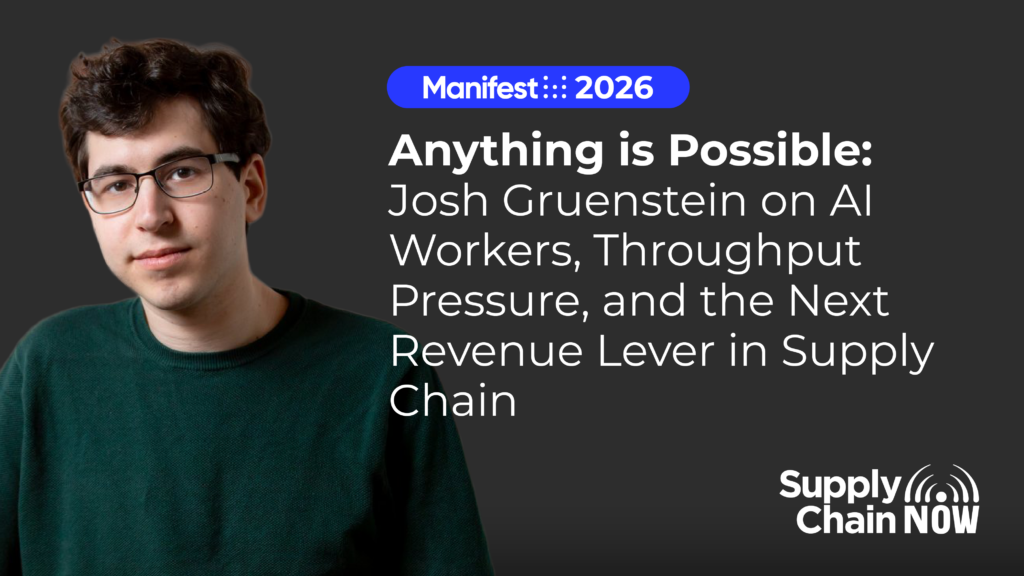
Anything is Possible: Josh Gruenstein on AI Workers, Throughput Pressure, and the Next Revenue Lever in Supply Chain
At Manifest 2026, Scott Luton spent time with Josh Gruenstein, Co-Founder and CEO of Tutor Intelligence, to talk about a future that’s no longer theoretical: AI-powered robot workers operating inside America’s warehouses and factories. And this isn’t a science experiment. It’s already happening. From MIT to the Warehouse Floor Gruenstein and his team came out of MIT’s Computer Science and AI Lab with a bold idea: build AI-powered robot workers that can handle the manual labor people don’t want to do. “We build physical robots,” Gruenstein explained. “We build AI models that enable robots to perceive their environments, and then we deploy those robots into factories and warehouses across the United States to do manual labor that people don’t want to do.” Unlike traditional automation projects that require massive capital outlays, Tutor Intelligence operates on a robots-as-a-service model. Companies can engage a Tutor robot for roughly $14–$18 an hour, creating a flexible, scalable path to automation without multimillion-dollar implementation risk. Automation Isn’t New. AI Is Changing the Playbook. When asked about dominant supply chain themes, Gruenstein pointed to a constant drumbeat: automation. But 2026 feels different. “Automation is obviously a constant theme,” he said. “What really seems different…