

More

supply chain simulation
November 19, 2026
The Talent Gap Starts in the Classroom
Supply chain employers keep asking for graduates who can think end-to-end, manage trade-offs, and collaborate under pressure. Here is how one university is actually delivering that and what it means for the profession. Every year, supply chain organizations hire new graduates who know what a bullwhip effect is but have never felt the pressure of deciding whether to dual-source a critical component when a supplier goes dark. They can define safety stock but freeze when demand spikes 30 percent and production capacity is already maxed out. They understand S&OP in theory but have never sat in a room where sales, operations, and finance are pulling in three different directions and someone must make a call. This is not a criticism of graduates. It is a structural problem with how supply chain has traditionally been taught. At the Neeley School of Business at Texas Christian University, we spent years recognizing this gap in our own classrooms before deciding to do something about it. What follows is what we learned and why we believe it matters for the profession as a whole. “They can define safety stock but freeze when demand spikes 30 percent and production capacity is already maxed out.” …
manufacturing leadership
November 12, 2026
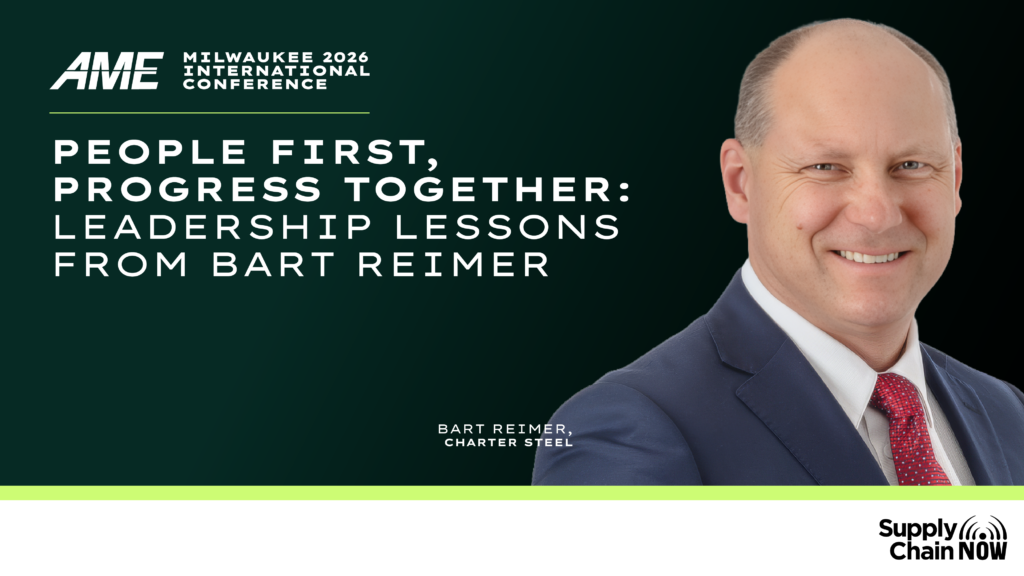
People First, Progress Together: Leadership Lessons from Bart Reimer
What does it really take to build an excellent manufacturing operation? Better processes? Smarter technology? Stronger leadership? For Bart Reimer, the answer involves all three, along with a healthy dose of humanity. During the Association for Manufacturing Excellence (AME) International Conference 2026 in Milwaukee, Supply Chain Now Founder and CEO Scott Luton sat down with Bart Reimer, Vice President of Operations at Charter Steel and incoming Chair of AME’s Board of Directors, for a conversation about leadership, continuous improvement, organizational transformation, and the future of manufacturing. Throughout their discussion, one powerful theme kept emerging: people matter. And the best leaders never lose sight of that fundamental truth. When a Flood Changes Everything Reimer’s leadership journey includes several pivotal experiences, but one of the most significant came courtesy of Mother Nature. Early in his career, Reimer worked his way from intern to general manager at a family-owned brick and refractory business. He knew practically everything about the operation, from its technical processes to its customers and financial performance. Then a devastating, once-in-500-year flood wiped out the business. Suddenly, Reimer found himself managing a large tire manufacturing plant, despite knowing absolutely nothing about making tires. That experience fundamentally changed his approach to…