

More
supply chain planning
January 16, 2026
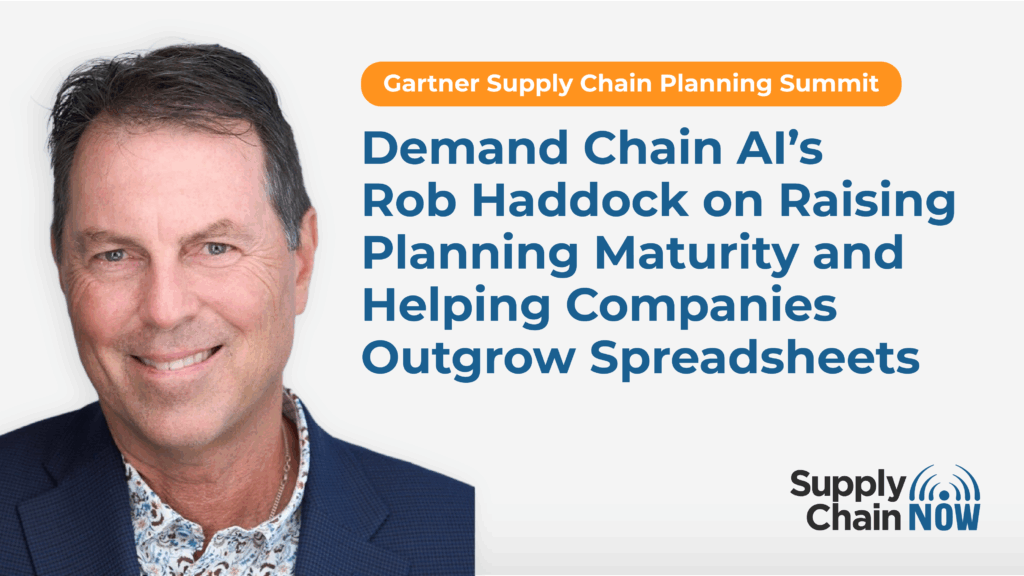
Demand Chain AI’s Rob Haddock on Raising Planning Maturity and Helping Companies Outgrow Spreadsheets
At the Gartner Supply Chain Planning Summit in Denver, Scott Luton caught up with Rob Haddock, a seasoned supply chain practitioner and advisor with Demand Chain AI, to discuss the persistent planning challenges organizations face—and why maturity, discipline, and optimization still matter more than buzzwords. Demand Chain AI blends consulting services with advanced supply chain technologies, focusing on optimization across trade promotion management, demand sensing, supply planning, and detailed production scheduling. Haddock’s role centers on helping organizations strengthen business processes—particularly sales and operations planning (S&OP), performance reporting, and the practical application of technology to improve execution on both the demand and supply sides. A Practitioner’s Perspective on Planning Gaps Haddock’s perspective is shaped by decades spent inside large, sophisticated supply chain organizations. Early in his career, he worked within an iconic, global beverage company where advanced planning environments were already in place—though, in hindsight, he admits those tools were sometimes underutilized. Today, Haddock spends much of his time working with small and mid-sized organizations that haven’t been as fortunate. In many of these environments, planning maturity is still low, foundational practices are missing, and—unsurprisingly—Excel remains the primary planning tool. “Basic business practices that have been around since the 1990s…
decision intelligence
October 7, 2026
AI in Supply Chains: Trusted Data Makes AI Work
Special Guest Blog Post written by Chris Cunnane with InterSystems Artificial intelligence is rapidly becoming a strategic priority across industries. Organizations are investing in AI to improve productivity, automate workflows, and unlock new business value. For supply chain leaders, however, the opportunity extends far beyond efficiency gains. AI has the potential to transform how organizations anticipate disruptions, make decisions, and coordinate activities across increasingly complex global networks. [ But there is an important reality many companies are learning: AI is only as valuable as the data that powers it. Without accurate, connected, and governed information, even the most sophisticated AI models can generate incomplete insights and unreliable recommendations. Success with AI starts with creating a trusted foundation of enterprise data. The Challenge: Too Much Data, Too Many Silos Supply chains generate vast amounts of information every day. ERP systems, warehouse management applications, transportation platforms, manufacturing systems, supplier networks, IoT devices, and third-party data sources all contribute critical operational intelligence. Yet most organizations struggle with fragmented information spread across hundreds of disconnected systems. As a result, when disruptions occur, teams often spend more time gathering and validating data than solving the actual problem. Decision-making slows down, opportunities are missed, and…