

More
MODEX 2026
May 11, 2026
Beyond the Robot: Why Software Is Driving the Next Wave of Warehouse Automation
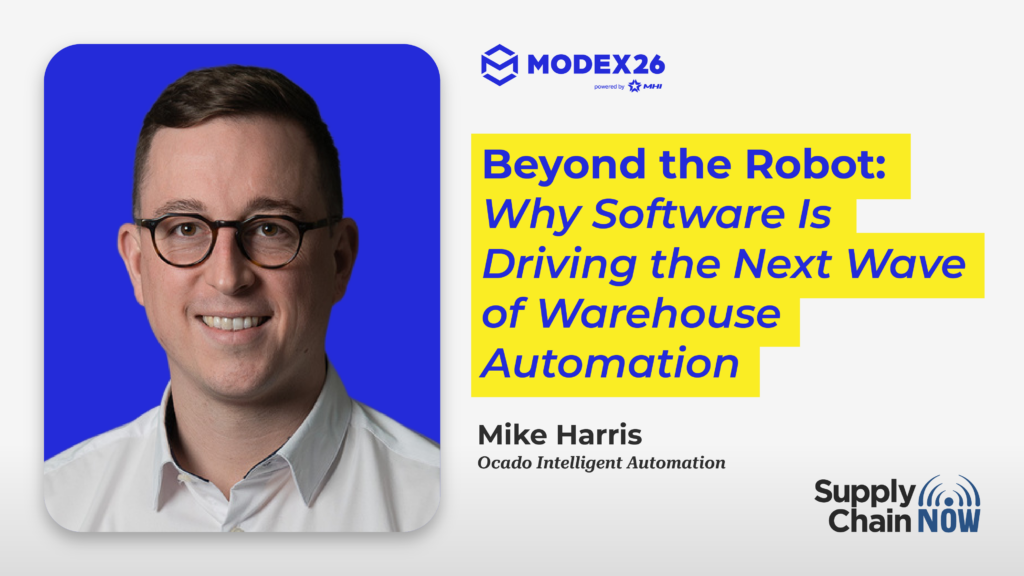
At MODEX 2026 in Atlanta, Scott Luton caught up with Mike Harris, VP of OMRS at Ocado Intelligent Automation, to explore how robotics, software, and evolving customer expectations are reshaping modern warehouse operations. While robots may grab the spotlight, Harris makes it clear: the real value lies beneath the surface, as in the intelligence that powers them. Rising Expectations and the Cost-to-Serve Challenge Warehouse operators are under increasing pressure from both ends of the supply chain. Costs continue to climb, while customer expectations are rising just as quickly. “Cost to serve is continuing to increase and customers expect things faster and completely accurate” Harris explains. This dynamic creates a constant balancing act. Organizations must improve speed and accuracy while controlling costs, a challenge that requires more than incremental improvements. It demands smarter, more adaptive systems. Flexibility and Long-Term Thinking Take Center Stage In today’s volatile environment, Harris sees a clear shift in how companies approach automation investments. “We’re finding that customers are looking to invest in technologies and partners that they want to stay with for a while,” he notes. Rather than chasing one-off solutions, organizations are prioritizing long-term partnerships and scalable platforms that can evolve with their…
supply chain sustainability
July 2, 2024
Guide to Sustainability in Logistics: Implementing Eco-Friendly Practices
The logistics and transport sector contributes about 24% of global CO2 emissions. Considering the push for supply chain sustainability across different sectors, the need for lower emissions has been heating up in recent years. With roughly a quarter of the world’s emissions tied to logistics, this industry will possibly be the final frontier to tackle regarding sustainability. While different strategies can be leveraged to reduce the impact of logistics operations on the environment, integrating eco-friendly practices and reducing Scope 3 emissions are some of the most pressing initiatives at hand. This article serves as a guide that will provide actionable steps for companies to embrace innovative solutions and navigate the transition toward a greener future. Scope 3: Understanding Supply Chain Emissions Modern supply chain management outsources different parts of the operation to leverage the expertise of different suppliers and stakeholders. Logistics operations are usually outsourced to third-party providers, and exercising control over their operations and monitoring their sustainability practices and emissions can be challenging. Here’s the harsh reality: no matter how well an organization manages to reduce Scope 1 and 2 emissions, the unaddressed Scope 3 emissions can bring the entire process to a screeching halt. This is especially true…