
Share:

In this episode of the Supply Chain Buzz, Scott Luton discusses the latest topics and top stories in supply chain, in 15 minutes or less!

More Podcast Episodes
top news
play-button-podcast
podcast-blue-microphone
Podcast
June 28, 2024

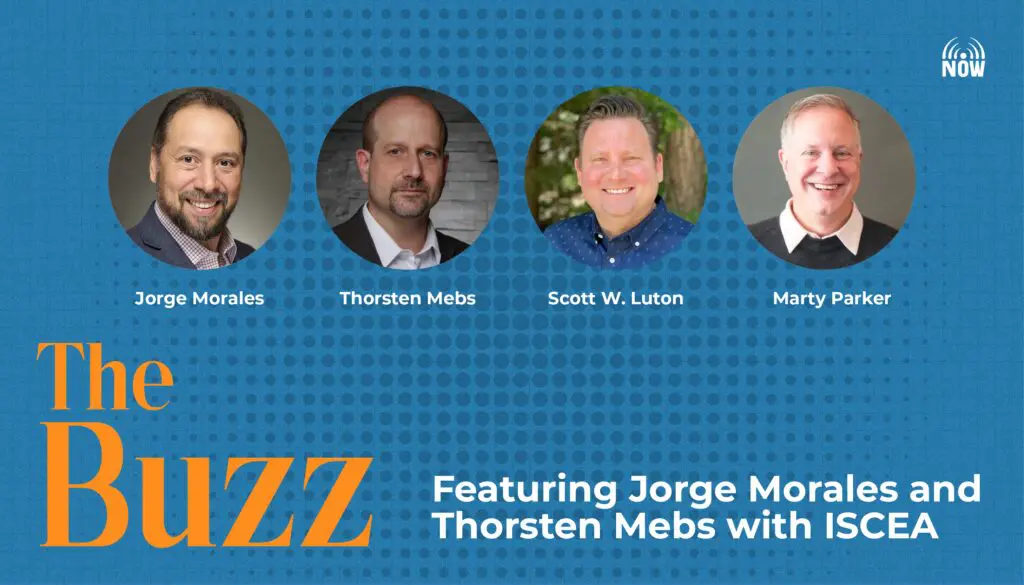
The Buzz for June 28th featuring Jorge Morales and Thorsten Mebs with ISCEA

The Buzz is Supply Chain Now’s regular Monday livestream, held at 12 noon ET each week. This show focuses on some of the leading stories from global supply chain and global business, always with special guests – the most important of which is the live audience! In this week’s episode of The Buzz, hosts Scott Luton and Marty Parker cover the top news in supply chain and welcome special guests Jorge Morales and Thorsten Mebs with ISCEA to the show. Together they discuss: The impact of inflation on online shopping trends The evolving automotive landscape in China The importance of understanding and addressing organizational constraints before implementing AI The need for continuous learning and upskilling in the face of technological advancements And much more!
return management
play-button-podcast
podcast-blue-microphone
Podcast
October 20, 2025

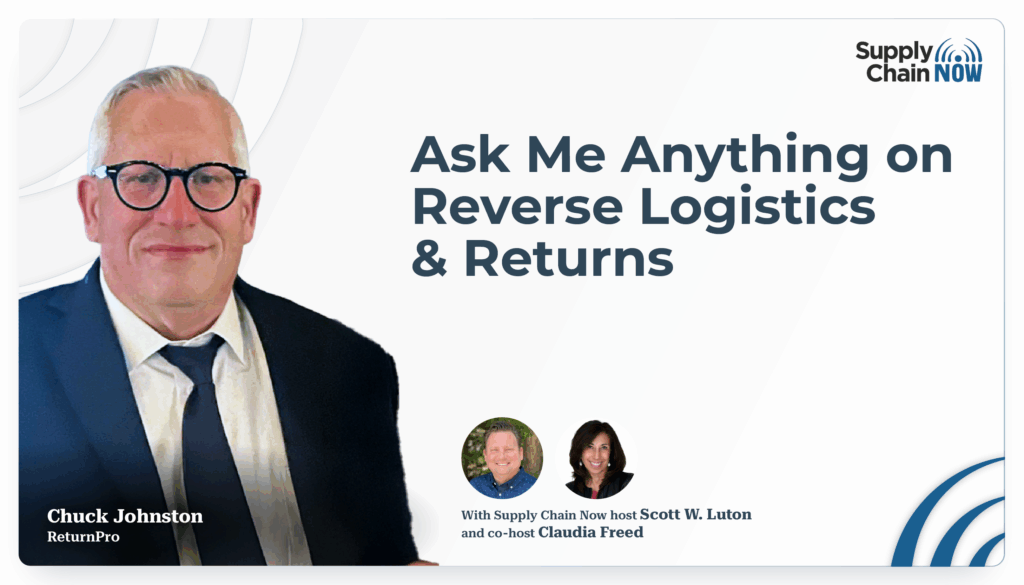
Ask Me Anything on Reverse Logistics & Returns

In this episode of Supply Chain Now, Scott Luton and special guest host Claudia Freed, President & CEO of EALGreen, welcome Chuck Johnston, Chief Strategy Officer at ReturnPro, for a deep dive into the “dark side” of supply chain: reverse logistics and returns management. They unpack why returns are a nearly trillion-dollar challenge in the U.S., how BORIS (buy online, return in store) strains store operations, and why many retailers still under-invest: leaders often can’t see the full cost across functions or make the ROI case for what’s treated as a cost center. Chuck shares how the space has evolved from yellow notepads to data-driven decisioning, highlighting intelligent algorithms that route items at the customer’s first return click, fraud mitigation with imaging and behavior signals, and how third-party innovation is compressing software build times. Claudia adds a nonprofit and circularity lens: donation channels, extended tax credits, and AI pilots (computer vision + MCP agents) that identify item condition and slotting in real time. Together, they explore where to start, why cross-functional “ambassadors” matter, and how partnerships across retailers, manufacturers, nonprofits, and 3PLs can turn returns from margin erosion into measurable value and social impact.   This episode is hosted by…

Supply Chain Now Radio – Episode-210

Share:

[00:00:04] A good morning Scott Luton is here with you again live on Supply Chain Now Radio. Welcome back to the show. And today’s show, we’re continuing our Supply chain Bus series, a brief weekly look at some of the top news and trends across the global End to end Supply chain community. All in 50 minutes or less. Today’s episode of Supply chain Buzz Supply Chain Now Radio is brought to you by the Effective syndicate and leading coaching and consulting firm that helps companies win by optimizing process and developing winning cultures.


[00:00:38] You can learn more at the effective syndicate dot com. It’s Monday, November 18th. Did you know on this date in 1883, American and Canadian railroads instituted five standard continental time zones, ending the crazy confusion stemming from thousands of local toms on this date in 1963. The first push button telephone goes in the service. And on this date in nineteen ninety three, the North American Free Trade Agreement, a.k.a. NAFTA, is approved by the U.S. House of Representatives. And we’ll see if NAFTA 2.0, also known as a U.S. m.c A, gets approved and ratified soon. Now let’s get to the industry buzz. First today, we are chatting chicken in a report by Josh Zumbrun in The Wall Street Journal. China last week agreed to lift a 4 year old ban on U.S. poultry imports. What might this mean for the U.S. poultry industry? Well, the National Chicken Council, yes, there is a national chicken council said that it estimated that renewed access to China’s market could result in one billion dollars in sales of chicken feet and about 1.2 billion dollars of other chicken products such as leg and breast meat, turkeys and poultry breeding stock. The breakthrough comes amid continued U.S. and China trade negotiations and the lifting of the ban is immediate in the U.S., it’s great news for some of the top chicken producing states such as Georgia, Alabama, North Carolina, Arkansas and Mississippi. It’s also good news from the continued and continuous Chinese and U.S. trade negotiations. In our second store today, let’s talk e-commerce industry behemoth Amazon has been courting more and more big brands for years.


[00:02:30] In a story coming to us from The Wall Street Journal, Nike has chosen to stop selling its clothes and sneakers directly to the e-commerce retailer. This is a big shift in direction for Nike. In 2017, the shoe company had agreed to sell products to Amazon in exchange for stricter controls on the counterfeits. Amongst other things, evidently, Nike has not been satisfied with Amazon’s inability to eliminate counterfeits and a lack of controls, a lack of controls on gray market goods in general. However, Amazon says that it prohibits to sell counterfeits. And the company has invested more than 400 million dollars last year to police its Web sites. It even allows brand owners to delete listings that don’t comply with the counterfeit and gray market goods policy. We’ll see how things continue to play out as identifying and regulating counterfeit products in general seems to get tougher each and every day. In our last story here today, we talk blockchain in a neat story that comes to the buzz from Supply chain diver able to put our finger on the pulse of where things stand when it comes to industry’s application of blockchain. Global technology consulting and advisory firm Gartner has been reviewing a wide variety of blockchain adoption cases as part of their research. Gartner identified three of the biggest hurdles that enterprise level organizations had when it comes to blockchain. First, an inability to get involved parties to smoothly work together.


[00:04:05] Second, clearly identifying the value that technology brings to the table. And thirdly, scalability and maturity of the technology. Despite these early challenges, Gartner expects blockchain to be adopted in a widespread fashion by 2028. In a review of 1063 enterprise companies, Gartner found early blockchain adopter adopters much mostly hail from highly regulated industries like banking and securities, as well as firms from the communications, media and services industries and the manufacturing sector. Last week we covered a practical blockchain application that was being implemented by Hewlett Packard and DHL. It’s led to a combined savings of dollars and time as more more of these use cases proliferate out through the marketplace. We hear the buzz expect blockchain to be seen less as cliche and more as the revolutionizing technology than it is. But what do you think? Break out your crystal balls and tell us what you think will happen with blockchain. You can shoot us a note to Amanda at Supply chain now radio wsj.com. That’s a wrap for today’s episode. Several of the leading Supply chain news stories and trends right here on the Supply chain Buzz on Supply Chain Now Radio. You’ll find links to each of the stories on the show, notes for your convenience, including a few additional resources. Big thanks to today’s sponsor of the Supply chain Buzz. The Effective syndicate be sure to check them out at the effective syndicate dot com. To our listeners. On behalf of the entire Supply Chain Now Radio team.


[00:05:46] Thank you for joining us. And this is Scott Luton wishing you a wonderful and very successful week ahead.