
More
decision intelligence
October 1, 2026
Leading Through Disruption: How Supply Chain Leaders Are Adapting to the “Never Normal”
A shipment delayed at sea can become a financial problem before it ever reaches the warehouse. A routing decision can change exposure to cargo theft. A technology investment can improve visibility while raising expectations for how quickly teams should respond. For supply chain leaders, geopolitical, technological, and economic disruption rarely arrive as separate challenges. They overlap, creating decisions that affect transportation, compliance, customer service, and profitability all at once. In the recent Supply Chain Now webinar, hosts Scott Luton and Jake Barr were joined by Henrik Holm, Vice President of Ocean Freight for the Americas at Apex Logistics International, and Linda Moran, Customs Compliance Senior Manager at Apex Logistics International, to explore how companies can adapt. Their discussion offered a practical perspective on what Barr calls the “never normal”: leaders need strategies that help them operate confidently even when the conditions around them keep changing. Building Stability Through Preparedness Stability can feel like an ambitious goal when trade policies shift, shipping routes change, and transportation capacity becomes unpredictable. Yet the panel’s discussion suggests that companies can create greater stability through the decisions they make before disruption occurs. Holm emphasized understanding when and where goods are needed, planning earlier, and…
foundational industries investment
February 23, 2026
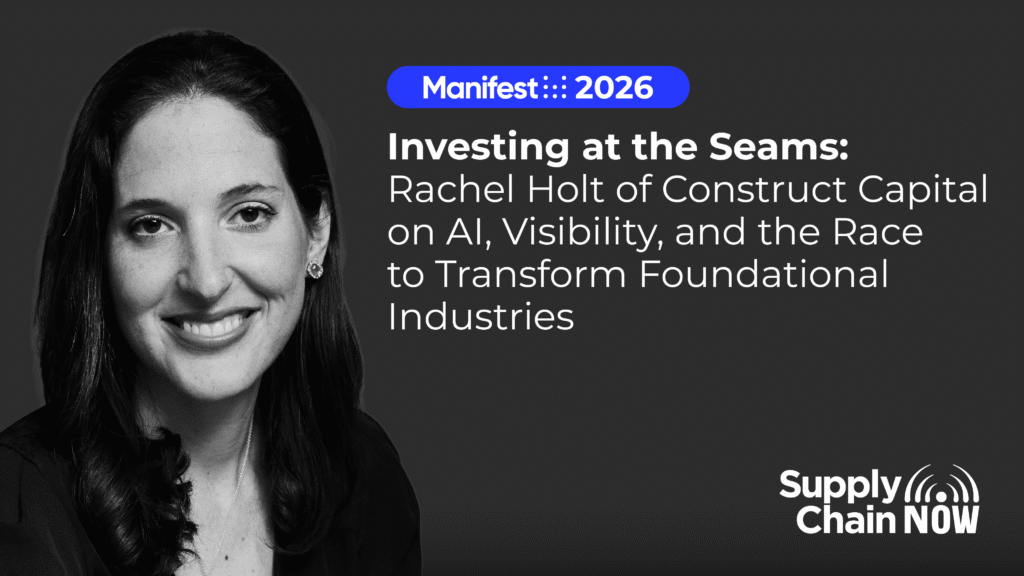
Investing at the Seams: Rachel Holt of Construct Capital on AI, Visibility, and the Race to Transform Foundational Industries
From Uber to Foundational Industries At Manifest 2026, Scott Luton sat down with Rachel Holt, Co-Founder and Managing Partner of Construct Capital, to explore how venture capital is fueling the next era of supply chain innovation. Construct Capital, now six years old, was founded in early 2020 with a bold thesis: transform foundational industries that represent nearly half of GDP: supply chain, logistics, manufacturing, mobility, infrastructure, and defense. When the fund launched, Holt recalls many skeptics asking whether supply chain and logistics were truly venture-scale opportunities. It echoed what she heard when she joined Uber in 2011, when transportation was considered slow moving and heavily regulated. Yet Uber went on to redefine personal logistics. Her final years at Uber brought a pivotal lesson. While the rides business operated with second-by-second visibility, the company’s e-bike and scooter supply chain operated in near darkness. Products shipped from China would disappear for weeks at sea, briefly reappear at ports, then stall again in customs. “We had no visibility, we had no ability to reroute,” Holt shared, as this Eureka moment would go on to help shape her investment focus. The Visibility Gap at the Seams Supply chain, Holt emphasized, is not monolithic.…