

More
September 24, 2021
This Week In Supply Chain Now: September 20th – September 24th
Stay up to date on all the latest conversations, interviews, and episodes we released this week here at Supply Chain Now! On Monday, we started the week off with a special episode of our #SupplyChainCity series Supply Chain Now with Scott Luton and special host Ben Harris. These two chat with Stacey Key, President and CEO of the Georgia Minority Supplier Development Council, and George Richter, SVP of Supply Chain Management at Cox. On This Week In Business History, Kelly covers the stories of three unsung heroes who have contributed their knowledge and talents to a few surprising industries. On Tuesday, we released a classic TEKTOK episode with host Karin Bursa, and featuring Craig Ablin, a supply chain management expert who has spent over 25 years in the industry. On Wednesday’s episode of Supply Chain Now, Scott welcomes back special guest host Ward Richmond and professional OTR driver and training engineer for Schneider, Kellylynn McLaughlin. On Thursday, Scott and guest host Tony Sciarotta welcomed Executive Chairman of G2 Reverse Logistics, Herb Shear, in another episode of our Reverse Logistics Series. On Friday, we published Monday’s Supply Chain Buzz livestream. Scott and Greg welcomed James Malley, the Co-Founder and CEO of…
AI-powered supply chain solutions
March 5, 2026
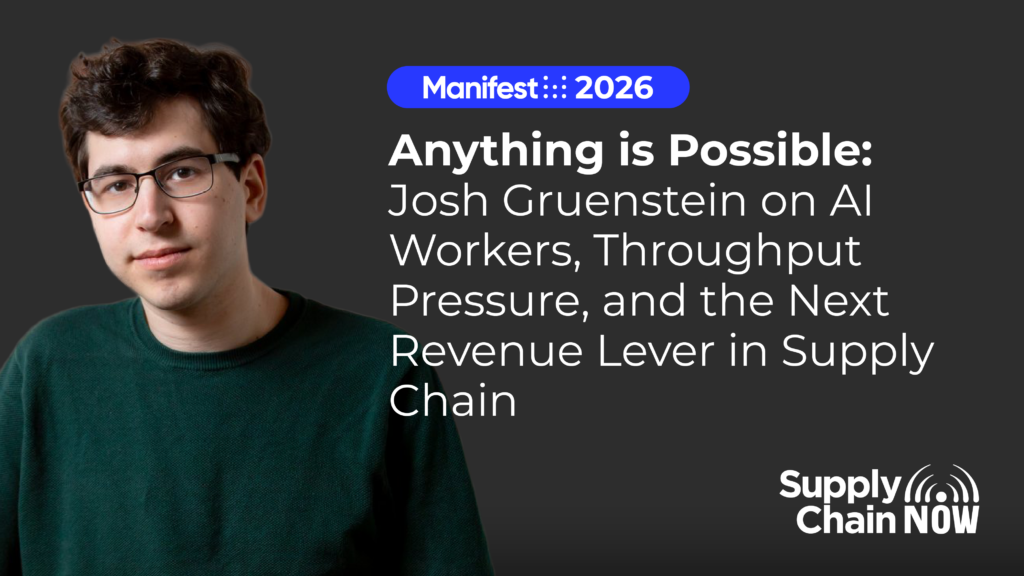
Anything is Possible: Josh Gruenstein on AI Workers, Throughput Pressure, and the Next Revenue Lever in Supply Chain
At Manifest 2026, Scott Luton spent time with Josh Gruenstein, Co-Founder and CEO of Tutor Intelligence, to talk about a future that’s no longer theoretical: AI-powered robot workers operating inside America’s warehouses and factories. And this isn’t a science experiment. It’s already happening. From MIT to the Warehouse Floor Gruenstein and his team came out of MIT’s Computer Science and AI Lab with a bold idea: build AI-powered robot workers that can handle the manual labor people don’t want to do. “We build physical robots,” Gruenstein explained. “We build AI models that enable robots to perceive their environments, and then we deploy those robots into factories and warehouses across the United States to do manual labor that people don’t want to do.” Unlike traditional automation projects that require massive capital outlays, Tutor Intelligence operates on a robots-as-a-service model. Companies can engage a Tutor robot for roughly $14–$18 an hour, creating a flexible, scalable path to automation without multimillion-dollar implementation risk. Automation Isn’t New. AI Is Changing the Playbook. When asked about dominant supply chain themes, Gruenstein pointed to a constant drumbeat: automation. But 2026 feels different. “Automation is obviously a constant theme,” he said. “What really seems different…